Showing posts with label Employees News. Show all posts

Wednesday, 18 July 2018

225 Group 'A' and 'B' officers punished for non-performance: Central Government


225 Group 'A' and 'B' officers punished for non-performance: Central Government

Central Government

New Delhi: As many as 225 Group 'A' and 'B' officers have been punished for non-performance, the central government said today.

The performance of a total of 25,082 Group 'A' and 54,873 Group 'B' officers has been reviewed up to May 2018, Minister of State for Personnel Jitendra Singh said in a written reply to Lok Sabha.

Of these, the relevant rules were invoked against 93 Group 'A' and 132 Group 'B' officers, he said.
In reply to another question, the minister said during 2017 and March 2018, vigilance clearance has been denied to 80 officers of Indian Administrative Service (IAS) on the ground of filing Immovable Property Returns after prescribed time or failing to file it.

He said that from the year 2014 onwards, sanction for prosecution has been granted against three IAS officers on account of having disproportionate assets.

PTI

Friday, 12 May 2017

Confederation confirms No Change in the Mass Dharna

Confederation confirms No Change in the Mass Dharna

Confederation confirms No Change in the Mass Dharna
PRO-GOVT AGENCIES ARE SPREADING FALSE NEWS.
MASS DHARNA IN FRONT OF FINANCE MINISTER'S OFFICE WILL BE HELD ON 23RD MAY 2017 ITSELF

It is reported that certain pro-Govt News agencies are spreading false news that Mass Dharna programme in front of Finance Ministers office is cancelled.

This is totally false news.

Last time also just a few days before our 15th December 2016 Parliament March the very same news agencies spread false news that Parliament March is cancelled.

This is a deliberate attempt to defeat our programme. Don’t believe in such false news.

Mobilise maximum employees to participate in the mass Dharna on 23rd May 2017.

 DHARNA NOTICE BY Confederation

23rd MAY 2017
MASS DHARNA IN FRONT OF FINANCE MINISTER’S OFFICE, NEW DELHI
EMPLOYEES & PENSIONERS COME IN LARGE NUMBERS
AND MAKE IT A GRAND SUCCESS

HONOUR THE ASSURANCE GIVEN BY GROUP OF MINISTERS ON 30.06.2016

  • Increase minimum pay and fitment formula.
  • Revise allowances including HRA with effect from 01.01.2016.
  • Grant option-I pension parity recommended by 7th CPC.
  • Revise pension and grant dearness relief to autonomous body pensioners
  • Implement positive recommendations of Kamlesh Chandra Committee on Gramin Dak Sevaks. Grant Civil Servant Status.
  • Regularise all Casual, Part-Time, Contingent and Contract Workers and grant equal pay for equal work.
  • Remove stringent conditions imposed for grant of MACP etc.

All affiliated organisations and COCs are once again requested to mobilise large number of employee and pensioners as per quota fixed in the last circular and make the programme a grand success.


M.Krishnan ,
Secretary General,
Confederation ,
Mob & WhatsApp; 09447068125.
Email : mkrishnan6854@ gmail.com
Source: Confederation News

Wednesday, 17 August 2016

Technical Resignation and Lien - Consolidated guidelines

No. 28020/1/2010-Estt.(C)
Government of India
Ministry of Personnel, Public Grievances & Pensions
(Department of Personnel & Training)
******
North Block, New Delhi
Dated 17th August, 2016
OFFICE MEMORANDUM

Subject: Technical Resignation & Lien- Consolidated guidelines.

The undersigned is directed to refer to this Department's OM of even number dated
the 26th December, 2013 on the above subject and to say that guidelines/instructions regarding Technical Resignation have been issued from time to time. It is now proposed to further consolidate these instructions, as the Department continues to receive frequent references on these issues.

2.1 Technical Resignation

2.1.1 As per the Ministry of Finance OM No. 3379-E.III (B)/65 dated the 17th June, 1965, the resignation is treated as a technical formality where a Government servant has applied through proper channel for a post in the same or some other Department, and is on selection, required to resign the previous post for administrative reasons. The resignation will be treated as technical resignation if these conditions are met, even if the Government servant has not mentioned the word "Technical" while submitting his resignation. The benefit of past service, if otherwise admissible under rules, may be given in such cases. Resignation in other cases including where competent authority has not allowed the Government servant to forward the application through proper channel will not be treated as a technical resignation and benefit of past service will not be admissible. Also, no question of benefit of a resignation being treated as a technical resignation arises in case of it being from a post held on ad hoc basis.

2.1.2 This benefit is also admissible to Government servants who have applied before joining the Government service and on that account the application was not routed through proper channel. The benefit of past service is allowed in such cases subject to the fulfillment of the following conditions:
(i) the Government servant should intimate the details of such application
immediately on their joining;
(ii) the Government servant at the time of resignation should specifically make a request, indicating that he is resigning to take up another appointment under the Government for which he applied before joining the Government service;
(iii) the authority accepting the resignation should satisfy itself that had the employee been in service on the date of application for the post mentioned by the employee, his application would have been forwarded through proper channel. (DOPT' s 0.M.No.13/24/92-Estt(Pay-1) dated 22.01.1993)
2.7 Applicability of Pension Scheme In cases where Government servants, who had originally joined government service prior to 01.01.2004, apply for posts in the same or other Departments and on selection they are asked to tender technical resignation, the past services are counted towards pension if the new post is in a pensionable establishment in terms of Rule 26(2) of CCS(Pension) Rules 1972. They will thus continue to be covered under the CCS(Pension) Rules, 1972 even if they join the new post after 1.1.2004.
(Department of Pension & Pensioners Welfare's O.M.No.28/2004-P&PW(B) dated 26.07.2005)

2.8 New Pension Scheme
In case of 'Technical Resignation' of Government servant covere uner National
Pension System (NPS), the balance standing to their Personal Retirement
Account (PRA) along-with their PRAN will be carried forward to the new office.

2.9 Transfer of Service Book from parent Department to present Department.
As per SR- 198, the Service Book is to be maintained for a Government servant from
the date of his/her first appointment to Government service and it must be kept in the custody of the Head of
Office in which he is serving and transferred with him from office to office.

2.10 Need for Medical examination.
In cases where a person has already been examined by a Medical Board in respect of
his previous appointment and if standard of medical examination prescribed for the new post is the same, then he need not be required to undergo a fresh examination.

2.11 Verification of Character & Antecedents
In the case of a person who was originally employed in an office of the Central
Government, if the period intervening between date of discharge from his previous office and the date of securing a new appointment, is less than a year, it would be reference e sufficient to the if the appointing authority, before making the appointment, satisfies itself by office in which the candidate was previously employed that (a) that office that have verified his character and antecedents; and (b) his conduct while in the employ in office render him unsuitable for employment under Government. If however, more than a year has lapsed after the discharge of the person from his prev office, verification should be dated carried out in full/afresh, in accordance with 0.M.No.18011/9(s)/78-Estt(B) 2nd July,1982.

3.1 Lien
3.1.1 Lien is defined in FR 9(13). It represents the right of a Government employee to hold a regular post, whether permanent or temporary, either immediately lien or on the termination of the period of absence. The benefit of having a post/service/cadre is enjoyed by all employees who are confirmed in the post/service/cadre of entry or who have been promoted to a higher post,  declared as having completed the probation where it is prescribed. It is also available to those who have been promoted on regular basis to a higher post where no probation is prescribed under the rules, as the case may be.
3.1.2 The above right  will, however, be subject to the condition that the junior-most person in the cadre will be liable to be reverted to the lower post/service/cadre if at persons so entitled is more any time the number of p than the posts available in that cadre/service.
(DOPT' s 0.M.No.18011/1/86-Estt (D) dated 28.03.1998)
3.2 Lien on a post
A Government servant who has acquired a lien on a post retains a lien on that post retains a lien on that post:
(a) while performing the duties of that post;
(b) while in foreign service, or holding a temporary post or officiating in another
post;
(c) during joining time on transfer to another post; ; unless is he is transferred substantively to a post on lower pay, in which case  his lien  is transferred  to the
new post from the date on which he is relieved of his duties in the old post;
(d) while on leave; and
(e) while under suspension.
A Government servant on acquiring a lien on a post will cease to hold any lien
previously acquired on any other post.
3.3  Retention of lien for appointment in another central government office/ State
Government
(i)  A permanent Government servant appointed in another Central Government  Department/Office/ State Government, has to resign from his parent department  unless he   reverts to that department within a period of 2 years, or 3 years in  exceptional cases. An undertaking to abide by this condition may be taken from him  at the time of forwarding of his application to other departments/offices.
(ii)  The exceptional cases may be when the Government servant is not confirmed in the  department/office where he has joined within a period of 2 years. In such cases he may be permitted to retain the lien in the parent department/ office for one more year. While granting such permission, a fresh undertaking similar to the one indicated above may be taken from the employee.
(iii) Timely action should be taken to ensure extension/ reversion/ resignation of the employees to their parent cadres on completion of the prescribed period of 2/3 years .In cases, where employees do not respond to instructions, suitable  action should be initiated against them for violating the agreement/ undertaking given by them as per (i) and (ii) above and for termination of their lien. Adequate opportunity may, however, be given to the officer prior to such consideration.
(iv) Temporary Government servants will be required to severe connections with the Government in case of their selection for outside posts. No lien will be retained in such cases.
(DOPT 0.M.No.8/4/70-Estt(C) dated 06.03.1974)
3.4 Termination of Lien
 
3.4.1 A Government servant's lien on a post may in no circumstances be terminated evenwith his consent if the result will be to leave him without a lien upon a permanent post.Unless his lien is transferred, a Government servant holding substantively a permanent post retains lien on that post. It will not be correct to deny a Government servant lien to a post he was holding substantively on the plea that he had not requested for retention of lien while submitting his Technical Resignation, or to relieve such a Government servant with a condition on that no lien will be retained.
 
3.4.2 A Government employee's lien on a post shall stand terminated on his acquiring a lien on a permanent post (whether under the Central Government or a State Government) outside the cadre on which he is borne.
 
3.4.3 No lien shall be retained:
a. where a Government servant has proceeded on immediate absorption basis to a post or service outside his service/ cadre/ post in the Government from the date of absorption; and
 
b. on foreign service/ deputation beyond the maximum limit admissible under the orders of the Government issued from time to time.
(Notification No.28020/1/96-Estt(C) dated 09.02.1998)
 
3.5 Transfer of Lien
 
The lien of a Government servant, who is not performing the duties of the post to
which the lien pertains, can be transferred to another post in the same cadre subject to the provisions of Fundamental Rule 15.
 
(Notification No.28020/1/96-Estt(C) dated 09.02.1998)
 
3.6 Joining Time, Joining Time Pay & Travelling Allowance
 
Provisions relating to joining time are as follows:
 
3.6.1 For appointment to posts under the Central Government on results of a competition and/or interview open to Government servants and others, Central Government employees and permanent/ provisionally permanent State Government employees will be entitled to joining time under the CCS(Joining Time) Rules,1979. Joining time will be included as qualifying service in the new job.
 
3.6.2 A Government servant on joining time shall be regarded as on duty during that period and shall be entitled to be paid joining time pay equal to the pay which was drawn before relinquishment of charge in the old post. He will also be entitled to Dearness Allowance, if any, appropriate to the joining time pay. In addition, he can also draw compensatory allowances like House Rent Allowance as applicable to the old station from which he w as transferred. He shall not be allowed Conveyance Allowance or permanent Travelling Allowance.
 
3.6.3 For appointments to posts under the Central Government on the basis of results of a competition and /or interview open to Government servants and others , Central
employees and permanent/ provisionally permanent State Government employees shall been titled to Transfer Travelling Allowance (TTA). However, temporary Central Government employees with less than 3 years of regular continuous service would not be entitled for TTA, as they are not entitled joining time pay under Joining Time Rules.
 
4. All Ministries/ Departments are requested to bring the instructions/ guidelines to the notice of all concerned.
 
(Mukesh Chaturvedi)
Director (Estt.)
Telefax: 23093176
 
http://ccis.nic.in/WriteReadData/CircularPortal/D2/D02est/28020_1_2010-Estt.C-17082016B.pdf

Sunday, 17 July 2016

Central government sexual harassment victim employees now get 90 days paid leave

Central government sexual harassment victim employees now get 90 days paid leave

No. 13026/2/2016-Estt(L)
Government of India
Ministry of Personnel, Public Grievances and Pensions
Department of Personnel & Training 

Old JNU Campus, New Delhi 110 067
Dated: 14.07.2016 
OFFICE MEMORANDUM 

Subject: Implementation of leave provision under the Sexual Harassment of Women at Workplace (Prevention, Prohibition & Redressal) Act, 2013 — Reg.

Consequent to the enactment of the 'Sexual Harassment of Women at  Workplace (Prevention, Prohibition and Redressal) Act, 2013', this Department is  considering issuing instructions for the grant of leave to the aggrieved woman during  pendency of inquiry up to a period of three months in addition to the leave which she  is otherwise entitled to.

2. In this regard, it is proposed to insert/incorporate a new Rule in the CCS  (Leave) Rules, 1972. The new rule may read as follows:

"Special Leave connected with inquiry on sexual harassment — Leave up to a maximum of 90 days may be granted to an aggrieved female Government Servant on the recommendation of the Internal Committee or the Local Committee, as the case may be, during the pendency of inquiry under Sexual Harassment of Women at Workplace (Prevention, Prohibition and Redressal) Act, 2013. 

(2) The leave so granted to the aggrieved woman under this rule shall not be debited against the leave account."

(Navneet Misra)
Under Secretary to the Government of India 

Copy to: NIC, DoPT for uploading on the website of the Ministry.

Thursday, 10 March 2016

Khadi on Fridays for Central Government employees?

Khadi on Fridays for Central Government employees?

According to unconfirmed sources, the Centre is giving serious thoughts about making Khadi-wearing compulsory for its employees on Fridays. News continues to flow non-stop about Central Government employees and their offices the past few days. Recently, an order was issued making it mandatory to hoist the national flag atop the Kendriya Vidyalaya school buildings all over the country, everyday.

There are now plans of making the Central Government employees wear Khadi once every week, preferably on Fridays. All the Central Government employees – starting from the top bosses right down to the entry-level staff, will be asked to wear Khadi once a week. Saxena, the director of Khadi Gram Udyog, said that he was planning to discuss this possibility with the government soon. He however added that it wouldn’t be made mandatory, and will be left to the discretion of the employees.

According to sources, the officer also said that the sale of Khadi will increase tremendously if all the Central Government employees come forward to buy at least one dress and hoped that the employees wouldn’t oppose this.

Saturday, 13 February 2016

Draft Memorandum of NFPE to be submitted on GDS Issue to the Chairman, GDS Committee

Draft Memorandum of NFPE to be submitted on GDS Issue to the Chairman, GDS Committee

GDS-Commitee-NFPE

From: – …………………………………………
…………………………………………
…………………………………………
…………………………………………
To Shri Kamlesh Chandra
Chairman,
Gramin Dak Sevak Committee
Ministry of Communication & IT
Government of India
Malcha Marg Post office Building
New Delhi – 110021
Sub: – Memorandum on GDS issues,

With due respects and regards, we submit the following for your kind consideration and favourable recommendations to the Government.
  1. Departmentalization of GDS by declaring them as Civil Servants and grant all benefits of regular employees on pro rata basis.
  1. Change the nomenclature of GDS as “Gramin Dak Karmachari” or “Rural Postal Employees”
  1. Considering the need and requirement of Rural Post Offices after modernization viz., Core Banking Solutions (CBS), Core Insurance Solution (CIS) and introduction of handheld computers at BOs and additional responsibilities, the working hours of all BOs may be extended to 8 hours and all GDS may be granted full time Civil Servant status. There should no combination of duties. The illegal condition that GDS shall not on duty for more than five hours should be removed.
  1. Minimum five hour wages should be paid even if the work load is less than 5 hours and if work load is more than five hours wages for full time (8hours) should be paid. Nomenclature of TRCA should be changed and it should be called as ‘Pay’. There should not be any reduction in wages under any circumstances.
  1. The Branch Postmaster shall be paid at the pro rata wages of Postal Assistants; GDSMD/GDSSV shall be paid equal to Postmen; and all other categories with the comparison of MTS. GDS shall be appointed and not engaged and the word ‘engagement’ shall be deleted in the existing rules.
  1. Time bound promotion (ACP) to higher pay scale on completion of 10 years, 20 years and 30 years may be granted to GDS. Point to Point fixation is requested for senior GDS. The pay shall be fixed to the seniors in the revised pay based on the number of years of service rendered to that extent by granting notional annual increments. The percentage of annual increment shall be at par with regular employees to whom the comparison is being made. The nomenclature of increment shall be introduced in the place of ‘future entitlement’.
  1. The GDS may be considered for grant of HRA, Transport Allowance, Split duty Allowance on pro rata basis at par with regular departmental employees whom we are comparing for wage fixation. The rent of the building in which BO is housed may be paid by the department.
  1. TA/DA may be granted to GDS if ordered in the interest of service and all other Allowance like Boat Allowance, SDA, may be extended to GDS.
  1. The GDS shall be covered with the Children Education Allowance and hostel subsidy at par with regular employees.
  1. The GDS shall be covered under the CS (MA) Rules or a new set of rules equal to that which provide full reimbursement of medical expenses to the GDS and their families.
  1. The GDS may be granted leave on the following norms.
(i)           E.L – One Day for each completed calendar month with accumulation.
(ii)          HPL – 20 days per year, with accumulation facility.
(iii)        Commuted leave may be introduced.
(iv)         Maternity leave – 180 days at par with regular employees with full pay & allowances. Pay shall be made from salary head and not from the welfare fund of GDS.
(v)          Child care leave shall be granted at par with regular employees.
(vi)         Special Disability Leave – As applicable to regular employees.
  1. Notwithstanding our claim of introduction of pension scheme at par with regular employees prior to 01-01-2004, we request to modify the S.D.B.S scheme to the extent of 10% recovery from the officials; 20% from the department. Ex-gratia gratuity shall be granted on completion 10 years service. Family pension shall also be introduced.
  1. All vacancies in the departmental posts viz. MTS, Postmen, shall be filled only by GDS and there shall be no other open market direct recruitment. In respect of PA cadre, the GDS possessing Qualifications and computer knowledge shall be permitted to write the competitive exam along with postman & MTS for the Departmental Quota vacancies.
  1. The GDS Conduct & Engagement rules 2011 shall be scrapped and CCS (Conduct) Rules 1964 may be made applicable to GDS also. It shall be covered under Article 309 of the Union Constitution.
  1. 50% of the past services of GDS shall be counted as regular service on promotion for pensionary benefits including gratuity.
  1. GDS shall also be covered under LTC Scheme to have recreation in life.
  1. GDS may be provided with uniforms and also grant of Washing Allowance.
  1. All advances like festival, medical, LTC, Tour TA, scooter, HBA, Motor Cycle Advance shall be extended to the GDS. All incentives, honorariums shall be introduced for the excess work performed by GDS.
  1. Furnishing of security band shall be dropped. Similarly the residential condition may also be dropped in the recruitment rules.
  1. Transfer facilities may further be liberalized; there shall be no loss of service or pay on transfer. Identity cards to GDSs are a must and that shall be supplied to GDS free of cost of the Department.
  1. Compassionate appointment may be granted to the dependents of deceased GDS, removing the existing conditions.
  1. GDS may be granted all Trade Union rights at par with regular employees.
  1. The amount payable under Group Insurance Scheme may be enhanced to five lakhs.
  1. The 50 years age limit for appearing for departmental examination may be removed.
  1. One point may be granted for Rs.4000- of cash handling in BOs.
We submit that these poor and down trodden 2.76 lakhs of Gramin Dak Sevaks should not be neglected and shall be extended with all benefits applicable to departmental employees. As Justice Talwar Quoted that ‘the weak and downtrodden need protection’. We hope that the respected Chairman, GDS Committee will look in to the prayers made by the All India Postal employees Union GDS (NFPE) also we made in the pre paras and render justice to this down-trodden section of the Postal employees.

With profound regards,
Yours sincerely,
Place: -
Date:-
(Name of the GDS with Designation)

Sunday, 15 November 2015

Pay Band for Postal Assistant

Pay Band for Postal Assistant

A notification is published by the Department of Posts, Government of India in connection with candidates called for the post of POSTAL ASSISTANTS. Based on this, for the post of POSTAL ASSISTANTS they will be applicable for the scale of pay in Pay Band 5200-20200 with Grade Pay 2400.

Let us know approximately, how much Gross pay will be drawn by the newly appointed Postal Assistant.

If appointed in the rural areas,
Basic pay – Rs.7510
Grade Pay – Rs.2400
Dearness Allowance @ 100% – Rs.9910.00
House Rent Allowance @ 10% (BP+GP) – Rs.991.00
Transport Allowance (Rs.800+100%) – Rs.1600.00
Gross – Rs. 22411.00
If appointed in the A1 cities like CHENNAI, CALCUTTA,MUMBAI & DELHI
Basic Pay – Rs. 7510.00
Grade Pay – Rs. 2400.00
Dearness Allowance @ 100% – Rs. 9910.00
House Rent Allowance @ 30% (BP+GP) – Rs.2973.00
Transport Allowance (Rs.1600+100%) Rs. 3200.00
Gross – Rs. 25993.00

If appointed in the B1 cities (list of B1 cities issued by the Central Government)
Basic Pay – Rs. 7510.00
Grade Pay – Rs. 2400.00
Dearness Allowance @ 100% – Rs. 9910.00
House Rent Allowance @ 30% (BP+GP) – Rs .1982.00
Transport Allowance (Rs.800+100%) – Rs.1600.00
Gross – Rs. 23402.00

Apart from this you can draw hill station allowance if you are posted in the hill stations.

Saturday, 5 September 2015

Trade unions eye Rs 15,000 per month minimum wage as national baseline

Trade unions eye Rs 15,000 per month minimum wage as national baseline
By Subodh Varma, TNN

One of the key issues on which the negotiations between the government and the 10 central trade unions that had called for a general strike on Wednesday broke down was that of minimum wages. A labour ministry document circulated amongst the trade unions days before the strike, argued that by current norms, prices and calorific needs, Rs.6330 per month is the monthly wage adequate for an unskilled worker with a wife and two small children.

The trade unions and various other federations that represent 15 crore workers had demanded Rs.15,000 per month minimum wage as a national level floor wage. Striking a generous posture, the government modestly increased its proposal to Rs.7098 per month.

What the government had proposed was less than half of what was demanded. This was one of the contributory factors to the breakdown of negotiations. Other demands of the workers included social security coverage, non-interference with existing labour laws, etc.

How did the government calculate their proposal? A look at the fine print shows a slew of gross under-estimations and the use of an archaic formula first spelled out way back in 1957. Some of the food items' prices are far from reality. For instance dal is costed at Rs.65 but only one of the various dals in the market - chana or gram dal - comes in this range. Arhar (tur) is Rs.135 per kg, urad is Rs.117.5, masur is Rs.95. All these current retail prices are from the consumer affairs ministry's price monitoring data spanning 81 cities and towns.

Mutton is priced at a bizarre Rs.80 per kg, although it doesn't really matter because only 50 g is allowed. This is convertible to 250 grams of vegetables which are priced at an imaginary Rs.16 per kg. In the real world mutton is selling at anywhere between Rs.300 to Rs.400 per kg. And rarely if any vegetable sells at Rs.16 per kg.


 But the real rub comes in the non-food items. Just Rs.390 is supposed to be spent on rent every month. And, fuel for cooking and utilities like electricity etc. are all supposed to be covered under a meagre Rs.780.

All education, medical expenses, marriages, care of elderly, recreation etc. is lumped together and costed at 25 percent of the food expenditure. This practice started after the Supreme Court in a landmark judgement in 1991 directed as much saying that if such a minimum wage cannot be guaranteed then the managements have no right to run their business. But even this works out to a mere Rs.980 per month.

Costs of education and healthcare have risen tremendously in the past several years and even one major episode of sickness in the family would be devastating. The government's wage calculation seems to be blissfully unaware of this.

Recent government data shows that real wages, that is, after adjusting for inflation are dipping while the share of wages to profits is also dipping in the organized sector. In the unorganized sector which employs over 90 percent of India's workforce, wages are abysmally low and conditions of work onerous. Small wonder then that the trade unions were unwilling to accept the government's proposals.


Source : The Economic Times

Tuesday, 14 July 2015

Kerala government employees to get hike in salary, retirement age to be raised by 2 yrs

Kerala government employees to get hike in salary, retirement age to be raised by 2 yrs

Thiruvananthapuram: A handsome hike for government employees’ salaries and an increase in their retirement age to 58 from the present 56 are among the key recommendations made by Kerala’s 10th Pay Commission.

The panel, headed by Justice CN Ramachandran, handed its report to Chief Minister Oommen Chandy at a function here today.

Among the various recommendations of the much-awaited report includes a proposal for minimum salary of Rs 17,000 and maximum of Rs 1.2 lakh for government employees under various categories.

High school teachers with service of 28 years should be promoted to the post of deputy headmasters, it proposed, adding that the minimum period of service needed for awarding pension should be lowered to 25 years from the present 30.

Accepting the report, Chandy said that the government would consider the recommendations and take appropriate steps regarding those.

An official release said that the first part of the report, that covers pay revision and pension, has been handed in now with the next part to be submitted within November.

Inputs with PTI

Method of Night Duty Allowance and Night Shift Bonus Calculation for Industrial Employees

Method of Night Duty Allowance and Night Shift Bonus Calculation for Industrial Employees

Night Duty Allowance & Night Shift Bonus in OFB- Para 196 & 201 of Office Manual Part-VI (Volume-I) Chapter -V (Labour-Methods of Payment and Allocation)

Night Duty Allowance

201. Industrial employees working on night shifts are eligible for Night Duty allowance on the basis of weightage of 10 minutes for every hour of night duty performed between 22.00 hours and 6.00 hours at the rates specified in the Government orders Issued from time to time.

For calculation of weightage, duty for less than half an hour shall be ignored and, duty for half an hour and more but less than one hour shall be reckoned as one full hour. The rounding off of fractions of an hour shall be made with reference to the, actual hours of night, duty performed in a month (i.e. wage period) and not on daily basis.

Night duty allowance not be admissible during overtime hours if any falling within the night duty hours. The allowance will not be treated as `Pay’ for purpose of piece work earnings or for other allowances admissible to the employees. The night duty allowance payable to the industrial employees shall be booked to work order number 02/00003/00 and the work order is exempt from DA levy.

Note: – In the muster rolls, the period of night shift indicating the time of commencement and closing of such a shift in respect of workers on night duty should be specifically indicated by the factory.
The net hours of work between 22.00, hrs and 6.00 hrs. performed by the workers daily during the normal hours of night shift duty (i.e. after excluding the period of recess, shift leave, overtime etc. during that period) ‘,which hours qualify for night duty allowance should be shown separately in muster roll and progressive weekly and monthly Carried over as done in the case of normal booking, of attendance.

Night Shift bonus

196. A night shift represents the hours worked between the termination of the day shift and the normal opening hours of the next day. The piece workers who Perform overtime work under Departmental rules in the night shift will be paid an extra half hour pay termed as ‘Night shift bonus‘ calculated at the hourly rate of 1/200 of the monthly basic pay plus dearness allowance, special pay, personal pay, pension (to the extent taken into account for fixation of pay in the case of re-employed pensioners) and city compensatory allowance for every hour of systematic overtime under Departmental Rules worked on the Night shift in addition to their piece yearnings. This element is not admissible to day workers.

Source: www.bpms.org.in
Click to view the order

Saturday, 27 June 2015

Stoppage of Fixed Medical Allowance to Central Government Employees under CS(MA) Rules who are working in remote areas

Stoppage of Fixed Medical Allowance to Central Government Employees under CS(MA) Rules who are working in remote areas

Ministry of Health and Family Welfare has issued an OM on Stoppage of Fixed Medical Allowance (FMA) being paid to the Central Government employees working in the interior/remote areas and their governance under CS(MA) Rules, 1944.
No.S.14025/09/2013-MS
Government of India
Ministry of Health and Family Welfare
Department of Health & Family Welfare
***********
Nirman Bhawan, NewDelhi
Dated 3rd June, 2015.
OFFICE MEMORANDUM

Subject: Stoppage of Fixed Medical Allowance (FMA) being paid to the Central Government employees working in the interior/remote areas and their governance under CS(MA) Rules, 1944.

Reference is invited to OMNo.S-1402011/88-MS dated 17.07.1990 in which fixed medical allowance to the tune of Rs.25/-per month was granted to employee working in the interior/remote areas where no Authorized Medical Attendant was available within a radius of 5 kms, which was subsequently revised to the tune of Rs.l00/- per month vide OMF.No.14025/33/98-MS dated 18.01.1999.

2. On receiving a proposal from Ministry of Defence on the issue of medical reimbursement to employees who are in receipt of Fixed Medical Allowance, the matter was examined in the Ministry in consultation with Department of Expenditure and Department of Personnel & Training.

3. It has now been decided to stop the above mentioned Fixed Medical Allowance.  Henceforth, the Central Government employees residing in interior/remote areas will be governed by the extant rules as laid down under CS(MA) Rules, 1944.

4. This O.M. will be effective from the date of issue. After issuance of this OM,the above mentioned OMs i.e.,O.M. No.S-1402011/88-MS dated 17.07.1990 and O.M F.No.14025/33/98-MS dated 18.01.1999. stand withdrawn.

5.This issues with the concurrence of the Department of Personnel &Training and Department of Expenditure.
(Bindu Tewari)
Director
Download Ministry of Health and Family Welfare OM No.S.14025/09/2013-MS 03.06.2015

Monday, 9 March 2015

Increasing Pension Limits Under Employees Pension Scheme

Increasing Pension Limits Under Employees Pension Scheme

Ministry of Labour & Employment
09-March, 2015 15:00 IST

The Government is not considering to enhance the age limit for Employees Pension Scheme (EPS).The Pension implementation Committee (PIC) has recommended to increase the short service pension entitlement age from 50 years to 55 years. The proposal is under consideration of the Central Board of Trustees (CBT),Employees’ Provident Fund (EPF).The proposal, if accepted is likely to decrease the reduction of pension due to short service.

This was stated by Shri Bandaru Dattatreya, the Minister of State(IC) for Labour and Employment in response to a written question in Lok Sabha today.

PIB

Tuesday, 3 March 2015

Railway Board Order: Advance reservation period increased from 60 days to 120 days w.e.f.1.4.2015

Railway Board Order: Advance reservation period increased from 60 days to 120 days w.e.f.1.4.2015


It has been decided to increase the advance reservation period from 60 days to 120 days (excluding the date of journey) w.e.f. 01.04.2015. CRIS will make necessary changes in the software for this purpose under intimation to all Zonal Railways as well as Board’s office.

There will be no change in case of certain day time Express Trains like Taj Express, Gomti Express, special trains, etc. where lower time limits for advance reservations are at present in force. There will also be no change in case of the limit of 360 days for foreign tourists.

Board desire that the above change may be given wide publicity well in advance of its implementation. Suitable instructions to all concerned may be issued to ensure smooth change-over to the new time limit.

Time limit for Advance Reservations in Railways has been increased from 60 to 120 days effective from 1.4.2015

Railway board issued orders on increasing the time limit for advance reservation in IRCTC has been enhanced from 1st April 2015

Source: 90paisa blog

Monday, 23 February 2015

Income Tax Expectations: Here’s What India Wants

Income Tax Expectations: Here’s What India Wants

A survey carried out by industry body Assocham has found that a majority of salaried employees want Finance Minister Arun Jaitley to increase the income tax exemption in the forthcoming Budget.

A hike in income tax exemption from Rs. 2.5 lakh to Rs. 3 lakh will lead to savings of up to Rs. 5,000 for those who fall in the Rs. 2.5 lakh to Rs. 5 lakh tax bracket. Those in the Rs. 5 lakh to Rs. 10 lakh tax bracket will save up to Rs. 10,000, while those in the highest tax bracket can save up to Rs. 15,000.

Any increase in exemption in income tax would leave more money in the hands of people and will increase their purchasing power, Assocham said.

If Mr Jaitley hikes income tax exemption limit, it will be for the second time in two years that salaried employees will get a relief on taxes.

The other big expectation is about exemption on housing loans. 78 per cent of those surveyed want interest exemption on home loans to go up to Rs. 5 lakh from Rs. 2 lakh.

Property prices in the country have gone up sharply over the years and many individuals have to pay large amounts as interest for home loans. Exemption on interest on home loan was hiked by Rs. 50,000 to Rs. 2 lakh in the previous Budget.

A large number of respondents in the survey also voted for hiking exemption limit under section 80C of the Income Tax Act; the section makes investments worth Rs. 1.5 lakh on saving instruments such as fixed deposits, national saving certificates and public provident funds exempt from taxes.

“Hike in exemption limits will boost the savings rate in the Indian economy to 35 per cent of GDP from below 30 per cent currently,” said Assocham secretary general D S Rawat.

88 per cent of respondents want the government to reduce the record-high duty on gold import. Import duty on gold was hiked to 10 per cent in 2013 when the economy was struggling with a high current account deficit and volatile rupee.

Nearly 82 per cent of the salaried class expects a separate deduction of Rs. 50,000 for the payment towards annuity or pension plans. Deduction of the amount paid towards annuity plans u/s 80CCC and NPS u/s 80CCD come under the threshold limit of section 80C currently.

Around 55 per cent of the survey respondents were between 25 and 29 year-old; 26 per cent fell between 30 and 39 years; 16 per cent were between 40 and 49 years. The survey was carried out among employees from 18 broad sectors, with maximum share contributed by employees from IT/ITes sector (17 per cent). It was conducted across Delhi, Mumbai, Kolkata, Chennai, Ahmedabad, Hyderabad, Pune, Chandigarh, Dehradun, etc. About 500 salaried employees from the different sectors were covered by the survey from each city on an average.

Tuesday, 10 February 2015

Interaction Meeting with Seventh Central Pay Commission on NFIR’s Memorandum

Interaction Meeting with Seventh Central Pay Commission on NFIR’s Memorandum:-

NFIR
National Federation of Indian Railwaymen
3, CHELMSFORD ROAD, NEW DELHI -110055
 
No. IV/NHR/7th CPC/CORRES/Pt. V
Dated: 05/02/2015
The Chairman,
Seventh Central Pay Commission,
Chhatrapati Shivaji Bhawan,
IIFT, Block B (B-14/A),
Qutab Institutional Area,
New Delhi 110016
(Post Box No. 4599-Hauz Khas P.O)
 
Dear Sir,
Sub: Inter-action meeting with the Seventh Central Pay Commission on NFIR’s memorandum-reg.
Ref: NFIR’s letter No.IV/NFIR/7th CPC/CORRES/Pt. V dated 02/08/2014.
Federation vide its letter dated 02/08/2014, addressed to the Secretary, Seventh Central Pay Commission had made following suggestions with regard to holding interaction meetings:
a) Inter-action meetings may be fixed giving us reasonable advance intimation to enable us to reschedule our other programmes,
b) Meeting/hearing may be fixed department wise to facilitate us to meet the Pay Commission along with the representatives of the conccrned department/category.
c) In the Railways, there are eight major departments with hundreds of categories. Eight different dates for explaining our case may kindly be considered.
d) Inter-action meetings may also be convened for explaining the case of miscellaneous and isolated categories in Railways.
e) Separate date and time be provided to facilitate the NFIR to explain uniqueness of railways as well unique nature of duties of railway employee in general.
Federation is yet to receive response from the Seventh Central Pay Commission.
 
In this connection, NFIR desires to mention that the 6th CPC had allotted a total time of 28 hours to us in different spells/different dates to explain the case of Railway employees belonging to various categories in different departments. Federation trusts that similar time slots would be provided to us by the 7th CPC as well.
 
NFIR. therefore, once again requests the Hon’ble Chairman Seventh Central Pay Commission to arrange to allot adequate time slots and convey to the Federation.
Yours faithfully,
sd/-
(Dr.M.Raghavaiah)
General Secretary
Source: NFIR

Sunday, 1 February 2015

6% hike in DA/DR from January, 2015 is Final: December, 2014 AICPIN released

6% hike in DA/DR from January, 2015 is Final: December, 2014 AICPIN released

The 6% hike in DA/DR from January, 2015 with total 113% is now FINAL after release of December, 2014 AICPIN.  All Central Government Employees & Pensioner are now eligible to get 6% hike in current DA/DR which is 107%.  All India Consumer Price Index Number (AICPIN) for Industrial Worker is remained stationery at 253 (two hundred and fifty three) for the month of December, 2014.   The additional installment of 6% DA/DR from January, 2015 will be approved by the Govt. in the month of March, 2015 and the arrears of the month from January to March, 2015 will be paid in the staring of next financial year i.e. April, 2015.

The Final table is for calculation of DA/DR for the month from January, 2015 is given below:-
Expect-
ation
Increase/ Decrease
Index
Month Base Year
2001
100
Total of 12
Months
Twelve monthly
Average
% increase over 115.76
for   DA
DA announced
or will be
announced

-4 Dec,13 239 2786 232.17 100.56% 100%
DA/DR from
July, 2014
-2 Jan,14 237 2802 233.5 101.71% 107%
1 Feb,14 238 2817 234.75 102.79%
1 Mar,14 239 2832 236 103.87%
3 Apr,14 242 2848 237.33 105.02%
2 May,14 244 2864 238.67 106.17%
2 Jun,14 246 2879 239.92 107.25%
JUL+AICPIN 6 Jul,14 252 2896 241.33 108.48% 113%
Aug+AICPIN 1 Aug,14 253 2912 242.67 109.63%
Sep+AICPIN 0 Sep,14 253 2927 243.92 110.71%
Oct+AICPIN 0 Oct,14 253 2939 244.92 111.57%
Nov+AICPIN 0 Nov,14 253 2949 245.75 112.29%
Dec+AICPIN 0 Dec,14 253 2963 246.92 113.30%
Dearness Allowance/Relief from January, 2015 will be

You may also download/save the excel sheet for self calculation.  The link for excel sheet is given below:

DOWNLOAD: EXCEL FILE FOR EXPECTED DEARNESS CALCULATION TO CALCULATE YOURSELF 

Press Release for CPI(IW) Base 2001=100 Monthly Index Letter – DECEMBER 2014

No. 5/1/2014- CPI
GOVERNMENT OF INDIA
MINISTRY OF LABOUR & EMPLOYMENT
LABOUR BUREAU
 ‘CLEREMONT’, SHIMLA-171004
DATED: the 30th January, 2015
 Press Release
Consumer Price Index for Industrial Workers (CPHW) – December, 2014

The All-India CPHW for December, 2014 remained stationary at 253 (two hundred and fifty three). On l-month percentage change, it remained static between November, 2014 and December, 2014 when compared with the decrease of (-) 1.65 per cent between the same two months a year ago.
The largest downward pressure to the change in current index came from Food group contributing (-) 1.09 percentage points to the total change. At item level, Coconut Oil, Poultry (Chicken), Chillies Green, Ginger, Onion, Vegetable & Fruit items, Sugar, Petrol, etc. are responsible for the decrease in index. However, this decrease was restricted to some extent by Rice, Wheat, Wheat Atta, Arhar Dal, Masur Dal, Moong Dal, Mustard Oil, Fish Fresh,’Goat Meat, Eggs (Hen), Dairy Milk, Milk (Cow & Buffalo), Tea (Readymade), Cigarette, Electricity Charges, Firewood, E.S.I. Contribution, Cable Charges, Private Tuition Fee, Taxi Fare, Barber Charges, Flower/F lower Garlands, etc., putting upward pressure on the index.
The year-on-year inflation measured by monthly CPHW stood at 5.86 per cent for December, 2014 as compared to 4.12 per cent for the previous month and 9.13 per cent during the corresponding month of the previous year. Similarly, the Food inflation stood at 5.73 per cent against 2.56 per cent of the previous month and 11.49 per cent during the corresponding month of the previous year.
At centre level, Kodarma reported a maximum decrease of 12 points followed by Ranchi Hatia (7 points), Tripura (6 points) and Varanasi & Agra (5 points each). Among others, 4 points fall was observed in 5 centres, 3 points in 4 centres, 2 points in 18 centres and 1 point in 16 centres. On the contrary, Bhilwara & Tiruchirapally recorded maximum increase of 5 points each followed by Mumbai & Puduchery (3 points each). Among others, 2 points rise was registered in 5 centres and 1 point in 9 centres. Rest of the 12 centres’ indices remained stationary.
The indices of 38 centres are below and other 39 centres’ indices are above national average. The index of Varanasi centre remained at par with all-India index.

The next index of CPI-1W for the month of January, 2015 will be released on Friday, 27 February, 2015. The same will also be available on the office website www. labourbureau. gov. in.
sd/-
(S.S. NEGI)
DIRECTOR
Source: http://labourbureau.nic.in/press%20note%20eng%20dec%202014.pdf

Thursday, 29 January 2015

Income Tax Exemption Limit can be increased upto Rs 3 Lac

Expected Potential Relief in Income Tax – 10% Tax on 3 to 10 Lakh


Income Tax Exemption Limit can be increased upto Rs 3 Lac

Finance minister Arun Jaitley may announce during the Budget

The Modi government may declare a raise in the Income Tax Exemption limit from the current 2.5 lacs to 3 lacs.

Finance Minister Arun Jaitley may announce an increase in the Income Tax Exemption limit to 3 lacs in the 2015-16 budget meeting, which will be a great relief to the taxpayers, particularly for Central Government Employees.

If this proposal is accepted, then there are chances that changes are made in the Income Tax Rate slab, which may also provide relief to the people of the High Income group.

It is being understood that the government can give a tax exemption up to an annual income of Rs 3 lacs; where a 10% tax was paid for an income between 2.5 to 5 lacs, there it is expected that people with an annual income of Rs 3 lacs to 10 lacs will have to pay a tax of 10%. Similarly, where people with an annual income of Rs 5-10 lacs had to pay a tax of 20%, it is expected that this tax rate would be extended for the income group of 10-20 lacs.

Similarly, the 30% tax rate for the income above 10 lacs is expected to be increased to a limit between 20 lacs and 1 crore for implementation. It has been told that the government is making easy the path of the High Income group and for above 1 crore, and is in the process of collecting a lump sum of 33% instead of the interest over 30% and surcharge of 10%.

According to sources, the special Investigation team formed in relation to black money has recommended a maximum cash possession limit of approximately 15 lacs which may also be declared.

Expected Potential Relief in Income Tax

Present Income Tax Slab
Total amount of Income Rate (Percentage)
Up to Rs 2.5 Lacs Nil
2.5 lacs to 5 lacs 10
Rs 5 Lacs to 10 Lacs 20
Above 10 Lacs 30
Above 1 Crore 30 plus 10 percent surcharge

Proposed Income Tax Slab
Total amount of Income Rate (Percentage)
Up to Rs 3 Lacs Nil
3 lacs to 10 lacs 10
Rs 10 Lacs to 20 Lacs 20
Rs 20 Lacs to 1 Crore 30
Above 1 Crore 33

Tuesday, 30 December 2014

Constitution of a Committee for Cadre Restructuring of the Central Secretariat Stenographers’ Service (CSSS)

Constitution of a Committee for Cadre Restructuring of the Central Secretariat Stenographers’ Service (CSSS)
No. 15/1/2014-CSJI(A)
Government of India
Ministry of Personnel, Public Grievances and Pensions
Department of Personnel &Training

Lok Nayak Bhawan, New Delhi – 110 003.
Dated the 29th December 2014

ORDER

Subject:- Constitution of a Committee for Cadre Restructuring of the Central Secretariat Stenographers’ Service (CSSS).

A Committee for the cadre restructuring of the Central Secretariat Stenographers’ Service with the following composition and terms of reference is constituted:

Composition: -
(i) Establishment Officer 85 Special Secretary, Chairman, Department of Personnel& Training

(ii) Joint Secretary (CS), Department of Personnel & Member Training

(iii) Joint Secretary (Pers.), Department of Expenditure : Member

(iv) Director (CS-II) , Department of Personnel & Training Member Secretary
 

Terms of Reference:-

(i) To review the structure of CSSS cadre so as to harmonise the functional requirements with the career expectations of its members.

(ii) To assess the magnitude of stagnation in various grades of CSSS and suggest remedial measures – both short term and long term – to reduce promotional blocks and at the same time prevent gaps from building up.

(iii) To suggest measures to enhance the effectiveness of service and capacity building of its members.

(iv) To take into view the suggestions of the stakeholders, viz. participating Ministries, Associations and members of the service for cadre review.

(v) To review the entitlement of stenographic assistance to various category of officers of Government of India.

(vi) To examine any issue as referred to it by the cadre controlling authority of CSSS

Read more-http://ccis.nic.in/WriteReadData/CircularPortal/D2/D02csd/cadrereviewcommittee.pdf

Grant of Special Allowance Rs.1000 to staff of Cash and Pay Department

Grant of Special Allowance  Rs.1000 to staff of Cash and Pay Department

GOVERNMENT OF INDIA
MINISTRY OF RAILWAYS
RAILWAY BOARD
RBE No. 144/2014.
No. E(P&A)I-2011/SP-1/AC-1
New Delhi, dated 16.12.2014.
The General Managers,
All Indian Railways and Production Units.

Sub: Grant of Special Allowance @ Rs.1000/-p.m. to staff of Cash & Pay Department (Senior Cashier/Head Shroff) on their posting as Accounts Stock Verifiers in GP Rs. 4200/- on passing Appendix IV -A (IREM) Examination.

Attention is invited to Railway Board’s letter No. 2000/AC-II/20/23 (Vole) dated 16.09.2009 vide which surplus staff of Cash and Pay department working in GP Rs. 2400/- and upto Rs. 4200/v i.e. Jr. Cashiers/ Sr. Shroffs (PB-1 Rs. 5200-20200/GP Rs. 2400/-) and Sr.Cashiers/ Hd. Shroffs (PB-2 Rs. 9300-34800/ GP Rs. 4200/-) were allowed to be considered for the post of Account Stock Verifiers subject to Non-availability of Account Assistants and Jr. Account Assistants.

2. One of the Zonal railways has made a reference for extending the benefit of Special Allowance @ Rs.1000/-p.m. to Accounts Stock Verifiers, coming from Cash & Pay Department (Senior Cashier/Head Shroff) on the same analogy as has been allowed to Accounts Assistants after their becoming Accounts Stock Verifiers. The matter has been examined and it has now been decided to extend the benefit of Special Allowance @ Rs. 1000/-p.m. to those Accounts Stock Verifiers (PB-2 Rs.9300-34800 with GP 4200/-), who are coming from the category of Senior Cashiers/ Head Shroffs (PB-2 Rs.9300-34800 with GP 4200/-) of Cash & Pay Department on passing Appendix IV -A (IREM) Examination.

3. This Special Allowance will not be counted for fixation of pay on promotion as this allowance is for arduous job of Stock Verification.

4. This Special Allowance will also not be counted for DA, HRA and other Pensionary purposes.

5. These orders will be effective from the date of issue of this Order.

6. This issues with the concurrence of the Finance Directorate of the Ministry of Railways.

7. Kindly acknowledge receipt.

(K. Shankar)
Director Estt. (P&A),
Railway Board

Subramanian Swamy raises one-rank one-pension issue with Manohar Parrikar

Subramanian Swamy raises one-rank one-pension issue with Manohar Parrikar

NEW DELHI: Seeking justice for ex-servicemen, BJP leader Subramanian Swamy today met Defence Minister Manohar Parrikar and raised the issue of one-rank one-pension.

He reminded Parrikar that the implementation of same-rank same-pension scheme was BJP’s 2014 election promise made by Prime Minister Narendra Modi during the campaigning at Bhiwani.

In his speech at Bhiwani, Modi had stated that if BJP came to power after the Lok Sabha elections, the BJP government would do justice to the ex-servicemen of the armed forces on the same rank-same pension issue.

One-rank, one-pension means soldiers of the same rank and the same length of service get the same pension, irrespective of their retirement date. For an example, a sepoy who retired in 1995 would get the same amount of pension as the one who retired in 1996.

According to Swamy, Parrikar told him that he is seized of the matter and is closely studying the issue with a view to finding a solution to the satisfaction of ex-servicemen.

The Defence Minister assured Swamy that an announcement on the issue of one-rank one-pension is expected to be made by the time of the Budget presentation in February next year.

The decision to implement the scheme was first announced by former Finance Minister P Chidambaram in the UPA government’s interim Budget in February this year. Chidambaram had allocated Rs 500 crore for it.
The NDA government had allocated Rs 1000 crore for the scheme in its July Budget this year.

Besides one-rank one-pension scheme, Swamy also brought to Parrikar’s notice some strategic issues regarding China’s defence capacity.

Source: The Economic Times

Flash News

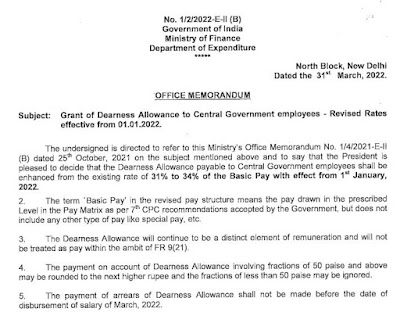
DA Jan 2022 - Grant of Dearness Allowance to Central Government employees - Revised Rates effective from 01.01.2022

 3% DA Hike - Revised Rates effective from 01.01.2022: DoE OM dated 31.03.2022 No. 1/2/2022-E-II (B) Government of India Ministry of Finance...