Showing posts with label Finance Minister. Show all posts

Monday, 16 September 2019

HBA - Central Government employees have a low-interest house construction advance


House Building Advance (HBA)

Central Government employees have a low-interest house construction advance
Finance Minister Nirmala Sitharaman said the lowering of interest rates will encourage more government employees to buy new houses as they were “a major contributor” to the overall demand.
Also Read: 7th Pay Commission House Building Advance

New Measures to Boost Housing Sector

Relaxation of ECB guidelines for Affordable housing
  • ECB guidelines will be relaxed to facilitate financing for home buyers who are eligible under the PMAY, in consultation with RBI.
  • This is in addition to the existing norms for ECB for affordable housing.
House Building Advance
  • The interest rate on House Building Advance shall be lowered and linked with the 10 Year G Sec Yields.
  • Government servants contribute to a major component of demand for houses. This will encourage more government servants to buy new houses
Also Check: Clarifications regarding House Building Advance - HBA

house-building-advance-central-government-employees


Friday, 2 March 2018

Finance Minister to inaugurate the Centralized GP Fund Module of PFMS for all the Central Government Employees and ePPO Module of PFMS for complete end -to -end electronic processing of Pension cases tomorrow


Finance Minister to inaugurate the Centralized GP Fund Module of PFMS for all the Central Government Employees and ePPO Module of PFMS for complete end -to -end electronic processing of Pension cases tomorrow
28 FEB 2018

On the occasion of 42nd Civil Accounts Day tomorrow, the Union Minister for Finance & Corporate Affairs , Shri Arun Jaitley will inaugurate the Centralized GP Fund Module of PFMS for all the Central Government Employees. The centralized GPF module meets a long standing demand of the Central Government Employees for a mapping of GPF Accounts with the unique Employee ID thereby facilitating online application for GPF advances and withdrawals with online access to the employee's current GPF balances. The module will streamline GPF accounting and transfer of balances.

During the Inaugural Session, the Finance Minister, Shri Jaitley will also inaugurate the ePPO module of PFMS for complete end -to -end electronic processing of Pension cases. The ePPO includes the integration of the BHAVISHYA application of the Department of Pension & Pensioners' Welfare and the PARAS application of CPAO with PFMS for seamless processing of Pension cases thereby eliminating delays and errors involved in manual processing.

A function is being organized tomorrow at D.S. Kothari Auditorium, DRDO Bhawan Complex, New Delhi to mark the 42nd Civil Accounts Day.

The Finance Minister, Shri Arun Jaitley will be the Chief Guest at the Inaugural Session. The Union Minister of State for Finance, Shri Pon. Radhakrishnan will preside over this Session. The Secretary (Expenditure), Shri A. N. Jha and the Controller General of Accounts(CGA), Shri Anthony Lianzuala will be the other dignitaries at the Inaugural Session.

It may be mentioned here that the Union Finance Minister, Shri Arun Jaitley had earlier graced the 40th Civil Accounts Day function on March 1, 2016 in which the Hon'ble President of India was the Chief Guest. The Union Finance Minister, Shri Jaitley had also very graciously inaugurated the ‘Mahalekha Niyantrak Bhawan', the new building of this office on September 14, 2016.
Earlier, the Finance Minister had been kind enough to launch the mandatory use of PFMS for Central -Sector schemes monitoring (Oct 2015), the Non -Tax Receipts Portal (NTRP) (Feb 2016) and the Web Responsive Pensioners' Service of the Central Pension Accounting Office (CPAO) (September 2016).

The Union Government initiated a major reform in Public Financial Management in 1976. The Audit and Accounts functions were separated by relieving the Comptroller and Auditor General of his responsibility of preparation of Union Government accounts. The accounting function was brought directly under the control of the Executive. Consequently, the Indian Civil Accounts Service (ICAS) was established. The ICAS was carved out from the Indian Audit & Accounts Service (IA & AS), initially through the promulgation of an Ordinance amending the C & AG's (Duties, Powers and Conditions of Service) Amendment Act, 1976. Later on, the Departmentalization of Union Accounts (Transfer of Personnel) Act, 1976 was enacted by Parliament and assented to by Hon'ble President of India on 8th April, 1976. The Act was deemed to have come into force with effect from 1st March, 1976. Accordingly, the ICAS is celebrating March 1 every year as the "Civil Accounts Day".
Since its inception the ICAS has steadily grown in stature and now plays an important role in the management of public finances of the Union Government.

Other highlights of the 42nd Civil Accounts Day function are

* Inauguration of the Centralised GPF and ePPO modules of PFMS
Reforms in public financial management are a continuous process. Structural changes take place in the economy and in the functioning of government which demand accounting data on public finances to be available to decision makers, often on real time basis. This demand for faster information can only be met through adoption of technology. Recognizing this need, the Service has since its inception, been a pioneer in the use of Information Technology in Payments, Accounting and Financial Reporting.

* Keynote address by Shri N. K. Singh, Chairman, Fifteenth Finance Commission (FFC)
Shri N. K. Singh, Chairman, FFC will deliver the keynote address at the Plenary Session from 12.00 PM to 12.50 PM on the topic "Managing Public Finances for a resurgent India". The Address will be of tremendous significance in the context of fiscal discipline efforts of the Union and the States that would be required to achieve fiscal consolidation.

* Address by Shri Rajnish Kumar, Chairman, State Bank of India
The post-lunch session (2:00 PM -2:50 PM) will feature a talk by Shri Rajnish Kumar, Chairman, State Bank of India on the topics "Leveraging Information Technology for an efficient receipt and payment system of the Government of India". As the head of the premier accredited and aggregator bank for Government business, the views of Chairman, SBI on the subject would be of immense significance especially in the context of implementation of the Public Financial Management System (PFMS) with a seamless integration with the banking systems.

Concluding session
This Session will be an Open House Session where Service Officers will interact for a way forward on issues relating to Accounts, IT and Internal Audit.

PIB

Wednesday, 1 February 2017

Income Tax Return form for the category of individuals having taxable income upto Rs 5 lakhs other than business income


A simple one- page Income Tax Return form for the category of individuals having taxable income upto Rs 5 lakhs other than business income.

"Finance Minister Shri Jaitley said that the present burden of taxation is mainly on honest tax payers and salaried employees who are showing their income correctly. Therefore, post-demonetisation, there is a legitimate expectation of this class of people to reduce their burden of taxation."

Press Information Bureau
Government of India
Ministry of Finance

01-February-2017 14:11 IST

Finance Minister reduces the tax rate from 10 to 5 per cent for individual income between Rs 2.5 to Rs 5 lakh.

Finance Minister appeals to all citizens to contribute to Nation Building by making a small payment of 5 per cent tax if their income is falling in this slab.

A simple one- page Income Tax Return form for the category of individuals having taxable income upto Rs 5 lakhs other than business income


The Union Finance Minister Shri Arun Jaitley reduced the rate of taxation from existing 10 per cent to 5 per cent for individual assesses between income of Rs 2.5 lakhs to Rs 5 lakhs. This would reduce the tax liability of all persons below Rs 5 lakh income either to zero (with rebate) or 50 per cent of their existing liability.

While presenting the General Budget 2017-18 in the Parliament today, the Union Finance Minister Shri Jaitley said that the present burden of taxation is mainly on honest tax payers and salaried employees who are showing their income correctly. Therefore, post-demonetisation, there is a legitimate expectation of this class of people to reduce their burden of taxation. The Finance Minister further said that if a nominal rate of taxation is kept for lower slab, many more people will prefer to come within the tax net. The Finance Minister made an appeal to all the citizens of India to contribute to Nation Building by making a small payment of 5 per cent tax if their income is falling in the lowest slab of Rs 2.5 lakhs to Rs 5 lakhs.

The Union Finance Minister Shri Jaitley said that the Government is trying to bring within tax-net more people who are evading taxes. So, in order to expand tax net, it is decided to have a simple one-page form to be filed as Income Tax Return for the category of individuals having taxable income upto Rs 5 lakhs other than business income. Also, a person of this category who files income tax return for the first time would not be subjected to any scrutiny in the first year unless there is specific information available with the Department regarding his high value transaction.

In his Budget Speech, the Finance Minister further said that in order not to have duplication of benefit, the existing benefit of rebate available to the same group of beneficiaries is being reduced to Rs 2500, available only to assessees upto income of Rs 3.5 lakhs. The combined effect of both these measures will mean that there would be zero tax liability for people getting income upto Rs 3 lakhs per annum. and the tax liability will only be Rs 2,500 for people with income between Rs 3 and Rs 3.5 lakhs. While the taxation liability of people with income upto Rs 5 lakhs is being reduced to half, all the other categories of tax payers in the subsequent slabs will also get a uniform benefit of Rs 12,500 per person. The total amount of tax foregone on account of this measure is Rs 15,500 crore.

In order to make good some of this revenue loss on account of this relief, a surcharge of 10 per cent of tax payable on categories of individuals whose annual taxable income is between Rs 50 lakhs and Rs 1 crore has been proposed. This is likely to give additional revenue of Rs 2,700 crore.

The Finance Minister said that the direct tax proposals for exemptions, etc. would result in revenue loss of Rs 22,700 crore but after counting for revenue gain of Rs 2,700 crore for additional resource mobilisation proposal, the net revenue loss in direct tax would come to Rs 20,000 crore.

PIB

Sunday, 29 January 2017

GST: Finance Minister may hike service tax to 16-18% in Budget


GST: Finance Minister may hike service tax to 16-18% in Budget

New Delhi: Finance Minister Arun Jaitley may hike service tax rate to 16-18 per cent from the current 15 per cent in the Budget, due on Wednesday, as a precursor to the Goods and Services Tax (GST) rollout.

The move, that will make flying, eating out, phone bills and a host of other services expensive, would be an attempt to take the rates closer to the proposed tax slabs for GST.

GST, which will subsume central and state levies like excise duty, service tax and VAT, is scheduled to be rolled out from July 1.

The tax slabs decided for the GST are 5, 12, 18 and 28 per cent and taking service tax closer to one of the slabs is a logical move in the Budget, tax experts said.

Tax experts say, Jaitley, who had in his previous budget hiked service tax rate by 0.5 per cent to 15 per cent, may raise the levy by at least one percentage point to 16 per cent.

Some others feel there could be different service tax rates with a lower 12 per cent for basic services and a higher 18 per cent for the rest.

Also, a higher service tax for April-June will help the government garner more revenue to meet expenses on schemes and programmes it may be planning to contain the impact of demonetisation.

A service tax rate closer to the GST rate will also help consumers avoid a greater price shock when the new national sales tax is rolled out.

While service tax until now is a central levy, it will be equally split between the Centre and states under the new GST regime. Most services, except essential ones like primary healthcare and basic education, will be covered by GST.

Service tax was budgeted to provide Rs 2.31 lakh crore in 2016-17, more than 14 per cent of the Centre’s total tax revenues of Rs 16.30 lakh crore.

This will be the third time that Jaitley will raise service tax rate. Service tax from June 1, 2015 was hiked from 12.36 per cent to 14 per cent. A 0.5 per cent Swachh Bharat Cess was levied on all services, taking the total incidence of service tax to 14.5 per cent from November 15, 2015.

In the last Budget, he imposed a Krishi Kalyan Cess at the rate of 0.5 per cent on all taxable services to take the levy to 15 per cent.

PTI

Saturday, 28 January 2017

GST will not lead to job losses at central excise dept, assures Jaitley


GST will not lead to job losses at central excise dept, assures Jaitley

New Delhi: Ahead of the rollout of GST, Finance Minister Arun Jaitley today sought to address concerns of job loss from reduced work of central excise and service tax officials, saying they should have no insecurity as enough work and opportunities will be available to them in the new indirect tax regime.

"I see no reason really for disquiet for the simple reason (that) opportunities which are available to people in service and the matter of policy and constitutional guarantee are all protected," he said at the Investiture Ceremony 2017 and International Customs Day 2017 organised by CBEC here.

Only the nature of activity will change because there will be one national sales tax replacing an array of central and state levies like excise duty, service tax and VAT.

"Important changes and evolutions which take place are never put on the back burner" just because the people who conduct the activity would now have to work in an altered form and environment, he said.

"The number of people required, the kind of opportunity will remain unchanged except that the nature of activity itself changes," he said.

GST, he said, has for last several yeas been considered as a larger part of policy consensus in India and an important taxation reform that will lead to the economic integration of the country.

"Once it takes place you have a situation where taxes (that) are levied by the state (and) by Centre (will) all be integrated into one and therefore resulting in one assessment.

"Multiple systems on assessment which is there at present will evolve into a newer kind of system," he said.

He was responding to Central Board of Excise and Customs (CBEC) Chairman Najib Shah’s remarks drawing his attention to "the rising disquiet in the cadre", saying there were human resource issues in the service.

Jaitley said the revenue to be collected is going to expand and there will be expansion of economic activity as well.

"Therefore even though you have two parallel machineries which could now be converging into similar kind of activities and shared responsibility, I think the future will stand witness to the fact that there will be adequate amount of opportunities to be created and therefore the kind of disquiet in service, the kind of personal pressure I see on you should reduce as there is no real occasion for a fear of this kind or a sense of insecurity for anyone in this service," he said.

The Finance Minister said change and evolution are an integral part of any economic order, and they are never held back because the nature of responsibility is going to change.

"This is an ongoing process it will continue and we will all have to adjust ourselves with this particular change. I can only assure you that there is no reason for disquiet, you can go and have a comfortable sleep tonight,” he told the revenue officials.

Revenue Secretary Hasmukh Adhia told the officers that they will have enough work to do under GST.

The Indian Revenue Service (Customs and Central Excise) Officers Association has asked the government to protect the sanctity of their service amid attempts by officers of state government VAT departments to equate themselves with IRS (Customs and Central Excise) officers.

PTI

Wednesday, 18 January 2017

GST: Service tax likely to be hiked to 18 percent this budget


GST: Service tax likely to be hiked to 18 percent this budget

New Delhi: Most services are likely to attract a tax of 18 percent under the Goods and Services Tax (GST) as Union Finance Minister Arun Jaitley presents the Union Budget on February 1.

It will be interesting to witness whether the Centre raises the service tax rate from the existing 15 percent by at least one percentage point to 16 percent as a precursor to the rollout of GST.
However, the Centre and states have agreed to rollout GST from July 1, 2017, after which most services will turn costlier.

Also, a higher service tax, even for three months, will help the Centre partially offset the revenue loss after the GST kicks in, sources indicated.

Under GST, the service tax collections will be divided equally between the Centre and the states. A service tax closer to the GST rate will also help consumers avoid a greater price shock after the new system is rolled out.

Jaitley-headed GST Council has agreed on a four-slab structure -5, 12, 18 and 28 percent-along with a cess on luxury and 'sin' goods such as tobacco.

Within these, two standard rates of 12 percent and 18 percent could extend to a majority of the taxable goods.

ANI

Tuesday, 13 September 2016

Cabinet approves creation of GST Council and its Secretariat

Cabinet approves creation of GST Council and its Secretariat

The Union Cabinet under the Chairmanship of Prime Minister Shri Narendra Modi has approved setting up of GST Council and setting up its Secretariat as per the following details:
(a) Creation of the GST Council as per Article 279A of the amended Constitution;
(b) Creation of the GST Council Secretariat, with its office at New Delhi;
(c) Appointment of the Secretary (Revenue) as the Ex-officio Secretary to the GST Council;
(d) Inclusion of the Chairperson, Central Board of Excise and Customs (CBEC), as a permanent invitee (non-voting) to all proceedings of the GST Council;
(e) Create one post of Additional Secretary to the GST Council in the GST Council Secretariat (at the level of Additional Secretary to the Government of India), and four posts of Commissioner in the GST Council Secretariat (at the level of Joint Secretary to the Government of India).
The Cabinet also decided to provide for adequate funds for meeting the recurring and non-recurring expenses of the GST Council Secretariat, the entire cost for which shall be borne by the Central Government. The GST Council Secretariat shall be manned by officers taken on deputation from both the Central and State Governments.

The steps required in the direction of implementation of GST are being taken ahead of the schedule so far.
The Finance Minister has also decided to call the first meeting of the GST Council on 22nd and 23rd September 2016 in New Delhi.

Background:
The Constitution (One Hundred and Twenty-second Amendment) Bill, 2016, for introduction of Goods and Services tax in the country was accorded assent by the President on 8th September, 2016, and the same has been notified as the Constitution (One Hundred and First Amendment) Act, 2016. As per Article 279A (1) of the amended Constitution, the GST Council has to be constituted by the President within 60 days of the commencement of Article 279A. The notification for bringing into force Article 279A with effect from 12th September, 2016 was issued on 10th September, 2016.

As per Article 279A of the amended Constitution, the GST Council which will be a joint forum of the Centre and the States, shall consist of the following members: -
a) Union Finance Minister - Chairperson
b) The Union Minister of State,
in-charge of Revenue of finance - Member
c) The Minister In-charge of finance or
taxation or any other Minister nominated
by each State Government - Members
As per Article 279A (4), the Council will make recommendations to the Union and the States on important issues related to GST, like the goods and services that may be subjected or exempted from GST, model GST Laws, principles that govern Place of Supply, threshold limits, GST rates including the floor rates with bands, special rates for raising additional resources during natural calamities/disasters, special provisions for certain States, etc.
*****
PIB

Sunday, 3 July 2016

Finance Minister Promises Minimum Pay 7th Pay Commission Hikes

Finance Minister Promises 'Minimum Pay' 7th Pay Commission Hikes

7th-CPC-minimum-pay-fitment-factor

New Delhi: Finance Minister Arun Jaitley has promised to consider to hike the minimum pay of central government employees beyond Rs 18,000, a day after the cabinet cleared 7th Pay Commission award for its employees.

Central government employees have been demanding hike in minimum pay since November 19, when 7th Pay Commission headed by Justice A K Mathur submitted its report to Jaitley.

The Finance Minister said he was not ‘rigid’ on the issue and the government will try to rectify some of employees’ demands including minimum pay.

Jaitley met with representatives of central government employees unions at Home Minister Rajnath Singh’s house for two hours till 11pm on Thursday night.

Jaitley, Rajnath Singh and Railways Minister Suresh Prabhu attended the meeting and assured unions leaders of central government employees that their demand would be looked into.

“The minimum pay of central government employees Rs 18,000 was made on recommendations of the 7th Pay Commission. But government will consider hiking it after discussions with all stakeholders,” he said in the meeting.

“Three ministers called us and we met them at Home Minister Rajnath Singh’s house late on Thursday for almost two hours. We have been assured that the minimum pay issue is going to be referred to one of two committees that the government is setting up to rectify any anomalies in the pay commission recommendation implementation,” Shiv Gopal Mishra, General Secretary of the National Joint Council Action (NJCA), a confederation of several central government employees’ unions, told reporters after the meeting.

The council claims a membership of 3.3 million, including the central government employees – Railways, Defence, Postal, Income Tax, Central Customs and Central Excise etc.

NJCA already have rejected Modi government’s overall 23.5 percent pay hike bonanza based on 7th Pay Commission recommendations and would go on indefinite strike from 6 am, 11 July.

They have been demanding Rs 26,000 as minimum pay instead of Rs 18,000 approved by the government based on the 7th Pay Commission’s recommendations.

Mishra also said the Home Minister assured them that “their interaction with us has the blessings of PM Narendra Modi”.

“On minimum pay, we are for a negotiated settlement and it seems there is some consideration at the highest level,” he added.

The increasing the minimum pay will change the salary fitment factor. If the minimum pay is hiked from Rs.18,000 to even Rs.20,000, the fitment factor will be higher than the 2.57 times approved by the government based on the pay commission recommendations.

If the 2.57 fitment formula is tinkered with, then salary and pension in general for all central government employees will go up.

NJCA wrote to all central government employees unions that “government has proposed to refer the issue of minimum pay and fitment factor to a committee for reconsideration. The NJCA will await communication in this regard from the government”.

It said that it will meet on 6 July again to decide on the proposed indefinite strike from July 11.

Source : tkbsen.in

Friday, 1 July 2016

7th Pay Commission might be issued next week and the government employees will start receiving new pay cheques

7th Pay Commission might be issued next week and the government employees will start receiving new pay cheques

'Notification on ‘7th Pay Commission’ next week’

New Delhi: The notification on 7th Pay Commission might be issued next week and the government employees will start receiving new pay cheques from this month.

The top Finance Ministry officials on Thursday said that notification in this regard is expected to be issued next week.

The union cabinet had on Wednesday approved the he long-awaited 7th pay commission Report’s recommendations hiking salaries of central government employees as well as pensions.

Initially, the public servants will be able to draw the hiked part of their basic pay and they will start receiving the hiked allowances five to six months later.

For example, employees belonging to the minimum pay of the existing 6th Pay Commission scale had so far been drawing a Rs 7,000 basic salary plus allowances. From July, their basic pay will rise to Rs 18,000, but their allowances will remain the same until the committee headed by the Finance Secretary to announce new allowances.

The officials said since the pay scale will be made effective retrospectively from January 1 this year, the public servants will be able to claim their arrears from the day after the notification is issued.

After the cabinet meeting, the Finance Minister Arun Jaitley said government salaries have to be competitive with the private sector, for which the Commission had engaged IIM-Ahmedabad to make the comparison.

“This will attract best talent in the government sector,” said the minister.

However, as per the cabinet approval, the minimum pay is now Rs 18,000 and maximum is Rs 2.5 lakh, but ideally the minimum should have been 1/10th of the maximum, the employees’s union leaders claimed.

The Cabinet ditto with the 7h Pay Commission recommendations, the commission recommended 23.55 per cent hike in salaries, allowances and pensions and a 14.27 per cent increase in basic pay for Central government employees, the lowest in 70 years.

The central government employees are in for disappointment as the cabinet approved a 14.27 per cent hike in basic pay, which is significantly lower than what the 6th pay commission had recommended. Sixth Pay Commission had recommended a 20 per cent hike in basic pay which the government doubled while implementing it in 2008.

The Congress and the Left parties Thursday came out in support of the indefinite strike from July 11 call given by central government employees’ unions to protest the “inadequate” hike in their salaries. While the Congress said the hike was the worst in the last 70 years, the CPM said it was “disappointing.”

Monday, 27 June 2016

7th Pay Commission: Rs 70,000 cr allocated for its implementation in Budget 2016

7th Pay Commission: Rs 70,000 cr allocated for its implementation in Budget 2016

7cpc-arun-jaitley


7th pay Commission: “We have provisioned for around 60-70 per cent of the total burden that was talked about,” a finance ministry official said. Around Rs 70,000 crore has been provisioned in the Union Budget 2016-17 for the implementation of the Seventh Pay Commission for government employees, a finance ministry official said.

While there’s no explicit overall provision number, the government had said the Seventh Pay Commission hike has been built in as interim allocation for different ministries.

“We have provisioned for around 60-70 per cent of the total burden that was talked about,” a finance ministry official said.

The Budget document states that “the implementation of the Seventh Pay Commission due from January 1, 2016 is to be implemented during 2016-17 fiscal as also the revised One Rank One Pension (OROP)scheme for Defence services.”

The finance ministry has provisioned for this in the Demands for Grants for individual departments and ministries. It is built into and subsumed into those allocations.

In January, the government had set up a high-powered panel headed by Cabinet Secretary P K Sinha to process the recommendations of the Seventh Pay Commission, which will have bearing on the remuneration of 47 lakh central government employees and 52 lakh pensioners.

The Empowered Committee of Secretaries will function as a Screening Committee to process the recommendations with regard to all relevant factors of the Commission in an expeditious detailed and holistic fashion.

Faced with the burden of Pay Commission recommendations, there were concerns on whether the government would be able to stick to the fiscal deficit target of 3.9 per cent for 2016-17. However, in Budget Union Finance Minister Arun Jaitley removed all doubts and promised to adhere to the fiscal consolidation roadmap and stick to the 3.9 per cent deficit target. (With PTI inputs)

Read at: Indian Express

Monday, 29 February 2016

Highlights of General Budget 2016

Highlights of General Budget 2016

union-budget-2016-higlights


Union Finance Minister Shri Arun Jaitley spoke on the Key Reform Measures in his Budget speech 2016-17

1. The Government is firm on its course towards fiscal consolidation without compromising on its development agenda. 3.5% fiscal deficit is targeted for FY 2017.

2. Total allocation for Agriculture, Farmers’ welfare and Irrigation set at Rs. 47,912 cr, which is nearly twice the allocation of the previous year.

3. New Health Protection scheme will provide health cover up to Rs. 1 lakh per family and additional Rs. 30,000 for senior citizens.

4. Free LPG connections will be provided in the name of woman member of a family to 1.5 cr BPL households in 2016-17 and to continue for two more years to cover 5 cr households in total.

5. Massive increase in public spending on infrastructure to Rs. 2.21 lakh cr, an increase of 22.5% over the previous year.

6. Higher Education Financing Authority set up, with an initial capital base of Rs. 1,000 cr to promote higher education. In addition, 10 public and 10 private institutions to emerge as world-class Teaching and Research Institutions.

7. Promoting a tax-friendly regime and minimizing hassles due to litigation through a New Dispute Resolution Scheme with low or zero penalties. Ongoing tax cases can be settled with ease.

8. Increased relief for middle-class tax-payers by raising the ceiling of tax rebate under Section 87A to Rs. 5,000 for individuals with income less than Rs. 5 lakhs and by raising the limit of deduction of rent paid under section 80GG to Rs. 60,000.

9. Directly providing financial and other subsidies benefits to people who deserve them by enacting a new law and developing a social security platform using Aadhar.

10. Boosting formal sector employment by provisioning Rs. 1,000 cr towards contributing 8.33% on behalf of all new employees enrolling in EPFO for the first three years of their employment.

11. Simplified and pro-market tax measures such as laying out the roadmap of phasing out of exemptions under Corporate Taxes, abolishing small cesses, providing complete pass through of income-tax to securitization trusts and reducing period of obtaining long-term capital gains treatment for unlisted companies to three years.

12. Promoting entrepreneurship by increasing the turnover limit under Presumptive taxation scheme to Rs. 2 cr, targeting to disburse loans worth Rs. 1.8 lakh cr under PM Mudra Yojana and providing 100% deduction of profits for 3 out of 5 years for start-ups.

13. Facilitating Affordable Housing by 100% tax exemption for profits from small projects, not subjecting distribution REITs and INVITs to Dividend Distribution Tax and encouraging small first-time home buyers by deducting ¬additional interest of Rs. 50,000.

14. Reducing black money through a scheme to declare undisclosed income by paying 45% tax in a given compliance window.

15. Strengthening the financial sector by allocating Rs. 25,000 cr towards recapitalising Public Sector Banks (PSBs), listing Government-owned General Insurance companies, and spelling out a roadmap for consolidating PSBs.

Source: PIB News

Thursday, 7 January 2016

Financial obligations due to implementation of OROP and 7th CPC Recommendations in the coming financial year – Finance Minister

Financial obligations due to implementation of OROP and 7th CPC Recommendations in the coming financial year – Finance Minister

Finance Minister: Due to various policy measures undertaken by the present Government, Indian Economy has achieved robust growth rate despite volatility and uncertainty in global economy; asks Captains of Indian Trade and Industry to come forward and make increased Private Investment especially in Infrastructure Sector .

The Union Finance Minister Shri Arun Jaitley said that in the first half of the Current Financial Year 2015-16, the Indian Economy has achieved robust growth rate despite volatility and uncertainty in global economy. He said that this was made possible by a slew of policy measures undertaken by the present Government including enhanced public investment, kick starting stalled projects, improving the status of financial inclusion significantly, improving governance through systematic changes like open auction of natural resources like coal and spectrum in a transparent manner, and greater fiscal federalism and improving business environment through reforms in policies and regulation among others. Shri Jaitley said that the current level of growth rate of our economy and sound fiscal fundamentals present better growth prospects for the next Financial Year 2016-17 as well. The Finance Minister Shri Jaitley was making the Opening Remarks during his third Pre-Budget Consultative Meeting with the representatives of Industry and Trade Groups here today.

The Union Finance Minister Shri Arun Jaitley said that the Government will continue to expand public spending even during the next financial year despite the major financial implications of the recommendations of the 14th Finance Commission which reduced the share of the Central Government by 10% and its forthcoming financial obligations due to implementation of One Rank One Pension (OROP) and 7th Pay Commission Recommendations in the coming financial year. He asked the representatives of Business and Trade Sector to increase the private sector spending especially in infrastructure sector.

Various suggestions were received during the aforesaid Consultative Meeting. Major recommendations include higher investment in irrigation and rural infrastructure sector as this will increase the spending capacity of the rural people which in turn will create demand for various items and increased economic activity. Other suggestions included focus on disinvestment of public sector undertakings by the Government to raise additional revenue and to reduce Government borrowings which, in turn, will make more money available for the private sector to borrow. Other suggestions included reduction in subsidy outflows and direct payment of fertilizer subsidy to farmers.

Suggestions were made that 7th Pay Commission recommendations be implemented in staggered manner and tax collections be increased by expanding the base. It was suggested that Minimum Alternate Tax (MAT) by withdrawn in calibrated manner, tax exemptions and allowances be withdrawn while tax rate may be rationalised in order to bring transparency, certainty and less discretion to make the tax administration more transparent and efficient. Tax incentives be given for use of debit and credit card, payment of utilities be made mandatory by cheques or through e-payment, clarity of policies by CBEC & CBDT to its field offices to avoid any discrepancies and discretions in tax administration and implementation of GST at the earliest.
Other suggestions include measures be taken to revive private sector investment especially in infrastructure sector through NIIF, use of Infrastructure Finance Companies like IIFCL to rebuilt the capacity of the private infrastructure sector by making it easier for them to raise funds. Bank guarantees be replaced by ‘bid bonds’ or ‘surety bonds’ for companies which, in turn, will help them getting credit at reduced cost and removal of cess and surcharges etc.

Other suggestions include measures to attract youth to agriculture sector by making farming highly mechanized and improving productivity. For this ‘Agriculture Equipment Banks’ may be set-up, segments of land be made in three categories, viz, barren land, single crop land and multi-crop land and separate rules for dealing with each category may be made.

Start-up parks for attracting young entrepreneurs be set-up on the line of IT parks. Suggestions were made that in order to ‘Make in India’ and ‘Ease of doing Business’ successful, measures may be taken to reduce the cost of doing business for which we need to improve infrastructure and reduce credit cost. To deal with the problem of NPA, recapitalization of banks be done through offering of shares to public. As regards tax matters, it was suggested that no appeal should be made where the two consecutive orders are in favour of the assesse except in rare situation and assesses may not be asked to deposit in case of first appeal and be asked to deposit only in case of second appeal.

It was suggested that measures be taken to generate demand in real estate sector which will in turn boost the steel and cement sectors which are major sectors for employment generation. Other suggestions include raise in exemption limit in case of income tax be raised from Rs. 2.00 lakh to Rs. 5.00 lakh, corporate tax be reduced to 25%, nominal rate of interest be charged on delayed payments, rationalization of exemptions and allowances and reduction in tax rates, reduction in corporate tax be extended to partnership firms etc.

It was suggested that measures be taken to uplift the power sector which is facing a challenging time, credit to MSME sector be boosted, Mid Day Meal Scheme may be scrapped due to large scale seepages and non-transparency in the implementation of the same. Suggestions were made to boost the exports, especially the MSME exports. It was suggested to boost e-commerce in mobile payment to achieve the goal of cashless economy, guidelines be issued for removal of anomalies in case of taxes being imposed by different States on e-payment and e-commerce. It was suggested to reduce customs duty on set-top boxes from 10% to 5%,and media entities be included for carry forward of losses in case of merger among others.

Along with the Finance Minister Shri Jaitley, the Pre-Budget Consultative Meeting with the representatives of Industry and Trade Groups was also attended among others by Shri R.N. Watal, Finance Secretary, Shri Shaktikanta Das, Secretary, DEA, Dr. Hasmukh Adhia, Revenue Secretary, Ms. Anjuly Chib Duggal, Secretary, Financial Services, Shri Amitabh Kant, Secretary, DIPP and Dr. Arvind Subramanian, Chief Economic Adviser (CEA). The representatives of the Industry and Trade Groups present during the meeting included Shri Sumit Mazumdar, President, CII, Shri Sunil Kanoria, President, ASSOCHAM, Shri Harshavardhan Neotia, President, FICCI, Shri R. Chandrasekhar, Chief Economist, NASSCOM, Shri Ajay Piraman, Piramal Enterprises Ltd, Shri S.C. Ralhan, President, FIEO, Shri R Seshasayee, Vice Chairman, Ashoik Leyland, Shri Ashish Gupta, Consulting CEO, Federation of Associations in Indian Tourism & Hospitality (FAITH), Shri P.K. Shah, Chairman, EEPC India, Shri G. Venkatesh Babu, LANCO Anpara Power Ltd, Shri Sangam Kurade, President, Federation of Indian Micro and Small & Medium Enterprises (FISME), Shri Abhishek Tiwar, Federation of Indian Women Entrepreneurs (FIWE), and Shri Girish Srivastava, Secretary General IBF among others.

PIB

Tuesday, 13 October 2015

7CPC News: 7th Pay Commission faces pay gap problem

7th Pay Commission faces pay gap problem

New Delhi: 7th Pay Commission faces serious challenge in submitting its recommendation to government till December for hiking salaries and allowances for central government employees as the employees’ unions test its account of controversial pay gap between top and bottom level government officials.

The previous pay commission showed a wide gap in pay between the top bureaucrats and the government employees at the bottom.

The first pay commission was recommended pay of the top bureaucrats 41 times higher than the government employees at the bottom. The top bureaucrats were given salary Rs 2,263 while the lowest earning employees got Rs 55.

Subsequent pay commissions reduced the ratio of pay between lowest earning employees and top bureaucrats from 1:41 in 1947 to about 1:12 in 2006. The minimum basic salary of central government employees is now Rs 7730 while maximum salary at the level of Secretary is Rs 80,000.

Accordingly, the 7th Pay Commission will have to consider reduction in the disparity of pay ratio between its highest and lowest paid employees because it determines the socialism view of the government and the higher number of central government employees are in the minimum pay slabs.

The pay gap increases employee’s turnover and work-related illness, with all the associated economic consequences.

The bureaucrats with high pay are generally happier, healthier and a better place to live for almost everyone in them compare to the lower earning employees.

A pay gap is calculated as the ratio of the pay of the highest paid employee of an organisation to the pay of the average or lowest paid employee in that organisation.

7th Pay Commission can make recommendations on promoting pay fairness in the central government employees’ fraternity by tackling disparities between the lowest and the highest paid central government servants.

The 7th Pay Commission, headed by Justice Ashok Kumar Mathur was appointed in February 2014 and its recommendations are scheduled to take effect from January 1, 2016.

As part of the exercise, the 7th Pay Commission holds discussions with various stakeholders, including organisations, federations, and groups representing civil employees as well as defence services.

The Commission is ready with its recommendations on revising emoluments for nearly 50 lakh central government employees and 55 lakh pensioners, and will submit report to the Finance Minister till December 31.

TST

Tuesday, 1 September 2015

Arun Jaitley on OROP – Annual pension revision do not happen anywhere in the world

Arun Jaitley on OROP – Annual pension revision do not happen anywhere in the world

“For the first time, a clause in OROP was openly rejected. The Finance Minister has refused to give annual increment for pensioners like servicemen get.”

“The task of the finance minister is very much like the housewife’s. She has to spend each and every rupee wisely to make sure that there is no cash crunch towards the end of the month,” Finance Minister Arun Jaitley told the reporters during a press meet.

Ex-servicemen have been fighting for the past 78 days demanding the implementation of One Rank One Pension. The finance minister told the reporters, “We are ready to give them OROP, but we cannot give them annual increments like they demand. We can consider revisions once every five years. The 7th Pay Commission will soon submit its report to the Government. If we have to implement their recommendations and the OROP, there will be additional expenses. We’ll have to manage that too.”

He also said that the Central was committed to the long pending demand of One Rank One Pension but the ‘only difficulty’ as the ‘arithmetical translation’.

“My work is very similar to the responsibilities of a housewife. She has to run the family with the money that her husband brings and ensure that there is no cash shortage throughout the month. Therefore, we will not be able to give a 3% annual increment on the pension that is being demanded by the veterans.

“We have the responsibility of looking after these soldiers who retire at the age of 35 or 38. We agree to implement the OROP scheme. Pensioners are likely to see a substantial increase in their pensions. But it is impossible to increase the pension each year. Accepting these “unreasonable concessions” will form the basis for others like BSF and CRPF to make similar demands.

“I have, in my mind, an opinion and formula for OROP scheme. Others too will have their own opinions and formulae, but they have to be reasonable and rational criteria. OROP may not be a scheme with monthly or annual revisions,” he said.

Two major obstacles are, one is yearly increment and another issue of base year. There have been several rounds of talks between the official and the protesting veterans on this issues. But all of those have failed.
The pension drawn by soldiers who had retired earlier much less pension, when compared with the pension received by those who had retired recently. Instead of taking into account the calendar year in which the soldier retires, OROP fixes the pension on the basis of the rank and the number of years the soldier had served, to calculate his pension. Any future enhancement in the rates of pension, it would benefit all the ex-servicemen. This is the most important feature of the scheme.

More than 20 lakh veterans and 6 lakh war widows all over the country are hoping that their pensions will be revised based on OROP Scheme effective from 1.4.2014.

Source: 90paisa.org

Appeals to Trade Unions to Reconsider Call for Proposed Strike (2 Sep,2015) : Bandaru Dattatreya

Government Working Positively on 9 of the 12 Demands of Trade Unions : Bandaru Dattatreya

Appeals to Trade Unions to Reconsider Call for Proposed Strike Tomorrow

Shri Bandaru Dattatreya, the Minister of State(IC) for Labour and Employment held a press conference here today. Elaborating on the initiatives and continuing efforts of the Government to address the issues and concerns of the Trade Unions for the welfare of workers, the Minister said that of the twelve demands of Trade Unions, the Government is positively working on at least nine demands. Shri Dattatreya said that as already assured while taking Labour Law reforms, the Trade Unions will be consulted. In continuation of earlier appeal to Trade Unions on 27th August, 2015, the Minister appealed again to reconsider their call for proposed strike tomorrow in the interest of workers and the Nation.

In this context, Shri Bandaru Dattatreya has sent a letter to to striking Trade Unions.

Here is the text of the letter-

“Dear

“This is with reference to my letter and appeal to you for reconsidering your call for strike on 2nd of September 2015 in the light of demands raised by the Central Trade Unions. While requesting you to reconsider your decision, I would like to bring the following to your consideration.

“The Charter of Demands given by you has been on high priority for me. I had held meeting with you on 19th Nov., 2014 to discuss the issues concerning the Charter of Demands. Thereafter, another meeting was held on 15th May, 2015 where Shri Dharmendra Pradhan, Hon’ble MoS (IC) for Petroleum and Natural Gas and Shri Piyush Goyal, Hon’ble MoS (IC) for Power also participated. The Inter-Ministerial Committee (IMC), constituted by Hon’ble Prime Minister, held its first meeting with you on 19th July, 2015.

“The second meeting of IMC to discuss the various issues relating to the Charter of Demands with Central Trade Unions was held for two days on 26th& 27th August, 2015.

“In view of the suggestions given by you in the meetings held by Inter-Ministerial Committee, the Government assured the following:

1. “Government is seriously considering amendments to the Minimum Wages Act to give minimum wages to all workers. As per the proposed amendment, the Central Government will prescribe National Minimum Wage for three different categories of States. It would be mandatory for the States to fix their minimum wage not below the National Minimum Wage so prescribed by the Central Government. If the minimum wage already notified by a State is higher than the National Minimum Wage prescribed by the Central Government, the higher notified minimum wage shall prevail.

“While prescribing the National Minimum Wage the norms given by ILC and Supreme Court judgement will be taken into consideration. At present the National Floor Level Minimum Wage is Rs. 160 per day but with the implementation of the said norms the minimum wage would be not less than Rs. 273 per day.

2. “For the purpose of bonus, the wage eligibility limit and calculation ceiling would be appropriately revised. It is proposed to revise the wage eligibility limit from Rs. 10,000 to Rs. 21,000 and calculation ceiling from Rs. 3500 to Rs. 7,000 or the minimum wage notified by the appropriate Government for that category of employment, whichever is higher. With the proposed revision of the minimum wages, the average calculation ceiling would be about Rs.10,000.

3. “The Government has taken many steps for the social security of all the workers, especially unorganized workers. The Government is working out ways to include construction workers, rickshaw pullers, auto rickshaw drivers and volunteers of different schemes like Aanganwadi Centres, Mid Day Meal Centres etc. For organized workers also many initiatives have been taken like Universal Account Number (UAN) for portability of account for EPFO members and Second Generation Health Reform Initiatives by ESIC.

4. “Regarding contract workers, a comprehensive review of the existing Act is being considered. The main features of the proposed revised Act would be deployment of contract labour through registered staffing agencies to be encouraged to ensure social security coverage and same working condition for contract workers as that of the regular workers. The issue of same wages to contract workers as that of regular workers for same nature of work requires wider consultation and a committee will be constituted for this purpose, if required.

5. “Government has already enhanced minimum pension for EPFO members and every pensioner gets minimum pension of Rs.1,000 per month perpetually.

6. “Labour Law reforms will be based on tripartite consultations as already stated by the Hon’ble Prime Minister. The States are also being advised to follow the tripartite process. I have held many tripartite consultation meetings with you on proposed labour law amendments. In future also, the tripartite consultation will be held for any proposed change in the labour laws.

7. “For strict adherence to Labour Law enforcement, advisory has been issued to the States and strict monitoring has been initiated by the Central Government. I have written a D.O. letter dated 25.05.2015 to Chief Ministers of all the States for strict enforcement of Labour Laws. Secretary (L&E) has also written D.O. letters dated 27.05.2015 and 26.08.2015 to Chief Secretaries of all the States in this regard. A circular for strict enforcement of labour laws was also issued by the Chief Labour Commissioner (Central) on 26/08/2015.

8. “For employment generation, the Government has taken many initiatives like Make in India, Skill India, Mudra Yojana and National Career Service Portal etc.

9. “Abolition of interviews for all recruitments at relatively junior level jobs which do not require any special knowledge/expertise is being done for transparency and expediting the process of recruitment.

10. “Inflation is lowest in last many years except for two items, onions and pulses. Government is taking necessary steps to contain the prices of these two commodities also.

11. “The Hon’ble Finance Minister in his concluding remarks has very clearly said that the new Government has charted out a very pragmatic economic agenda for the benefit of everyone, especially those who are poor and disadvantaged section of the society. However, this agenda needs your support and will appreciate if we can get your valuable inputs on this. He has also assured that for this a continuous dialogue will be maintained with the labour unions.

12. “He also mentioned that as far as the FDI in Railways is concerned, it is necessary because Railways require huge investment for upgrading the .infrastructure. This is possible only with the help of private sector and hence FDI is being allowed in railways and the FDI will be only in infrastructure and will not be allowed in the operation of Railways.

13. “As far as FDI in Defence is concerned, the Finance Minister has explained that India is the largest importer of military hardware in the world and this means a large amount of funds are being paid in foreign exchange to outsiders including private organizations. On the other side when we produce military hardware within the country, we not only save in terms of foreign exchange but also create many jobs within the country. Hence it is very important that we take advantage of FDI in defence to achieve three objectives of (i) saving foreign exchange, (ii) creation of jobs and (iii) more importantly to ensure that we are not dependent on outsiders for the security of the nation.

Finally, as the Hon’ble Prime Minister has already stated, the journey of labour reforms will not be meaningful until we have dialogue and consultation with the labour and labour unions. I assure that we will have consultations with labour unions and give due weightage to the views of labour unions in all such initiatives including the initiatives of other Departments which may affect the labour.

With warm regards.”

Source: PIB News

Monday, 22 June 2015

Finance Ministry approved 10th Bipartite Settlement Wage Revision for Bank employees for period 1.11.2012 to 31.10.2017

Finance Ministry approved 10th Bipartite Settlement Wage Revision for Bank employees for period 1.11.2012 to 31.10.2017

Salary Revision for Officer Employees of Public Sector Banks governed by Officer’s Service Regulation – 10th Bipartite Settlement for period 1.11.2012 to 31.10.2017

Government of India
Ministry of Finance
Department of Financial Services
Jeevan Deep. IIIrd Floor,
Parliament Street, New Delhi,
Dated the June 19, 2015
To
Sh. M.V.Tanksale,
Chief Executive,
Indian Banks’ Association,
Mumbai.

Subject: Salary Revision for Officer Employees of Public Sector Banks governed by Officer’s Service Regulation – 10th Bipartite Settlement for period 1.11.2012 to 31.10.2017

Sir.
I am directed to refer to your letter No. HR&IR/KSC/GOVT/665 dated 25th May, 2015 on the above subject and to say that Government has ‘No objection‘ to IBA authorizing the Banks to pay revised salary and arrears of pay and allowances to serving officers and revised pension and arrears to existing pension optees retired w.e.f. on or after 1.11.2012 as per the provisions at the Joint Note pending amendments to the Officer’s Service Regulations/Pension Regulations subject to the provisions made by the respective banks in the particular year.

2. As regards declaring 2nd and 4th Saturday as holidays and other Saturdays as full working days is concerned. IBA may rater to this Department’s letter No. 4/1/7/2015-IR dated 2.6.2015.

3. This issues with the approval of Hon’ble Finance Minister
Yours faithfully,
(S R. Mehar)
Deputy Secretary to the Government at India
10th Bipartite Settlement Wage Revision
Source: http://banknewskumar.blogspot.in/

Monday, 23 February 2015

Income Tax Expectations: Here’s What India Wants

Income Tax Expectations: Here’s What India Wants

A survey carried out by industry body Assocham has found that a majority of salaried employees want Finance Minister Arun Jaitley to increase the income tax exemption in the forthcoming Budget.

A hike in income tax exemption from Rs. 2.5 lakh to Rs. 3 lakh will lead to savings of up to Rs. 5,000 for those who fall in the Rs. 2.5 lakh to Rs. 5 lakh tax bracket. Those in the Rs. 5 lakh to Rs. 10 lakh tax bracket will save up to Rs. 10,000, while those in the highest tax bracket can save up to Rs. 15,000.

Any increase in exemption in income tax would leave more money in the hands of people and will increase their purchasing power, Assocham said.

If Mr Jaitley hikes income tax exemption limit, it will be for the second time in two years that salaried employees will get a relief on taxes.

The other big expectation is about exemption on housing loans. 78 per cent of those surveyed want interest exemption on home loans to go up to Rs. 5 lakh from Rs. 2 lakh.

Property prices in the country have gone up sharply over the years and many individuals have to pay large amounts as interest for home loans. Exemption on interest on home loan was hiked by Rs. 50,000 to Rs. 2 lakh in the previous Budget.

A large number of respondents in the survey also voted for hiking exemption limit under section 80C of the Income Tax Act; the section makes investments worth Rs. 1.5 lakh on saving instruments such as fixed deposits, national saving certificates and public provident funds exempt from taxes.

“Hike in exemption limits will boost the savings rate in the Indian economy to 35 per cent of GDP from below 30 per cent currently,” said Assocham secretary general D S Rawat.

88 per cent of respondents want the government to reduce the record-high duty on gold import. Import duty on gold was hiked to 10 per cent in 2013 when the economy was struggling with a high current account deficit and volatile rupee.

Nearly 82 per cent of the salaried class expects a separate deduction of Rs. 50,000 for the payment towards annuity or pension plans. Deduction of the amount paid towards annuity plans u/s 80CCC and NPS u/s 80CCD come under the threshold limit of section 80C currently.

Around 55 per cent of the survey respondents were between 25 and 29 year-old; 26 per cent fell between 30 and 39 years; 16 per cent were between 40 and 49 years. The survey was carried out among employees from 18 broad sectors, with maximum share contributed by employees from IT/ITes sector (17 per cent). It was conducted across Delhi, Mumbai, Kolkata, Chennai, Ahmedabad, Hyderabad, Pune, Chandigarh, Dehradun, etc. About 500 salaried employees from the different sectors were covered by the survey from each city on an average.

Sunday, 21 December 2014

7th Pay Commission interim report-Official Statement by Finance Ministry

7th Pay Commission interim report-Official Statement by Finance Ministry


GOVERNMENT OF INDIA
MINISTRY OF FINANCE
RAJYA SABHA
UNSTARRED QUESTION NO-230

ANSWERED ON-25.11.2014
7th Pay Commission
230 . SHRI SHANTARAM NAIK

a) the details of meetings, the 7th Pay Commission has taken so far and the items/issues discussed till date;
b) the States, visited, by the Commission if any till date and the States which the Commission proposes to visit;
c) whether the Commission proposes to take the views of the State Governments as regards their pay-scales since invariably, most of the States adopt the Central Pay Commission reports;
d) whether Commission proposes to submit any interim report;
e) whether the Commission proposes to make any recommendations to bring in financial transparency; and
f) if so, the details thereof?
 
ANSWER
SHRI JAYANT SINHA
MINISTER OF STATE IN THE MINISTRY OF FINANCE

(a)&(b): The 7th Central Pay Commission is required to make its recommendations on its Terms of Reference. Also, the Commission is to devise its own procedure. The Commission’s Terms of Reference do not enjoin upon it to keep the Government updated on its functioning and the procedure being followed by it during the course of its deliberations.

(c ): The Terms of Reference of the Commission provide that the Commission will make its recommendations, keeping in view, inter alia, the likely impact of the recommendations on the finances of the State Governments, which usually adopt the recommendations with some modifications.

(d)to(f): The Commission is required to submit its report on its Terms of Reference. However, no Report, including any interim one, has so far been submitted by the Commission.

Source- http://rajyasabha.nic.in/

Sunday, 23 November 2014

Income Tax exemption may raise further – Finance Minister

Income Tax exemption may raise further – Finance Minister

May raise tax exemption limit further: Arun Jaitley

NEW DELHI: Finance minister Arun Jaitley on Saturday said that he does not favour burdening the salaried and middle-class with more taxes but would go after the evaders in widening the net.

In fact, he would encourage more money being put in the pockets of tax payers that will lead to spending and collection of more indirect taxes.

“This widening of the tax base. What does it mean? I pay the same indirect tax as my attendant. Our volume of consumption may be different. So everybody is paying indirect taxes.

"And literally almost half your taxes are indirect taxes today. He pays excise, he pays customs duty, he pays service tax. Now as far as income tax is concerned, to bring those who evade tax is widening the tax net, I am all for it," the minister said in an interaction with PTI journalists at PTI headquarters.

He was replying to a question on whether his budget would look at widening the tax base to maximise revenue.

Jaitley, who will be presenting his first full fledged budget in February, said that in his last budget he had increased the tax exemption limit from Rs 2 lakh to Rs 2.5 lakh and would even raise it further if he had more money.

"After all what are we talking about Rs 2.5 lakh today means, taking all the deductions which we have given, somebody up to Rs 3.5-4 lakh does not have to pay tax. So we have reached the situation broadly.

"One earning Rs 35,000-40,000 per month, if the person puts some money for savings, (he) won't have to pay tax. But people falling in this bracket say that they don't save anything with salary of Rs 35,000-40,000 (with) the present cost of living, the transport cost, the fees of children and so on," Jaitley said.

Therefore, the minister said, he was against reducing the exemptions to widen the tax net. "Then that's not my approach," he added.

"So I am quite willing, if I had my way and I had more money in my pocket, I would like to expand. But today the revenue position is challenging. Last time I gave several concessions, which were actually beyond my means.

"But it's all fine to bring those who evade tax under the tax net. But to bring this vulnerable section into the tax net, that can't be the policy today. In fact if you put additional money in their pockets and allow them to spend, then I collect correspondingly more indirect taxes so I will rather encourage more economic activity."

On black money within the country, he said: "It is huge quantity and more easily traceable. Because you go to real estate, you go to land, you go to mining, you go to jewellery, you go to luxury goods, you will find the domestic (black money). You go to educational institutions, you will find it there. Therefore to trace out the buyers and the recipients is also easy."  


Source: TOI http://timesofindia.indiatimes.com/business/india-business/May-raise-tax-exemption-limit-further-Arun-Jaitley/articleshow/45240535.cms

Friday, 29 August 2014

Confederation writes to Finance Ministry regarding Transport Allowance

Confederation writes to Finance Ministry regarding Transport Allowance to regulate to Faridabad Gurgaon, Ghaziabad and Nodia cities at par with Delhi rates

CONFEDERATION OF CENTRAL GOVT. EMPLOYEES & WORKERS
1st Floor, North Avenue PO Building, New Delhi – 110001
Website: WWW. Confederationhq.blogspot.com
Email: Confederationhq@yahoo.co.in
Ref: Conf/Genl/2014

Dated – 26.08.2014
To
The Secretary
Ministry of Finance
Department of Expenditure
New Delhi – 110001

Sub: Regulation of Transport Allowance at Faridabad Gurgaon, Ghaziabad and Nodia at par with Delhi rates.

Sir,
Your kind attention is invited to the OM No. 21(8)2010-E-II (B) dated 01.08.2012 of Ministry of Finance, Department of Expenditure regarding regulation of Transport Allowance at Faridabad, Gurgaon, Ghziabad and Noida wherein instructions have been issued to regulate the Transport Allowance at the rates applicable to ‘Other Cities’ i.e other than 13 classified cities as per the condition laid down in OM no. 21(2)12008-E-II (B) dated 29.08.2008. Issuance of the OM has created panics among the employees posted at these cities. Immediate action is required to be taken to avoid implementation of the OM.

In this connection following points are brought to your kind notice :

1. Ministry of Finance, Department of Expenditure had issued OM 2(4)-E.II (B)/65 dated 05.11.1974 vide which special dispensation was given to Faridabad at Delhi rates in respect of CCA & H RA.

2. 5th Central Pay Commission had made recommendations to grant of transport allowance to Central Government employees to compensate the cost incurred on commuting between the place of residence and the place of duty. Transport allowance was implemented vide 0M No. — 1(13)97-E-Il (B) dated 03.10.1997, according to which, transport allowance was to be regulated on the basis of classification of cities for the purpose of CCA. Para 3.1 of said order Is reproduced below-

The cities referred to as ‘A’ and ‘A-1’ in these orders shall be the same as those classified as such for the purpose of Compensatory (City) Allowance (CCA) in terms of the orders issued
separately regulating grant of CCA to the Central Government employees.

3. Vide para 4.2 8, 6 CPC had recommended abolition of CCA and increased the rates of transport allowance subsuming the element of CCA. The abolition of CCA was compensated by increasing the rates of transport allowance.

4. Faridabad has been given the status of A-1 city (as being part of the Urban Agglomerate of Delhiat par with NOIDA, Ghazia bad and Gurgan etc.) since 1974 for the purposes of HRA & CCA and since August, 1997 for the purpose of transport allowance as given above. These facilities are being extended to the Central Government employees/officers posted at Faridabad accordingly.

5. It may further be noted that, Ministry of Finance, vide No. 21 (2)/2008-E.ll dated 29.08.2008 has classified 13 cities as A-I/A which, inter-alia, includes Delhi (UA). Delhi (Urban Agglomerate) includes Faridabad, Ghaziabad, Noida & Gurgaon As such, the rates of Transport Allowance admissible for the City of Delhi, automatically stands extended to the other constituents of the Urban Agglomerate.

6. If rate of the transport allowance is reduced the rate payable to other cities, employees posted at Faridabad, Ghaziabad, Noida & Gurgaon will be deceived from the benefit given by the 6th CPC by subsuming the element of CCA in transport allowance as they were being paid CCA at Delhi rates.

7. In view of the above, it reveals that the transport allowance was being regulated on the basis of classification of cities for the purpose of CCA and payment of transport allowance at Delhi rates, to the employees posted at Faridabad is fully justified. This stands already concluded by the orders and judgments of the Hon’ble CAT Principal Bench, New Delhi (copy enclosed for ready reference) as given below-

1) OA No. 483/2005, Judgment dated 16.09.2005.

2) OA No. 2441/2005, Judgment dated 02.08,2006

3) RA No. 296/2010, Judgment dated 14.01.2011.

4) OA No. 368/2011, Judgment dated 21.07.2011.

5) OA no. 459/2011, Judgment dated 05.08.2011.

6) CP No. 302/2011, Judgment dated 30.03.2011.

8. These judgments squarely covers this issue wherein the Hon’ble CAT, Principal Bench, New Delhi had upheld the payment of Transport Allowance at par with Delhi (UA) and the said judgments were accepted by the Government and duly implemented. It appears that the Department of Expenditure has not noticed the above judicial pronouncement and issued the clarification vide OM dated 1” August, 2012, which seem to be in contravention of the directions of the Hon’ble CAT.

It is therefore, requested to kindly take cognizance of the facts and particularly the binding judgments of the Hon’bel CAT, New Delhi as mentioned above to withdraw the latest instructions issued vide ID No. 21 (8)12010-E-Il (B) dated 01.08.2012 for reducing the Transport Allowance on par with “Other Cities”.

An early action ¡n this regard is highly solicited.

DA: as above


Yours faithfully,
sd/-
(M. Krishnan)
Secretary General
Copy to: -
Corn, N. Somaiah, Vice President, Confederation of Central Government Employees & Workers c/o
Takshasila Vidyapeetham, Dasaigudam Road Shantinagar, Suryapet Dist. Nalgonda (A.P).

Source: http://confederationhq.blogspot.in/2014/08/confederation-writes-to-ministry-of.html

Flash News

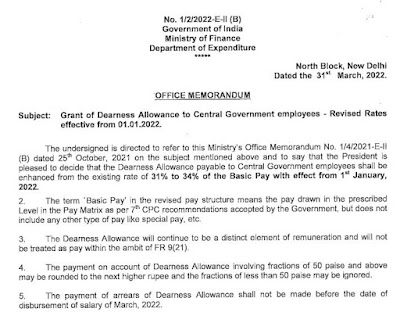
DA Jan 2022 - Grant of Dearness Allowance to Central Government employees - Revised Rates effective from 01.01.2022

 3% DA Hike - Revised Rates effective from 01.01.2022: DoE OM dated 31.03.2022 No. 1/2/2022-E-II (B) Government of India Ministry of Finance...