Showing posts with label pay gap. Show all posts

Thursday, 17 August 2017

7th CPC - Government Firmly Rejects Demand to Reduce Pay Gap

7th CPC - Government Firmly Rejects Demand to Reduce Pay Gap

7th CPC - Government Firmly Rejects Demand to Reduce Pay Gap

The pay gap under the 7th Pay Commission was a major issue for Central Government employees. The cabinet decided go ahead with the recommendations of the pay panel which suggested 14.27 per cent hike in basic pay which was effective from January 1 2016.

The cabinet had cleared the recommendations of the pay panel in June which effected 4.8 million central government employees and 5.2 million pensioners.

Recommendations by-passed

While clearing the pay panel’s recommendations the basic hike in pay effective January 1 2016 was at 14.27 per cent. The recommendations made by the Empowered Committee headed by Cabinet Secretary P K Sinha for an average 30 per cent hike in basic pay was bypassed by the Union Cabinet.

Pay matrix

As per the notification there were 18 pay matrices that were approved. The notification said, the highest pay matrix (Level-18) for the Cabinet secretary to the Union government is Rs 2,50,000 (fixed), which was Rs 90,000 (fixed) in the immediate past under 6th pay commission recommendation. The rate of increase is 178%. The pay matrix in the lowest grade (Level-1) is Rs 18,000 which was Rs 7,000 under 6th pay commission recommendation. The rate of increase is 157%.

The ratio of pay between the highest declared pay matrix (Level-18) and the lowest grade (Level -1) in the 7th Pay Commission recommendations is 1:13.9, which was 1:12 as per the previous pay commission:

No Pay Gap made up

All pay commissions in the past had made up the pay gap between the lower paid employees and the top officials from second Pay Commission 1:41 ratio to Sixth pay commission 1:12. In the first pay commission, the pay of the top bureaucrats was 41 times higher than the employee earning the lowest. The future pay commissions however reduced the ratio from 1:41 in 1947 to about 1:12 in 2006.

Reducing Pay Gap Ruled Out

Reliable sources confirm, the government has put aside the demand by central government employees to reduce the pay gap. The government has categorically made it clear that no decision will be taken to reduce the pay gap under the 7th Pay Commission, confirm sources. Government employees have been demanding for a long time to pay ratio should be minimised. They have also demanded that Rs 25,000 should be the minimum pay in the new pay scale and the fitment factor will be higher than the 2.57 times approved by the government based on the pay commission recommendations.

Tuesday, 13 October 2015

7CPC News: 7th Pay Commission faces pay gap problem

7th Pay Commission faces pay gap problem

New Delhi: 7th Pay Commission faces serious challenge in submitting its recommendation to government till December for hiking salaries and allowances for central government employees as the employees’ unions test its account of controversial pay gap between top and bottom level government officials.

The previous pay commission showed a wide gap in pay between the top bureaucrats and the government employees at the bottom.

The first pay commission was recommended pay of the top bureaucrats 41 times higher than the government employees at the bottom. The top bureaucrats were given salary Rs 2,263 while the lowest earning employees got Rs 55.

Subsequent pay commissions reduced the ratio of pay between lowest earning employees and top bureaucrats from 1:41 in 1947 to about 1:12 in 2006. The minimum basic salary of central government employees is now Rs 7730 while maximum salary at the level of Secretary is Rs 80,000.

Accordingly, the 7th Pay Commission will have to consider reduction in the disparity of pay ratio between its highest and lowest paid employees because it determines the socialism view of the government and the higher number of central government employees are in the minimum pay slabs.

The pay gap increases employee’s turnover and work-related illness, with all the associated economic consequences.

The bureaucrats with high pay are generally happier, healthier and a better place to live for almost everyone in them compare to the lower earning employees.

A pay gap is calculated as the ratio of the pay of the highest paid employee of an organisation to the pay of the average or lowest paid employee in that organisation.

7th Pay Commission can make recommendations on promoting pay fairness in the central government employees’ fraternity by tackling disparities between the lowest and the highest paid central government servants.

The 7th Pay Commission, headed by Justice Ashok Kumar Mathur was appointed in February 2014 and its recommendations are scheduled to take effect from January 1, 2016.

As part of the exercise, the 7th Pay Commission holds discussions with various stakeholders, including organisations, federations, and groups representing civil employees as well as defence services.

The Commission is ready with its recommendations on revising emoluments for nearly 50 lakh central government employees and 55 lakh pensioners, and will submit report to the Finance Minister till December 31.

TST

Flash News

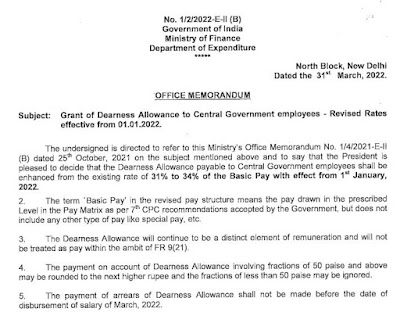
DA Jan 2022 - Grant of Dearness Allowance to Central Government employees - Revised Rates effective from 01.01.2022

 3% DA Hike - Revised Rates effective from 01.01.2022: DoE OM dated 31.03.2022 No. 1/2/2022-E-II (B) Government of India Ministry of Finance...