Showing posts with label 7CPC News. Show all posts

Tuesday, 30 July 2019

OPPORTUNITY FOR 7TH CPC PAY REVISION OF OPTION TO RAILWAY EMPLOYEES

OPPORTUNITY FOR 7TH CPC PAY REVISION OF OPTION TO RAILWAY EMPLOYEES

Railway Services (Revised Pay) Rules, 2016 – opportunity for revision of option to come over to revised pay structure.

GOVERNMENT OF INDIA
MINISTRY OF RAILWAYS
(RAILWAY BOARD)

No. PC-VII/2018/RSRP/1

New Delhi, dated:10.07.2019

The General Managers
All Indian Railways/PUs
(As per mailing list)

Sub: – Railway Services (Revised Pay) Rules, 2016 – opportunity for revision of option to come over to revised pay structure.

Ref:- Board’s letter No. PC-VII/2018/RSRP/1 dated 17.12.2018 (RBE No. 197/2018)

Please refer to Board ‘s letter mentioned above inter-alia circulating Ministry of Finance’s (MoF) OM No.4-13/17-IC/E-IIIA dated 12.12.2018 regarding opportunity for revision of option to come over to revised pay structure under CCS(RP) Rules, 2016 for adoption of the same in Railways with respect to RS(RP) Rules, 2016.

Consequent to issue of the same, certain Railways has sought clarification whether option to switch over to 7th CPC pay structure can be exercised in a prospective manner covering promotions materialized after notification of RS(RP) Rules, 2016.

2. With respect to above, it is stated that earlier, the issue has been examined in Board’s Office and a reference has already been made to MoF seeking clarification on the issue. Response from MoF is awaited.

Till such time clarifications are received from MoF, it is advised that while allowing options, conditions as stipulated in Rules 5 & 6 of RS(RP) Rules, 2016 may strictly be followed as Ministry of Finance while liberalizing conditions under Rule 6(4) of CCS(RP) Rules, 2016 which provides that the option once exercised shall be final and permitting another opportunity to employees to revise their initial option in terms of Rule 5 & 6 within a period of 3 months, made no changes in the other conditions laid down in Rules 5 & 6 of CCS(RP) Rules, 2016 governing exercise of option.

3. Hence, it is clarified that option for switching over to 7th CPC with respect to promotions up to 28 .07.2016 (date of notification of RS(RP) Rules, 2016) valid only and option for switching over to 7th CPC cannot be exercised with respect to promotions materialized after the said date.

Further, Illustrations on pay fixation methodology in cases

(a) where a Railway Servant has been placed in a higher grade pay or scale between 1st day of January, 2016 and the date of notification of RS(RP) Rules, 2016 on account of promotion or upgradation and elect to switch over to revised pay structure from the date of such promotion/upgradation and

(b) fixation of pay in case an employee elect to continue to draw pay in existing pay structure until he vacates his post or ceases to draw pay in the existing pay structure with respect to promotion upgradation materialized after the date of notification of RS(RP) Rules, 2016 in terms of relevant provisions of RS(RP) Rules, 2016 is enclosed as Annexure-I.

4. This issue are in concurrence with Finance Directorate of Ministry of Railways.

Encl. As above.

(Jaya Kumar G)
Dy. Director, Pay Commission-VII
Railway Board

Saturday, 25 June 2016

7th Pay Commission: Lower rank employees to get highest percentage salary hike

7th Pay Commission: Lower rank employees to get highest percentage salary hike

In a populist move, Prime Minister Narendra Modi led government is likely to pay highest percentage of salary hike to the lower rank government employees with the implementation of the 7th Pay Commission recommendations.

New Delhi, June 24: Prime Minister Narendra Modi led government is likely to pay highest percentage of salary hike to the lower rank government employees with the implementation of the 7th Pay Commission recommendations. The Prime Minister’s Office (PMO) has reportedly asked Cabinet Secretary Pradeep Kumar Sinha led Empowered Committee of Secretaries, that is examining the 7th Pay Commission recommendations, to increase the pay of lower grade employees.

The PMO told the Empowered Committee that the salaries of employees in the lower ranks should rise by the highest percentage, reported The Sen Times. The government decided to give highest percentage salary hike to bottom grades employees and maintain parity of incomes between mid-level tier officers and the bottom grade employees.

Notably, all pay commissions in the past had not only recommended highest percentage of salary hike for top central government officials but also considered the disparity ratio between its highest and lowest paid employees. The ration of highest and lowest paid employees was about 1:12 in 2006.

The 7th Pay Commission, headed by Justice A K Mathur, had originally proposed hike of 14.27 in basic pay, 23.55 per cent in salary, allowances and pensions. The Empowered Committee of Secretaries has reportedly recommended a whopping 30 per cent hike in government employees’s salary, making the minimum amount Rs 23,500 and the maximum to Rs 3,25,000.

The Empowered Committee of Secretaries will submit its final report later this month and the Cabinet will take final call on the 7th Pay Commission recommendations in July. 47 lakh central government employees and 52 lakh pensioners will be benefited from the recommendations of 7th Pay Commission.

Source : http://www.india.com/

Tuesday, 31 May 2016

Cadre Review before implementation of 7th Pay Commission recommendations

Cadre Review before implementation of 7th Pay Commission recommendations

Cadre-Review-7th-CPC

All India Civil Accounts Employees Association demands cadre review for Gr B and C employees before implementation of 7th Pay Commission recommendations

General secretaries of All India Civil Accounts Employees Association and All India Civil Accounts Employees Association category-II demands cadre review before implementation of 7th CPC.


   All India Civil Accounts Employees Association
    (RECOGNISED BY GOVT. OF INDIA)
    CENTRAL HEADQUARTER: NEW DELHI
    All India Civil Accounts Employees Association Category -II
    CENTRAL HEADQUARTERS: COCHIN
    Zonal Accounts Office, CBDT,
    Sanjuan Towers, Old Railway Station Road Cochin- 682018
    Phone No. 011-23345070, Mob. No. 9868520926 e-mail:- v.aicaea@gmail.com

 Central Office: –
    16-A, Akbar Road Hutments,
    17/2 – C, P & T Quarters,
    New Delhi: – 110011

Address for Communication:-
Kali Bari Marg,
New Delhi-110001 

No: AICAEA/HQ/A-2/2016/ 517-558
Dated: 27th May, 2016
To,
    Shri M.J.Joseph,
    Controller General of Accounts,
    Ministry of Finance,
    Department of Expenditure,
    Loknayak Bhawan,
    Khan Market,
    New Delhi – 110003

Subject: – Settlement of the long pending issues and appropriate recommendations on 7th CPC related matters- regarding

Sir,

We have been directed to refer our letter No: AICAEA/HQ/A-2/2016/417 dated 17th April, 2016 on the subject mentioned above and state that the employees are totally aggrieved for non-settlement of their grievances for more than one and a half years.

Moreover, large numbers of the issues that were discussed in the meeting held between the official side of CGA office and the National Executive of All India Civil Accounts employees Association under your Chairpersonship on 6th November 2015 are yet to be settled. Further, it was stated in the said meeting that the

“Ministry of Finance, Department of Expenditure has returned the Cadre Review proposal of Group ‘B’ & ‘C’ cadres of CCAS with the remarks that proposal may be re-examined in terms of instructions contained in their O.M. NO. 5(3)/E.III/97 dated 07.01.1999 and No. 7(1)/E.Coord/2014 dated 29.10.2014. DoE has also informed that the revision of pay in respect of Civil Accounts Employees will not be done in isolation and the same may be viewed and examined in the larger context of Organized Accounts Service as a whole. Therefore, the matter will be examined by DoE, MoF, in a holistic manner keeping in view the recommendations of 7th Pay Commission as well. The Association was therefore asked to wait for the 7th Pay Commission recommendation and the decision of the Government.”


But, we would like to bring the following facts to your kind information –

1. Pending implementation of 7CPC recommendations, the Ministry of Finance has accorded approval to the Cadre Review proposals of the Department of Posts.

2. The C&AG has made his recommendations to the Government for cadre review/ cadre restructuring/ amendments in the Recruitment Rules.

Hence, in view of these facts and as per the DOPT instructions, cadre review of the Gr. B & C employees of Civil Accounts Employees, which should have been done much earlier and before the cadre review of the Gr “A” cadres of Civil Accounts organization was done in 2012-13, needs to be initiated immediately in consultation with the Associations.

Apart from the above, the employees and officers of Civil Accounts organization are yet to learn about the recommendations given by the Controller General of Accounts to the Empowered Committee constituted by the Government for implementing the recommendations of 7CPC.

Therefore, for the purpose of review of the status of the issues discussed on 6th November 20159 (including the issue of Cadre Review) and to be appraised about the recommendations given by the Controller General of Accounts to the Empowered Committee constituted, our National Executive Members wish to meet you on 10th June 2016. We shall be thankful if you kindly accept our proposal and make it convenient to meet us on the proposed date. Time of the meeting may kindly be intimated to us at an early date please.

It may kindly be noted that the issues for discussion in the meeting will be the items forwarded by us through our letter dated 17th April, 2016.

Thanking you,

Yours faithfully
(G.K.Nair)
Secretary General
All India Civil Accounts Employees
Association Category II

(V.Bhattacharjee)
Secretary General
All India Civil Accounts Employees Association

    Sir,

    We have been directed to refer our letter No: AICAEA/HQ/A-2/2016/417 dated 17th April, 2016 on the subject mentioned above and state that the employees are totally aggrieved for non-settlement of their grievances for more than one and a half years.

    Moreover, large numbers of the issues that were discussed in the meeting held between the official side of CGA office and the National Executive of All India Civil Accounts employees Association under your Chairpersonship on 6th November 2015 are yet to be settled. Further, it was stated in the said meeting that the

    “Ministry of Finance, Department of Expenditure has returned the Cadre Review proposal of Group ‘B’ & ‘C’ cadres of CCAS with the remarks that proposal may be re-examined in terms of instructions contained in their O.M. NO. 5(3)/E.III/97 dated 07.01.1999 and No. 7(1)/E.Coord/2014 dated 29.10.2014. DoE has also informed that the revision of pay in respect of Civil Accounts Employees will not be done in isolation and the same may be viewed and examined in the larger context of Organized Accounts Service as a whole. Therefore, the matter will be examined by DoE, MoF, in a holistic manner keeping in view the recommendations of 7th Pay Commission as well. The Association was therefore asked to wait for the 7th Pay Commission recommendation and the decision of the Government.”

    But, we would like to bring the following facts to your kind information –

    1. Pending implementation of 7CPC recommendations, the Ministry of Finance has accorded approval to the Cadre Review proposals of the Department of Posts.

    2. The C&AG has made his recommendations to the Government for cadre review/ cadre restructuring/ amendments in the Recruitment Rules.

    Hence, in view of these facts and as per the DOPT instructions, cadre review of the Gr. B & C employees of Civil Accounts Employees, which should have been done much earlier and before the cadre review of the Gr “A” cadres of Civil Accounts organization was done in 2012-13, needs to be initiated immediately in consultation with the Associations.

    Apart from the above, the employees and officers of Civil Accounts organization are yet to learn about the recommendations given by the Controller General of Accounts to the Empowered Committee constituted by the Government for implementing the recommendations of 7CPC.

    Therefore, for the purpose of review of the status of the issues discussed on 6th November 20159 (including the issue of Cadre Review) and to be appraised about the recommendations given by the Controller General of Accounts to the Empowered Committee constituted, our National Executive Members wish to meet you on 10th June 2016. We shall be thankful if you kindly accept our proposal and make it convenient to meet us on the proposed date. Time of the meeting may kindly be intimated to us at an early date please.

    It may kindly be noted that the issues for discussion in the meeting will be the items forwarded by us through our letter dated 17th April, 2016.

    Thanking you,

    Yours faithfully
    (G.K.Nair)

    Secretary General
    All India Civil Accounts Employees
    Association Category II
        (V.Bhattacharjee)
    Secretary General
    All India Civil Accounts Employees Association

Source : nfcaahqnd  

7th Pay Commission News – No indication on revision of Fitment Formula, pay matrix

7th Pay Commission News – No indication on revision of Fitment Formula, pay matrix – NJCA reports on 7th CPC Empowered Committee’s possible proposal for slight increase in minimum pay but no consequential increase in Fitment Formula and entire pay matrix

7th Pay Commission News – NJCA has issued a communication to all its constituent member organisations indicating the expected recommendations of Empowered Committee on 7th Pay Commission report. NJCA has observed as follows

1. Slight Increase in Minimum Pay more than what was recommended by 7th Pay Commission

2. However, increase in minimum pay is not going to result in consequential upward revision in fitment formula and pay matrix.

3. 7th Pay Commission has proposed for reduction in the HRA rate from the present of 30%, 20% and 10% to 24%, 16% and 8% respectively. There is no indication as such from Empowered Committee for restoring these HRA rates to the present level.

4. 7th Pay Commission has recommended for abolishing more than fifty allowances. However, staff side is for restoring those allowances. The Empowered Committee may propose for forming a Committee by Government for getting its opinion on necessity of granting various allowances

5. As far as NPS scheme is concerned all Central Trade Unions an Federations are demanding for replacing the same with Old Pension Scheme (Defined Pension). It is expected that this matter may be referred by the Govt to a Committee formed for this purpose.

6. 7th Pay Commission has recommended for proving two options in respect of revision of present pension on implementation of its recommendations. As per first option (option 1), revision pension will be determined on the basis of number of increments earned by the pensioner in the pay scale from this he / she retired. Option 2 provides for arriving at the revised pension by multiplying the present pension with multiplication of factor of 2.57. A pensioner can choose any one of the options that is beneficial to him / her.

However, NJCA has now indicated that Department of Pension and Defence Ministry are against the option 1, as they are not possession of necessary records for revising the pension as per Option 1. As most of the pensioners would be benefited only if their pension is revised on the basis of increments earned by them, this will be great loss for them if Govt ignores 7th Pay Commission’s recommendations for revision of pension on the basis of increments earned by pensioners.

The extract of communication dated 27.05.2016, by NJCA is given below.

NJCA
National Joint Council of Action
4, State Entry Road New Delhi-110055
Ph: 011-23365912, 23343493, Fax: 23363167
No.NJCA/2016

Dated May 27, 2016

All Constituent Organisations,
National Council(JCM)

Dear Comrades,

As there had been no response from the Government to our communication dated 2nd May, 2016, we decided to seek an appointment with the Cabinet Secretary. Accordingly a delegation consisting of the following members of the NJCA met Cabinet Secretary, Shri P.K. Sinha on 26. May 2016.

Com. Shiva Gopal Misra Com.
Guman Singh
Corn. K.K.N. Rutty

From the discussions, it appears that, the Empowered Committee has made up their mind to recommend to the Government a slight increase in the Minimum Wage. No indication was however given as to the consequential revision of the Fitment Formula and Pay Matrix. There had also not been any hint about the need to restore the percentage of the HRA, which the 7th CPC has recommended for reduction. On Advances and Allowances, abolished, the Government might be advised to setup a committee to go into the matter and make suggestions. In the matter of the New Contributory Pension Scheme also, the Government might refer the demand to a committee.

On the question of pension benefit to the retired personnel, who are covered by the defined benefit pension scheme, the Cabinet secretary indicated that, both the Department of Pension and Defence Ministry were of the firm view that the first option recommended by the 7th CPC to bring about the parity with the past pensioners being infeasible and impracticable (due to the non-availability of the requisite records) might not be accepted and acted upon.

    Surprised over this development, the delegation requested for an official formal meeting of the Standing Committee so that the considered views of the Staff Side could be presented. The delegation informed to the Cabinet Secretary that, non-acceptance of the recommendation of the 7th CPC in the case of pensioners will be extremely disappointing for them and will give rise to avoidable discontent. The Cabinet Secretary suggested to the Staff Side to reach out to the Department of Pension and Ministry of Defence in’ the matter. So far he is concerned; he is an open minded on this subject, provided it is workable.

    The National JCA will meet on 3rd June 2016 at New Delhi to consider these developments and take appropriate decision.

Source: Confederation of Central Government Employees and Workers

Saturday, 21 May 2016

Who are entitled to 7th Pay Commission additional Bunching increment ?

Who are entitled to 7th Pay Commission additional Bunching increment ?

Who are entitled to 7th Pay Commission Bunching Benefit as per Para 5.1.36 of Pay Commission report ? – As per Illustration provided in the report Employees in GP 10,000 who are fitted in to minimum of Level 14 of New Pay Matrix will be eligible for one additional increment and would be fitted in to next cell of Level 14.

7th Pay Commission Pay Fixation:

As per Para 5.1.28 of 7th Pay Commission Report, pay fixation in the new pay structure will have to be made as follows

Step 1: Identify Basic Pay (Pay in the pay band plus Grade Pay) drawn by an employee as on the date of implementation. This figure is ‘A’.

Step 2: Multiply ‘A’ with 2.57, round-off to the nearest rupee, and obtain result ‘B’.

Step 3: The figure so arrived at, i.e., ‘B’ or the next higher figure closest to it in the Level assigned to his/her grade pay, will be the new pay in the new pay matrix. In case the value of ‘B’ is less than the starting pay of the Level, then the pay will be equal to the starting pay of that level


In addition to above, 7th Pay Commission proposes bunching benefit in Para 5.1.36 whenever more than two stages are bunched together for fixation of pay in 7th CPC pay matrix, one additional increment equal to 3 percent may be given for every two stages bunched, and pay fixed in the subsequent cell in the pay matrix.

Further, Para 5.1.37 of the report provides an illustration for fixation of pay of two employees who are drawing pay of Rs 53,000 and Rs54,590 in the GP 10000.

As per this illustration, after applying 7CPC multiplication factor of 2.57, both of these employees will have to be fixed in first cell of level 15 in the pay of Rs1,44,200 as their revised pay are worked out to Rs1,36,210 and Rs1,40,296 respectively which are not more than the first cell of level 15 (Rs1,44,200)

But to avoid bunching of these two stages of pay, the person drawing pay of Rs54,590 will get fixed in second cell of level 15 in the pay of Rs1,48,500, while the other who is drawing pay of Rs 53,000 will have to be fixed in Rs1,44,200.

Based on this illustration, a table containing Entry pay of Rs. 53,000 in GP 10000, subsequent stages for this pay (pay with increment of 3% for every year) and 7th Pay Commission pay fixation for the same has been prepared as below.

7CPC pay fixation for GP 10,000
6cpc pay basic pay X 2.57 7cpc pay matrix Fixation in 7CPC pay with bunching increment if applicable
53000 136210 144200 144200
54590 140296 144200 **148500
56230 144511 148500 148500
** One increment as bunching benefit
Employees in Grade Pay 5400, 6600, 7600 and 8900 who are fixed in stages next to entry pay will also be entitled to 7th Pay Commission Bunching Benefit

Applying same principles, we could find that next stage in entry pay in respect of Grade Pay 5400, 6600, 7600 and 8900 would be entitled to one additional increment as bunching benefit

1. Grade pay 5400 corresponding to pay band 15600-39100 (Entry Pay Rs. 21000 and subsequent stages of pay with increment of 3% for every year)

7CPC pay fixation for GP 5400 (15600-39100)
6cpc pay basic pay X 2.57 7cpc pay matrix Fixation in 7CPC pay with bunching increment if applicable
21000 53970 56100 56100
21630 55589
56100
57800 **
22280 57260 57800 57800
22950 58982 59500 59500
** One increment as bunching benefit

2. Grade pay 6600 (Entry Pay Rs. 25350 and subsequent stages of pay with increment of 3% for every year)

7CPC pay fixation for GP 6600
6cpc pay
basic pay X 2.57
7cpc pay matrix
Fixation in 7CPC pay with bunching increment if applicable
25350
65150
67700
67700
26120
67128
67700
69700 **
26910
69159
69700
69700
27720
71240
71800
71800
** One increment as bunching benefit

3. Grade pay 7600 (Entry Pay Rs. 29500 and subsequent stages of pay with increment of 3% for every year)

7CPC pay fixation for GP 7600
6cpc pay
basic pay X 2.57
7cpc pay matrix
Fixation in 7CPC pay with bunching increment if applicable
29500 75815 78800
78800
30390 78102
78800
81200 **
31310 80467 81200
81200
32250 82883 83600
83600
** One increment as bunching benefit

4. Grade pay 8900 (Entry Pay Rs. 49100 and subsequent stages of pay with increment of 3% for every year)

7CPC pay fixation for GP 8900
6cpc pay
basic pay X 2.57
7cpc pay matrix
Fixation in 7CPC pay with bunching increment if applicable
49100 126187 131100
131100
50580 129991 131100
135000 **
52100 133897 135000
135000
53670 137932 139100
139100
** One increment as bunching benefit

Whether Employees in who are fixed in the middle stages of new 7th CPC pay matrix will be eligible for Bunching Benefit ?

Relevant portions of 7th Pay Commission report (para 5.1.36 and Para 5.1.37) that discuss about Bunching increment are given under the heading “Entry Pay”.
The illustration provided by 7th CPC for fixation of pay with bunching increment also discusses only about entry pay in a grade pay.
Also, Para 5.1.28 of 7th Pay Commission Report which explains the method of fitment of existing 6th CPC pay in all stages in to 7th Pay Commission Pay Matrix does not contain any explanation about Bunching increment
Hence, it is not clear from the 7CPC report whether bunching benefit would apply to employees who are fixed in middle stages of new pay matrix.
For instance, we analysed the pay fixation of entry pay pertaining to Grade Pay Rs. 1800 and Grade Pay Rs. 2400 and its subsequent stages of pay with increment of 3% for every year
7CPC pay fixation for GP 1800
6cpc pay
basic pay X 2.57
7cpc pay matrix
Fixation in 7CPC pay
7000 17990 18000
18000
7210 18530 19100
19100
7430 19095 19100
19100 ##
7660 19686 20300
20300
7890 20277 20900 20900
## Bunching of 6cpc pay in two stages in to one stage of 7CPC Pay Matrix
7CPC pay fixation for GP 2400
6cpc pay
basic pay X 2.57
7cpc pay matrix
Fixation in 7CPC pay
11170 28707 29600 29600
11510 29581 30500 30500
11860 30480 30500 30500 ##
12220 31405 32300 32300
12590 32356 33300 33300

From the above, it could be seen that Pay pertains to Grade Pay of Rs. 1800 and Rs. 2400 in middle stages are getting bunched and fitted in to one stage of new pay structure as per the methods of fitment envisaged by 7th Pay Commission.

However, 7th pay Commission report has not discussed about applicability of Bunching Benefit in respect of pay fixation in middle stages of new pay matrix. It is also not clear whether bunching increment would apply to subsequent stages of pay when bunching increment is given to previous stage in the same level. For instance, 7th Pay Commission has recommended that pay of Rs. 54590 in GP 10,000 will be eligible for bunching increment and will be fitted in new of pay of Rs. 148,500. However, there is no discussion about the subsequent stage to Rs. 54,490 in GP 10,000 which is also getting fixed in same new Pay of Rs. 148,500/-

We are of the opinion that to clarify all these doubts, Govt has to come up clear-cut Clarification on Bunching Increment issue while 7th Pay Commission report is implemented.

Monday, 16 May 2016

7th Pay Commission Latest News

7th Pay Commission Latest News – PMO keen on 7th CPC Salary to be based on Inflationary Trend – Reasonable expectations of central government employees will be met.

The Central government has hardly been insensitive to the reasonable expectations of central government employees while announcing salary hikes in pay commissions. The same appears in the case of the 7th Pay Commission as well.

The Prime Minister’s Office is keenly awaiting the final touch up to the 7th Pay panel’s recommendations, and is keen that inflationary trends be kept in perspective while finalising the salary structure of the government employees.

The trade unions, while protesting the 7th Pay Panel’s recommendations, said that the proposed 7th Pay Commission hike was the lowest in many decades and not in sync with inflation.

Other than the pressure of trade unions, the results of the Assembly election in five states, West Bengal, Assam, Tamil Nadu, Kerala, Pondicherry, are likely to have an influence on the final pay out.

The notification towards implementation of the seventh pay commission will be announced only after the result of the elections. If the mandate goes totally in favour of the Opposition, the government will be under greater pressure to keep the dissatisfaction related to salalry hike in check.

Even other wise, the government would like to nip the popular opinion building up that the current government is apathetic to the needs of common man.

The two earlier policy decisions on the proposed EPF changes and their subsequent rollback showed government in a bad light.

Source: Zee News

Friday, 29 January 2016

Secretaries Committee to hold first meeting to process 7th Pay Commission report on Feb 2

Secretaries Committee to hold first meeting to process 7th Pay Commission report on Feb 2

Nodal officers of different ministries and departments will hold first meeting on February 2 to formulate action points for processing 7th Pay Commission report that have bearing on remuneration of about 1 crore central government employees and pensioners.

An Empowered Committee of Secretaries, headed by Cabinet Secretary P K Sinha, has been set up to process the panel’s recommendations that would put an additional burden of Rs 1.02 lakh crore on the exchequer.

An Implementation Cell has been created in the Finance Ministry which will work as the Secretariat of the Committee.

Joint Secretary (Implementation Cell) would take the meeting of all the Nodal Officers of ministries/departments on February 2 to discuss the relevant issues in connection with the processing of the recommendations, a Finance Ministry office memorandum said.

The meeting is aimed at strengthening the points of action pertaining to all the ministries/departments in general and also with regard to specific issues with a view to “enabling an effective, holistic and quicker processing” of the recommendations.

In November 2015, the Finance Ministry had asked concerned Ministries and Departments to nominate a nodal officer at the level of a Joint Secretary to interact with the Implementation Cell.

The recommendations when implemented would have a bearing on the remuneration of 47 lakh central government employees and 52 lakh pensioners.

Subject to acceptance by the government, the recommendations will take effect from January 1, 2016.


PTI

Tuesday, 22 December 2015

Ratio of minimum and maximum pay in 7th Pay Commission

Ratio of minimum and maximum pay in 7th Pay Commission

The pay scale of officers of Secretary level has been recommended Rs 2,25,000/- and minimum pay has been recommended Rs18,000/-. The 7th CPC ratio is 1:12.5

The ratio of minimum and maximum pay (Secretary level, not Cabinet Secretary) was 1:10.66 in 4th CPC. Further it was 1:10.19 in 5th CPC and 1:11.42 in 6th CPC. 7th CPC has extended it to 1:12.5 whereas it had been recommended in previous Pay Commissions the ratio of minimum and maximum pay should not exceed 1:8. The pay scale of officers of Secretary level has been recommended Rs 2,25,000/- and minimum pay has been recommended Rs18,000/-.

Ratio of maximum salary drawn by the Secretary to Government of India to minimum salary drawn by the lowest functionary in the government. The  below table brings out the trend in pay structure in the government of India over the years:

Saturday, 19 December 2015

Assistant Archivists, Archivists and Scientific Officer to get Higher Grade Pay -7th CPC recommendation

Assistant Archivists, Archivists and Scientific Officer to get Higher Grade Pay -7th CPC recommendation

7th Pay Commission has recommended higher Grade Pay for National Archives of India Posts – Assistant Archivists (GP 4200 to GP 4600), Archivists(GP 4600 to GP 4800) and Scientific Officers (GP 4600 to GP 4800) and a non-functional upgrade to GP 5400 (PB-2) after four years. These employees should be placed at the appropriate level in the Pay Matrix.

7th Pay Commission has recommended higher Grade Pay for Assistant Archivists, Archivists and Scientific Officer of National Archives of India

Seventh Pay Commission has recommended higher Grade Pay for Assistant Archivists (GP 4200 to GP 4600), Archivists(GP 4600 to GP 4800) and Scientific Officers (GP 4600 to GP 4800) of National Archives of India


National Archives of India

Assistant Archivists


Assistant Archivists, presently in GP 4200 are being currently recruited through the Staff Selection Commission. They are the feeder cadre for Archivists who are in the GP 4600.

The Commission has received representation for a higher entry pay scale with GP 4800 for Assistant Archivists. To advance their case they have stated that the entry level education qualification for the post is post-graduation and one year diploma in archival studies or two years experience of research in modern Indian History.

Analysis and Recommendations

The Commission notes that that Assistant Archivists are being currently recruited through the Staff Selection Commission. The ministry in its reply to the Commission have supported the demand of the Association of Indian Archivists and suggested a GP 4800 for Assistant Archivists which is slightly higher than the GP 4600 available for the Assistants of CSS. For the post of Archivists, the ministry has suggested GP 5400 (PB-3).

The Commission taking note of the demands made, reply of the ministry, the role of Archivists and the entry level qualifications recommends as under:

  • The existing cadre of Assistant Archivists should be upgraded to GP 4600 from the existing GP 4200, and then placed at the appropriate level in the Pay Matrix.
  • Accordingly, the Commission recommends upgradation in the pay for the cadre of Archivists to GP 4800 from the existing GP 4600. After upgradation, these employees should be placed at the appropriate level in the Pay Matrix.


Assistant  Microphotographist/Assistant  Chemist  and  Microphotographist/ScientificOfficer

The Commission has received representation for a higher entry pay scale with GP 4800 in place of the current GP 4200 for Assistant Microphotographist and Assistant Chemists.

To advance their case they have stated that they are professionals in conservation/preservation of records and have lower entry level pay scales than their counterparts in the National Museum. Similarly for the post of Micro-photographist and Scientific Officer a higher GP 5400 (PB-3) has been sought.

Analysis and Recommendations

The Commission notes that that Assistant Microphotographist and Assistant Chemist are being currently recruited through the Staff Selection Commission and their entry level qualification is graduation. They are the feeder cadre for Microphotographist and Scientific Officer respectively who are in the GP 4600. The essential qualifications for a Scientific Officer is post graduation/Bachelor of Engineering in paper technology with three years experience in research/teaching in a recognised educational institution etc.

The ministry in its reply to the Commission have endorsed the demand of the Association for revision to GP 4800 for the cadre of Assistant Microphotographist and Assistant Chemist. For Microphotographist/Scientific Officer the ministry has recommended GP 5400 (PB-2).

The Commission taking note of the entry level qualification of graduation does not recommend any upgradation in the pay of Assistant Microphotographist and Assistant Chemist.

The Commission is recommending upgradation in the pay for the post of Scientific Officer from the existing GP 4600 to GP 4800, and a non-functional upgrade to GP 5400 (PB-2) after four years. After upgradation, these employees should be placed at the appropriate level in the Pay Matrix.

Friday, 18 December 2015

Interesting Statistics from the 7th Pay Commission Report – Part 2

Interesting Statistics from the 7th Pay Commission Report – Part 2
According to the 7th Central Pay Commission Report, close to 29% of the employees are in the age group of 50 to 60 years. More than 44% of the employees are in the age group of 20 to 40 years. The average per capita expenditure on pay & allowances of a central government employee is 3.92 lakh rupees for the financial year 2012-13.
The Part 1 of this series looked at the number of vacancies, number of employees in various ministries/departments and number of employees by different categories in Government of India. Below are a few more interesting statistics from the CPC report.

Employee Age Profile

There is more or less an even spread of employees in different age groups. 22% of the employees are between 20 and 30 years while an equal percentage are between 30 and 40 years. 26% of the employees are between 40 and 50 years while the remaining 29% are between 50 and 60 years.


There are stark differences within ministries in the age profile of employees. The Ministry of Home Affairs has the highest percentage of employees in the 20 to 30 years bracket at 40%. This could be due to the fact that most of them come from the central armed forces. The Ministry of Petroleum & Ministry of Textiles, both have just 2% employees each in this age group.

In the 30 to 40 years age group, Ministry of Youth Affairs has the highest percentage at 29% and Ministry of Coal has the least at 7%. In the 40 to 50 years age group, Ministry of Tourism has the highest percentage with a whopping 65% while the Ministry of Textiles has the least percentage at 15%.

In the 50 to 60 years age group, Ministry of Textiles has the highest at 75%. Coupled with the other figures, 90% of the employees in the Ministry of Textiles are above 40 years. The Ministry of Home Affairs has only 7% employees in this age group.

interesting-statistics-from-the-7th-pay-commission-report_age-profile-snapshot-of-various-minisries


Expenditure on Pay & Allowances
The Government of India extends various types of allowances to the employees apart from their regular pay. The government expenditure on pay & allowances has been steadily growing. From 51664 crore rupees in 2007-08, the expenditure went up to 129599 crore rupees in 2012-13, an increase of more than 150%. The growth has been steady except in 2010-11 where it increased only marginally.

interesting-statistics-from-the-7th-pay-commission-report_total-expenditure-on-pay-and-allowance

Of the total expenditure, the highest expenditure is on the Ministry of Railways, followed by the Ministry of Home Affairs. This is only natural because they employ the maximum number of people.

Per Capita Expenditure on Pay & Allowances

The per capita expenditure on pay & allowances indicates that the government has spent Rs 3.92 lakh per employee during the financial year 2012-13 towards pay and allowances.

The highest per capita expenditure on pay & allowances is for the employees of the Ministry of External Affairs at Rs 34.95 lakh per annum. This is an aberration since it also includes pay & allowances paid abroad. Second in the list is Ministry of Renewable Energy with 10.65 lakh rupees followed by Ministry of Food Processing at 8.29 lakh rupees. Department of Electronics & IT and Ministry of Power make up the top five. The per capita expenditure for these departments & ministries is substantially higher than the average.


While the Ministry of Railways & Home Affairs have seen the highest expenditure for pay & allowances, their per capita expenditure compared to the average is not the highest. The average pay & allowances was least for the Ministry of Railways at Rs 2.97 lakh while it was Rs 4.18 lakh for Ministry of Home Affairs.

interesting-statistics-from-the-7th-pay-commission-report_per-capita-expenditure-on-pay-and-allowance

Tuesday, 15 December 2015

‘Good’ to ‘Very Good’ – 7th CPC enhancing the performance level for MACP and Regular Promotion

‘Good’ to ‘Very Good’ – 7th CPC enhancing the performance level for MACP and Regular Promotion
 
The 7th Pay Commission has recommended on the benchmark level for MACP and Regular Promotion in Central Government services.

The 7th Pay Commission feels that a significant change is required in promotion aspect. The benchmark for performance appraisal for MACP as well as for regular promotion.

The Commission recommends that this benchmark, in the interest of improving performance level, be enhanced from ‘Good’ to ‘Very Good.’

In addition, introduction of more stringent criteria such as clearing of departmental examinations or mandatory training before grant of MACP can also be considered by the government.

And also the Commission is proposing withholding of annual increments in the case of those employees who are not able to meet the benchmark either for MACP or a regular promotion within the first 20 years of their service.

Tuesday, 13 October 2015

7CPC News: 7th Pay Commission faces pay gap problem

7th Pay Commission faces pay gap problem

New Delhi: 7th Pay Commission faces serious challenge in submitting its recommendation to government till December for hiking salaries and allowances for central government employees as the employees’ unions test its account of controversial pay gap between top and bottom level government officials.

The previous pay commission showed a wide gap in pay between the top bureaucrats and the government employees at the bottom.

The first pay commission was recommended pay of the top bureaucrats 41 times higher than the government employees at the bottom. The top bureaucrats were given salary Rs 2,263 while the lowest earning employees got Rs 55.

Subsequent pay commissions reduced the ratio of pay between lowest earning employees and top bureaucrats from 1:41 in 1947 to about 1:12 in 2006. The minimum basic salary of central government employees is now Rs 7730 while maximum salary at the level of Secretary is Rs 80,000.

Accordingly, the 7th Pay Commission will have to consider reduction in the disparity of pay ratio between its highest and lowest paid employees because it determines the socialism view of the government and the higher number of central government employees are in the minimum pay slabs.

The pay gap increases employee’s turnover and work-related illness, with all the associated economic consequences.

The bureaucrats with high pay are generally happier, healthier and a better place to live for almost everyone in them compare to the lower earning employees.

A pay gap is calculated as the ratio of the pay of the highest paid employee of an organisation to the pay of the average or lowest paid employee in that organisation.

7th Pay Commission can make recommendations on promoting pay fairness in the central government employees’ fraternity by tackling disparities between the lowest and the highest paid central government servants.

The 7th Pay Commission, headed by Justice Ashok Kumar Mathur was appointed in February 2014 and its recommendations are scheduled to take effect from January 1, 2016.

As part of the exercise, the 7th Pay Commission holds discussions with various stakeholders, including organisations, federations, and groups representing civil employees as well as defence services.

The Commission is ready with its recommendations on revising emoluments for nearly 50 lakh central government employees and 55 lakh pensioners, and will submit report to the Finance Minister till December 31.

TST

Flash News

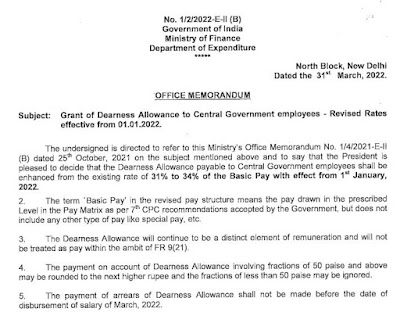
DA Jan 2022 - Grant of Dearness Allowance to Central Government employees - Revised Rates effective from 01.01.2022

 3% DA Hike - Revised Rates effective from 01.01.2022: DoE OM dated 31.03.2022 No. 1/2/2022-E-II (B) Government of India Ministry of Finance...