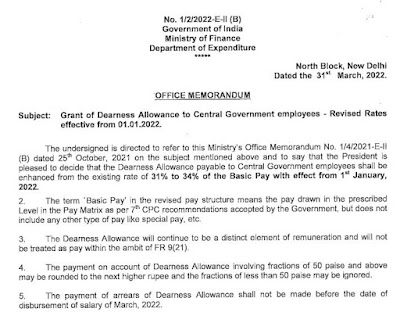
All about 7th Central Pay Commission for Central Government Employees. Dearness Allowance for Government Employees, CENTRAL GOVERNMENT EMPLOYEES NEWS - DOPT, DOPT Orders, Expected DA & more.
Family pension is payable to the unmarried/ widowed/ divorced
daughter until she gets married or remarried or until she starts earning
DEPARTMENT OF PENSION AND PENSIONERS’ WELFARE
Government Of India
Family Pension for Daughter under CCS (Pension) Rules
1. The family pension
is payable to the unmarried/ widowed/ divorced daughter until she gets
married or remarried or until she starts earning her livelihood,
whichever is earlier.
2. The family pension is payable to unmarried/ widowed/ divorced
daughter above the age of 25, after all unmarried children have attained
the 25 years of age or have started . earning their livelihood,
whichever is earlier.
3. If the deceased government servant/ pensioner has survived by any
disabled child, the widow/ divorced/ unmarried daughter will be eligible
to receive family pension only after the turn of disabled child.
4. Divorced daughter is eligible for family pension where the divorce
proceedings had been filed in a competent Court during the lifetime of
the employee/ pensioner or his/her spouse but divorce took place after
their death. In such cases, the family pension will commence from the
date of divorce.
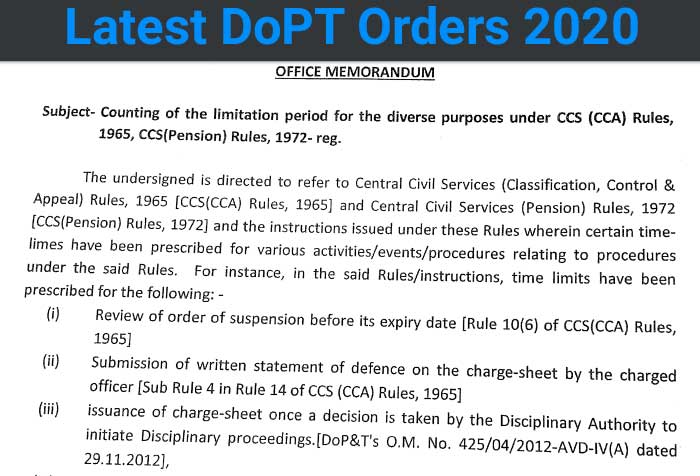
Counting of the limitation period for the diverse purposes under CCS (CCA) Rules, 1965, CCS (Pension) Rules,
1972
Latest DoPT Orders 2020
F.No.11013/9/2014-Estt.A. III
Government of India
Ministry of Personnel, Public Grievances and Pensions
(Department of Personnel
and Training)
North Block, New Delhi
Dated the 5th June, 2020
OFFICE MEMORANDUM
Subject: Counting of the limitation period for the diverse purposes under CCS (CCA) Rules, 1965, CCS (Pension) Rules, 1972
The undersigned is directed to refer to OM of even number dated 30th
March, 2020 whereby, considering the unprecedented situation of lockdown
w.e.f. 24th March, 2020, the period of lockdown was decided to be
excluded from the time-limits prescribed in various Rules/instructions.
While in the initial periods of lockdown, the Government offices were
directed to work either with skeletal staff or with 1/3rd of its
strength, DoPT’s extant instructions provide for attendance of 100%
officers of the level of DS & above and 50% below DS on all working
days. Ministry of Home Affairs vide its Order dated 30th May, 2020 has
also issued instructions for phase-wise reopening of prohibited
activities outside the containment zone. In view of this, it has now
been decided that the exclusion of lockdown period w.e.f. 24th March,
2020 shall cease to have further effect with the issue of this O.M.
Therefore, after exclusion of lockdown period, action as per time-lines
provided under various Rules/ instructions may be completed within the
period as explained in paras 2 & 3 of O.M. dated 30th March, 2020
referred above.
(Umesh Kumar Bhatia)
Deputy Secretary to the Govt. of India
The undersigned is directed to refer to Central Civil Services
(Classification, Control & Appeal) Rules, 1965 [CCS(CCA) Rules,
1965] and Central Civil Services (Pension) Rules, 1972 [CCS(Pension)
Rules, 1972] and the instructions issued under these Rules wherein
certain timelines have been prescribed for various activities/ events/ procedures relating to procedures under the said Rules,
For instance, in the said
Rules/instructions, time limits have been prescribed for the following:
Review of order of Suspension before its expiry date [Rule 10(6) of CCS(CCA) Rules, 1965]
Submission
of written statement of defence on the charge-sheet by the charged
officer ISub Rule 4 in Rule 14 of CCS (CCA) Rules, 1965]
issuance
of charge-sheet once a decision is taken by the Disciplinary Authority
to initiate Disciplinary proceedings.{DopTs 0. M. No.
425/04/2012-AVDIV(A) dated 29.11.2012],
completion of Inquiry and submission of report by the Inquiring Authority [Sub rule (24) in Rule 14 of CCS (CCA) Rules, 1965]
disciplinary
proceedings initiated against a Pensioner shall not be in respect of an
event which took place four years before such initiation,{Rule 9 of
CCS(Pension) Rules, 1972]
Acceptance of notice of VRS under Rule 48Aof CCS(Pension) Rules, 1972
(The list is only illustrative and not exhaustive)
2. Consequent upon the outbreak of COVID-19,
and considering the unprecedented situation of the Lockdown w.e.f. 24th
March 2020, it may not be feasible to adhere to the timelines
prescribed in the said Rules and to the instructions issued under the
Rules. It has accordingly been decided not to count the period of the
Lockdown for the purposes of adherence to the prescribed timelines,
including those listed above. For example, if the due date for
completing a process/work/event at the start of the Lockdown falls after
20 days, then the due date will get postponed by the number of Lockdown
days and the same number (20) of days will be available to complete the
work after the Lockdown is lifted.
3. However, after the Lockdown is lifted, if the time left to
complete the task is less than 15 days) then the processes may be
allowed to be completed within 15 days.
4. In addition, timelines may have been prescribed for receipt of
applications for direct recruitment, deputation, etc. Where the last
date of receipt of application for direct recruitment, deputation etc.
falls within the period of the Lockdown, the last date shall be extended
by the number of days of the Lockdown. Similarly, the time limits
prescribed in the CCS (Conduct) Rules, 1964, for various purposes shall
also be extended by the number of days of the Lockdown.
5. These instructions are applicable only in such cases where there
is an intervening Lockdown period and it will not be applicable
otherwise.
Relaxation of Central Civil Services (Leave) Rules, 1972, it has now been decided with the approval of
competent authority to grant Commuted Leave without production of medical certificate to those officials who
are above 50 years of age and have underlying conditions
The undersigned is directed to state that the leave sanctioning authorities were advised vide O.M. of even
number dated 17th March, 2020 to sanction leave who wish to self-quarantine, as a preventive measure. In this
regard, in relaxation of Central Civil Services CCS (Leave) Rules, 1972, it has now been decided with the approval of competent
authority to grant Commuted Leave without production of medical certificate to those officials who are above
50 years of age and have underlying conditions i.e. Diabetes, Respiratory problems, Renal diseases and other
life-threatening illness, for a period upto 4th April, 2020, so as to avoid unnecessary burden on the health
care system.
These instructions shall be applicable to Ministries / Departments / attached and subordinate offices of
Central Government. Similar instructions may be issued to Autonomous / Statutory Bodies.
sd/-
(Umesh Kumar Bhatia)
Deputy Secretary to the Government of India
Latest News on NPS: Old Pension Scheme for 2004 CG Employees
The Department of Pension and Pensioners ' Welfare released a significant order on 17 February 2020 on
extending the benefit to Central government employees whose appointment has been postponed after 31 December
2003.
Under this Order, a single right to be protected under CCS (Pension) Rules (1972) may be given to government
officers who have been deemed effective to obtain the results declared before or on 31.12.2003 against
vacancies that take place before 01.01.2004 for joints on or after 01.01.2004. The Central government
employees in question can exercise this option by 31.05.2020 at the earliest.
Latest news on NPS to OPS
Amendment in CCS (Pension) Rules 1972 - Central Government Employees
No. 57/04/2019-P&PVW/(B)
Government of India
Department of Pension and PW
Lok Nayak Bhawan, Khan Market,
New Delhi, the 17 February, 2020
OFFICE MEMORANDUM
Subject: Coverage under Central Civil Services (Pension) Rules, 1972, in place of National Pension
System, of those Central Government employees whose selection for appointment was finalized before 01.01.2004
but who joined Government service on or after 01.01.2004.
The undersigned is directed to say that consequent on introduction of National Pension System (NPS) vide Ministry of Finance (Department of Economic Affairs)
Notification No. 5/7/2003-ECB & PR dated 22.12.2003, all Government servants appointed on or after
01.01.2004 to the posts in the Central Government service (except armed forces) are mandatorily covered under
the said scheme. The Central Civil Services (Pension) Rules, 1972 and other connected rules were also amended
vide Notification dated 30.12.2003 and, after the said amendment, those rules are not applicable to the
Government servants appointed to Government service after 31.12.2003.
2. Representations have been received in this Department from the Government servants appointed on or after
1.1.2004 requesting for the benefit of the pension scheme under Central Civil Services (Pension) Rules, 1972 on the ground that their appointment was delayed
on account of administrative reasons or lapses. Similar references have been received from
Ministries/Departments seeking advice of this Department on the question whether the Government servants who
were appointed on or after 1.1.2004 could also be extended the benefit of pension scheme under CCS (Pension)
Rules, if their appointment was delayed beyond 31.12.2003 on account of administrative reasons and the delay
in appointment was beyond the control of the said Government servants.
3. From the representations of the Central
Government employees and the references received from Ministries /Departments, it has been
observed that in many of the cases referred to this Department, selection process (including written
examination, interview and declaration of result) for recruitment had been completed before 01.01.2004 but
the employee joined the Government service on or after 01.01.2004. A few illustrations where the selection
was finalized before 01.01.2004 but actual joining took place on or after 01.01.2004 are as under:
(i) The result for recruitment was declared before 01.01.2004 but the offer of appointment and actual joining
of the Government servant was delayed on account of police verification, medical examination etc.;
(ii) Some of the candidates selected through a common selection process were issued offers of appointments
and were also appointed before 01.01.2004 whereas the offers of appointment to other selected candidates were
issued on or after 1.1.2004 due to administrative reasons/constraints including pending Court/ CAT cases.
(iii) Candidates selected before 01.01.2004 through a common competitive examination were allocated to
different Departments/ organization. While recruitment process was completed by some Department(s) /
organizations on or before 31.12.2003 in respect of one or more candidates, the offers of appointment to the
candidates allocated to the other Departments / organization were issued on or after 01.01.2004.
(iv) Offers of appointment to selected candidates were made before 01.01.2004 with a direction to join on or
after 01.01.2004.
(v) Offers of appointment were issued to selected candidates before 01.01.2004, and many/ most candidates
joined service before 01.01.2004. However, some candidate(s) were allowed extension of joining time and they
joined service on or after 01.01.2004. However, their seniority was either unaffected or was depressed in the
same batch or to a subsequent batch, the result for which subsequent batch was declared before 01.01.2004.
(vi) The result for recruitment was declared before 01.01.2004 but one or more candidates were declared
disqualified on the grounds of medical fitness or verification of character and antecedents, caste or income
certificates. Subsequently, on review, they were found fit for appointment and were issued offers of
appointment on or after 01.01.2004.
In all the above illustrative cases, since the result for recruitment was declared before 01.01.2004, denial
of the benefit of pension under CCS (Pension) Rules, 1972 to the affected Government servants is not
considered justified.
4. The matter has been examined in consultation with the Department of Personnel & Training, Department
of Expenditure and Department of Legal Affairs in the light of the various representations/references and
decisions of the Courts in this regard. It has been decided that in all cases where the results for
recruitment were declared before 01.01.2004 against vacancies occurring on or before 31.12.2003, the
candidates declared successful for recruitment shall be eligible for coverage under the CCS (Pension) Rules, 1972. Accordingly, such Government servants who were declared
successful for recruitment in the results declared on or before 31.12.2003 against vacancies occurring before
01.01.2004 and are covered under the National Pension System on joining service on or after 01.01.2004, may
be given a one-time option to be covered under the CCS(Pension) Rules, 1972. This option may
be exercised by the concerned Government servants latest by 31.05.2020.
5. Those Government servants who are eligible to exercise option in accordance with para-4 above, but who do
not exercise this option by the stipulated date, shall continue to be covered by the National Pension system
(NPS).
6. The option once exercised shall be final.
7. It is clarified, that the above option would be available to only those Government servants who were
declared successful for recruitment before 01.01.2004, against vacancies pertaining to the period prior to
that date. This option shall, however, not be available to the Government servants appointed on or after
01.01.2004 if they fall in any of the following categories:
(i) Government servants whose names were included in a panel of selected candidates before 01.01.2004 for
recruitment against vacancies occurring on or after 01.01.2004 and were, accordingly, recruited on or after
01.01.2004.
(ii) A Government servant whose name was included in a panel of selected candidates prepared before
01.01.2004 for vacancies arising before and after 01.01.2004 but was actually appointed after 31.12.2003
against a vacancy arising on or after 01.01.2004.
(iii) Government servants who were selected against vacancies pertaining to the period prior to 01.01.2004 on
the basis of an advertisement / notification issued before 01.01.2004 or a written examination / interview
held before 01.01.2004 but results for recruitment were declared on or after 01.01.2004.
(iv) Government servants who joined on or after 01.01.2004 after they were granted extension of joining time
on their own request and, in accordance with the instructions issued by the Department of Personnel &
Training, their seniority was depressed on account of such extension of joining time to a batch for which the
result for recruitment was declared on or after 01.01.2004.
8. The matter regarding coverage under the CCS (Pension) Rules, 1972 based on the option exercised by the
Government servant shall be placed before the appointing authority for consideration in accordance with these
instructions. In case the Government servant fulfils the conditions for coverage under the CCS (Pension)
Rules, 1972, in accordance with these instructions, necessary order in this regard shall be issued latest by
30 September, 2020. The NPS account of such Government servants shall, consequently, be
closed w.e.f. 01st November, 2020.
9. The Government servants who exercise option to switch over to the pension scheme under CCS (Pension)
Rules, 1972, shall be required to subscribe to the General Provident Fund (GPF). Regarding accountal of the
corpus in the NPS account of the Government servant, Controller General of Accounts (CGA) has furnished the
following clarification vide letter No. 1(7)(2)/2010/cla./TA III/390 dated 14.11.2019:
i. Adjustment of Employees’ contribution in Accounts: Amount may be credited to individual’s
GPF account and the account may be recasted permitting up-to-date interest (Authority-FR-16 &Rule 11 of
GPF Rules).
ii. Adjustment of Government contribution under NPS in Accounts: To be accounted for as (-)
Dr. to object head 70 – Deduct Recoveries under Major Head 2071 - Pension and other Retirement benefit –
Minor Head 911- Deduct Recoveries of overpayment (GAR 35 and para 3.10 of List of Major and Minor Heads of
Accounts).
iii. Adjustment of increased value of subscription on account of appreciation of investments
- May be accounted for by crediting the amount to Govt. account under M.H. 0071- Contribution towards Pension
and Other Retirements Benefits 800- Other Receipts ( Note under the above Head in LMMHA).
10. All Ministries / Departments are requested to give wide publicity to these orders. The
cases of those Government servants who fulfil the conditions mentioned in this O.M. and who exercise option
to switch over to the pension scheme under CCS (Pension) Rules may be settled by the administrative
Ministries / Departments in accordance with these orders.
11. These orders issue with the concurrence of Ministry of Finance, Department of Expenditure, vide their
I.D. Note No. 1(7) EV/2019 dated 08.01.2020.
12. In their application to the employees of Indian Audit and Accounts Department, these orders are issued
after consultation with Comptroller and Auditor General of India, as mandated under Article 148(5) of the
Constitution.
13. Hindi version will follow.
(Ruchir Mittal)
Deputy Secretary to the Government of India
Official Gazette Notification - Ex-servicemen Amendment Rules 2020
MINISTRY OF PERSONNEL, PUBLIC GRIEVANCES AND PENSIONS (Department of Personnel and Training)
NOTIFICATION
New Delhi, the 13th February, 2020
G.S.R. 116(E).- In exercise of the powers conferred by the proviso to article 309 of the
Constitution, the President hereby makes the following rules further to amend the Ex-servicemen (Re-
employment in Central Civil Services and Posts) Rules, 1979, namely:-
1. Short title and commencement : -
(1) These rules may be called the Ex-servicemen (Re-employment in Central Civil Services and Posts) Amendment Rules,
2020.
(2) They shall come into force on the date of its publication in the Official Gazette.
2. In the Ex-servicemen (Re-employment in Central Civil Services and Posts) Rules, 1979, in rule 2, in clause (c) in sub-clause
(ii), the following proviso shall be inserted, namely:-
“Provided that Short Service Commissioned Officers released from service after completing initial terms of
engagement otherwise than by way of dismissal or discharge on account of misconduct or
inefficiency and have been given gratuity shall be eligible to the status of Ex-servicemen;”
F. No. 36034/1/2019-Estt.(Res)]
SUJATACHATURVEDI, Addl. Secy.
Note: The Principal rules were published in the Gazette of India, Part II,
Section 3, Sub-section (ii), vide G.S.R.1530, dated the 15th December, 1979 and subsequently amended as
follows:-
7th CPC Date of next increment under Rule 10 of Central Civil Services Revised Pay Rules 2016
No. 4-21/2017-IC/E.IIIA
Government of India
Ministry of Finance Department of Expenditure
North Block, New Delhi-110001
Dated the 28th November, 2019
OFFICE MEMORANDUM
Subject: Date of next increment under Rule 10 of Central Civil Services (Revised Pay) Rules, 2016 - Clarifications - regarding.
The undersigned is directed to invite the attention to Rule 10 of the CCS (RP) Rules, 2016 which provides for the entitlement of employees for drawal of annual increment either on 1st January or 1st July depending on the date of appointment, promotion or grant of financial upgrdation. The Sub-Rule (2) thereof provides that increment in respect of an employee appointed or promoted or granted financial up-gradation including up-gradation under Modified Assured Carrier Progression Scheme (MACPS) during the period between the 2nd day of January and 1stday of July (both inclusive) shall be granted on 1st day of January and the increment in respect of an employee appointed or promoted or granted financial up-gradation under MACPS during the period between the 2nd day of July and 1st day of January (both inclusive) shall be granted on 1st day of July.
2. A number of references were received in the Ministry of Finance seeking clarifications regarding drawal of next increment by the employees promoted on 1st July, 2016. On consideration of the matter, Department of Expenditure vide it’s Office Memorandum of even number dated 31.07.2018 has clarified that in case an employee is promoted or granted financial up-gradation including up-gradation under the MACP scheme on 1st January or 1st July, where the pay is fixed in the Level applicable to the post on which promotion is made in accordance with the Rule 13 of the CCS (RP) Rules, 2016, the first increment in the Level applicable to the post on which promotion is made shall accrue on the following 1st July or 1st January, as the case may be, provided a period of 6 months qualifying service is strictly fulfilled. The next increment thereafter shall, however, accrue only after completion of one year.
3. Consequent upon issue of Office Memorandum dated 31.07.2018 different Ministries/ Departments have sought clarification on applicability of DOE's O.M dated 31.07.2018 keeping in view the provisions of Rule 10 of CCS (RP) Rules 2016 , Rule 22(I)(a)(1) of Fundamental Rules & provisions of Stepping up of pay. The issues on which various Ministries / Departments have sought clarifications and decisions thereon are brought in the succeeding paragraphs.
Issue No. 1: Whether after promotion on 1st July and fixation of pay with two increments the date of next increment will be 1st January or 1st July
4. During the regime of 6th CPC, when the annual increment was admissible uniformly on 1st July every year, employees completing 6 months and above in the revised pay structure as on 1st July were eligible for grant of increment. In the 7th CPC regime there are two dates of increments pt January and 1st July. Keeping in view the spirit of 6th CPC, O.M dated 31.07.2018 was issued providing for accrual of next increment on 1st July/1st January in respect of employees getting promotion on , 1st January/ 1st July provided 6 months qualifying service is strictly fulfilled.
5. The instructions contained in the O.M. dated 31.07.2018 are self-explanatory in respect of the cases of promotion/ financial up-gradation falling on 1st July or 1st January. These instructions provide that in case of promotion/ financial up gradation on 1st July and 1st January and getting fixation of pay in the Level applicable to the post in which promotion is made in accordance with Rule 13 of the CCS (RP) Rules 2016, the first increment in the level in which promotion is made shall accrue on the following 1st January or 1st July, as the case may be, provided a period of 6 months’ qualifying service is fulfilled.
Issue No.2 : Accrual of next increment in case of regular promotion / financial up gradation of an employee on any date other than the date of annual increment and option for pay fixation is exercised under FR 22(I)(a)(1).
The opportunity to exercise of option for pay fixation under FR 22(I)(a)(1) is available to employees in case of promotion / financial up-gradation. Therefore, the Central Government Employee promoted on regular basis/granted financial up gradation on any date other than the date of his/ her annual increment in lower grade and exercises the option under FR 22(I)(a)(1) read with Department of Personnel & Training’s OM No.13/02/2017-Estt.(Pay-I) dated 27.07.2017 for fixation of pay from the date of accrual of next increment in the scale of pay in lower grade, he may be allowed the 1st increment in promotional grade on 1st January/ 1st July as the case may be after completion of 6 months’ qualifying service after such fixation on 1st July/ 1st January (i.e., the date of increment in lower grade) on the analogy of Department of Expenditure’s OM dated 31.07.2018. The next increment, thereafter, shall however, accrue only after completion of one year.
Since there is material change, it has also been approved that the employees who have been regularly promoted or granted financial up-gradation on or after 01.01.2016 and desire to exercise/ re-exercise option for pay fixation under FR22(I)(a) (l) shall be given an opportunity to exercise or re-exercise of the option there under. Such an option shall be exercised within one month of issue of this O.M.
These instructions will be applicable with effect from 01.01.2016.
In so far as persons serving in the Indian Audit and Accounts Department are concerned, these orders issue after consultation with the Comptroller and Auditor General of India.
Hindi version of these orders is attached.
(B.K.Manthan)
Deputy Secretary to the Government of India
Performance Appraisal Report draft circular of Central Civil Services Rules, 2019
DoPT Orders 2019
No.21011/01/2017-Estt.A-1I
Government of India
Ministry of Personnel, Public Grievances and Pensions
Department of Personnel & Training
North Block, New Delhi
Dated 27th September 2019
OFFICE MEMORANDUM
Subject: Circulation of draft Central Civil Services (Performance Appraisal Report) Rules, 2019 - seeking comments
of Ministries/Department.
The undersigned is directed to say that Annual Performance Assessment Report (APAR) of Government servants
holding Group 'A', Group 'B' and Group 'C' posts of Central Civil Services are at present being governed by
instructions/guidelines issued by this Department from time to time.
2. With a view to consolidate the instructions, draft Central Civil Services (Performance Appraisal Report) Rules, 2019
have been prepared and enclosed. Comments/ suggestions/ modifications on the draft Rules, if any, may be furnished to the
undersigned within two weeks from the date of issue of the O.M. at the e-mail address jayashree.c@nic.in.
(Jayashree Chellamani)
Under Secretary to the Govt. of India
Tel: 23040468
Email: jayashree.c@nic.in
Ministry of Personnel, Public Grievances and Pensions Department of Personnel and Training
DRAFT
CENTRAL CIVIL SERVICES (PERFORMANCE APPRAISAL REPORT) RULES, 2019
In exercise of the powers conferred under Article 309 and clause (5) of Article 148 of the Constitution of India and after
consultation with the Comptroller and Auditor-General in relation to persons serving in the Indian Audit and Accounts
Department, the President of India hereby makes the following rules, namely: -
1. Short title and commencement - (1) These rules may be called the Central Civil Services (Performance
Appraisal Report) Rules, 2019, in short CCS (PAR) Rules, 2019.
(2) They shall come into force on the date of their
publication in the Official Gazette.
2. Application:-
(1) These rules shall be applicable to all Government servants holding Group 'A', Group'B' and Group 'C' posts of Central
Civil Services in Ministries/Departments (including attached and subordinate offices), civilian Government servants in the
Defence Services and to officers appointed against a civil post on contract basis, but shall not apply to:
(a) any railway servant,
(b) any officer of the All India Services,
(c) any person in casual employment,
(d) any person for whom special provision is made, in respect of all or any matters covered by these rules, by or under any
law for the time being in force or by or under any agreement entered into.
(2) Notwithstanding anything contained in sub-rule (1), the President may by an order exclude any group of Government
servants from the operation of all or any of these rules.
(3) In the case of a Government servant temporarily transferred to a service or post to which these rules do not apply,
these rules shall continue to apply.
(4) If any doubt arises as to whether these rules or any of them apply to any person it shall be referred to the President
or such other authority as may be specified by the President by general or special order and the President or such other
authority shall decide the same.
3. Definitions. - In these rules, unless the context otherwise requires;-
(a) "Accepting Authority" means the authority which supervises the performance of the reviewing authority as may be
specifically empowered in this behalf by the Government;
(b) "Annual Confidential Report (ACR)" means Performance
Appraisal Report recorded prior to the reporting year 2008-09.
(c) "Cadre Controlling Authority (CCA)", in relation
to a service has the same meaning as in the rules regulating that Service;
(d) "Central Civil Services" means all
Central Civil Services including General Central Services but excluding All India Services;
(e) "Competent Authority"
means authority referred to in Rule 14(7)(a) and Rule 14(8)(a) of these Rules to decide the representation of officers
reported upon against PAR disclosed to him/her;
(f) "Custodian" means the Unit/Section responsible for generation,
disclosure and overall maintenance of PAR/Dossier.
(g) "Dossier" means the compilation of the PARs and ACRs written
on an officer of the Service, referred to in rule 4, and includes such other documents as may be specified by the Central
Government, by general or special order, in this behalf;
(h) "Empanelment" means the process of assessing the
suitability for appointment at the level of Joint Secretary and above as well as equivalent posts in the Government of
India;
(i) "Government" means,
(i) in case of a Government servant on deputation to a State Government or who
is deputed for service in any company, association or body of individuals whether incorporated or not, which is wholly or
substantially owned or controlled by the Government of a State, or in a local authority set up by an Act of the Legislature
of a State, the Government of that State;
(ii) in any other case, the Central Government.
(j) "Government servant" means any person appointed by Government to any civil service or post in connection with the
affairs of the Union and includes a civilian in a Defence Service; Explanation- A Government servant whose services are placed at the disposal of a company, corporation,
organisation or a local authority by the Government shall, for the purpose of these rules, be deemed to be a Government
servant serving under the Government notwithstanding that his salary is drawn from sources other than the Consolidated Fund
of India;
(k) "Officer Reported Upon" means officer of Central Civil Services whose performance is assessed through PAR;
(l) "Performance Appraisal Report" means the PAR for the financial year (April to March or a part thereof) and referred to
in the rules;
(m) "Report" means PAR;
(n) "Reporting Authority" means such authority supervising the performance
of the Officer Reported Upon, as may be specifically empowered in this behalf by the Government Provided that where the
Officer Reported Upon is a Group 'C' officer, the Reporting Officer shall be an officer holding a post not below Level-6 in
Pay Matrix in ih Central Pay Commission.
(o) "Reviewing Authority" means such authority supervising the performance of
the reporting authority, as may be specifically empowered in this behalf by the Government;
(p) "Schedule" means the
Schedules annexed to these rules;
(q) "State" means a State specified in the First Schedule to the Constitution and
includes a Union Territory;
(r) "State Government" means the Government of the State where the officer reported upon
is working in connection with affairs of the State.
4. Maintenance and custody of PAR.-(1) A comprehensive dossier shall be maintained for each Government
servant by the Central Government in the manner specified under these rules and the dossier shall consist of the documents
specified in Schedule- 1.
(2) Time schedule for recording and maintaining of PAR shall be as provided in Schedule-2 Appendix-II and as may be
specified by the Government from time to time. Provided that if a report for a financial year is not recorded by 31 st
December of the year in which the financial year ended, no remarks may be recorded thereafter and the officer may be
assessed on the basis of the overall record and self-appraisal for the year, if he has submitted his self-appraisal within
the scheduled time.
(3) (a) The Dossier of a Government servant shall be retained for a period of two years from the date of superannuation,
retirement, resignation or death. After a period of retention of the dossier for two years but before weeding out, if a
specific written request is received from the concerned retired officer, a copy of the dossier may be provided to him. Such
Dossier before being weeded out shall be retained in electronic form such as PDF format etc.
(b) Pending finalisation of disciplinary proceedings at the time of superannuation or retirement or resignation, the period
of two years shall count from the date of issue of final orders in the disciplinary proceedings;
(c) Where at the time of superannuation or retirement or resignation, a case is pending in Central Administrative Tribunal
or any Court of Law, the period of two years shall count from the date of final decision in the case or two years from the
lapse of time for filing of appeal or two years from the date of final decision on the appeal filed, if any;
5. Form of the PAR-
(1) Every CCA shall, if not already done, migrate to electronic generation and
recording of PAR in electronic form immediately after notification of these Rules.
Provided that in exceptional case,
prior approval of the Department of Personnel & Training may be obtained for manual generation and
recording/reviewing/acceptance of PAR.
(2) The PAR shall be generated and recorded by the officer reported upon
electronically in such form as specified in Appendix-I-A, 1-8 and I-C of Schedule Provided that the Central Government may
make such additions in the form or modify the cut-off dates so specified, as may be considered necessary.
(3) In case
of Government servants on deputation, the format of the parent cadre shall prevail for recording of PAR.
(4) The
comments of the reporting, reviewing and accepting authority, in case he is a Government servant, shall be recorded
electronically, as per guidelines issued from time to time for filling the report.
(5) The political executives may
record their comments manually and the PAR so recorded shall be uploaded electronically as per time frame specified in
Appendix-II of Schedule 2.
(6) Accepting Authority is to be an additional level in the channel of recording of PAR in
respect of Group 'A' posts (DS/ Director or equivalent level and above).
(7) The PAR shall be written for such
Government servants who may be on study leave or training in such form as is specified in the Appendix-III / Appendix-IV of
Schedule 2.
6. Reporting of PAR.-
(1) The PAR shall be generated by Custodian and written by the officer
reported upon electronically.
(2) The reporting authority shall record his remarks on the report, within the timeframe specified in the Appendix-II of
Schedule 2. Provided that a report may not be written in such cases as may be specified by the Central Government, by
general or special order;
(3) Where more than one report is written for an officer reported upon during the course of a financial year, each such
report shall indicate the period to which it pertains: Provided that only one report shall be written on a Government
servant for a particular period during the course of the financial year and there shall be a single reporting, reviewing
and accepting authority at each level of appraisal which shall be specified, in the channel for writing PAR, by the
Government.Provided further that if more than one person of the same superior level supervises the performance of the
Government servant, the administrative Ministry/ Department shall identify the reporting officer / reviewing officer /
accepting authority, as the case may be, who has/have supervised substantial work of the officer reported upon, during the
period of report, well in advance of the relevant appraisal year.
Provided, further, that if the officer reported upon occupies more than one post, the Government shall identify the post
(substantive or additional charge) to report, review and accept, well in advance of the relevant assessment year.
(4) Where the reporting authority has not supervised the performance of a Government servant for a minimum period of three
months, but the reviewing authority has supervised the performance of Government servant for a minimum period of three
months during the period for which report is to be written, the reviewing authority shall write the report of any such
officer for any such period.
(5) Where, both the reporting authority and the reviewing authority have not supervised the performance of the Government
servant for a minimum period of three months and the accepting authority, if any, has supervised the performance for a
minimum period of three months, the accepting authority shall write the report of such officer for such period.
(6) Where the officer reported upon has not worked under a Reporting Officer, a Reviewing Officer and an Accepting
Authority, for a minimum period of three months, he shall mandatorily submit a self-appraisal and thereafter the Custodian
shall place 'No Report Certificate (NRC)' in the dossier for such period;
(7) Where the officer reported upon has been sanctioned leave (all kinds of leave as are admissible under rules governing
leave) for a period of more than 15 days at a stretch, the period of leave so sanctioned shall be deducted from the total
period spent on the post, for the purpose of computing the minimum period of three months required for recording, reviewing
and acceptance of Report.
(8) A PAR shall also be written when either the officer reported upon or the reporting authority, who is a government
servant, relinquishes charge of the post on transfer/deputation etc., and, in such a case, the report shall be written
within the time frame as specified in Appendix-II of Schedule 2 of the Rules for completion of PAR.
7. Review of the PAR-
(1) The reviewing authority shall record his remarks on the report, within the timeframe specified in the Appendix-II of
Schedule 2.
(2) Where the report is written by the reviewing authority under sub-rule (4) of rule 6, or where the reviewing authority
has not supervised the work for a minimum period of three months, and the Accepting authority, if any, has supervised the
performance of the Government servant for a minimum period of three months during the period for which the report is
written, the accepting authority shall review the report of any such officer for such period within the time frame
specified in the Appendix-II of Schedule-2.
(3) It shall not be competent for the reviewing authority, or the accepting authority, to review any such report unless the
performance of the Government servant has been supervised by such authority for a minimum period of three months during the
period for which the report has been written.
Provided further that where for a reporting period more than one
officer has supervised the work as reviewing authority, the Reviewing Authority, who has last supervised the work of the
officer reported upon for a minimum period of three months during the relevant period of the report may review the entire
report but the assessment may be limited to the work for the period he has supervised.
(4) Where the officer reported upon has not worked under a Reviewing Authority, if any, for a minimum period of three
months and there is no provision of accepting the report by an accepting authority, a 'No Review Certificate" (NRC) stating
that the work of the officer reported upon has not been supervised by any officer in the capacity of a Reviewing Officer
during the period, may be placed in the Dossier;
8. Acceptance of the PAR -
(1) The accepting authority, if any, shall within the timeframe specified in Appendix-II of Schedule 2, record his remarks
on the PAR and may accept it, with such modifications as may be considered necessary, and countersign the report:Provided
that where the accepting authority has not seen the performance of the Government servant for a minimum period of three
months during the period for which the report has been written, it shall not be necessary for the accepting authority to
accept any such report and an entry to this effect in the form of a 'No Acceptance Certificate' shall be made in the
PAR.
Provided further that where for a reporting period more than one officer has supervised the work as accepting authority,
the Accepting Authority, who has last supervised the work of the officer reported upon for a minimum period of three months
during the relevant period of the report may accept the entire report but the assessment may be limited to the work for the
period he has supervised.
(2) Notwithstanding anything contained in rule 6 or rule 7, where the accepting authority writes or reviews the PAR of a
Government servant, it shall not be necessary to review or accept any such report.
9. Restriction on reporting, reviewing and accepting authorities in certain cases:
Not with standing anything contained in rules 6, 7 and 8, it shall not be competent for the reporting authority, the
reviewing authority or the accepting authority to write a report -
(a) Where the reporting authority is a Government servant, who has retired, superannuated or resigned the post, after one
month of such retirement, superannuation or resignation;
(b) In other cases, after one month of the date on which he demits office.
Explanation. - F or the purpose of this
rule-
(a) "a Minister" shall not be deemed as having demitted the office if he continues to be a Minister in the Council of
Ministers with a different portfolio or in the Council of Ministers immediately reconstituted after the previous Council of
Ministers of which he was a Minister with the same or a different portfolio, provided the Prime Minister continues in
office.
(b) "a Minister" shall be deemed to have demitted the office where pursuant to fresh elections, a new
Council of Ministers has been reconstituted, even if the Minister who was in the earlier Council of Ministers, finds a
place in the new Council of Ministers with the same or different portfolio.
10. Recording of entries within prescribed time limits:- Where the officer reported upon fails to submit
his self-appraisal within the prescribed time, the reporting authority shall record remarks without self-appraisal. A
certificate to the effect that self-appraisal was not submitted by the officer reported upon within the prescribed time,
shall be placed along with the report by the Custodian. In case the remarks are not recorded by the Reporting Authority
within the stipulated time, he shall forfeit his right to enter any remark in the Report. Similarly, the Reviewing
Authority and the Accepting Authority shall also forfeit their right to record any remark in the Report beyond the
prescribed time-limit.
Provided if the officer reported upon has submitted the self-appraisal within prescribed time, the report containing the
self-appraisal, together with a certificate to the effect that the Reporting/Reviewing/Accepting authority, as the case may
be, has/have not recorded the remarks within the prescribed time limit shall be placed in the dossier and the officer may
be assessed on the basis of the overall record and self-appraisal for the year, if he has submitted self-appraisal on time.
11. Recording of entries relating to integrity of the officer reported upon: - The reporting, reviewing
and accepting authority while recording the entries regarding integrity of officer reported upon shall keep in view the
guidelines for filling up integrity column, issued from time to time.
12. Treating the PAR as non-est.-The PAR not recorded in terms of the provisions of these Rules and
instructions issued there under shall be treated as non-est.
13. Communication of the PAR to the Central Government. - The report shall be obtained by the CCA if the
Government servant is serving in connection with the affairs of the State or local body or autonomous body or public sector
enterprise on deputation, shortterm contract or any other kind of attachment:
Provided that if the PAR is written in a language other than Hindi or English, it shall be accompanied by an authentic
certified translation in Hindi or English.
14. Disclosure of PAR to the officer reported upon and procedure for representation -
(1) After
finalization, the full report including the overall grading and appraisal of integrity shall be disclosed electronically to
the officer reported upon by the Custodian within the time limit prescribed in Appendix-II of Schedule 2, to enable him to
submit his representation, if any.
Provided that where a Government servant has only one supervisory level above him, as in the case of personal staff
attached to officers, such disclosure shall be made after the reporting authority has recorded his remarks, within the time
limit prescribed in Appendix-II of Schedule 2.
(2) The officer reported upon, on disclosure of the report, shall have the opportunity to give representation, if any, to
the competent authority through the Custodian, within fifteen days of the receipt of the Report.
Provided further
that no representation shall be accepted from the officer reported upon if such representation is not within the
stipulated time of fifteen days, except where the officer reported upon is rendered immobilized on medical grounds.
(3) The representation, if any, shall be restricted to the specific factual observations contained in the Report leading to
the appraisal of the officer in terms of attributes, work output and competency and grading.
(4) The competent authority to decide the representation received in terms of sub-rule (1) & (2) above, relating to
overall grading or entry/entries in the PAR, shall within fifteen days of the receipt of the representation, forward or
cause to be forwarded the same, to the Accepting, Reviewing and Reporting authorities and call for their comments on the
representation.
(5) The reporting authority shall, within fifteen days of receipt of the representation, forward the representation, along
with his comments to the reviewing authority. The Reviewing authority shall forward the representation along with views of
the reporting authority and his comments to the accepting authority within fifteen days of receipt of the views of the
reporting authority. The accepting authority shall forward the representation along with the comments of the reporting and
reviewing authority and his comments to the competent authority, within 15 days of the receipt of the comments of the
reviewing authority.
(6) The competent authority shall, after obtaining the comments of the Reporting/Reviewing/Accepting authority within the
time limit mentioned in Appendix-II of Schedule 2, including from those who have retired or demitted/ relinquished office
as the case may be, finalise his decision within a period of 30 days as under:-
In the case of representation against overall grading, the said authority may upgrade or downgrade or make no change
in the grading already given and while doing so, shall record sufficient reasons for doing the same.
In the case of representation against entries/remarks, the said authority shall after examination, expunge, modify or
retain the entries/remarks, without altering the overall grading. The authority, while expunging or modifying or retaining
the adverse remarks, shall give reasoned order for doing so, failing which the order shall be treated as invalid and the
report shall be treated as non-est.
In cases involving representation against both overall grading and entries, the said authority shall clearly bring out
the reasons for any upgradation, downgradation or retention of overall grading and also expunction or modification or
retention of entries/ remarks and shall give a reasoned order for doing so, failing which the order shall be treated as
invalid and the report shall be treated as non-est;
The decision of the said authority shall be communicated to the officer reported upon by the Custodian in the form of
reasoned order, within a period of 15 days of the decision.
(7) Authority competent to decide representations where competent authority is below Minister:
The competent authority to decide the representation will be one level higher than the Accepting Authority. Where there
is no Accepting Authority, it shall be one level higher than the Reviewing Authority. Provided that where there are no
Reviewing/Accepting authorities, the authority to decide the representation shall be one level higher than the Reporting
Authority. The competent authority shall forward the representation to the Reporting Authority, Reviewing Authority and the
Accepting Authority, as the case may be, and call for their comments. The comments of the reporting/reviewing/accepting
authority (as the case may be) are required to be sought even if they have superannuated/retired/resigned or demitted
office. In case the comments of reporting / reviewing /accepting authority are not received within the time limit mentioned
in Appendix-II of Schedule 2, it shall be presumed that reporting /reviewing /accepting authority has no comments to
offer.
The competent authority shall consider the representation of the officer reported upon, the comments of the reporting
authority, reviewing authority and the accepting authority and shall finalise the decision within a period of 30 days.
The decision shall be communicated in the form of reasoned order to the officer reported upon by the Custodian within a
period of 15 days of the decision.
(8) Authority competent to decide representations -where competent authority is 'Minister'
(a) where the reporting or reviewing or accepting authority, is a Minister, the competent authority to decide the
representation against any entry/remark as well as the overall grading in the report will be the current Minister. Before
deciding the representation, comments of the Reporting/Reviewing/Accepting Authority shall be obtained, by the Custodian.
The comments of the reporting/reviewing/accepting authority (as the case may be) are required to be sought even if they
have superannuated/retired/resigned or demitted office. In case the comments of reporting / reviewing /accepting authority
are not received within the time limit mentioned in Appendix-II of Schedule 2, it shall be presumed that
reporting/reviewing/accepting authority has no comments to offer.
b) The competent authority shall consider the representation of the officer reported upon, the comments of the reporting
authority, reviewing authority and the accepting authority, if any, and may decide to expunge, modify or retain the remarks
and upgrade, downgrade or retain the overall grading. The competent authority shall finalise the decision within a period
of 30 days from the date of receipt of the representation.
(c) The decision shall be communicated to the officer reported upon through a reasoned order,by Custodian, within a period
of 15 days of the decision.
15. Memorial
If the officer reported upon is not satisfied with the decision on his representation,
he may submit a Memorial to the President within a period of ninety days of the receipt of the decision:
(i) Where
the representation has been decided by an authority below Minister-in-charge of the Ministry/Department where the officer
reported upon worked during the period of report - Memorial shall be decided by Minister-in-Charge;
(ii) Where the
representation has been decided by Minister-in-Charge, the memorial shall be decided by the Minister-in-Charge on the
recommendation of a Committee. The Committee shall be constituted by the Secretary of the Cadre Controlling Authority to
which the officer belongs, and any two other Secretaries who may be nominated by the Minister in charge. The Secretary of
the Cadre Controlling Authority to which the officer belongs shall be the Convenor Member of the Committee.
16. Recording of report in case of suspension
Report shall not be recorded for the period an officer
is under suspension.
17. Applicability of rules and orders- Matters in respect of which no express provision has been made in
these rules shall be determined by rules and orders issued by the Government from time to time.
18. Savings clause: Save as otherwise provided, the provisions of these rules shall not affect
prejudicially anything done or omitted to be done in terms of various instructions issued from time to time prior to the
notification of these rules. Provided that in respect of matters not covered by these rules, the instructions and orders
issued by the Department of Personnel & Training prior to notification of the rules, shall stand.
19. General. -
The Central Government may issue instructions, not inconsistent with the provisions of these rules, or as it may consider
necessary, with regard to the writing of the PARs, the maintenance of dossier and the effect of the PARs on the conditions
of service of a Government servant.
Gazette Notification - Central Civil Services CCS (Pension) Second Amendment Rules, 2019
CCS (Pension) Second Amendment Rules, 2019.
MINISTRY OF PERSONNEL, PUBLIC GRIEVANCES AND PENSIONS
(Department of Pension and Pensioners’ Welfare)
NOTIFICATION
New Delhi, the 19th September, 2019
G.S.R. 673(E). - In exercise of the powers conferred by the proviso to article 309 and clause (5) of
article 148 of the Constitution and after consultation with the Comptroller and Auditor-General of India in relation to
persons serving in the Indian Audit and Accounts Department, the President hereby makes the following rules further to
amend the Central Civil Services (Pension) Rules, 1972, namely :-
1. Short title and commencement. (1) These rules may be called the Central Civil Services (Pension) Second
Amendment Rules, 2019.
(2) They shall come into force from 1st day of October, 2019
2. In the Central Civil Services (Pension) Rules, 1972,-
(i) in rule 54,
(a) in sub-rule (3), -
(A) in clause (a), in sub–clause (i), the words “after having rendered not less than seven years’ continuous service”
shall be omitted;
(B) in clause (b), in sub-clause (i), the words “after having rendered not less than seven years’ continuous service”
shall be omitted;
(b) after sub-rule (3), the following sub-rule shall be inserted, namely: –
“(3A) Where of a Government servant who died within ten years before the 1st day of October, 2019, without completing,
continuous service of seven years, his family shall be eligible for family pension at enhanced rates in accordance with
sub-rule (3) with effect from the 1st day of October, 2019, subject to fulfilment of other conditions for grant of family
pension.”
(ii) in rule 79, for clauses (a) and (b), the following clauses shall be substituted, namely:-
(a) For the purpose of Family Pension, 1964, if the family of the deceased Government servant has become eligible for
family pension in accordance with sub-rule (2) of rule 54, the amount of family pension and the period for which it is
payable shall be determined in accordance with sub-rule (3) of rule 54 within one month from the date of receipt of
intimation of the date of death of the Government servant.
(i) If the entire service rendered by the deceased Government servant is not capable of being verified and accepted,
the amount of death gratuity shall be provisionally determined in accordance with clause (b) of sub-rule (1) of rule 50 on
the basis of the length of qualifying service which is verified and accepted immediately preceding the date of death of the
Government servant and the amount of death gratuity, so determined shall be authorised to the beneficiaries on provisional
basis within one month from the date of receipt of intimation of date of death of the Government servant.
(ii) The final amount of the death gratuity shall be determined by the Head of Office on the acceptance and
verification of the entire spell of service by him within a period of six months from the date on which the authority for
the payment of provisional death gratuity was issued and the balance, if any, becoming payable as a result of determination
of the final amount of death gratuity shall then be authorised to the beneficiaries.”;
(iii) for Form 18, the following Form shall be substituted, namely:-
“Form 18
[See rules 78(1), 80(1), 80(3), 80 (5), 80-B (1) and 80-B (5)] Assessment and authorisation of payment of family pension and death gratuity when a Government servant dies while
in service
Filling up the post of Library & Information Officer in Level-11 of CCS(RP) Rules 2016 on Composite Method
F.No.21/07/2019-CS-I(P)
Ministry of Personnel, Public Grievances Pension
Department of Personnel & Training
(C.S.I Division)
2nd Floor, ‘A’ wing,
Lok Nayak Bhawan,
Khan Market, New Delhi
Dated 26th July, 2019
OFFICE MEMORANDUM
Subject:- Filling up the post of Library & Information Officer ( General Central Service, Group ‘A’ , Gazetted, Non-Ministerial) in Level-11 of CCS (RP) Rules 2016 in the Office of UPSC on Composite Method [ Deputation (including Short Term Contract) plus promotion basis] -reg.
The undersigned is directed to circulate herewith Vacancy Circular No. A.35021/02/2019-Admn-II dated 04.06.2019 (along-with enclosures) from Union Public Service Commission (UPSC) proposes to fill up one post of Library & Information Officer (General Central Services, Gr. A Gazetted, Non-Ministerial) in the Level 11 of CCS (RP) Rules 2016 in the Office of UPSC on deputation (including Short Term Contract) plus promotion basis.
It may be noted that cadre clearance from C.S.I Division will be required in case of Under Secretary and above level officers of CSS applying for deputation.
In case of any further clarification, applicants are requested to contact the concerned Ministries / Departments
Ministry of Personnel, Public Grievances & Pensions Rules for filing IPRs
18 JUL 2019
In terms of Rule 18 of the Central Civil Services (Conduct) Rules, 1964, Immovable Property Returns (IPRs) are required to
be submitted by all Government servants on their first appointment to any service or post and subsequently to be submitted
annually. Similar provisions are also available in All India Services (Conduct) Rules, 1968.
Department of Personnel & Training (DoPT) being the cadre controlling authority for Indian Administrative Service
(IAS), Central Secretariat Service (CSS) and Central Secretariat Stenographers Service (CSSS) maintains the data in respect
of officers belonging to these services. As per information in respect of these officers, IPRs for the year 2018, have not
been filed by 52 IAS officers of the level of Joint Secretary & above, 163 CSS officers of the level of Under Secretary
& above and 51 CSSS officers of the level of Principal Private Secretary & above.
DoPT, vide O.M. No. 104/33/2005-AVD-I dated 7.09.2011 and O.M. No. 11012/11/2007-Estt.(A) dated 27.09.2011, has prescribed
that vigilance clearance shall be denied to the officers of All India Services and Central Civil Services/ Posts for
certain purposes if they fail to submit their annual Immovable Property Returns of the previous year latest by 31st January
of the following year.
This information was provided by the Union Minister of State (Independent Charge) Development of North-Eastern Region
(DoNER), MoS PMO, Personnel, Public Grievances & Pensions, Atomic Energy and Space, Dr Jitendra Singh in written reply
to a question in Rajya Sabha today.
Strengthening of administration Periodic review of Central Government Employees under Fundamental Rule (FR) 56(j)/(l) and Rule 48 of CCS (pension) Rules, 1972
NFIR
No.25013/3/2019-Estt.A-IV
Government of India
Ministry of personnel, public Grievances & Pensions
Department of Personnel & Training
Establishment A-IV Desk
North Block, New Delhi
New Delhi, 20th June, 2019
Office MEMORANDUM
Subject: Strengthening of administration Periodic review of Central Government Employees under Fundamental Rule (FR) 56(j)/(l) and Rule 48 of CCS (pension) Rules, 1972
The undersigned is directed to refer to this Department’s O.M No.25013/1/2013-Estt.A dated 21.3.2014, OM No.25013/1/2013-Estt.A-IV dated 11.9.2015, 11.03.2016 and 10.8.2017 for periodic review of Central Government Employees for strengthening of administration under Fundamental Rule (FR) 56(j)/(l) and Rule 48 of CCS (pension) Rules, 1972.
The detailed guidelines on the above sunjeci are already in public domain at http://dopt.gov.in under Notifications -> OM & Orders -> Establishment -> Premature Retirement.
All Ministries / Departments are requested to undertake the periodic reviews in letter and spirit, including in public sector undertakings (PSUs) / Banks and Autonomous institutions, under their administrative control. Department of Public Enterprises will also compile and countercheck with all concerned Ministries / Departments.
The Ministries / Departments should ensure that the prescribed procedure like forming of opinion to retire a Government employee prematurely in public interest is strictly adhered to, and that the decision is not an arbitrary one, and is not based on collateral grounds as per the order of the Hon’ble Supreme Court in case of UOI & Col, J.N.Sinha [1571 SCR (1) 791].
All the Ministries / Departments shall furnish a report to Dop&T in the format given below by 15th day of each month starting from 15th July, 2019. Department of Public Enterprises are requested to also compile and countercheck the data with all concerned administrative Ministries / Departments in respect of PSUs before furnishing the report to DoP&T.
Number of employees to be reviewed under FR 56 (j) group-wise (A/B/C) – 1 Number of employees reviewed under FR 56 (j) group-wise (A/B/C) – 2 Number of employees reviewed and against whom FR 56 (j) invoked/ recommended group-wise (A/B/C) – 3 Number of employees retired prematurely under FR 56 (j) group-wise (A/B/C) – 4
Withdrawal of resignation of Central Government Servants Appointed after 31.12.2003 covered under the National Pension System
No.28035/2/2014- Estt.(A)
Government Of India
Ministry Of Personnel, Public Grievances and Pensions
Department Of Personnel & Training
North Block, New Delhi - 110 001
Dated: 10th June,2019
Office Memorandum
Subject: Withdrawal of resignation of Central Government Servants Appointed after 31.12.2003 covered under the National Pension System (NPS) - reg.
The undersigned is directed to say that instructions on the procedure to be followed for Resignation from Service have been provided vide Ministry of Home Affairs O.M.No.39/6/57-Ests.(A) dated 06.05.1958, Department of Personnel & Training (DoPT) O.M.No.28034/25/87-Estt (A) dated 11.02.1988, No.28034/4/94-Estt. (A) dated 31.05.1994 and No.28035/2/2007 -Estt.(A) dated 04.02.2007. Para 5 of DoPT O.M. dated 11.02.1988 referred to above, provides the procedure for withdrawal of resignation as governed by Rule 26 (4) to (6) of Central Civil Services (Pension) Rules, 1972. References are being received from Ministries/ Departments on the request for withdrawal of resignation by Government servants appointed after 31.12.2003 and for whom CCS (Pension) Rules are not applicable. The matter of withdrawal of resignation of Government servants of Central Civil Services/Posts, appointed after 31.12.2003 who are covered under the National Pension System (NPS) and for whom CCS (Pension) Rules, 1972 is not applicable has been considered in this Department and with the approval of the competent authority, it has been decided that the following guidelines/instructions may be followed while considering the request for withdrawal of resignation of the aforesaid Government Servants.
2. The appointing authority may permit a person to withdraw his resignation in the public interest on the following conditions, namely:
that the resignation was tendered by the Government Servant for some compelling reasons which did not involve any reflection on his integrity. efficiency, or conduct and the request for withdrawal of the resignation has been made as a result of a material change in the circumstances which originally compelled him to tender the resignation.
that during the period intervening between the date on which the resignation became effective and the date from which the request for withdrawal was made, the conduct of the person concerned was in no way improper;
that the period of absence from duty between the date on which the resignation became effective and the date on which the person is allowed to resume duty as a result of permission to withdraw the resignation is not more than ninety days;
that the post, which was vacated by the Government servant on the acceptance of his resignation or any other comparable post, is available.
3. Request for withdrawal of a resignation shall not be accepted by the appointing authority where a Government Servant resigns his service or post with a view to taking up an appointment in or under a private commercial company or in or under a corporation or company wholly or substantially owned or controlled by the Government or in or under a body controlled or financed by the Government.
4. when an order is passed by the appointing authority allowing a person to withdraw his resignation and to resume duty, the order shall be deemed to include the con donation of interruption in service for the purpose.
5. No withdrawal from NPS corpus shall be permissible within a period of 90 days from the date on which the resignation becomes effective. i.e the resignation is accepted by the competent authority and the Government servant is relieved of his duties. However, the aforesaid condition shall not be applicable in case of death of the government servant after the resignation becomes effective.
6. The provision for withdrawal of resignation shall not be applicable for temporary Government Servants.
7. Above guidelines/instructions will be applicable only for the Government Servants appointed on central civil service/posts after 31.12.2003 who are covered under the National Pension System (NPS) and for whom CCS (Pension) Rules,1972 is not applicable. Further, these guidelines/instructions will be applicable till the time the statutory rules regarding withdrawal of resignation for such Government Servants are notified.
8. This O.M. shall be prospective and cases already settled shall not be opened.
9. this issues in consultation with the office of comptroller and Auditor general of India.
10. It is requested to bring it to the notice of all concerned for strict compliance.
Periodic Review of Central Government Employees under FR 56(j)/(l) and Rule 48 of CCS(Pension) Rules, 1972
No.25013/3/2019-Estt.A-IV
Government of India
Ministry of Personnel, Public Grievances & pensions
Department of Personnel & Training
Establishment A-IV Desk
North Block, New Delhi
New Delhi, 20th June, 2019
OFFICE MEMORANDUM
Subject :- Strengthening of administration - Periodic review of Central Government Employees under Fundamental Rule (FR) 56(j) / (l) and Rule 48 of CCS (Pension) Rules, 1972
The undersigned is directed to refer to this Department's O.M No.25013 /1/2013- Estt.A dated 21.3.2014, OM No.25013/1/2013- Estt.A-IV dated 11.9.2015, 11.03.2016 and 10.8.2017 for periodic review of Central Government Employees for strengthening of administration under Fundamental Rule (FR) 56(j)/(I) and Rule 48 of CCS(Pension) Rules, 1972.
The detailed guidelines on the above subject are already in public domain at http://dopt.gov.in under Notifications --> OM & Orders --> Establishment ---> Premature Retirement.
All Ministries/ Departments are requested to undertake the periodic reviews in letter and spirit, including in public sector undertakings (PSUs) / Banks and Autonomous institutions, under their administrative control. Department of Public Enterprises will also compile and countercheck with all concerned Ministries/ Departments.
The Ministries/ Departments should ensure that the prescribed procedure like forming of opinion to retire a Government employee prematurely in public interest is strictly adhered to, and that the decision is not an arbitrary one, and is not based on collateral grounds as per the order of the Hon'ble Supreme Court in case of UOI & Col. J.N.Sinha [1571 SCR (1) 791].
All the Ministries/ Departments shall furnish a report to DoP&T in the format given below by 15th day of each month starting from 15th July, 2019. Department of Public Enterprises are requested to also compile and counter check the data with all concerned administrative Ministries/ Departments in respect of PSUs before furnishing the report to DoP&T.
Number of employees to be reviewed under FR 56 (j) group-wise (A/B/C) - 1
Number of employees reviewed under FR 56 (j) group-wise (A/B/C) - 2
Number of employees reviewed and against whom FR 56 (j) invoked/ recommended group-wise (A/B/C) - 3 Number of employees retired prematurely under FR 56 (j) group-wise (A/B/C) - 4
(Surya Narayan Jha)
Under secretary to the Government of India
To
The Secretaries of All Ministries/ Departments
(as per the standard list)
Rule 10 CCS(RP) Rules, 2008 - revised pay scale and one increment may be granted on 01.01.2006, and the next increment on 01.07.2006
[Part of the Minutes of the 47th Meeting of National Council (JCM) held on 13th April, 2019 issued by DoPT vide OM No. 3/1/2019-JCA dated 13.06.2019]
6.3 D/o Expenditure, M/o Finance
6.3.5 Item No.3/19/ NC-47 - Benefit of proviso to rule 10 CCS(RP) Rules, 2008
Staff Side stated that benefit of Proviso to Rule 10 CCS (RP) Rules, 2008, to those who complete 1 year service at maximum has been sought. It has been stated that there are cases when employees drawing maximum of their Pay Scale complete one year after 01.01.2006 are denied the benefit of next increment in the revised pay structure. The pay may be fixed in the revised pay scale with effect from 01.01.2006 and one increment may be granted on 01.01.2006, and the next increment on 01.07.2006.
Reply of the Official Side:
As per Rule 10 of CCS(RP) Rules, 2008, in the 6th CPC regime, a uniform date of annual increment, viz 1st July of every year has been introduced, under which employees completing six months and above in the revised pay structure as on 1st July would be eligible for increment on 01.07.2006. OM dated 4.7.2014 has also stipulated that the increment on 01.01.2006 shall also be allowed to those who had reached the maximum of the applicable pre revised pay scale more than one year before 01.01.2006, and were in receipt of stagnation increment(s), provided the revised pay was fixed on 01.01.2006.
Therefore, the proposal/demand is not in consonance with the 1st Proviso to Rule 10 and the benefit of increment on 01.01.2006 cannot be given in these cases.
This item may be treated as closed.
Previous Agenda Item of 47th NC (JCM) Meeting
Item No. 11/10/NC-46 - A-l Status to Bangalore City
Next Agenda Item of 47th NC (JCM) Meeting
Item No. 11/19/NC-47 - Insisting on non-availability certificate from the Estate officer.
Regulation of pay on imposition of a penalty under CCS (CCA) Rules, 1965
No: 1 1 01211512016-Estt A-III
Government of India
Ministry of Personnel, Public Grievances and Pensions
Department of Personnel & Training
Establishment A-III Desk
North Block, New Delhi - 110001
Dated June 18,2019
OFFICE MEMORANDUM
Subject: Regulation of pay on imposition of a penalty under CCS (CCA) Rules, 1965.
The Undersigned is directed to say that the following penalties prescribed in the Rule 11 of CCS (CCA) Rules, 1965, have a bearing on the pay of the officer:
11. Penalties
Minor Penalties -
(iii) (a) reduction to a lower stage in the time-scale of pay by one stage for a
period not exceeding three years, without cumulative effect and not adversely affecting his pension.
(iv) withholding of increments of pay;
Major Penalties -
(v) save as provided for in clause (iii) (a), reduction to a lower stage in the
time-scale of pay for a specified period, with further directions as to whether or not the Government servant will earn increments of pay during the period of such reduction and whether on the expiry of such period, the reduction will or will not have the effect of postponing the future increments of his pay
(vi) reduction to lower time-scale of pay, grade, post or service for a period to be specified in the order of penalty, which shall be a bar to the promotion of the Government servant during such specified period to the time-scale of pay, grade, post or service from which he was reduced, with direction as to whether or not, on promotion on the expiry of the said specified period -
(a) the period of reduction to time-scale of pay, grade, post or service shall operate to postpone future increments of his pay, and if so, to what extent; and
(b) the Government servant shall regain his original seniority in the higher time scale of pay , grade, post or service;
2. Vide Central Civil Services (Revised Pay) Rules,2016 notified vide notification No. GSR 721(E) dated 25.07.2016, the present system of Pay Bands and Grade Pays have been dispensed with and a new system of pay matrix as specified under Part A of Schedule of Central Civil Service (Revised Pay) Rules, 2016 have been introduced. The status of the employee so far determined by Grade pay, will now be determined by Level in the Pay Matrix. Further, as per Rule 10 (1) of the CCS (Revised Pay) Rules, 2016, there are two dates for grant of increment namely, 1st January and 1st July of every year, instead of the existing date of 1st July.
3. As per clause 3 of the Central Civil Services (Revised Pay) Rules, 2016 'Level' is defined as under:
'Level' in the Pay Matrix shall mean the Level corresponding to the existing Pay Band and Grade pay or Scale specified in Part A of the Schedule."
4. In the light of implementation of the Revised (Pay) Rules, 2016, the regulation of pay on imposition of these penalties, is discussed in the subsequent paras:
A. Reduction to a lower stage of pay by one stage {Rule 11( iii a)}
On imposition of a penalty under this Rule, the pay would be fixed at the
next upper vertical cell in the same level in the pay matrix. In other words, in case of reduction by one stage, the revised pay would be the pay drawn in the same level at the stage before the last increment.
Note: The above mentioned penalty cannot be imposed on a Government
Servant drawing pay at the minimum of the Level.
B. Withholding of increment {Rule 11(iv)}
As already noted in para 2 above, increment is granted either on 1st January or 1st July of every year, as per the eligibility. Therefore, on imposition of penalty of withholding of increment, the next increment(s) due after the date of imposition of the penalty would be withheld. In case where penalty of withholding of multiple increments is imposed, increments due on 1st January or 1st July, as the case may be, in the subsequent years would similarly be withheld. The increment would be restored at the end of the period for which the penalty is imposed. The increments will be given on notional basis without arrears and without affecting date of next increment on restoration of increment.
This also applies to cases where the penalty is imposed for part of a year.
For instance, if the penalty of withholding of one increment for six months is imposed on a Government servant in October 2017, then withholding of increment will be on following manner:
When the date of increment is 1st January ?
The increment falling due on 1.01.2018 will be withheld for a period of next six months, that is, till 30.06.2018. The increment would be released on 1.07.2018 without arrear.
When the date of increment is on 1st July ?
The increment falling due on 1 07.2018 will be withheld for a period of next six months, that is, till 31.12.2018. The increment would be released on 01.01 .2018 without arrears.
C. Reduction to a lower stage in the time-scale of pay for a specified period [Rule 11( v)]
The process of imposition of penalty of reduction by one stage under Rule 11(iii a) explained above shall be repeated for every additional stage of reduction to the lower vertical cell in the same level of pay in the Pay Matrix.
Note 1: It is not permissible to impose a penalty under this rule if the pay after imposition of the penalty would fall below the first cell of the same Level.
Note 2: Disciplinary Authority may weigh all factors before deciding upon the quantum of penalty i.e. the number of stage by which the pay is to be reduced.
D. Reduction to lower time-scale of pay under Rule 11(vi)
In the case of imposition of penalty of reduction to lower time-scale of pay, the pay of the Government servant would be reduced to the stage of pay he/she would have drawn had he/she continued in the lower post for the period of penalty. The mode of fixation of pay in this case is similar to reversing the mode of fixation of pay on promotion.
However, Disciplinary Authority has the power, in terms of FR 2g, to indicate the pay which the Government servant on whom a penalty of reduction in rank has been imposed, would draw.
It may also be noted that a Government servant cannot be reduced in rank to a post not held earlier by him in the cadre.
For example.
A direct recruit Assistant Section Officer cannot be reduced to the lower rank like SSA/JSA.
A Government servant holding any post like LDC/ Tax Assistant etc. who qualifies as Assistant Section Officer as a Direct Recruit and is later promoted as section officer cannot be reduced to the rank, which was earlier held by him before ASo (DR) but only to that of an Assistant Section Officer.
5. Some illustrations on pay fixation on the above cases are annexed
6. In so far as the personnel serving in Indian Audit and Accounts Department are concerned, these instructions are being issued after consultation with the Comptroller and Auditor General of India.
7. Hindi version will follow
(Satish Kumar)
Under Secretary to the Govt. of India
Annexure-l
ILLUSTRATIONS
Reduction to lower stage in the time-scale of Pay
Example
Level
Cell
Pay
On the date of Penalty
9
7
Rs. 63300
Reduction by 1 Stage
9
6
Rs.61500
Reduction by 2 Stage
9
5
Rs.59700
Reduction by 3 Stage
9
4
Rs. 58000
Reduction by 4 Stage
9
3
Rs. 56300
Reduction by 5 Stage
9
2
Rs.54700
Example: 2
Level
Cell
Pay
On the date of Penalty
9
3
Rs. 56300
Reduction by 1 Stage
9
2
Rs.54700
Reduction by 2 Stage
9
1
Rs. 53100
Reduction by 3 Stage
**
**
**
Reduction by 4 Stage
Reduction by 5 Stage
** In the above illustration, a penalty of reduction by more than two stages would fall below the first cell of the same Level, such a penalty therefore, would not be implementable. Therefore, while imposing the penalty of reduction to a lower stage in time-scale of pay under Rule 11 (v) of the CCS (CCA) Rules, 1965, Disciplinary Authority may weigh all factors before deciding upon the quantum of penalty, i.e. the number of stages by which the pay is to be reduced.