All about 7th Central Pay Commission for Central Government Employees. Dearness Allowance for Government Employees, CENTRAL GOVERNMENT EMPLOYEES NEWS - DOPT, DOPT Orders, Expected DA & more.
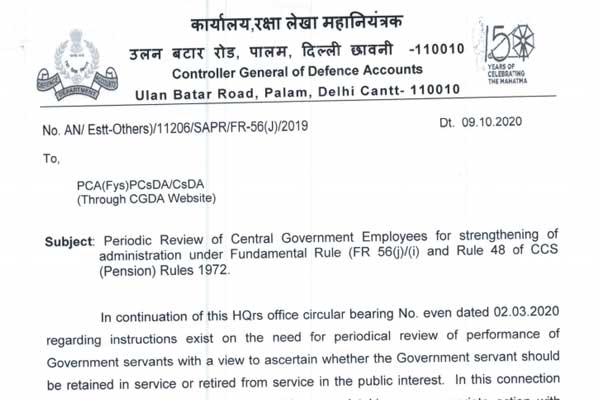
Periodic Review of Central Government Employees for strengthening of administration under Fundamental Rule (FR 56U)/(i) and Rule 48 of CCS (Pension) Rules
Controller General of Defence Accounts Ulan Batar Road, Palam, Delhi Cantt- 110010
No. AN/ Estt-Others)/11206 /SAPR/FR-56(J)/2019
Dt. 09.10.2020
To,
PCA(Fys) PCsDA/ CsDA (Through CGDA Website)
Subject: Periodic Review of Central Government Employees for strengthening of administration under Fundamental Rule (FR 56U)/(i) and Rule 48 of CCS (Pension) Rules 1972.
In continuation of this HQrs office circular bearing No. even dated 02.03.2020 regarding instructions exist on the need for periodical review of performance of Government servants with a view to ascertain whether the Government servant should be retained in service or retired from service in the public interest. In this connection relevant orders were enclosed for guidance and taking an appropriate action with reference to orders on the subject.
In this regard, a copy of DoPT letter No. 25013/03/2019-Estt .A-IV dated 28/08/2020 on the above subject is forwarded herewith for information, guidance and necessary action please.
Family pension is payable to the unmarried/ widowed/ divorced
daughter until she gets married or remarried or until she starts earning
DEPARTMENT OF PENSION AND PENSIONERS’ WELFARE
Government Of India
Family Pension for Daughter under CCS (Pension) Rules
1. The family pension
is payable to the unmarried/ widowed/ divorced daughter until she gets
married or remarried or until she starts earning her livelihood,
whichever is earlier.
2. The family pension is payable to unmarried/ widowed/ divorced
daughter above the age of 25, after all unmarried children have attained
the 25 years of age or have started . earning their livelihood,
whichever is earlier.
3. If the deceased government servant/ pensioner has survived by any
disabled child, the widow/ divorced/ unmarried daughter will be eligible
to receive family pension only after the turn of disabled child.
4. Divorced daughter is eligible for family pension where the divorce
proceedings had been filed in a competent Court during the lifetime of
the employee/ pensioner or his/her spouse but divorce took place after
their death. In such cases, the family pension will commence from the
date of divorce.
Retention in Govt.Service beyond the age of 50 years or on completion of 30 years of service
CGDA
OFFICE OF CONTROLLER GENERAL OF DEFENCE ACCOUNTS
ULAN BATAR MARG, PALAM, DELHI CANTT. -110010
No.AN/II/2604/F R-56(j)/Q.E 03/2020
Date:01.06.2020
To
All PCsDA/PCA (Fy)/CsDA/AN-4 Section (local)
(Through CGDA website)
Subject: Retention in Govt. Service beyond the age of 50
years or on completion of 30 years of service- Sr.AOQs/ AOs/AD(OL)/
Sr.PS under FR-56(j)
In terms of Para 4, Appendix of DOP&T O.M. No. 25013/1/2013-Estt.
(A) dated 21.03.2014 (copy enclosed), in order to ensure that the
powers vested in the appropriate authority are exercised fairly and
impartially and not arbitrarily, following procedure and guidelines have
been prescribed for reviewing the cases of government employees covered
under the aforesaid rules:
(1) The cases of Govt. Servants covered by FR 56(j) or FR 56
(I) or Rule 48 (1)(b) of CCS (Pension) Rules should be reviewed six
months before they attained the age of 50/55 years or complete 30 years’
service/30 years of qualifying service, whichever occurs earlier.
(ii) Committee shall be constituted in each Ministry/ Department/
Office to which all such cases shall be referred for recommendation as
to whether the officer concerned should be retained in service or
retired from service in the public interest.
2. In this connection, please refer to HQrs Office letter No.
AN/II/02604/99 dated 13.09.1999 vide which all controllers were
requested to review all cases covered under FR 56(j) at least 6 months
in advance.
3. However, it has been observed that some of the controllers are not
adhering the time line as stipulated in the aforesaid orders. It is
found that review under FR 56(j) in respect of some SAOs/AQOs who
attaining the age of 50 years between January, 2020 to June, 2020 has
not been carried out by the controller’s office.
4. It is therefore, requested to adhere strictly the time line
mentioned in the aforesaid DOP&T orders and review all such cases at
the earliest. Reviewed cases may be forwarded to HQrs office. If
already forwarded, the same may be ignored.
A handbook for retiring central government employees
Retirement guide for a central government employees
Who is Eligible for Pension?
A Central Government Employee who joined in pensionable service prior to 01/01/2004
Contributory
Provident Fund (CPF) beneficiaries in service on 01.01.1986 other than
those who chose to continue under the CPF Scheme thereafter.
Temporary employees retiring on superannuation pension/ invalidation with not less than 10 years service qualifying for pension.
An employee who is dismissed or removed from service forfeits his pension.
Resignation from service entails forfeiture of past service.
When can you get Pension?
Pension is payable on retirement after attaining the age of compulsory retirement (superannuation) or in advance of this age under certain circumstances.
Pension is also payable before the age of superannuation o
voluntary retirement after rendering 20 years of qualifying service
under Rule 48-of CCS (Pension) Rules or after attaining the age of
50/55 years under FR 56(K) subject to other conditions as laid down in
the rules.
Family pension is payable to eligible family member on the death of an employee while in service or after retirement.
Classes of Pension
Pension granted under CCS (Pension) Rules, 1972 can be:
Superannuation Pension
Retiring Pension
Invalid Pension
Compensation Pension
Compulsory Retirement Pension or Compassionate Allowance
Pension on absorption to a PSU/ Autonomous body
DOs for Retirees for timely processing of their pension papers/claims
During the service Retiree is required to ensure that
His/Her family details are kept updated
All Nominations are kept updated
Head of Office/ DDO has verified the service – no gaps in service
You are entitled to Certificate's of qualifying service on
completing 18 years of service and 5 years before retirement. This
period is not to be reopened for assessment
Leave Record is kept updated
Points to be kept in mind while filling up the forms on Bhavishya Portal
Choose your bank with caution – Please see your easy
accessibility to the nearest branch of the bank. This will be helpful as
you grow in age.
Joint account with spouse is mandatory unless
exempted by Head of Office. This is important while sanctioning of
family pension after the death of pensioner, the spouse will not face
any difficulty, as the process for switch over from pension to family
pension is much easier.
Primary account holder should be the
pensioner. If the spouse is primary account holder, the pension case
will be returned by the concerned bank.
Name of all family
members should be given to Head of office in Form 3. Married sons and
married daughters are also the part of the family and the same should be
mentioned in form 3.
Option to get Pension Payment order (PPO) through Head of office instead of Bank can be exercised.
Address of communication should be properly indicated in the Form
Mobile
number/ email should be updated in the system site. NIC/ GOV Mail
should be mentioned as alternate Email and the Email other than NIC/ GOV
should be mentioned as primary mail.
Name in the bank account
and service record should not be mismatched. For example, if the name in
the service record is Naresh Kumar Sharma, in bank account also it
should be the same (instead of writing N.K.Sharma)
Photo
uploaded /pasted by the retiree should be clear and as per the
guidelines mentioned on Bhavishya. Selfie/ blurred photographs are not
allowed.
Name and Date of Birth of family members should be
correct and matched from the service records and other supporting
documents such as educational certificate/Aadhaar Card/Driving license
etc.
The retiree should consider appropriately before applying
to avail the facility of CGHS/ FMA/ CGHS (In-door) + FMA/health facility
of previous organization as well as spouse’s health facility.
Commutation
of the pension is optional and therefore a subjective concept. The
retiree should take decision regarding the commutation of pension as per
his / her requirement.
Late submission of pension forms should
be avoided. The Bhavishya system sends message to the retiree 8 months
before the date of retirement; intimating the login id and password. The
retiree now requires filling his pension papers on Bhavishya system.
Basic Statistical Returns (BSR) Code
It is mandatory to mention BSR code of Bank branch (where pension is
desired to be credited) in the pension papers to enable CPAO to transmit
the pension to pensioner’s bank account. The BSR codes of the
respective banks are available on the website of CPAO
(https://cpao.nic.in/Ministry/BSR.php).
What is BSR code and its use?
Basic Statistical Returns (BSR) Code is a 7 digit code allotted
by Reserve Bank of India (RBI) to all the registered Banks in India. The
first 3 digits out of the 7 represent bank name whereas the remaining 4
digits codify the branch of the bank. BSR is a system to integrate the
date relating to various commercial banks and promote the filing of the
same with RBI at regular intervals. It is used in 3 particular places:-
When TDS/ TCS returns are to be filled, BSR Code is used in Challan
details and deducted details. This system is used to maintain records
of the online payments and alerts the Income Tax Department about the
payment through Banks.
BSR Codes also assist any international tax authority to track the payment made by an individual to a foreign country.
BSR codes enable the senior citizens to receive pensions also.
Although both IFSC codes and BSR codes help uniquely identify a
particular Bank Branch, they are different in 2 ways. While IFSC is an
11 digit alphanumeric code, the BSR code consists of 7 digits. An IFSC
code is used while making online money transfers through RTGS (Real-Time
Gross Settlement Systems) and NEFT (National Electronic Fund
Transfer), While BSR codes are used for filling online TDS/ TCS returns
or for easy distribution of pension among retired Government employee.
The Road Map/ Time Frame for Processing the pension cases W.R.T. all the stakeholders is as follows:-
After 18 years and 5 years before retirement: –
Certificate regarding verification of qualifying service. (Notification No. 1/19/13-P&PW (E) dated 29.8.2014)
12-15 months before retirement:-
Commencement of service verification process by Head of Office
Assessment of outstanding dues
Reference to PAO and Directorate of Estates (for NDC)
8 months before retirement:-
Certificate regarding qualifying service and emoluments along with blank Form-5 to be given to retiring employee
6 months before retirement retiring employee to give:-
Filled in Form-5 with bank account details and joint photograph
Details
of family in Form 3, unmarried sons and married daughters are also part
of family and the same should be mentioned in Form 3
Nomination forms for gratuity, GPF, CGEGIS, Commuted
Value of pension and arrears of pension (Form-A)
Undertaking for the Bank
Anubhav Form
4 months before retirement:-
Pension papers (Form 5, Form 7 and Form 8) to be forwarded by HOO to
PAO indicating Government dues to be recovered from Gratuity.
1 month before retirement:-
PPO to be sent by PAO to CPAO. CPAO to forward it with SSA to the Bank within 21 days.
Copy of PPO:-
To be given by PAO (through HOO) to retiring employee after issue of SSA by CPAO (OM No. 1/27/11-P&PW (E) dated 7.5.2012).
Claims for Gratuity, CVP, GPF, CGEIS and Leave Encashment to be processed simultaneously and paid on last day of service.
(Information that follows relates to benefits on superannuation)
What are your Retirement benefits?
Retirement Benefits comprise the following:-
Pension or family pension subject to a guaranteed minimum of Rs. 9000/- per month (since 01.01.2016).
Lump sum payment resulting from commutation of a portion of pension.
Retirement / death gratuity limited to a maximum of Rs. 20.00 lakh (since 01.01.2016).
Dearness Relief on pension/ family pension at rates prescribed with
reference to price rise (this remains suspended during employment
/re-employment under the Government)
(For a qualifying service of less than 10 years only service gratuity is payable)
How are your Pension/Retirement Benefits worked out?
For Retired Employees
Service Gratuity
You are entitled to receive only service gratuity (and not pension) if your total qualifying service is less than 10 years.
It is calculated @ 1/2 month’s emoluments for each completed six monthly period of qualifying service.
An emolument for this purpose includes DA admissible at the time of retirement.
There is no limit for minimum amount
This
is a one-time lump sum payment in lieu of pension and is distinct from
and is paid over and above the retirement gratuity referred to later in
this section.
Pension
If you retire under the rules and have qualifying service of 10
years, your pension is calculated @50% of last pay or average emoluments
(i.e. average of the basic pay drawn by you during the last 10 months
of your service), whichever is more beneficial to you.
Guaranteed
minimum pension is Rs. 9,000 (Rupees Nine thousand only) per month. In
addition, Dearness relief is also payable thereon.
Maximum limit
on pension is Rs. 1, 25,000 (Rupees one lakh twenty five thousand only)
per month. In addition, Dearness relief is also payable thereon.
Pension is payable upto and including the day of death.
Commutation of Pension
You have an option to commute a portion of pension, not exceeding 40% of it, into a lump sum payment.
You need not undergo any medical examination if you exercise this option within one year of retirement.
The
lump sum payable to you is calculated with reference to the commutation
table as provided in CCS (Commutation of Pension) Rules, 1981.
Your monthly pension will stand reduced by the portion commuted
But, your dearness relief entitlement will be calculated on the basis of the full pension (i.e. including the commuted portion)
The commuted portion of pension will be restored to you on the expiry of 15 years from the date of commutation.
In the event of death of pensioner, commuted portion is not deducted from family pension.
Retirement Gratuity
5 years of qualifying service and eligibility to receive service
gratuity/ pension is essential to get this one-time lump sum benefit.
Your
retirement gratuity is calculated at the rate of ¼ month’s emoluments
for each completed six-monthly period of qualifying service subject to a
maximum 161/2 times the monthly emoluments.
Emoluments for this purpose will include DA admissible at the time of retirement.
There is no guaranteed minimum amount.
The maximum retirement gratuity payable is 161/2 times the emoluments limited to Rs. 20.00 lakh from 01.01.2016.
Dearness Relief
Dearness Relief is sanctioned as compensation against price rise.
The quantum payable will be governed by the orders issued by the Government from time to time.
All pensioners, irrespective of the amount of their pension, are eligible for this benefit (expect these on re-employment).
There is no ceiling in regard to the total of pension plus dearness relief which a pensioner can receive.
For Families
Death Gratuity
Widow/Widower or the nominee of an employee, dying while in service is entitled to receive Death Gratuity.
There is no requirement of completing any minimum length of qualifying service by the decreased employee for this purpose.
Entitlement is regulated as under:
Length of Qualifying Service
Rate of Death Gratuity
Less than 1 year
2 times of emoluments*
One year or more but less than 5 years
6 times of emoluments*
5 years or more but less than 11 years
12 times of emoluments*
11 years or more but less than 20 years
20 times of emoluments*
20 years or more
Half of emoluments* for every completed six-monthly period of qualifying service subject to a maximum of 33 times.
* The total of death gratuity payable cannot exceed rupees twenty lakh
in all cases. Emoluments for this purpose include dearness allowance
admissible at the time of retirement.Family Pension
Family pension becomes payable to the Widow/Widower or an
eligible family member from the day following the date of death of the
employee either while in service or after retirement.
The
decreased employee should had either one year of continuous service or
should have been declared medically fit for government service if death
takes place before completion of one year of continuous service.
It
is normally payable only to one member of the family at a time barring
cases wherein more than one widow is left behind, twin children, etc.
The
Guaranteed minimum pension is Rs. 9,000 (Rupees Nine thousand only)
(Since 01.01.2016). In addition, Dearness relief as per prescribed rate
is also payable.
Entitlement is calculated as shown below:
Basic Pay
Amount of Monthly family pension
All levels
30% of basic pay subject to a minimum of Rs. 9000 per month since 01.01.2016
In case of a Govt. Servant who dies while in service family
pension at enhanced rate is admissible for a period of ten years from
the date following the date of death. In case of death of a pensioner,
family pension at enhanced rate would be payable for a period of seven
years or till the pensioner would have attained the age of 67 years,
whichever is earlier.
Like pension, family pension is also payable upto and including for the day of death of the recipient.
But,
family pension is payable for life to a son/ daughter who is suffering
from any disorder/ disability of mind or is physically crippled
/disabled/ thus rendering him/ her unable to earn a living. Dependent,
divorced, widow and unmarried daughter, dependent parents, dependent
disabled siblings are eligible for family pension for life subject to
fulfilment of certain conditions.
Dearness Relief
Dearness relief to family pensioners is paid at the same rate and on the same conditions as for pensioners.
Family Pension on Death/ Discharge for government employees under National Pension System (NPS)
National Pension System (NPS) was introduced for central government
civil employees w.e.f. 01.01.2004 by Ministry of Finance (Department
of Economic Affairs) vide Notification No. 5/7/2003-ECB & PR dated
22.12.2003. National Pension System is mandatory for all new recruits
joining the central government service (except armed forces) from
01.01.2004. Accordingly, the CCS (Pension) Rules, 1972 are applicable
to government servants appointed on or before 31.12.2003
However, the benefits under Old Pension Scheme were extended to the central government employees covered under NPS vide Department of Pension
and Pensioners’ Welfare O.M. No. 38/41/06 – P&PW(A) dated
05.05.2009 in the event of their death or discharge from government
service on account of invalidation/ disability.
In the case Government servant or his family avails the benefits
under the old pension scheme in accordance with DoP&PW’s O.M. dated
05.05.2009, the entire accumulated pension fund of the Government
servant under NPS would be surrendered into the Government account in
accordance with Pension Fund Regulatory and Development Authority
(Exits and Withdrawals under NPS) Regulations, 2015.
The benefits of Retirement gratuity and death gratuity have also
been extended to the central government employees covered under NPS
vide DoP&PW’s O.M. No. 7/5/2012-P&PW(F/B) dated 26.08. 2016 on
the same terms and conditions as are applicable under CCS (Pension)
Rules, 1972.
How to Claim Pension
Pension claims are processed by your Head of Office. He is also
responsible for setting the entitlements consequent to the death of an
employee in harness.
The process of sanctioning your pension
claims is required to be initiated by the Head of office 12 to 15 months
in advance of the retirement date.
Eight months prior to the
retirement date, you are to furnish certain information (e.g. joint
photo with wife / husband, family details, name of bank through which
you desire to draw your pension, etc.) to your Head of Office in Form-5.
Your
co-operation with the head of office is vital to ensure timely
settlement of your claim. Head of Office will send the pension papers to
P&AO in form 7 & 8 within 4 months prior to your date of
retirement.
Pension is sanctioned by the Accounts Officer who is
required to issue you Pension Payment Order (PPO) not later than one
month in advance of the retirement date. He will send the PPO to CPAO
who will issue SSA to designated pension paying bank within 21 days
thereafter.
If any delay is anticipated in this, the Head of Office is required to sanction provisional pension and provisional gratuity.
Normally,
family pension is also sanctioned to spouse at the same time as pension
and indicated in the PPO. Family pension is to be drawn only after the
death of the pensioner. In such cases no separate sanction for family
pension is required. The spouse has to submit an application along with
death certificate to the Bank, if he/she had a joint account with the
decreased pensioner.
For getting family pension in other cases, the decreased pensioner’s family should apply in form-14.
– To the pension disbursing authority for payment, if the name of
family pensioner and amount of family pension is already indicated in
the PPO, or
– To the Head of Office for sanction of family pension in all other cases.
Interest on delayed payment
You are entitled to receive
interest on the amount of retirement/death gratuity if its payment is
delayed due to administrative lapse beyond a period of 3 months. The
interest shall be paid at GPF rates prescribed from time to time.
How Pension is paid
The monthly pension to Central Government pensioners/ family
pensioners is paid through public sector banks and through a few
specified private banks. The Postal and Railway pensioner have also
option to draw pension through post offices.
Nomination/ Cheque Book/ Standing Instruction facilities have been extended to pensioners drawing their pension through banks.
Redress of grievances
If you have any grievance / complaint in pension matters you may
take it up with your Head of Office, the pension sanctioning authority
or the pension disbursing authority, as the case may be.
You may also approach the Integrated Grievance Cell and Call Centre of Department of Pension & Pensioners’ Welfare, 8th floor,
Janpath Bhawan, Janpath, New Delhi-110001, (Toll Free Number
1800-11-1960) which provides the platform for facilitating redress of
the grievances of pensioners. You can also lodge your grievance /
complaint through Centralized Web-based Pension Grievances Redress and
Monitoring System (CPENGRAMS) for speedy redressal and effective
monitoring of grievances by various Central Government Ministries /
Departments/ Organizations. How to use this system is explained in the
website of the Department of Pension & Pensioners’ Welfare at pensionersportal.gov.in.
Non-Pensionary Retirement Benefits
Retired Employees or their families are also entitled to the following non-pensionary retirement benefits:
Cash equivalent of leave salary for earned leave due to the employee, subject to a maximum of 300 days.
Encashment
of half pay leave sue to the officer to the extent of shortfall in
earned leave to make up the maximum of 300 days ceiling on Earned leave
for encashment above.
Insurance cover and/or accumulation in the Saving Fund under the Central Government Employees Group Insurance Scheme, 1980.
Normal
dues from the GPF account and in the case of death of the employee
while in service, additional amount limited to Rs. 60000 from the
Deposit –linked Insurance scheme under the General Provident Fund Rules.
On
retirement, you are entitled to travel entitlement consisting of (i)
Travel entitlement for self and family (ii) Composite Transfer and
packing grant (CTG) (iii) Reimbursement of charges on transportation of
personal effects (iv) Reimbursement of charges on transportation of
conveyance as detailed below:-
Travel Entitlements
Travel entitlements as prescribed for tour / transfer, except for
International Travel, will be applicable in case of journeys on
retirement. The general conditions of admissibility prescribed in
S.R.147 will, however, continue to be applicable.
Composite Transfer Grant (CTG)
The Composite Transfer Grant shall be paid at the rate of 80%of
the last month’s basic pay in case of those employees, who on
retirement, settled down at places other than last station(s) of their
duty located at a distance of or more than 20 km. However, in case of
settlement to and from the island territories of Andaman, Nicobar &
Lakshadweep, CTG shall be paid at the rate of 100% of last month’s basic
pay. Further, NPA and MSP shall not be included as part of basic pay
while determining entitlement for CTG. The transfer incidentals and road
mileage for journeys between the residence and the railway station/bus
stand, etc., at the old and new station, are already subsumed in the
composite transfer grant and will not be separately admissible.
As
in the case of serving employees, government servants who, on
retirement, settle at the last station of duty itself or within a
distance of less than 20 kms may be paid one third of the CTG subject to
the condition that a change of residence is actually involved.
Transportation of personal effects
Presently the scale of transportation of personal effects for which re-imbursement is admissible is as follows:-
Level in Pay Matrix
By Train/ Streamer
By Road
12 and above
6000 kg by goods train/ 4 wheeler wagon / 1 double container
Rs. 50/- per Km
6 to 11
6000 kg by goods train/ 4 wheeler wagon / 1 single container
Rs. 50/- per Km
5
3000 kg
Rs. 25/- per Km
4 and below
1500 kg
Rs. 15/- per Km
Transportation of conveyance
Level in Pay Matrix
Reimbursement
6 and above
1 motor car etc. or 1 motor cycle/ scooter
5 and below
1 motorcycle/ scooter/ moped/ bicycle
Fixed Medical Allowance
Fixed Medical Allowance @ Rs. 1000 per month is paid to the
pensioners/ family pensioners who are residing outside the
jurisdictional area of CGHS scheme and other such schemes of other ministries/ department and would have been eligible for this scheme while in service.
Medical facilities under the Central Government Health Scheme
(CGHS) in various cities/ areas covered by the scheme are also
available to eligible Central Govt. Pensioners on contribution /
payment basis. CGHS facility (both OPD and IPD) is also available to
pensioners residing outside CGHS area.
Pensioners residing outside CGHS area but in receipt of FMA, are
not eligible to avail OPD facilities at wellness centers. They can,
however, avail IPD facilities on making contribution under the Central
Government Health Scheme (CGHS).
Anubhav
DoP&PW has also provided you a platform to share your experience
of working with the Government through a write-up- the write-ups which
the Government may share online with other Miniseries / Departments.
This platform has been provided with the intention to garner the
resources of retiring employees to help create wealth of information for
the Government. An annual award scheme is also in existence to attract
quality write-ups. The details can be seen at http://pensionersportal.gov.in/Anubhav.
Sankalp
Believing that the life after retirement is a
second inning in the life of a Government Employee, the Department of
Pension & Pensioners’ Welfare has taken up an initiative to
motivate and channelize the skill, experience and time available with
Central Government Pensioners into meaningful social activities through
a platform entitled “SANKALP”. Under this initiative, you can register yourself for voluntary work on SANKALP platform http://pensionersportal.gov.in/sankalp/
Disbursement of Monthly Pension
Payment of pension to Central Government Civil Pensioners is
made by all nationalized banks authorized by Reserve Bank of India. In
addition RBI has also authorized HDFC Bank Ltd., ICICI Bank Ltd., IDBI
Bank Ltd., and UTI Bank Ltd., (now Axis Bank Ltd.) to make payment of
pension to Central Government Civil Pensioners.
The time schedule to be followed by various offices for start of pension is as follows.
Name of the Office
Time Schedule
(i)
Pay & Accounts Officer issuing PPO
Despatch of PPO by PAO to the CPAO on the last working day of the month preceding the month of retirement.
(ii)
Central Pension Accounting Office (CPAO)
Despatch of PPO by CPAO to CPPC/ link branch of Authorized bank by 20th of the month of retirement.
(iii)
Link Branch
Despatch of PPO by link branch to paying branch by 23rd of the month of retirement.
(iv)
Paying Branch
Paying Branch will complete all formalities and ensure that the pension has been credited to the pensioner’s account on the 1st date of the month
Payment of CGEIS Accumulations and Interest Thereon
The individual accounts of contributions made by IAS officers,
irrespective of their places of posting during the entire service, are
centrally maintained by Controller of Accounts DoP&T. As such the
final payment due on the date of retirement in respect of accumulations
under CGEIS is authorized by Controller of Accounts DoP&T.
For Pensioners becoming Non-Resident Indian after Retirement
A Pensioner on becoming the NRI should intimate the fact that he
has become NRI to the pension paying branch in India and on receipt of
the same the paying bank branch in India should convert the account of
pensioner to Non-resident Ordinary (NRO) account.
The authorized
bank then may credit the pension amount of such NRI pensioners to a
non-resident (ordinary) account opened/maintained as per provision of
the Exchange Control after ensuring the personal identification and
other requirements as may be necessary under the scheme for payment of
pension to Central Government Civil Pensioners.
Central Government Health Scheme (CGHS) Facility for Pensioners
Procedure to get a CGHS card for Retiring Employee
For availing CGHS facility after retirement, pensioners need apply in the prescribed from (available on CGHS web portal cghs.nic.in and website www.cghs.gov.in and also in the wellness Centers)
The
form should be completely filled up with individual photographs pasted
as specified in the form along with the following documents:-
(i) Proof of residence
(ii) Proof of stay of dependents.
(iii) Proof of age of son
(iv) In case of differently abled dependent son above 25 years, disability certificate from competent authority as specified
(v) Surrender certificate of CGHS Card (Only if CGHS Card was issued during Service Period)
(vi) Attested copies of PPO/Provisional PPO/Last Pay Certificate (in
case PPO is not readily available immediately after retirement.)
(vii) Demand Draft in the name of “PAO CGHS New Delhi”.
The amount of Demand Draft will be for contribution due for one
year if the card is to be made for yearly renewal basis and for 10 years
if whole life card is required.
Dependency Criteria
For availing the medical facilities under the scheme, parents (or
parents-in-law in case of female employee), unmarried son till 25 years
of age, dependent unmarried/ windowed/ divorced/ separated daughters and
sisters, minor brothers are deemed dependent on the government employee
if they are normally residing – with him and their income from all
sources including pension and pension equivalent of DCRG benefit is less
than Rs. 9000 + DA per month. This criteria does not apply to spouse
and disabled son irrespective of age (please see definition of
disability in instructions for filling CGHS card)
Channel of Submission
The application with enclosures is to be submitted to Addl. Director
(HQ) in Delhi or concerned Addl. Director (CGHS) of the city, where the
facility is required.
Provision for making Pensioner CGHS Card while in service
A serving employee can apply for a pensioner CGHS Card along with his pension papers.
Application
with enclosures and bank draft is to be forwarded to the CGHS through
the office of the employee. The pensioner card will be issued on the day
of retirement (provided it is applied for at least six weeks before
retirement date) and will get activated from next day.
Online Application for CGHS Card
The card can be applied online by visiting CGHS web portal www.cghs.nic.in or CGHS website www.cghs.gov.in.
However at present provision for uploading the supporting documents
is not available. After online submission of the application, the
applicant is required to take a print out of the application and submit
it with supporting documents (duly endorsed by the Head of the
Department/Office in case of serving employees) in the office of the
Additional Director HQ in Delhi or Additional Director in other cities.
Addition / Deletion of Names in CGHS Cards
On the death of the main card holder, the card becomes invalid
and fresh card has to be applied for by the spouse after he/she starts
drawing the family pension. Old CGHS card and a Death certificate need
to be attached with the application.
A serving employee on
marriage or on the birth of his/her child may get the names of spouse /
child added to the card after submitting the form for addition duly
endorsed by his department
After the death of spouse and
death/marriage/employment of a son/daughter/ dependent it is the
responsibility of main card holder to inform CGHS for necessary deletion
of the card.
Validity of the CGHS Card
In case of yearly contribution pensioner cards, in order to
continue validity, contribution is to be made prior to completion of the
continuing year.
CGHS card is valid in all CGHS cities for treatment/ investigation/
Hospitalization. There is no need for transit permit to get treatment
in another CGHS city except for receiving high value medicines
classified as “lifesaving” / restricted supply medicines for which
temporary attachment to a wellness center is required
CGHS Card for Pensioners Residing Outside CGHS Cities
Pensioners residing outside CGHS covered area can opt for a regular
CGHS Card or an IPD (Indoor treatment) CGHS Card with fixed medical
allowance (in lieu of OPD treatment) from the nearby CGHS city. IPD card
holders will not be eligible for OPD treatment & issue of medicines
from CGHS wellness centers.
Self – Printing of CGHS Card
As soon as the application for CGHS card is accepted at the CGHS
card section, an acknowledgement letter is issued to the applicant
mentioning the card number and the Ben ID of all family members. The
plastic cards are normally available after one month of the application
at the parent wellness center of the card holder.
In the meantime the acknowledgement letter can be used to avail the facilities from the wellness center.
Print your own card online facility
A beneficiary can also self-print his and his dependents cards
online through Beneficiary login. This e-CGHS Card is equivalent to the
plastic card. After downloading the card in PDF format beneficiary can
take a color print out and get it laminated for further use.
The beneficiary can print his/her or family members’ card using following steps
Visit CGHS portal cghs.nic.in
Click Beneficiary Login
Enter your Ben ID, password and sign in
Click Print card for the beneficiary whose card needs to be printed
Enter the onetime password sent on your registered mobile
Click Print CGHS Card
A message appears on the screen requesting to take a colored print out and get the card laminated. Click OK
Download or open the e-CGHS card in PDF format
Print e-CGHS card using control P command
A beneficiary may use an e-CGHS card for availing health care
facilities. The credentials of the beneficiaries can be verified by the
Health Care Organisations (HCOs) through the computer database using the
beneficiary ID number, if required.
Importance of CGHS Card
All the CGHS beneficiaries and their dependents are provided
with photo ID plastic cards individually with unique beneficiary ID
number which need to be produced at each service point to avail the
facilities.
Safe custody of the CGHS Cards is the responsibility
of the beneficiary and in case of loss of the card beneficiary is
required to inform the police and CGHS authorities.
Duplicate
CGHS card can be obtained against lost card by applying for the same to
be concerned Additional Director along with a copy of FIR and will be
charged Rs. 50/-
General
Your PPO is a valuable document containing a running account of your pensionary entitlements. Please keep it in safe custody.
All pensions/ gratuities and dearness relief are payable in rupees in India only.
Payment to NRI pensioners is paid through non-resident (ordinary)
account opened/maintained as per provisions of the exchange control.
They are expressed in whole rupees, the fraction being rounded off to the next higher rupee.
No employee can earn two pensions in the same service/post at the
same time or by the same continuous service. However, there is no bar
to an employee drawing more than one pension due to a combination of
pension and family pension or civil & military pension.
Pension/family pension is payable upto and including the day on which its recipient dies.
A pensioner is entitled to nominate any other person to receive his
life-time arrears. The nomination is to be submitted to the Head of
Office while the pension claims are being processed or to the pension
disbursing authority any time thereafter.
Grant of pension and its continuance are subject to future good conduct of the pensioners.
Pension finally authorized cannot be revised to the disadvantage of the pensioner except to correct a clerical error.
Pension cannot be attached, seized etc., for any demand against a
pensioner; nor can a pensioner make any assignments, etc., in
anticipation of pension.
But, if a pensioner is convicted of a serious crime or it’s found
guilty of grave misconduct or negligence, pension may be withheld or
withdrawn fully or partly for a specified or indefinite period.
Recovery from pension may also be made for any pecuniary loss caused to
the Government.
Government dues (pertaining to government accommodation,
outstanding balance of advances, overpayment, etc.) are adjustable
against gratuities (other than service gratuity) and/or Dearness
Relief.
Acceptance of certain kinds of post-retirement employment (e.g.
commercial employment before expiry of one year from retirement,
employment under foreign governments, etc.) by pensioners who retired
from Group-A service /post requires prior permission of the Central
Government. Failure to comply with this requirement could lead to
stoppage of pension for such period as may be decided by the
Government.
Review of PPS ad-hoc of CSSS under FR 56 J and Rule 48 of CCS Pension Rules, 1972
REMINDER-II IMMEDIATE
No. 3/7/2019-CS.II(A)
Government of India
Ministry of Personnel, Public Grievances & Pensions
Department of Personnel and Training
3rd Floor, Lok Nayak Bhawan,
Khan Market, New Delhi - 110003.
Dated: 08.01.2020
OFFICE MEMORANDUM
Subject: Review of PPS/PPS (ad-hoc) of CSSS under FR 56(J) and Rule 48 of CCS (Pension) Rules, 1972 -
regarding
The undersigned is directed to refer to this Department's OM of even number dated 08.11.2019 and subsequent reminder dated
03.12.2019 on the subject mentioned above and to say that only 18 cadre units of CSSS as shown in Annexure have provided the
inputs in respect of those officers who are covered under the extant provisions of FR 56(J) and Rule 48 of CCS (Pension) Rules, 1972.
2. It may be appreciated that this all important exercise is to be carried out on top priority and on a regular &
continuous basis. It is unfortunate that the inputs are not being received promptly from a large number of cadre units
delaying the process.
3. All the remaining cadre units are, therefore, once again requested to furnish the information as per the proforma
attached immediately and the same may be furnished to this Division by 21.01.2020 positively. Soft copy of the same may also
be sent to 'dinesh.d13@nic.in' with a copy to 'sumit.k13@nic.in'.
Government amends Rule 54 of CCS (Pension) Rules, 1972 for Central Government Employees who dies early in his career
Ministry of Personnel, Public Grievances & Pensions Government amends Rule 54 of CCS (Pension) Rules, 1972
23 SEP 2019 6:46PM
On death of a Government servant while in service, the family is entitled to a family pension in accordance with Rule 54 of the Central Civil Services (Pension) Rules, 1972. The family pension was payable at enhanced rate of 50% of the pay last drawn for a period of 10 years, if the Government servant had rendered a continuous service of not less than seven years; thereafter the rate of family pension was 30% of the pay last drawn. In case the Government servant had rendered a service of less than seven years before his death, the rate of family pension was 30% from the beginning and family pension at enhanced rate of 50% of last pay drawn was not payable to the family.
The Government felt that the need for family pension at enhanced rate is more in the case of a Government servant who dies early in his career, as his pay at the initial phase of service is much less. The Government has, therefore, amended Rule 54 of the Central Civil Services (Pension) Rules, 1972 by a notification dated 19th September, 2019. As per the amended Rule 54, the family of a Government servant, who dies within seven years of joining service, will also be eligible for family pension at enhanced rate of 50% of last pay drawn, for a period of 10 years.
The above amendment would be effective from 1st October, 2019. However, the families of Government servants who died before completion of service of seven years within 10 years before 1st October, 2019, will also be eligible for family pension at enhanced rates with effect from 1st October, 2019.
The benefit of amended provisions would be available to the families of all Government servants, including the personnel of CAPFs, in the unfortunate event of their death within seven years of joining Government service.
Strengthening of administration Periodic review of Central Government Employees under Fundamental Rule (FR) 56(j)/(l) and Rule 48 of CCS (pension) Rules, 1972
NFIR
No.25013/3/2019-Estt.A-IV
Government of India
Ministry of personnel, public Grievances & Pensions
Department of Personnel & Training
Establishment A-IV Desk
North Block, New Delhi
New Delhi, 20th June, 2019
Office MEMORANDUM
Subject: Strengthening of administration Periodic review of Central Government Employees under Fundamental Rule (FR) 56(j)/(l) and Rule 48 of CCS (pension) Rules, 1972
The undersigned is directed to refer to this Department’s O.M No.25013/1/2013-Estt.A dated 21.3.2014, OM No.25013/1/2013-Estt.A-IV dated 11.9.2015, 11.03.2016 and 10.8.2017 for periodic review of Central Government Employees for strengthening of administration under Fundamental Rule (FR) 56(j)/(l) and Rule 48 of CCS (pension) Rules, 1972.
The detailed guidelines on the above sunjeci are already in public domain at http://dopt.gov.in under Notifications -> OM & Orders -> Establishment -> Premature Retirement.
All Ministries / Departments are requested to undertake the periodic reviews in letter and spirit, including in public sector undertakings (PSUs) / Banks and Autonomous institutions, under their administrative control. Department of Public Enterprises will also compile and countercheck with all concerned Ministries / Departments.
The Ministries / Departments should ensure that the prescribed procedure like forming of opinion to retire a Government employee prematurely in public interest is strictly adhered to, and that the decision is not an arbitrary one, and is not based on collateral grounds as per the order of the Hon’ble Supreme Court in case of UOI & Col, J.N.Sinha [1571 SCR (1) 791].
All the Ministries / Departments shall furnish a report to Dop&T in the format given below by 15th day of each month starting from 15th July, 2019. Department of Public Enterprises are requested to also compile and countercheck the data with all concerned administrative Ministries / Departments in respect of PSUs before furnishing the report to DoP&T.
Number of employees to be reviewed under FR 56 (j) group-wise (A/B/C) – 1 Number of employees reviewed under FR 56 (j) group-wise (A/B/C) – 2 Number of employees reviewed and against whom FR 56 (j) invoked/ recommended group-wise (A/B/C) – 3 Number of employees retired prematurely under FR 56 (j) group-wise (A/B/C) – 4
Withdrawal of resignation of Central Government Servants Appointed after 31.12.2003 covered under the National Pension System
No.28035/2/2014- Estt.(A)
Government Of India
Ministry Of Personnel, Public Grievances and Pensions
Department Of Personnel & Training
North Block, New Delhi - 110 001
Dated: 10th June,2019
Office Memorandum
Subject: Withdrawal of resignation of Central Government Servants Appointed after 31.12.2003 covered under the National Pension System (NPS) - reg.
The undersigned is directed to say that instructions on the procedure to be followed for Resignation from Service have been provided vide Ministry of Home Affairs O.M.No.39/6/57-Ests.(A) dated 06.05.1958, Department of Personnel & Training (DoPT) O.M.No.28034/25/87-Estt (A) dated 11.02.1988, No.28034/4/94-Estt. (A) dated 31.05.1994 and No.28035/2/2007 -Estt.(A) dated 04.02.2007. Para 5 of DoPT O.M. dated 11.02.1988 referred to above, provides the procedure for withdrawal of resignation as governed by Rule 26 (4) to (6) of Central Civil Services (Pension) Rules, 1972. References are being received from Ministries/ Departments on the request for withdrawal of resignation by Government servants appointed after 31.12.2003 and for whom CCS (Pension) Rules are not applicable. The matter of withdrawal of resignation of Government servants of Central Civil Services/Posts, appointed after 31.12.2003 who are covered under the National Pension System (NPS) and for whom CCS (Pension) Rules, 1972 is not applicable has been considered in this Department and with the approval of the competent authority, it has been decided that the following guidelines/instructions may be followed while considering the request for withdrawal of resignation of the aforesaid Government Servants.
2. The appointing authority may permit a person to withdraw his resignation in the public interest on the following conditions, namely:
that the resignation was tendered by the Government Servant for some compelling reasons which did not involve any reflection on his integrity. efficiency, or conduct and the request for withdrawal of the resignation has been made as a result of a material change in the circumstances which originally compelled him to tender the resignation.
that during the period intervening between the date on which the resignation became effective and the date from which the request for withdrawal was made, the conduct of the person concerned was in no way improper;
that the period of absence from duty between the date on which the resignation became effective and the date on which the person is allowed to resume duty as a result of permission to withdraw the resignation is not more than ninety days;
that the post, which was vacated by the Government servant on the acceptance of his resignation or any other comparable post, is available.
3. Request for withdrawal of a resignation shall not be accepted by the appointing authority where a Government Servant resigns his service or post with a view to taking up an appointment in or under a private commercial company or in or under a corporation or company wholly or substantially owned or controlled by the Government or in or under a body controlled or financed by the Government.
4. when an order is passed by the appointing authority allowing a person to withdraw his resignation and to resume duty, the order shall be deemed to include the con donation of interruption in service for the purpose.
5. No withdrawal from NPS corpus shall be permissible within a period of 90 days from the date on which the resignation becomes effective. i.e the resignation is accepted by the competent authority and the Government servant is relieved of his duties. However, the aforesaid condition shall not be applicable in case of death of the government servant after the resignation becomes effective.
6. The provision for withdrawal of resignation shall not be applicable for temporary Government Servants.
7. Above guidelines/instructions will be applicable only for the Government Servants appointed on central civil service/posts after 31.12.2003 who are covered under the National Pension System (NPS) and for whom CCS (Pension) Rules,1972 is not applicable. Further, these guidelines/instructions will be applicable till the time the statutory rules regarding withdrawal of resignation for such Government Servants are notified.
8. This O.M. shall be prospective and cases already settled shall not be opened.
9. this issues in consultation with the office of comptroller and Auditor general of India.
10. It is requested to bring it to the notice of all concerned for strict compliance.
Periodic Review of Central Government Employees under FR 56(j)/(l) and Rule 48 of CCS(Pension) Rules, 1972
No.25013/3/2019-Estt.A-IV
Government of India
Ministry of Personnel, Public Grievances & pensions
Department of Personnel & Training
Establishment A-IV Desk
North Block, New Delhi
New Delhi, 20th June, 2019
OFFICE MEMORANDUM
Subject :- Strengthening of administration - Periodic review of Central Government Employees under Fundamental Rule (FR) 56(j) / (l) and Rule 48 of CCS (Pension) Rules, 1972
The undersigned is directed to refer to this Department's O.M No.25013 /1/2013- Estt.A dated 21.3.2014, OM No.25013/1/2013- Estt.A-IV dated 11.9.2015, 11.03.2016 and 10.8.2017 for periodic review of Central Government Employees for strengthening of administration under Fundamental Rule (FR) 56(j)/(I) and Rule 48 of CCS(Pension) Rules, 1972.
The detailed guidelines on the above subject are already in public domain at http://dopt.gov.in under Notifications --> OM & Orders --> Establishment ---> Premature Retirement.
All Ministries/ Departments are requested to undertake the periodic reviews in letter and spirit, including in public sector undertakings (PSUs) / Banks and Autonomous institutions, under their administrative control. Department of Public Enterprises will also compile and countercheck with all concerned Ministries/ Departments.
The Ministries/ Departments should ensure that the prescribed procedure like forming of opinion to retire a Government employee prematurely in public interest is strictly adhered to, and that the decision is not an arbitrary one, and is not based on collateral grounds as per the order of the Hon'ble Supreme Court in case of UOI & Col. J.N.Sinha [1571 SCR (1) 791].
All the Ministries/ Departments shall furnish a report to DoP&T in the format given below by 15th day of each month starting from 15th July, 2019. Department of Public Enterprises are requested to also compile and counter check the data with all concerned administrative Ministries/ Departments in respect of PSUs before furnishing the report to DoP&T.
Number of employees to be reviewed under FR 56 (j) group-wise (A/B/C) - 1
Number of employees reviewed under FR 56 (j) group-wise (A/B/C) - 2
Number of employees reviewed and against whom FR 56 (j) invoked/ recommended group-wise (A/B/C) - 3 Number of employees retired prematurely under FR 56 (j) group-wise (A/B/C) - 4
(Surya Narayan Jha)
Under secretary to the Government of India
To
The Secretaries of All Ministries/ Departments
(as per the standard list)
Engagement of a consultant in the Department of Pension & Pensioners Welfare
F.No.26020/17/2019-Adm.I
Ministry of Personnel PG & Pension
Department of Pension & Pensioners Welfare
3rd Floor, Lok Nayak Bhawan
Khan Market, New Delhi
Dated 22nd May, 2019
OFFICE MEMORANDUM
Sub: Engagement of a consultant in the Department of Pension & Pensioners Welfare
The Department of Pension & Pensioners' Welfare intends to engage a consultant to assist the Department for undertaking comprehensive review/revision of CCS (Pension) Rules and orders issued by the Government on the subject of pensionary benefits and other important issues requiring immediate attention. The revision and review of the rules etc. is being undertaken by the Department in compliance with recommendation of the Hon'ble Supreme Court in the matter of UoI Vs. R. Sethumadhavan and Other. In addition, the Department may also assign the consultant any other work related to this Department.
Accordingly, applications are invited from retired Central Government Employees having been retired from the post of Deputy Secretary/ Director or equivalent i.e., to say from any-post carrying the following Pay Band / Pay Matrix:
i. Rs.15600 - 39100 + 7600 Grade Pay;. or ii. Rs.37400 - 67000 + 8700 Grade Pay; or iii. Pay Matrix 12 or 13 under 7th CPC
MANDATORY SERVICE EXPERIENCE
The applicant should have a minimum of 3 years experience in dealing with
pension cases and pension related court cases of Central Government Employees.
Age
Age should not be more than 65 years on the date of advertisement.
REMUNERATION
On selection, the consultant will be paid consolidated remuneration equivalent to his last pay drawn minus pension. He will also be paid Dearness Allowance on the 'remuneration amount' at the rates applicable for Central Government Employees on the date of engagement. No other allowance such as HRA / Transport Allowance etc. will be payable to the consultant.
The consultant may be required to undertake outstation visits also for which he will be paid Travelling Allowance/ hotel/ guest-house reimbursement as per rules applicable to equivalent scales.
DURATION OF ENGAGEMENT
The duration of engagement will be one year from the date of initial engagement which period may be curtailed or extended at the sole discretion of the Department and the same will be binding on the consultant.
The appointment of consultants would be on full-time basis and he will not be permitted to take up any other assignrnent during the period of Consultancy with the DoP&PW.
The appointment of consultant is of a temporary (non - official) nature and the appointment can be cancelled at any time by the Department without assigning any reason.
Retired central government officers desirous of consideration for the above assignment may submit their application in the prescribed proforma (Annexure-I), to Shri AshokKumar Singh, Under Secretary (Admn.I), Department of Pension & Pensioners Welfare, 3rd Floor, Lok Nayak Bhawan, Khan Market, New Delhi - 110 003 latest by 7th June, 2019 either in person or through post.
Applications received beyond the closing date or giving false information will not be entertained and will be summarily rejected, Only shortlisted candidates will be intimated and department of Pension & PW reserves the right to reject any or all applications without assigning any reason.
Encl. As above
(Ashok Kumar Singh)
Under Secretary to the Govt. of India
ANNEXURE-I
PROFORMA APPLICATION FOR CONSULTANT IN THE DEPARTMENT OF
PENSION & PENSIONERS' WELFARE
Steps to complete the pension case as prescribed in in CCS (Pension) Rules,
1972
(Annexure-1 of CPAO letter Simplification of pension procedure-submission of undertaking by
retiring Government servant and Handing over of PPO booklet by HOO)
Annexure-1
Timeline of finalizing the pension cases
1. Rule-58 of CCS (Pension) Rules, 1972
Undertake the work of preparation of
pension paper by the HOO.
One year before the date of retirement on superannuation or on the date on which he proceeds on
leave preparatory to retirement.
2. Rule-59 of CCS Pension Rules, 1972
Timelines for completion of two stages
of preparation of paper.
Not later than eight months prior to the date of retirement
3. Rule-59 of CCS (Pension) Rules, 1972
Forwarding Form-5 to retiring
govt. servant of superannuation advising him to submit the form duly completed in all respect.
Not later than six months prior to the date of his retirement
4. Rule-59 (A) of CCS (Pension) Rules, 1972
Forwarding Form-5 to the
retiring govt. servant other than superannuation
Should be forwarded before retirement but after the approval of such retirement by the competent
authority or the retirement has become effective.
5. Rule-60 of CCS (Pension) Rules, 1972
Completion of pension papers by
HOO.
i) Superannuation: Completion of Part-I of Form-7 by HOO.
ii) other than
superannuation
Not later than four months before the retirement
Within 3 months after submission of Form-5 by the Govt. servant.
6. Rule-61 of CCS (Pension) Rules, 1972
Forwarding of pension papers
to Accounts Officer by HOO.
i) Superannuation
ii) other than superannuation
Not later than four months
Not later than three months after the date of submission of Form-5
7. Rule-65 of CCS (Pension) Rules, 1972
Authorisation of pension and
gratuity by the Accounts Officer of PAO.
One month in advance of the date of retirement of the Govt. servant.
Grant of Invalid Pension under Rule 38 of the Central Civil Services (Pension) Rules, 1972
No. 21 /01/2016-P&PW(F)
Government of India
Ministry of Personnel, Public Grievances & Pensions
(Department of Pension & Pensioners' Welfare)
New Delhi, the 12th February, 2019
OFFICE MEMORANDUM
Sub :- Grant of Invalid Pension under Rule 38 of the Central Civil Services (Pension) Rules, 1972 - Clarification regarding
The undersigned is directed to say that Rule 38 and Rule 49 of the Central Civil Services (Pension) Rules, 1972 have been amended vide Notification No. 21/1/2016-P&PW(F) dated 4th January, 2019 (copy enclosed). The proviso to the amended Rule 38 of the CCS(Pension) Rules provides that a Government servant who retires from service on account of any bodily or mental infirmity which permanently incapacitates him for the service before completing qualifying service of ten years, may also be granted invalid pension in accordance with sub-rule (2) of rule 49, subject to the conditions that the Government servant:
(a) was examined by the appropriate medical authority either before his appointment or after his appointment to the service or post and was declared fit by that authority for Government sell/ice, and
(b) fulfils all other conditions mentioned in this rule for grant of invalid pension.
In this connection, it is clarified that the condition of qualifying service of ten years for grant of pension under Rule 49(2) of the CCS (Pension) Rules, 1972 shall not be applicable in the case of a Government servant retiring on Invalid Pension on account of any bodily or mental infirmity, under Rule -A. Accordingly, Invalid Pension at the rate of 50% of emoluments or average emoluments, whichever is more beneficial, subject to a minimum of nine thousand rupees per mensem and maximum of one lakh twenty five thousand rupees per mensem, shall be payable to a Government servant who retires under Rule 38 of CCS (Pension) Rules, 1972 even before completing a qualifying service of ten years.
All Ministries/Departments are requested that the above clarification ma) be brought to the notice of Fiends of Department, Attached and Subordinate Offices, Controllers of Accounts. Pay & Accounts Offices. etc, under them.
Revision of Provisional pension sanctioned
under Rule 69 of the CCS (Pension) Rules,
1972
No.25014/06/2016.AIS-II
Government of India
Ministry of Personnel, Public
Grievances and Pensions
Department of Personnel
& Training
North Block. New Delhi - 110001
Dated the 18th
April 2018
To
The Chief Secretaries of all the
State
Governments and UTs.
Subject:
Revision of Provisional pension sanctioned
under Rule 69 of the CCS (Pension) Rules,
1972.
Sir,
I
am directed to refer to the Department of Pension and
Pensioner
Welfare's OM No. 38/49/16-P&PW(A) dated 12th
February, 2018 (copy
enclosed) regarding "Revision of Provisional
pension".
2.
The applicability of the provisions of the aforesaid
OM regarding grant
of Provisional Pension sanctioned under Rule 69 of the
CCS(Pension)
Rules, 1972 has been considered by this Department and
it has been
decided to make the provisions of the aforesaid Office
Memorandum of
Department of Pension and. Pensioner Welfare regarding
"Revision of
Provisional Pension" applicable mutatis-mutandis, to
the All India
Service Pensioners to whom provisional pension was
sanctioned under Rule
6 of All India Service (Death-Cum Retirement-Benefits)
Rules, 1958.
Yours faithfully
S/d,
(Jyotsna Gupta)
Under Secretary to Government of India
No.38/49/16-P&PW(A)
Government of India
Ministry of Personnel, Public
Grievances and Pensions
Department of Personnel
& Training
3rd floor, Lok Nayak Bhavan,
Khan Market, New
Delhi
Dated the 12th February, 2018
Office
Memorandum
Sub:- Revision of provisional pension
sanctioned tinder Rule 69 of the CCS (Pension) Rules,
1972
The
undersigned is directed to say that in implementation
of the decision
taken on the recommendations of the 7th CPC, orders
were issued vide
this Departments' OM No. 38/37/2016- P&PW(A)(ii)
dated 04.08.2016
for revision of pension of pre-2016 pensioners/family
pensioners w.e.f
01.01.2016 by multiplying the pre-revised
pension/family pension by a
factor of 2.57. Subsequently, vide OM No: 38/37/20 I6-
P&PW(A) dated
12.05,2017, it has been decided that the pension/family
pension of all
Central civil pensioners/Family pensioners, who
retired/dial prior to
01.01.2016, may be revised w.e.f. 01.01.2016 by
notionally fixing their
pay in the pay matrix recommended by the 7th CPC in
the level
corresponding to the pay in the pay scale/pay band and
grade pay at
which they retired/died.
2. Instructions
were issued vide this
Department's OM of even number dated 30.11.2016 for
extending the
benefit of OM dated 4.8.2016 to the following
categories of pensioners
drawing provisional pension under Rule-69 of the CCS
(Pension) Rules,
1972,
(i) Retired before 1,1.2016 and sanctioned
provisional pension under Rule-69 of the CCS (Pension)
Rules on account
of departmental/judicial proceedings or suspension.
(ii)
Suspended before 1,1.2016 and sanctioned provisional
pension, based on
their pre-revised pay under Rule-69 of the CCS
(Pension) Rules on
retirement on or after 1.1.2016.
3. It has now been
decided that provisional pension sanctioned in the
above cases may be
revised w.e,f. 1,1.2016 in accordance with the
instructions contained in
this Department’s OM No.38/37/2016-P&PW(A) dated
12th May, 2017.
Higher of the two formulations i.e. OM dated 4.8.2016
or OM dated
12.5.2017 would he the revised provisional pension
1.1.2016 in such
cases.
4. This issues with the approval of
Department of Expenditure. Ministry of finance ID N0.1
(21)/E-V/2016 dated 15,01.2018.
5. Hindi
version will follow.
Enc. a. a.
S/d,
(Harjit Singh)
Director
To
All Ministries/Departments as per standard list
attached.
Revision of Additional Relief on death/disability of govt servant under NPS in 7th CPC: Railway Board Order RBE No. 78/2017
PC-VII No. 28/2017
RBE No.: 78/2017
GOVERNMENT OF INDIA (BHARAT SARKAR)
MINISTRY OF RAILWAYS (RAIL MANTRALAYA)
(RAILWAY BOARD)
No. 2016/F(E)III/1(1)/7
New Delhi, Dated : 31.07.2017
The GMs/FA&CAOs,
All Zonal Railways/Production Units,
(As per mailing list)
Subject: Revision
of Additional Relief on death/disability of Government servants covered
under New Pension Scheme (NPS) in pursuance of Government's decision on
the recommendations of the 7th CPC - reg.
A copy of
Department of Pension and Pensioners' Welfare (DOP&PW)'s O.M. No.
28/03/2017-P&PW(B) dated 30th May, 2017 on the above cited subject
is enclosed for information and compliance.
These instructions
shall apply mutatis mutandis on the Railways also. Rules 38, 49, 50 and
54 of CCS (Pension) Rules, 1972 and CCS (Extraordinary Pension) Rules,
mentioned in DOP&PW's O.M. correspond to Rules 55, 69, 70 and 75 of
the Railway Services (Pension) Rules, 1993 and Railway Services
(Extraordinary Pension) Rules, 1993 respectively. The DOP&PW's O.M.
No. 38/41/06/P&PW(A) dated 05.05.2009, referred to in their
aforesaid O.M. dated 30.05.2017 has been circulated on the Railways vide
this office letter No. 2008/AC-II/2 1/19 dated 29.05.2009.
2. Please acknowledge receipt.
sd/-
(G. Priya Sudarsani)
Joint Director, Finance (Estt.),
Railway Board.
Review of CSS/CSSS officers up to SO/PS level under FR 56(j) and Rule 48 of CCS (Pension) Rules, 1972
F.No.21/19/2015-CS.I(P)
Government of India
Ministry of Personnel, Public Grievances and Pensions
(Department of Personnel & Training)
2nd Floor, Lok Nayak Bhawan,
Khan Market,
New Delhi-110003
Dated the June 15th, 2017.
OFFICE MEMORANDUM
Subject: Review of CSS/CSSS officers up to SO/PS level under FR 56(j) and Rule 48 of CCS (Pension) Rules, 1972 -reg.
References
have been received from Ministry of Social Justice & Empowerment
vide their O.M. in December, 2016, Ministry of Mines vide their O.M.
dated 20.01.2017 and Ministry of Urban Development vide their O.M. dated
11.01.2017 on the above mentioned subject. The same were examine with
reference to the guidelines with regard to periodical review under FR 56
(j) outlined by Establishment Division of DoPT vide their O.M. dated
11.09.2015 (copy enclosed).
2. To ensure uniformity in periodical
review under FR 56 (j) and Rule 48 of CCS (Pension) Rules, 1972,
attention is invited to para 9 of the aforesaid O.M. which clearly
mentions that Secretaries of the Ministries/Departments are also
empowered to constitute Internal Committee which will be headed by the
Secretary of the Ministry/Department concerned to review periodically
the performance of the officers qualifying under FR 56 (j).
3.
While doing the periodical review under FR 56 (j) and Rule 48 of CCS
(Pension) Rules, 1972, the cases should be examined taking into account
the entire service records in terms of para 3 of the aforesaid O.M. A 15
column format (copy enclosed) which was annexed to this Department's DO
letter of even No.3/8/2015-CS.I(D) dated 26.02.2016 may be utilized for
conducting the periodical review.
4. The timelines as mentioned in the aforesaid O.M. may be strictly adhered to.
5. The above instructions are applicable with respect to periodical review of officers only up to SO/PS level of CSS/CSSS Cadre.
(K. Srinivasan)
Under Secretary to the Government of India
Request for payment of salary to the employees &
payment of pension on 01.04.2017
Ref: P/4-1/Staff
Dated : 29.03.2017
To,
Shri B. V. Sudhakar
Secretary (P)
Department of Posts
Dak Bhawan, New Delhi - 110001
Sir,
Sub:- Request for payment of salary to the employees &
payment of pension on 01.04.2017 - Reg.
Ref:-
(1) Dte. Lr. No. 2-1/2007-08/PA-(TECH-I) D 813-897 dated
11.12.2014.
(2) Controller General of Accounts Manual Part III Section II
Rule 64.
Being
it is End of Year and there is transaction holiday in Finacle
on 1st
April and subsequently 2nd April 2017 happens to be Sunday,
payment of
salary to the employees and payment of pension to the
pensioners could
not be effected through salary account credit/payments.
As
per the Statutory rules of the Dept. and as per the reference
(2) cited
above pay and allowances are earned and shall be due for
payment on the
last working day of the month to which they relate and the pay
and
allowances for the month of March shall be paid on the first
working day
of April.
As per CCS Pension Rules 1972, it is mandatory to pay
the pension on the last working day of the month and during
the month of
March, it is on 1st April of the year.
It is therefore requested to
kindly cause suitable action in this regard and issue orders
to the pay
drawing and disbursing authorities, for making payment of the
pay and
allowances of the working staff by cash through Roll payment
on
01.04.2017 itself and pension manually, instead of crediting
the same
into their PO SB/Bank Accounts on any subsequent date after
2nd April.
This was ordered during the year 2015 and 2016.
With regards,
Yours faithfully,
(R. N. Parashar) General Secretary
Copy to: -All CWC Members Press
Will
the Minister of COMMUNICATIONS be pleased to state:
(a)
the total number of postal circles in the country and the
number of
GPOs, SPOs and EDBOs functioning under these circles alongwith
number of
these post offices located in rural and urban regions
separately;
(b)
the number of post offices manned by Grameen Dak Sevaks
(GDSs)
State/UT-wise alongwith the details about the monthly salary
of the GDS;
(c) whether Grameen Dak Sevaks (GDSs)
are eligible for pension like other Government employees and
if not, the reasons therefor;
(d)
whether Government is contemplating to constitute any
Committee to look
into the salary structure and other service matters of
Grameen Dak
Sevaks and if so, the details thereof;
(e) whether
the said committee has submitted its said report and if so,
the salient features of the said report; and
(f)
the time by which it is likely to be implemented?
ANSWER
THE MINISTER OF STATE (IC) OF THE MINISTRY OF
COMMUNICATIONS &
MINISTER OF STATE IN THE MINISTRY OF
RAILWAYS
(SHRI MANOJ SINHA)
(a)
Madam, the total number of Postal Circles in the country is
23. The
total number of GPOs is 24, the total number of Sub Post
Offices (SPOs)
is 24753, the total number of Extra Departmental Branch
Offices (EDBOs)
is 129346. The details of these post offices rural and urban
regions
wise is enclosed at Annexure-I.
(b) The number of
post offices
which are manned by Gramin Dak Sewaks (GDS) is given in the
Annexure-II.
Details of the monthly wages admissible to various categories
of Gramin
Dak Sewaks are given in the Annexure-III.
(c) No,
Madam. The
legal status of the Gramin Dak Sevaks as held in 1977 by Apex
Court is
that they are holders of the civil posts outside the regular
civil
service. Being a distinct and separate category, CCS (Pension)
Rules,
1972 are not applicable in the case of Gramin Dak Sevaks
(GDS).
(d)
Yes, Madam. To examine the system of Branch Post Offices,
engagement
conditions, existing structure of allowances and all other
welfare
issues pertaining to Gramin Dak Sevaks, a one-man Committee
under the
Chairmanship of Shri Kamlesh Chandra, Retired Member Postal
Services
Board was set up.
(e) Yes, Madam. The committee has
submitted its report. The salient feature of the report is
given in the Annexure-IV.
(f)
The recommendations of the committee are being examined by
the
Department of Posts. No timeline is specified to implement the
recommendations of the Committee.