Showing posts with label Retirement. Show all posts

Thursday, 10 September 2020

Confederation strongly oppose premature retirement of Central Government Employees, completed 30 years of service and attained age of 50 - 55 years

Retirement of Central Government Employees
The Department of Personnel and Training has issued an office memorandum on 28th August, 2020 that allows it to prematurely retire government servants even if they are within the 50 to 55 age groups or have completed 30 years of service.

Compulsory Retirement of Government Employees
CONFEDERATION OF CENTRAL GOVT EMPLOYEES & WORKERS
1st Floor, North Avenue PO Building, New Delhi – 110001
Dated – 04.09.2020
Confederation of Central Govt. Employees and Workers strongly oppose the move of Government of India to unilaterally and arbitrarily imposition of provisions of rules FR 56 (J) and rule 48 (h) pension rules to retire the Govt Employees prematurely and forcibly vide the OM No. 25013/03/2019-Estt-A IV dated 28. August 2020 issued by Department of Personal and Training, Govt. of India.
The above mentioned OM gives the power to Government to cause premature retirement of any Govt. official who has completed 30 years of service and attained age of 50/55 years on various vague grounds as such “doubtful integrity”, “ineffectiveness” and When petty allegations.
This OM gives infinite power to the authority to pick and choose the targeted employees for such forced premature retirement. The victim employee will not be given any opportunity to explain as natural justice demands. After retirement, he can approach advisory committee appointed by the Govt. of India.
This shows the autocratic attitude of Govt. of India towards the bask rights of employees and unions and in violation of Labour laws.
Confederation of Central Govt. Employees and workers strongly oppose such an authoritarian and arbitrary move of Govt. of India and demand for withdrawal the said OM forthwith.
If this OM is not withdrawn the Central Govt. Employees will be compelled to launch serious agitational programmes.
R. N. Parashar
Secretary General
Confederation
Source: confederationhq.blogspot.com

Monday, 8 June 2020

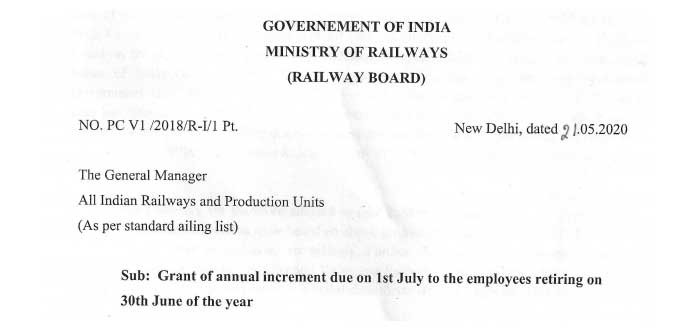
Grant of annual increment due on 1st July to the employees retiring on 30th June of the year

A person who retires on the last working day would not be entitled for any increment falling due on the next day and payable next day thereafter, because he would not answer the tests in these Rules
File No.PC-VI/2018/ R-I/1 -Part(1)
GOVERNMENT OF INDIA
MINISTRY OF RAILWAYS
(RAILWAY BOARD)
NO. PC V1 / 2018/R-I/1 Pt.

 Grant of annual increment due on 1st July retiring on 30th June of the year
New Delhi, dated 21.05.2020

The General Manager
All Indian Railways and Production Units
(As per standard mailing list)

Sub: Grant of annual increment due on 1st July to the employees retiring on 30th June of the year

A number of representations are being received in this office seeking grant of one notional increment as due on 1st July in favour of employee retiring on 30th June before drawing the same, exclusively for the purpose of pensionary benefits.

Also check: 7th Pay Commission Annual Increment

2. As the Railways are aware, the annual increment is granted to railway employees on completion of laid down qualifying service for the purpose. Based on the recommendations of the Sixth Central Pay Commission, as accepted by the Government of India, Railway Services (Revised Pay) Rules, 2008 were notified on the lines of Central Civil Services (Revised Pay) Rules, 2008. As per Rule 10 of above Rules, it was stipulated that there will be a uniform date of annual increment, viz. 1st July of every year and the employees completing 6 months and above in the revised pay structure as on 1 of July will be eligible to be granted the increment. There has been no change in the above rule / extant policy so as to enable grant of increment (notional or actual) on 30th June, where it was due on the following 1st July.

3. In the various representations being received in this office, certain Judgments in the case of Shri Ayyamperumal, an employee of Department of Revenue are being cited. As the details of above court matter and policy decision of concerned nodal departments were not available in this office, the matter was referred to concerned departments of Government of India seeking their advice / guidelines.

4. DOP&T vide their O.M dated 11.11.2019 have stated that the Judgment passed in the case of Shri P. Ayyamperumal is in personam. Further, the judgment pronounced by Hon’ble High Court of Madras in P. Ayyamperumal case, as endorsed by Hon’ble Supreme Court, is based on the decision in the case of M. Balasubramaniam, which was related to Fundamental Rules of State Govt. However Central Government employees are governed by Central Government Rules. Further, Hon’ble High Court of Andhra Pradesh at Hyderabad in C. Subbarao case has inter-alia observed that “A person who retires on the last working day would not be entitled for any increment falling due on the next day and payable next day thereafter, because he would not answer the tests in these Rules.” A copy of DOP&T O.M dated 11.11.2019 is enclosed herewith.

5. The Railways are therefore advised to take further necessary action to dispose off the pending representations on the issue based on above position and advice of DOP&T. The pending court cases may also be defended accordingly. Further, in case any clarification / inputs are required relating to railway Fundamental Rules and Railway Pension Rules, Finance (Estt.) dte. may also please be consulted being the nodal directorate on these aspects. This issues with the approval of DG/HR, Railway Board.

DA: As above

(U. K. Tiwari)
Joint Director, Pay Commission
Railway Board

Sunday, 19 January 2020

Retirement guide for a central government employees

A handbook for retiring central government employees

Retirement guide for a central government employees


Retirement guide for a central government employees

Who is Eligible for Pension?

  • A Central Government Employee who joined in pensionable service prior to 01/01/2004
  • Contributory Provident Fund (CPF) beneficiaries in service on 01.01.1986 other than those who chose to continue under the CPF Scheme thereafter.
  • Temporary employees retiring on superannuation pension/ invalidation with not less than 10 years service qualifying for pension.
  • An employee who is dismissed or removed from service forfeits his pension.
  • Resignation from service entails forfeiture of past service.

When can you get Pension?

  • Pension is payable on retirement after attaining the age of compulsory retirement (superannuation) or in advance of this age under certain circumstances.
  • Pension is also payable before the age of superannuation o voluntary retirement after rendering 20 years of qualifying service under Rule 48-of CCS (Pension) Rules or after attaining the age of 50/55 years under FR 56(K) subject to other conditions as laid down in the rules.
  • Family pension is payable to eligible family member on the death of an employee while in service or after retirement.

Classes of Pension 

Pension granted under CCS (Pension) Rules, 1972 can be:
  • Superannuation Pension
  • Retiring Pension
  • Invalid Pension
  • Compensation Pension
  • Compulsory Retirement Pension or Compassionate Allowance
  • Pension on absorption to a PSU/ Autonomous body

DOs for Retirees for timely processing of their pension papers/claims

During the service Retiree is required to ensure that 

  • His/Her family details are kept updated
  • All Nominations are kept updated
  • Head of Office/ DDO has verified the service – no gaps in service
  • You are entitled to Certificate's of qualifying service on completing 18 years of service and 5 years before retirement. This period is not to be reopened for assessment
  • Leave Record is kept updated

Points to be kept in mind while filling up the forms on Bhavishya Portal 

  • Choose your bank with caution – Please see your easy accessibility to the nearest branch of the bank. This will be helpful as you grow in age.
  • Joint account with spouse is mandatory unless exempted by Head of Office. This is important while sanctioning of family pension after the death of pensioner, the spouse will not face any difficulty, as the process for switch over from pension to family pension is much easier.
  • Primary account holder should be the pensioner. If the spouse is primary account holder, the pension case will be returned by the concerned bank.
  • Name of all family members should be given to Head of office in Form 3. Married sons and married daughters are also the part of the family and the same should be mentioned in form 3.
  • Option to get Pension Payment order (PPO) through Head of office instead of Bank can be exercised.
  • Address of communication should be properly indicated in the Form
  • Mobile number/ email should be updated in the system site. NIC/ GOV Mail should be mentioned as alternate Email and the Email other than NIC/ GOV should be mentioned as primary mail.
  • Name in the bank account and service record should not be mismatched. For example, if the name in the service record is Naresh Kumar Sharma, in bank account also it should be the same (instead of writing N.K.Sharma)
  • Photo uploaded /pasted by the retiree should be clear and as per the guidelines mentioned on Bhavishya. Selfie/ blurred photographs are not allowed.
  • Name and Date of Birth of family members should be correct and matched from the service records and other supporting documents such as educational certificate/Aadhaar Card/Driving license etc.
  • The retiree should consider appropriately before applying to avail the facility of CGHS/ FMA/ CGHS (In-door) + FMA/health facility of previous organization as well as spouse’s health facility.
  • Commutation of the pension is optional and therefore a subjective concept. The retiree should take decision regarding the commutation of pension as per his / her requirement.
  • Late submission of pension forms should be avoided. The Bhavishya system sends message to the retiree 8 months before the date of retirement; intimating the login id and password. The retiree now requires filling his pension papers on Bhavishya system.

Basic Statistical Returns (BSR) Code

It is mandatory to mention BSR code of Bank branch (where pension is desired to be credited) in the pension papers to enable CPAO to transmit the pension to pensioner’s bank account. The BSR codes of the respective banks are available on the website of CPAO (https://cpao.nic.in/Ministry/BSR.php).

What is BSR code and its use?

  • Basic Statistical Returns (BSR) Code is a 7 digit code allotted by Reserve Bank of India (RBI) to all the registered Banks in India. The first 3 digits out of the 7 represent bank name whereas the remaining 4 digits codify the branch of the bank. BSR is a system to integrate the date relating to various commercial banks and promote the filing of the same with RBI at regular intervals. It is used in 3 particular places:-
  1. When TDS/ TCS returns are to be filled, BSR Code is used in Challan details and deducted details. This system is used to maintain records of the online payments and alerts the Income Tax Department about the payment through Banks.
  2. BSR Codes also assist any international tax authority to track the payment made by an individual to a foreign country.
  3. BSR codes enable the senior citizens to receive pensions also.
  • Although both IFSC codes and BSR codes help uniquely identify a particular Bank Branch, they are different in 2 ways. While IFSC is an 11 digit alphanumeric code, the BSR code consists of 7 digits. An IFSC code is used while making online money transfers through RTGS (Real-Time Gross Settlement Systems) and NEFT (National Electronic Fund Transfer), While BSR codes are used for filling online TDS/ TCS returns or for easy distribution of pension among retired Government employee.

The Road Map/ Time Frame for Processing the pension cases W.R.T. all the stakeholders is as follows:-

After 18 years and 5 years before retirement: –

Certificate regarding verification of qualifying service. (Notification No. 1/19/13-P&PW (E) dated 29.8.2014)

12-15 months before retirement:-

  • Commencement of service verification process by Head of Office
  • Assessment of outstanding dues
  • Reference to PAO and Directorate of Estates (for NDC)

8 months before retirement:-

Certificate regarding qualifying service and emoluments along with blank Form-5 to be given to retiring employee

6 months before retirement retiring employee to give:-

  • Filled in Form-5 with bank account details and joint photograph
  • Details of family in Form 3, unmarried sons and married daughters are also part of family and the same should be mentioned in Form 3
  • Nomination forms for gratuity, GPF, CGEGIS, Commuted
  • Value of pension and arrears of pension (Form-A)
  • Undertaking for the Bank
  • Anubhav Form

4 months before retirement:-

Pension papers (Form 5, Form 7 and Form 8) to be forwarded by HOO to PAO indicating Government dues to be recovered from Gratuity.

1 month before retirement:-

PPO to be sent by PAO to CPAO.  CPAO to forward it with SSA to the Bank within 21 days.

Copy of PPO:-

To be given by PAO (through HOO) to retiring employee after issue of SSA by CPAO (OM No. 1/27/11-P&PW (E) dated 7.5.2012).

Claims for Gratuity, CVP, GPF, CGEIS and Leave Encashment to be processed simultaneously and paid on last day of service.

(Information that follows relates to benefits on superannuation)

What are your Retirement benefits?

Retirement Benefits comprise the following:-
  • Pension or family pension subject to a guaranteed minimum of Rs. 9000/- per month (since 01.01.2016).
  • Lump sum payment resulting from commutation of a portion of pension.
  • Retirement / death gratuity limited to a maximum of Rs. 20.00 lakh (since 01.01.2016).
  • Dearness Relief on pension/ family pension at rates prescribed with reference to price rise (this remains suspended during employment /re-employment under the Government)
(For a qualifying service of less than 10 years only service gratuity is payable)

How are your Pension/Retirement Benefits worked out?

For Retired Employees

Service Gratuity
  • You are entitled to receive only service gratuity (and not pension) if your total qualifying service is less than 10 years.
  • It is calculated @ 1/2 month’s emoluments for each completed six monthly period of qualifying service.
  • An emolument for this purpose includes DA admissible at the time of retirement.
  • There is no limit for minimum amount
  • This is a one-time lump sum payment in lieu of pension and is distinct from and is paid over and above the retirement gratuity referred to later in this section.
Pension
  • If you retire under the rules and have qualifying service of 10 years, your pension is calculated @50% of last pay or average emoluments (i.e. average of the basic pay drawn by you during the last 10 months of your service), whichever is more beneficial to you.
  • Guaranteed minimum pension is Rs. 9,000 (Rupees Nine thousand only) per month. In addition, Dearness relief is also payable thereon.
  • Maximum limit on pension is Rs. 1, 25,000 (Rupees one lakh twenty five thousand only) per month. In addition, Dearness relief is also payable thereon.
  • Pension is payable upto and including the day of death.
Commutation of Pension
  • You have an option to commute a portion of pension, not exceeding 40% of it, into a lump sum payment.
  • You need not undergo any medical examination if you exercise this option within one year of retirement.
  • The lump sum payable to you is calculated with reference to the commutation table as provided in CCS (Commutation of Pension) Rules, 1981.
  • Your monthly pension will stand reduced by the portion commuted
  • But, your dearness relief entitlement will be calculated on the basis of the full pension (i.e. including the commuted portion)
  • The commuted portion of pension will be restored to you on the expiry of 15 years from the date of commutation.
  • In the event of death of pensioner, commuted portion is not deducted from family pension.
Retirement Gratuity
  • 5 years of qualifying service and eligibility to receive service gratuity/ pension is essential to get this one-time lump sum benefit.
  • Your retirement gratuity is calculated at the rate of ¼ month’s emoluments for each completed six-monthly period of qualifying service subject to a maximum 161/2 times the monthly emoluments.
  • Emoluments for this purpose will include DA admissible at the time of retirement.
  • There is no guaranteed minimum amount.
  • The maximum retirement gratuity payable is 161/2 times the emoluments limited to Rs. 20.00 lakh from 01.01.2016.
Dearness Relief
  • Dearness Relief is sanctioned as compensation against price rise.
  • The quantum payable will be governed by the orders issued by the Government from time to time.
  • All pensioners, irrespective of the amount of their pension, are eligible for this benefit (expect these on re-employment).
  • There is no ceiling in regard to the total of pension plus dearness relief which a pensioner can receive.

For Families

Death Gratuity
  • Widow/Widower or the nominee of an employee, dying while in service is entitled to receive Death Gratuity.
  • There is no requirement of completing any minimum length of qualifying service by the decreased employee for this purpose.
  • Entitlement is regulated as under:

Length of Qualifying ServiceRate of Death Gratuity
Less than 1 year2 times of emoluments*
One year or more but less than 5 years6 times of emoluments*
5 years or more but less than 11 years12 times of emoluments*
11 years or more but less than 20 years20 times of emoluments*
20 years or moreHalf of emoluments* for every completed six-monthly period of qualifying service subject to a maximum of 33 times.
* The total of death gratuity payable cannot exceed rupees twenty lakh in all cases. Emoluments for this purpose include dearness allowance admissible at the time of retirement.Family Pension
  • Family pension becomes payable to the Widow/Widower or an eligible family member from the day following the date of death of the employee either while in service or after retirement.
  • The decreased employee should had either one year of continuous service or should have been declared medically fit for government service if death takes place before completion of one year of continuous service.
  • It is normally payable only to one member of the family at a time barring cases wherein more than one widow is left behind, twin children, etc.
  • The Guaranteed minimum pension is Rs. 9,000 (Rupees Nine thousand only) (Since 01.01.2016). In addition, Dearness relief as per prescribed rate is also payable.
  • Entitlement is calculated as shown below:

Basic PayAmount of Monthly family pension
All levels30% of basic pay subject to a minimum of Rs. 9000 per month since 01.01.2016
  • In case of a Govt. Servant who dies while in service family pension at enhanced rate is admissible for a period of ten years from the date following the date of death. In case of death of a pensioner, family pension at enhanced rate would be payable for a period of seven years or till the pensioner would have attained the age of 67 years, whichever is earlier.
  • Like pension, family pension is also payable upto and including for the day of death of the recipient.
  • But, family pension is payable for life to a son/ daughter who is suffering from any disorder/ disability of mind or is physically crippled /disabled/ thus rendering him/ her unable to earn a living. Dependent, divorced, widow and unmarried daughter, dependent parents, dependent disabled siblings are eligible for family pension for life subject to fulfilment of certain conditions.
Dearness Relief
Dearness relief to family pensioners is paid at the same rate and on the same conditions as for pensioners.

Family Pension on Death/ Discharge for government employees under National Pension System (NPS)

  • National Pension System (NPS) was introduced for central government civil employees w.e.f. 01.01.2004 by Ministry of Finance (Department of Economic Affairs) vide Notification No. 5/7/2003-ECB & PR dated 22.12.2003. National Pension System is mandatory for all new recruits joining the central government service (except armed forces) from 01.01.2004. Accordingly, the CCS (Pension) Rules, 1972 are applicable to government servants appointed on or before 31.12.2003
  • However, the benefits under Old Pension Scheme were extended to the central government employees covered under NPS vide Department of Pension and Pensioners’ Welfare O.M. No. 38/41/06 – P&PW(A) dated 05.05.2009 in the event of their death or discharge from government service on account of invalidation/ disability.
  • In the case Government servant or his family avails the benefits under the old pension scheme in accordance with DoP&PW’s O.M. dated 05.05.2009, the entire accumulated pension fund of the Government servant under NPS would be surrendered into the Government account in accordance with Pension Fund Regulatory and Development Authority (Exits and Withdrawals under NPS) Regulations, 2015.
  • The benefits of Retirement gratuity and death gratuity have also been extended to the central government employees covered under NPS vide DoP&PW’s O.M. No. 7/5/2012-P&PW(F/B) dated 26.08. 2016 on the same terms and conditions as are applicable under CCS (Pension) Rules, 1972.

How to Claim Pension

  • Pension claims are processed by your Head of Office. He is also responsible for setting the entitlements consequent to the death of an employee in harness.
  • The process of sanctioning your pension claims is required to be initiated by the Head of office 12 to 15 months in advance of the retirement date.
  • Eight months prior to the retirement date, you are to furnish certain information (e.g. joint photo with wife / husband, family details, name of bank through which you desire to draw your pension, etc.) to your Head of Office in Form-5.
  • Your co-operation with the head of office is vital to ensure timely settlement of your claim. Head of Office will send the pension papers to P&AO in form 7 & 8 within 4 months prior to your date of retirement.
  • Pension is sanctioned by the Accounts Officer who is required to issue you Pension Payment Order (PPO) not later than one month in advance of the retirement date. He will send the PPO to CPAO who will issue SSA to designated pension paying bank within 21 days thereafter.
  • If any delay is anticipated in this, the Head of Office is required to sanction provisional pension and provisional gratuity.
  • Normally, family pension is also sanctioned to spouse at the same time as pension and indicated in the PPO. Family pension is to be drawn only after the death of the pensioner. In such cases no separate sanction for family pension is required. The spouse has to submit an application along with death certificate to the Bank, if he/she had a joint account with the decreased pensioner.
  • For getting family pension in other cases, the decreased pensioner’s family should apply in form-14.
– To the pension disbursing authority for payment, if the name of family pensioner and amount of family pension is already indicated in the PPO, or
– To the Head of Office for sanction of family pension in all other cases.

Interest on delayed payment

You are entitled to receive interest on the amount of retirement/death gratuity if its payment is delayed due to administrative lapse beyond a period of 3 months. The interest shall be paid at GPF rates prescribed from time to time.

How Pension is paid

  • The monthly pension to Central Government pensioners/ family pensioners is paid through public sector banks and through a few specified private banks. The Postal and Railway pensioner have also option to draw pension through post offices.
  • Nomination/ Cheque Book/ Standing Instruction facilities have been extended to pensioners drawing their pension through banks.

Redress of grievances

  • If you have any grievance / complaint in pension matters you may take it up with your Head of Office, the pension sanctioning authority or the pension disbursing authority, as the case may be.
  • You may also approach the Integrated Grievance Cell and Call Centre of Department of Pension & Pensioners’ Welfare, 8th floor, Janpath Bhawan, Janpath, New Delhi-110001, (Toll Free Number 1800-11-1960) which provides the platform for facilitating redress of the grievances of pensioners. You can also lodge your grievance / complaint through Centralized Web-based Pension Grievances Redress and Monitoring System (CPENGRAMS) for speedy redressal and effective monitoring of grievances by various Central Government Ministries / Departments/ Organizations. How to use this system is explained in the website of the Department of Pension & Pensioners’ Welfare at pensionersportal.gov.in.

Non-Pensionary Retirement Benefits

Retired Employees or their families are also entitled to the following non-pensionary retirement benefits:

  • Cash equivalent of leave salary for earned leave due to the employee, subject to a maximum of 300 days.
  • Encashment of half pay leave sue to the officer to the extent of shortfall in earned leave to make up the maximum of 300 days ceiling on Earned leave for encashment above.
  • Insurance cover and/or accumulation in the Saving Fund under the Central Government Employees Group Insurance Scheme, 1980.
  • Normal dues from the GPF account and in the case of death of the employee while in service, additional amount limited to Rs. 60000 from the Deposit –linked Insurance scheme under the General Provident Fund Rules.
  • On retirement, you are entitled to travel entitlement consisting of (i) Travel entitlement for self and family (ii) Composite Transfer and packing grant (CTG) (iii) Reimbursement of charges on transportation of personal effects (iv) Reimbursement of charges on transportation of conveyance as detailed below:-

Travel Entitlements

Travel entitlements as prescribed for tour / transfer, except for International Travel, will be applicable in case of journeys on retirement. The general conditions of admissibility prescribed in S.R.147 will, however, continue to be applicable.

Composite Transfer Grant (CTG)

  • The Composite Transfer Grant shall be paid at the rate of 80%of the last month’s basic pay in case of those employees, who on retirement, settled down at places other than last station(s) of their duty located at a distance of or more than 20 km. However, in case of settlement to and from the island territories of Andaman, Nicobar & Lakshadweep, CTG shall be paid at the rate of 100% of last month’s basic pay. Further, NPA and MSP shall not be included as part of basic pay while determining entitlement for CTG. The transfer incidentals and road mileage for journeys between the residence and the railway station/bus stand, etc., at the old and new station, are already subsumed in the composite transfer grant and will not be separately admissible.
  • As in the case of serving employees, government servants who, on retirement, settle at the last station of duty itself or within a distance of less than 20 kms may be paid one third of the CTG subject to the condition that a change of residence is actually involved.

Transportation of personal effects

Presently the scale of transportation of personal effects for which re-imbursement is admissible is as follows:-

Level in Pay MatrixBy Train/ StreamerBy Road
12 and above6000 kg by goods train/ 4 wheeler wagon / 1 double containerRs. 50/- per Km
6 to 116000 kg by goods train/ 4 wheeler wagon / 1 single containerRs. 50/- per Km
53000 kgRs. 25/- per Km
4 and below1500 kgRs. 15/- per Km

Transportation of conveyance


Level in Pay MatrixReimbursement
6 and above1 motor car etc. or 1 motor cycle/ scooter
5 and below1 motorcycle/ scooter/ moped/ bicycle

Fixed Medical Allowance

  • Fixed Medical Allowance @ Rs. 1000 per month is paid to the pensioners/ family pensioners who are residing outside the jurisdictional area of CGHS scheme and other such schemes of other ministries/ department and would have been eligible for this scheme while in service.
  • Medical facilities under the Central Government Health Scheme (CGHS) in various cities/ areas covered by the scheme are also available to eligible Central Govt. Pensioners on contribution / payment basis. CGHS facility (both OPD and IPD) is also available to pensioners residing outside CGHS area.
  • Pensioners residing outside CGHS area but in receipt of FMA, are not eligible to avail OPD facilities at wellness centers. They can, however, avail IPD facilities on making contribution under the Central Government Health Scheme (CGHS).

Anubhav

DoP&PW has also provided you a platform to share your experience of working with the Government through a write-up- the write-ups which the Government may share online with other Miniseries / Departments. This platform has been provided with the intention to garner the resources of retiring employees to help create wealth of information for the Government. An annual award scheme is also in existence to attract quality write-ups. The details can be seen at http://pensionersportal.gov.in/Anubhav.

Sankalp

Believing that the life after retirement is a second inning in the life of a Government Employee, the Department of Pension & Pensioners’ Welfare has taken up an initiative to motivate and channelize the skill, experience and time available with Central Government Pensioners into meaningful social activities through a platform entitled “SANKALP”. Under this initiative, you can register yourself for voluntary work on SANKALP platform http://pensionersportal.gov.in/sankalp/

Disbursement of Monthly Pension

  • Payment of pension to Central Government Civil Pensioners is made by all nationalized banks authorized by Reserve Bank of India. In addition RBI has also authorized HDFC Bank Ltd., ICICI Bank Ltd., IDBI Bank Ltd., and UTI Bank Ltd., (now Axis Bank Ltd.) to make payment of pension to Central Government Civil Pensioners.
  • The time schedule to be followed by various offices for start of pension is as follows.


Name of the OfficeTime Schedule
(i)Pay & Accounts Officer issuing PPODespatch of PPO by PAO to the CPAO on the last working day of the month preceding the month of retirement.
(ii)Central Pension Accounting Office (CPAO)Despatch of PPO by CPAO to CPPC/ link branch of Authorized bank by 20th of the month of retirement.
(iii)Link BranchDespatch of PPO by link branch to paying branch by 23rd of the month of retirement.
(iv)Paying BranchPaying Branch will complete all formalities and ensure that the pension has been credited to the pensioner’s account on the 1st date of the month

Payment of CGEIS Accumulations and Interest Thereon

The individual accounts of contributions made by IAS officers, irrespective of their places of posting during the entire service, are centrally maintained by Controller of Accounts DoP&T. As such the final payment due on the date of retirement in respect of accumulations under CGEIS is authorized by Controller of Accounts DoP&T.

For Pensioners becoming Non-Resident Indian after Retirement

  • A Pensioner on becoming the NRI should intimate the fact that he has become NRI to the pension paying branch in India and on receipt of the same the paying bank branch in India should convert the account of pensioner to Non-resident Ordinary (NRO) account.
  • The authorized bank then may credit the pension amount of such NRI pensioners to a non-resident (ordinary) account opened/maintained as per provision of the Exchange Control after ensuring the personal identification and other requirements as may be necessary under the scheme for payment of pension to Central Government Civil Pensioners.

Central Government Health Scheme (CGHS) Facility for Pensioners

Procedure to get a CGHS card for Retiring Employee

  • For availing CGHS facility after retirement, pensioners need apply in the prescribed from (available on CGHS web portal cghs.nic.in and website www.cghs.gov.in and also in the wellness Centers)
  • The form should be completely filled up with individual photographs pasted as specified in the form along with the following documents:-
(i) Proof of residence
(ii) Proof of stay of dependents.
(iii) Proof of age of son
(iv) In case of differently abled dependent son above 25 years, disability certificate from competent authority as specified
(v) Surrender certificate of CGHS Card (Only if CGHS Card was issued during Service Period)
(vi) Attested copies of PPO/Provisional PPO/Last Pay Certificate (in case PPO is not readily available immediately after retirement.)
(vii) Demand Draft in the name of “PAO CGHS New Delhi”.
  • The amount of Demand Draft will be for contribution due for one year if the card is to be made for yearly renewal basis and for 10 years if whole life card is required.

Dependency Criteria

For availing the medical facilities under the scheme, parents (or parents-in-law in case of female employee), unmarried son till 25 years of age, dependent unmarried/ windowed/ divorced/ separated daughters and sisters, minor brothers are deemed dependent on the government employee if they are normally residing – with him and their income from all sources including pension and pension equivalent of DCRG benefit is less than Rs. 9000 + DA per month. This criteria does not apply to spouse and disabled son irrespective of age (please see definition of disability in instructions for filling CGHS card)

Channel of Submission

The application with enclosures is to be submitted to Addl. Director (HQ) in Delhi or concerned Addl. Director (CGHS) of the city, where the facility is required.

Provision for making Pensioner CGHS Card while in service

  • A serving employee can apply for a pensioner CGHS Card along with his pension papers.
  • Application with enclosures and bank draft is to be forwarded to the CGHS through the office of the employee. The pensioner card will be issued on the day of retirement (provided it is applied for at least six weeks before retirement date) and will get activated from next day.

Online Application for CGHS Card

The card can be applied online by visiting CGHS web portal www.cghs.nic.in or CGHS website www.cghs.gov.in.
However at present provision for uploading the supporting documents is not available. After online submission of the application, the applicant is required to take a print out of the application and submit it with supporting documents (duly endorsed by the Head of the Department/Office in case of serving employees) in the office of the Additional Director HQ in Delhi or Additional Director in other cities.

Addition / Deletion of Names in CGHS Cards

  • On the death of the main card holder, the card becomes invalid and fresh card has to be applied for by the spouse after he/she starts drawing the family pension. Old CGHS card and a Death certificate need to be attached with the application.
  • A serving employee on marriage or on the birth of his/her child may get the names of spouse / child added to the card after submitting the form for addition duly endorsed by his department
  • After the death of spouse and death/marriage/employment of a son/daughter/ dependent it is the responsibility of main card holder to inform CGHS for necessary deletion of the card.

Validity of the CGHS Card

  • In case of yearly contribution pensioner cards, in order to continue validity, contribution is to be made prior to completion of the continuing year.
  • CGHS card is valid in all CGHS cities for treatment/ investigation/ Hospitalization. There is no need for transit permit to get treatment in another CGHS city except for receiving high value medicines classified as “lifesaving” / restricted supply medicines for which temporary attachment to a wellness center is required

CGHS Card for Pensioners Residing Outside CGHS Cities

Pensioners residing outside CGHS covered area can opt for a regular CGHS Card or an IPD (Indoor treatment) CGHS Card with fixed medical allowance (in lieu of OPD treatment) from the nearby CGHS city. IPD card holders will not be eligible for OPD treatment & issue of medicines from CGHS wellness centers.

Self – Printing of CGHS Card

  • As soon as the application for CGHS card is accepted at the CGHS card section, an acknowledgement letter is issued to the applicant mentioning the card number and the Ben ID of all family members. The plastic cards are normally available after one month of the application at the parent wellness center of the card holder.
  • In the meantime the acknowledgement letter can be used to avail the facilities from the wellness center.

Print your own card online facility

  • A beneficiary can also self-print his and his dependents cards online through Beneficiary login. This e-CGHS Card is equivalent to the plastic card. After downloading the card in PDF format beneficiary can take a color print out and get it laminated for further use.
  • The beneficiary can print his/her or family members’ card using following steps
  1. Visit CGHS portal cghs.nic.in
  2. Click Beneficiary Login
  3. Enter your Ben ID, password and sign in
  4. Click Print card for the beneficiary whose card needs to be printed
  5. Enter the onetime password sent on your registered mobile
  6. Click Print CGHS Card
  7. A message appears on the screen requesting to take a colored print out and get the card laminated. Click OK
  8. Download or open the e-CGHS card in PDF format
  9. Print e-CGHS card using control P command
  • A beneficiary may use an e-CGHS card for availing health care facilities. The credentials of the beneficiaries can be verified by the Health Care Organisations (HCOs) through the computer database using the beneficiary ID number, if required.

Importance of CGHS Card

  • All the CGHS beneficiaries and their dependents are provided with photo ID plastic cards individually with unique beneficiary ID number which need to be produced at each service point to avail the facilities.
  • Safe custody of the CGHS Cards is the responsibility of the beneficiary and in case of loss of the card beneficiary is required to inform the police and CGHS authorities.
  • Duplicate CGHS card can be obtained against lost card by applying for the same to be concerned Additional Director along with a copy of FIR and will be charged Rs. 50/-

General

  • Your PPO is a valuable document containing a running account of your pensionary entitlements. Please keep it in safe custody.
  • All pensions/ gratuities and dearness relief are payable in rupees in India only.
  • Payment to NRI pensioners is paid through non-resident (ordinary) account opened/maintained as per provisions of the exchange control.
  • They are expressed in whole rupees, the fraction being rounded off to the next higher rupee.
  • No employee can earn two pensions in the same service/post at the same time or by the same continuous service. However, there is no bar to an employee drawing more than one pension due to a combination of pension and family pension or civil & military pension.
  • Pension/family pension is payable upto and including the day on which its recipient dies.
  • A pensioner is entitled to nominate any other person to receive his life-time arrears. The nomination is to be submitted to the Head of Office while the pension claims are being processed or to the pension disbursing authority any time thereafter.
  • Grant of pension and its continuance are subject to future good conduct of the pensioners.
  • Pension finally authorized cannot be revised to the disadvantage of the pensioner except to correct a clerical error.
  • Pension cannot be attached, seized etc., for any demand against a pensioner; nor can a pensioner make any assignments, etc., in anticipation of pension.
  • But, if a pensioner is convicted of a serious crime or it’s found guilty of grave misconduct or negligence, pension may be withheld or withdrawn fully or partly for a specified or indefinite period. Recovery from pension may also be made for any pecuniary loss caused to the Government.
  • Government dues (pertaining to government accommodation, outstanding balance of advances, overpayment, etc.) are adjustable against gratuities (other than service gratuity) and/or Dearness Relief.
  • Acceptance of certain kinds of post-retirement employment (e.g. commercial employment before expiry of one year from retirement, employment under foreign governments, etc.) by pensioners who retired from Group-A service /post requires prior permission of the Central Government. Failure to comply with this requirement could lead to stoppage of pension for such period as may be decided by the Government.

Monday, 28 October 2019

Applicability of Rule 31 of Railway Service Rules 1993 for counting service period paid from contingencies for calculation of pension, gratuity on retirement


Applicability of Rule 31 of Railway Service (Pension) Rules 1993 for counting service period paid from contingencies for calculation of pension, gratuity on retirement

Railway Rule 31


No. 11/35/2018
Dated: 23/10/2019
The Secretary (E)
Railway Board,
New Delhi

Dear Sir,
Sub: Applicability of Rule 31 of Railway Service (Pension) Rules 1993 for counting of service period paid from contingencies for calculation of pension, gratuity on retirement - reg.

Ref: (i) NFIR’s PNM Item No: 27/2011.
(ii) Railway Board’s letter No. 2016/ E(LR)I/NM1-12 dated 14/12/2016.
(iii) NFIR’s letter No. II/35 Part XIII dated 19/12/2016.
(iv) Railway Board’s letter No. E(NG)II/2014/ CL/RWF/6 PNM - NFIR dated 17/05/2017 .
(v) NFIR’s letter No. 11/35/2018 dated 09/06/2018 &.06/11/2018.
(vi) Railway Board’s letter No. E(NG)II/2014 /RWF/CL/6 PNM-NFIR dated 21/12/ 2018.
(vii) PCPO / RWF’s letter No. RWF/ G0-26/566 dated 08th March, 2019 to Secretary (E), Railway Board.
(viii) Railway Board’s letter No E(NG)II/ 2017/ER/CL/4 dated 15/05/2019 addressed to GM(P) RWF.

Kind attention is invited to the Federation’s demand to consider applicability of Rule No. 31 of Railway Service (Pension) Rules 1993 for counting of service period paid from contingencies for calculation of retirement gratuity in favour of former casual labour who were paid wages for contingency and absorbed subsequently in Rail Wheel Factory, Yelahanka vide NFIR’s Agenda Item No. 27/2011. Federation takes note that though the Railway board vide letter dated 15/05/2019 issued half-baked clarification to RWF Authorities with reference to PCPO, RWF’s letter dated 08th March,2019 without mentioning NFIR PNM Agenda Item pending since the last about eight years since the year 2011.

Read More: Indian railway news for railway employee

In this connection, NFIR re-iterates that the Apex Court in its Judgement / Order in Civil Appeal No. 3938 of 2017 [ arising out SLP (C) No. 23723 of 2015 dated 24th March, 2017] gave following directions (in para 55) for compliance:-
  1. the casual worker after obtaining temporary status is entitled to reckon 50% of his services till he is regularized on a iegular/temporary post for the purposes of calculation of Pension.
  2. the casual worker before obtaining the temporary status is also entitled to reckon 50% of casual service for purposes of pension.
  3. Those casual workers who are appointed to any post either substantively or in officiating or in temporary capacity are entiled to reckon the entire period from date of taking charge to such post as per Rule 20 of Rules, 1993.
Federation feels disappointed that the clarification dated 15/05/2019 is inadequate due to the fact that instructions covering above points have not been incorporated for taking action by all Zones/ PUs to settle similarly placed cases including those of RWF, Yelahanka.

NFIR, therefore, requests the Railway Board to consider and issue modified instructions to the General Managers of Zones / PUs & RWF citing NFIR’s PNM meeting discussions.

A copy of the instructions may be endorsed to the Federation.
Yours faithfully,
(Dr.M. Raghavaiah)
General Secretary
Source: NFIR

Friday, 27 September 2019

Important matter of the service period, affecting the Central Government Employees - JCM (Staff Side)

Important matter of the service period, affecting the Central Government Employees - JCM (Staff Side)

NCJCM

Shiva Gopal Mishra
Secretary
Ph: 23382286
National Council (Staff Side)
Joint Consultative Machinery
for Central Government Employees
13-C, Ferozshah Road, New Delhi – 110001
E-Mail: nc.jcm.np@gmail.com
No.NC/ JCM/2019
Dated: September 25, 2019
All Constituents of the JCM (Staff Side)

Dear Comrades,
Sub: Government’s briefing to the PTI on the age of superannuation of the Central Government Employees

Also read: Retirement Age 60 years / 33 years service

There are serious rumours in the air that the Department of Personnel & Training (Government of India) has mooted a proposal in regard to age of superannuation of the Central Government Employees, laying down condition of either 33 years of Qualifying Service or 60 years of age, whichever is earlier. It is also being claimed by several sources that, this proposal has already been sent to the Finance Ministry for their approval.

In this connection, it is clarified that, this has not to be given any cognizance since it is not possible without prior consultation with the JCM (Staff Side), being an important matter of the service condition, affecting the Central Government Employees.

Also check: No Increase or Decrease the Age of Retirement of Central Government Employees
Sincerely Yours,
sd/-
(Shiva Gopal Mishra)
Secretary (Staff Side)
National Council (JCM)
service-matter-affecting-Central-Government-Employees


Source: NCJCM

Monday, 19 August 2019

Indian Navy Personnel Serving Retirement And Pension Officers - Pensionary Benefits

Indian Navy Personnel Serving Retirement And Pension Officers

Pensionary Benefits

Introduction
Based on the recommendations of the Vth Pay Commission, the Government has abolished the standard pension of the rank. The normal retiring pension is purely based on two factors i.e. Qualifying Service and Average Monthly Emoluments.

Type of Benefits
If the minimum qualifying service required has been completed officers are eligible for
  • Retiring Pension
  • Retirement Gratuity
Minimum Qualifying Service
In case officers have not rendered the minimum qualifying service for pension, then they are entitled to
  • Retiring Gratuity
  • Retirement Gratuity
4. Qualifying Service
It shall mean the actual qualifying service rendered plus a weightage (in years) appropriate to the last rank held (as given subsequently below). The minimum qualifying service (without weightage) to be eligible for retiring pension is 20 years (15 years in case of a late entrant). The maximum qualifying service including weightage reckonable for pensionary benefits is 33 years.

5. Counting of Other Service
Full pre-commissioned service rendered under the Central Government whether in a Civil Department or in the Armed Forces shall be taken in account while working out the Qualifying service for pensionary benefits and determining the minimum Qualifying service for retiring pension.

6. Calculation of Fraction of Year for Qualifying Service
To calculate the length of the Qualifying service, fraction of a year equal to 3 months and above but less than 6 months shall be treated as a completed one half year and reckoned as Qualifying service.

7. Weightage
The object of the weightage for calculating the Retiring Pension is to give the benefit of entitlement to Retiring pension as close as possible to 50% of reckonable emoluments which is the maximum admissible after 33 years of service. The weightage allowed is as follows

RankWeightage
Sub Lt/Lt9 years
Lt Cdr8 years
Cdr7 years
Capt (TS)7 years
Captain (with less than 3 years and 10 months service)7 years
Captain (with 3 years and 10 months and more service)5 years
Admiral/ Vice Admiral/ Rear Admiral3 years

8. Reckonable Emoluments
For the purpose of working out the Retiring Pension the term Reckonable Emoluments means the average of the Pay. Dearness Pay, Non-practising Allowance and the Rank pay and Stagnation Pay, if any, drawn during the 10 months immediately preceding the date of retirement.

9. Quantum of Retiring Pension
  • The retiring pension is calculated at 50% of average emoluments. The amount so determined is the retiring pension for 33 years of reckonable qualifying service. For lesser period of reckonable qualifying service, this amount is proportionately reduced. The minimum pension shall not be less than Rupee 1,275/- per month wef 01 Jan 1996.
  • Further with effect from 01 Apr 2004, since 50% of Dearness Allowance converted into Dearness Pay is counted for retirement benefits, pension/family pension shall be calculated at 50% and 30% respectively of the pay plus Dearness Pay subject to minimum of Rupee 1,913/- and maximum of 50% and 30% respectively of the highest pay plus Dearness Pay in the Government. The highest pay in the Govt wef 01 Jan 96 is Rupee 30,000/-. The highest pension, as of now, comes to Rupee 22,500/- (i.e. basic pension Rupee 15,000/- + dearness pay Rupee 7,500/- = total pension Rupee 22,500/-).
10. Protection of Retiring Pension
Retiring Pension in the rank of Cdr, Commodore (Captain with 3 years and 10 months , or more service) and Rear Admiral shall in NO CASE be less than the pension admissible to the officer as a Lt Cdr, Captain (with less than 3 years and 10 months service) or as a Commodore, as the case may be, had the officer not been promoted to the higher rank.

11. Retirement/Retiring Gratuity
Please see the details in Chapter IV on Gratuity.

12. Pension Disbursing Authorities
The officers may claim the pension through Govt. Treasury/Pension Payment Masters/ Defence Pension Disbursing Officers. They may also draw the pension through Public Sector Banks, if they so desire. With effect from 09 Jul 05, pensioners can operate the joint account of pension with his/her spouse.

13. Illustration
An illustration showing the procedure for calculation of Retiring Pension is given at appendix H. For a near exact amount of pension and gratuity, officers are advised to browse the NPO website https://www.navpay.gov.in

Source: Indian Navy

Saturday, 13 July 2019

Retention of Government Accommodation after retirement till the lifetime in cases related to medical and education of children?

Retention of Government Accommodation after retirement till the lifetime in cases related to medical and education of children?

GOVERNMENT OF INDIA
MINISTRY OF HOUSING AND URBAN AFFAIRS
LOK SABHA

UNSTARRED QUESTION NO: 902
ANSWERED ON: 27.06.2019

Retention of Government Accommodation

Upendra Singh Rawat
Kaushal Kishore
Will the Minister of HOUSING AND URBAN AFFAIRS be pleased to state:-

(a) Whether the Government has any proposal for retention of the Government accommodation by the Central Government servants after retirement, on payment of suitable rent, at least till the lifetime of the Central Government servant, especially in cases related to medical and education of children;

(b) If so, the details thereof; and

(c) If not, the reasons therefor?

ANSWER

THE MINISTER OF STATE (INDEPENDENT CHANRGE) OF THE MINISTRY OF HOUSING AND URBAN AFFAIRS (SHRI HARDEEP SINGH PURI)

(a) No, Sir.

(b) Does not arise in view of reply to (a) above.

(c) As per Rule 40(1)(ii) of Central Government General Pool Residential Accommodation (CGGPRA) Rules, 2017, on retirement, a central Government employee who is an allottee of General Pool Residential Accommodation (GPRA), can retain Government Accommodation for six months on payment of normal license fee.

Source: Lok Sabha

Friday, 28 June 2019

Extending the benefit of financial upgradation under MACPS to Railway School Teachers


GOVERNMENT OF INDIA
MINISTRY OF RAILWAYS
(Railway Board)

The issue under consideration is the issue of extending the benefit of financial upgradation under MACPS to Railway School Teachers instead of CAS (Career Advancement Scheme) presently operating for them. This issue has been raised by both the Federations (AIRF and NFIR) and IRPOF. Recently, this issue was also raised in 47th Meeting of NC/JCM held on 13-4-2019, chaired by Cabinet Secretary.

Sub: Extending the benefit of financial upgradation under MACPS to Railway School Teachers.

In the above context, it is stated that Railway School Teachers have all along been treated at par with teachers under Ministry of Human Resources and Development in every respect viz. recruitment qualification, pay structure, age of retirement etc. including Career Advancement Scheme (CAS). CAS was introduced in year 1988 based on recommendations of Dr. Chattopadhyaya Committee for the teachers under Ministry of Human Resources and the same was also adopted in respect of Railway Teachers which provides for grant of two financial upgradation on completion of 12 months 24 years of service with reference to the Recruitment Grade, in certain specified Pay Scales/ Grades called Senior Scale and Selection Scale respectively.

As Railway School Teachers are common category and their service conditions etc. are regulated as per identical terms and conditions as the teachers available under Ministry of Human Resource and Development (M/o HRD), therefore, CAS Scheme was continued in their respect instead of implementation of ACP/ MACP Scheme. On receipt of some representations / references stating that the MACP Scheme is being implemented in respect of teachers working under Ministry of Defence, Department of Space, a reference was made to M/o HRD vide Board's letter dated 18.12.2017, (followed by reminders dated 27.06.2018 and 27.01.2019) seeking clarification as to whether MACP Scheme can be implemented in respect of Railway School Teachers. M/o HRD vide their letter dated 26/11/2018 have advised that Railway Board is Competent Authority to decide the terms and conditions of service of Railway School Teachers and Department of, Personnel and Training may be approached for further clarifications on MACP provisions.

Meanwhile a copy of OM dated 26-4-2019 of Ministry of Human Resource Development enclosing a copy of Speaking Order dated 18-4-2019 passed in compliance of order dated 15-11-2018 by CAT/ Lucknow in OA No. 172/2014 for extension of MACP benefit to teachers under Kendriya Vidyalayas have been received. On perusal of the said Speaking Order it has been observed as under:
a) The Association of Kendriya Vidyalaya teachers had chosen to remain in the existing Scheme of three tier pay scales (i.e. CAS) and accordingly MHRD conveyed KVS that 'Government has decided not to extend ACP Scheme to the teachings staff of KVS and that they would continue in the existing scheme;

b) On implementation of MACP Scheme, the MHRD decided to extend the same to non-teaching staff of KVS;

c) MHRD considered the issue of extension of MACP benefit to teaching category of KVS in consultation with DOPT who in turn further consulted Department of-Expenditure and taking note of the fact that one of the conditions for extending the benefit of MACPS was that the earlier ACP Scheme should have been adopted by the concerned authority and that the KVS itself had chosen not to opt for earlier ACP Scheme for their teaching staff, the proposal for grant of MACPS to teachers under KVS was not agreed by Deptt. of Expenditure;

d) In two cases viz. OA No. 3855/2015 before CAT/ PBNew Delhi and OA No. 515/2013 before CAT/ Ernakulam, the Tribunals have dismissed the claim for extension of MACP benefit to teachers under Kendriya Vidyalaya Sangatthan;

e) In view of the position stated in para (a) to (d) above, MHRD vide its Speaking order dated 18-4-2019 have declined the claim of KVS teachers for grant of MACP benefit.
3. It is pertinent to mention that benefit of financial upgradation accruing under CAS viz- a-viz MACP was examined in detail and it has been observed that MACP Scheme is broadly beneficial than the CAS presently being implemented for the Railway School Teachers as at the time of grant of financial upgradation under CAS, benefit of pay fixation is not allowed whereas in case of MACP, benefit of pay fixation is allowed an admissible in cases of normal promotion.

4. In view of the above and in terms of para 13 of DOP&T's OM dated 19-5-2009 it is proposed that CAS may be replaced by MACPS for grant of financial upgradation to the Railway School teachers.

5. This has the approval of Board (MS and, FC)
(Subhankar Dutta)
Deputy Director, pay Commission-V
Railway Board
Source: NFIR

Monday, 25 March 2019

Railways: Emergency Cashless Treatment Scheme (CTSE) Card issue during retirement

Railways: Emergency Cashless Treatment Scheme (CTSE) Card issue during retirement

GOVERNMENT OF INDIA
MINISTRY OF RAILWAYS
RAILWAY BOARD
No. 2018/Trans.Cell/Health/Medical Card
Dated: 20.03.2019
The General Manager, All Indian Railways/PUs, NF(Con), CORE
The DG/RDSO/Lucknow, DG/NAIR/Vadodara
CAOs, DMW/Patiala, WPO/Patna, COFMOW/NDLS, RWP/Bela, CAO/IROAF

Sub: Issue of Cashless Treatment Scheme in Emergency (CTSE) Card at the time of retirement.
Ref:
(1) Railway Board letter no.2018/Trans.Cell/Health/Medical Cards dated 30.07.2018.
(2) GM/SECR’s letter no. G/SECR/70 dated 31.01.2019.

With reference to GM/SECR’s letter at (2), and Board’s letter at (1) above, Board (MS, FC & CRB), have approved the following:

Issue of Cashless Treatment Scheme in Emergency (CTSE) Card to willing and eligible retiring Railway employees and their dependents at the time of retirement or before subject to their deposition of the required fee as per extant rules and the same will be effective from the next day of retirement.
Other extant instructions/guidelines issued from Board on the subject shall remain unchanged or as modified from time to time.

This issues with the concurrence of Associate Finance of Transformation Cell of Railway Board.
Kindly acknowledge the receipt and ensure compliance
(Umesh Balonda)
Executive Director/S&T
Transformation Cell
Dated: 20.03.2019

Monday, 31 December 2018

Grant of Disability Pension


Ministry of Defence
Grant of Disability Pension
31 DEC 2018
As per Ministry of Defence order dated 31.01.2001, Armed Forces Personnel who retire voluntarily / or seek discharge on request are not eligible for any award on account of disability. Provided that Armed Forces Personnel who are due for retirement / discharge on completion of tenure, or on completion of service limits, or on completion of the terms of engagement or on attaining the prescribed age of retirement, and who seeks pre-mature retirement / discharge on request for the purpose of getting higher commutation value of pension will remain eligible for disability element.
Further, Armed Forces personnel who are retained in service despite disability, which is accepted as attributable to or aggravated by Military Service and have forgone lump sum compensation in lieu of that disability, may be given disability element / war injury element at the time of their retirement / discharge whether voluntary or otherwise in addition to Retiring / Service Pension or Retiring / Service Gratuity. These provisions are effective from 1.1.2006

This information was given by Raksha Rajya Mantri Dr. Subhash Bhamre in a written reply to Shri Sanjay Seth in Rajya Sabha today.

PIB

Thursday, 20 December 2018

Annuity based alternate pension proposal for the employees of NVS prior to 1.1.2004


Annuity based alternate pension proposal for the employees of NVS prior to 1.1.2004

NVS-alternate-pension


F. No. 3-1/2018 -NVS(Admn)/3584
Date : 4/12/2018
To,
The Deputy Commissioner,
All Regional Offices

Sub: Annuity based alternate pension proposal for the employees of NVS prior to 1.1.2004 - reg.

Sir,
In continuation to this office letter of even number dated 06.12.2018 seeking willingness of the employees with regard to introduction of alternate annuity based pension, it is to clarify the following:-

1. Own share of employee in the existing CPF scheme shall remain intact. It will not be utilized for creating the corpus fund of the alternate pension plan.

2. However, the management share of the existing CPF scheme will be utilized to form the corpus fund for the proposed annuity based pension scheme.

3. Proposed basic pension is 50% of the basic pay at the time of retirement and there is no provision for DA thereon.

4. Provision for commutation of pension upto 1/3rd of the basic pension exists..Employee at the time of retirement can get the commutation value. It would be more or less equal to the management share. Besides 213rd of basic pension per month fixed at the time of retirement is payable.

5. The pension is payable till the pensioner is alive. There is no provision for family pension after death of the employee.
6. However, proposal for provisioning of DA and family pension is also being sent to the Ministry for
consideration.

7. In case of death of the eligible employees during service, Provision for a lump sum insured amount payable to their dependents is proposed to be covered under group term Insurance Scheme.

The afore mentioned information may be widely circulated amongst the eligible employees to enable them to franchise their options/willingness for the proposed annuity based pension.

This issues with the approval of Competent Authority.
Yours faithfully,
S/d,
(B.C. Panda)
Assistant Commissioner (Admn.)

Wednesday, 19 December 2018

Senior Citizen Entitlement of Employees

Ministry of Personnel, Public Grievances & Pensions
Senior Citizen Entitlement of Employees
19 DEC 2018
Department of Social Justice & Empowerment has informed that there is at present no proposal in that Department for lowering the age of senior citizen. Government employees become entitle to pension on retirement. There is also no proposal to increase or decrease the age of retirement of Central Government Employees.

The salient features of the pension entitlements of employees retiring from the Central Government are as under:
  • A Government servant retiring in accordance with the rules, after completing a qualifying service of not less than 10 years, is entitled to a pension @ 50% of his last pay or 50% of average emoluments for the last 10 months, whichever is more beneficial to him/her.
  • After completion of 80 years of age or above, additional pension @ 20% to 100% is payable to the retired Government servant.
  • A retired/retiring Government servant is entitled to, at his/her option, a lump sum payment, by commutation of a maximum of 40% of his/her pension.
  • On retirement, a Government employee is entitled to a retirement gratuity based on his/her emoluments and length of qualifying service.
  • On death of a Central Government pensioner, the family is entitled to a family pension the amount of which is 50% of the last pay for a period of seven years, or for a period up to the date on which the retired deceased Government servant would have attained the age of 67 years had he/she survived, whichever is earlier. Thereafter, the amount of family pension is 30% of his last pay.  The amount of family pension is also increased by 20% to 100% after the family pensioner attains the age of 80 years and above.
  • The family of a Government servant, who dies while in service after having rendered not less than seven years’ continuous service, is entitled to a family pension 50% of the last pay for a period of ten years. Thereafter, the amount of family pension is 30% of his/her last pay.
This was stated by the Minister of State in the Ministry of Personnel, Public Grievances and Pensions and Minister of State in the Prime Minister's Office, Dr. Jitendra Singh in a written reply to a question in the Lok Sabha today.

PIB

Tuesday, 20 November 2018

DoPT: Promotion of Government servants found fit by review DPC after retirement - procedure and guidelines to be followed

DoPT: Promotion of Government servants found fit by review DPC after retirement - procedure and guidelines to be followed

F. No. 22011/3/2013-Estt. (D)
Government of India
Ministry of Personnel, Public Grievances and Pension
Department of Personnel & Training
North Block, New Delhi
Dated 15th November, 2018
OFFICE MEMORANDUM
Sub: Promotion of Government servants found fit by review DPC after retirement - procedure and guidelines to be followed

The undersigned is directed to invite reference to this Department's OM of even number dated 25.1.2016 which deals with the grant of notional promotion to a Government servant exonerated in a disciplinary proceedings after retirement. However, the cases of Government servants who are found fit by review DPC after their retirement on account of revision of seniority list of the feeder cadre, upgradation of below benchmark APARs etc. are not covered under the said OM. These cases have now been examined and it has been decided to lay down procedure as narrated in subsequent paragraphs for dealing with such cases.
2. A Government servant who is not recommended in the panel by the original / supplementary DPC but later on is recommended in the panel by a review DPC but has since retired may be given the benefit of notional promotion w.e. f. the date of promotion of his immediate junior in the reviewed panel and fixation of notional pay subject to the fulfillment of the following conditions:
(i) That the officer who is immediate junior to the retired Government servant assumed charge of the higher post on or before the date of superannuation of the retired Government servant.
(ii) That the said retired Government servant was clear from vigilance angle on the date of promotion of his immediate junior.
(iii) A retired Government servant who is considered for notional promotion from the date of promotion of his immediate junior on the recommendation of a review DPC would also be entitled to fixation of pension on the basis of such notional pay.
(iv) The notional promotion, notional pay fixation and revision of pension shall be further subject to extant rules on promotion, pay fixation and CCS (Pension) Rules, 1972, Actual increase in pension shall be given only from the date of approval of reviewed panel by the competent authority. No arrears shall be paid.
3. The provisions contained in this Office Memorandum shall become operational from the date of issue of this Office Memorandum. Past cases settled in accordance with the earlier provision shall not be reopened.
4. In so far as persons serving in the Indian Audit & Accounts Department are concerned, these orders issue after consultation with the Comptroller & Auditor General of India.
(G.Jayanthi)
Joint Secretary (E.I)
To
All Ministries and Departments of Government of India.

Source: DoPT

Friday, 9 November 2018

Gratuity for Central Civil Services

Gratuity for Central Civil Services

Frequently Asked Questions (FAQs)
(Central Civil Services)


10. GRATUITY

(10.1) When will the gratuity withheld at the time of retirement be released?
The withheld amount of gratuity under sub-rule (5) of CCS(Pension) Rules, 1972, the retiring Government employees, shall be paid immediately on production of "No Demand Certificate" from the Directorate of Estates after actual vacation of the Government accommodation.

The Directorate of Estates shall ensure that "No Demand Certificate" shall be given to the Government employee within a period of fourteen days from the actual date of vacation of the Government accommodation and the allottee shall be entitled to payment of interest (at the rate applicable to General Provident Fund deposit determined from time to time by the Government of India) on the excess withheld amount of gratuity which is required to be refunded., after adjusting the arrears of licence fee and damages, if any, payable by the allottee and the interest shall be payable by the Directorate of Estates through the concerned Accounts Officer of the Government employee from the actual date of vacation of the Government accommodation up to the date of refund of excess withheld amount of gratuity.

(10.2) Whether retirement gratuity/death gratuity, commuted value of the pension is taxable?
No. Death gratuity/retirement gratuity and commuted value of the pension are fully exempted from Income tax.

(10.3) Is there any ceiling on gratuities and if so what is the maximum amount admissible?
Yes. Ceiling on all gratuities has been raised to Rs. 20 lakhs w.e.f 01.01.20016 (earlier the limit was Rs.10 lakhs). DA admissible on the date of retirement is also to be added with pay for calculation of gratuity.

(10.4) Whether retirement gratuity, death gratuity can be paid by PAO/CPAO?
No. The amount of retirement/death gratuity as determined by the PAO shall be intimated to the Head of Office who will draw and disburse the amount to the retired Government servant or to the nominee/family as the case may be.

(10.5) Whether 10% gratuity or whole of the Gratuity is to be withheld at the time of retirement of all Government Servants?
No. The Administrative Deptt/Accounts Officer shall not withhold any gratuity unless the Head of Office
a) Enclose instructions received from Directorate of Estate for withholding of 10% gratuity for outstanding license fee.
Or
b) Informs of ongoing disciplinary proceedings.

(10.6) What all are dues recoverable from retirement gratuity?
The Government dues as ascertained and assessed by the Head of Office which remain outstanding on the date of retirement shall be adjusted against the amount of retirement Gratuity. The term Government dues includes dues pertaining to Government accommodation including arrears of license fee as well as damages for occupation of the Government accommodation beyond the permissible period after the date of retirement, if any. Government dues also includes balance of house building advance, conveyance, or any other advance, overpayment of pay and allowance or leave salary and arrears of TDS etc.

(10.7) If the nominee for death gratuity is a minor, how will be the gratuity paid?
If death gratuity is granted to a minor member of the family, it shall be payable to the guardian on behalf of the minor. In the case of absence of a natural guardian, the death gratuity to the extent of 20% or Rs.1.50 lakhs shall be paid to the guardian, without production of a guardianship certificate, but subject to production of an indemnity bond with suitable sureties. The balance amount shall be paid to the guardian on production of a guardianship certificate.

(10.8) When the retirement gratuity be withheld by the Government?
The retirement gratuity can be withheld in the following circumstances. 1. 100% gratuity shall be withheld on retirement if any disciplinary/judicial proceedings are instituted against the Government servant before his retirement. The gratuity in such cases will be withheld till the conclusion of the departmental/judicial proceedings and issue of final orders thereon.

2. The Administrative Department/Accounts Officer receives instructions from Directorate of Estates to withhold 10% gratuity for outstanding license fee/damages in respect of the Government accommodation.

(10.9) What action is required to be taken when gratuity is withheld on account of continuing disciplinary proceedings/judicial proceedings and when these payments will be paid?
The President reserves to himself the right of withholding a pension or gratuity or both either in full or in part or withdrawing a pension in full or in part, whether permanently or for a specified period and of ordering recovery from a pension or gratuity of the whole or part of any pecuniary loss caused to the Government, if, in any departmental or judicial proceedings, the pensioner is found guilty or grave misconduct or negligence during he  period or service, including service rendered upon re-employment after retirement. When the Government servant is exonerated fully after the departmental/judicial proceedings,, gratuity shall be paid after issue of the final orders. When the Government servant/pensioner is found guilty, Government will issue orders for regulation of gratuity.

(10.10) Whether interest is payable for delayed payment of gratuity and what is the rate of interest applicable in these cases of delayed payment of gratuity?
If payment of gratuity is delayed beyond its permissible period, interest at the rate of interest rate applicable to GPF deposits from time to time is required to be paid along with gratuity. In every case of delayed payment of gratuity shall be considered by the Secretary of the Administrative Ministry/Department and if the delay is due to administrative delay, Secretary of the Administrative Ministry/Department will sanction payment of interest. In all case where interest has been sanctioned by the Secretary of the Administrative Ministry/Department, such Ministry/Department shall fix the responsibility and take disciplinary action against the Government servant or servants who are found responsible for the delay in the payment of gratuity.

Friday, 21 September 2018

IMPORTANT JUDGEMENT- OFFICIAL RETIRED ON 30th JUNE IS ELIGIBLE FOR INCREMENT DUE ON 1st JULY NOTIONALLY FOR PENSIONARY BENEFITS IN THE HIGH COURT OF JUDICATURE AT MADRAS


IMPORTANT JUDGEMENT- OFFICIAL RETIRED ON 30th JUNE IS ELIGIBLE FOR INCREMENT DUE ON 1st JULY NOTIONALLY FOR PENSIONARY BENEFITS
IN THE HIGH COURT OF JUDICATURE AT MADRAS

DATED: 15.09.2017
CORAM
THE HON’BLE MR.JUSTICE HULUVADI G.RAMESH
AND
THE HON’BLE MR.JUSTICE RMT.TEEKAA RAMAN
W.P.No.15732 of 2017
P.Ayyamperumal …
Petitioner
-vs-
1.The Registrar,
Central Administrative Tribunal,
Madras Bench,
High Court Complex,
Chennai-600 105.

2.Union of Indirep.by
the Chairman, CBEC,
North Block,
New Delhi-110 001.

3.Union of India rep.by
Department of Personnel & Training
New Delhi.

4.The Director of General (Inspection),
Customs & Central Excise,
"D" Block, I.P.Bhawan, I.P.Estate,
New Delhi-110 002.

.. Respondents
Petition filed under Article 226 of the Constitution of India, for issuance of a Writ of Certiorarified Mandamus calling for the records of the first respondent in O.A./310/00917/2015 dated 21.03.2017 and quash the same and consequently direct the fourth respondent to treat the retirement date of the petitioner as on 01.07.2013 and grant all the consequential benefits including the pensionary benefits.

For Petitioner :: Mr.P.Ayyamperumal,
Petitioner-in-Person
For Respondents :: Mr.K.Mohanamurali,

ORDER

(Order of the Court was made by
HULUVADI G.RAMESH, J.)

This writ petition has been filed to quash the order passed by the first respondent-Tribunal in O.A./310/00917/2015 dated 21.03.2017 and to consequently direct the fourth respondent to treat the retirement date of the petitioner as 01.07.2013 and grant him all the consequential benefits including the pensionary benefits.

2.The case of the petitioner is that he joined the Indian Revenue Service in Customs and Excise Department in the year 1982 and retired as Additional Director General, Chennai on 30.06.2013 on attaining the age of superannuation. After the Sixth Pay Commission, the Central Government fixed 1st July as the date of increment for all employees by amending Rule 10 of the Central Civil Services (Revised Pay) Rules, 2008. In view of the said amendment, the petitioner was denied the last increment, though he completed a full one year in service, ie., from 01.07.2012 to 30.06.2013. Hence, the petitioner filed the original application in O.A.No.310/00917/2015 before the Central Administrative Tribunal, Madras Bench, and by order dated 21.03.2017, the Tribunal rejected the claim of the petitioner by taking a view that an incumbent is only entitled to increment on 1st July if he continued in service on that day. Since the petitioner was no longer in service on 1st July 2013, he was denied the relief. Challenging the order passed by the Tribunal, the present writ petition is filed.

3.The petitioner, appearing as party-in-person, has referred to the judgment passed by this Court in State of Tamil Nadu, rep.by its Secretary to Government, Finance Department and others v.M.Balasubramaniam, reported in CDJ 2012 MHC 6525, wherein the appeal filed by the State challenging the order passed in the writ petition entitling the employee who was similarly placed like that of the petitioner, the benefit of increment on the ground that he has completed one full year of service from 01.04.2002 to 31.03.2003, was rejected. Referring to that judgment, the petitioner has submitted that the said benefit has to be extended to him. He further submitted that even though the above decision squarely covers his case, no mention has been made by the Central Administrative Tribunal as to how that decision is not applicable to him. With regard to the said issue, the petitioner has also referred to the order passed by the Government of Tamil Nadu in G.O.Ms.No.311, Finance (CMPC) Department, dated 31.12.2014, and submitted that in the said G.O., it has been mentioned that the Pay Grievance Redressal Cell has recommended that when the date of increment of a Government servant falls due on the day following superannuation on completion of one full year of service, such service may be considered for the benefit of notional increment purely for the purpose of pensionary benefits and not for any other purpose. Stating so, the petitioner prayed for allowing this writ petition.

4.Heard the learned Senior Panel Counsel appearing for the respondents 2 to 4 on the submissions made by the petitioner and perused the materials available on record.

5.The petitioner retired as Additional Director General, Chennai on 30.06.2013 on attaining the age of superannuation. After the Sixth Pay Commission, the Central Government fixed 1st July as the date of increment for all employees by amending Rule 10 of the Central Civil Services (Revised Pay)
Rules, 2008. In view of the said amendment, the petitioner was denied the last increment, though he completed a full one year in service, ie., from 01.07.2012 to 30.06.2013. Hence,
the petitioner filed the original application in O.A.No.310/00917/2015 before the Central Administrative Tribunal, Madras Bench, and the same was rejected on the ground that an incumbent is only entitled to increment on 1st July if he continued in service on that day.

6.In the case on hand, the petitioner got retired on 30.06.2013. As per the Central Civil Services (Revised Pay) Rules, 2008, the increment has to be given only on 01.07.2013, but he had been superannuated on 30.06.2013 itself. The judgment referred to by the petitioner in State of Tamil Nadu, rep.by its Secretary to Government, Finance Department and others v. M.Balasubramaniam, reported in CDJ 2012 MHC 6525, was passed under similar circumstances on 20.09.2012, wherein this Court confirmed the order passed in W.P.No.8440 of 2011 allowing the writ petition filed by the employee, by observing that the employee had completed one full year of service from 01.04.2002 to 31.03.2003, which entitled him to the benefit of increment which accrued to him during that period.

7.The petitioner herein had completed one full year service as on 30.06.2013, but the increment fell due on 01.07.2013, on which date he was not in service. In view of the above judgment of this Court, naturally he has to be treated as having completed one full year of service, though the date of increment falls on the next day of his retirement. Applying the said judgment to the present case, the writ petition is allowed and the impugned order passed by the first respondent-Tribunal dated 21.03.2017 is quashed. The petitioner shall be given one notional increment for the period from 01.07.2012 to 30.06.2013, as he has completed one full year of service, though his increment fell on 01.07.2013, for the purpose of pensionary benefits and not for any other purpose. No costs.

Index : Yes/No
Internet : Yes/No

(H.G.R.,J.) (T.K.R.,J.)

15.09.2017

KM

To

1.The Registrar,
Central Administrative Tribunal,
Madras Bench, High Court Complex,
Chennai-600 105.

2.The Chairman, CBEC,
Union of India,
North Block,
New Delhi-110 001.

3.Department of Personnel & Training,
Union of India,
New Delhi.

4.The Director of General (Inspection),
Customs & Central Excise,
"D" Block, I.P.Bhawan, I.P.Estate,
New Delhi-110 002.

Download Order

Flash News

DA Jan 2022 - Grant of Dearness Allowance to Central Government employees - Revised Rates effective from 01.01.2022

 3% DA Hike - Revised Rates effective from 01.01.2022: DoE OM dated 31.03.2022 No. 1/2/2022-E-II (B) Government of India Ministry of Finance...