Showing posts with label pensionary benefits. Show all posts

Tuesday, 23 February 2021

Grant of annual increment falling due on the next day of superannuation/ retirement, for the purpose of pensionary benefits

Annual increment next day of superannuation

Grant of annual increment falling due on the next day of superannuation/ retirement, for the purpose of 

pensionary benefits - Guidelines BSNL

BSNL

BHARAT SANCHAR NIGAM LIMITED
[A Government of India Enterprise]
Corporate Office, Taxation Section

First Floor, Bharat Sanchar Bhawan
Janpath, NewDelhi-110 002
Dated: 18.02.2020

No.48-2 / 2021-Pen (B)

To

All Heads of Circles/ Telecom Districts/ Regions/ Projects/
Telecom Stores /Telecom Factories & Other Administrative Offices
Bharat Sanchar Nigam Limited

Sub: Grant of annual increment falling due on the next day of superannuation/ retirement, for the purpose of pensionary benefits – Guidelines regarding.

Sir,

Of late, this Office has been receiving many Court Cases as well as letters from various Telecom Circles seeking guidelines for disposal of representations received from retired employees, regarding grant of national increment falling due on the next day of superannuation/ retirement etc. for the purpose of pensionary benefits.

2. . In this regard , I am directed to forward herewith DOP&T O.M . No. 19/2 /2018-Estt (Pay-I) dated 03/02/2021 , along with its enclosures, with regard to grant of notional increment for pensionary benefits in pursuance of the judgement dated 15/09/2017 of Hon ‘ble High Court of Madras in W. P. No. 15732 of 2017 in the case of P. Ayyamperumal Vs. Union of India & Ors.

3. DOP&T vide its aforesaid O.M has mentioned that the judgment dated 15/09/2017 of Hon’ble High Court of Madras in W.P. No. 15732 of 2017 in the case of P.Ayyamperumal Vs Union of India & Ors is in personal in nature. In this regard, a brief note reflecting the Government’s stand on the instant issue has been attached as Annexure-1.

4 . Further, it has been mentioned that in a similar case, the Hon ‘ble Supreme Court, vide judgement dated 29/03/2019, while dismissing the SLP (C) Dy. No. 6468/2019 filed by DOT against the judgement dated 03/05/2017 of Hon ‘ble High Court, Lucknow Bench in W .P. No. 484 /2010 in the matter of UOI & Ors. Vs. Sakha Ram Tripathy & Ors., has inter alia, observed the following :

” There is delay of 566 day s in filing the special leave petition. We don’t see any reason to condone the delay. The Special leave petition is dismissed on delay, keeping all the questions of law open.”

5. Since the question of law on the instant issue is open and not yet decided, the decision for implementation of the judgment dated 15/09/2017 of Hon’ble High Court of Madras in W .P. No. 15732 of 2017 in Shri P. Ayyamperumal case, in rem has not been taken.

Court cases for granting notional increment for pensionary benefits in pursuance of the judgement dated 15.09.2017 of Hon’ble High Court of Madras in W.P. No. 15732 of 2017 in the case of P. Ayyamperumal Vs Union of India

5. Accordingly, all the Telecom Circles/ Other Administrative Units/Cadre Controlling Units of BSNL Corporate Office are requested to dispose of the grievances/ representations received from various retired employees of BSNL in the light of the aforesaid guidelines issued by DOP&T. Further, where Court Cases have been filed by the retired employees in various Courts of Law, for grant of notional increment after retirement for pensionary benefits, it is, requested to defend these Courts cases in the above light and also to suitably incorporate the guidelines issued by DOP&T vide it’s O.M. dated 03/02/2021 while preparing the Counter Reply in such cases. Further, since the issue involves grant of pension and pensionary benefits, all the Telecom Circles/Administrative Units are requested to consult the concerned CCA Unit, while defending the Court Cases pertaining to their respective Circle/ Unit.

This issue with the approval of the Competent Authority .

Enclosures: As above .

Yours faithfully,

(Sudhanshu Shekhar Ray)
Asstt. General Manager (Estt)


Wednesday, 7 August 2019

PENSIONARY BENEFITS UNDER NPS ON VOLUNTARY RETIREMENT

PENSIONARY BENEFITS UNDER NPS ON VOLUNTARY RETIREMENT

GOVERNMENT OF INDIA
MINISTRY OF FINANCE
DEPARTMENT OF FINANCIAL SERVICES
RAJYA SABHA
UNSTARRED QUESTION NO.3404
ANSWERED ON JULY 23, 2019/
SHRAVANA 1, 1941 (SAKA)

PENSIONARY BENEFITS UNDER NPS ON VOLUNTARY RETIREMENT
  1. Shri Ravi Prakash Verma
Will the Minister of FINANCE be pleased to state:
(a) whether voluntary retirement is allowed to employees of Central Government covered under NPS after completion of 20 years of service on the lines of old pension scheme;
(b) if so, the details thereof;
(c) the details of pensionary benefits and other retirement benefits available/ allowed under NPS to employees who voluntarily retire;
(d) whether Government would increase its contribution to 20 per cent from 14 per cent under NPS in view of dismal returns on NPS fund to make it more attractive;
(e) if so, the details thereof; and
(f) if not, the reasons therefor?

ANSWER

The Minister of State (Finance) (Shri Anurag Singh Thakur)

(a) and (b) The features and benefits under National Pension System (NPS) and the old pension scheme are independent. Under NPS, there is a provision for voluntary retirement/exit prior to the age of superannuation, without linking it with the minimum number of 20 years of service.
(c) As per Pension Fund Regulatory and Development Authority (Exits and Withdrawals under the National Pension System) Regulations, 2015, and amendments there under, the provisions for voluntary retirement/exit and the benefits available/ allowed under NPS to employees of Central Government who voluntary retires are as follows:

"3(b) where the subscriber who, before attaining the age of superannuation prescribed by the service rules applicable to him or her, voluntarily retires or exits, then at least eighty per cent out of the accumulated pension wealth of the subscriber shall mandatorily be utilized for purchase of annuity and the balance of the accumulated pension wealth, after such utilization, shall be paid to the subscriber in lump sum or he shall have a choice to collect such remaining pension wealth in accordance with the other options specified by the Authority from time to time, in the interest of the subscribers”

Further, as informed by the Department of Pension and Pensioners’ Welfare, the benefit of retirement gratuity and death gratuity has been extended to Government employees covered under NPS on the same terms and conditions as are applicable under CCS (Pension) Rules, 1972.

(d) to (f) Recently, vide Gazette Notification dated 31.01.2019, the mandatory contribution by the Central Government for its employees covered under NPS Tier-I has been enhanced from the existing 10% of basic pay +DA to 14% of basic pay + DA. The employees’ contribution rate would remain at the existing 10% of basic pay + DA. There is no proposal to increase the contribution to 20 per cent from 14 per cent under NPS.

Source: Rajya Sabha

Tuesday, 23 April 2019

Revision of Pension/ Family Pensioners of Pre 01.01.2016 and Post 01.01.2016 retired employees of the Indian Institute of Advanced Study


Revision of Pension/ Family Pensioners of Pre 01.01.2016 and Post 01.01.2016 retired employees of the Indian Institute of Advanced Study, Shimla

F.NO.6-1/2019-U.3
Government of India
Ministry of Human Resource Development
Department of Higher Education
U.3 Section
Room No. 519, 'C -Wing
Shastri Bhawan, New Delhi
Dated: April 12th, 2019
To,
The Director,
Indian Institute of Advanced Study,
Rashtrapati Nivas,
Shimla -171005

Subject:Revision of Pension/ family pension of Pre-01.01.2016 and Post 01.01.2016 retired employees of the Indian Institute of Advanced Study, Shimla -reg

Sir,

I am directed to refer to the Government's decision regarding provisions regulating pension including the revision of pension/ family pension of Pre-01.01.2016 retired employees of the Indian Institute of Advanced Study (HAS), Shimla on the recommendations of 7th Central pay Commission issued vide Department of Pension and Pensioner's Welfare O.M. No. 38/37/2016-P&PW(A) dated 04.08.2016, 12.05.2017, 06.07.2017,18.07.2017 and 13.09.2017.

2. The DoP&PW (as per aforesaid OMs) has provided for following manner of revision of pension/family pension:

As per 2nd formulation (recommended by 7th CPC), vide para - 4.1 of O.M. dated 04.08.2016, as follows:

For existing pensioners, who have retired before 01.01.2016 the revised pension/ family pension with effect from 01.01.2016 shall be determined by multiplying the existing pension/family pension, as had been fixed at the time of implementation of 6th Central pay Commission (CPC) recommendations, by 2.57. The amount of revised pension/family pension so arrived at shall be rounded off to next higher rupee.

As per 1st formulation (recommended by 7th CPC), vide para - 4 of O.M. dated 12.05.2017,as follows:

The pension/family pension w.e.f. 01.01.2016 may be revised by notionally fixing the pay of pensioners in the pay matrix recommended by the 7th CPC in the level corresponding to the pay in the pay scale/ pay band and grade pay at which pensioners retired/ died. This will be done by notional pay fixation under each intervening Pay Commission based on the Formula for revision of pay. While fixing pay on notional basis, the pay fixation formulae approved by the Government and other relevant instructions on the subject in force at the relevant time shall be strictly followed. 50% of the notional pay as on 01.01.2016 shall be the revised pension and 30% of this notional pay shall be the revised family pension w.e.f. 01.01.2016 as per the first formulation. In the case of family pensioners who were entitled to family pension at enhanced rate, the revised family pension shall be 50% of the notional pay as on 01.01.2016 and shall be payable till the period up to which family pension at enhanced rate is admissible as per rules. The amount of revised pension/family pension so arrived at shall be rounded off to next higher rupee.

3. The DoP&PW's above mentioned OM dated 12.05.2017 vide para-5,further maintains that higher of the two Formulations i.e. the pension/family pension already revised in accordance with this Department's OM No.38/37/2016-P&PW(A) (ii) dated 04.08.2016 or the revised pension/family pension as worked out in accordance with para 4 of OM dated 12.05.2017, shall be granted to pre- 01.01.2016 pensioners as revised pension/family pension w.e.f. 01.01.2016. In cases where pension/family pension being paid w.e.f. 01.01.2016 in accordance with this Department's OM No. 38/37/2016-P&PW(A) (ii) dated 04.08.2016 happens to be more than pension/family pension as worked out in accordance with para 4 of OM dated 12.05.2017, the pension/family pension already being paid shall be treated as revised pension/family pension w.e.f. 01.01.2016.

4. Accordingly, the Indian Institute of Advanced Study (HAS), Shimla may workout the pension/family pension of its pre-01.01.2016 pensioners/family pensioners as per the formulations discussed above read with other principles enunciated in Department of Pension and Pensioner's Welfare's O.M. No. 38/37/2016- P&PW(A) (ii) dated 12.05.2017 and 06.07.2017 and subsequent OMs dated 18.07.2017 & 13.09.2017.

5. In the case of those employees who retired/died before 01.01.1986, the pension may be worked out on lines with these concordance tables given in Department of Pension and Pensioner's Welfare OM No. 38/37/2016-P&PW(A) dated 06.07.2017 based on their notional pay as on 01.01.1986, which was fixed in accordance with this Department's OM No. 45/86/97- P&PW(A) (iii) dated 10.02.1998.

6.The revision of pension and pensionary benefits such as gratuity etc. to those pensioners who retired on or after 01.01.2016 shall be done as per Department of Pension and Pensioner's Welfare O.M. No. 38/37/2016-P&PW(A) (I) dated 04.08.2016. The revision of pension and pensionary benefits such as gratuity etc. are to be made applicable to only those who are already covered with the schemes which are in accordance with the similar schemes for Central Government employees.

7. This order is applicable in only those cases where such pension schemes have already been adopted with prior approval of Government of India/Ministry of Human Resource Development (MHRD) and the benefits was applicable as per Sixth CPC.

8. In case the Institute has fixed the pension in a manner different from the above formulations, the same may have to be reworked by the Institute and necessary adjustment be made.

9. Any excess payment made on account of incorrect fixation of pension or any other excess payment made shall be adjusted/ recovered against the future payments due or otherwise to the beneficiary.

10.The Indian Institute of Advanced Study (HAS), Shimla is hereby advised to review its user charges for increase in its internal revenue generation to take up a part of the pensionary burden.

11.This issues with the approval of the Integrated Finance Division vide its note Diary No. 1143 dated 02.04.2019.

12.Hindi Version will follow.
(Sanjay Kumar Singh)
Under Secretary to the Government of India
Download the Order here

Thursday, 4 October 2018

Government has no power to withhold Pensionary Benefits if departmental or judicial proceeding are pending: Supreme Court


Government has no power to withhold Pensionary Benefits if departmental or judicial proceeding are pending: Supreme Court

C.A. No.6770/2013 @ SLP (C) No. 1427 of 2009

REPORTABLE
IN THE SUPREME COURT OF INDIA
CIVIL APPELLATE JURISDICTION
CIVIL APPEAL NO. 6770 OF 2013

(Arising out of Special Leave Petition (Civil) No. 1427 of 2009)

State of Jharkhand & Ors. ---- Appellant(s)
Vs.
Jitendra Kumar Srivastava & Anr. --- Respondent(s)
WITH
C.A. No. 6771/2013
(arising out of SLP(C) No. 1428 of 2009)
J U D G M E N T
A.K. Sikri, J

1. Leave granted. pensionary

2. Crisp and short question which arises for consideration in these cases is as to whether, in the absence of any provision in the Pension Rules, the State Government can withhold a part of pension and/or gratuity during the pendency of departmental/ criminal proceedings? The High Court has - answered this question, vide the impugned judgment, in the negative and hence directed the appellant to release the withheld dues to the respondent. Not happy with this outcome, the State of Jharkhand has preferred this appeal.

3. For the sake of convenience we will gather the facts from Civil Appeal arising out of SLP(Civil) No. 1427 of 2009. Only facts which need to be noted, giving rise to the aforesaid questions of law, are the following:

The respondent was working in the Department of Animal Husbandry and Fisheries. He joined the said Department in the Government of Bihar on 2.11.1966. On 16.4.1996, two cases were registered against him under various Sections of the Indian Penal Code as well as Prevention of Corruption Act, alleging serious financial irregularities during the years 1990-1991, 1991-1992 when he was posted as Artificial Insemination Officer, Ranchi. On promulgation of the Bihar Reorganisation Act, 2000, State of Jharkhand (Appellant herein) came into existence and the Respondent became the employee of the appellant State. Prosecution, in respect of the aforesaid two criminal cases against the respondent is pending. On 30th January, 2002, the appellant also ordered initiation of disciplinary action against him. While these proceedings were still pending, on attaining the age of superannuation, the respondent retired from the post of Artificial Insemination Officer, Ranchi on 31.08.2002. The appellant sanctioned the release and payment of General Provident Fund on 25.5.2003. Thereafter, on 18.3.2004, the Appellant sanctioned 90 percent provisional pension to the respondent. Remaining 10 percent pension and salary of his suspension period (30.1.2002 to 30.8.2002) was withheld pending outcome of the criminal cases/ departmental inquiry against him. He was also not paid leave encashment and gratuity.

4. Feeling aggrieved with this action of the withholding of his 10 percent of the pension and non-release of the other aforesaid dues, the respondent preferred the Writ Petition before the High Court of Jharkhand. This Writ Petition was disposed of by the High Court by remitting the case back to the Department to decide the claim of the petitioner for payment of provisional pension, gratuity etc. in terms of Resolution No. 3014 dated 31.7.1980. The appellant, thereafter, considered the representation of the respondent but rejected the same vide orders dated 16.3.2006. The respondent challenged the rejection by filing another Writ Petition before the High Court. The said petition was dismissed by the learned Single Judge. The respondent filed C.A. No.6770/2013 @ SLP (C) No. 1427 of 2009 Intra Court Appeal which has been allowed by the Division Bench vide the - impugned orders dated 31.10.2007. The Division Bench has held that the question is squarely covered by the full Bench decision of that Court in the case of Dr. Dudh Nath Pandey vs. State of Jharkhand and Ors. 2007 (4) JCR 1. In the said full Bench Judgment dated 28.8.2007, after detailed discussions on the various nuances of the subject matter, the High Court has held:

" To sum up the answer for the two questions are as follows:

(i) Under Rule 43(a) and 43(b) of Bihar Pension Rules, there is no power for the Government to withhold Gratuity and Pension during the pendency of the departmental proceeding or criminal proceeding. It does not give any power to withhold Leave Encashment at any stage either prior to the proceeding or after conclusion of the Proceeding.

(ii) The circular, issued by the Finance Department, referring to the withholding of the leave encashment would not apply to the present facts of the case as it has no sanctity of law".

5. Mr. Amarendra Sharan, the learned Senior Counsel appearing for the petitioner accepted the fact that in so far as the Pension Rules are concerned, there is no provision for withholding a part of pension or gratuity. He, however, submitted that there are administrative instructions which permit withholding of a part of pension and gratuity. His submission was that when the rules are silent on a particular aspect, gap can be filled by the - administrative instructions which was well settled legal position, laid down way back in the year 1968 by the Constitution Bench Judgment of this Court in Sant Ram Sharma vs. Union of India 1968 (1) SCR 111. He, thus, argued that the High Court has committed an error in holding that there was no power with the Government to withhold the part of pension or gratuity, pending disciplinary/criminal proceedings.

6. The aforesaid arguments of the learned Senior Counsel based on the judgment in Sant Ram Sharma would not cut any ice in so far as present case is concerned, because of the reason this case has no applicability in the given case. Sant Ram judgment governs the field of administrative law wherein the Constitution Bench laid down the principle that the rules framed by the authority in exercise of powers contained in an enactment, would also have statutory force. Though the administration can issue administrative instructions for the smooth administrative function, such administrative instructions cannot supplant the rules. However, these administrative instructions can supplement the statutory rules by taking care of those situations where the statutory rules are silent. This ratio of that judgment is narrated in the following manner:

"It is true that there is no specific provision in the Rules laying down the principle of promotion of junior or senior grade - officers to selection grade posts. But that does not mean that till statutory rules are framed in this behalf the Government cannot issue administrative instructions regarding the principle to be followed in promotions of the officers concerned to selection grade posts. It is true that Government cannot amend or supersede statutory rules by administrative instructions, but if the rules are silent on any particular point Government can fill up the gaps and supplement the rules and issue instructions and inconsistent with the rules already framed".

There cannot be any quarrel on this exposition of law which is well grounded in a series of judgments pronounced post Sant Ram Sharma case as well. However, the question which is posed in the present case is altogether different.

7. It is an accepted position that gratuity and pension are not the bounties. An employee earns these benefits by dint of his long, continuous, faithful and un-blemished service. Conceptually it is so lucidly described in D.S. Nakara and Ors. Vs. Union of India; (1983) 1 SCC 305 by Justice D.A. Desai, who spoke for the Bench, in his inimitable style, in the following words:

"The approach of the respondents raises a vital and none too easy of answer, question as to why pension is paid. And why was it required to be liberalised? Is the employer, which expression will include even the State, bound to pay pension? Is there any obligation on the employer to provide for the erstwhile employee even after the contract of employment has come to an end and the employee has ceased to render service?

What is a pension? What are the goals of pension? What public interest or purpose, if any, it seeks to serve? If it does seek to serve some public purpose, is it thwarted by such artificial division of retirement pre and post a certain date? We need seek answer to these and incidental questions so as to render just justice between parties to this petition.

The antiquated notion of pension being a bounty a gratituous payment depending upon the sweet will or grace of the employer not claimable as a right and, therefore, no right to pension can be enforced through Court has been swept under the carpet by the decision of the Constitution Bench in Deoki Nandan Prasad v. State of Bihar and Ors.[1971] Su. S.C.R. 634 wherein this Court authoritatively ruled that pension is a right and the payment of it does not depend upon the discretion of the Government but is governed by the rules and a Government servant coming within those rules is entitled to claim pension. It was further held that the grant of pension does not depend upon any one’s discretion. It is only for the purpose of quantifying the amount having regard to service and other allied maters that it may be necessary for the authority to pass an order to that effect but the right to receive pension flows to the officer not because of any such order but by virtue of the rules. This view was reaffirmed in State of Punjab and Anr. V. Iqbal Singh (1976) IILLJ 377SC".

8. It is thus hard earned benefit which accrues to an employee and is in the nature of "property". This right to property cannot be taken away without the due process of law as per the provisions of Article 300 A of the Constitution of India.

9. Having explained the legal position, let us first discuss the rules relating to release of Pension. The present case is admittedly governed by -

Bihar Pension Rules, as applicable to the State of Jharkhand. Rule 43(b) of the said Pension Rules confers power on the State Government to withhold or withdraw a pension or part thereof under certain circumstances. This Rule 43(b) reads as under:

"43(b) The State Government further reserve to themselves the right of withholding or withdrawing a pension or any part of it, whether permanently or for specified period, and the right of ordering the recovery from a pension of the whole or part of any pecuniary loss caused to Government if the pensioner is found in departmental or judicial proceeding to have been guilty to grave misconduct, or to have caused pecuniary loss to Government misconduct, or to have caused pecuniary loss to Government by misconduct or negligence, during his service including service rendered on re-employment after retirement".
From the reading of the aforesaid Rule 43(b), following position emerges:-
(i) The State Government has the power to withhold or withdraw pension or any part of it when the pensioner is found to be guilty of grave misconduct either in a departmental proceeding or judicial proceeding.
(ii) This provision does not empower the State to invoke the said power while the department proceeding or judicial proceeding are pending.
(iii) The power of withholding leave encashment is not provided under this rule to the State irrespective of the result of the above proceedings.
(iv) This power can be invoked only when the proceedings are concluded finding guilty and not before.

10. There is also a Proviso to Rule 43(b), which provides that:-
"A. Such departmental proceedings, if not instituted while the Government Servant was on duty either before retirement or during re-employment.
i. Shall not be instituted save with the sanction of the State Government.
ii Shall be in respect of an event which took place not more than four years before the institution of such proceedings.
iii Shall be conducted by such authority and at such place or places as the State Government may direct and in accordance with the procedure applicable to proceedings on which an order of dismissal from service may be made:-

B. Judicial proceedings, if not instituted while the Government Servant was on duty either before retirement or during re-employment shall have been instated in accordance with sub clause (ii) of clause (a) and

C. The Bihar Public Service Commission, shall be consulted before final orders are passed.
It is apparent that the proviso speaks about the institution of proceedings. For initiating proceedings, Rule 43(b) puts some conditions, i.e, Department proceeding as indicated in Rule 43(b), if not instituted while the Government Servant was on duty, then it shall not be instituted except:-
(a) With the sanction of the Government,
(b) It shall be in respect of an event which took place not more than four years before the institution of the proceedings.
(c) Such proceedings shall be conducted by the enquiry officer in accordance with the proceedings by which dismissal of the services can be made.

Thus, in so far as the proviso is concerned that deals with condition for initiation of proceedings and the period of limitation within which such proceedings can be initiated.

11. Reading of Rule 43(b) makes it abundantly clear that even after the conclusion of the departmental inquiry, it is permissible for the Government to withhold pension etc. ONLY when a finding is recorded either in departmental inquiry or judicial proceedings that the employee had committed grave misconduct in the discharge of his duty while in his office. There is no provision in the rules for withholding of the pension/ gratuity when such departmental proceedings or judicial proceedings are still pending.

12. Right to receive pension was recognized as right to property by the Constitution Bench Judgment of this Court in Deokinandan Prasad vs. State of Bihar; (1971) 2 SCC 330, as is apparent from the following discussion:

"29. The last question to be considered, is, whether the right to receive pension by a Government servant is property, so as to attract Articles 19(1)(f) and 31(1) of the Constitution. This question falls to be decided in order to consider whether the writ petition is maintainable under Article 32. To this aspect, we have already adverted to earlier and we now proceed to consider the same.

30. According to the petitioner the right to receive pension is property and the respondents by an executive order dated June 12, 1968 have wrongfully withheld his pension. That order affects his fundamental rights under Articles 19(1)(f) and 31(1) of the Constitution. The respondents, as we have already indicated, do not dispute the right of the petitioner to get pension, but for the order passed on August 5, 1966. There is only a bald averment in the counter-affidavit that no question of any fundamental right arises for consideration. Mr. Jha, learned counsel for the respondents, was not prepared to take up the position that the right to receive pension cannot be considered to be property under any circumstances. According to him, in this case, no order has been passed by the State granting pension. We understood the learned counsel to urge that if the State had passed an order granting pension and later on resiles from that order, the latter order may be considered to affect the petitioner's right regarding property so as to attract Articles 19(1) (f) and 31(1) of the Constitution.

31. We are not inclined to accept the contention of the learned counsel for the respondents. By a reference to the material provisions in the Pension Rules, we have already indicated that the grant of pension does not depend upon an order being passed by the authorities to that effect. It may be that for the purposes of quantifying the amount having regard to the period of service and other allied matters, it may be necessary for the authorities to pass an order to that effect, but the right to receive pension flows to an officer not because of the said order but by virtue of the Rules. The Rules, we have already pointed out, clearly recognise the right of persons like the petitioner to receive pension under the circumstances mentioned therein.

32. The question whether the pension granted to a public servant is property attracting Article 31(1) came up for consideration before the Punjab High Court in Bhagwant Singh v. Union of India A.I.R. 1962 Pun 503. It was held that such a right constitutes 'property' and any interference will be a breach of Article 31(1) of the Constitution. It was further held that the State cannot by an executive order curtail or abolish altogether the right of the public servant to receive pension. This decision was given by a learned Single Judge. This decision was taken up in Letters Patent Appeal by the Union of India. The Letters Patent Bench in its decision in Union of India v. Bhagwant Singh I.L.R. 1965 Pun 1 approved the decision of the learned Single Judge. The Letters Patent Bench held that the pension granted to a public servant on his retirement is 'property' within the meaning of Article 31(1) of the Constitution and he could be deprived of the same only by an authority of law and that pension does not cease to be property on the mere denial or cancellation of it. It was further held that the character of pension as 'property' cannot possibly undergo such mutation at the whim of a particular person or authority.

33. The matter again came up before a Full Bench of the Punjab and Haryana High Court in K.R. Erry v. The State of Punjab I.L.R. 1967 P & H 278. The High Court had to consider the nature of the right of an officer to get pension. The majority quoted with approval the principles laid down in the two earlier decisions of the same High Court, referred to above, and held that the pension is not to be treated as a bounty payable on the sweet will and pleasure of the Government and that the right to superannuation pension including its amount is a valuable right vesting in a Government servant It was further held by the majority that even though an opportunity had already been afforded to the officer on an earlier occasion for showing cause against the imposition of penalty for lapse or misconduct on his part and he has been found guilty, nevertheless, when a cut is sought to be imposed in the quantum of pension payable to an officer on the basis of misconduct already proved against him, a further opportunity to show cause in that regard must be given to the officer. This view regarding the giving of further opportunity was expressed by the learned Judges on the basis of the relevant Punjab Civil Service Rules. But the learned Chief Justice in his dissenting judgment was not prepared to agree with the majority that under such circumstances a further opportunity should be given to an officer when a reduction in the amount of pension payable is made by the State. It is not necessary for us in the case on hand, to consider the question whether before taking action by way of reducing or denying the pension on the basis of disciplinary action already taken, a further notice to show cause should be given to an officer. That question does not arise for consideration before us. Nor are we concerned with the further question regarding the procedure, if any, to be adopted by the authorities before reducing or withholding the pension for the first time after the retirement of an officer. Hence we express no opinion regarding the views expressed by the majority and the minority Judges in the above Punjab High C.A. No.6770/2013 @ SLP (C) No. 1427 of 2009 Court decision, on this aspect. But we agree with the view of the majority when it has approved its earlier decision that pension is not a bounty payable on the sweet will and pleasure of the Government and that, on the other hand, the right to pension is a valuable right vesting in a government servant.

34. This Court in State of Madhya Pradesh v. Ranojirao Shinde and Anr. MANU/SC/0030/1968 : [1968]3SCR489 had to consider the question whether a 'cash grant' is 'property' within the meaning of that expression in Articles 19(1)(f) and 31(1) of the Constitution. This Court held that it was property, observing 'it is obvious that a right to sum of money is property'.

35. Having due regard to the above decisions, we are of the opinion that the right of the petitioner to receive pension is property under Article 31(1) and by a mere executive order the State had no power to withhold the same. Similarly, the said claim is also property under Article 19(1)(f) and it is not saved by Sub-article (5) of Article 19. Therefore, it follows that the order dated June 12, 1968 denying the petitioner right to receive pension affects the fundamental right of the petitioner under Articles 19(1) (f) and 31(1)of the Constitution, and as such the writ petition under Article 32 is maintainable. It may be that under the Pension Act (Act 23 of 1871) there is a bar against a civil court entertaining any suit relating to the matters mentioned therein. That does not stand in the way of a Writ of Mandamus being issued to the State to properly consider the claim of the petitioner for payment of pension according to law".

13. In State of West Bengal Vs. Haresh C. Banerjee and Ors. (2006) 7 SCC 651, this Court recognized that even when, after the repeal of Article 19(1)(f) and Article 31 (1) of the Constitution vide Constitution (Forty- Fourth Amendment) Act, 1978 w.e.f. 20th June, 1979, the right to property was no longer remained a fundamental right, it was still a Constitutional right, as provided in Article 300A of the Constitution. Right to receive pension was treated as right to property. Otherwise, challenge in that case was to the vires of Rule 10(1) of the West Bengal Services (Death-cum-- Retirement Benefit) Rules, 1971 which conferred the right upon the Governor to withhold or withdraw a pension or any part thereof under certain circumstances and the said challenge was repelled by this Court. Fact remains that there is an imprimatur to the legal principle that the right to receive pension is recognized as a right in "property".

14. Article 300 A of the Constitution of India reads as under:
"300A Persons not to be deprived of property save by authority of law. - No person shall be deprived of his property save by authority of law."

Once we proceed on that premise, the answer to the question posed by us in the beginning of this judgment becomes too obvious. A person cannot be deprived of this pension without the authority of law, which is the Constitutional mandate enshrined in Article 300 A of the Constitution. It follows that attempt of the appellant to take away a part of pension or gratuity or even leave encashment without any statutory provision and under the umbrage of administrative instruction cannot be countenanced.

15. It hardly needs to be emphasized that the executive instructions are not having statutory character and, therefore, cannot be termed as "law" within the meaning of aforesaid Article 300A. On the basis of such a circular, which is not having force of law, the appellant cannot withhold - even a part of pension or gratuity. As we noticed above, so far as statutory rules are concerned, there is no provision for withholding pension or gratuity in the given situation. Had there been any such provision in these rules, the position would have been different.

16. We, accordingly, find that there is no merit in the instant appeals as the impugned order of the High Court is without blemish. Accordingly, these appeals are dismissed with costs quantified at Rs. 10,000/- each.
……………………….J.
[K.S. Radhakrishnan]
………………………….J.
[A.K. Sikri]
New Delhi
August 14, 2013
Friday, 21 September 2018

IMPORTANT JUDGEMENT- OFFICIAL RETIRED ON 30th JUNE IS ELIGIBLE FOR INCREMENT DUE ON 1st JULY NOTIONALLY FOR PENSIONARY BENEFITS IN THE HIGH COURT OF JUDICATURE AT MADRAS


IMPORTANT JUDGEMENT- OFFICIAL RETIRED ON 30th JUNE IS ELIGIBLE FOR INCREMENT DUE ON 1st JULY NOTIONALLY FOR PENSIONARY BENEFITS
IN THE HIGH COURT OF JUDICATURE AT MADRAS

DATED: 15.09.2017
CORAM
THE HON’BLE MR.JUSTICE HULUVADI G.RAMESH
AND
THE HON’BLE MR.JUSTICE RMT.TEEKAA RAMAN
W.P.No.15732 of 2017
P.Ayyamperumal …
Petitioner
-vs-
1.The Registrar,
Central Administrative Tribunal,
Madras Bench,
High Court Complex,
Chennai-600 105.

2.Union of Indirep.by
the Chairman, CBEC,
North Block,
New Delhi-110 001.

3.Union of India rep.by
Department of Personnel & Training
New Delhi.

4.The Director of General (Inspection),
Customs & Central Excise,
"D" Block, I.P.Bhawan, I.P.Estate,
New Delhi-110 002.
.. Respondents
Petition filed under Article 226 of the Constitution of India, for issuance of a Writ of Certiorarified Mandamus calling for the records of the first respondent in O.A./310/00917/2015 dated 21.03.2017 and quash the same and consequently direct the fourth respondent to treat the retirement date of the petitioner as on 01.07.2013 and grant all the consequential benefits including the pensionary benefits.

For Petitioner :: Mr.P.Ayyamperumal,
Petitioner-in-Person
For Respondents :: Mr.K.Mohanamurali,

ORDER

(Order of the Court was made by
HULUVADI G.RAMESH, J.)

This writ petition has been filed to quash the order passed by the first respondent-Tribunal in O.A./310/00917/2015 dated 21.03.2017 and to consequently direct the fourth respondent to treat the retirement date of the petitioner as 01.07.2013 and grant him all the consequential benefits including the pensionary benefits.

2.The case of the petitioner is that he joined the Indian Revenue Service in Customs and Excise Department in the year 1982 and retired as Additional Director General, Chennai on 30.06.2013 on attaining the age of superannuation. After the Sixth Pay Commission, the Central Government fixed 1st July as the date of increment for all employees by amending Rule 10 of the Central Civil Services (Revised Pay) Rules, 2008. In view of the said amendment, the petitioner was denied the last increment, though he completed a full one year in service, ie., from 01.07.2012 to 30.06.2013. Hence, the petitioner filed the original application in O.A.No.310/00917/2015 before the Central Administrative Tribunal, Madras Bench, and by order dated 21.03.2017, the Tribunal rejected the claim of the petitioner by taking a view that an incumbent is only entitled to increment on 1st July if he continued in service on that day. Since the petitioner was no longer in service on 1st July 2013, he was denied the relief. Challenging the order passed by the Tribunal, the present writ petition is filed.

3.The petitioner, appearing as party-in-person, has referred to the judgment passed by this Court in State of Tamil Nadu, rep.by its Secretary to Government, Finance Department and others v.M.Balasubramaniam, reported in CDJ 2012 MHC 6525, wherein the appeal filed by the State challenging the order passed in the writ petition entitling the employee who was similarly placed like that of the petitioner, the benefit of increment on the ground that he has completed one full year of service from 01.04.2002 to 31.03.2003, was rejected. Referring to that judgment, the petitioner has submitted that the said benefit has to be extended to him. He further submitted that even though the above decision squarely covers his case, no mention has been made by the Central Administrative Tribunal as to how that decision is not applicable to him. With regard to the said issue, the petitioner has also referred to the order passed by the Government of Tamil Nadu in G.O.Ms.No.311, Finance (CMPC) Department, dated 31.12.2014, and submitted that in the said G.O., it has been mentioned that the Pay Grievance Redressal Cell has recommended that when the date of increment of a Government servant falls due on the day following superannuation on completion of one full year of service, such service may be considered for the benefit of notional increment purely for the purpose of pensionary benefits and not for any other purpose. Stating so, the petitioner prayed for allowing this writ petition.

4.Heard the learned Senior Panel Counsel appearing for the respondents 2 to 4 on the submissions made by the petitioner and perused the materials available on record.

5.The petitioner retired as Additional Director General, Chennai on 30.06.2013 on attaining the age of superannuation. After the Sixth Pay Commission, the Central Government fixed 1st July as the date of increment for all employees by amending Rule 10 of the Central Civil Services (Revised Pay)
Rules, 2008. In view of the said amendment, the petitioner was denied the last increment, though he completed a full one year in service, ie., from 01.07.2012 to 30.06.2013. Hence,
the petitioner filed the original application in O.A.No.310/00917/2015 before the Central Administrative Tribunal, Madras Bench, and the same was rejected on the ground that an incumbent is only entitled to increment on 1st July if he continued in service on that day.

6.In the case on hand, the petitioner got retired on 30.06.2013. As per the Central Civil Services (Revised Pay) Rules, 2008, the increment has to be given only on 01.07.2013, but he had been superannuated on 30.06.2013 itself. The judgment referred to by the petitioner in State of Tamil Nadu, rep.by its Secretary to Government, Finance Department and others v. M.Balasubramaniam, reported in CDJ 2012 MHC 6525, was passed under similar circumstances on 20.09.2012, wherein this Court confirmed the order passed in W.P.No.8440 of 2011 allowing the writ petition filed by the employee, by observing that the employee had completed one full year of service from 01.04.2002 to 31.03.2003, which entitled him to the benefit of increment which accrued to him during that period.

7.The petitioner herein had completed one full year service as on 30.06.2013, but the increment fell due on 01.07.2013, on which date he was not in service. In view of the above judgment of this Court, naturally he has to be treated as having completed one full year of service, though the date of increment falls on the next day of his retirement. Applying the said judgment to the present case, the writ petition is allowed and the impugned order passed by the first respondent-Tribunal dated 21.03.2017 is quashed. The petitioner shall be given one notional increment for the period from 01.07.2012 to 30.06.2013, as he has completed one full year of service, though his increment fell on 01.07.2013, for the purpose of pensionary benefits and not for any other purpose. No costs.

Index : Yes/No
Internet : Yes/No

(H.G.R.,J.) (T.K.R.,J.)

15.09.2017

KM

To

1.The Registrar,
Central Administrative Tribunal,
Madras Bench, High Court Complex,
Chennai-600 105.

2.The Chairman, CBEC,
Union of India,
North Block,
New Delhi-110 001.

3.Department of Personnel & Training,
Union of India,
New Delhi.

4.The Director of General (Inspection),
Customs & Central Excise,
"D" Block, I.P.Bhawan, I.P.Estate,
New Delhi-110 002.

Download Order

Wednesday, 15 November 2017

Pay element relating to Running Staff/Loco Inspectors after the recommendations of Seventh CPC

Pay element relating to Running Staff/Loco Inspectors after the recommendations of Seventh CPC
GOVERNMENT OF INDIA
MINISTRY OF RAILWAYS
(RAILWAY BOARD)
No.E(P&A)II-2015/RS-25
New Delhi,
dated:13.11.2017
The General Manager,
Metro Railway,
Kolkata.

Sub : Pay element relating to Running Staff/Loco Inspectors after the recommendations of Seventh CPC.

Please refer to your letter no. MRTS/E.345/0/12/Pt.IV/Misc dt. 05.05.2017 requesting a clarification about the percentage of pay element to be reckoned for the purpose of computation of pensionary benefits in respect of Loco Inspectors. This issue has also been raised by GS/NFIR in his letter no. IV/RSAC/Conf/Pt. VIII dt. 15.09.2017.

2. Loco Inspectors are entitled to 30% add-on pay element for retirement benefits as per paragraph no. 5.5 of Board’s letter no. E(P&A)II/83/RS-10(iv) dt. 25.11.1992 which has not been amended as yet. It is clarified that the pay element (presently 30% until further orders) has to be reckoned in the revised pay structure of Seventh CPC for calculation of pensionary benefits of Loco Inspectors.

3. In this connection it is noted that many retired Loco Inspectors, even after getting the benefit of 30% add-on pay element at the time of pay fixation as Loco Inspectors, have gone to Courts of Law claiming 55% pay element for pensionary benefits equating themselves to the running staff. It is reiterated that Loco Inspectors are not classified as running staff and therefore are not entitled to 55% pay element for pensionary benefits. This fact may be conveyed to such Loco Inspectors while calculating their pensionary benefits.

4.This issues with the concurrence of the Finance Directorate of the Ministry of Railways.
S/d,
(Salim Md. Ahmed)
Deputy Director/E(P&A)II,
Railway Board

Sunday, 14 May 2017

Another gimmick by the Modi Government: Cabinet decision on 3rd May 2017 related 7th CPC - Reg

Cabinet decision on 3rd May 2017 related 7th CPC - Reg. Another gimmick by the Modi Government

National Federation of Atomic Energy Employees
NFAEE
DEPARTMENT OF ATOMIC ENERGY
Regn.No.17/9615
Recognised by DAE vide DAE OM No. 8/1/2007 - IR&W/95 dated 13th June 2007
NFAEE Office, Opp. NIYAMAK BHAVAN, Anusaktinagar, Mumbai 400 094
Web site: www.nfaeehq.blogspot.com ; Email address: nfaee@yahoo.com

Ref. No: nfaee/17/085
Dated :04.05.2017
To
All Affiliates
NFAEE

Sub:  Cabinet decision on 3rd May 2017 related 7th CPC - Reg. Another gimmick by the Modi Government

Dear Comrades,
A press communique was issued by Ministry of Finance on 3rd May 2017 with a caption "Cabinet approves modification in the 7th CPC recommendations on pay and pensionary benefits." Copy of the said communique is attached.

But in the said communique nowhere it was mentioned about any modifications in the recommendations on pay. It contains only two subjects, Revision of pensioners of pre - 2016 pensioners and family pensioners and Disability Pension for Defence Pensioners. The communique is left with half information with regards to pre 2016 pensioners as it was not clarified how the pension is going to regulate.

The attempt of the Government is to create confusion among the Central Government Employees in general and the Public at large, as the Confederation of Central Government Employees & Workers has been announced its next course of action to hold dharna in front of the house of Finance Minister Arun Jaitely's New Delhi on 23rd May 2017.

We can also expect statements from the so called NJCA leadership to congratulate the Government and may even claim because of their effort only the Cabinet too decision on pre - 2016 pensioners (or inaction?).
Beware of such leaders and the Government's attitude and ensure grand success of the Dharna on 23rd May 2017 at Delhi and in all units as per the call from Confederation of Central Government Employees & Workers. Be ready for Dharna

With fraternal Greetings
Comradely yours
S/d,
(Jayaraj KV)
Secretary General
Source : http://nfaeehq.blogspot.in/

Friday, 5 May 2017

Modifications in the 7th CPC recommendations on pay and pensionary benefits approved by the Cabinet on 3rd May, 2017

Modifications in the 7th CPC recommendations on pay and pensionary benefits approved by the Cabinet on 3rd May, 2017

The Union Cabinet chaired by the Prime Minister Shri Narendra Modi approved important proposals relating to modifications in the 7th CPC (Central Pay Commission) recommendations on pay and pensionary benefits in the course of their implementation. Earlier, on 29th June, 2016, the Cabinet had approved implementation of the recommendations with an additional financial outgo of Rs.84,933 crore for 2016-17 (including arrears for 2 months of 2015-16).

The benefit of the proposed modifications will be available with effect from 1stJanuary, 2016, i.e., the date of implementation of 7th CPC recommendations. With the increase approved by the Cabinet, the annual pension bill alone of the Central Government is likely to be Rs.1,76,071 crore. Some of the important decisions of the Cabinet are mentioned below:

1. Revision of pension of pre -2016 pensioners and family pensioners
The Cabinet approved modifications in the recommendations of the 7th CPC relating to the method of revision of pension of pre-2016 pensioners and family pensioners based on suggestions made by the Committee chaired by Secretary (Pensions) constituted with the approval of the Cabinet. The modified formulation of pension revision approved by the Cabinet will entail an additional benefit to the pensioners and an additional expenditure of approximately Rs.5031 crore for 2016-17 over and above the expenditure already incurred in revision of pension as per the second formulation based on fitment factor. It will benefit over 55 lakh pre-2016 civil and defence pensioners and family pensioners.

While approving the implementation of the 7th CPC recommendations on 29thJune, 2016,the Cabinet had approved the changed method of pension revision recommended by the 7th CPC for pre-2016 pensioners, comprising of two alternative formulations, subject to the feasibility of the first formulation which was to be examined by the Committee.

In terms of the Cabinet decision, pensions of pre-2016 pensioners were revised as per the second formulation multiplying existing pension by a fitment factor of 2.57, though the pensioners were to be given the option of choosing the more beneficial of the two formulations as per the 7th CPC recommendations.
In order to provide the more beneficial option to the pensioners, Cabinet has accepted the recommendations of the Committee, which has suggested revision of pension based on information contained in the Pension Payment Order (PPO) issued to every pensioner. The revised procedure of fixation of notional pay is more scientific, rational and implementable in all the cases. The Committee reached its findings based on an analysis of hundreds of live pension cases. The modified formulation will be beneficial to more pensioners than the first formulation recommended by the 7th CPC, which was not found to be feasible to implement on account of non-availability of records in a large number of cases and was also found to be prone to several anomalies.

2. Disability Pension for Defence Pensioners
The Cabinet also approved the retention of percentage-based regime of disability pension implemented post 6thCPC, which the 7th CPC had recommended to be replaced by a slab-based system.

The issue of disability pension was referred to the National Anomaly Committee by the Ministry of Defence on account of the representation received from the Defence Forces to retain the slab-based system, as it would have resulted in reduction in the amount of disability pension for existing pensioners and a reduction in the amount of disability pension for future retirees when compared to percentage-based disability pension.
The decision which will benefit existing and future Defence pensioners would entailan additional expenditure of approximately Rs.130 crore per annum.

3. Changes in Pay Structure and Revision of the three Pay Matrices:
The Cabinet, while approving the 7th CPC recommendations for their implementation on 29thJune, had made two modifications in the Defence Pay Matrix as under:
(i) Index of Rationalisation (IOR) of Level 13A (Brigadier) may be increased from 2.57 to 2.67.

(ii) Additional 3 stages in Levels 12A (Lt. Col.) , 3 stages in Level 13 (Colonel) and 2 stages in Level 13A (Brigadier) may be added.
The Cabinet has now approved further modifications in the pay structure and the three Pay Matrices, i.e. Civil, Defence and Military Nursing Service (MNS). The modifications are listed below:

(i) Defence Pay Matrixhas been extended to 40 stages similar to the Civil Pay Matrix: The 7th CPC had recommended a compact Pay Matrix for Defence Forces personnel keeping in view the number of levels, age and retirement profiles of the service personnel.Ministry of Defence raised the issue that the compact nature of the Defence Pay Matrix may lead to stagnation for JCOs in Defence Forces and proposed that the Defence Pay Matrix be extended to 40 stages. The Cabinet decision to extend the Defence Pay Matrix will benefit the JCOs who can continue in service without facing any stagnation till their retirement age of 57 years.

(ii) IOR for Levels 12 A(Lt. Col. and equivalent)and 13(Colonel and equivalent)in the Defence Pay Matrix and Level 13 (Director and equivalent)in the Civil Pay Matrix has been increased from 2.57 to 2.67: Variable IOR ranging from 2.57 to 2.81 has been applied by the 7th CPC to arrive at Minimum Pay in each Level on the premise that with enhancement of Levels from PayBand 1 to 2, 2 to 3 and onwards, the role, responsibility and accountability increases at each step in the hierarchy. This principle has not been applied in respect of Levels 12A (Lt. Col. and equivalent), 13 (Colonel and equivalent) and 13A (Brigadier and equivalent) of Defence Pay Matrix and Level 13 (Director and equivalent) of the Civil Pay Matrix on the ground that there was a disproportionate increase in entry pay at the level pertaining to GP 8700 in the 6thCPC regime. The IOR for Level 13A (Brigadier and equivalent) in the Defence Pay Matrix has already been revised upwards with the approval of the Cabinet earlier. In view of the request from Ministry of Defence for raising the IOR for Levels 12 A and 13 of the Defence Pay Matrix and requests from others, the IOR for these levels has been revised upwards to ensure uniformity of approach in determining the IOR.

(iii) To give effect to the decisions to extend the Defence Pay Matrix and to enhance the IORs, the three Pay Matrices -Civil, Defence and MNS -have also been revised. While doing so, two calculation errors noticed in the MNS Pay Matrix have also been rectified.

(iv) To ensure against reduction in pay, benefit of pay protection in the form of Personal Pay was earlier extended to officers when posted on deputation under Central Staffing Scheme (CSS) with the approval of Cabinet. The benefit will also be available to officers coming on Central Deputation on posts not covered under the CSS.

Thursday, 30 March 2017

30% add on pay element to the retiring Loco Inspectors for reckoning pensionary benefits


30% add on pay element to the retiring Loco Inspectors for reckoning pensionary benefits

No.IV/RSAC/Conf./Part VII
Dated:28/03/2017
The Secretary (E),
Railway Board,
New Delhi

Dear Sir,
Sub: Thirty percent (30%) add on pay element to the retiring Loco Inspectors for reckoning pensionary benefits- reg.

Ref: Railway Board’s letter No.E(P&A)II-2015/RS-25 dated 24/01/2017

The Railway Board vide letter dated 24th January 2017 has clarified to the Zonal Railways that the Running Staff are entitled for 55% add on pay element on their 7th CPC Pay for Pensionary benefits. However, clarification with regard to continuance of 30% add on pay element for retiral benefits to the retiring Loco Inspectors has not been incorporated in Board’s letter dated 24th January 2017, referred to above. Railway Board's attention is also invited to its letters No.E(P&A)II/83/RS-10 (iv) dated 25/II/l992 and No.E(P&A)II-2005/RS-34 dated 26/12/2008 (RBE No.20212008) on the subject.

NFIR, therefore, requests the Railway Board to issue clarification for reckoning 30% add on pay element to the last pay drawn by retiring Loco Inspectors for payment of pensionary benefits. Copy of Railway Board’s letter No.E(P&A)II-2005/RS-34 dated 26/12/2008 is also enclosed.
Yours faithfully,
sd/-
(Dr.M.Raghavaiah)
General Secretary
Source: NFIR

Sunday, 2 October 2016

Resolution on pensionary matter on recommendation of 7th CPC

Resolution on pensionary matter on recommendation of 7th CPC
(TO BE PUBLISHED IN THE GAZETTE OF (EXTRAORDINARY), PART SECTION III)

GOVERNMENT OF INDIA
MINISTRY OF DEFENCE
DEPARTMENT OF EX-SERVICEMEN WELFARE

RESOLUTION
New Delhi, the
30th September, 2016

The Terms of Reference of the Seventh Central Pay Commission as contained in Ministry of Finance (Department or Expenditure) Resolution (A), dated 28.2.2014, as amended vide Resolution, dated 8.9.2015, inter alia , included the following:-

To examine. review, evolve, and recommend changes that are desirable and feasible regarding the principles that should govern emoluments structure, concessions and facilities/benefits, in cash or kind well the retirement benefits of the personnel belonging to the Defence Forces, having regard to the historical and traditional parities, with due emphasis on the aspects unique to these personnel.

2. The Commission submitted its report to the Government on 19th November, 2015. Government has considered the recommendations of the Commission on pensionary benefits to the personnel belonging to the Defence Force contained in Chapter 10.2 of the Report of the Commission and have decided that the recommendations shall broadly accepted subject to certain modifications.

3. Detailed recommendations the Commission relating to pensionary benefits and decisions taken thereon by the Government are listed in the statement annexed to this Resolution.

4. The revised provisions regarding pensionary benefits will be effective from 01.01.2016.
sd/-
(K. Damayanthi)
Joint Secretary the Govt. of India

ANNEXURE
Statement showing the recommendations of the Seventh Central Pay Commission relating to principles which should govern the structure of pension and other terminal benefits contained in Chapter 10.2 of the Report and the decisions of Government thereon.

Item No. Recommendation for past Defence Forces personnel Decision of Government
1Revision of Pension of pre 7th CPC retirees The Commission recommends the following pension formulation for Defence Forces Personnel who have retired before 01.01.2016 :
(i) All the Defence Forces who retired prior to 01.01.2016 (expected date of implementation of the Seventh CPC recommendations ) shall first be fixed in the Pay Matrix being recommended by this Commission, on the basis of the Pay Band and Grade Pay at which they retired, at the minimum of the corresponding level in the matrix. This amount shall be raised, to arrive at the notional pay of the retiree, by adding the number of increments he 1 she had earned in that level while in service, at the rate of three percent. Military Service Pay shall be added to the amount which is arrived at after notionally fitting him in the 7th CPC matrix. Fifty percent of the total amount so arrived at shall be the revised pension.
(ii) The second calculation to be carried out is as follows. The pension, as had been fixed at the time of implementation of the VI CPC recommendations, shall be multiplied by 2.57 to arrive at an alternate value for the revised pension.
(iii) Pensioners shall be entitled to the higher of the two.
It is recognized that the fixation of the pension as per formulation (i) above may take a little time since the records of each pensioner will have to be checked to ascertain the number of increments earned in the retiring level. It is, therefore, recommended that in the first instance the pension, may be fixed in terms of formulation (ii) above, till final fixation of the pension under the Seventh CPC matrix is undertaken.
(Para 10.2.87 & 10.2.88 of the Report)
Both the options recommended by the 7th Central Pay Commission as regards pension revision be accepted subject to feasibility of the implementation. Revision of pension using the second option based on fitment factor of 2.57 be implemented by multiplying the pension drawn on 31.12.2015 immediately. The first option may be made applicable if its implementation is found feasible after examination by the Committee comprising Secretary (Pension) as Chairman and Member (Staff) Railway Board, Member (Staff) D/o Posts, Additional Secretary &FA M/o Home Affairs and Controller General of Accounts as Members
2Rates of Pension, Family Pension & Special Family Pension
The Commission does not recommend any further increase in the rate of Pension for JCOs/ORs. (Para 10.2.22)
No change is being recommended by the Commission for either civilian or defence pensioners in Enhanced Ordinary Family Pension. (Para 10.2.33)
No further increase in the existing rate of Special Family Pension is recommended by the Commission. (Para 10.2.35)
Accepted.
3Additional Pension and Family Pension to the older pensioners.
No further increase in the existing rate of additional pension and additional family pension with advancing age is recommended by the Commiss:ion.(Para 10.2.24)
No further increase in the existing rate of additional pension and additional family pension with advancing age is recommended by the Commission.(Para 10,2.37)
Accepted.
4Pre-2006 Honorary Naib Subedar
This Commission does not find any merit in re-opening an issue that has been clearly settled. Therefore no change is Being recommended in this regard. (Para 10.2.26 )
Accepted.
5Defence Security Corps (DSC) personnel
The Commission does not recommend reduction in the qualifying service for entitlement of second pension to Defence Security Corps (DSC) personnel from 15 to 10 years. (Para 10.2.28)
Accepted.
6Depression in Pension for Qualifying Service
The Commission observes that pension formulation is appropriate and finds no justification for a review of the existing arrangements with regard to pension of Territorial Army personnel.(Para 10.2.30)
Accepted.
7Inclusion of War Injury Element/Disability Element in Computation of Family Pension
The Commission has not recommended any further change in the existing provisions with regard to inclusion of war injury element/disability element in the computation of family pension. (Para 10.2.39)
Accepted.
8Enhancement in rate of disability pension.
The Commission is of the considered view that the regime implemented post VI CPC needs to be discontinued, and recommended a return to the slab based system. The slab rates for disability element for 100 percent disability would be as follows

RankLevelsRate per
month(INR)
Service Officers10 and above27000
Honorary Commissioned Officers
Subedar Major /Equivalents6 to 917000
Subedar /Equivalent
Naib Subedar /Equivalents
Havildar/Equivalents5 and below12000
Nailc/Equivalents
Sepoy/Equivalents
Accepted
9Enhancing the Cover of Disability.
The Commission recommends broad-banding of disability for all personnel retiring with disability, including premature cases/ voluntary retirement cases fo disability greater than 20 percent.(Para 10.2.57)
Accepted.
10Additional old age Pension should be Applicable for Disability/War Injury Pension. No further enhancement by inclusion of elements of disability/ war injury pension has been recommended by the Commission.(Para 10.2.59)Accepted.
11Neither Attributable Nor Aggravated (NANA) cases, be awarded Disability Pension
The Commission recommends that while the existing regulations involving disability Neither Attributable Nor Aggravated (NANA) by service may continue, it is for the authorities to establish, in each case, through a reasoned order that disability was Neither Attributable Nor Aggravated ANA) by military service. (Para 10.2.61)
Accepted.
12War Injury Pension where Individual is Retained in Service
The Commission does not recommend any change in the. existing regime of payouts for those with war injury and retained in service. (Para 10.2.63)
Accepted.
13Ex-gratia Lump Sum Compensation to Invalided out Defence Personnel.
The Commission has recommended an increase in the existing lump sum compensation of Rs. 9 lakh for 100 percent disability to Rs. 20 lakh. However it finds no justification to recommend broad banding for payment of Ex-gratia award to service personnel boarded out on account of disability/war injury attributable to or aggravated by
military service.(Para 10.2.65)
Accepted.
14Ex Gratia Disability Award to Cadets.
The Commission, however, keeping in views the facts relating to cadets recommends an increase ex-gratia disability award from the existing Rs. 6,300 per month to Rs. 16,200 per month for 100 percent disability. (Para 10.2.67 )
Accepted.

Click to read the resolution
Authority: http://www.desw.gov.in/

Flash News

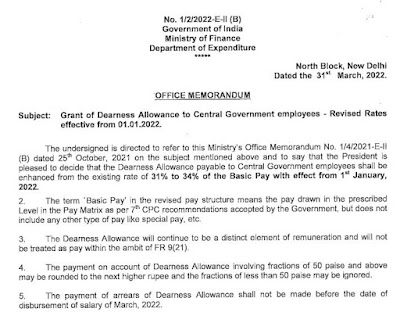
DA Jan 2022 - Grant of Dearness Allowance to Central Government employees - Revised Rates effective from 01.01.2022

 3% DA Hike - Revised Rates effective from 01.01.2022: DoE OM dated 31.03.2022 No. 1/2/2022-E-II (B) Government of India Ministry of Finance...