Showing posts with label Retirement Benefits. Show all posts

Tuesday, 3 September 2019

Pension and Other Retirement Benefits for Assistant Section Officers with Pension cases (Code: PRB-2) will be conducted by this Institute from 02.12.2019 to 06.12.2019


Pension and Other Retirement Benefits for Assistant Section Officers with Pension cases (Code: PRB-2) will be conducted by this Institute from 02.12.2019 to 06.12.2019

Programmes on Pension & Other Retirement Benefits ( PRB-2-14)

Dated : 28th August, 2019
To
  1. The Secretary to the Govt. of India
    (All Ministries / Departments)
  2. The Chief Controller of Accounts/ Controller of Accounts
    (All Ministries / Departments)
  3. The Head of Department, All Attached & Subordinate Offices.
Sub:- Training Circular - Special Programme on Pension and other Retirement Benefits for Assistant Section Officers and equivalent officers dealing with Pension cases (Code: PRB2-14) will be conducted by this Institute from 02.12.2019 to 06.12.2019.

Madam / Sir,
A special Programme on Pension and Other Retirement Benefits for Assistant Section Officers and equivalent officers dealing with Pension cases (Code: PRB-2) will be conducted by this Institute from 02.12.2019 to 06.12.2019.

The Programme particulars are given in annexure to this letter. Nominations may be submitted online. The online form which is available at ISTM website: http://www.istm.gov.in/ under the link ‘Online Form’, may be sent well before the closing date, i.e. 2nd November, 2019. Besides, the print out of the ‘Online nomination form’ duly sponsored by the sponsoring authority may also be sent by post/by hand to Mr. Nafe Singh, Faculty Consultant and Course Director, so as to reach by 5.00 PM on 2nd November, 2019. No nomination shall be accepted without being duly sponsored and received online within the stipulated date. List of accepted nominations will be displayed in ISTM website. The course may be cancelled / postponed on account of less number of nominations or other administrative compulsion.

ISTM has a modest hostel facility where AC rooms are available on twin sharing, first come first served basis to the outstation participants only. The names of selected officials shall be placed on the website of ISTM under the link “Confirmed Nomination”. Only those candidates should be relieved, whose nominations have been accepted by this Institute and a confirmation to that effect is issued by ISTM.
Yours Faithfully
(Nafe Singh)
Faculty Consultant & Course Director
Encl: As above.

Source: istm.gov.in

Wednesday, 7 August 2019

PENSIONARY BENEFITS UNDER NPS ON VOLUNTARY RETIREMENT

PENSIONARY BENEFITS UNDER NPS ON VOLUNTARY RETIREMENT

GOVERNMENT OF INDIA
MINISTRY OF FINANCE
DEPARTMENT OF FINANCIAL SERVICES
RAJYA SABHA
UNSTARRED QUESTION NO.3404
ANSWERED ON JULY 23, 2019/
SHRAVANA 1, 1941 (SAKA)

PENSIONARY BENEFITS UNDER NPS ON VOLUNTARY RETIREMENT
  1. Shri Ravi Prakash Verma
Will the Minister of FINANCE be pleased to state:
(a) whether voluntary retirement is allowed to employees of Central Government covered under NPS after completion of 20 years of service on the lines of old pension scheme;
(b) if so, the details thereof;
(c) the details of pensionary benefits and other retirement benefits available/ allowed under NPS to employees who voluntarily retire;
(d) whether Government would increase its contribution to 20 per cent from 14 per cent under NPS in view of dismal returns on NPS fund to make it more attractive;
(e) if so, the details thereof; and
(f) if not, the reasons therefor?

ANSWER

The Minister of State (Finance) (Shri Anurag Singh Thakur)

(a) and (b) The features and benefits under National Pension System (NPS) and the old pension scheme are independent. Under NPS, there is a provision for voluntary retirement/exit prior to the age of superannuation, without linking it with the minimum number of 20 years of service.
(c) As per Pension Fund Regulatory and Development Authority (Exits and Withdrawals under the National Pension System) Regulations, 2015, and amendments there under, the provisions for voluntary retirement/exit and the benefits available/ allowed under NPS to employees of Central Government who voluntary retires are as follows:

"3(b) where the subscriber who, before attaining the age of superannuation prescribed by the service rules applicable to him or her, voluntarily retires or exits, then at least eighty per cent out of the accumulated pension wealth of the subscriber shall mandatorily be utilized for purchase of annuity and the balance of the accumulated pension wealth, after such utilization, shall be paid to the subscriber in lump sum or he shall have a choice to collect such remaining pension wealth in accordance with the other options specified by the Authority from time to time, in the interest of the subscribers”

Further, as informed by the Department of Pension and Pensioners’ Welfare, the benefit of retirement gratuity and death gratuity has been extended to Government employees covered under NPS on the same terms and conditions as are applicable under CCS (Pension) Rules, 1972.

(d) to (f) Recently, vide Gazette Notification dated 31.01.2019, the mandatory contribution by the Central Government for its employees covered under NPS Tier-I has been enhanced from the existing 10% of basic pay +DA to 14% of basic pay + DA. The employees’ contribution rate would remain at the existing 10% of basic pay + DA. There is no proposal to increase the contribution to 20 per cent from 14 per cent under NPS.

Source: Rajya Sabha

Saturday, 20 April 2019

Request for reckoning the Additional Allowance granted to Loco Pilot (Mail), Loco Pilot (Passenger) and Mail Guard for the purpose of computation of retirement benefits to Running Staff

Request for reckoning the Additional Allowance granted to Loco Pilot (Mail), Loco Pilot (Passenger) and Mail Guard for the purpose of computation of retirement benefits to Running Staff.

NFIR

National Federation of Indian Railwaymen
No. IV/RSAC/2018
Dated: 18/04/2019
The Secretary (E),
Railway Board,
New Delhi

Dear Sir,
Sub: Request for reckoning the Additional Allowance granted to Loco Pilot (Mail), Loco Pilot (Passenger) and Mail Guard for the purpose of computation of retirement benefits to Running Staff.

Ref:
(i) NFIR's PNM Item No. 08/2011.
(ii) NFIR's letter No. IV/RSAC/Con./Part VIII dated 13/10/2017.
(iii) Railway Board's letter No-E(P&A)II-2011/FE2/2 dated 11/12/20l7.

Kind attention of Railway Board is invited to NFIR's PNM Agenda Item No. 08/2011, Federation's letter and Railway Board's reply thereon, iited under reference.

The Railway Board through Action Taken Statement during NFIR's PNM meeting held on 10th/11th May, 2018 conveyed that the issue has been referred to the Ministry of Finance vide Board's letter dated 14/09/2016 and reminders vide dated 22/11/2016, 16/02/2017 and 17/05/2017 have also been sent to the Ministry of Finance (DoE), but however reply was still awaited. Railway Board may kindly appreciate that this is more than eight years old PNM Item without finality.

NFIR, therefore requests the Railway Board to kindly make special effons for obtaining approval of Ministry of Finance in order to finalize this long pending PNM Item.

Yours faithfully,
(Dr. M.Raghavaiah)
General Secretary

Copy to the Executive Director, PC-I, Railway Board, DFCC Building, Tilak Bridge, Pragati
Maidan, Metro Bhavan, New Delhi.
Copy to the Executive Director (IR), Railway Board, New Delhi.
Copy to the General Secretaries of Zonal Unions of NFIR.
File No.8/2011 (PNM).
File No. IV/NFIR/RSAC-JC.

Source: NFIR

Friday, 1 February 2019

NFIR: Revision of Pension of Pre-2016 Retired Running Staff- Improper instructions of Railway Board


Revision of Pension of Pre-2016 Retired Running Staff- Improper instructions of Railway Board
NFIR
National Federation of Indian Railwaymen
3, CHELMSFORD ROAD, NEW DELHI - 110055
No.II/35/2018
Dated:28-01-2019
The Secretary(E)
Railway Board
New Delhi

Dear Sir,
Sub: Revision of Pension of Pre-2016 Retired Running Staff- Improper instructions of Railway Board - reg.

Ref: (i) GS/NFIR’s letter to Railway Board vide no.II/35/Part XIV dated 15-01-2018
(ii) Railway Board’s letter No.D-43/34/3017-F(E)III dated 24-01-2018
(iii) NFIR’s letter No.II/35/Part XIV dated 12-02-2018 & 26-02-2018 addressed to CRB.
(iv) NFIR’s PNM Agenda Item No.9 sent to Railway Board on 26-06-2018
(v) DoP&PW O.M.No.38/17/18-P&PW (A) dated 1st June 2018 to Railway Board.
(vi) Railway Board’s O.M.No.D-43/34/2017-F(E)III,dated 23-05-2018 & 16-08-2018 to Department of pension & Pensioners welfare Lok Nayak Bhawan, New delhi
(vii) NFIR’s letter No.II/35/2018 dated 19.09.2018 to Railway Boards.

Federation vide its letter dated 15-01-2018 provided to the Railway Board sample concordance tables for revision of pension cases of pre-01-01-2016 retired Running Staff. Railway Board vide letter dated 24-01-2018 have however issued instructions for revision of pension of pre-2016 retired Running Staff. The Federation vide its letter dated 26-02-2018 had pointed they be withdrawn as the same do not ensure correct revising of pension fixation of pre-2016 retired Running Staff. Federation also cited various provisions of DoP&PW and also those contained in IREM. Consequently, Railway Board vide O.M.dated 23-05-2018 sought clarification from DoP&PW to which the DoP&PW vide O.M.dated 01st June 2018 wanted few illustrations of the formulation so as to compare the pay/pension as on 01-01-2016 as per Railway Board’s instructions dated 24-01-2018 with pay and payable pension as suggested by our Unions.

Federation has come to know that the detailed information sought for by the DoP&PW has since been conveyed by the Railway Ministry vide OM dated 16-08-2018, but however progress in the matter is yet to be apprised to the Federation.

In this connection, NFIR also invites kind attention of the Railway Board to PNM Agenda item No.9 (sent to Railway Board on 26-06-2018) discussions on which are yet to take place. Federation however gives below additional points for consideration:-
  • Pay of General Category staff in Grade 5500-9000 on 31-05-2015 with 3 stagnation increments (i.e 9525/- Rs.56900) as on 01-01-2016
  • Likewise the Notional Pay of Running Should be fixed as Rs.56900 + 30% i.e. Rs.73,970. Thus, retirement benefit of Running Staff would then be calculated on Notional pay i.e. Rs.73,970 + 55% – Rs.1,14,659 and payable pension comes to Rs.57329.50
  • whereas, as per Railway Board’s order 30% pay element is not to be added on Rs.56900 and retirement benefit calculated on Rs.56900 + 55% divided by 2 i.e. Rs.56900 + 31295 = 88195 divided by 2 i.e. Rs.44090 hence a loss of Rs.13,229 in pension.
NFIR, therefore, once again requests the Railway Board to furnish proper illustrations to the DoP&PW for obtaining clear clarification for arriving at actual entitled pension to the retired Running Staff. A copy of the reference made to the DoP&Pw may also be provided to the Federation.

Yours faithfully
(Dr.M.Raghavaiah)
General Secretary
Source: NFIR

Saturday, 28 July 2018

Retirement Benefits for Central Government Employees

Retirement Benefits for Central Government Employees

Pension

The minimum eligibility period for receipt of pension is 10 years. A Central Government servant retiring in accordance with the Pension Rules is entitled to receive pension on completion of at least 10 years of qualifying service.
In the case of Family Pension the widow is eligible to receive family pension on death of her spouse after completion of one year of continuous service or even before completion of one year if the Government servant had been examined by the appropriate Medical Authority and declared fit for Government service.
W.e.f 1.1.2006, Pension is calculated with reference to emoluments (i.e.last basic pay) or average emoluments (i.e. average of the basic pay drawn during the last 10 months of the service) whichever is more beneficial. The amount of pension is 50% of the emoluments or average emoluments whichever is beneficial.
Minimum pension presently is Rs. 9000 per month. Maximum limit on pension is 50% of the highest pay in the Government of India (presently Rs. 1,25,000) per month. Pension is payable up to and including the date of death.

Commutation of Pension

A Central Government servant has an option to commute a portion of pension, not exceeding 40% of it, into a lump sum payment. No medical examination is required if the option is exercised within one year of retirement. If the option is exercised after expiry of one year, he/she will have to under-go medical examination by the specified competent authority.
Lump sum payable is calculated with reference to the Commutation Table. The monthly pension will stand reduced by the portion commuted and the commuted portion will be restored on the expiry of 15 years from the date of receipt of the commuted value of pension. Dearness Relief, however, will continue to be calculated on the basis of the original pension (i.e. without reduction of commuted portion).
The formula for arriving for commuted value of Pension (CVP) is
CVP = 40 % (X) Commutation factor* (X)12
* The commutation factor will be with reference to age next birthday on the date on which commutation becomes absolute as per the New Table annexed to the CCS (Commutation of Pension) Rules, 1981.

Death/Retirement Gratuity

Retirement Gratuity
This is payable to the retiring Government servant. A minimum of 5 years' qualifying service and eligibility to receive service gratuity/pension is essential to get this one time lump sum benefit. Retirement gratuity is calculated @ 1/4th of a months Basic Pay plus Dearness Allowance drawn on the date of retirement for each completed six monthly period of qualifying service. There is no minimum limit for the amount of gratuity. The retirement gratuity payable for qualifying service of 33 years or more is 16 times the Basic Pay plus DA, subject to a maximum of Rs. 20 lakhs.

Death Gratuity
This is a one-time lump sum benefit payable to the nominee or family member of a Government servant dying in harness. There is no stipulation in regard to any minimum length of service rendered by the deceased employee. Entitlement of death gratuity is regulated as under:

Qualifying ServiceRate
Less than one year2 times of basic pay
One year or more but less than 5 years6 times of basic pay
5 years or more but less than 11 years12 times of basic pay
11 years or more but less than 20 years20 times of basic pay
20 years or moreHalf of emoluments for every completed 6 monthly period of qualifying service subject to a maximum of 33 times of emoluments.
Maximum amount of Death Gratuity admissible is Rs. 20 lakhs w.e.f. 1.1.2016

Service Gratuity
A retiring Government servant will be entitled to receive service gratuity (and not pension) if total qualifying service is less than 10 years. Admissible amount is half months basic pay last drawn plus DA for each completed 6 monthly period of qualifying service. This one time lump sum payment is distinct from retirement gratuity and is paid over and above the retirement gratuity.

Issue of No Demand Certificate
Dues owed by the retiring employees on account of Licence Fee for Government accommodation, advances, over payment of pay and allowances are required to be assessed by the Head of Office and intimated to the Accounts Officer two months in advance of the date of retirement so that these are recovered from retirement gratuity before payment. For this purpose the Licence Fee for those in occupation of Government accommodation is taken into account up to the end of the permissible period for which accommodation can be retained after retirement under the Rules on normal rent. The recovery of Licence Fee beyond that period is the responsibility of the Directorate of Estates. If, for any reason final dues cannot be assessed on time, then 10% of gratuity is withheld from gratuity on the basis of a commutation from the Directorate of Estates in this regard.

General Provident Fund and Incentives
As per General Provident fund (Central Services) Rules, 1960 all temporary Government servants after a continuous service of one year, all re-employed pensioners (Other than those eligible for admission to the Contributory Provident Fund) and all permanent Government servants are eligible to subscribe to the Fund. However, these rules are not applicable to any of the Government Servants who join service on or after 1.1.2004. A subscriber, at the time of joining the fund is required to make a nomination, in the prescribed form, conferring on one or more persons the right to receive the amount that may stand to his credit in the fund in the event of his death, before that amount has become payable or having become payable has not been paid. A subscriber shall subscribe monthly to the Fund except during the period when he is under suspension. Subscriptions to the Provident Fund are stopped 3 months prior to the date of superannuation. Rates of subscription shall not be less than 6% of subscribers emoluments are not more than his emoluments. Rate of interest varies according to notifications of the Government issued from time to time. The rules provide for drawal advances/ withdrawals from the fund for specific purposes.
The conditions for withdrawal from the fund have been liberalized and now no documentary proof is required to be furnished by the subscriber for GPF withdrawal. On retirement of a subscriber, instructions have been issued for immediate payment of final balance on retirement. No application is required to be submitted by the subscriber for final payment from the fund

Deposit Linked Insurance Scheme
Under the GPF Rules, on the death of subscriber, the person entitled to receive the amount standing to the credit of the subscriber shall be paid an additional amount equal to the average balance in the account during the 3 years immediately preceding the death of the subscriber subject to certain conditions provided in the relevant Rule. The additional amount payable under that Rule shall not exceed Rs. 60,000/-. To get this benefit, the subscriber should have put in at least 5 years service at the time of his/her death.

Contributory Provident Fund
The Contributory Provident Fund Rules (India), 1962 are applicable to every non-pensionable servant of the Government belonging to any of the services under the control of the President. A subscriber, at the time of joining the Fund is required to make a nomination in the prescribed Form conferring on one or more persons the right to receive the amount that may stand to his credit in the Fund in the event of his death, before that amount has become payable or having become payable has not been paid.
A subscriber shall subscribe monthly to the Fund when on duty or Foreign Service but not during the period of suspension. Rates of subscription shall not be less than 10% of the emoluments and not more than his emoluments. The employer's contribution at that percentage prescribed by the Government will be credited to the subscriber's account and this is 10%. The Rules provide for drawal of advances/ withdrawals from the CPF for specific purposes. As in GPF Rules, the CPF Rules also provide for Deposit Linked Insurance Scheme.

Leave Encashment

Encashment of leave is a benefit granted under the CCS (Leave) Rules and is not a pensionary benefit. Encashment of Earned Leave/Half Pay Leave standing at the credit of the retiring Government servant is admissible on the date of retirement subject to a maximum of 300 days.

Central Government Employees Group Insurance Scheme

A portion of monthly contributions paid while in service is credited in a Saving Fund, on which interest accrues. A Government servant while entering service has to apply in Form No. 4 of the above Scheme to the Head of Office, who shall issue a sanction for the payment of subscriber's accumulation in the Savings Fund segment together with interest and arrange for its disbursement, soon after retirement. Payments under this Scheme are made in accordance with the Table of Benefit (as issued by Department of Expenditure) which takes in to account interest up to the date of cessation of service. Insurance cover benefit under this Scheme is available to the family in the event of death of the subscriber.

Monday, 3 July 2017

Enhanced DA after Retirement on 30th June and 31st December to be considered for Retirement Benefits

Enhanced DA after Retirement on 30th June and 31st December to be considered for Retirement Benefits
Shri. JVSR.Krishna raised an important issue in our comments forum. Considering the merits of this issue, we posted here to draw the attention of authorities concerned to take necessary action to address the grievances of similarly placed retiring government servants.

Dearness Allowance & Dearness Relief:
As per the prevailing conditions, Govt of India sanctioning DA once in 6 months i.e. 1st Jan. & 1st July. Based on consumer price index, due to raise in the inflation for the period of once in 6 months i.e. 1st Jan. to 30th June & 1st July to 31st December respectively DA being sanctioned to those Central Govt. employees and as DR to the Central Govt. Pensioners. This DA/DR is cumulatively added every month, for administrative convenience, it was being sanctioned once in 6 months. For those Central Govt. employees who were having DOB 1st of any month are being forcibly superannuated on the last working day of the preceding month. Particularly, those who were having DOB 1st Jan. & 1st July, though they have completed 6 months, sanctioned DA was not considered for calculating Retirement benefits viz. Gratuity & Leave encashment purpose.

Retired Government servants is entitled for revised rate of D.A
whether a retired Government servant is entitled for revised rate of D.A., which comes into force after such Government servant retires from service on attaining the age of superannuation.
As per the Honble. CAT judgement, DA was allowed for calculation of retirement benefits; to those retired on 30th June (DA was sanctioned next to their retirement date. The said case was appealed in Honble. High Court of A.P. the WP was dismissed, further, Govt. of India appealed as SLP in Honble. Supreme Court of India, there also it was dismissed.

Orders were issued for implementation of DA to the Central Govt. Servants, who were working in Accountant General Office, Hyderabad. The same was implemented.
Since, it is a common issue, individuals who were worked in various Departments of Central Govt. should not insisted that who ever will proceed litigation, it will be implemented. It shall be implemented across the board to all the employees to save the money & man power of Govt. of India to avoid litigations.

References: a) CAT Hyderabad Bench OA No.552 of 2003;
b) High Court , Andhra Pradesh WRIT PETITION NO.26506 OF 2012 dt.11/9/2012
c) Supreme Court SLP No.16237/2013 dt.27.10.2014
d) Through Lr No.PAG(G&SSA)/Legal Cell/RTI/F.No.118/2016-17/D.No.45 dt.02/11/2016 intimated that Supreme Court order was implemented for payment of Retirement Gratuity & cash equivalent to leave salary.

Friday, 7 April 2017

Non-payment of retirement benefits to the Running Staff retired on or after 01/01/2016


Non-payment of retirement benefits to the Running Staff retired on or after 01/01/2016-reg

Registration No. : RTU/Nnn/31/2012
NFIR
National Federation of Indian Railwaymen
3, CHELMSFORD ROAD, NEW DELHI - 110 055
Affiliated to
Indian National Trade Union Congress (INTUC)
International Transport Workers Federation (ITF)

No.IV/RSAC/Conf./Part VII
Dated: 15/03/2017
The Member Staff,
Railway Board,
New Delhi

The Financial Commissioner (Railways),
Railway Board,
New Delhi

Dear Sir,
Sub: Non-payment of retirement benefits to the Running Staff retired on or after 01/01/2016-reg.
Complaints are being received quite frequently from the Zonal Railways that the Running Staff retired on or after 01/01/2016 have not yet been paid pensionary dues duly adding 55% to their 7th CPC Pay Matrix. It is further learnt that due to IPAS problems, almost on all the Zonal Railways, revised pensionary benefits have not been paid and the Administration has also not taken initiatives to solve the technical problem in co-ordination with the CRIS.

NFIR requests kind intervention in the matter so as to see that the retired Running Staff (from 01/01/2016 onwards) are paid retiral benefits duly reckoning 55% of pay as part of 7th CPC pay. Incidentally, Federation also conveys that all those retired Running Staff are entitled for pension arrears on revision of their present pension with the 55% addition of pay element.

NFIR, therefore, requests the Board (MS & FC) to take immediate action in resolving this issue in co-ordination with CRIS.

Action taken in the matter may kindly be advised to the Federation in due course.
Yours faithfully
(Dr. M. Raghavaiah)
General Secretary
GOVERNMENT OF INDIA
MINISTRY OF RAILWAYS
(RAILWAY BOARD)
No.2015/AAC-II/21/11
New Delhi, dated 30.03.2017
FA&CAO,
Western Railway
Mumbai

Sub: Non-Payment of retirement benefits to the Running Staff retired on or after 01.01.2016.
Please find enclosed NFIR's letter no.IV/RSAC/Conf./Part VII dated 15.03.2017 on the above subject which is self explanatory.

It is requested to kindly examine the same for taking further action in consultation with CRIS under intimation to Board's Office.

DA: As above
(V.Prakash)
joint Director Accounts
Railway Board
Signed Copy

Monday, 6 March 2017

NFIR: Agenda Points for Next NC JCM Standing Committee Meeting

NFIR: Agenda Points for Next NC JCM Standing Committee Meeting

No.IV/NFIR/SCM/Pt.VI
Dated: 05/03/2017
The Secretary,
JCM (Staff Side),
13-C, Ferozshah Road,
New Delhi

Dear Brother.
Sub: Agenda Items for next meeting of Standing Committee of NC (JCM)-reg.
Ref: Ministry of Personnel, Public Grievances & Pensions, DoP&T’s letter No.F.No.3/3/2016-JCA dated 1st March 2017.

Please find enclosed the items to be included in the agenda for meeting.
Yours faithfully,
sd/-
(Dr.M.Raghavaiah)
General Secretary

Sub: Counting full service of Temporary causal labourers for pensionary and retirement benefits in Railways-reg.

The Staff Side had discussed its demand for counting fulI service of temporary status of casual labourers for pensionary and retirement benefits at the level of Railway Ministry. Consequently, the Railway Ministry had agreed and accordingly proposal was sent to the Ministry of Finance and DoP&T seeking clearance. Unfortunately, the MoF/DoP&T have not accorded approval:-

In this connection, the Staff Side brings following key points for consideration.

(a) The Casual Labourers in Railways had attained temporary status on completion of prescribed days of continuous working and got the benefits admissible to temporary Railway/Government employees such as regular Pay Scale, Medical facility etc.,
(b) The Railway Administrations have however taken abnormally long periods to absorb them as regular staff although regular posts were vacant.
(c) The status of casual labourers in railways after acquiring temporary status (termed as Temporary employee) is exactly similar to the substitutes in whose case, the total service from the date of attainment of temporary status is counted for reckoning qualifying service for pensionary benefits.
(d) Various CATs, High Courts and even the Apex Court have given decisions against the differential treatment between the casual labour and substitutes particularly when both attained temporary status and directed to treat them at par so far as reckoning the service from the date of temporary status till the date of regularization for pensionary benefits etc.,
(e) The SLPs filed by the Union of India before the Apex Court in a few cases of casual labourers were dismissed and the Hon'ble Supreme Court had directed the Union of India to calculate Pension and other retiral benefits payable to the retiring/retired employees, taking into account the 100% temporary status service.

The Staff Side, therefore, requests to consider the above valid points and accord approval for counting total temporary status service of Casual Labourers for pensionary benefits in Railways.

Sub: Modified Assured Career Progression Scheme (MACPS) for the Central Government Employees - Arbitrary revision of benchmark from Good to Very Good-reg.

The Staff Side brings to the notice of the Government that after introduction of the Modified Assured Career Progression Scheme (MACPS) w.e.f. 01st June 2009, the JCM (Staff Side) took up the issue relating to the benchmark laid down for granting financial upgradation under the schemd at the level of DoP&T and discussed in the Joint Committee Meetings and National Advisory Committee Meetings held on 17/0712012 ad 2710712012, urging to reconsider the benchmark concept taking into consideration the norms laid down for promotion of staff. After discussions, the DoP&T vide O.M. No. 35034/3/2008-Estt. (D) (Vol. II) dated 1st November 2010 & 4th October 2012 had issued instructions that the benchmark maintained for filling the vacancy through promotion by selection/non-selection/fitness be adopted for granting financial upgradation.

The Staff Side however, expresses its disappointment over the decision (Resolution No.1-2/2016-IC dated 25th July 2016) of the Ministry of Finance (Department of Expenditure) introducing the benchmark "Very Good" for granting financial upgradation. The Government could have taken into consideration the bilateral agreement reached with the JCM (Staff Side) and the decision communicated vide DoP&T O.M. dated lst November 2010 and 4th October 2012 for continuance of the standard prescribed already for granting MACP. Ignoring the said decision and introducing the benchmark concept of "Very Good" is an unjustified action when bilateral agreement had already been reached with the JCM (Staff Side).

The Staff Side therefore urges to review for cancellation of upgraded bench mark decision.

Source: NFIR

Saturday, 11 February 2017

Pay element in the case of Loco Inspectors - 30% addition to 7th CPC pay matrix for refirement benefits


Pay element in the case of Loco Inspectors - 30% addition to 7th CPC pay matrix for refinement benefits
NFIR
National Federation of Indian Railwaymen
3, CHELMSFORD ROAD, NEW DELHI - 110 055

Affiliated to:
Indian National Trade Union Congress (INTUC)
International Transport Workers Federation (ITF)
No-IV/RSAC/Conf./Pt. VII
Dated: 08/02/2017
The Secretary (E),
Railway Board,
New Delhi

Dear Sir,
Sub: Pay element in the case of Loco Inspectors - 30% addition to 7th CPC pay matrix for retirement benefits - reg.

Ref: (i) NFIR's demand in the Board PNM meeting held on 22nd & 23rd December, 2016 for continuance of 55% & 30% pay element on 7th CPC pay matrix levels.

(ii)Railway Board' s letter No.E(P&A)II-2015/RS-25 dated 24/01/2017.

Pursuant to NFIR's references and discussions held in the Railway Board PNM meeting on 22nd and 23rd December, 2016, the Railway Board vide letter dated 24/01/2017 has issued instructions to the GMs of Zonal Railways to reckon add-on pay element of 55% on 7th CPC pay matrix levels for calculation of emoluments for the purpose of retirement benefits and 30% for other purposes to the running staff as per IREM provisions and extant instructions.

In the above context, NFIR brings to the notice of the Railway Board that in terms of the extant instructions (Railway Board's letter No.E(P&A)II/83/RS-10(IV) dated 25/11/1992) contained in para 5.5 of Board's letter dated 25/11/1992, the running staff deployed as Loco Inspectors are entitled for 30% addition to their basic pay for the purpose of pensionary benefits. Those Loco Inspectors retired/retiring w.e.f. January 2016 are required to be granted retirement benefits with 30% add on to their pay in the 7th CPC pay matrix level, but, however in the absence of Railway Board's instructions, some Zonal Railways are entertaining doubts and denying benefit of 30%o on revised pay matrix.

NFIR, therefore, requests the Railway Board to issue suitable clarification to the Zonal Railways to ensure 30% addition to the 7th CPC pay matrix of Loco Inspectors for payment of retiral benefits similar to running staff for whom 55% addition is allowed. A copy of the instruction issued may be endorsed to the Federation.

Yours faithfully,
(Dr M.Raghavaiah)
General Secretary
Source: NFIR

Friday, 21 October 2016

Merger of Dearness Allowance with the Basic Pay - Computation of emoluments of Running Staff for granting retirement benefits

Merger of Dearness Allowance with the Basic Pay - Computation of emoluments of Running Staff for granting retirement benefits
GOVERNMENT OF INDIA
MINISTRY OF RAILWAYS
RAILWAY BOARD
E(P&A)II-2012/DC/JCM/1
New Delhi, Dated 17.10.2016
The General Secretary,
NFIR,
3, Chelmsford Road,
New Delhi - 110055

Sub: Merger of Dearness Allowance with the Basci Pay w.e.f. 01.04.2004 - computation of emoluments of Running Staff for granting retirement benefits - reg.

Ref: NFIR's letter No.IV/RSAC/Conf./Part VII dated 05.09.2016

I am directed to refer to your letter dated 05.09.2016 wherein the Federation has mentioned that Northern Railway has vide letter 720/EW/Misc/Union-Items/2015/E.IV/Loose dated 16.11.2015 correctly computed the emoluments of Running Staff with reference to Dearness Allowance and 30% thereon for the purpose of allowing the retirement benefits to those Running Staff who had retired during the period 01.04.2004 and 31.12.2005.

The matter has been examined in Baord's office and its observed that the methodology for computation contained in Northern Railway's letter referred to above, is not in conformity with the instructions on the matter as laid down in Baord's letter No.E(P&A)II-2004/RS-13 dated 12.10.2004, Northern Railway has accordingly been advised to take immediate corrective action in the matter vide Board's letter No.E(P&A)II-2014/RS-24 dated 22.07.2016.
Yours faithfully,
sd/-
For Secretary/Railway Board
Source: NFIR

Saturday, 27 August 2016

Centre Extends Retirement Benefits to all Central Government Employees

Centre Extends Retirement Benefits to all Central Govt Employees – Under the existing system the pension of the Government servants appointed on or after January 1, 2004 is regulated by the new Defined Contribution Pension System.

In a measure that would benefit thousands of Central government employees, the central government on Friday extended the Retirement Benefits and death gratuity to all, irrespective of the date on which they had entered government service.

Under the existing system the pension of the Government servants appointed on or after January 1, 2004 is regulated by the new Defined Contribution Pension System (known as National Pension System) whereas those who were in service earlier were covered under the Central Service (Pension) Rules, 1972.

According to a notification by the Department of Personnel, the issue of grant of gratuity in respect of government employees covered by the National Pension System has been under consideration and it has now been decided that they shall be eligible for Retirement Benefits, gratuity and Death gratuity’ on the same terms and conditions, as are applicable to other employees covered by the Central Service (Pension) Rules, 1972.

It said these orders will be applicable to those Central Civil Government employees ‘who joined Government service on or after January 1,2004 and are covered by the National Pension System and will take effect from the same date.’

Source: The Hindu

Thursday, 25 February 2016

Government servant getting retirement benefit from deputation office

Government servant getting retirement benefit from deputation office

Appointment to a post on deputation basis is made for a period normally specified in the Recruitment Rules of the deputation post, unless the period of deputation is extended by the Government in terms of prevailing instructions. After expiry of such deputation period, the Government servant is required to revert back to the parent organization/ office. The Guidelines regulating premature repatriation from Central Deputation also provide for repatriation to parent cadre in certain cases such as to avail benefit of promotion. However, there are no specific instructions which require a Government servant on deputation to be reverted back to the parent organization/ office before retirement only to facilitate fixation of pensionary benefits.

Rule 33 of Central Civil Services (Pension) Rules prescribes the emoluments to be taken into account for calculating pension.

This was stated by the Minister of State in the Ministry of Personnel, Public Grievances and Pensions and Minister of State in the Prime Minister’s Office Dr. Jitendra Singh in a written reply to a question by Shri Motilal Vora in the Rajya Sabha today.

Tuesday, 12 January 2016

Timely payment of Retirement/Death benefits: Instructions by KVS

Timely payment of Retirement/Death benefits: Instructions by KVS

KENDRIYA VIDYALAYA SANGATHAN (HQ)
18, Institutional Area, S.J. Marg,
New Delhi-110016.
No.F.18(1362)KVS(HQ)Misc/2015
Dated:23/12/2015
To
The Deputy Commissioner,
All Regional Offices.

Sub: Timely payment of Retirement/Death benefits — reg.

Madam/Sir,

As per extant instructions the retirement benefits are to be paid to retiring employees on the day of retirement. In case of death of employee while in service, it is the duty of the Head of Office to get the papers completed from the family of the deceased employee and settle the dues most expeditiously so that the family of the deceased does not suffer for want of financial support. Various stages for preparatory work have already been prescribed in Accounts Code as amended from time to time.

Primary responsibility for timely completion of papers and sending these to the Pension Sanctioning Authority rests with the Head of Office (Principal in case of staff working in Vidyalayas and Deputy Commissioner in case of Regional Office). Nevertheless the Deputy Commissioner as administrative head of the Region as well as Pension Sanctioning Authority in respect of staff working in Kendriya Vidyalayas has overall responsibility to ensure timely sanction and payment of dues accruing on retirement/death of the employees.
It has been observed that in a number of cases the Principals as well as the Deputy Commissioners have been found to be quite insensitive to the matter concerning retirement/death benefits of the employees. In death cases particularly, the distressed families whose bread winner is no more have to wait for months together for getting the dues. A single day’s delay in payment of salary to a regular staff creates a big hue and cry. What happens to a family who is not only bereaved but also lost financial support all of a sudden. While the struggle of the family is unimaginable, it is inhuman on the part of the Officers concerned to leave this sensitive issue at the mercy of lower level functionaries and go with their own priorities.
Delay in settlement of cases pertaining to retirement/death benefits on the part of the Officers/officials concerned has been viewed very seriously. Already a Finance Officer has been put under suspension for laxity in supervision and action is being initiated in other similar cases to fix responsibilities on defaulting employees irrespective of their position and status.
Deputy Commissioners of all Regional Offices are, therefore, advised to take note that there shall be Zero tolerance for delay in settlement of retirement/death benefits of the employees at all levels. These instructions should be circulated to all Kendriya Vidyalayas under jurisdiction of respective Regions.

Yours faithfully,
(Santosh Kumar Mall)
COMMISSIONER
Authority : www.kvsangathan.nic.in
Click to view the order

Friday, 13 March 2015

NFIR: Retirement benefits of railway employees

NFIR: Retirement benefits of railway employees

Counting of services paid from contingencies with regular service for retirement benefits of raiiway employees who have put in such service – reg.
NFIR
Natiohal Federationf Indian Railwaymen
3, CHELMSFORD ROAD,
NEW DELHI – 1 10 055
Affiliated to :
Indian NationalTrade Union Congress (INTUC)
International Transport Workers’ Federation (lTF)
No. Il/35/pt.11
Dated: 09/03/2015
Thc Secretary (E),
Railway Board,
New Delhi

Dear Sir,

Sub: Counting of services paid from contingencies with regular service for retirement benefits of raiiway employees who have put in such service – reg.

Ref:
(i) NFIR’s PNM Item No.27/2011 & 3/2013.
(ii) Ministry of Railway’s OM No.E(NG)II/2014/CL/14 dated 25/11/2014 to the Secretary, Dop&T, North Block, NewDelhi.
(iii) NFIR’s letter No.II/35/Part.11 dated 07/01/2015.
(iv) Ministry of Personnel, Public Grievances & pensions, Dop&T oM No. Misc- 14017/6/2015 – Estt(RR), Dy. No. 1066914/15/CR dated 26/02/2015 addressed to Secretary, Railway Board, New Delhi & copy endorsed to the General Secretary, NFIR

The Secretary, DoP&T, North Block, New Delhi while enclosing copy of NFIR,s lefter No. II/35/Part. 11 dated 07/01/2015, has addressed letter to the secretary, Railway Board (OM dated 26/02/2015), wherein the Railway Ministry has been advised to send the proposal in accordance with the procedure laid down in Dop&T OM No. 2034/2/2010 – Estt. (D) dated 13th August, 2010.

Federation also desires to state that the issue was discussed in the NFIR’s PNM meeting held with the Railway Board on 19th/20th December, 2014 wherein the official Side while discussing PNM Itern No. 27/2011 & 3/2013 had stated that the subject matter has been referred to the DoP&T vide dated 25/11/2014 whose response was awaited. However the Dop&T’s OM dated 26/02/2015 reveals that the Railway Ministry has not sent proposal in the prescribed format. For ready reference copy of DoP&T OM dated 26/02/2015 is enclosed.

NFIR, therefore, requests the Railway Board to kindly see that proper proposal is sent to the DoPT duly endorsing copy to the Federation. The matter may be treated as important in view of the fact that the PNM item is pending since four years.
DA/As above
Yours faithfully,
(Dr. M. Raghavaiah)
General Secretary
Source: http://www.nfirindia.org/

Wednesday, 4 June 2014

Memorandum to VII CPC on merger of DA with Pay and Interim Relief

Memorandum to VII CPC on merger of DA with Pay and Interim Relief:-

National Council (Staff Side)
Joint Consultative Machinery
for Central Government Employees
13-C, Ferozshah Road, New Delhi - 110001
Shiva Gopal Mishra
General Secretary
No.NC4JCM/2O14/VII CPC
Dated: June 3, 2014
Justice Shri Ashok Kumar Mathur,
Chairman,
Seventh Central Pay Commission,
New Delhi
Dear Sir
Sub: Memorandum to VII CPC on merger of DA with Pay and Interim Relief
As was decided in the Preliminary Discussion Meeting, held on 28”‘ May, 2014, with the VII CPC, we submit herewith Memorandum on Merger of Dearness Allowance with Pay and Interim Relief, on behalf of Staff Side, National Council(JCM).
Yours faithfully,
sd/-
(Shiva Gopal Mishra)
Copy to: Ms Meena Agan/val, Secretary, Seventh Central Pay Commission (Government of India), New Delhi, along with a copy of above cited memorandum.
Encl: As above
Copy to: All Constituent Organizations of the NC/JCM(Staff Side), along with a copy of above cited memorandum.
Encl: As above
MEMORANDUM 
ON MERGER OF DA WITH PAY AND INTERIM RELIEF. 

We solicit the kind reference of the 7th Central Pay Commission to the discussion during the informal interaction the staff side of the National Council had with the Commission on 28.5.2014, when we inter alia raised the issue of merger of Dearness allowance and Interim Relief.
2. Before we dwell upon the issues, it may not be out of place to refer to the evolution of the JCM which later became the negotiating platform for the entirety of Central Government employees and workers It was conceived to bring about a conflict free industrial climate in Civil Service in the wake of the tumultuous experience of an industrial strike action in 1960. The National Council, the apex forum under the three tier system headed by the Cabinet Secretary was empowered to deliberate upon the common issues of the Central Government employees. The Staff Side, National Council, thus became the united voice of the entirety of the Central Government employees on fundamental issues like Wages, Pay Scales, Rate of increment, Dearness compensation and other general allowances.
3. However, over the years, JCM became an ineffective instrument to address the basic issues and demands of the employees. We shall detail the requirements to empower and streamline the functioning of the JCM as a negotiating forum in our Main Memorandum to the Commission.
4. The twin issues viz. Merger of DA and Interim relief had been the subject matter of discussion with the Government when the Staff side was called upon to present their views in the matter of finalization of the terms of reference for the 7th CPC by the Secretary, Personnel, (Department of Personnel and Training) in his capacity as Chairman, Standing Committee, National Council JCM. Though we pleaded for the specific reference of the above two issues, to the 7th CPC, the final 1 version of the terms of reference approved by the Government did not find a place for our views. We have, therefore, been constrained to take recourse to clause 5 in the terms of reference, which enables the Commission to send interim report to the Government.
MERGER OF DA WITH PAY: 
5. Dearness allowance is considered as a device to protect, to a greater or lesser extent, the real income of wage earners and salaried employees from the effects of rise in prices. As per the vagaries of price fluctuation in the market, the allowances are bound to go up and down. Constant rise in the price level, might bring about a situation whereby the quantum of allowance shall go up. Such a phenomenon of constant increase of prices of commodities gave rise to the demand for merger of Dearness allowances with pay so as to make it pay, rather than an allowance, with all concomitant benefits. A committee to advice the Govt. on the portion of such DA to be treated as pay was appointed on 15th July, 1952 (Resolution No. F6(6)E-II/52). The terms of reference of the Committee was :
“Taking in to consideration the rates of dearness allowance that have been sanctioned to date for Central Govt. servents, and the level at which cost of living index are likely to stabilize in the foreseable future, to recommend the percentage of dearness allowance now given to the Central Govt. servents which should be allowed to be treated as pay for all purposes in future, provided that by doing so the present total pay and dearness allowance is not enhanced:”
6. The said committee was headed by Shri N.V. Gadgil, Member of Parliament. The Committee in its report concluded that
“We have recorded the various reasons which we have taken into account in arriving at the conclusion that the appropriate level below which the All India cost of living index is not likely to fall, should be taken as 265-284. We find that for the index figure of 265, the Central Pay Commission formula allows Govt. Employees in the lowest pay group a dearness allowance of Rs.20/- and this amount remain unchanged until the cost of living index go above the index of the next level i.e. 285. We, therefore, consider that the employees in this pay group, a sum of Rs. 20/- which represents 50% of the present dearness allowance of Rs. 40 per month should be treated as pay (page 22 chapter V Report of the Dearness allowance Committee).”
7. The Committee also enumerated in their report the purposes for which the DA shall be treated as pay as under:-
  • Retirement Benefits
  • Travelling allowance
  • Compensatory allowance
  • House rent allowance
  • Compensation of Leave Salary etc.
8. The 3rd CPC, whose recommendations were implemented with effect from 1.1.1973 had no reference from the Govt. on the question of merger of DA. Still while dealing with the issue of Dearness allowance (vol.IV – Page 1 Ch.55) the Commission noted that “no other country in the world (except Ceylon and Pakistan) seems to be following the practice of paying dearness allowance or cost of living allowance as a separate element of wage. In most of the countries compensation to Govt. employees for the increase in the price level is given by way of periodical salary revisions Prior to the setting up of the 3rd CPC, pursuant to the discussion in the National Council, JCM, the entire dearness allowance as on 1.8.1966 was treated as Dearness pay and the consequent increase in allowance was granted by the Government with effect from 1.12.1968. In para 16, the Commission recommended that should the price level rise above twelve monthly index of 272 ( 1960=100) the Government should review the position and decide whether the Dearness allowance Scheme should be extended further or the pay scale themselves should be revised. ( Page 4 Chapter 55. Vol. 4 3 rd CPC report). On crossing the index point of 272, the Government conceded the demand for merger of 36% of DA with pay. Later, based on an agreement reached at the National Council JCM the DA granted upto the index level of 320 points i.e. 60% of the Basic Pay was merged through executive instructions for purpose of allowances and pension. Before the 4th CPC was set up in 1983, the issue of further merger of DA with Pay was raised by the employees. Conceding the demand the Government decided that DA entitled to be drawn upto the index average of 568 points be treated as pay for all purposes.

9. Since the Pay Scales were to be constructed with reference to the consumer price index as on the date of revision, every Commission had to perforce merge the entire DA when the actual revision was made. The DA on such revised pay is to be computed on the basis of annual average rise of index after every six months interval. Therefore, the question of merger of DA again rose at the time of negotiation with the Government for setting up the 5th CPC. An agreement was reached on merger of certain percentage of DA and interim relief. (Rs. 100/-) in September, 1993. In April, 1994, the Government issued notification setting up the 5 th CPC (resolution No. 5(12)E-III/93 dated 9.4.1994).
10. The Staff Side placed before the 5th CPC the necessity to merge DA with Pay at an index level below which prices were not likely to move downwards. Pointing out that in the last two decades i.e. 1980s and 1990s there had been not a single occasion when the annual average index had fallen consequent upon which the DA rates were to be reduced, they requested the Commission to merge the entire DA which had been at 97% of the Basic pay as on 1.7. 1993. (The AICPI index being 1201.66). The Commission after deliberations on the memorandum and discussion with the staff Side, recommended that 97% of Basic Pay as DA admissible from. 1.7. 1993 be treated as Pay for all purposes. However, they suggested that the said merger might be given effect only from 1.4. 1995.
The 5th CPC submitted its final report to the Government on 19th January, 1997. Before the Commission, the Staff side had demanded that as and when the consumer price index exceeds 25% of the base index at which the pay is fixed that proportion of Dearness allowance should be treated as Pay for all purposes and the decision on this must not be left at the discretion of the Government. The Commission considering this demand observed that:
“From the past trend of CPI given in annexure 11’8.1 it is observed that 50% increase in prices generally takes around five years to materialise. A mid-term quinquennial revision of salaries of the Government employees is not something the Government should grudge. In view of the above, we recommend that DA should be converted into Dearness Pay each time the CPI increases by 50% over the base index used by the last Pay Commission. Such DA should be termed as Dearness Pay and be counted for all purposes including retirement benefits. (Chapter 105 page 157)”. The 5th CPC thus regularised the periodical merger of DA into a well thought 11. out scheme. They also established that wage revision is needed either when the DA exceeds 50% over the base index or after five years .
12. The Government, however, did not act upon this recommendation, when the percentage of DA exceeded 50( 52%) as on 1.7.2002, though it had accepted the recommendation in 1997. With the persistent persuasion, ultimately, the Government issued orders treating 50% DA as Dearness Pay for all purposes with effect from.1.4.2004.
13. Even though the 5th CPC had brought about a finality on the approach to the question of merger of DA with pay, the 6th CPC reopened the issue afresh. The Commission made the following observation-
“This conversion (merger of DA with Pay) is however not necessary in the revised structure being recommended where increments are payable as a percentage of Pay in the Pay Band and Grade Pay thereon and provision has been made for all allowances/benefits to be revised periodically, linked to the increase in the price index. The Commission is, therefore, not recommending merger of DA with Basic pay at any stage.”
14. The 3rd, 4th and 5th Central Pay Commissions had approvingly endorsed the recommendations made by Gadgil Committee in 1952. The practice of periodical merger had been followed as a device to protect the erosion in the real value of wages (including allowances) especially at the lowest level of employees. This erosion becomes unbearable when DA crosses over 50%. To say that the increment rate which is presently 3% of pay would take care of the erosion is to say the least, atrocious. Increment is granted as a legitimate reward for the service rendered by an employee for a year. It has nothing to do with the erosion in the real value of wages. No doubt, the 6th CPC has recommended that a few allowances should be revised by 25% as and when the DA crosses over the stipulated 50%. Such allowances are very in number. Moreover, 25% rise as a compensation when the DA itself rises to 50% is arbitrary and conceived to compensate the worker with lesser amount than what he is entitled to.
15. We, therefore, strongly plead before the Commission, for the reasons enumerated in the foregoing paras, that the Dearness allowance as on 1.1.2014 which stood at 100% may be recommended to be merged and treated as Dearness Pay for grant of all benefits, allowances, pension and other retirement entitlements.
16. We further submit that Merger of D.A. as on 1.1.2014 may also be recommended in respect of pensioners and Gramin Dak Sewaks of Postal Departments.
INTERIM RELIEF 
Barring the 6th Central Pay Commission, all other Commissions had recommended grant of Interim Relief to the Central Government Employees. As per the 5thCPC, Interim relief represented a provisional arrangement during the period between setting up of a Pay Commission and submission of a report by the Commission and its acceptance by the Government. Most of the earlier Commissions with the exception of Ist and 6th Central Pay Commission had taken 2-3 years and sometimes more to finalise their recommendations. Despite the specific reference made to the 6th CPC, by the Government to consider grant of Interim Relief the Commission took the position that having decided to submit its recommendation within the stipulated period of eighteen months and having arrived at a view that its recommendations must be effective from 1.1.2006, it shall not waste time on the question of interim relief. What the 6th CPC failed to appreciate was the erosion in the real value of wages that had taken place over the years due to inflation and rise in prices of essential commodities and the inability especially of the employees at the lower level to make the both ends meet with the available wages. No doubt, the employees had been to some extent benefitted by the decision of the Government to merge 50% Dearness allowance and treat it as pay for all purposes including DA thereon.
2. Every Pay Commission which had recommended Interim Relief had made it amply clear that it was intended to provide some relief to the employees pending a comprehensive determination of their salary structure and other benefits. The relief granted was treated as sui generis (one of its own kind, unique) and it was not taken into account for determining any allowance or benefit.
3. We give below briefly the course of negotiation and approach of various earlier Pay Commissions on the question of grant of interim relief.
4. The Second Pay Commission gave a report within a month’s time and recommended an Interim Relief of Rs. 5/-. The third pay Commission gave three instalments of Interim Relief on varying rates. After appoint of the 4th CPC in July, 1983, Government sanctioned (Vide Department of Expenditure O.M.No. 7(39)-E III/83 dated 2nd August, 1983) on their own initiative Interim Relief at varying rates of Rs. 50 and Rs. 100 per month. In March, 1985, 4th CPC submitted a report and granted a further interim relief at 10% of Basic pay subject to a minimum of Rs. 50 per month. Again before the setting up of the 5th CPC, the Government sanctioned Rs. 100 as interim Relief. As it was not considered adequate, the staff side of the National Council, JCM submitted a memorandum to the 5th CPC demanding additional interim relief. The Govt. vide their Department of Expenditure, Resolution No. 5(12)EIII/93 dated 12.01.1995 amended the terms of reference to enable the Commission to decide upon the additional interim relief. The 5th Central Pay Commission in their interim report submitted on 2 nd May, 1995, recommended Interim Relief equal to 10% of Basic Pay subject to a minimum of Rs. 100/-. The terms of reference of 6th CPC on the issue of Interim Relief was as under:-
“2.g. To examine desirability and need to sanction any interim relief till the time the recommendations of the Commission are made and accepted by the Government. “
5. It has to be recalled that the Government did not initially refer the question of Interim Relief to the 5th CPC but when the Staff Side submitted their memorandum to the Commission on I.R., the Government had to amend the terms of reference and refer the issue to the Commission for their decision.

6. These go to establish the need for a relief in view of the erosion in the real value of wages, the need to fill the widening gap in wages when compared to outside rates and the fact that final recommendations of the 7 th Pay Commission are bound to revise the wage structure and above all the need to provide some relief to the employees who would retire before the Commission’s recommendations are finally submitted to the Government and accepted by them.
7. We give hereunder a table indicating the retail prices of the commodities which goes into the computation of minimum wage as per Dr.Ackroyd formula as on 1.1.2006 (quoted by the 6th CPC in their report. Page 53. Table 2.1`.1 Chapter 2.2.) and the actual retail price of those very commodities as on 1.1.2011. The percentage increase in the prices of each commodity is also given in the table. The average rise in prices was of the order of 174%, whereas the Dearness allowance entitlement was only 51%.. The table clearly indicate the erosion in the real value of the wages.
Sl.No
Name of articles
Price as 1.1.2006
As on date
%increase
1
Rice
18
38
120
2
Dhall 4 varieties; average
40
87
120
3
Raw vegetables
10
40
400
4
Green veg.
10
56
560
5
Other veg
10
40
400
6
Fruits
30
100
330
7
milk
24
32
40
8
Sugar,jiggery. average
24
43
95
9
Edible oil.3 varieties.average
50
95
95
10
Fish
120
300
150
11
meat
120
240
100
12
egg
2
3
50
13
Detergents/soap
200
350
75
14
Cloth
80
120
50
Average increase
174

8. The need based minimum wage computed on the basis of Dr Ackroyd formula as on 1.1.2014 will be around Rs. 26,000 bringing about a gap of almost 12,000 at the level of an MTS. We shall submit the details thereof in our main memorandum.

9. The only Public Sector undertaking in which the wage agreement has been reached in 2013 is the Coal India Limited. As per the said agreement, the minimum wage at the lowest level of the worker as on 1.12014 is:
Basic Pay --------------------------------Rs. 15, 712
Dearness allowance:  29.6%
Special allowance: 4.0%
Special DA: 1.795%
Attendance bonus:  10%
Total: 49.395%-------------------------- Rs. 7132.46
Total salary:  -----------------------------Rs.22844.46 
At the MTS level 22.844.46 x 130% ---- Rs.29697.


10. As per the formula adopted by the 5th CPC, the minimum wage will work out to Rs. 22,857 as under:

A. Per Capita NNP at constant price for 2004-05 - Rs. 24,143
B. Per capita NNP at constant price for 2011-12 - Rs. 38,037
C. The increase registered over 8 years. - Rs. 13,894.
D. Percentage increase over 2004-05 - 57.54877.
E. Emoluments of an MTS as on 1.1.2014 - Rs. 14,000
F. 57.55% of Rs. 14,000.  - Rs. 8,857.
G. Wage to be fixed in thecase of MTS as on1.1.14. - Rs. 22857.

From the above it is seen that Central Government employees presently have a very depressed salary structure. The final outcome of the deliberations of the 7 th CPC will become available only by 2016. It is, therefore, needed that the employees have to be compensated in the form of Interim Relief. In our opinion the Commission may, as has been done by the various earlier Pay Commissions, recommend atleast 25% of Pay in Pay Band plus Grade Pay as Interim Relief subject to a minimum of Rs. 4000/-. Incidentally we may point out that the grant of interim relief will enable the Government to spread out the financial outlay on account of wage revision over a period of more than three years.
We further urge that the Commission may kindly recommended Interim Relief at the above rate subject to minimum of Rs.2000/- to as pensioners and Gramin Dak Sevaks of Postal Department.

SHIVA GOPAL MISHRA
Secretary, Staff Side, National Council JCM.

Source: http://ncjcmstaffside.com/wp-content/uploads/2014/06/Memorandum-for-IR-and-DA-merger_03.06.2014.pdf

Flash News

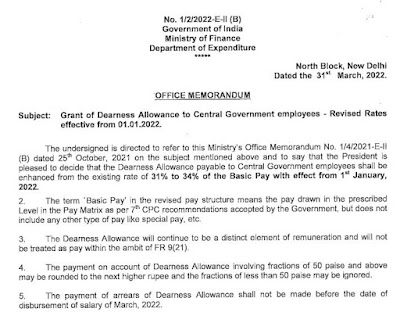
DA Jan 2022 - Grant of Dearness Allowance to Central Government employees - Revised Rates effective from 01.01.2022

 3% DA Hike - Revised Rates effective from 01.01.2022: DoE OM dated 31.03.2022 No. 1/2/2022-E-II (B) Government of India Ministry of Finance...