Showing posts with label 7th CPC Increment. Show all posts

Saturday, 28 December 2019

7th CPC Date of next increment under Rule 10 of Central Civil Services Revised Pay Rules 2016

7th CPC Date of next increment under Rule 10 of Central Civil Services Revised Pay Rules 2016

No. 4-21/2017-IC/E.IIIA
Government of India
Ministry of Finance
Department of Expenditure


North Block, New Delhi-110001
Dated the 28th November, 2019

OFFICE MEMORANDUM

Subject: Date of next increment under Rule 10 of Central Civil Services (Revised Pay) Rules, 2016 - Clarifications - regarding.

The undersigned is directed to invite the attention to Rule 10 of the CCS (RP) Rules, 2016 which provides for the entitlement of employees for drawal of annual increment either on 1st January or 1st July depending on the date of appointment, promotion or grant of financial upgrdation. The Sub-Rule (2) thereof provides that increment in respect of an employee appointed or promoted or granted financial up­-gradation including up-gradation under Modified Assured Carrier Progression Scheme (MACPS) during the period between the 2nd day of January and 1stday of July (both inclusive) shall be granted on 1st day of January and the increment in respect of an employee appointed or promoted or granted financial up-gradation under MACPS during the period between the 2nd day of July and 1st day of January (both inclusive) shall be granted on 1st day of July.


2. A number of references were received in the Ministry of Finance seeking clarifications regarding drawal of next increment by the employees promoted on 1st July, 2016. On consideration of the matter, Department of Expenditure vide it’s Office Memorandum of even number dated 31.07.2018 has clarified that in case an employee is promoted or granted financial up-gradation including up-gradation under the MACP scheme on 1st January or 1st July, where the pay is fixed in the Level applicable to the post on which promotion is made in accordance with the Rule 13 of the CCS (RP) Rules, 2016, the first increment in the Level applicable to the post on which promotion is made shall accrue on the following 1st July or 1st January, as the case may be, provided a period of 6 months qualifying service is strictly fulfilled. The next increment thereafter shall, however, accrue only after completion of one year.

3. Consequent upon issue of Office Memorandum dated 31.07.2018 different Ministries/ Departments have sought clarification on applicability of DOE's O.M dated 31.07.2018 keeping in view the provisions of Rule 10 of CCS (RP) Rules 2016 , Rule 22(I)(a)(1) of Fundamental Rules & provisions of Stepping up of pay. The issues on which various Ministries / Departments have sought clarifications and decisions thereon are brought in the succeeding paragraphs.
Issue No. 1: Whether after promotion on 1st July and fixation of pay with two increments the date of next increment will be 1st January or 1st July
4. During the regime of 6th CPC, when the annual increment was admissible uniformly on 1st July every year, employees completing 6 months and above in the revised pay structure as on 1st July were eligible for grant of increment. In the 7th CPC regime there are two dates of increments pt January and 1st July. Keeping in view the spirit of 6th CPC, O.M dated 31.07.2018 was issued providing for accrual of next increment on 1st July/1st January in respect of employees getting promotion on , 1st January/ 1st July provided 6 months qualifying service is strictly fulfilled.

5. The instructions contained in the O.M. dated 31.07.2018 are self-explanatory in respect of the cases of promotion/ financial up-gradation falling on 1st July or 1st January. These instructions provide that in case of promotion/ financial up­ gradation on 1st July and 1st January and getting fixation of pay in the Level applicable to the post in which promotion is made in accordance with Rule 13 of the CCS (RP) Rules 2016, the first increment in the level in which promotion is made shall accrue on the following 1st January or 1st July, as the case may be, provided a period of 6 months’ qualifying service is fulfilled.
Issue No.2 : Accrual of next increment in case of regular promotion / financial up­ gradation of an employee on any date other than the date of annual increment and option for pay fixation is exercised under FR 22(I)(a)(1).
The opportunity to exercise of option for pay fixation under FR 22(I)(a)(1) is available to employees in case of promotion / financial up-gradation. Therefore, the Central Government Employee promoted on regular basis/granted financial up­ gradation on any date other than the date of his/ her annual increment in lower grade and exercises the option under FR 22(I)(a)(1) read with Department of Personnel & Training’s OM No.13/02/2017-Estt.(Pay-I) dated 27.07.2017 for fixation of pay from the date of accrual of next increment in the scale of pay in lower grade, he may be allowed the 1st increment in promotional grade on 1st January/ 1st July as the case may be after completion of 6 months’ qualifying service after such fixation on 1st July/ 1st January (i.e., the date of increment in lower grade) on the analogy of Department of Expenditure’s OM dated 31.07.2018. The next increment, thereafter, shall however, accrue only after completion of one year.

Since there is material change, it has also been approved that the employees who have been regularly promoted or granted financial up-gradation on or after 01.01.2016 and desire to exercise/ re-exercise option for pay fixation under FR22(I)(a) (l) shall be given an opportunity to exercise or re-exercise of the option there under. Such an option shall be exercised within one month of issue of this O.M.
These instructions will be applicable with effect from 01.01.2016.

In so far as persons serving in the Indian Audit and Accounts Department are concerned, these orders issue after consultation with the Comptroller and Auditor General of India.

Hindi version of these orders is attached.

(B.K.Manthan)
Deputy Secretary to the Government of India
7th CPC Date of next increment under Rule 10 of Central Civil Services Revised Pay Rules 2016


Source: DoE

Thursday, 19 December 2019

Calculation Date of Next Increment (DNI) in Promotion – Questions and Answers of Rajya Sabha 2019

Clarification on Date of Next Increment (DNI) in Promotion – Rajya Sabha Questions and Answers 2019

In Rajya Sabha on 10.12.2019, a question was raised regarding the determination of date of next increment for Central Government employees. The Minister of State for Finance Shri Anurag Singh Thakur has replied in written form as follows…

“In case an employee, promoted between 2nd January and 30th June (both inclusive), opts for pay fixation from the date of next increment i.e., 1st July, the first increment on the level to which he/she has been promoted will be on following 1st January”.

Also he said, as per Department of Expenditure’s O.M. No. 4-21/2017-IC/E.III(A) dated 28.11.2019, the employee promoted on any other date than the date of annual increment and exercises the option under FR 22(1)(a)(1) for fixation of pay from the date of accrual of next increment in the scale of pay in lower grade, would be allowed the 1st increment in promotional grade on 1st January 1st July as the case may be after completion of 6 months’ qualifying service after such fixation on 1st July / 1st January (i.e., the date of increment in lower grade).

Source: DoPT & MoF Orders

Tuesday, 29 October 2019

Madras High Court Order - Notional increment of pensionary benefits

Madras High Court Order - Notional increment/re-fixation of pensionary benefits

Notional-Increment-Pensioner-Benefits-Madras-High-Court-Order


F.No.A-23011/36/2013-Ad.IIA
Government of India
Ministry of Finance
Department of Revenue
Central Board of Indirect Taxes and Customs
North Block, New Delhi,
Dated the 18 October, 2019
To,
All Pr. Chief Commissioners / Chief Commissioners / Director General under CBIC,

Subject: Grant of notional increment / re-fixation of pensionary benefits as per Hon’ble Madras High Court Order in WP No. 15732/2017 in the case of Sh.P.Ayyamperumal - regarding.

Sir/Madam,

1. I am directed to inform that the Order dated 15.09.2017 of the Hon’ble High passed in the matter of P.Ayyamperumal’s case (WP No.15732/ 2017) is in personam and not in in rem. Therefore, the CBIC has implemented the High Court’s order in personam after dismissal of review petition filed in the Supreme Court, for petitioner only which would not be quoted as precedent in future.

2. A number of cases on the similar grounds are pending at various fora, and similar demands from other similarly placed officers could also arise after Hon’ble Supreme Court’s Order dated 08.08.2019 in R.P.(C) No.1731/2019. Keeping this in mind, a request was made to DoPT seeking their opinion about the future course of action to be taken in case pertaining to similarly placed applicants and non ­applicants.

Also check: Grant of one notional increment/pension benefits to retirees those who retired on 30th June as per Madras High Court Order

3. DoPT has now informed that Deptt. of Legal Affairs have observed that:
"It is very clear that the judgment of Hon’ble High Court of Madras passed in the matter of Sh. P.Ayyamperumal is in personam and not in rem."
4. Based on the above, DoPT has informed that in so far as other similar cases are concerned, the same may be defended on following grounds:-

4.1 In so far as P. Ayyamperumal case is concerned, it is stated that the judgment of Hon’ble High Court of Madras is in personam.

4.2 Further, the case of Sh. M Balasubramaniam referred by Hon’ble High Court in it’s judgment in P. Ayyamperumal case is related to Fundamental Rules of Tamil Nadu Government whereas P. Ayyamperumal case relates to Central Government Rules.

4.3. It is relevant to mention here that in a similar matter, Hon’ble High Court of Andhra Pradesh at Hyderabad in year 2005, in C.Subbarao case, has inter-alia observed as under:

In support of the above observations, the Division Bench also placed reliance on Banerjee case (supra). We are afraid, the Division Bench was not correct in coming to the conclusion that being a reward for unblemished past service, Government servant retiring on the last day of the month would also be entitled for increment even after such increment is due after retirement. We have already made reference to all Rules governing the situation. There is no warrant to come to such conclusion. Increment is given (See Article 43 of CS Regulations) as a periodical rise to a Government employee for the good behavior in the service. Such increment is possible only when the appointment is “Progressive Appointment” and it is not a universal rule.

Also read: Grant of Notional Increment on completion of 12 Months of Service

Further, as per Rule 14 of the Pension Rules, a person is entitled for pay, increment and other allowances only when he is entitled to receive pay from out of Consolidated Fund of India and continues to be in Government service. A person who retires on the last working day would not be entitled for any increment falling due on the next day and payable next day thereafter (See Article 151 of CS Regulations), because he would not answer the tests in these Rules.

Reliance placed on Banerjee case (supra) is also in our considered opinion not correct because, as observed by us, Banerjee case (supra) does not deal with increment, but deals with enhancement of DA by the Central Government to pensioners. Therefore, we are not able to accept the view taken by the Division Bench. We accordingly overrule the judgment in Malakondaiah case (supra).

4.4 In addition, subsequent to the judgment of Hon’ble High Court of Madras in P. Ayyamperumal’s case, Hon’ble CAT Madras Bench vide its orders dated 19.03.2019 in 0.A. No. 310/00309/ 2019 and O.A. No. 310/00312/ 2019 and Order dated 27.03.2019 in O.A. No. 310/00026/ 2019 has also dismissed the similar requests related with notional increment for pensionary benefits.

5. Accordingly, it is requested that all the pending / future court cases on the similar issue should be defended/ dealt with adequately on the above lines.
Yours faithfully,
sd/-
(A.K. Mishra)
Under Secretary to the Government of India

Sunday, 5 August 2018

Increment Date in Rule 10 of CCS (RP) Rules 2016 - Clarification


Increment Date in Rule 10 of CCS (RP) Rules 2016 - Clarification
F.No. 4-21/2017-IC/E.III(A)
Government of India
Ministry of Finance Department of Expenditure
North Block, New Delhi
Dated 31st July, 2018
OFFICE MEMORANDUM

Subject: Date of next increment- Rule 10 of CCS (RP) Rules, 2016- regarding.

The undersigned is directed to invite attention to Rule 10 of CCS (RP) Rules 2016 which provides, inter alia, that there shall be two dates for increment namely 1st January and 1st July of every year, instead of the provision of one date of increment on the 1st July during the 6th Pay Commission pay structure. The Rule further provides that an employee shall be entitled to only one annual increment either on 1st January or 1st July depending on the date of appointment, promotion or grant of financial upgradation. The Sub-Rule (2) thereof provides that increment in respect of an employee appointed or promoted or granted financial upgradation including upgradation under MACP during the period between the 2nd day of January and 1st day of July (both inclusive) shall be granted on 1st day of January and the increment in respect of an employee appointed or promoted or granted financial upgradation including upgradation under MACP during the period between 2nd day of July and 1st day of January (both inclusive) shall be granted on 1st day of July.

2. The proviso to Sub-Rule 2 of Rule 10 of CCS (PR) Rules, 2016 provides that the next increment after drawal of increment on 1st day of July 2016 shall accrue as on 1st day of July 2017.

3. A number of references has been received in the Ministry of Finance seeking clarification whether in case of an employee promoted on 1st July 2016, whose pay was fixed on 01/07/2016 in terms of the rules governing fixation of pay on promotion, the next increment may be allowed on 1st January 2017 or on 1st July 2017.

4. The matter has been considered. During the regime of pay structure obtaining immediately prior to 01/01/2016, when the annual increment was admissible uniformly on 1st July every year, the increment was admissible on 1st July, provided the condition of 6 months service was fulfilled. Thereafter, the next increment used to be given after a period of 12 months.

5. Accordingly, keeping in view the principle followed during the period before 1.1.2016 immediately prior to coming into force of the CCS(RP) Rules, 2016, which has been modified in the revised pay structure in terms of Rule 10 thereof by way of 2 dates of increment on 1st January and 1st July, it is clarified that in case an employee is promoted or granted financial upgradation including upgradation under the MACP scheme on 1st January or 1st July, where the pay is fixed in the Level applicable to the post on which promotion is made in accordance with the Rule 13 of the CCS(RP) Rules, 2016, the first increment in the Level applicable to the post on which promotion is made shall accrue on the following 1st July or 1st January, as the case may be, provided a period of 6 months qualifying service is strictly fulfilled. The next increment thereafter shall, however, accrue only after completion of one year.

6. This order is issued in consultation with office of C&AG in its application to employees working in Indian Audit and Accounts Department.

7. Hindi version of this order is also attached.
sd/-
(Ram Gopal)
Under Secretary to the Government of India

Friday, 20 October 2017

Fixation of Pay and grant of increment in revised pay structure clarification - CGDA


Fixation of Pay and grant of increment in revised pay structure clarification - CGDA

CGDA-INCREMENT-REVISED-PAY-STRUCTURE


"Further, they have clarified that if the date of next increment on 01.07.2016 for a post held on 01.01.2016 falls after the date of promotion, then the date of next increment for the post held on 01.01.2016 has no relevance for option. Thus, the option cannot be exercised from 01.07.2016 to switch over to revised pay structure"

No.AN/XIV/14164/7thCPC/Corr/Vol-II
Dated: 18/10/2017
To
All PCsDA/CsDA
PCof A(Fys) Kolkata

Subject : Fixation of Pay and grant of increment in revised pay structure clarification - regarding.

The matter regarding fixation of pay under 7th CPC in respect of employees promoted between 1st day of January and the date of notification of CCS(RP)Rules 2016 and methodology to be adopted in such cases has already been furnished by HQrs vide letter bearing No. AN/XIV/14164/7th CPC/Corr/Vol-I dated 8.09.2016. Further, on receipt of Dept of Expenditure OM dated 29.09.2016 , the same was circulated to all controllers for necessary action regarding re fixation of pay in such cases. Also , references on above subject received from Controllers was suitably replied in the light of above orders.

2. Of late, this HQrs has been receiving various references regarding application of the orders issued by AT-II Section of this office vide their letter No. AT/II/2703/Clar dated 28.04.2017 thereby seeking clarification regarding availability of option to switch over to 7th CPC from 07/2016 in cases where the official has been promoted between 1st January 2016 and the date of notification.

3. The matter was referred to MoD(Fin.) DAD Coord for taking up the matter with Ministry of Finance (Dept. of Expenditure) for issuing necessary clarification in this regard.

4. In reply, Ministry of Finance, Department of Expenditure vide their No. 300346981 dated 14.09.2017 received under MoD(Fin) ID No. 1333/C/2017 dated 18.09.2017 have clarified that -“the option to switch over to the revised pay structure either on 01.01.2016 or the date of next increment is applicable under Rule 5 of CCS(RP)Rules 2016 in case of post held on 01.01.2016.
Further, they have clarified that if the date of next increment on 01.07.2016 for a post held on 01.01.2016 falls after the date of promotion, then the date of next increment for the post held on 01.01.2016 has no relevance for option. Thus, the option cannot be exercised from 01.07.2016 to switch over to revised pay structure . (copy attached)

5.This is for information and necessary action.
sd/-
(Kavita Garg)
Sr. Dy.CGDA (AN)
Authority: www.cgda.nic.in

Monday, 4 September 2017

Loss in increment in 7th CPC Pay Matrix - Demand of 3% Increment at all stages: Agenda Items for NAC Meeting


Loss in increment in 7th CPC Pay Matrix - Demand of 3% Increment at all stages: Agenda Items for NAC Meeting

Item No:2
3% Increment at all stages
In Para 5.1.21, the Commission has stated that it has constructed the Pay Matrix, which has two dimensions i.e. horizontal and vertical ranges. The vertical range is supposed to denote the pay progression with the level. The steps are to reflect the annual forward progression of three per cent in each level. More specifically under the Caption "Annual increment" in Para 5.1.38, the Commission has emphatically stated that the annual increment is being retained at 3 percent.

In the forward to the report, the Chairman Justice Shri AK Mathur (Para 1.19) writes "the prevailing rate of increment is considered quite satisfactory and has been retained". This apart in para 4.1.17, the Commission states that the various stages within a level moves upward @ 3% p.a.

Having stated categorically that a Govt servant must get his annual increment @3% of his pay, the recommendation that one’s pay on award of annual increment must move to the next cell in the matrix would become tenable only if the difference between the two cells is more than 3% of the Pay of the Govt servant.
From the chart annexed it could be seen that it is not so at many stages warranting a revision of the Pay Matrix at those level, where the employee gets less than 3% as has annual increment when he moves on to the next higher stage in the matrix.

ILLUSTRATION -I - LOSS IN INCREMENT
Pay LevelSl.No. in the Pay Level (Cell)Basic Pay in the Revised Pay ScaleNext above Basic Pay after adding 3% incrementNext above Basic Pay fixed as per pay matrixAmount of loss to the employeeActual increment rate %age
112249002564725600472.81
126376003872838700282.92
39276002842828400282.89
316340003502035000202.94
411343003532935300292.91
422475004892548900252.94
510381003924339200432.88
520511005263352600332.93
66411004233342300332.91
69449004624746200472.89

Monday, 14 August 2017

Anomaly in Pay Matrix levels of 7th CPC


Anomaly in Pay Matrix levels of 7th CPC
NFIR
National Federation of Indian Railwaymen
3, CHELMSFORD ROAD, NEW DELHI - 110 055
No.IV/NAC/7th CPC/2016
Dated:10/08/2017
The Secretary (E), Railway Board, New Delhi

Dear Sir,
Sub: Anomaly in Pay Matrix levels of 7th CPC. 

NFIR brings to the kind notice of Railway Board the anomaly arisen due to non-grant of 3% of pay towards annual increment, pursuant to implementation of 7th CPC pay matrix levels as explained below:-

(a) Clause (c) of terms of reference of the National Anomaly Committee says that the Official Side and Staff Side are of the opinion that any recommendation is in contravention of the principle or the policy enunciated by the 7th CPC itself without the commission assigning any reason, constitutes an anomaly.
(b) The recommendations of 7th CPC regarding Annual Increment are as follows:
(i) 7th CPC Report - Highlights of recommendations-
Annual Increment- The rate of annual increment is being retained at 3%.
(ii) 7th CPC Report Forward:-
Para 1.19- The prevailing rate of increment is considered satisfactory and has been retained.
(iii) 7th CPC Report - Chapter 4.1-Principles of pay determination -
Para-4.1.17 -The various stages within a pay level moves upwards at the rate of 3% per annum.
(iv) 7th CPC Report -Chapter -5.1 -Pay structure (Civilian employees)

Para 5.1.38-Annual Increment.

"The rate of annual increment is being retained at 3%" Para 5.1.21-The vertical range of each level denotes pay progress within that level. That indicates steps of annual financial progression of 3% within each level.
However, contrary to the above principle laid down by 7th CPC, the actual increment rate in the following pay level of the pay matrix are less than 3% as illustrated in the following table.

S.NoPay level in The pay
level (Cell)
Basic pay in the revised scaleNext above basic pay after adding 3% incrementNext above basic pay after fixed as
per pay matrix
Amount of loss to the
employee
Actual increment rate 3%
112249002564725600 (Cell 13)472.81
22205002111521100 (Cell 3)152.92
39276002842828400 (Cell 10)282.89
411343003532935300 (Cell 12)292.91
510381003924339200 (Cell 11)432.88
69449004624746200 (Cell 10)472.89
713641006602366000 (Cell 14)232.96
89604006221262200 (Cell 10)122.98
918877009033190300312.96


7th-cpc-increment-rate-anomaly

(d) From the above table it can be concluded that:

1. The recommendations of 7th CPC regarding increment rate is in contravention of the principle or policy enunciated by 7th CPC, hence it constitutes an anomaly .

2. In many stages even though the increment rate shown is 3%, it is rounded off to next below amount causing financial loss to the employees.

3. In the 6th CPC, while calculating increment, if the last digit as one or above, it used to be rounded off to next 10. So in this pay matrix, if the amount is 10 and above, it should be rounded off to next 100.
NFIR therefore requests the Railway Board to take necessary action for rectification of anomaly so as to ensure that the increment @ 3% of pay is granted to employees in whose cases where the actual amount is less than 3%.
Yours faithfully,
(Dr M. Raghavaiah)
General Secretary
Source - NFIR

Friday, 30 September 2016

7th CPC Pay Fixation and Grant of Increment in revised pay structure: Finmin Clarification

7th CPC Pay Fixation and Grant of Increment in revised pay structure : Finmin issued clarification orders on 29.9.2016

7thCPC-pay-fixation


Fixation of pay and grant of increment in the revised pay structure : clarifications : regarding.

No.1-6/2016-IC(Pt.)
Government of India
Department of Expenditure
Implementation Cell
Room No.214, The Ashok, New Delhi
Dated the 29th September, 2016
OFFICE MEMORANDUM
Subject: Fixation of pay and grant of increment in the revised pay structure : clarifications : regarding.

Following the notification of Central Civil Services (Revised Pay) Rules, 2015, this Department has received references seeking clarifications regarding various aspects of fixation of pay in the revised pay structure as also pay fixation and grant of increment in future under revised pay structure. The matter has been considered in this Department and the points of doubts are clarified as under:

1. Point of doubt: As per the provisions of FR22 (l) (a) (1), the Government servants (other than those appointed on deputation to ex-cadre post or ad hoc basis or on direct recruitment basis) have the option, to be exercised within one month from the date of promotion, to have the pay fixed under this rule from the date of such promotion/ appointment or from the date of next increment.

Some of the employees, promoted between 01.01.2016 and the date of notification of CCS (RP) Rules, 2016 had opted for their pay fixation on promotion/financial up-gradation under MACPS from the date of their next increment in the lower grade. Consequent upon notification of CCS (RP) Rules, 2016 i.e. 25th July, 2016, the option submitted by such employees has now turned out to be disadvantageous. Whether such employee may be allowed to revise their option under FR 22 at this stage.

Clarification: Under the changed circumstances after notification of CCS (RP) Rules, 2016, the employee may be allowed to exercise revised option for fixation of pay under FR22(l)(a)(1), Such revised option shall be exercised within one month of issue of this 0M. Option so revised, shall be final.

2. Point of doubt: Whether employees appointed/promoted/ during granted financial up-gradation 02.01.2015 and 01.07.2015 will be entitled to grant of one increment on 01.01.2016,.

Clarification: Since the provisions of CCS  (RP)Rules, 2016 are effective  from 01.01.2016, no increment shall be allowed on 01.01.2016 at the time of fixation of pay in the revised pay structure.

sd/-
(R.K.Chaturvedi)
Joint Secretary to the Govt. of India
Click to view the order

Authority: www.finmin.nic.in

Thursday, 8 September 2016

Stagnation Increment in 7th CPC – Clarification issued by Finmin on 7.10.2016

Stagnation Increment in 7th CPC – Clarification issued by Finmin on 7.10.2016

Revision of pay of employees stagnating at the maximum of the Pay Band and Grade Pay or scale in pre-revised structure under Central Civil Services (Revised Pay) Rules, 2016.

No.1-6/2016-IC
Government of India
Department of Expenditure
Implementation Cell
Room No.214, The Ashok, New Delhi
Dated the 7th September,2016
OFFICE MEMORANDUM

Subject: Revision of pay of employees stagnating at the maximum of the Pay Band and Grade Pay or scale in pre-revised structure under Central Civil Services (Revised Pay) Rules, 2016.

The undersigned is directed to say that consequent upon notification of Central Civil Services (Revised Pay) Rules, 2016, representations have been received regarding provision of additional increments in the revised pay structure on 01.01.2016 in case of employees who had been stagnating at the maximum of the Pay Band and Grade Pay or scale in the pre-revised pay structure.

2. The matter was examined in this Department and it has been decided that in case of persons who had been drawing maximum of the applicable Pay Band and Grade Pay or scale, as the case may be, for more than two years as on 01.01.2016, one increment in the applicable Level in the Pay Matrix shall be granted on 01.01.2016 for every two completed years of stagnation at the maximum of the said Pay Band and Grade Pay or scale. Grant of additional increment (s) shall be subject to condition that the pay arrived at after grant of such increment does not exceed the maximum of the applicable Level in the Pay Matrix. Illustrations:

Pay Band and Grade Pay or scale PB-4 (37400 – 67000), GP 10000 HAG (67000 – 79000)
Maximum of the applicable Pay Band and Grade Pay or Scale 77000 79000
Date on which pay fixed at maximum of the applicable pay
band and Grade pay or scale
01.07.2014 01.07.2013
Revised pay in the applicable level in the new pay matrix 199600 205100
No.of years completed at maximum of the applicable Pay
Band and Grade Pay or scale as on 01.01.2016
1 Year and 6 Months 2 Years and 6 Months
No. of increment(s) to be granted on 01.01.2016 Nil 01
Revised Pay after grant of increment on 01.01.2016 199600 211300

3. After fixation of pay on 01.01.2016 as indicated above, the date of increment shall be regulated as per the provisions of Rule 10 of Central Civil Services (Revised Pay) Rules, 2016.
(R.K.Chaturvedi)
Joint Secretary to the Govt. of India

Friday, 12 August 2016

Annual Increment on 1st January 2016 to Govt Servants appointed from 2nd January 2015 to 1st July 2015

Increment Anomaly in 7th CPC – Employees recruited in the period between 2.1.2015 and 1.7.2015

Annual Increment on 1st January 2016 to Govt Servants appointed from 2nd January 2015 to 1st July 2015

When one Increment Date was introduced in Sixth CPC , there was an anomaly in granting Annual Increment to Government servants whose Increment date falls between 2nd January and 1st July 2006. It was raised in Anomaly Committee and the Committee had  recommended to grant one Increment for the aggrieved government servants.

Identical to that situation is observed in this Pay Commission also. There was an issue of unable to grant Annual increment even after  completing required service for the Government Servants recruited in the period between 2nd January and 1st July in Sixth CPC Regime. To address this issue Staff Unions and Association demanded to introduce Two Increment dates. The Central Government Accepted the demand and approved 1st January and 1st July as two dates for granting Annual Increment after fulfilling the conditions laid down in Rule No.10 in Revised Pay Rules 2016

But the Government Servants those who are appointed during the period between 2nd January and 1st July 2015 has to travel few more months  in 7th Pay Commission to get their first Annual Increment after completing 12 Months Service.

What CCS (Revised Pay) Rule 2016 says..?

In the illustration laid down in Rule No,10, it has been stated that..
(b) In case of an employee appointed or promoted in the normal hierarchy or under MACPS during the period between 2nd day of January, 2016 and 1st day of July, 2016, who did not draw any increment on 1st day of July, 2016, the next increment shall accrue on 1st day of January, 2017 and thereafter it shall accrue after one year on annual basis:

Though it is applicable for those who are appointed or promoted in the normal hierarchy or under MACPS during the period between 2nd day of January, 2016 and 1st day of July, 2016, why  it shouldn’t be extended to the Government servants those who are appointed  or promoted between 2nd January 2015 and 1st July 2015.

Since they have been travelling in 7th Pay Commission after completing 12 Months Service without Annual Increment, it is to be considered an Anomaly and it should be addressed at the earliest, otherwise should be raised in 7th CPC Anomaly committee.

Friday, 5 August 2016

Option for Revising 7th CPC pay on Increment date is Beneficial in Rare cases

Option for Revising 7th CPC pay on Increment date is Beneficial in Rare cases

Workout before Giving Option for Revising 7th CPC Pay

Giving Option for revision of 7th CPC Pay is a must and important thing to be done by Central Government Employees in respect of implementation of 7th Pay Commission recommendations

Your 7th CPC Pay will be revised as per the Option you choose to revise your Pay

There are Two options provided in option form
1 . I ___________________________________ hereby elect the revised pay structure with effect from 1st January 2016
2. I, __________________________________ hereby elect to continue on Pay band and Grade Pay of my substantive / officiating post mentioned below until:
* the date of my next increment/the date of my subsequent increment raising my pay to Rs ________________ / I vacate or cease to draw pay in the existing pay structure / the date of my next promotion/upgradation to the post of _________________________

Normally it has been advised by the administrative Department that …

For Option -I

The Government servants those who are not getting Promotion or Upgradation between 1st January 2016 to 1st July 2016 should select No.1 Option i.e electing to revise the Pay with effect from 1.1.2016

For Option -II

The Government servants those who got Promotion / upgradation in the Period between 2st January 2016 and 1st July 2016 will have to select any one of the conditions given in Option No.2 after working out their Pay as per the choices given. Because which Option is beneficial to them is depends on the Basic Pay and Period of Service in the Pre revised Scale. The cases may vary individual to individual.

It is to be noted that one can choose to revise his pay from his next Increment date in Normal Conditions also. Because if revising the pay after granting one increment is beneficial than revising pay from 1st January 2016, he will be allowed to choose the option of I elect to continue on Pay band and Grade Pay of my substantive post until the date of my next increment.

It is observed that selecting revising pay from the Date of next increment in second Option is beneficial in rare cases.

But one important thing to be kept in mind before opting Options other than 1st January 2016
In all Options other than 1st January 2016 YOU SHOULD BE READY TO FORGO ARREARS FOR THE PERIOD FROM 1ST JANUARY TO THE DATE YOU SELECT TO REVISE YOUR PAY.

If you are ready to forego arrears, then you calculate your pay on 1st January 2016 and 1st July 2016 with an increment and select which one is beneficial to you and go according to that.

How to calculate in normal conditions if there is no promotion involved…

A. As on 1.1.2016
Your Basic Pay x 2.57
And Select the Cell same or nearest Higher to this amount arrived at in corresponding Level
B. As on 1.7.2016 after One Increment in sixth CPC
Your Basic Pay x 2.57
And Select the Cell same or nearest Higher to this amount arrived at in corresponding Level
If A is Higher than B, you can select No. 1 option i.e Revising the Pay with effect from 1st January 2016.
If B is Higher than A , You can select the date of my next increment Date in Option no.2. i.e Revising the Pay with effect from 1st July 2016.

Source : http://govtstaffnews.in/

Tuesday, 26 July 2016

7th CPC Annual Increment – Two Dates for Grant of Increment

7th CPC Annual Increment – Two Dates for Grant of Increment

There shall be two dates for grant of increment namely, 1st January and 1st July of every year, instead of existing date of 1st July; provided that an employee shall be entitled to only one annual increment on either one of these two dates depending on the date of appointment, promotion or grant of financial up-gradation.

Sl.No

Recommendation of the Seventh Central Pay Commission
Decision of the Government
1
The manner of drawal of annual increment to be as laid down in Para 5.1.53 of the Report.
Accepted

Authority: http://egazette.nic.in/WriteReadData/2016/170924.pdf

Thursday, 30 June 2016

7th CPC Cabinet Decision – Frequently Asked Question

7th CPC Cabinet Decision – Frequently Asked Question

7thCPC-FAQ


1.  What is the Fitment Factor used in Pay Matrix?
A fitment factor of 2.57 will be applied across all Levels in the Pay Matrices.

2. Did Cabinet approve for the employees request of changing minimum wages?
No, the 7th CPC recommendation will be implemented (Rs.18000/-)

3. What would be the current House Building Advance?
The ceiling of House Building Advance from Rs.7.50 lakh to 25 lakh,

4. When will I get my arrears?
All arrears including pensioner will be paid during this financial year (2016-17) itself.

5. What would be Rate of increment?
Rate of increment has been retained at 3 %. This will benefit the employees in future on account of higher basic pay as the annual increments that they earn in future will be 2.57 times than at present.

6. What’s the status of NPS Implementation?
Cabinet decided to form two separate committee for looking into the issues.

7. What would be my current Central Government Employees Group Insurance Scheme (CGEGIS)?
It will stay at the existing rate of Rs.30, Rs.60 & Rs.120/- for Group C, B & A respectively.

8. Has the old allowance has been abolished?
Currently No (June’2016). Existing will continue and after 4 month’s there may be changes.

9. What would be the HRA Percentage after Cabinet Decision?
HRA would be at the rate of 30, 20 & 10 percentage and after 4 month’s there may be changes.

10. Has there been any changes in Defence Pay Matrix?
Yes, there has been changes in 13A (Brigadier), Level 12A (Lieutenant Colonel), 13 (Colonel) and 13A (Brigadier).

11. Will there be any changes in Military Service Pay?
Yes, Rates of Military Service Pay revised from Rs. 1000, 2000, 4200 & 6000 to 3600, 5200, 10800 & 15500 respectively for various categories of Defence Forces personnel.

12. For pension, what would be multiplication factor?
2.57 would be the factor to determine the pension and will be reviewed after 4 months.

Have question on 7th CPC?
Post your comments in our website

Wednesday, 23 December 2015

2 Increment days proposal ignored by 7th Pay Commission

2 Increment days proposal ignored by 7th Pay Commission

There is no explanation in the report of 7th CPC about the suggestion regarding the 2 Increment Days in respect of Central Government employees given by the NC JCM Staff Side.

7th CPC


Prior to the 6th Pay Commission, there was separate increment date for each central government employees. Sixth Pay Commission recommended uniform increment date for all the central government employees and the new conditions for granting of increment. As per the sixth CPC recommendations, Government servants completing six months and above in the same Grade Pay as on 1st of July are eligible to be granted the Increment.

One who joins duty on or after 2nd January 2015, will get his annual increment on 1st July of next year i.e after rendering 17 months of service.

In such a way, those who are retiring on 30th June are denied annual increment even after completing 12 months’ service in same Grade pay.


The NC JCM had highlighted such anomalies in detail to the 7th Pay Commission. To remove these anomalies NCJCM Staff Side has proposed to recommend two increment dates at the interval of six months i.e 1st January and 1st July of every year. It is expected that, if it is accepted by 7th CPC, it will address the above issues. But unfortunately 7th CPC didn’t accept this proposal and said nothing about that.

Further, it followed same recommendation of sixth cpc that granting 3% increment on 1st July of every year . But nothing has been said about the criteria for annual increment to be granted. Hence in the context of no recommendation has been made on conditions for granting annual increment, it can be assumed that the prevailing conditions for granting annual increment to be followed.

So consequent upon implementation of 7th pay commission, there will be no relevance in respect of attendance on 1st January for granting annual increment for serving employees. Finally, the method implemented by the 6th Pay Commission, regarding the qualifications of employees to receive the annual increments, is very likely to continue after 01.01.2016.

But the commission is proposing withholding of annual increments in the case of those employees who are not able to meet the benchmark either for MACP or a regular promotion within the first 20 years of their service.

An illustration of annual increment calculation given in the report…


Source: 7thpaycommissionnews.in

Monday, 7 December 2015

7th Pay Commission has recommended on the rate of annual increment is being retained at 3%

7th Pay Commission Annual Increment : The 7th Pay Commission has recommended on the rate of annual increment is being retained at 3 percent.


Withholding Annual Increments of Non-performers after 20 Years :

There is a widespread perception that increments as well as upward movement in the hierarchy happen as a matter of course. The perception is that grant of MACP, although subject to the employee attaining the laid down threshold of performance, is taken for granted. This Commission believes that employees who do not meet the laid down performance criterion should not be allowed to earn future annual increments. The Commission is therefore proposing withholding of annual increments in the case of those employees who are not able to meet the benchmark either for MACP or a regular promotion within the first 20 years of their service.

This will act as a deterrent for complacent and inefficient employees. However, since this is not a penalty, the norms for penal action in disciplinary cases involving withholding increments will not be applicable in such cases. This will be treated as an “efficiency bar”. Additionally, for such employees there could be an option to leave service on similar terms and conditions as prescribed for voluntary retirement.


Grant of First Annual Increment in Recruits Pay :

The main demand of the Services in this connection is that the existing stipulation that next increment will be granted from the date of attestation or mustering be done away with. They have pointed out that trades whose skill requirements are low and whose entry level qualifications are lower invariably get attested or mustered earlier and thus are entitled to the next annual increment earlier than trades whose training period is longer.

Analysis and Recommendations :

The Commission is of the view that grant of next increment in the case of recruits should not place those with higher entry level qualifications at a disadvantage. The Commission, accordingly recommends that the date of enrolment should be reckoned for the purposes of first increment for all recruits who are finally successfully attested/mustered.

Needless to say that the most powerful keyword among the Central government employees, because a pay hike once in a year consolidated according to their basic pay. It is also a consolation even they are not getting promotion for years.

In 6th CPC tremendously modified in increment rules that the date of increment and rate of increment had been revised as first July of every year and 3% of basic pay.
In the same way in 7th CPC, employees are seeking modifications in the rules of getting increment…
NC JCM Staff Side suggested to 7th Pay Commission on Increment.


Increment

5.1 Whether the present system of annual increment on 1st July of every year uniformly in case of all employees has served its purpose or not? Whether any changes are required?

No. In fact the single date increment system has brought in anomalies, which were discussed at length at the National Anomaly Committee, without reaching an agreement.

In our Opinion, the commission must recommend, for administrative expediency, two specific dates as increment dates. Viz. 1st January and 1st July. Those recruited/appointed/promoted during the period between 1st Jan and 30th June, will have their increment date on 1st January and those recruited/appointed/promoted between Ist July and 31st December will have it on Ist July next. This apart the Commission is required to specifically recommend that those who retire on 30th June or 31st December are granted one increment on the last day of their service.

What should be the reasonable quantum of annual increment?


The reasonable quantum of increment should not be less than 5% of the basic pay or the rate of increment agreed upon through bilateral discussion in the Banking industry, whichever is higher.

Whether there should be a provision of variable increments at a rate higher than the normal annual increment in case of high achievers? If so, what should be transparent and objective parameters to assess high achievement, which could be uniformly applied across Central Government?

Without defining the term “high achiever” and prescribing transparent and objective parameters to assess high achievement the system of variable increments at a rate higher than normal annual increments will be misused on subjective assessment of high achievements. For these reasons and for what we have stated in reply to question No. 2.3 the scheme of variable increment is not desirable.

Annual rate of increment @ 5% of the pay.

Fixation of pay on promotion = 2 increments and difference of pay between present and promotional posts (minimum Rs.3000)

Source: 7thpaycommissionnews.in

Friday, 10 July 2015

Yearly Increment for Central Government Employees from July 2015, Will the 7th CPC continue the same formula?

Yearly Increment for Central Government Employees from July 2015, Will the 7th CPC continue the same formula?

“Will the 7th CPC continue the same formulae adopted by the 6th CPC, or it brings any changes in to it…!”
As we are in the last six months for the implementation of 7th Central Pay Commission, let us look at the calculation of yearly increment implemented in the 6th CPC.

The 6th Central Pay Commission which came in to effect from January 2006 and fully implemented with allowances like HRA, CCA, etc., from August 2008, presented a totally different look when compared to previous pay commissions. There were different types of decisions, ideas, information and recommendations in it.

The main change was that, it brought a new type of Pay Scales namely Pay in the Pay Band and Grade Pay. In order to maintain records and for easy calculation, the 6th CPC had fixed a common date for the yearly increment irrespective of their appointment date. In the previous pay commissions, the increment was given to an employee on his/her appointment month. For example, if an employee was appointed in the month of January, his/her increment month will be in the same month every year. But the 6th CPC recommended a common date and the month of July every year was fixed as the increment month for all Central Government Employees. This decision was widely appreciated by everyone. A point in the 6th CPC says that, ‘If an employee has completed six months or more in the revised pay structure as per 6th CPC, as on 1st July, he/she will be given one increment…’

In the 5th CPC, an employee’s pay is fixed in the Scale of Pay. If that individual’s scale of pay is – 3050-75-3950-80-4590, he/she gets yearly increment of Rs.75/- up to Rs.3950/- and Rs. 80/- from Rs.4590/-… If the employee reaches maximum of his pay scale, there is no further increment and get stagnated there. There were such instances of employees with no increment for three to four years.
Whereas in the 6th CPC, to remove stagnation, the commission introduced the running pay bands for all posts. If an employee reaches maximum of his pay band, after one year he will be placed in the next pay band providing him one increment. Thus, he/she moves up to the next pay band. It was a good recommendation as far as employees are concerned.

The 6th CPC also recommended that the yearly increment should not be fixed as in 5th CPC, but 3% of the employee’s basic pay should be calculated and added to the basic pay. The increment so calculated, should be rounded off to the next multiple of 10, ignoring the paise, and added to the pay band. For example, if the amount of increment comes to Rs. 1500.80, then the amount will be rounded off to Rs. 1500/- and if the amount comes to Rs. 1501.00, then it will be rounded off to Rs.1510/-.

As of now, no one can predict what will be the recommendations in the 7th CPC…The Commission in its website, said that it had stopped all type of interactions, meetings etc. and it is ready to submit its report to the Central Government in September 2015…

Will the 7th CPC continue the same formulae adopted by the 6th CPC, or it brings any changes in to it…!
Let’s all hope for the best……!

Source: www.govtstaffnewsportal.in

Tuesday, 30 June 2015

7th Pay Commission likely to recommend Jan 1, July 1 as Annual Increment issuing days

7th Pay Commission likely to recommend Jan 1, July 1 as Annual Increment issuing days

    “On July 1 of each year, annual increments are given for all the Central Government employees. So, tomorrow is the “Increment Day” for all.”

The 6th Pay Commission had introduced the practice of granting annual increment for all on the same day. Until then, increments were implemented for the employees based either on their date of joining or on their promotion dates.

In order to reduce the monthly work burden and for administrative expediency, suggestions from the various departments were presented to the 6th Pay Commission to recommend a single day as increment date. The 6th Pay Commission had recommend 1st July of earch year as increment day. From 01.01.2006 onwards, July 1 was made the day of implementation of annual increments to all CG staff.

Employees who are appointed after January 1st are not eligible for that year’s annual increment on July 1. They qualify for annual increment only the next year. And those who retire on 30th June, they are not eligible for annual increment.

The new increment rule continues to make a huge impact, when employees are joining duty and retire from duty, due to complex CCS (RP) rules on increment. Pointing out the practical difficulties in implementing this scheme, the National Council JCM suggested to the 7th Pay Commission may recommend that two specific dates, Viz January 1st and July 1st.

According to the NC JCM Staff Side suggestion, those recruited/appointed/promoted during the period between 1st January and 30th June will have their increment date on 1st January and those recruited/appointed/promoted between 1st July and 31st December will have it on 1st July next year.

It was also suggested to recommend that those who retire on June 30 and December 31 should be given one increment on the last day of their service.

Reliable sources confirm that, instead of granting 1st July, the 7th Pay Commission may recommend to implement a 2 Day annual increment method.

Source: CGEN.in

Flash News

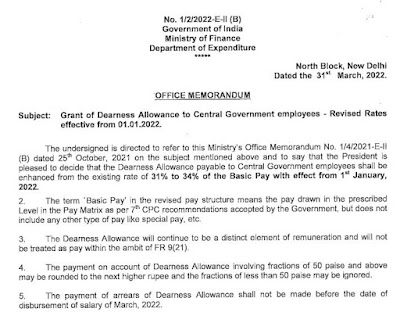
DA Jan 2022 - Grant of Dearness Allowance to Central Government employees - Revised Rates effective from 01.01.2022

 3% DA Hike - Revised Rates effective from 01.01.2022: DoE OM dated 31.03.2022 No. 1/2/2022-E-II (B) Government of India Ministry of Finance...