Showing posts with label 7th CPC annual increment. Show all posts

Monday, 4 September 2017

Loss in increment in 7th CPC Pay Matrix - Demand of 3% Increment at all stages: Agenda Items for NAC Meeting


Loss in increment in 7th CPC Pay Matrix - Demand of 3% Increment at all stages: Agenda Items for NAC Meeting

Item No:2
3% Increment at all stages
In Para 5.1.21, the Commission has stated that it has constructed the Pay Matrix, which has two dimensions i.e. horizontal and vertical ranges. The vertical range is supposed to denote the pay progression with the level. The steps are to reflect the annual forward progression of three per cent in each level. More specifically under the Caption "Annual increment" in Para 5.1.38, the Commission has emphatically stated that the annual increment is being retained at 3 percent.

In the forward to the report, the Chairman Justice Shri AK Mathur (Para 1.19) writes "the prevailing rate of increment is considered quite satisfactory and has been retained". This apart in para 4.1.17, the Commission states that the various stages within a level moves upward @ 3% p.a.

Having stated categorically that a Govt servant must get his annual increment @3% of his pay, the recommendation that one’s pay on award of annual increment must move to the next cell in the matrix would become tenable only if the difference between the two cells is more than 3% of the Pay of the Govt servant.
From the chart annexed it could be seen that it is not so at many stages warranting a revision of the Pay Matrix at those level, where the employee gets less than 3% as has annual increment when he moves on to the next higher stage in the matrix.

ILLUSTRATION -I - LOSS IN INCREMENT
Pay LevelSl.No. in the Pay Level (Cell)Basic Pay in the Revised Pay ScaleNext above Basic Pay after adding 3% incrementNext above Basic Pay fixed as per pay matrixAmount of loss to the employeeActual increment rate %age
112249002564725600472.81
126376003872838700282.92
39276002842828400282.89
316340003502035000202.94
411343003532935300292.91
422475004892548900252.94
510381003924339200432.88
520511005263352600332.93
66411004233342300332.91
69449004624746200472.89

Monday, 14 August 2017

Anomaly in Pay Matrix levels of 7th CPC


Anomaly in Pay Matrix levels of 7th CPC
NFIR
National Federation of Indian Railwaymen
3, CHELMSFORD ROAD, NEW DELHI - 110 055
No.IV/NAC/7th CPC/2016
Dated:10/08/2017
The Secretary (E), Railway Board, New Delhi

Dear Sir,
Sub: Anomaly in Pay Matrix levels of 7th CPC. 

NFIR brings to the kind notice of Railway Board the anomaly arisen due to non-grant of 3% of pay towards annual increment, pursuant to implementation of 7th CPC pay matrix levels as explained below:-

(a) Clause (c) of terms of reference of the National Anomaly Committee says that the Official Side and Staff Side are of the opinion that any recommendation is in contravention of the principle or the policy enunciated by the 7th CPC itself without the commission assigning any reason, constitutes an anomaly.
(b) The recommendations of 7th CPC regarding Annual Increment are as follows:
(i) 7th CPC Report - Highlights of recommendations-
Annual Increment- The rate of annual increment is being retained at 3%.
(ii) 7th CPC Report Forward:-
Para 1.19- The prevailing rate of increment is considered satisfactory and has been retained.
(iii) 7th CPC Report - Chapter 4.1-Principles of pay determination -
Para-4.1.17 -The various stages within a pay level moves upwards at the rate of 3% per annum.
(iv) 7th CPC Report -Chapter -5.1 -Pay structure (Civilian employees)

Para 5.1.38-Annual Increment.

"The rate of annual increment is being retained at 3%" Para 5.1.21-The vertical range of each level denotes pay progress within that level. That indicates steps of annual financial progression of 3% within each level.
However, contrary to the above principle laid down by 7th CPC, the actual increment rate in the following pay level of the pay matrix are less than 3% as illustrated in the following table.

S.NoPay level in The pay
level (Cell)
Basic pay in the revised scaleNext above basic pay after adding 3% incrementNext above basic pay after fixed as
per pay matrix
Amount of loss to the
employee
Actual increment rate 3%
112249002564725600 (Cell 13)472.81
22205002111521100 (Cell 3)152.92
39276002842828400 (Cell 10)282.89
411343003532935300 (Cell 12)292.91
510381003924339200 (Cell 11)432.88
69449004624746200 (Cell 10)472.89
713641006602366000 (Cell 14)232.96
89604006221262200 (Cell 10)122.98
918877009033190300312.96


7th-cpc-increment-rate-anomaly

(d) From the above table it can be concluded that:

1. The recommendations of 7th CPC regarding increment rate is in contravention of the principle or policy enunciated by 7th CPC, hence it constitutes an anomaly .

2. In many stages even though the increment rate shown is 3%, it is rounded off to next below amount causing financial loss to the employees.

3. In the 6th CPC, while calculating increment, if the last digit as one or above, it used to be rounded off to next 10. So in this pay matrix, if the amount is 10 and above, it should be rounded off to next 100.
NFIR therefore requests the Railway Board to take necessary action for rectification of anomaly so as to ensure that the increment @ 3% of pay is granted to employees in whose cases where the actual amount is less than 3%.
Yours faithfully,
(Dr M. Raghavaiah)
General Secretary
Source - NFIR

Sunday, 2 April 2017

7th Central Pay Commission retains rate of annual increment at 3%


7th Central Pay Commission retains rate of annual increment at 3%

7thpaycommission-breaking-news


The 7th Central Pay Commission has retained the rate of annual increment at 3 per cent. The 7th CPC has also recommended withholding of annual increments in the case of those employees who are not able to meet the benchmark either for MACP or a regular promotion within the first 20 years of their service.

The 7th Central Pay Commission has retained the rate of annual increment at 3 per cent. The 7th CPC has also recommended withholding of annual increments in the case of those employees who are not able to meet the benchmark either for MACP or a regular promotion within the first 20 years of their service. These recommendations have been accepted by the government.

The 7th CPC has observed that it is essential to have a linkage between Departmental Results Framework Documents (RFD) and Annual Appraisal Performance Report (APAR), and has suggested the following modifications in the existing APAR system for determining Performance Related Pay:

(i) Alignment of Objectives: The Ministry’s Vision/Mission needs to be translated into a set of strategic objectives for each department and these objectives need to be cascaded by the Department Head to his subordinates and subsequently down the chain.

(ii) Prioritizing Objectives, Assigning Success Indicators and their Weights: Objectives reflected in the APAR should be prioritized and assigned weights along with success indicators or Key Performance Indicators. The Commission recommended 60 percent weight on work output and 40 percent weight on personal attributes, instead of the existing 60 percent weight on personal attributes and only 40 percent weight to work output.

(iii) No Ex-ante Agreement: The indicators in the APAR of an officer/staff will need to be discussed and set with the supervisor at the beginning of the year.

(iv) Timelines: The timelines for RFD may be synchronized with the preparation of the APAR so that the targets set under RFD get reflected in individual APARs in a seamless manner.

(v) Online APAR System: The Commission recommended introduction of online APARs system for all Central Government officers/employees.

This was stated by Arjun Ram Meghwal, Minister of State in the Ministry of Finance, in a written reply to a question in Lok Sabha today.

Source: financialexpress

Flash News

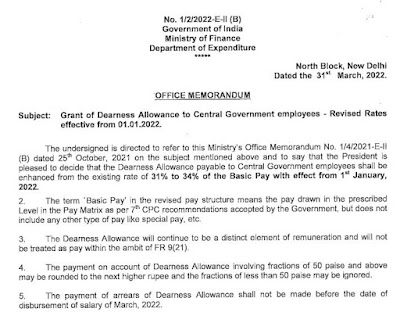
DA Jan 2022 - Grant of Dearness Allowance to Central Government employees - Revised Rates effective from 01.01.2022

 3% DA Hike - Revised Rates effective from 01.01.2022: DoE OM dated 31.03.2022 No. 1/2/2022-E-II (B) Government of India Ministry of Finance...