Showing posts with label 7th CPC Allowances. Show all posts

Wednesday, 11 December 2019

7th CPC pay and allowances will be available to all the Government employees of UTs of Jammu & Kashmir and Ladakh

7th Central Pay Commission allowances

7th CPC pay and allowances will be available to all the Government employees of UTs of Jammu & Kashmir and Ladakh

Ministry of Home Affairs

7th Central Pay Commission allowances worth around Rs. 4800 crores approved for Government employees of UTs of Jammu & Kashmir and Ladakh

Two AIIMS like institutions in Jammu and Srinagar and eight medical colleges in Jammu, Kashmir and Ladakh regions approved: Shri G. Kishan Reddy

10 DEC 2019

Union Minister of State for Home Affairs, Shri G. Kishan Reddy, in a written reply to a question regarding development of new UTs of Jammu and Kashmir and Ladakh, in Lok Sabha today, said that the Government of India has been fully committed to the overall development of the erstwhile State of Jammu and Kashmir as well as the newly created Union Territory of Jammu and Kashmir and the newly created Union Territory of Ladakh.

Also check the latest happenings in 7th Central Pay Commission

Shri Reddy informed the House that certain 7th Central Pay Commission (CPC) allowances namely Children Education Allowance, Hostel Allowance, Transport Allowance, LTC, Fixed Medical Allowance that were not being given to nearly 4.5 Lakh State Government employees in the erstwhile State of Jammu and Kashmir have been approved for an estimated cost of Rs.4800 Crores, for all such employees, who are now working in the Union Territory of Jammu and Kashmir and the Union Territory of Ladakh, since the day these new Union Territories came into existence i.e 31st October 2019. Since the newly created UTs have come into existence, all the 7th CPC pay and allowances will be available to all the Government employees of both the new UTs.

Further, Shri Reddy stated that after the creation of the two UTs on 31st October, 2019, a total of Rs.14,559.25 crores as the balance share of 14th Finance Commission grants, share of taxes etc. that were being given to the erstwhile State of Jammu and Kashmir has been apportioned amongst the two new UTs. Out of this, Rs. 2,977.31 crores has already been released to the UT of Jammu and Kashmir and Rs.1,275.99 crores has already been released to the UT of Ladakh till date.

On account of article 35A and other constitutional ambiguities, the people of these regions were denied full rights enshrined in the Constitution of India and other benefits of various Central Laws that were being enjoyed by other citizens in the country. After the declaration issued by the President under Article 370, based on recommendation of the Parliament, and reorganization of the erstwhile State of Jammu and Kashmir into Union Territory of Jammu and Kashmir and Union Territory of Ladakh, all such aspects have been addressed and therefore the Jammu, Kashmir and Ladakh regions can develop and progress like other parts of the country.

Under the Centrally Sponsored Scheme, the Government has approved establishment of eight medical colleges in Jammu, Kashmir and Ladakh regions. These medical colleges, which are under various stages of implementation, will come up in the districts of Doda, Kathua, Baramulla, Anantnag, Rajouri, Udhampur, Handwara (Dist. Kupwara) in the UT of Jammu and Kashmir and the district of Leh in the UT of Ladakh. The Government has also approved creation of two AIIMS like institutions in Jammu and Srinagar, the Minister informed.

PIB

Monday, 2 December 2019

7th CPC Special Allowance / Qualification Pay for Accounts cadre

Department has considered the proposal to revise the rates of Special Allowance and Qualification Pay for Account Cadres

7th CPC Special Allowance for Accounts cadre


No.11-1/2016/7th CPC/Part.II (B)
GOVERNMENT OF INDIA
MINISTRY OF FINANCE
DEPARTMENT OF EXPENDITURE
(7th CPC matters)

North Block, New Delhi
Dated: 14th Nov, 2019
OFFICE MEMORANDUM

Subject: Admissibility of Special Allowance / Qualification Pay for Accounts cadre - revision of rates as per 7th CPC

The proposal regarding revision of rates of Special Allowance/ Qualification Pay to accounts cadre has been considered in this Department. In accordance with the recommendations of the 7th Central Pay Commission and as approved by the Government, it is agreed to revise the rates of Special Allowance and Qualification Pay for the Accounts Cadre of the following Organizations, as under:


Sl.NoCadre/ OrganizationRevised rates of Special AllowanceRevised rates of qualification pay
iOffice of C&AG of IndiaRs.360/- pm for 1st year and
@Rs.630/- pm for 2nd year
Rs.270/- pm
iiOffice of CGARs.360/- pm for 1st year and
@ Rs.630/- pm for 2nd year
Rs.270/- pm
iiiOffice of CGDARs.360/- pm for 1st year and
@Rs.630/- pm for 2nd year
NA
ivIPTAFSNARs.270/- pm

2. This issues with the approval of Hon'ble Finance Minister.

Also check: Implementation of the recommendations of 7th Central Pay Commission - Grant of Special Compensatory Allowances subsumed under Tough Location Allowance

(Abhay N.Sahay)
Under Secretary
23095646
7th CPC Special Allowance for Accounts cadre


Monday, 28 January 2019

7th CPC: Grant of Special Compensatory Allowances subsumed under Tough Location Allowance


Clarification on 7th CPC Special Compensatory Allowance
Implementation of the recommendations of 7th Central Pay Commission - Grant of Special Compensatory Allowances subsumed under Tough Location Allowance

No.3/1/2017-E.II(B)
Government of India
Ministry of Finance
Department of Expenditure
New Delhi, the 17th January, 2019
CORRIGENDUM

Subject: Implementation of the recommendations of 7th Central Pay Commission - Grant of Special Compensatory Allowances subsumed under Tough Location Allowance.

The undersigned is directed to refer to this Department's O.M. of even number dated 19th July, 2017 regarding grant of Special Compensatory Allowances subsumed under Tough Location Allowance consequent upon acceptance of the recommendations of the 7th Central Pay Commission. In this regard, in Annexure-I to the O.M., where places/areas have been mentioned. Part 'A' Sl.No.4 - Jammu and Kashmir - "Illaqas of Padder and Niabat Nowgam in Kashmir Tehsil’ under Doda District may be read as "Illaqas af Padder and Niabat Nowgam in Kishtwar Tehsil".
sd/-

(Nimala Dev)
Dy. Secretary to the Government of India

Wednesday, 31 October 2018

7th CPC Charge Allowance - Railway Board Orders

7th CPC Charge Allowance - Railway Board Orders

Clarification on admissibility of Charge Allowance in Indian Railways
GOVERNMENT OF INDIA (BHARAT SARKAR)
Ministry of Railways (Rail Mantralaya)
(Railway Board)
No. PC-VII/2017/I/7/5/8
New Delhi, dated: 25.10.2018
The General Manager/PCPOs,
All Indian Railways & Production Units,

Sub: Clarification on admissibility of Charge Allowance in Indian Railways

Consequent to implementation of recommendations of 7th CPC, various references have been received from Zonal Railways regarding admissibility of Charge Allowance in the CPC pay structure and grant of benefits like DA, HRA etc. on the same.

2. In this context, it is informed that the issue of admissibility of Charge Allowance in 7th CPC pay structure is presently under examination in Department of Personnel and Training.

3. In view of the same, it is informed that any clarifications regarding Charge Allowance can only be issued by Board's office once guidelines in this matter are issued by DoPT.
sd/-
(Jay Kumar G)
Deputy Director, Pay Commission-VII
Railway Board
Source: Railway Board

Tuesday, 25 September 2018

7th CPC Allowances Related to Working on Holidays


7th CPC Allowances Related to Working on Holidays

7th Central Pay Commission Recommendations on Allowances Related to Working on Holidays

Allowances Covered
1. Holiday Compensatory Allowance
2. Holiday Monetary Compensation
3. National Holiday Allowance
Employees, who are regularly required to work on holidays, are compensated in a variety of ways. Some, like the employees of Delhi Police and the CISF, are granted an extra month's pay per year. Employees of other CAPFs are granted extra thirty days' leave. Some other categories of staff are paid allowances, which are dealt with in this section. There are 3 such allowances.

1. Holiday Compensatory Allowance

It is a compensation for non-gazetted staff of IB who are required to perform duties on holidays and weekends; granted at the rate of one day's (Basic Pay + DA) for up to thirty days in a financial year. No demands have been received regarding this allowance.

Analysis and Recommendations

The Commission notes that employees in almost all ministries/departments are, sometimes, required to work on weekends. They are usually compensated by providing a "compensatory off." Thus, grant of an allowance for weekend working is not justified.

At the same time, the sensitive, and time bound nature of work done by IB should also be kept in mind. Therefore, it is recommended that the non-gazetted staff of IB, presently covered under Holiday Compensatory Allowance, should, henceforth, be covered by National Holiday Allowance. They will be granted this allowance for up to twelve holidays in a year (including the three National Holidays) at the rates prescribed. Accordingly, Holiday Compensatory Allowance, as a separate allowance, should be abolished.

[Government Decision on Holiday Compensatory Allowance: Abolished as a separate allowance. Eligible employees to be governed by National Holiday Allowance. Not to be subsumed and retained as a separate allowance. Existing system to continue in Intelligence Bureau (IB) and Research and Analysis Wing (RAW)]

2. Holiday Monetary Compensation

This allowance is granted in Department of Posts and is payable to postmen and other departmental staff who are required to perform duty on second holiday if three consecutive holidays occur. The existing rates are:

Category Rate of Remuneration
Supervisor Rs.85 per holiday for 4 hours
Postal Assistant Rs.85 per holiday for 4 hours
PostmenSorting Postmen/Rs.85 per holiday
Multi-tasking staff Rs.60 per holiday for 4 hours
Demands have been received to increase the rate of this allowance to Rs.600 per holiday.

Analysis and Recommendations

Since the allowance is not DA indexed, it is proposed to raise the amount to Rs.200 per holiday for Supervisors, Postal Assistants and Postmen/Sorting Postmen; and Rs.150 per holiday for Multi-tasking Staff. The rate of allowance will further increase by 25 percent each time DA increases by 50 percent.

[Government Decision on Holiday Monetary Compensation: Retained. Rationalized. Accepted ]

3. National Holiday Allowance

This allowance is paid to non-gazetted Railway employees who are rostered to work on a "National Holiday." The existing rates are:

Pay in Pay Band + Grade Pay Rate
up to Rs.7260 Rs.256 per day
Rs.7261-Rs.9700 Rs.318 per day
Rs.9701 and above (limited to non-gazetted staff) Rs.420 per day

There are demands to increase the amount of this allowance to 1.5 x (one day's Basic Pay + DA)

Analysis and Recommendations
The Commission notes that although there are only three National Holidays, this allowance is granted for twelve days in a year due to operational constraints. Also, the allowance is already partially indexed to the DA. Hence, it is recommended that the amount should be increased by 50 percent to the following:

LevelRate of Allowance (per day)
1 and 2Rs.384
3 to 5 Rs.477
6 to 8 (limited to non-gazetted staff) Rs.630

The rate of allowance will further increase by 25 percent each time DA rises by 50 percent.

[Government Decision on National Holiday Allowance: Retained. Enhanced by 50%. Accepted ]

Thursday, 5 April 2018

DAD Releases Handbook on Pay & allowances of JCOs & ORs


Ministry of Defence
DAD Releases Handbook on Pay & allowances of JCOs & ORs
Dated 04 APR 2018
The Defence Accounts Department is entrusted with the responsibility of maintaining the pay accounts of million plus Jawans and JCOs of Indian Army. The Pay Accounts Offices (PAOs) of this department are at the forefront of the concerted efforts that are being put in to ensure that these men get their correct dues within reasonable time frame.

An important requirement to meet the expectations of the end user and ensuring their contentment is that the JCOs/ORs understands their dues and their entitlement. If they further appreciate the processes involved in acceptance or denial of any dues, it would equip them with enough knowledge to have better awareness to contest entitlement inconsistencies, if any.

This handbook was conceptualized with the aim to provide more grasp on the rules of entitlement as well as to have complete transparency of procedures in the PAOs. This first edition contains all the procedures right from the inception stage of publishing and processing of the daily Part II orders, till the final processing and disbursement of entitlements.

The book also details the functional boundaries and constraints of PAOs. The chapters are so ordered that they lay down entitlement parameters in a user-friendly manner. Each of the chapter seeks to enlighten the JCOs/OR on the documentary and procedural requirements for processing an entitlement.

The audit and procedural requirements behind processing of Contingent Bill items, AFPP Fund claims, MACPs, transfer/deputation, leave/TD etc., are all detailed in distinct chapters of the handbook. The deductions from pay and allowances, bank account details, etc. are also elaborated in the book.

In a unique separate chapter interpretation of the Monthly Pay Slip has been elaborated. It details item-wise description of notifications provided in the Pay Slip, which, it is expected, would not only ameliorate grievances of Jawans at the inception stage but also give him confidence regarding legitimacy of the entitlements so granted. A chapter on general FAQs is also included for assistance and ready reference.

The book has sought to cover all the parameters of pay and allowances of JCOs/ORs, incorporating the 7th CPC entitlements as well, wherever available on the date of publication. This book in pdf format is also available on the website of PAO(OR) AMC & 11 GRRC as well as of PCDA(CC), Lucknow.

Sunday, 18 March 2018

Grant of Tough Location Allowance to Central Govt. Employees of Darjeeling


Grant of Tough Location Allowance to Central Govt. Employees of Darjeeling
"Consider grant of any kind of Special Duty Allowance/Tough Location Allowance/High Altitude Allowance as a special case"
Ref: Confdn/Genl/2016-19
Dated : 14.03.2018
To
The Secretary
Ministry of Finance
Department of Expenditure
North Block, New Delhi - 110001

Sir,
Sub:  Grant of Tough Location Allowance to Central Govt. Employees of Darjeeling.

This is to bring to your kind notice that Hill Compensatory Allowance (HCA) was being paid till June 2017 to the employees of Darjeeling. Unfortunately HCA has been withdrawan from the month of July 2017 onwards after implementation of 7th CPC Allowance Committee report. However, the neighbouring state, Sikkim is still getting the Special Compensatory Allowance (SCA). It is worth mentioning that Darjeeling and Sikkim share same type of terrain, alongwith climatic conditions. It is further to mention here that the employees of some hill areas viz; Shimla in Himachal Pradesh, comparatively similar to Darjeeling Hills, are enjoying Tough Location Allowance (TLA). But the employees of Darjeeling are deprived of both the Tough Location Allowance (TLA) and Special Compensatory Allowance (SCA).

Darjeeling being the world famous tourist spot and the "Queen of Hills" is one of the expensive place to live in as all the basic commodities are to come from Siliguri, which is a 'Y' category city with 16% HRA. This has led the employees of Darjeeling being economically handicapped with the removal of Hill Compensatory Allowance.

In view of the above, I request you to review the orders withdrawing the Allowance already enjoyed by the employees of Darjeeling, and Consider grant of any kind of Special Duty Allowance/Tough Location Allowance/High Altitude Allowance as a special case, considering the geographical, climatical and economical hardship faced by the employees.

Awaiting response,
Yours faithfully,
(M. Krishnan)
Secretary General
& Member, Standing Committee
National Council (JCM)
Mob: 09447168125

Email: mkrishnan6854@gmail.com
Source: Confederation

Tuesday, 2 January 2018

Annual Report on Pay & Allowances for Central Government Employees - Finance Ministry

Annual Report on Pay & Allowances for Central Government Employees - Finance Ministry

Pay Research Unit
Department of Expenditure
Ministry of Finance
New Delhi

ANNUAL REPORT ON PAY & ALLOWANCES FOR THE YEAR 2016-17

SALIENT FEATURES

1. The total expenditure on Pay and Allowances (excluding Productivity Linked Bonus/Ad-hoc Bonus, Honorarium, Encashment of Earned Leave and Travelling Allowance) for Regular Central Government Civilian employees including employees of the Union Territories was Rs.182513.25 crore in 2016-17 as compared to Rs.150028.57 crore in 2015-16. Thus, there is an increase in expenditure by Rs.32484.68 crore over previous year which in relative terms works out to around 21.65%.

2. The Total expenditure on pay and allowances as a percentage of Revenue Receipts and Revenue Expenditure of the Central Government during the financial year 2016-17 is 10.88% and 9.18% as compared 10.45% and 8.43% respectively during the financial year 2015-16.

3. Out of the total expenditure of Rs.182513.25 crore, the percentage expenditure on Pay, Dearness Allowance (DA), House Rent Allowance (HRA) and other allowances are 65.75%, 16.57%, 3.42% and 14.26% respectively.

4. Out of the total expenditure of Rs.6253.93 crore on HRA in 2016-17, the HRA expenditure for 'X' class cities is Rs.2817.83 crore which is around 45.06% of the total expenditure on HRA.

5. Almost 86% of the total expenditure was incurred by five major Ministries/Departments (Railways, Defence (Civil), Home Affairs, Posts and Revenue) during 2016-17.

6. Of the total expenditure on Pay and Allowances in 2016-17, the Ministry of Railways continues to have the largest share i.e 38.92% , marginally increased from 34.98% in 2015- 16. Share of Ministry of Home Affairs has decreased from 26.59% to 25.06% and department of Posts has been decreased from 7.74% to 5.55% . Share of Ministry of Defence (Civil) has decreased from the previous year i.e. from 12.11% to 12.04%.

7. The expenditure of UT administrations is Rs.3781.92 crore in 2016-17 as compared to Rs.3382.19 crore in 2015-16. Thus, there is an increase in expenditure by Rs.399.73. crore over previous year which in relative terms works out to around 11.82%.

8. The expenditure of Indian Missions/ Embassies abroad is Rs.1426.08 crore in 2016-17 as compared to Rs.1159.54 crore in 2015-16. Thus, there is an increase in expenditure by Rs.266.54 crore over previous year which in relative terms works out to around 22.98%.

9. As on 01.03.2016, the total number of Regular Central Government Civilian Employees in position was 32.21 lakh against the sanctioned strength of 36.34 lakh and approximately 11.36% of the posts were vacant.

10. Almost 92% of the total manpower is covered by five major Ministries/Departments viz, Railways, Defence (Civil) , Home Affairs, Posts and Revenue. Of the total strength of 32.21 lakh, the percentage share of the Railways is 41.33%, Home Affairs 29.44%, Defence (Civil) 12.37%, Posts 6.02 %, Revenue 3.11% and all other Ministries/ Departments 7.73%

11. Against the sanctioned strength of 9.57 lakh in Central Police Forces, 9.01 lakh employees were in position as on 01.03.2016. In Union Territories (UTs) 64910 employees were in position as on 01.03.2016.

12. DA based on All India Consumer Price Index.

Source: www.doe.gov.in

Sunday, 3 December 2017

7th CPC Report of the Committee Funeral Allowance

7th CPC Report of the Committee Funeral Allowance

7th-Pay-Commission-Funeral-Allowance


Funeral Allowance (Para 8.17.54)

Existing Provision: When death of an employee occurs in peace areas, a funeral allowance of Rs. 6,000 is granted and mortuary charges are reimbursed in the case of Defence personnel.

Reasons mentioned by 7th CPC for recommending abolition:
With the pay raises provided by successive Pay Commissions, this kind of an allowance has lost its meaning.

Demand:

Ministry of Defence: This allowance may not be discontinued considering the circumstances in which this allowance is granted. The rates may be enhanced by suitable multiplication factor.

Analysis and Recommendations of the Committee:
The Committee is of the view that this cannot be categorized as an allowance as it is not paid to the employee but to the Next of Kin. Para 8.2.3 of the 7th CPC Report also states that  "Allowance" should be used when it is paid to an individual and if it is paid as an administrative expenditure, it should be referred to as expense or expenditure. Considering the circumstances, continuation of this expenditure by the Government might be necessary. However, instead of calling it Funeral Allowance, it may be renamed as Funeral Expense, and the expenditure on this account, at the existing rate of Rs.6,000/- and mortuary expenses, may be directly borne by the concerned Unit and reflected in budget and accounts accordingly with further proviso that, whenever necessary, the concerned unit can pay this amount to Next of Kin of the deceased at the applicable rates.

Check the Detailed Report of the Committee on Allowances

Good Service / Good Conduct / Badge Pay in 7th Pay Commission


Good Service / Good Conduct / Badge Pay in 7th Pay Commission

Good Service / Good Conduct / Badge Pay (Para 8.8.3-5)

Existing Provisions: PBORs of the three Services are granted Good Service Pay after completion of certain specified length of service during which they have maintained high degree of discipline, good conduct and professional update. For PBORs of army, the specified length is 3, 6 and 9 years of service. For PBORs of IAF and Navy, it is 4, 8 and 12 years of service. For the PBORs of the Indian Army. The existing rate is Rs.64 pm for each of the three stages, while for the PBORs of Indian Navy and the Indian Air Force, the amount is Rs.80 pm.

Recommendations of 7th CPC: The 7th CPC has recommended to enhance the rate of this allowance by 2.25. The nomenclature has also been changed to Good Service/Good Conduct/ Badge Allowance.

Demands:

I. Defence Forces: Good Service Pay / Good Service Badge be allowed to all JCOs on their promotion or these may be allowed to be subsumed in the Pay at the time of promotion to JCO.

II. Cabinet Secretariat: This allowance may be granted to PBORs in Special Frontier Force (SFF) as well.

Analysis and Recommendations of the Committee:
The demands of the Defence Forces as well as SFF do not emanate from any changes suggested by the 7th CPC in this regard. Therefore, they do not fall under the remit of this Committee. MoD has not made any recommendations in this regard. The recommendations of the 7th CPC on Good Service / Good Conduct / Badge Pay,  may therefore, be accepted without any change

Source : doe.gov.in

Wednesday, 29 November 2017

7th CPC : Central Government employees will not get Family Planning Allowances

7th CPC : Central Government employees will not get Family Planning Allowances

7thCPC-Allowances-Central-Government-Employees-family-planning


GOVERNMENT OF INDIA
MINISTRY OF  FINANCE
RAJYA SABHA
UNSTARRED QUESTION NO-2447
ANSWERED ON-08.08.2017

Doing away with allowances under 7th CPC

2447 .    Shri A. K. Selvaraj

(a) whether the Central Government employees will not get Family Planning Allowances;

(b) whether it is a fact that the diet, haircutting and soap toilet allowances given to select categories of employee have been discontinued; and

c) whether it is also a fact that a raft of grants and allocations made to various sections of Government employees have been done away with or revised as per the recommendations of the Committee on Allowances, if so, the details thereof?

ANSWER
FINANCE MINISTER
(SHRI ARUN JAITLEY)

(a): The 7th Central Pay Commission recommended that Family Planning Allowance should be abolished. The Government has accepted the recommendation with effect from 1st July, 2017.

(b): The 7th Central Pay Commission recommended that Diet Allowance granted to deputationists in Bureau of Immigration should be abolished. The 7th Central Pay Commission (7th CPC) in paras 8.17.22 to 8.17.24 of its report recommended, inter-alia, that Haircutting Allowance and Soap Toilet Allowance admissible to Personnel Below Officer's Rank of Defence Forces, as components of Composite Personal Maintenance Allowance (CPMA), should be increased by 50%. The Government has accepted these recommendations with effect from 1st July, 2017.

(c): The Committee on Allowances was set up in July, 2016, to examine the recommendations of the 7th Central Pay Commission pertaining to allowances.


ENGLISH VERSION  /  HINDI_VERSION

Friday, 24 November 2017

Deputation (Duty) Allowance to Central Government Employees - Recommendations of the 7th Pay Commission - DOPT Orders

Deputation (Duty) Allowance to Central Government Employees - Recommendations of the 7th Pay Commission - DOPT Orders
7th-CPC-Deputation-Duty-Allowance-DoPT


No.2/11/2017-Estt.(Pay-II)
Government of India
Ministry of Personnel, Public Grievances & Pensions
Department of Personnel & Training

North Block, New Delhi
Dated the 24th November, 2017

OFFICE MEMORANDUM

Subject:- Grant of Deputation (Duty) Allowance - Recommendations of the Seventh Central Pay Commission - Regarding.

This Department’s OM No. 6/8/2009-Estt.(Pay-II) dated 17.6.2010 inter-alia provides for rates of Deputation (Duty) Allowance admissible to Central Government employees.

2. As provided in para 7 of Ministry of Finance, Department of Expenditure’s Resolution No.1-2/2016-IC dated 25th July, 2016, the matter regarding allowances (except Dearness Allowance) based on the recommendations of the 7th Central Pay Commission (CPC) was referred to a Committee under the Chairmanship of Finance Secretary and until a final decision thereon, all Allowances have been paid at the existing rates in the existing pay structure.

3. The decision of the Government on various allowances based on the recommendations of the 7th CPC and in the light of the recommendations of the Committee under the Chairmanship of the Finance Secretary has since been issued as per the Resolution No.11-1/2016-IC dated 6th July 2017 of Department of Expenditure.

4. As mentioned at Sl.No.46 of the Appendix-II of the said Resolution dated 6th July 2017, the recommendation of the 7th CPC for enhancement of ceiling of Deputation (Duty) Allowance for civilians by 2.25 times has been accepted and this decision is effective from 1st July, 2017. Accordingly, the President is pleased to decide that the rates of Deputation (Duty) Allowance and certain other conditions relating to grant of Deputation (Duty) Allowance shall be as under:-

The Deputation (Duty) Allowance admissible shall be at the following rates:

(a) In case of deputation within the same station the Deputation (Duty) Allowance will be payable at the rate of 5% of basic pay subject to a maximum of Rs.4500 p.m.

(b) In case of deputation involving change of station, the Deputation (Duty) Allowance will be payable at the rate of 10% of the basic pay subject to a maximum of Rs.9000 p.m.

(c) The ceilings will further rise by 25 percent each time Dearness Allowance increases by 50 percent.

(d) Basic Pay, from time to time, plus Deputation (Duty) Allowance shall not exceed the basic pay in the apex level i.e. Rs. 2,25,000/-. In the case of Government servants receiving Non Practising Allowance, their basic pay plus Non-Practising Allowance plus Deputation (Duty) Allowance shall not exceed the average of basic pay of the revised scale applicable to the Apex Level and the Level of the Cabinet Secretary i.e. Rs.2,37,500/-.

Note: 1 ‘Basic pay’ in the revised pay structure (the pay structure based on 7th Central Pay Commission recommendations) means the pay drawn by the deputationist, from time to time, in the prescribed Level, in Pay Matrix, of the post held by him substantively in the parent cadre, but does not include any other type of pay like personal pay, etc.

Note: 2 In cases where the basic pay in parent cadre has been upgraded on account of non-functional upgradation (NFU), Modified Assured Career Progression Scheme (MACP), Non Functional Selection Grade (NFSG), etc., the upgraded basic pay under such upgradations shall not be taken into account for the purpose of Deputation (Duty) Allowance.

Note 3 In the case of a Proforma Promotion under Next Below Rule (NBR): If such a Proforma Promotion is in a Level of the Pay Matrix which is higher than that of the ex-cadre post, the basic pay under such Proforma Promotion shall not be taken into account for the purpose of Deputation (Duty) Allowance. However, if such a Proforma Promotion under NBR is in a Level of the pay matrix which is equal to or below that of the ex-cadre post, Deputation (Duty) Allowance shall be admissible on the basic pay of the parent cadre post allowed under the proforma promotion, if opted by the deputationist.

Note 4 In case of Reverse Foreign Service, if the appointment is made to post whose pay structure and/ or Dearness Allowance (DA) pattern is dissimilar to that in the parent organisation, the option for electing to draw the basic pay in the parent cadre [alongwith the Deputation (Duty) Allowance thereon and the personal pay, if any] will not be available to such employee.

Note: 5 The term ‘same station’ for the purpose will be determined with reference to the station where the person was on duty before proceeding on deputation.

Note: 6 Where there is no change in the headquarters with reference to the last post held, the transfer should be treated as within the same station and when there is change in headquarters it would be treated as not in the same station. So far as places falling within the same urban agglomeration of the old headquarters are concerned, they would be treated as transfer within the same station.

5. Para 6.1 of this Department’s OM No.6/8/2009-Estt(Pay-II) dated 17.6.2010 stands amended to the above effect.

6. In so far as persons serving in the Indian Audit & Accounts Department are concerned, these orders issue after consultation with the Comptroller & Auditor General of India.

7. These orders shall take effect from 1st July, 2017

(Rajeev Bahree)
Under Secretary to the Government of India

Source: DOPT

Tuesday, 21 November 2017

7th Central Pay Commission: Grant of Extra Work Allowance (abolition of existing Flight Charge Certificate Allowance)


7th Central Pay Commission: Grant of Extra Work Allowance (abolition of existing Flight Charge Certificate Allowance)

7th-CPC-extra-work-allowance


Instruction regarding Grant of Extra Work Allowance, Dress Allowance and Tough location Allowance
No.PC-1(16)/2017/D (pay/Services)
Government of India
Ministry of Defence
New Delhi, the 16th Nov, 2017
To,
The Chief of the Army Staff
The Chief of the Naval Staff
The Chief of the Air Staff

Subject: Grant of Extra Work Allowance (abolition of existing Flight Charge Certificate Allowance) - decision of the Government on the recommendation of the Seventh Central Pay Commission.

Sir,
I am directed to refer to MoD letter No.1 (54)/2008/D(Pay/Services) dated 04.11.2008 and Department of Expenditure OM No.12-3/2016-E.III(A) dated 20.07.2017 and to say that consequent upon the decision taken by the Government on the recommendations of the Seventh Central Pay Commission vide Ministry of Finance Resolution No.11-1/2016-1C, Flight Charge Certificate Allowance has been abolished as a separate allowance and the President is pleased to decide that the eligible personnel shall now to be covered under a New Extra Work Allowance which shall be governed as under:
(a) Extra Work Allowance will be paid at a uniform rate of 2% (two percent) of the basic pay per month.

(b) An employee shall receive this allowance for a maximum period of one year, and there should be minimum gap of one year before the same employee is deployed for similar duty again.

(c) This allowance should not be combined, i.e., if same employee is performing two or more such duties and is ellqible for 2 percent allowance for each add-on, then the total Extra Work Allowance payable will remain capped at 2 percent of basic pay.

(d) The other terms and conditions would continue to be applicable along with their admissibility (unless otherwise stated) as mentioned in MoD letter dated 04.11.2008 and otherwise.
3. These orders shall take effect from 1st July, 20174.

4. This issues with the concurrence of the Ministry of Defence (Finance) vide their Diary No.446/AG/PD dated 05.10.2017.
Yours faithfully,
sd/-
(Jayant Sinha)
Joint Secretary to the Govt of India
Authority: https://mod.gov.in/

Tuesday, 31 October 2017

7th CPC: Recommendations of the Official Committee, 2017 on revision of pay and allowances and other related benefits - Admitting of salary - Instructions

7th CPC: Recommendations of the Official Committee, 2017 on revision of pay and allowances and other related benefits - Admitting of salary - Instructions

FINANCE (CMPC) DEPARTMENT
Secretariat,
Chennai - 600 009.
Letter No.54867/CMPC/2017-1, dated: 30-10-2017
From
Thiru K.SHANMUGAM, I.A.S.,
Additional Chief Secretary to Government.

To
All Secretaries to Government.

Sir/Madam,
Sub: Recommendations of the Official Committee, 2017 on revision of pay and allowances and other related benefits - Admitting of salary - Instructions - Regarding.

Ref:
  1. G.O.Ms.No.303, Finance (Pay Cell) Department, dated: 11-10-2017.
  2. G.O.Ms.No.304, Finance (Pay Cell) Department, dated: 13-10-2017.
  3. G.O.Ms.No.305, Finance (Pay Cell) Department, dated: 13-10-2017.
  4. G.O.Ms.No.306, Finance (Pay Cell) Department, dated: 13-10-2017.
I am to invite your attention to the references cited.

2. Based on the recommendations of the Official Committee, 2017, orders have been issued in the Government Orders first to fourth cited granting revision of pay, special pay and allowances to the State Government employees and teachers including employees of local bodies. The pay revision has been given notional effect from 1st January 2016 with monetary benefit from 1st October 2017.

3. As per Rule 6(2) of the Tamil Nadu Revised Pay Rules, 2017 every employee shall have to exercise option to come over to the revised pay structure within 3 months from the date of coming into force of the above rules on a date advantageous to the employees concerned as classified under sub-rule (1) of the above Rules. Considering the time limit available for exercising option by the employees to switch over to the revised pay structure, the pay bills have been presented by the Drawing and Disbursing Officers in the old pay itself to avoid difficulty in drawing salary by the employees.

4. Based on the option exercised by the individual employees,
(i) In the case of non-self drawing employees, the Heads of Offices concerned shall fix the pay of such employees in the revised pay structure and send the orders to the Drawing and Disbursing Officers concerned for drawing salary in the new pay immediately;

(ii) Likewise in the case of self-drawing officers, the Pay and Accounts Officer in case of the city offices including Pay and Accounts Officer, Madurai and in respect of other officers in Districts, the Accountant General shall fix the pay of the Officers in the revised pay structure and issue necessary pay slips so as to enable the Officers concerned to present the bills and draw the salary in the new pay structure immediately.
5. The Drawing and Disbursing Officers concerned on getting the orders from the Heads of Offices / pay fixing authorities concerned shall draw and disburse monthly salaries in the new pay structure from the month of November 2017 along with arrears for the month of October 2017. They shall present salary bills accordingly for the month of November 2017 after claiming arrears for October 2017 before 20-11-2017.

6. The National Informatics Centre (NIC) is requested to update the software application for salary bills in accordance with the orders issued in the Government Orders cited to enable drawing of salary in revised pay structure from November 2017, after claiming the arrears for the month of October 2017 before 20-11-2017.

7. The Commissioner of Treasuries and Accounts is also requested to co-ordinate with the National Informatics Centre (NIC) to finalise the revised software application for presenting salary bills in the revised pay structure immediately.

8. All Head of Departments are therefore requested to issue necessary instructions to all their subordinate officers to adhere to the above instructions scrupulously.
Yours faithfully,
Sd/-
For Additional Chief Secretary to Government.

Tuesday, 24 October 2017

7th CPC: Report of the Committee on Allowances


Report of the Committee on Allowances
April, 2017

Preface

Government of India, vide OM No.11-1/2016-IC dated 23rd July 2016 constituted a Committee under the Chairmanship of Finance Secretary & Secretary (Expenditure) and Secretaries of Home Affairs, Defence, Health & Family Welfare, Personnel & Training, Posts and Chariman, Railway Board as Members to examine the recommendations of the 7th CPC on Allowances.

The Committee acknowledges the assistance provided by Shri R.K.Chaturvedi Joint Secretary (IC) and his team, Shri P.K.Das, Additional Secretary (Expenditure) who headed the Group of Officers and the members of his group, the representatives of Departments / Ministries, Services and Staff Associations in finalizing the Report.

The Committee, after due deliberations, submits its report on 27th April, 2017.

sd/-
(Ashok Lavasa)
Chairman
sd/-
(Rajiv Mehrishi)
Member
sd/-
(G.Mohan Kumar)
Member
sd/-
(C K Mishra)
Member
sd/-
(B P Sharma)
Member
sd/-
(B V Sudhakar)
Member
sd/-
(A K Mittal)
Member
sd/-
(R K Chaturvedi)
Member Secretary

New Delhi
Date: 27th April 2017
Report of the Committee on 7th CPC Allowances

Authority: www.doe.gov.in
Click to view the Report

Wednesday, 9 August 2017

7th CPC Allowances: Haircutting Allowance and Soap Toilet Allowance admissible to PBOR


7th CPC Allowances: Haircutting Allowance and Soap Toilet Allowance admissible to PBOR

Doing away with allowances under 7th CPC

The 7th Central Pay Commission recommended that Family Planning Allowance should be abolished. The Government has accepted the recommendation with effect from 1st July, 2017.

The 7th Central Pay Commission recommended that Diet Allowance granted to deputationists in Bureau of Immigration should be abolished.

The 7th Central Pay Commission in paras 8.17.22 to 8.17.24 of its report recommended, inter- alia, that Haircutting Allowance and Soap Toilet Allowance admissible to Personnel Below Officer's Rank of Defence Forces, as components of Composite Personal Maintenance Allowance(CPMA), should be increased by 50%. The Government has accepted these recommendations with effect from 1st July, 2017.

The Committee on Allowances was set up in July, 2016, to examine the recommendations of the 7th Central Pay Commission pertaining to allowances.

This information was given by Finance Minister Shri Arun Jaitley in a written reply to Shri A.K.Selvaraj in Rajya Sabha today.

Tuesday, 8 August 2017

7th CPC Allowances query Central Government employees: Reason for saving of 40,000 crores by delaying tactics

7th CPC Allowances query Central Government employees: Reason for saving of 40,000 crores by delaying tactics

Government of India
Ministry of Finance
Department of Expenditure

RAJYA SABHA
UNSTARRED QUESTION NO. 1833
TO BE ANSWERED ON TUESDAY, THE 1ST AUGUST, 2017
SHRAVANA 10, 1939 (SAKA)

RECOMMENDATIONS OF COMMITTEE ON ALLOWANCES ON 7TH CPC
QUESTION
1833. SHRI NEERAJ SHEKHAR:
Will the Minister of FINANCE be pleased to state:
(a) the details of the recommendations of Committee on Allowances formed after implementation of 7th CPC in 2016;
(b) the details of the accepted recommendations of said Committee;
(c) the details of the rejected recommendations of the said Committee; and
(d) whether Government has saved around Rs.40,000/- crores by delaying tactics and by rejecting arrears on allowances to Central Government employees and if so, the reasons therefor?

ANSWER
MINISTER OF STATE IN THE MINISTRY OF FINANCE
(SHRI ARJUN RAM MEGHWAL)

(a) to (d): The Committee on Allowances (CoA) recommended the acceptance of the recommendations of the Seventh Central Pay Commission (7th CPC) with 33 modifications. The recommendations of the CoA were accepted with 8 modifications by the Government. The 7th CPC recommendations on allowances were approved by the Government on 28.06.2017 with modifications in respect of 34 allowances. As per the established practice relating to implementation of earlier Central Pay Commission's recommendations on allowances, the recommendations of the 7th CPC on allowances have been implemented prospectively with effect from 01.07.2017.

Source: ENGLISH VERSION

Sunday, 30 July 2017

7th CPC Allowances extension of Govt decision to Quasi-govt Org, Autonomous Org, Statutory Bodies funded by CG

7th CPC Allowances extension of Govt decision to Quasi-govt Org, Autonomous Org, Statutory Bodies funded by CG
F. No. 1/1/2016-E-III(A)
Government of India
Ministry of Finance
Department of Expenditure
North Block, New Delhi
Dated the 26th July, 2017
Office Memorandum

Subject: Revision of rates of Allowances -extension of Government decisions on the recommendations the 7th Central Pay Commission in respect of employees of Quasi Government Organizations, Autonomous Organizations, Statutory Bodies set-up by and funded/controlled by the Central Government-regarding.

The undersigned is directed to invite attention to this Department's OM of even number dated 13.1.2017, regarding extension of revised pay scales based on the recommendations of the 7th Central Pay Commission in respect of employees of Quasi-Government Organizations, Autonomous Organizations, Statutory Bodies set-up by and funded/controlled by the Central Government and to say that in terms of para 6 thereof, it was mentioned that the Central Government has not taken any decision in regard to various allowances based on the recommendation of the 7th Central Pay Commission in respect of Central Government employees and, therefore, until further orders, the existing allowances in the autonomous organizations shall continue to be admissible as per the existing terms and conditions, irrespective of the revised pay scales having been adopted.

2. The decision of the Central Government on the recommendations of the 7th Central Pay Commission in regard to allowances in respect of Central Government employees have since been announced as per this Department's Resolution No. 11-1/2016-IC dated 67.2017 and the consequent Government orders have also been issued by this Department in regard to allowances like HRA, Travelling Allowance, Transport Allowance, Family Planning Allowance, etc. The attention is also invited to this Department's OM No.29/1/2017-E-IIB dated 11th July, 2017 regarding non-disbursal of discontinued allowances.

3. Accordingly, it has been decided that such of the existing allowances at present admissible in case of employees of Quasi-Government Organizations, Autonomous Organizations, Statutory Bodies set-up by and funded/controlled by the Central Government, as are exactly as per the Central Government pattern, may be revised in accordance with the decision contained in the aforesaid Resolution dated 6.7.2017 read with the Government orders issued in the matter. The provisions contained in this Department's OM No. 29/1/2017-E-IIB dt. 11th July, 2017 regarding non-disbursal of discontinued allowances shall also be strictly followed.

4. All other stipulations including the modalities for additional financial impact on allowances, as contained in the OM dated 13.1.2017 referred to in para 1 above, shall continue to be applicable in regard to these orders.

5. Hindi version of these orders is attached.
(Amar Nath Singh)
Director
Source: [www.doe.gov.in]

Wednesday, 12 July 2017

Central Government fails to implement 7th pay commission arrears on allowances


Central Government fails to implement 7th pay commission arrears on allowances

New Delhi: Despite all that has been said about the arrears on allowances under the 7th Pay Commission recommendations, an important issue for central government employees, which has now been notified on June 6 without arrears.

Finance Minister Arun Jaitley had claimed his commitment to implement the allowances after four months of the basic pay hike but it failed to come true.

More than 18 months have passed since the 7th pay commission report was submitted and 11 months have elapsed since the union cabinet approved the 7th Pay Commission recommendations for basic salary hike of central government employees, the centre now notified 7th pay commission allowances without arrears.
The government has given higher basic pay in August 2016 with arrears, effective from January 1, 2016 to its employees on the recommendations of the 7th pay commission but the increased allowances, which comes into effect from July 1, 2017.

The government used delaying tactics to save the government money to pay revised allowances without arrears. Hence the ‘Committee on Allowances’ headed by the Finance Secretary Ashok Lavasa was formed for examination allowances.

However. the government stuck with the 7th Pay Commission's recommendations on allowances and gave nod accordingly but no recommendation of the ‘Committee on Allowances’ was approved.
The delay in the implementation of allowances is chiefly because of the financial gains of the government, while financial condition of the government is very sound.

The delayed implementation of allowances have saved the government nearly Rs 40,000 crore.
The non-payment of arrears on allowances has caused tremendous irritation and frustration among the central government employees.

TST

Tuesday, 11 July 2017

Air Travel is allowed for Central Government employees those who are in Level 6


TA Rules in 7th CPC: Air Travel is Allowed for Central Government Employees from Level 6 and Above

Now the Air Travel is allowed for Central Government employees those who are in Level 6 (Pre Revised Rs.4200 Grade Pay) and above. It is Good News for those who are in Level 6 to 8, as the Travel entitlement for them so far is AC II by Train only. Now they are entitled to Travel By Air in Economy Class.

The Central Government published Gazette Notification for 7th CPC Allowances on 6th July 2017. The 7th CPC has recommended that 53 allowances be abolished and 37 be subsumed in an existing or a newly proposed allowances. But the Government has decided to retain 12 Allowances from that 53 Allowances and allowed 3 Allowances to continue as separate allowance from these 37 Allowances recommended to be subsumed. Finally the Committee on Allowances and ECoS after the discussion with stakeholders, recommended to Modify 34 Allowances

The 7th CPC has recommended that Travelling Allowances can be continued without any changes. But the Government has decided to extend the Air Travel Entitlement to Govt Servants those who are in Level As per the Gazette Notification issued by Government of India, the Travelling allowance is rationalised to enable the Central Staffs from Level 6 to 8 to Travel by Air . The Official concerned clarified that, this Modified Travel Entitlement will be extended to LTC also.

Appendix I
List of allowances recommended by the Seventh Central Pay Commission (7th CPC) along with modifications as approved by the Government of India

Sl.Name of the AllowanceRecommendation of 7th CPCModifications accepted by the Government
31.Travelling AllowanceRetained. Rationalized.
Indian Railways to reconsider its position regarding air travel to its employees.
Level 6 to 8 of Pay Matrix to be entitled for Air travel.Level 5 A of Defence Forces to be clubbed with Level 6 for travelling entitlements.
Existing system to continue in Ministry of Railways.

Flash News

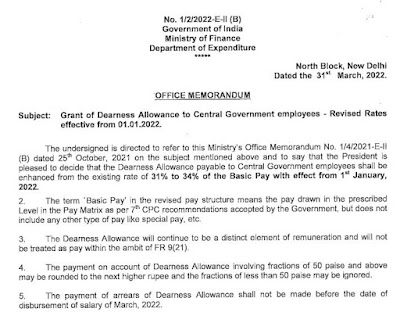
DA Jan 2022 - Grant of Dearness Allowance to Central Government employees - Revised Rates effective from 01.01.2022

 3% DA Hike - Revised Rates effective from 01.01.2022: DoE OM dated 31.03.2022 No. 1/2/2022-E-II (B) Government of India Ministry of Finance...