Showing posts with label Central Government. Show all posts

Tuesday, 17 March 2020

DoPT - Preventive measures to be taken to contain the spread of Novel Coronavirus (COVID-19)

Latest DoPT Orders 2020

F. No. 11013/9/ 2014-Estt.A. III
Government of India
Ministry of Personnel, Public Grievances and Pensions
(Department of Personnel and Training)

North Block, New Delhi
Dated: 16/03/2020

OFFICE MEMORANDUM

Coronavirus (COVID-19)

DoPT - Preventive measures to be taken to contain the spread of Novel Coronavirus (COVID-19)


Subject: Preventive measures to be taken to contain the spread of Novel Coronavirus (COVID-19) - regarding.

In order to contain the spread of Novel Coronavirus (COVID-19), some precautionary measures are required to be taken by all the employees and the Ministries / Departments. In this regard, it has been decided to issue the following advisory for the well-being of Government employees and in public interest.
All the Ministries / Departments are advised to take all necessary measures such as :-
  • Install thermal scanners at the entry of Government buildings, as feasible. Mandatory placing of hand sanitizers at the entry of Government buildings. Those found having flu-like symptoms may be advised to take proper treatment / quarantine etc.
  • Discourage, to the maximum extent, entry of visitors in the office complex. Routine issue of visitors/ temporary passes should be suspended with immediate effect. Only those visitors whom have proper permission of the officer who they want to meet, should be allowed after being properly screened.
  • Meetings, as far as feasible, should be done through video conferencing. To minimize or reschedule meetings involving large number of people unless necessary.
  • Avoid non-essential official travel.
  • Undertake essential correspondence on official email and avoid sending files and documents to other offices, to the extent possible.
  • Facilitate delivery and receipt of dak at the entry point itself of the office building, as far as practicable.
  • Close all gyms/recreation centres/ creches located in Government buildings.
  • Ensure proper cleaning and frequent sanitization of the workplace, particularly of the frequently touched surfaces.
  • Ensure regular supply of hand sanitisers, soap and running water in the washrooms.
  • All officials may be advised to take care of their own health and look out for respiratory symptoms/fever and, if feeling unwell, should leave the workplace immediately after informing their reporting officers. They should observe home-quarantine as per the guidelines issued by MoH&FW, Government of India available at the following URL: Draft Guidelines for home quarantine
  • (xi) The leave sanctioning authorities are advised to sanction leave whenever any request is made for self-quarantine as a precautionary measure.
  • (xii) Advise all employees who are at higher risk i.e. older employees, pregnant employees and employees who have
  • underlying medical conditions, to take extra precautions. The Ministries / Departments may take care not to expose such employees to any front-line work requiring direct contact with the public.
An indicative list of Do's and Don'ts is also annexed for wide dissemination.

End: As above

(Umesh Kumar Bhatia)
Deputy Secretary to the Govt. of India

ANNEXURE

Do's

• To maintain personal hygiene and physical distancing.
• To practice frequent hand washing. Wash hands with soap and water or use alcohol-based hand rub. Wash hands even if they are visibly clean.
• To cover your nose and mouth with handkerchief / tissue while sneezing and coughing.
• To throw used tissues into closed bins immediately after use.
• To maintain a safe distance from persons during interaction, especially with those having flu-like symptoms.
• To sneeze in the inner side of your elbow and not to cough into the palms of your hands.
• To take their temperature regularly and check for respiratory symptoms.
To see a doctor if you feel unwell (fever, difficulty in breathing and coughing). While visiting doctor, wear a mask/ cloth to cover your mouth and nose.
• For any fever/ flu-like signs/ symptoms, please call State helpline number. or the 24x7 helpline number of the Ministry of Health & Family Welfare at 011-23978046.

Don'ts

• Shake hands.
• Have a close contact with anyone, if you're experiencing cough and fever.
• Touch your eyes, nose and mouth.
• Sneeze or cough into palms of your hands.
• Spit in Public.
• Travel unnecessarily, particularly to any affected region.
• Participate in large gatherings, including sitting in groups at canteens.
• Visit gyms, clubs and crowded places etc.
• Spread rumours or panic.

Source: DoPT

Monday, 16 March 2020

Conditions for Promotion to next grade are applicable / allowed under rules to officials of Central Government

Conditions for Promotion to next grade are applicable / allowed under rules to officials of Central Government
GOVERNMENT OF INDIA
MINISTRY OF PERSONNEL, PUBLIC GRIEVANCES AND PENSIONS
(DEPARTMENT OF PERSONNEL & TRAINING)

RAJYA SABHA
Conditions for Promotion to next grade are applicable allowed under rules to officials of Central Government

UNSTARRED QUESTION NO. 2181
(TO BE ANSWERED ON 12.03.2020)

CONDITIONS FOR PROMOTION OF OFFICIALS

SHRI NEERAJ SHEKHAR:
SHRI RAVI PRAKASH VERMA:
Will the PRIME MINISTER be pleased to state:

(a) whether different sets of service conditions and conditions for promotion to next grade are applicable / allowed under rules to officials of Central Government appointed through same advertisement and same examination for the same post;

(b) if so, the details thereof along with the relevant rules and orders in this regard; and
(c) if not, the details of the relevant rules / orders in this regard?

Whether MACP scheme entitles financial upgradation of pay to the next grade pay or to the grade pay of the next promotional post as envisaged under the ACP scheme

ANSWER

MINISTER OF STATE IN THE MINISTRY OF PERSONNEL, PUBLIC GRIEVANCES AND PENSIONS AND MINISTER OF STATE IN THE PRIME MINISTER'S OFFICE (DR. JITENDRA SINGH)

(a) to (c): Candidates recruited through a common advertisement and common examination may be allotted different cadres / services under the Central Government on the basis of their choice, merit and eligibility conditions prescribed in the respective Service Rules / Recruitment Rules. After allocation of cadre / service to such selected candidates, their service conditions and eligibility for promotion to the next and subsequent grades in the hierarchy are regulated as per the provisions of relevant Recruitment Rules / Service Rules of the respective Cadres / Services of the Central Government.

Source: Rajya Sabha Q&A

Thursday, 5 March 2020

Implementation of RTI Act


Ministry of Personnel, Public Grievances & Pensions
Implementation of RTI Act

04 MAR 2020

The Central Government is fully committed to implement the Right to Information (RTI) Act in respect of public authorities under it. Each State Government is responsible for implementation of the Right to Information Act in respect of the public authorities in the State concerned.

In respect of the Central Information Commissions, the appointment process has been conducted duly as and when vacancies were required to be filled up and has not been at preliminary stage.

Also check: DoPT - Notification regarding RTI Rules 2019

The Hon’ble Supreme Court vide its Order dated 16.12.2019 in M.A. No. 1979 of 2019 in WP (C) No. 436 of 2018: Ms Anjali Bhardwaj & Others Vs. Union of India and Others pertaining to fill up the vacancies in Central Information Commissions, has inter-alia directed that the Government complete the process of appointment in 3 months.

The process has reached an advanced stage for appointment of the Chief Information Commissioner and one Information Commission in Central Information Commission.

This information was provided by the Union Minister of State (Independent Charge) Development of North- Eastern Region (DoNER), MoS PMO, Personnel, Public Grievances & Pensions, Atomic Energy and Space, Dr Jitendra Singh in written reply to a question in Lok Sabha today.

MACP ON PROMOTIONAL HIERARCHY - MACP Supreme Court Order – Heard & Reserved - Order dated 23 Jan 2020

PIB

Thursday, 27 February 2020

Latest DoPT Orders 2020 - Updation of list of Cadre Controlling Authorities of Central Services

Latest DoPT Orders 2020

Priority

T-16017/3/2020-iGOT
Govt. of India
Ministry of Personnel, Public Grievances and Pensions
Department of Personnel & Training
(Training Division)

Old JNU Campus, New Delhi
Dated: 25.02.2020

OFFICE MEMORANDUM

Subject: Updation of list of Cadre Controlling Authorities of Central Services / Cadres (Group ‘A’, ‘B’ and ‘C’) and Training Institutes under the administrative control of Central Govt. - regarding.

DoPT has launched Integrated Government Online Training Programme (iGOT) to augment the existing training mechanism with online module-based training coupled with certification with an objective to make training inputs available to all Government officials on site and on flexi time basis.

Also check: Revised Rotational Transfer Policy applicable to CSS officers - Latest DoPT Orders 2020 January 27, 2020

2. In this connection, details of Cadre Controlling Authorities of all Central Services/ Cadres (Group ‘A’, ‘B’ & ‘C’) and Training Institutes under the administrative control of Central Govt. are being updated.

3. In view of the above, all the Ministries / Departments / Training Institutes of Govt. of India are requested to provide the information as per the Annexure-I and Annexure-II, whichever applicable.
4. All Ministries / Departments/ Training Institutes of Govt. of India are also requested to nominate an officer of the level of Under Secretary as nodal officer for the purpose of iGOT and provide his/her contact details as per Annexure-III.

5. If a Ministry / Department is not Cadre Controlling Authority of any Service / Cadre and / or does not have any Training Institute under its administrative control, a reply to this effect may also kindly be furnished.

Also read: Cabinet approves Cadre review of Posts & Telegraphs Building Works Service Group A

6. The requisite information may be provided to Training Division, DoPT on priority basis and not later than 06.03.2020. The information may also be sent through e-mail at e-mail id : soigot-dopt@gov.in.

(Manoj Gupta )
Under Secretary to the Govt. of India

To,
Secretaries of All the Ministries / Departments of
the Govt. of India and Heads of Training Institutes under
the Govt. of India as per list enclosed.

Source: DoPT

Thursday, 12 December 2019

Penal Provisions for Violation of Reservation in Promotion

Ministry of Personnel, Public Grievances & Pensions
Penal Provisions for Violation of Reservation in Promotion

12 DEC 2019

The Central Government officers/ officials are governed by Central Civil Services (Conduct) Rules, 1964 and Central Civil Services (Classification, Control & Appeal) Rules, 1965 which have adequate provision to deal with the officers/ officials who violate the policy guidelines issued by the Central Government. The Government has issued guidelines from time to time to all Ministries/ Departments to strictly observe the reservation policy and other orders relating to representation of reserved categories. Instructions provide that cases of negligence or lapse in the matter of following reservation and other orders relating to the reserved category should be viewed seriously and be brought to the notice of appropriate authorities and suitable action be taken promptly. As per the guidelines dated 04.01.2013, all Ministries/ Departments are required to appoint/ nominate Liaison officers at least of the rank of Deputy Secretary and setting up of special Reservation Cell for enforcement of orders of reservation in posts and services of the Central Government.

Also check: 10% reservation would be provided for Economically Weaker Sections (EWS) in Central Government posts and services

The DoPT monitors the progress in filling up of backlog vacancies for SCs, STs and OBCs with ten Ministries/ Departments, having more than 90% of the employees in Central Government. Out of these Ministries/ Departments, six Ministries/ Departments have informed that as on 01.01.2018, 7782 backlog vacancies for SCs, 6903 backlog vacancies for STs and 10859 backlog vacancies for OBCs remained unfilled. Besides the above six, three more Ministries/ Departments have informed that as on 01.01.2019, 1713 backlog vacancies for SCs, 2530 backlog vacancies for STs and 1773 backlog vacancies for STs remained unfilled.

This information was provided by the Union Minister of State (Independent Charge) Development of North-Eastern Region (DoNER), MoS PMO, Personnel, Public Grievances & Pensions, Atomic Energy and Space, Dr Jitendra Singh in written reply to a question in Rajya Sabha today.

PIB

Thursday, 21 November 2019

Central Government Special Recruitment Drive for SCs/STs


Central Government Special Recruitment Drive for SCs/STs

Central Government Special Recruitment Drive for SCs/STs

Ministry of Personnel, Public Grievances & Pensions
Special Recruitment Drive for SCs/STs
21 NOV 2019
Department of Personnel & Training (DoPT) has issued general instructions to all Ministries/ Departments to constitute an In-House Committee for identification of backlog reserved vacancies, to study the root cause of such vacancies, to initiate measures to remove the factors causing such vacancies and to fill them up through Special Recruitment Drives. DoPT monitors the progress with regard to filling up of backlog reserved vacancies for Scheduled Castes (SCs), Scheduled Tribes (STs) and Other Backward Classes (OBCs) in ten Ministries/Departments, having more than 90% of the employees of Central Government.

Also read: First major recruitment with the benefit of 10% reservations for EWS

As per the data provided by six Ministries/ Departments (which includes data relating to Public Sector Banks, Financial Institutions, Central Public Sector Undertakings etc.), as on 31.12.2017, out of 13968 backlog vacancies for SCs and 11040 backlog vacancies for STs, 6186 backlog vacancies for SCs and 4137 backlog vacancies for STs were filled up. As on 01.01.2018, 7782 backlog vacancies for SCs and 6903 backlog vacancies for STs remained unfilled.

Besides the above six, three more Ministries/ Departments have informed that as on 31.12.2018, out of 9624 backlog vacancies for SCs and 8659 backlog vacancies for STs, 7911 backlog vacancies for SCs and 6129 backlog vacancies for STs were filled up. As on 01.01.2019, 1713 backlog vacancies for SCs and 2530 backlog vacancies for STs remained unfilled.

This information was provided by the Union Minister of State (Independent Charge) Development of North-Eastern Region (DoNER), MoS PMO, Personnel, Public Grievances & Pensions, Atomic Energy and Space, Dr Jitendra Singh in written reply to a question in Rajya Sabha today.

PIB

Wednesday, 20 November 2019

Provisions regarding reservation under the Central Government


Provisions regarding reservation under the Central Government

Provisions regarding reservation under the Central Government


Ministry of Personnel, Public Grievances & Pensions
Provisions relating to Reservations
20 NOV 2019
The instructions issued by Government on India under Article 16 (4) and 16 (4A) of the Constitution are, mutatis mutandis, followed by the Public Sector Undertakings (PSUs), Financial Institutions including the Public Sector Banks under the Central Government. Implementation of the reservation provisions are insisted upon as a pre-condition to receive grants-in-aid by the voluntary organizations, autonomous bodies /institutions etc. where:-

Also check: MACP FOR THE CENTRAL GOVERNMENT CIVILIAN EMPLOYEES - DOPT CONSOLIDATED GUIDELINES
  • the recipient body employs more than 20 persons on a regular basis and at least 50% of its recurring expenditure is met from grants-in-aid from Central Government; and
  • the body is registered society of a cooperative institution and is in receipt of a general purpose annual grants-in-aid of Rs. 2 lakhs and above from the Consolidated Fund of India.
Ministries/Departments have been directed to include suitable clause in the terms and conditions under which voluntary agencies / organizations etc. are given grants-in-aid by the Government for reservation for SCs/ STs/ OBCs in the posts and services under such organisations or agencies. It has further being provided that while sanctioning further grants, the progress made in employing SCs/ STs/ OBCs should be kept in view.

This information was provided by the Union Minister of State (Independent Charge) Development of North-Eastern Region (DoNER), MoS PMO, Personnel, Public Grievances & Pensions, Atomic Energy and Space, Dr Jitendra Singh in written reply to a question in Lok Sabha today.

PIB

Thursday, 12 September 2019

NPS National Pension Scheme for Traders and Self Employed Persons

NPS

Ministry of Labour & Employment
Prime Minister launches National Pension Scheme for Traders and Self Employed Persons
12 SEP 2019

The Prime Minister of India, Shri Narendra Modi launched at Ranchi today, the National Pension Scheme for Traders and Self Employed Persons, a pension scheme for the Vyaparis (shopkeepers /retail traders and self-employed persons) with annual turnover not exceeding Rs 1.5 crore. The Governor of Jharkhand Smt. Draupadi Murmu, Chief Minister of Jharkhand Shri Raghubar Das, Minister of Tribal Affairs Shri Arjun Munda, Minister of State for Labour & Employment (I/C) Shri Santosh Kumar Gangwar and other dignitaries were also present on the occasion. With this nation-wide launch, the facility for enrollment under the scheme has been made available to the prospective beneficiaries through 3.50 lakh Common Service Center (CSCs) across the country. In addition people can also self-enroll by visiting the portal maandhan.in/vyapari. The eligible Vyaparis can visit their nearest CSCs and get enrolled under the scheme. At the time of enrollment, the beneficiary is required to have an Aadhaar card and a saving bank/ Jan-dhan Account passbook only. He/ She should be within 18 to 40 years of age group. GSTIN is required only for those with turnover above Rs. 40 lakhs. The enrolment under the scheme is free of cost for the beneficiaries. The enrolment is based upon self- certification.

Government has approved National Pension Scheme for Traders and Self Employed Persons in acknowledgement of notable contribution of Vyaparis (shopkeepers/ retail traders and self-employed persons). It is a voluntary and contributory pension scheme for entry age of 18 to 40 years with a provision for minimum assured pension of Rs 3,000/- monthly on attaining the age of 60 years. The beneficiary should not be income tax payer and also not a member of EPFO/ ESIC/ NPS (Govt.)/ PM-SYM. The Central Government shall give 50 % share of the monthly contribution and remaining 50% contribution shall be made by the beneficiary. The monthly contribution is kept low to make it affordable. For example, a beneficiary is required to contribute as little as Rs.100/- per month at a median entry age of 29 years.

This pension scheme is one of the top priorities of Prime Minister Narendra Modi’s Government in its second term. According to the Ministry’s 100-day plan, this scheme will target enrolling 25 lakh subscribers in 2019-20 and 2 crore subscribers by 2023-2024. An estimated 3 crore Vyaparis in the country are expected to be benefited under the pension scheme.

PIB

Wednesday, 4 September 2019

Enforcement of various provisions of the Arbitration and Conciliation (Amendment) Act, 2019

Ministry Of Law & Justice
Enforcement of various provisions of the Arbitration and Conciliation (Amendment) Act, 2019.

04 SEP 2019

The Arbitration and Conciliation (Amendment) Act, 2019 was notified on 9th August, 2019. Sub-Section 2 of Section 1 of the Arbitration and Conciliation (Amendment) Act, 2019 provides as under:-

“(2) Save as otherwise provided in this Act, it shall come into force on such date as the Central Government may, by notification in the Official Gazette, appoint and different dates may be appointed for different provisions of this Act and any reference in any such provision to the commencement of this Act shall be construed as a reference to the coming into force of that provision.”

The Central Government by exercising powers conferred under sub-section 1 of the Arbitration and Conciliation (Amendment) Act, 2019, appoints the 30th August, 2019, for enforcement of the following Sections of the Arbitration and Conciliation (Amendment) Act, 2019:-

(i) Section 1;

(ii) Section 4 to 9 [both inclusive];

(iii) Section 11 to Section 13 [both inclusive];

(iv) Section 15.


Necessary Gazette Notification in this regard has been issued by the Central Government. In pursuance of the above notification, the section 17, 23,29A, 34, 37, 45 and 50 of the Arbitration and Conciliation Act, 1996 (the Act) stand amended. Also three new sections namely 42A, 42B, and 87 stand inserted in the Act. The insertion of section 87 is with retrospective effect i.e. 23rd October, 2015, with a view to clarify the applicability of the said cut-off date on arbitration and related court proceedings.

PIB

Monday, 12 August 2019

Central Government approves extension of benefits of Child Care Leave to single male civilian employees

CCL

Central Government approves extension of benefits of Child Care Leave to single male civilian employees

Raksha Mantri Shri Rajnath Singh has approved extension of benefits of Child Care Leave (CCL) to single male service personnel and certain relaxations of CCL provisions in case of woman officers of defence forces, in line with a recent DoPT order extending similar benefits of CCL to civilian employees.

Presently, CCL is being granted to woman officers in defence forces. Recently, DoPT has made certain amendments for grant of CCL to civilian employees, whereby the CCL granted to woman employees till now has been extended to single male government servants also. The age limit of 22 years prescribed earlier in the case of a child with 40 percent disability has been removed for the purpose of availing CCL. Further, the minimum period of CCL that can be availed at a time has been reduced to 05 days instead of 15 days.

Now the proposal of Ministry of Defence extending similar benefits to Defence personnel has been approved by Raksha Mantri Shri Rajnath Singh. With this, single male service personnel will be able to avail the benefit of CCL. Single male service personnel and woman officers of defence forces will also be able to avail CCL in respect of child with 40 percent disability without any restriction of age limit of the child. Further, the minimum period of CCL that can be availed in each spell has been reduced to 05 days from the earlier limit of 15 days.

PIB

Wednesday, 7 August 2019

PENSIONARY BENEFITS UNDER NPS ON VOLUNTARY RETIREMENT

PENSIONARY BENEFITS UNDER NPS ON VOLUNTARY RETIREMENT

GOVERNMENT OF INDIA
MINISTRY OF FINANCE
DEPARTMENT OF FINANCIAL SERVICES
RAJYA SABHA
UNSTARRED QUESTION NO.3404
ANSWERED ON JULY 23, 2019/
SHRAVANA 1, 1941 (SAKA)

PENSIONARY BENEFITS UNDER NPS ON VOLUNTARY RETIREMENT
  1. Shri Ravi Prakash Verma
Will the Minister of FINANCE be pleased to state:
(a) whether voluntary retirement is allowed to employees of Central Government covered under NPS after completion of 20 years of service on the lines of old pension scheme;
(b) if so, the details thereof;
(c) the details of pensionary benefits and other retirement benefits available/ allowed under NPS to employees who voluntarily retire;
(d) whether Government would increase its contribution to 20 per cent from 14 per cent under NPS in view of dismal returns on NPS fund to make it more attractive;
(e) if so, the details thereof; and
(f) if not, the reasons therefor?

ANSWER

The Minister of State (Finance) (Shri Anurag Singh Thakur)

(a) and (b) The features and benefits under National Pension System (NPS) and the old pension scheme are independent. Under NPS, there is a provision for voluntary retirement/exit prior to the age of superannuation, without linking it with the minimum number of 20 years of service.
(c) As per Pension Fund Regulatory and Development Authority (Exits and Withdrawals under the National Pension System) Regulations, 2015, and amendments there under, the provisions for voluntary retirement/exit and the benefits available/ allowed under NPS to employees of Central Government who voluntary retires are as follows:

"3(b) where the subscriber who, before attaining the age of superannuation prescribed by the service rules applicable to him or her, voluntarily retires or exits, then at least eighty per cent out of the accumulated pension wealth of the subscriber shall mandatorily be utilized for purchase of annuity and the balance of the accumulated pension wealth, after such utilization, shall be paid to the subscriber in lump sum or he shall have a choice to collect such remaining pension wealth in accordance with the other options specified by the Authority from time to time, in the interest of the subscribers”

Further, as informed by the Department of Pension and Pensioners’ Welfare, the benefit of retirement gratuity and death gratuity has been extended to Government employees covered under NPS on the same terms and conditions as are applicable under CCS (Pension) Rules, 1972.

(d) to (f) Recently, vide Gazette Notification dated 31.01.2019, the mandatory contribution by the Central Government for its employees covered under NPS Tier-I has been enhanced from the existing 10% of basic pay +DA to 14% of basic pay + DA. The employees’ contribution rate would remain at the existing 10% of basic pay + DA. There is no proposal to increase the contribution to 20 per cent from 14 per cent under NPS.

Source: Rajya Sabha

Thursday, 1 August 2019

MoS (PP) Dr Jitendra Singh gives Appointment letters to candidates appointed on compassionate grounds in DoPT

MoS (PP) Dr Jitendra Singh gives Appointment letters to candidates appointed on compassionate grounds in DoPT

Ministry of Personnel, Public Grievances & Pensions
MoS (PP) Dr Jitendra Singh gives Appointment letters to candidates appointed on compassionate grounds in DoPT

01 AUG 2019

The Union Minister of State (Independent Charge) for Development of North Eastern Region (DoNER), MoS PMO, Personnel, Public Grievances, Pensions, Atomic Energy and Space, Dr Jitendra Singh gave appointment letters to the candidates selected on the basis of compassionate grounds in Department of Personnel & Training (DoPT), here today. The Secretary, Department of Administrative Reforms & Public Grievances and Department of Pensions, Shri K. V. Eapen and senior officers of the Ministry were also present on the occasion. The letters were presented to 9 such candidates selected for appointment as MTS in DoPT.

Speaking on the occasion, Dr Jitendra Singh said that the Government has a system of compassionate appointments where employment is given to the dependents of the deceased Government servants who have died before reaching their retirement. The appointments are given to the most suitable applicants based on their penury conditions and to support their livelihood. He expressed happiness and satisfaction that this pending process has been completed by DoPT. The Minister said that this is a human issue and this step will help these families in meeting their livelihood needs. He added that 18 such vacancies were there, out of which 9 have been selected and given appointment letters today. He conveyed his wishes to the candidates and encouraged them to work hard to contribute to the Government system.

The last such appointment was made during the year 2014 against the vacancies that occurred for the year 2011. Present appointments are being made for the vacancies that occurred since the year 2012 and onwards. In total, 18 vacancies occurred during these years, for which 18 applications were received. Accordingly, in order to ensure that appointment on compassionate ground should go only to the most deserving dependents, a Sub-Committee was constituted to physically verify their penury conditions. The Sub-Committee had submitted its report on 03.05.2019. Finally, the Screening Committee met on 15th May, 2019 to assess the suitability of the applicants on the basis of the Guidelines on Compassionate appointments. The Screening Committee also considered the report of the Sub-Committee and recommended 09 most suitable applicants for appointment to the post of MTS on compassionate ground against vacancies that have arisen since 2012.

Thus, a very important long pending issue of appointments on compassionate ground in DoPT has been resolved within a very short span of time for which the bereaved families of the deceased employees were waiting for last 7 years.

PIB

Monday, 29 July 2019

Internship with the Department of Posts

Internship with the Department of Posts

No.18-06/2018- BD & MD
Government of India
Department of Posts
Business Development Directorate
Dak Bhavan, New Delhi – 110001
Tel: 011 23096 110, 23096129

Internship with the Department of Posts

The Department of Posts with its vast network of 1,54,939 Post Offices is the largest postal network in the world and is in the business of providing mail, parcel, logistics, retail and financial services across the nation. Department intends to offer internships at New Delhi only to the students pursuing Under Graduate/Graduate/Post Graduate studies from recognized University / Institution within India. Internship will be offered in the areas of Marketing, Parcel & Logistics, eCommerce, Retail Management, Asset Management, Insurance & Actuaries, Banking & Financial Inclusion, Fund Management, HR Management, Network & Technology etc. Internship period will be of one month and will tentatively start w.e.f. 15.05.2019.

Detailed guidelines and application form in this regard may be downloaded from www.indiapost.gov.in and filled in application forms may be sent latest by 28.04.2019 to Deputy General Manager, BD & M Directorate, Dak Bhawan, Sansad Marg, New Delhi – 110001. Alternatively, scanned copies of the documents may be sent to gmspeedpost@indiapost.gov.in. Applications received before issuance of this notification or after due date will not be considered.

INTERNSHIP GUIDELINES
OF
DEPARTMENT OF POSTS

1. OBJECTIVE:
The Department of Posts, with its network of 1,54,939 Post Offices, is the largest postal network in the world. In order to explore the potential & ideas available with the young generation in the field of Technology, Marketing, Social Media, Banking, Insurance, Public Administration and Management spheres etc, Department intends to provide internship programme and fellowships.

Interaction with young scholars will provide new ideas and research support from the field of Academics. At the same time, it will provide an opportunity to young scholars to contribute to the Department and provide an insight into working of the Government.

Several academic institutions and young scholars have expressed a desire to contribute to the Department. The Department of Posts is of the view that an Internship Programme will ensure interaction of the Department with Young Indian scholars with sound academic background from reputed Institutions in the country and will also allow them to understand the postal industry. This programme seeks to engage students pursuing Under Graduate/Graduate/Post Graduate Degrees from recognized University/Institution within India as “Interns”. These interns shall be given exposure through various Circles/Divisions of Postal Directorate. A list of domain/areas for which Internship is invited is enclosed as Annexure ‘A’. For the “interns” the exposure to the functioning of the Indian Government may be an add-on in furthering their future interests.

2. DEFINITIONS:
Unless the context requires otherwise, following words shall have the meaning attributed to them in these guidelines:-

    “Department” means Department of Posts
    “Sponsoring Institution” means the Academic Institution, in which the applicant is currently studying or recently passed out
    “Applicant on Internship” is a person, who wants to work, for mutual benefit, with the Department on a full-time basis with the sole purpose of enriching his knowledge in the area of expertise.
    “Area of Expertise” means the subject or area in which the applicant possesses expertise and wants to enrich it further.

3. ELIGIBILITY:
i. Indian students from recognized universities in India or abroad who have secured at least 60% marks in the last held degree or certificate examination and :

a. Who have completed education under 10+2+3 pattern of education i.e. students who have completed 15 years of formal education.
or
b. Who are pursuing 3rd year in the Business studies and Engineering in 10+2+3 pattern of education.
or
c. Who are pursuing 4th or 5th year in the integrated degree course or dual degree of 10+2+5 pattern of education
or
d. Who have completed 2nd year of Software Engineering in any IIT/NIT or 1st/ 2nd Year of Business Studies in any IIM/ recognized Management Institute.

ii. Possessing minimum qualifications as above shall not guarantee Internship in the Department. Candidates having exposure in the area of intended internship with good academic background and having higher qualification, based on need shall be given preference.

4. DURATION OF INTERNSHIP:
The duration of internship shall be of one (1) month. Interns not completing the requisite period will not be issued any certificate.

5. HOW TO APPLY:

i. Interested and eligible students must send their applications by post or submit in person, along with their CVs and areas of work interest to the Chief General Manager, BD & M Directorate, Dak Bhawan, Sansad Marg, New Delhi-110001 in the prescribed application form. These applications need to be sponsored by the Institution in which the intern is enrolled in.

ii. At the time of joining on selection, applicants shall be required to produce a letter from their Supervisor/ Head of Department/Principal, indicating their status in the Institution and “No Objection” for allowing their student to undergo Internship programme for the period for which he/she has been selected.

iii. Students who have c ompleted their education, need not to apply for the internship programme

6. SELECTION:

i. The applications will be scrutinized by BD & M Directorate only.

a. The applications forwarded will be placed before the selection committee consisting of Chief General Manager, BD & M Directorate and General Manager (A & BD).
b. The selection committee may conduct personal or telephonic interview, if required. No TA/DA shall be paid to candidates for attending the personal interview.

ii. After selection of the candidates BD & M Directorate will issue an offer letter to the candidates

iii. Maximum of 2 (Two) interns for Internship at a time in a particular domain/area as given in Annexure A can be considered for internship.

iv. Depending on the number of applications received against a particular domain/area, Department reserves the right to fix up the eligibility criteria, limit the number of applicants to be called for a particular period and to decide about the mode of screening thereof.

7. LOGISTICS & SUPPORT:

Interns will be required to have their own laptops. The Department will provide them working space, workplace internet facility and other necessities as deemed fit by the concerned Heads.

8. CODE OF CONDUCT:
The Intern engaged by the Department shall observe the following Code of Conduct, which shall include but not be limited to, the following:

i. The Intern shall follow the rules and regulations of the Department that are in general applicable to employees of the Department.
ii. The Intern shall follow the confidentiality protocol of the Department and shall not reveal to any person or organization confidential information of the Department, its work and its policies.
iii. Interns may, with the prior permission of the Department, present their work to academic bodies and at seminars and conferences. However, even for this purpose information that is confidential to the Department must not be revealed under any circumstance.
iv. Any papers and documents written and/or published by the Intern should carry the caveat that the views are the personal views of the intern and do not represent or reflect the views of the Department.
v. Interns will follow the advice given to them by the Department regarding representations to third parties.
vi. In general an Intern may not interact with or represent the Department vis-à-vis third parties. However, some Interns may specifically be authorized to interact with third parties on the behalf of the Department depending on the nature of their roles and responsibilities.
vii. No Intern shall interact with or represent or comment about the Department to the media (print and electronic) including social media and personal Facebook/ twitter handles.
viii. Interns will conduct themselves professionally in their relationship with the Department and the public in general.
ix. It may be strictly observed that the conduct of the interns and their access to data shall be the sole responsibility of the concerned Advisors/Heads only.
x. Any work done for the Department by the intern during the period of Internship will be the sole property of the Department and Department reserves the right to use any such work for its own purpose.

9. PLACEMENT:
i. The interns would be attached with one of the officers of minimum JTS rank in the concerned Circle/Division of Directorate.
ii. The internship is neither a job nor an assurance of a job with the Department.

10. SUBMISSION OF PAPER:
i. Work Plans and work schedules shall be developed by supervisor and the Interns shall invariably adhere to the same.
ii. The Interns will be required to submit a Report/ paper and give a presentation on the work undertaken at the end of the internship to the Head of respective Division/ Directorate. Report shall be signed by the officer with whom intern is attached.
iii. The Interns will also be required to give their mandatory feedback to the concerned Head of Department on their experience of the programme, monitoring and supervision.

11. TOKEN REMUNERATION:
i. Interns may be paid token remuneration @ Rs.10, 000/- per month per intern.
ii. Eligibility of candidate for payment of remuneration will be decided by selection committee while selecting the candidate.
iii. The remuneration shall be paid after the completion of Internship on submission of Report duly accepted by the Heads of Division of Postal Directorate which shall be countersigned by atleast JAG Level officer of that unit.

12. DECLARATION OF SECRECY:
Interns will be required to furnish to the Department a declaration of secrecy before reporting for the Internship.

13. CERTIFICATE OF INTERNSHIP:
Certificates will be issued by the BD & M Directorate to the interns on the completion of Internship and submission of Report duly countersigned and accepted by the competent authority as stated above in Para 10 (iii).

14. TERMINATION:
i. The Department may disengage from the Intern if the Department is of the view that the services of the Intern are no more required.
ii. In general the Department may terminate the services of the Intern at any time without assigning any reasons and with immediate effect.
iii. In general, if the Intern decides to disengage from the Department, he should provide 2 weeks’ prior notice. Notice period may be waived by the supervisor depending on the role of the intern.
iv. Upon, termination, the Intern must hand over any papers, equipments or other assets which might have been given to the Intern in course of his work with the Department. This will include any badges or ID cards which may have been issued to the intern.
v. If it comes to the notice that the person whose services have been terminated by the Department continues to act in a manner which gives an impression that he is still working for the Department, the Department shall be free to take appropriate legal action against such person.

Annexure “A”

Domains/Area Available for Internship

  •     Insurance/Actuaries
  •     Philately
  •     Fund Management/Finance
  •     Retail Management
  •     eCommerce/Courier, Express and Parcel (CEP)
  •     Parcel/Logistics & supply Chain
  •     Asset management
  •     Marketing/ Publicity and Branding
  •     Banking & Financial Inclusion
  •     HR Management
  •     Network & Technology and Software Security
  •     Legal and Legislative mechanism

Source: India Post

Friday, 26 July 2019

Reduction in number of vacancies in various departments of the central government

Reduction in number of vacancies in various departments of the central government

The government on Thursday told the Rajya Sabha that there has been a reduction in number of vacancies in various departments of the central government.

Replying to supplementaries during Question Hour, Minister of State for Personnel, Public Grievances and Pensions Jitendra Singh said filling up of vacancies in the government was a continuous process and efforts were being made to reduce them further.

“The government is already working in this direction. If you go by the vacancy figures, the percentage of the vacancy strength has been constantly reducing over the past five to six years.

“When this government came in, in the year 2013-14, ending March 31, 2014 before the government took over, the vacancy percentage was 16.2 per cent. The successive year it is 11.57 per cent. Then in 2015-16 it is 11.52 per cent, then in 2016-17 it is 11.36 per cent. In fact, the record is better in the central government than many of the states,” he said.

Singh said the record in the central government was far better than Karnataka where he said it had gone down from 27.3 per cent in 2014-15 to 32.56 per cent in 2018-19.

He also informed the House that steps to fill up almost 4 lakh vacancies in central government departments was underway and would be filled up by 2020.

The minister also pointed out that the Congress had claimed in its manifesto for the recent Lok Sabha polls that it will fill up the 4 lakh vacancies in the central government departments and the PSUs.

But, he said, the party did not mention that the process for filling up the vacancies had already started during the last NDA regime.

Singh said there is a total vacancy of 6,83,823 in all departments of central government, out of which almost half 3,89,069, almost 4 lakh, were already in the process of being filled up in the beginning of the year.

“All of 4 lakh vacancies in central government and PSUs, judiciary and Parliament will be filled up before March 2020.

But the catch is that the process of filling the vacancies had already been in the process. So we are already pro-active in filling up of vacancies,” the minister said.

In his written reply, the minister said vacancies in Central Government Ministries/Departments, their attached and subordinate offices arise due to retirement, resignation, voluntary retirement, promotion, transfer, transfer on deputation, termination of service, dismissal from service, death etc.

Based on the vacancies reported by the user Departments, the SSC has started recruitment process to fill up 1,05, 338 posts during the year 2019 and 2020, the minister said.

“During 2017-18, the Centralised Employment Notifications (CENs) for 1,27,573 combined vacancies of various Group C and Level-1 posts were notified by the Ministry of Railways For new and future vacancies to arise in two years time, another five CENs covering 1,56,138 vacancies of various Group C and Level-1 posts have been issued in 2018-19.

“Thus, recruitment process to fill up 3,89,069 vacancies has already started,” the minister said.

To reduce the recruitment cycle, some recruiting agencies have switched over to computer based on-line test and interview for non-gazetted posts has been discontinued, he said in a written reply.

The minister also said provisional appointment is being made pending verification of antecedents of the candidates.

PTI

Monday, 15 July 2019

30,85,205 Persons Enrolled in Pradhan Mantri Shram Yogi Maandhan PM-SYM as on July 10, 2019

30,85,205 Persons Enrolled in Pradhan Mantri Shram Yogi Maandhan PM-SYM as on July 10, 2019

Ministry of Labour & Employment

Pradhan Mantri Shram Yogi Maandhan
30,85,205 Persons Enrolled in PM-SYM as on July 10, 2019

15 JUL 2019

Government of India in February 2019 launched the Pradhan Mantri Shram Yogi Maandhan (PM-SYM), a voluntary and contributory pension Scheme, for the benefit of unorganised workers, as per the eligibility. The scheme assures minimum monthly pension of Rs. 3000/- to the beneficiaries after attaining the age of 60 years. Under the Scheme, the subscriber is required to pay the prescribed monthly contribution amount and the Central Government provides the equal matching contribution. This scheme is implemented through Life Insurance Corporation of India. Enrolment under the Scheme was started with effect from 15-02-2019. As on date 10.07.2019, the total person enrolled under PM-SYM are 30,85,205.

This information was given by Shri Santosh Kumar Gangwar Union Minister of State (I/C) for Labour and Employment in written reply to a question in Lok Sabha today.

PIB

Saturday, 20 April 2019

Variable Dearness Allowance - Minimum Wages effect from 1.4.2019 - Chief Labour Commissioner (Central) Orders

Variable Dearness Allowance - Minimum Wages effect from 1.4.2019 - Chief Labour Commissioner (Central) Orders 

F.No.1/8(3)/2019-LS-II
Government of India
Ministry of Labour & Employment
Office of the Chief Labour Commissioner(C)
New Delhi
Dated: 27/3/2019
ORDER

In exercise of the powers conferred by Central Government vide Notification No. S.O. 188(E) dated 19th January, 2017 of the Ministry of Labour and Employment the undersigned, hereby revise the rates of Variable Dearness Allowance on the basis of the average consumer price index number for the preceding period of six months ending on 31.12.2018 reaching 301.33 from 288.33 (base 2001 = 100) and thereby resulting in an increase of 13 points for Industrial Workers as under. This order shall come into force w.e.f. 01.04.2019 :-

Category of workerRates of V.D.A. Area wise per day (in Rupees)
A B C
Unskilled615040
Semi-Skilled/ Unskilled Supervisor665747
Skilled/ Clerical736657
Highly Skilled797366

Therefore the minimum rates of wages showing the basic rates and Variable Dearness Allowance payable w.e.f. 01 04 2019 will be as under :-

Category of workerRates of wages including V.D.A. Area wise per day
(in Rupees)
A AreaB AreaC Area
Unskilled523+61= 584437+50= 487350+40= 390
Semi-Skilled/ Unskilled Supervisor579+66= 645494+57= 551410+47 = 457
Skilled/ Clerical637+73= 710579+66= 645494+57= 551

The VDA has been rounded off to the next higher rupee as per the decision of the Minimum Wages Central Advisory Board.

The classification of workers under different categories will be same as in Part­ I of the notification, whereas classification of cities will be same as in the Part-II of the notification dated l9th January, 2017. The present classification of cities into areas A, 8 & C is enclosed at Annexure 1 for ready reference.
sd/-
(RAJAN VERMA)
CHIEF LABOUR COMMISSIONER(C)

Monday, 1 April 2019

The Payment of Bonus (Amendment) Rules, 2019: Gazette Notification


The Payment of Bonus (Amendment) Rules, 2019: Gazette Notification

Payment_Bonus_Amendment_Rules_2019_Gazette_Notification


MINISTRY OF LABOUR AND EMPLOYMENT

NOTIFICATION
New Delhi, the 29th January, 2019

G.S.R. 58(E). - Whereas a draft of certain rules further to amend the Payment of Bonus Rules, 1975, among other rules, were published in the Gazette of India, Extraordinary, Part II, Section 3, sub-section (i) vide notification of the Government of India in the Ministry of Labour and Employment number G.S.R. 413(E), dated the 23rd April, 2018, inviting objections and suggestions from all persons likely to be affected thereby, within a period of three months, from the date on which copies of Official Gazette containing the said notification were made available to the public;

And whereas copies of the said Official Gazette were made available to the general public on the 23rd April, 2018;

And whereas the objections and suggestions received on the said draft rules from the public have been considered by the Central Government;

Now, therefore, in exercise of the powers conferred by section 38 of the Payment of Bonus Act, 1965 (31 of 1965), the Central Government hereby makes the following rules further to amend the Payment of Bonus Rules, 1975, namely:-
  1. (1) These rules may be called the Payment of Bonus (Amendment) Rules, 2019.
    (2) They shall come into force on the date of their publication in the Official Gazette.
  2. In the Payment of Bonus Rules, 1975, for rule 5, the following rule shall be substituted, namely:-
‘5. Annual return.- Every employer shall, on or before the 1st day of February in each year, upload unified annual return in Form D on the web portal of the Central Government in the Ministry of Labour and Employment giving information as to the particulars specified in respect of the preceding year:

Provided that during inspection, the inspector may require the production of accounts, books, registers and other documents maintained in electronic form or otherwise.

Explanation.- For the purposes of this rule, the expression “electronic form” shall have the same meaning as assigned to it in clause (r) of section 2 of the Information Technology Act, 2000 (21 of 2000).’.
[No. Z-20025/24/2018-LRC]
MANISH KUMAR GUPTA, Jt. Secy.

Note: The Payment of Bonus Rules, 1975 was published in the Gazette of India dated the 6th September, 1975 vide notification number G.S.R. 2367, dated the 21st August, 1975 and lastly amended vide notification number G.S.R.1115(E) dated the 6th December, 2016.

Source: labour.gov.in

Thursday, 14 February 2019

Pradhan Mantri Shram Yogi Maan-Dhan (Pm- Sym) to be Implemented from February 15

Ministry of Labour & Employment

Pradhan Mantri Shram Yogi Maan-Dhan (Pm- Sym) to be Implemented from February 15
14 FEB 2019
Pradhan Mantri Shram Yogi Maan-dhan (PM-SYM) will be rolled out by the Ministry of Labour and Employment tomorrow i.e. 15.02.2019. The scheme announced in the Interim Budget was notified by the Ministry recently. As many as 42 crore workers are estimated to be engaged in the unorganized sector of the country.

The unorganised workers mostly engaged as home based workers, street vendors, mid-day meal workers, head loaders, brick kiln workers, cobblers, rag pickers, domestic workers, washer men, rickshaw pullers, landless labourers, own account workers, agricultural workers, construction workers, beedi workers, handloom workers, leather workers, audio- visual workers and similar other occupations whose monthly income is Rs 15,000/ per month or less and belong to the entry age group of 18-40 years are eligible for the scheme. They should not be covered under New Pension Scheme (NPS), Employees’ State Insurance Corporation (ESIC) scheme or Employees’ Provident Fund Organisation (EPFO). Further, he/she should not be an income tax payer.

Following are the salient Features of PM-SYM:
  • Minimum Assured Pension: Each subscriber under the PM-SYM, shall receive minimum assured pension of Rs 3000/- per month after attaining the age of 60 years.
  • Family Pension: During the receipt of pension, if the subscriber dies, the spouse of the beneficiary shall be entitled to receive 50% of the pension received by the beneficiary as family pension. Family pension is applicable only to spouse.
(iii) If a beneficiary has given regular contribution and died due to any cause (before age of 60 years), his/her spouse will be entitled to join and continue the scheme subsequently by payment of regular contribution or exit the scheme as per provisions of exit and withdrawal.

Contribution by the Subscriber: The subscriber’s contributions to PM-SYM shall be made through ‘auto-debit’ facility from his/ her savings bank account/ Jan- Dhan account. The subscriber is required to contribute the prescribed contribution amount from the age of joining PM-SYM till the age of 60 years. The chart showing details of entry age specific monthly contribution is as under:

Entry AgeSuperannuation AgeMember's monthly contribution (Rs)Central Govt's monthly contribution (Rs)Total monthly contribution (Rs)
(1)(2)(3)(4)(5)= (3)+(4)
18605555110
19605858116
20606161122
21606464128
22606868136
23607272144
24607676152
25608080160
26608585170
27609090180
28609595190
2960100100200
3060105105210
3160110110220
3260120120240
3360130130260
3460140140280
3560150150300
3660160160320
3760170170340
3860180180360
3960190190380
4060200200400

Matching contribution by the Central Government: PM-SYM is a voluntary and contributory pension scheme on a 50:50 basis where prescribed age-specific contribution shall be made by the beneficiary and the matching contribution by the Central Government as per the chart. For example, if a person enters the scheme at an age of 29 years, he is required to contribute Rs 100/ - per month till the age of 60 years. An equal amount of Rs 100/- will be contributed by the Central Government.

Enrolment Process under PM-SYM:
The subscriber will be required to have a mobile phone, savings bank account and Aadhaar number. The eligible subscriber may visit the nearest CSCs and get enrolled for PM-SYM using Aadhaar number and savings bank account/ Jan-Dhan account number on self-certification basis.
Later, facility will be provided where the subscriber can also visit the PM-SYM web portal or can download the mobile app and self-register using Aadhar number/ savings bank account/ Jan-Dhan account number on self-certification basis.

Enrollment agencies: The enrolment will be carried out by all the Community Service Centers (CSCs). The unorganised workers may visit their nearest CSCs along with their Aadhar Card and Savings Bank account passbook/Jandhan account and get registered themselves for the Scheme. Contribution amount for the first month shall be paid in cash for which they will be provided with a receipt.

Facilitation Centres: All the branch offices of LIC, the offices of ESIC/EPFO and all Labour offices of Central and State Governments will facilitate the unorganised workers about the Scheme, its benefits and the procedure to be followed, at their respective centers.
In this respect, the arrangements to be made by all offices of LIC, ESIC, EPFO all Labour offices of Central and State Governments are given below, for ease of reference:
  1. All LIC, EPFO/ESIC and all Labour offices of Central and State Governments may set up a “Facilitation Desk” to facilitate the unorganised workers, guide about the features of the Scheme and direct them to nearest CSC.
  2. Each desk may consist of at least one staff.
  3. They will have backdrop, standi at the main gate and sufficient number of brochures printed in Hindi and regional languages to be provided to the unorganised workers.
  4. Unorganised workers will visit these centres with Aadhaar Card, Savings bank account/ Jandhan account and mobile phone.
  5. Help desk will have onsite suitable sitting and other necessary facilities for these workers.
  6. Any other measures intended to facilitate the unorganised workers about the Scheme, in their respective centers.
Fund Management: PM-SYM will be a Central Sector Scheme administered by the Ministry of Labour and Employment and implemented through Life Insurance Corporation of India and CSCs. LIC will be the Pension Fund Manager and responsible for Pension pay out. The amount collected under PM-SYM pension scheme shall be invested as per the investment pattern specified by Government of India.

Exit and Withdrawal: Considering the hardships and erratic nature of employability of these workers, the exit provisions of scheme have been kept flexible. Exit provisions are as under:
  • In case subscriber exits the scheme within a period of less than 10 years, the beneficiary’s share of contribution only will be returned to him with savings bank interest rate.
  • If subscriber exits after a period of 10 years or more but before superannuation age i.e. 60 years of age, the beneficiary’s share of contribution along with accumulated interest as actually earned by fund or at the savings bank interest rate whichever is higher.
  • If a beneficiary has given regular contributions and died due to any cause, his/ her spouse will be entitled to continue the scheme subsequently by payment of regular contribution or exit by receiving the beneficiary’s contribution along with accumulated interest as actually earned by fund or at the savings bank interest rate whichever is higher.
  • If a beneficiary has given regular contributions and become permanently disabled due to any cause before the superannuation age, i.e. 60 years, and unable to continue to contribute under the scheme, his/ her spouse will be entitled to continue the scheme subsequently by payment of regular contribution or exit the scheme by receiving the beneficiary’s contribution with interest as actually earned by fund or at the savings bank interest rate whichever is higher.
  • After the death of subscriber as well as his/her spouse, the entire corpus will be credited back to the fund.
  • Any other exit provision, as may be decided by the Government on advice of NSSB.
Default of Contributions:
If a subscriber has not paid the contribution continuously he/she will be allowed to regularize his contribution by paying entire outstanding dues, along with penalty charges, if any, decided by the Government.

Pension Pay out:
Once the beneficiary joins the scheme at the entry age of 18-40 years, the beneficiary has to contribute till 60 years of age. On attaining the age of 60 years, the subscriber will get the assured monthly pension of Rs.3000/- with benefit of family pension, as the case may be.

Doubt and Clarification: In case of any doubt on the scheme, clarification provided by the JS& DGLW will be final.

PIB

Sunday, 27 January 2019

Supreme Court agrees to examine Centre's decision to grant 10 pc quota to poor in general category


Supreme Court agrees to examine Centre's decision to grant 10 pc quota to poor in general category

The Supreme Court Friday decided to examine the Centre's decision to grant 10 percent reservation in jobs and education to poor candidates belonging to general category.

A bench comprising Chief Justice Ranjan Gogoi and Justice Sanjiv Khanna issued notice to the central government on various petitions challenging the validity of the Constitution (103 Amendment) Act, 2019, which paved the way for grant of quota to poor belonging to general category.

"We are examining the matter and hence issuing notice returnable within four weeks," the bench said.
The bench, however, did not stay the operation of the Centre's decision granting quota to the poor in the general category.

In poll year, the Narendra Modi government had come out with the constitutional amendment bill giving quota benefits to the poor among general category candidates.

The petitions were filed by parties including organisations like Janhit Abhiyan and Youth For Equality challenging the Centre's decision.

The petition, filed by Youth For Equality, has sought the quashing of the bill saying that the economic criterion cannot be the sole basis for reservation.
The plea has said the bill violates basic feature of the Constitution as reservation on economic grounds cannot be limited to the general categories and the 50 per cent ceiling limit cannot be breached.

A similar plea has been filed by businessman Tehseen Poonawalla seeking to quash the bill, saying that backwardness for the purpose of reservation cannot be defined by "economic status alone".
The quota will be over and above the existing 50 per cent reservation to SCs, STs and Other Backward Classes (OBCs).

Lok Sabha and Rajya Sabha cleared the Bill on January 8 and 9 respectively and it has also been signed by President Ram Nath Kovind.

Source: PTINews

Friday, 4 January 2019

DoPT: Appointment of Information Commissioners in the Central Information Commission.

DoPT: Appointment of Information Commissioners in the Central Information Commission.

F. NO. 4/16/2018-IR
Government of India
Ministry of Personnel, Public Grievances and Pensions
(Department of Personnel and Training)
North Block,, New Delhi
Dated: 4th January, 2019

Subject: Appointment of Information Commissioners in the Central Information Commission. 

Under the Right to Information Act 2005, the Government of India has constituted the Central Information Commission which is located in New Delhi. The powers and functions of the Information Commissioner in the Central Information Commission are as per the RTI Act, 2005.

2. It is proposed to appoint four Information Commissioners in the Central Information Commission.

3. The Act provides that the Information Commissioner: -
(i) shall be a person of eminence in public life with wide knowledge and experience in law, science and technology, social service, management, journalism, mass-media or administration and governance.
(ii) shall not be a Member of Parliament or Member of the Legislature of any State or Union Territory, as the case may be, or hold any other office of profit or connected with any political party or carrying on any business or pursuing any profession. It is clarified that cessation/termination of holding of office of profit, pursuing any profession or carrying any business is a condition precedent to the appointment of a person as Information Commissioner.
4. Persons who have attained the age of 65 years shall not be eligible for appointment.

5. The salary, allowances and other terms and conditions of service of the Information Commissioner shall be as may be specified at the time of appointment of the selected candidate.

6. Persons fulfilling the criteria and interested for appointment to the post of Information Commissioner may send their particulars in the enclosed proforma only, by post, to Under Secretary (Rh), Department of Personnel and Training, North Block, New Delhi or through e-mail to usrti-dopt@nic.inso as to reach latest upto 25th January, 2019. Persons, who are serving under the State/Central Government or any other Organization, should send their particulars through proper channel (administrative Ministry/Department/State/UTs) only before the due date.
(Sanjay Kjmar)
Under Secretary (RTI)
Tel.2379 2759
Note: RTI Act, 2005 and Rules there under may be referred to by intending applicants for general familiarization, as could be appropriate.

Download the Proforma for sending particulars for consideration for the post of Information Commissioner in the Central Information Commission

Flash News

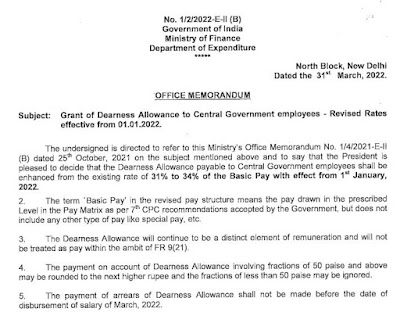
DA Jan 2022 - Grant of Dearness Allowance to Central Government employees - Revised Rates effective from 01.01.2022

 3% DA Hike - Revised Rates effective from 01.01.2022: DoE OM dated 31.03.2022 No. 1/2/2022-E-II (B) Government of India Ministry of Finance...