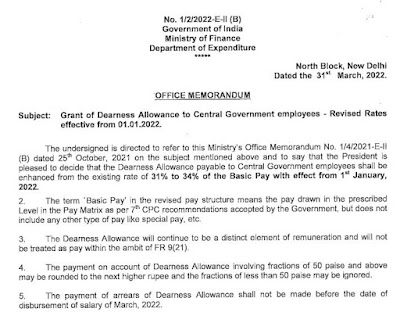
All about 7th Central Pay Commission for Central Government Employees. Dearness Allowance for Government Employees, CENTRAL GOVERNMENT EMPLOYEES NEWS - DOPT, DOPT Orders, Expected DA & more.
As per direction of CRC and Cabinet Sectt., issues to be addressed and revised proposal to be sent for consideration of CRC. Deptt. of Science & Technology to provide input.
4.
Indian Cost Accounts Service
As per deliberations held in meeting of CRC, DoE/CAC to submit revised proposal. Revised proposal has been received from DoE and is under consideration.
(2) Pending with Cabinet Secretariat (1)
5.
Indian Radio Regulatory Service
Proposal to be considered by the Cadre Review Committee.
(3) Pending with Department of Expenditure (8)
6.
Indian Ordnance Factories Health Services (IOFHS)
Meeting of CRC held on 28/08/ 2019. Revised proposal of DoPT, as per directions of CRC, sent to DoE for obtaining approval of Secretary (Expenditure).
7.
Central Health Service (CHS)
Proposal and recommendations of DoPT sent to DoE for obtaining approval of Secretary (Expenditure).
8.
Central Geological Service Group ‘A’
Proposal and recommendations of DoPT sent to DoE for obtaining approval of Secretary (Expenditure)
9.
Geological Survey of India Chemical Service Group ‘A’
Proposal and recommendations of DoPT sent to DoE for obtaining approval of Secretary (Expenditure)
10.
Geological Survey of India Geophysical Service Group ‘A’
Proposal and recommendations of DoPT sent to DoE for obtaining approval of Secretary (Expenditure)
11.
Geological Survey of India Engineering Service Group ‘A’
Proposal and recommendations of DoPT sent to DoE for obtaining approval of Secretary (Expenditure)
12.
Indian Corporate Law Service
Proposal and recommendations of DoPT sent to DoE for obtaining approval of Secretary (Expenditure)
13.
Indian Railway Health Service
Proposal and recommendations of DoPT sent to DoE for obtaining approval of Secretary (Expenditure)
(4) Pending with DoPT (2)
14.
Military Engineering Service (IDSE, Surveyor, Architect)
Recommendations of DoE on the proposal of Deptt. of Defence and DoPT has been received. Note for consideration of Cadre Review Committee is under finalisation for sending to Cabinet Sectt. for consideration of CRC.
15.
Railway Protection Force
Ministry of Railways has submitted revised proposal which is under examination.
(5) Proposal pending with CCA for clarification/re-submission as per DoPT’s observations (3)
16.
Medical Cadres of CAPFs, NSG & AR
MHA to provide requisite information/clarification.
17.
Indian Economic Service
DEA to provide revised proposal
18.
Indian Skill Development Service
MSDE to provide revised proposal
*CCA – Cadre Controlling Authority
Note: (1) CCA for Services at SI. No. 16 to 18 may take necessary action at the earliest.
All CCAs, where previous cadre review held prior to October 2015, is requested to prepare the proposal and submit the same to DoPT at the Status of the proposal in Administrative Ministry, as on date, may be sent immediately. (mail: harmit.pahuja@gov.in , randhir.kumar14@nic.in )
All CCAs of Central Group ‘A’ Services to provide Statistical Profile (as on 1/7/ 2020) and Service Profile (wherever due) to (mail: harmit.pahuja@gov.in , randhir.kumar14@nic.in )
Sub: Calculation of monthly contribution towards cost of Pension payable during foreign service – Reg.
The undersigned is directed to invite reference to this Department’s OM No. 2/34/2008-Estt (Pay-II) dated 19th November, 2009 on the above subject and to say that according to this OM w.e.f. 01.01.2006, the pension contribution payable in respect of a Government employee during the active period of his foreign service shall be based on the existing basic pay (Pay in the Pay Band plus Grade Pay) of the post held by the Government servant at the time of proceeding on foreign service, and in case he receives Proforma promotion/ financial up-gradation while on foreign service, on the basic pay (Pay in the Pay Band plus Grade Pay) fixed on such promotion/ financial up-gradation.
2. Consequent upon implementation of the recommendations of the 7th CPC, the matter of issuing revised instructions on the above subject has been engaging the attention of the Government of India. The President is now pleased to decide that pension contribution payable in respect of a Government servant during the active period of his foreign service shall be based on the basic pay in the level (in Pay Matrix) of the post held by him/ her at the time of proceeding on foreign service; and in case of grant of Proforma promotion/financial up-gradation while on foreign service, the same shall be based on basic pay in the Level (in Pay Matrix) fixed on such Proforma promotion / financial up-gradation.
3. In respect of Government employees covered by the NPS, during the active period of foreign service w.e.f. 01.01.2016, it has been decided to fix the monthly Pension contribution @ 24% of basic pay in the level (in Pay Matrix) of the post held by him/her at the time of proceeding on foreign service plus DA admissible on such basic pay (i.e. employee’s contribution @ 10%, employer’s contribution @ 10% and contribution by employer for gratuity @ 4%). However, consequent to revision of Government’s contribution for NPS from 10 % to 14% w.e.f. 01.04.20 19 vide Department of Financial Services Notification dated 31.01.2019, the monthly Pension contribution for Government employees covered by the NPS w.e.f. 01.04.2019 will be 28% of basic pay in the level (in Pay Matrix) plus DA of the post held by him/her, which will include employee’s contribution @ 10%, employer’s contribution @ 14%, and contribution by employer for gratuity @ 4%. In case of grant of Proforma promotion/ financial up-gradation while on foreign service, the same shall be based on basic pay in the Level (in Pay Matrix) fixed on such Proforma promotion /financial up-gradation.
4. In respect of the employees covered under the Old Defined Benefit Pension Scheme, it has been decided to fix their rates of monthly contribution of pension during the active period of foreign service as 14% of basic pay in the level (in Pay Matrix) of the post held by him/her at the time of proceeding on foreign service plus DA admissible on such basic pay during foreign service w.e.f. 01.01.2016. The monthly contribution of pension during the active period of foreign service w.e.f. 01.04.2019 will be 18% of the basic pay in Pay Matrix of the post held by the officer at the time of proceeding on foreign service plus DA admissible on such basic pay.
In case of grant of Proforma promotion/ financial up-gradation while on foreign service, the same shall be based on basic pay in the Level (in Pay Matrix) fixed on such Proforma promotion/ financial up-gradation.
5. It has also been decided that these pension contributions would be in addition to the leave salary contributions for the period of foreign service, in respect of both NPS employees and the employees under Old Defined Benefit Pension Scheme.
6. In case of employees covered under NPS, during the period of active foreign service, the borrowing organisation shall make its part of contribution mandatorily to the NPS Account of the employee.
7. This OM will be effective from 01.01.2016. In respect of persons who are already on foreign service as on 01.01.2016, the pension contribution will be calculated at the above rates on the revised pay as per 7th CPC from the date which they opt to come over to the revised pay structure after implementation of 7th CPC recommendations, in their parent cadres. For the earlier period, the pension contributions will be as per extant orders i.e. the order in force during period prior to 01.01.20 16 from time to time.
8. The modalities! mechanism of payment of pension contribution during the active period of foreign service in respect of NPS subscribers will be issued separately.
9. In their application to the persons belonging to Indian Audit and Accounts Department, these orders are issued under Article 148(5) of the Constitution and after consultation with the Comptroller & Auditor General of India.
10. Hindi version will follow.
(Rajeev Bahree) Under Secretary to the Government of India
To All Ministries/ Department (As per standard list)
No. 25012/I/2015-Estt.A-IV
Government of India
Ministry of Personnel, Public Grievances and Pensions
Department of Personnel and Training
Establishment A-IV Desk
North Block, New Delhi-110 001
Dated: September 7, 2020
OFFICE MEMORANDUM
Subject:- Request received for Voluntary retirement from service (VRS) from Persons With Disabilities – Supreme Court Order in Bhagwan Dass & Anr Vs Punjab State Electricity Board, (2008) 1 SCC 579 – clarification reg.
The undersigned is directed to refer to this Department’s O.M. of even no. dated 19.05.2015 on the subject noted above regarding the treatment of VRS notice given by a Government servant on medical grounds or on account of disability.
In this regard, it is stated that the Persons with Disabilities (Equal Opportunities, Protection of Rights and Full Participation) Act, 1995 (PWD Act) has been repealed by the Rights of Persons with Disabilities Act, 2016 (RPWD Act, 2016), which came into force on 19th April, 2017. Hence, section 47 of PWD Act, 1995 as stated in DoPT’s O.M. of even no. 19.05.2015 is replaced by the provisions of section 20 of the RPWD Act, 2016.
Section 20 of Rights of Persons with Disabilities Act, 2016 provides as under:
“20. (1) No Government establishment shall discriminate against any person with disability in any matter relating to employment: Provided that the appropriate Government may, having regard to the type of work carried on in any establishment, by notification and subject to such conditions, if any, exempt any establishment from the provisions of this section. (2) Every Government establishment shall provide reasonable accommodation and appropriate barrier free and conducive environment to employees with disability. (3) No promotion shall be denied to a person merely on the ground of disability. (4) No Government establishment shall dispense with or reduce in rank, an employee who acquires a disability during his or her service: Provided that, if an employee after acquiring disability is not suitable for the post he was holding, shall be shifted to some other post with the same pay scale and service benefits: provided further that if it is not possible to adjust the employee against any post, he may be kept on a supernumeraty post until a suitable post is available or he attains the age of superannuation, whichever is earlier. (5) The appropriate Government may frame policies for posting and transfer of employees with disabilities.
In view of the above provision of RPWD Act, 2016 and Hon’ble Supreme Court’s judgement in case of Bhagwan Dass & anr vs Punjab State Electricity Board (2008) 1 Scc 579, it is stated that whenever a Government servant seeks voluntary retirement citing medical grounds, or when the said VRS notice has been submitted due to a disability, the Administrative authorities shall examine as to whether the case is covered under Section 20 . (4) of RPWD Act, 2016. In case the provisions are applicable, the Government servant shall be advised that he/she has the option of continuing in service with the same pay scale and service benefits. In case a disabled Government servant reconsiders his decision and withdraws the notice for voluntary retirement, his case shall be dealt with the aforesaid provisions of Section 20 of RPWD Act, 2016. If however, in spite of being so advised, such Government servant still wishes to take voluntary retirement, the request may be processed as per the applicable rules.
All the Ministries and Departments are requested to keep the above in view while processing cases of requests for voluntary retirement from disabled Government servants.
(Surya Narayan Jha)
Under Secretary to the Government of India
To
The Secretaries
All Ministries /Departments of Government of India
(As per the standard list)
F.No.11013/9/2014-Estt. A.III
Government of India
Ministry of Personnel, Public Grievances and Pensions
(Department of Personnel
and Training)
North Block, New Delhi
Dated the 5th June, 2020
OFFICE MEMORANDUM
Subject: Preventive measures to be taken to contain the spread of Novel Coronavirus (COVID-19) – Attendance regarding.
The undersigned is directed to refer to OM of even number dated the
17th March, 2020, 18th May, 2020 and 19th May, 2020 whereby advisory for
well-being of Government employees and attendance in Government offices
with staggered timings were issued by Department of Personnel &
Training (DoPT).
2. Kind attention is also drawn to Ministry of Home Affairs’ Order
dated 30.05.2020 whereby ‘Additional Directives for Work Places’ have
been prescribed. Further, the Ministry of Health & Family Welfare
(MoH&FW) on 4th June, 2020 has issued Standard Operating Procedure
on preventive measures to contain spread of COVID-19 in workplace settings (copy enclosed).
3. It is emphasized that strict adherence to the practices of social
distancing norms and health & hygiene practices, as enunciated in
these guidelines, is of paramount importance and the Government servants
as responsible employees should abide by these practices so that the
Government offices function in the most efficient manner in the given
situation. All the Ministries / Departments/offices as well as the
Central Government employees are, therefore, directed to ensure strict
compliance of instructions issued by DoPT as well as MHA and MoH&FW.
(Umesh Kumar Bhatra)
Deputy Secretary to the Govt. of India
4th June, 2020
Government of IndiaMinistry of Health & Family Welfare
SOP on preventive measures to contain spread of COVID-19 in offices
1. Background
Offices and other workplaces are relatively close settings, with
shared spaces like work stations, corridors, elevators & stairs,
parking places, cafeteria, meeting rooms and conference halls etc. and
COVID-19 infection can spread relatively fast among officials, staffs
and visitors.
There is a need to prevent spread of infection and to respond in a
timely and effective manner in case suspect case of COVID-19 is detected
in these settings, so as to limit the spread of infection.
2. Scope
This document outlines the preventive and response measures to be
observed to contain the spread of COVID-19 in office settings. The
document is divided into the following sub-sections
(i) Generic preventive measures to be followed at all times
(ii) Measures specific to offices
(iii) Measures to be taken on occurrence
of case(s)
(iv) Disinfection procedures to be implemented in case of occurrence of suspect / confirmed case.
Offices in containment zones shall remain closed except for medical
& essential sevices. Only those outside containment zones will be
allowed to open up.
3. Generic preventive measures
Persons above 65 years of age, persons with comorbidities, pregnant
women are advised to stay at home, except for essential and health
purposes. Office management to facilitate the process.
The generic preventive measures include simple public health measures
that are to be followed to reduce the risk of infection with COVID-19.
These measures need to be observed by all (employees and visitors) at
all times. These include:
i. Individuals must maintain a minimum distance of 6 feet in public places as far as feasible.
ii. Use of face covers/masks to be
mandatory.
iii.
Practice frequent hand washing with soap (for at least 40-60 seconds)
even when hands are not visibly dirty. Use of alcohol-based hand
sanitizers (for at least 20 seconds) can be made wherever feasible.
iv.
Respiratory etiquettes to be strictly followed. This involves strict
practice of covering one’s mouth and nose while coughing/sneezing with a
tissue / handkerchief / flexed elbow and disposing off used tissues
properly.
v. Self-monitoring of health by all and reporting any illness at the earliest to the immediate supervisory officer.
vi.
Spitting shall be strictly prohibited.
vii. Installation & use of Aarogya Setu App by employees.
4. Specific preventive measures for offices:
i. Entrance to have mandatory hand hygiene (sanitizes dispenser) and thermal screening provisions.
ii. Only asymptomatic staff/visitors shall be allowed.
iii.
Any officer and staff residing in containment zone should inform the
same to supervisory officer and not attend the office till containment
zone is denotified. Such staff should be permitted to work from home and
it will not be counted as leave period.
iv. Drivers shall maintain
social distancing and shall follow required dos and don’ts related to
COVID-19. It shall be ensured by the service providers/ officers/ staff
that drivers residing in containment zones shall not be allowed to drive
vehicles.
v. There shall be provision for disinfection of the
interior of the vehicle using 1% sodium hypochlorite solution/ spray. A
proper disinfection of steering, door handles, keys, etc. should be
taken up.
vi. Advise all employees who are at higher risk i.e. older
employees, pregnant employees and employees who have underlying medical
conditions, to take extra precautions. They should preferably not be
exposed to any front-line work requiring direct contact with the public.
Office management to facilitate work from home wherever feasible.
vii.
All officers and staff / visitors to be allowed entry only if using
face cover/masks. The face cover/mask has to be worn at all times inside
the office premises.
viii. Routine issue of visitors/ temporary
passes should be suspended and visitors with proper permission of the
officer who they want to meet, should be allowed after being properly
screened.
ix. Meetings, as far as feasible, should be done through video conferencing.
x. Posters/ standees/ AV media on preventive
measures about COVID-19 to be displayed prominently.
xi. Staggering of office hours, lunch hours/coffee breaks to be done, as far as feasible.
xii. Proper crowd management in the parking lots and outside the premises – duly following social distancing norms be ensured.
xiii.
Valet parking, if available, shall be operational with operating staff
wearing face covers/ masks and gloves as appropriate. A proper
disinfection of steering, door handles, keys, etc. of vehicles should be
taken up.
xiv. Any shops, stalls, cafeteria etc., outside and within
the office premises shall follow social distancing norms at all times.
xv. Specific markings may be made with sufficient distance to manage the queue and ensure social distancing in the premises.
xvi. Preferably separate entry and exit for officers, staff and visitors shall be organised.
xvii.
Proper cleaning and frequent sanitization of the workplace,
particularly of the frequently touched surfaces must be ensured.
xviii. Ensure regular supply of hand sanitisers, soap and running water in the washrooms.
xix. Required precautions while handling supplies, inventories and goods in the office shall be ensured.
xx. Seating arrangement to be made in such a way that adequate social distancing is maintained.
xxi. Number of people in the elevators shall be restricted, duly maintaining social distancing norms.
xxii.
For air-conditioning/ventilation, the guidelines of CPWD shall be
followed which inter alia emphasises that the temperature setting of all
air conditioning devices should be in the range of 24-30°C, relative
humidity should be in the range of 40¬70%, intake of fresh air should be
as much as possible and cross ventilation should be adequate.
xxiii. Large gatherings continue to remain prohibited.
xxiv.
Effective and frequent sanitation within the premises shall be
maintained with particular focus on lavatories, drinking and hand
washing stations/areas.
xxv. Cleaning and regular disinfection (using
1% sodium hypochlorite) of frequently touched surfaces (door knobs,
elevator buttons, hand rails, benches, washroom fixtures, etc.) shall be
done in office premises and in common areas
xxvi. Proper disposal of face covers / masks / gloves left over by visitors and/or employees shall be ensured.
xxvii. In the cafeteria/canteen/dining halls:
a.Adequate crowd and queue management to be ensured to ensure social distancing norms.
b. Staff / waiters to wear mask and hand gloves and take other required precautionary measures.
c.The seating arrangement to ensure a
distance of at least 1 meter between patrons as far as feasible.
d. In the kitchen, the staff to follow social distancing norms.
5. Measures to be taken on occurrence of case(s):
Despite taking the above measures, the occurrence of cases among the
employees working in the office cannot be ruled out. The following
measures will be taken in such circumstances:
i. When one or few person(s) who share a room/close office space
is/are found to be suffering from symptoms suggestive of COVID-19:
Place the ill person in a room or area where they are isolated
from others at the workplace. Provide a mask/face cover till such time
he/she is examined by a doctor.
Immediately inform the nearest medical facility (hospital/clinic) or call the state or district helpline.
A
risk assessment will be undertaken by the designated public health
authority (district RRT/treating physician) and accordingly further
advice shall be made regarding management of case, his/her contacts and
need for disinfection.
The suspect case if reporting very
mild/mild symptoms on assessment by the health authorities would be
placed under home isolation.
Suspect case, if assessed by health
authorities as moderate to severe, will be treated as per health
protocol in appropriate health facility.
The rapid response team of the concerned district shall be requisitioned and will undertake the listing of contacts.
The
necessary actions for contact tracing and disinfection of work place
will start once the report of the patient is received as positive. The
report will be expedited for this purpose.
ii. If there are large numbers of contacts from a pre-symptomatic /
asymptomatic case, there could be a possibility of a cluster emerging in
workplace setting. Due to the close environment in workplace settings
this could even be a large cluster (>15 cases). The essential
principles of risk assessment, isolation, and quarantine of contacts,
case referral and management will remain the same. However, the scale of
arrangements will be higher.
iii. Management of contacts:
The contacts will be categorised into high and low risk contacts by the District RRTas detailed in the Annexure I.
The high-risk exposure contacts shall be quarantined for 14 days.
These persons shall undergo testing as per ICMR protocol.
The low risk exposure contacts shall continue to work and closely monitor their health for next 14 days.
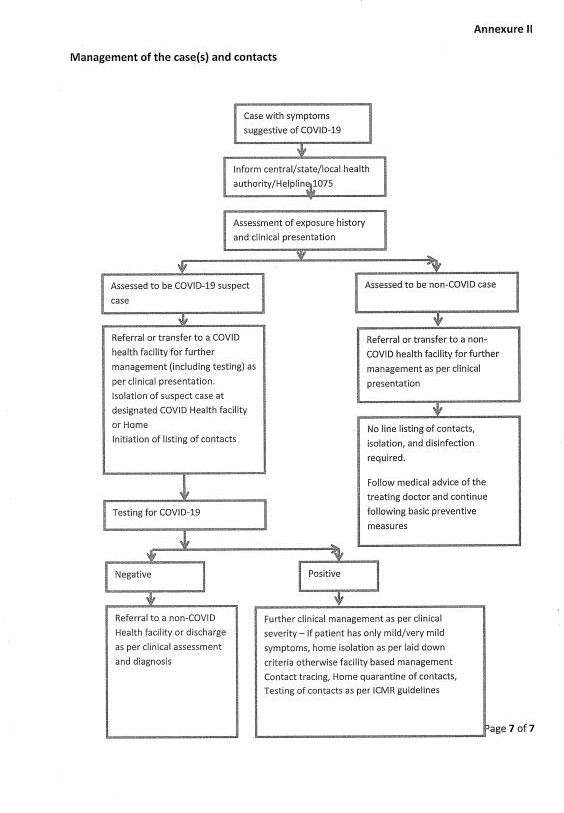
The flowchart for management of contact/ cases is placed at Annexure – II.
6. Closure of workplace
i. If there are one or two cases reported, the disinfection procedure
will be limited to places/areas visited by the patient in past 48 hrs.
There is no need to close the entire office building/halt work in other
areas of the office and work can be resumed after disinfection as per
laid down protocol.
ii. However, if there is a larger outbreak, the
building/block will have to be closed for 48 hours after thorough
disinfection. All the staff will work from home, till the building/block
is adequately disinfected and is declared fit for re-occupation.
7. Disinfection Procedures in Offices
Detailed guidelines on the disinfection as already issued by Ministry
of Health & Family Welfare as available on their website shall be
followed.
Annexure I
Risk profiling of contacts
Contacts are persons who have been exposed to a confirmed case
anytime between 2 days prior to onset of symptoms (in the positive case)
and the date of isolation (or maximum 14 days after the symptom onset
in the case).
High-risk contact
Touched body fluids of the patient (respiratory tract
secretions, blood, vomit, saliva, urine, faeces; e.g. being coughed on,
touching used paper tissues with a bare hand)
Had direct physical contact with the body of the patient including physical examination without PPE
Touched or cleaned the linens, clothes, or dishes of the patient.
Lives in the same household as the patient.
Anyone in close proximity (within 1 meter) of the confirmed case without precautions.
Passengers
in close proximity (within 1 meter) in a conveyance with a symptomatic
person who later tested positive for COVID-19 for more than 6 hours.
Low-risk contact
Shared the same space (worked in same room/similar) but not having a high-risk exposure to confirmed case of COVID-19.
Travelled in same environment (bus/train/flight/any mode of transit) but not having a high-risk exposure.
Stepping up of pay of senior Assistants of CSS drawing less pay on promotion in the Section Officers Grade than their
juniors
Latest central government employees news today
Stepping up of salaries of senior Assistants of CSS earning less
salary on promotion in the Section Officers Grade than their juniors
सं.-18/2/2014-CS-I (S)
भारत सरकार Government of India
कार्मिक,लोक शिकायत और पेंशन मंत्रालय /
Ministry of Personnel, P.G. and Pensions
कार्मिक एवं प्रशिक्षण विभाग /
(Department of Personnel & Training)
2nd Floor, A Wing, Lok Nayak Bhawan,
New Delhi -110003, the 01st June, 2020
Subject: Stepping up of pay of senior Assistants of CSS
drawing less pay on promotion in the Section Officers Grade than their
juniors – OM No. 18/2/2007- CS-I dated 20.05.2014 – Writ Petitions filed
in the matter -regarding.
The undersigned is directed to refer to this Department’s OM of even
number dated 01.07.2019 wherein instructions, for dealing with stepping
up of pay cases consequent to directions of Hon’ble High Court of Delhi
vide their interim orders in various Writ Petitions filed in the matter,
were issued.
2. In this connection it is reiterated that the pay of the
petitioners and similarly placed non-petitioners is to be restored only
if they submit the ‘Affidavit of Undertaking’ as directed by the Hon’ble
High Court of Delhi in the format attached with this Department’s OM
under reference.
3. As regards the manner in which the pay is to be restored, it is
clarified that the pay of the petitioners and non-petitioners, who
submit the affidavit of undertaking in the prescribed format, may be
restored notionally from the date with effect from which the stepping up
of pay was granted earlier and regularly from the date of submission of
the affidavit of undertaking as directed by Hon’ble High Court of Delhi
subject to the outcome of the Writ Petitions or orders of any competent
court in related matters.
4. If an officer, whose pay has been restored in accordance with the
above instructions, superannuates or retires voluntarily, his/ her case
may be dealt as per the provisions of CCS (Pension) Rules 1972 relating
to provisional pension, payment of gratuity etc.
Accordingly, correct Roster Can be drawn up by the Heads of Department. Needless to say, officials / staff employed at home on a specific day should always be accessible by telephone and electronic means of communication
F. No. 11013/9/2014-Estt.A-III
Government of India
Ministry of Personnel, Public Grievances & Pensions
Department of Personnel & Training
Establishment A-III Desk
North Block, New Delhi.
Dated the 23 April, 2020
OFFICE MEMORANDUM
Subject:- Preventive measures to contain the spread of COVID-19
The undersigned is directed to refer to O.M of even number dated 17th March, 2020 on the above-mentioned subject. The Ministry of Home Affairs (MHA) vide its Order dated 15.4.2020 has now extended the nationwide lockdown till 3rd May, 2020 to contain spread of Coronavirus in the country and has issued the consolidated revised guidelines for strict compliance. Para 18(ii) of these consolidated revised guidelines, inter-alia, provide that all officers of the level of Deputy Secretaries & above are to function with 100% attendance while 33% of the remaining officers/staff are to attend offices as per requirement.
2. The spirit of the guidelines is that crowding in the offices may be avoided and safe social distancing norms may be maintained. It is, however, seen that in some Ministries/ Departments, more than 33% of officials /staff below Deputy Secretary level are being called to offices. This might lead to undesirable crowding in the office jeopardizing the preventive measures in place for containing the spread of COVID-19.
3. It is reiterated that guidelines for attendance for officers/staff at levels below Deputy Secretary, be strictly followed. Heads of Departments (HoDs) may also direct their officers/staff to attend office in staggered timings to further avoid crowding in offices/work spaces. As suggested vide O.M. of even number dated 19th March, 2020, the staggered timings may be as follows :-
(a) 9.00 am. to 5.30 p.m. (b) 9.30 a.m. to 6.00 p.m. (c) 10 a.m. to 6.30 p.m.
Suitable Roster May, accordingly, be drawn up by the Heads of Department. Needless to say that officials/ staff working from home on a particular day should be available on telephone and electronic means of communications at all times. They should attend office, if called for any exigencies of work.
Sd/-
(Umesh Kumar Bhatia)
Deputy Secretary to the Govt. of India
Central Government Holiday on 14.04.2020 Dr. B.R. Ambedkar's birthday
F.No. 12/4/2020-JCA2
Government of India
Ministry of Personnel, Public Grievance & Pensions
(Department of Personnel & Training)
Establishment (JCA-2)Section
North Block, New Delhi
Dated the 08th April, 2020.
OFFICE MEMORANDUM
Subject : Declaration of Holiday on 14thApril, 2020 - Birthday of Dr. B.R. Ambedkar.
It has been decided to declare Tuesday, the 14thApril, 2020, as a Closed Holiday on account of the birthday of Dr. B.R.Ambedkar, for all Central Government offices, including Industrial Establishment throughout India.
Extension of tenure of all the officers appointed under the Central Staffing Scheme or through CSB procedure
IMMEDIATE
No 36/3/2020-E0(SM-I)
Government of India
Secretariat of the
Appointments Committee of the Cabinet
Ministry of Personnel, Public Grievances & Pensions
Department of Personnel & Training
New Delhi
Dated, the 7th April, 2020
OFFICE MEMORANDUM
Subject : Extension of tenure of all the officers working as Deputy Secretary / Director/ Joint Secretary or at equivalent level who have been appointed under the Central Staffing Scheme or through CSB procedure - regarding.
The Appointments Committee of the Cabinet has approved the extension of tenure (except on completion of tenure / extended tenure on superannuation) of all the officers working as Deputy Secretary / Director / Joint Secretary or at equivalent level (appointed under the Central Staffing Scheme CSS or through CSB procedure) and completing their regular extended tenure between the period from 25.03.2020 to 30.04.2020 for a period up to 30.06.2020, or until further orders, whichever is earlier.
F.No.14062/01/2020 - AIS-III
Government of India
Ministry of Personnel, PG and Pensions
Department of Personnel and Training
North Block, New Delhi
Dated 31st March, 2020
To,
The Chief Secretaries of States/ UTs
Subject: Counting of the limitation period for diverse purposes under various All India Service/ IAS/ IPS/ IFS Rules and Regulations / instructions made under the powers conferred by sub-section (1) of Section 3 of the All India Services Act 1951- reg.
Sir / Madam,
The undersigned is directed to refer to All India Services/ IAS/ IPS / IFS Rules, inter-alia. AIS (DCRB) Rules 1958, AIS (D&A) Rules,1969, AIS(Conduct) Rules,1968, Pay Rules for IAS / IPS/ IFS and Regulations/ Instructions issued there-under, prescribing certain time-limits for specific activities /events relating to procedures under the said Rules / Regulations/Instructions. For instance, in the said Rules/ Regulations / Instructions, time-limits have been prescribed for the following:
Validity period of suspension including its con?rmation by Central Government, review of order of suspension and communication of suspension to Central Government by State Governments, etc. under Rule 3 of AIS (D&A) Rules 1969
Submission of written statement of defence. completion of Inquiry and submission of report by the Inquiring Authority under AIS (D&A) Rules 1969
Submission of representation on advice of UPSC under Rule 9 of AIS (D&A) Rules, 1969
Period of Limitation for appeal under Rule 17 of AIS (D&A) Rules 1969
Revision and Review under Rule 24 of AIS (D&A) Rules 1969
Disciplinary proceedings initiated; against a Pensioner as per Rule 6 of AIS (DCRB) Rules, 1958
Acceptance of notice of VRS under Rule 16 of AIS (DCRB) Rules, 1958
Concurrence of vacancy to state Governments Under Respective Pay Rules of IAS/ IPS/ IFS Scanned with CamScanner
Intimation of Movable / Immovable Property under Rule 16 of AIS (Conduct) Rules,1968 including other time limits prescribed under ibid rules
( The list is only illustrative and not exhaustive )
2. In view of the pandemic caused by spread of COVID-19 and unprecedented nation-wide lockdown, it may not be feasible to carry out time bound activities/events as mentioned above during the lockdown period and to adhere to the prescribed time-lines under various extant Rules, and/or the Regulations / Instructions issued under these Rules. It has accordingly been decided under the powers conferred by sub-section (1) of Section 3 of the All India Services Act 1951. that intervening period of lockdown shall be excluded while reckoning the periods towards completion of activities within the time-limits prescribed for the purpose under various All India Service/ IAS/ IPS/ IFS Rules and/or the regulations / instructions there-under. For instance, if the due date for completing an activity / event at the start of lockdown falls after 20 days, then the due date is proposed to be postponed by the number of lockdown days and further that the same number of 20 days be available to complete the task after the lockdown is lifted.
3. Further, it has also been decided that after the lockdown is lifted, a minimum time of 15 days may be given for completing the activity / event, i.e., if the time left to complete any task is less than 15 days after the lockdown is lifted, then the task may be allowed to be completed within 15 days from the date that the lockdown is lifted.
4. The afore-mentioned relaxations in respect of activities / events covered under various All India Service/ IAS/ IPS/ IFS Rules and Regulations / instructions made there-under are applicable only in such cases where there is an intervening lockdown period; and will not be applicable otherwise. Further, these relaxations shall not be applicable also in cases where, in view of the pandemic caused by spread of COVlD-19, speci?c relaxations in timelines have separately been allowed under the relevant A18 and IAS /IPS /IFS Rules etc.
5. This issues with the approval of competent authority.
(Khushboo Chowdhary)
Deputy Secretary to the Government of India
Central government employees who reach the age of retirement on 31 March 2020 under or under Fundamental Rule 56 and who are due to retirement. On 31 March 2020,
they shall retire from the Central Government workforce, regardless of whether they working from home or working from office.
F No.33/12/73 Estt-A
Government of India
Department of Personnel and Training
(Establishment A-Ill Desk)
North Block. New Delhi
Dated the 31st March. 2020
OFFICE MEMORANDUM
Subject: Retirement of Government Servants on 31st March, 2020 - clarification
In view of the unprecedented situation arising out of country-wide lock down declared by the Government consequent to we outbreak COVID-19, it is clarified that the central
Government employees who are attaining the age of superannuation on 31st March, 2020 in terms or Fundamental Rule 56 and due to retire. shall
retire from Central Government service on 31st March, 2020, irrespective of whether they are working from home or working from office.
(Umesh Kumar Bhatia)
Deputy Secretary to the Government of India
(i) Heads of Department (HoDs) may ensure that 50 per cent of Group B and C employees are required to attend
office every day, and the remaining 50 per cent staff should be instructed to work from home. All HoDs are
advised to draft a weekly roster of duty for Group B and C staff and ask them to attend office on alternate
weeks. While deciding the roster for 'the first week, HoDs are advised to include officials who are residing
in close proximity to their office or use their own transport to travel to the offices.
(ii) Further, the working hours for all employees who attend office on a particular day should be staggered.
It is suggested that three groups of employees may be formed and asked to attend office as per the following
timings:-
(a) 9 AM to 5.30 PM (b) 9.30 AM to 6 PM (c) 10 AM to 6.30 PM
(iii) The officials who are working from home on a particular day as per the roster drawn up should be
available on telephone and electronic means of communication at all times. They should attend office, if
called for any exigency of work.
(iv) Similar instructions may be issued to Attached/Subordinate Offices, Autonomous/Statutory Bodies.
(v) The Department of Financial Services (DFS) and Department of Public Enterprises (DPE) may issue similar
instructions regarding Financial Institutions and Public Sector Undertakings.
(vi) These instructions shall not apply to the offices and employees engaged in essential / emergency
services and those directly engaged in taking measures to control spread of COVID-19.
(vii) These orders shall be applicable with immediate effect and will remain in force till 4th April,
2020.
(Sujata Chaturvedi)
Additional Secretary to the Government of India
To
All the Ministries/Departments of the Government of India