Showing posts with label 6CPC. Show all posts

Sunday, 12 September 2021

Download 6th CPC DA Order for Central Govt Employees from July 2021 PDF

 6th CPC DA hike for Central Government employees from 1st July 2021

6th CPC DA - 164% to 189% of the Basic Pay with effect from 01.07.2021.
Central Government employees DA as per 6th Pay Commission from July 2021 - 6th CPC DA hike DOE Order

Download 6th CPC DA Order for Central Govt Employees from July 2021 PDF

No. 1/3(1)/2008 -E.II(B)
Government of India
Ministry of Finance
Department of Expenditure


North Block, New Delhi
Dated the 13 August, 2021

OFFICE MEMORANDUM

Subject- Revised rates of Dearness Allowance to the employees of Central Government and Central Autonomous Bodies continuing to draw their pay in the pre-revised pay scale/ Grade Pay as per 6th Central Pay Commission w.e.f. 01.07.2021

The undersigned is. directed to refer to this Department’s O.M. No. 1/3(1}/ 2008-E.1{B) dated 25 October 2019 revising the rate of Dearness Allowance (DA) w.e.f. 01.07.2019 in respect of employees of Central Government. and Central Autonomous Bodies continuing to draw their pay in the pre-revised pay scale/Grade Pay as per 6th Central Pay Commission and to this Department’s OM No. 1/1/2020- E.I(B) dated 23.04.2020 vide which instalments of Dearness Allowance to Central Government employees due from 01.01.2020, 01.07.2020 and 01.01.2021, were frozen.

  1. The rate of DA admissible to above categories of employees of Central Government and Central Autonomous Bodies shall be enhanced from the existing 164% to 189% of the Basic Pay with effect from 01.07.2021. The increase subsumes the additional instalments arising on 01.01.2020, 04.07.2020 and 01.01.2021, The rate of Deamess Allowance for the period from 07.04.2020 till 30.08.2024 shall remain at 164%.
  2. The provisions contained in paras 3, 4 and 5 of this Ministry’s O.M.No.1(3)/2008-E.|I(B) dated 29 August, 2008-shall continue to be applicable while regulating Dearness Allowance under these orders. .
  3. The contents of this Office Memorandum may also be brought to the notice of all organisations under the administrative control of the Ministries/Departments which have adopted the Central Government scales of pay.

(Nirmala Dev)
Director

To
All Ministries/ Departments of the Government of India (as per standard distribution list).

Saturday, 9 March 2019

6th CPC DA from Jan 2019 @154% for CGE and Central Autonomous Bodies continuing to draw pre-revised pay


Rate of Dearness Allowance applicable w.e.f. 01.01.2019 to the Central Government Employees and Central Autonomous Bodies continuing to draw their pay in the pre­ revised pay scale/Grade Pay as per 6th CPC


6th CPC DA from Jan 2019 @154% for CGE and Central Autonomous Bodies continuing to draw pre-revised pay

No. 1/3(1)/2008-E.II(B)
Government of India
Ministry of Finance
Department of Expenditure
North Block, New Delhi
Dated the 8th March, 2019.
OFFICE MEMORANDUM

Subject:- Rate of Dearness Allowance applicable w.e.f. 01.01.2019 to the employees of Central Government and Central Autonomous Bodies continuing to draw their pay in the pre­ revised pay scale/Grade Pay as per 6th Central Pay Commission

The undersigned is directed to refer to this Department's O.M. O.M. No. 1/3/2008-E.ll(B) dated 11th September, 2018 revising the rate of Dearness Allowance (DA) w.e.f. 01.07.2018 in respect of employees of Central Government and Central Autonomous Bodies continuing to draw their pay in the pre-revised pay scale/Grade Pay as per 6th Central Pay Commission.
  1. The rate of DA admissible to above categories of employees of Central Government and Central Autonomous Bodies shall be enhanced from the existing 148% to 154% w.e.f. 01.01.2019.
  2. The provisions contained in paras 3, 4 and 5 of this Ministry's O.M.No.1 (3)/2008-E.ll(B) dated 29111 August, 2008 shall continue to be applicable while regulating Dearness Allowance under these orders.
  3. The payment of arrears of Dearness Allowance shall not be made before the date of disbursement of salary of March, 2019.
  4. The contents of this Office Memorandum may also be brought to the notice of all organisations under the administrative control of the Ministries/Departments which have adopted the Central Government scales of pay.
(A. Bandyopadhyay)
Under Secretary to the Government of India
Source: DoE

Saturday, 26 March 2016

6th Pay Commission Dearness Allowance ends with 6% hike at 125%

6th Pay Commission Dearness Allowance ends with 6% hike at 125%

Cabinet approves 6 percent Dearness Allowance hike for Central Government employees

“In the 7th Pay Commission report, submitted to the government on 19.11.2015, it was mentioned that the DA is assumed to be 125 percent as on 1 January, 2016, the day from which the
Commission expects its recommendations to be implemented by the government. As calculated by the 7th Pay Commission, a six percent Dearness Allowance hike is being given to the Central Government employees.”


The Dearness Allowance (DA) is paid to Central Government employees to adjust the cost of living and to protect their Basic Pay from erosion in the real value on account of inflation. Presently, DA is based on the All India Consumer Price Index (Industrial Workers).

On 23.03.2016, Wednesday, the Centre decided to give a Dearness Allowance of 6 percent to the Central Government employees in order to enable them to manage the price rise and inflation.

On the occasion of Holi, a special cabinet meeting, under the leadership of Prime Minister Narendra Modi, was held in New Delhi on 23rd March 2016. At the end of the meeting, Mr. Ravishankar Prasad, the Minister of Communications and Information Technology, spoke to the reporters. He said, “The cabinet has decided to issue a Dearness Allowance of six percent to the Central Government employees and pensioners.”

The Dearness Allowance is expected to be calculated from January 1, 2016 onwards. This increases the total Dearness Allowance from 119 percent to 125 percent. More than 50 lakh Central Government employees and 58 lakh pensioners will benefit from this. The government will incur an additional financial burden of Rs.14,725 crores. Dearness Allowance is issued twice a year, based on inflation. The previous Dearness Allowance hike, of six percent, was issued in the month of September 2015, and had a retrospective effect from July 2015 onwards.

This is the last and final instalment of Dearness Allowance calculated by the recommendations of 6th Pay Commission. And, after implementation of 7th Pay Commission the new and first Dearness allowance from 1.7.2016 will be approved by the Cabinet in the middle of September 2016.

Tuesday, 3 November 2015

Payment of revised rate of Composite Personal Maintenance Allowance (CPMA) as per 6th CPC Orders

Payment of revised rate of Composite Personal Maintenance Allowance (CPMA) as per 6th CPC Orders
Ministry Of Defence
D(pay/Services)

Subject: Payment of revised rate of Composite Personal Maintenance Allowance (CPMA) as per 6th CPC Orders.

Reference CGDA UO No.AT/I/3510/6th CPC/Vol. IX dated 21.01.2015 on the above subject.

2. The matter has been examined in consultation with Defence (finance). It is clarified that composite personal Maintenance Allowance (CPMA) is admissible at single rate w.e.f. 01.09.2008 as per MoD letter No.1/54/2008/D(Pay/Services) dated 4.11.2008 irrespective whether service in kind has been provided or not. It is also clarified that MoD letter No.90099/AG/PS3(b)/1541/D(Pay/Services) dated 13.7.1998 stands obsolete after implementation of VI CPC recommendations.
(Prashant Rastogi)
Under Secretary
Ph: 23012739
Signed Copy Click here

Wednesday, 16 September 2015

Finance Minister Arun Jaitley to receive 6th Pay Commission report in December

Finance Minister Arun Jaitley to receive Sixth Pay Commission report in December


New Delhi : The Seventh Pay Commission headed by Justice Ashok Kumar Mathur is likely to submit its report to Union Finance Minister Arun Jaitley in December, presumably recommending a 40 per cent hike in salary for the central government employees.

Justice Mathur already told PTI on August 25, “The Commission may submit its report by the end of September.”

“We are likely to recommend something for the good of central government employees, after observation of inflation, the government’s financial position and salary structure of government employees in other countries. The Finance Minister will give the latest highlights,” a top official of the pay panel said, speaking on condition of anonymity.

He also said it has been mandated to recommend incentive schemes to reward excellence in productivity, performance and integrity, which it will do.

“Though previous Pay Commissions have talked about linking pay with productivity, the earlier governments have not accepted such recommendations. Since this government has shown strong political will, we hope they will accept our recommendations,” he added.

Over 5 million central government employees are expecting a bounty from the report which is likely to recommend major changes in salaries and terms of employment, including performance-linked pay and incentives.

“A joint secretary gets now Rs 128,000 as monthly salary with dearness allowance. I do not expect it to go up to more than Rs 160,000,” a joint secretary-level official of the Central Government said.

In his pre-budget speech in February, Jaitley said,“the Seventh Pay Commission impact may have to be absorbed in financial year 2016-17.”

The salary outgo of central government employees will increase in financial year 2016-17 at 15.79 per cent to Rs 1.16 lakh crore with the likely implementation of the Seventh Pay Commission award, said the statement tabled by Finance Minister Arun Jaitley in Parliament on August 12.

The Seventh Pay Commission, which was set up by the UPA government, was required to submit its report by August-end. The government constitutes the Pay Commission almost every 10 years to revise the pay scale of its employees and often these are adopted by states after some modifications.

The Commission has already completed discussions with various stakeholders, including organisations, federations, groups representing civil employees as well as Defence services and is in the process of finalising its recommendations.

The recommendations of the Seventh Pay Commission are scheduled to come into effect from January 1, 2016.

The Sixth Pay Commission was implemented with effect from January 1, 2006, the fifth from January 1, 1996 and the fourth from January 1, 1986.

Friday, 11 September 2015

Revision of House Rent Allowance for CPSE employees on the basis of Census – 2011

Revision of House Rent Allowance for CPSE employees on the basis of Census – 2011

No. 2(46)/2012-DPE (WC)-GL-XIII /2015
Government of India
Ministry of Heavy Industries & Public Enterprises
Department of Public Enterprises
Public Enterprises Bhawan,
Block No.14, CGO Complex, Lodhi Road,
New Delhi.
Dated, the 07th Sept 2015
OFFICE MEMORANDUM

Subject : Re-classification/Upgradation of Cities/Towns on the basis of Census – 2011 for the purpose of grant of House Rent Allowance (HRA) for CPSE employees

The undersigned is directed to refer to para ‘7’ of DPE OM dated 26.11.2008, para ‘2’(iii) of OM dated 02.04.2009 and DPE OM dated 07/01/2013 on the subject cited above.

2. Department of Expenditure, vide OM No. 2/5/2014-E.II(B) dated 21/07/2015, has re- classified the cities/towns on the basis of Census-2011 as “X”, “Y” and “Z” for the purpose of HRA as enumerated in the Annexure to this OM.

3. It has been decided that the re-classification of cities/towns on the basis of census 2011 for the purpose of grant of HRA as contained in the Department of Expenditure OM dated 21/07/2015 would also be implemented in the Central Public Sector Enterprises with effect from 1st April 2015.

4. These guidelines would be applicable to the employees of CPSEs who are on 2007 IDA pay scale and also to the employees on 6th CPC recommendation based CDA pay scales.

5. All the administrative Ministries/Departments of the Government of India are requested to bring the foregoing to the notice of the public sector enterprises under their administrative control for their information and necessary action.

6. This issues with the approval of Minister (HI & PE).
sd/-
(S Meenakshisundaram)
Director
Click to view the order

Wednesday, 9 September 2015

Cabinet Approved 6% Hike in Dearness Allowance for Central Government employees

Cabinet Approved 6% Hike in Dearness Allowance for Central Government employees 

Release of additional instalment of Dearness Allowance to Central Government employees and Dearness Relief to Pensioners due from 1.7.2015

The Union Cabinet, chaired by the Prime Minister Shri Narendra Modi, has approved release of an additional instalment of Dearness Allowance (DA) to Central Government employees and Dearness Relief (DR) to Pensioners w.e.f. 01.07.2015. This represents an increase of 6 percent over the existing rate of 113 percent of the Basic Pay/Pension, to compensate for price rise.

This will benefit about 50 lakh Government employees and 56 lakh pensioners.

The increase is in accordance with the accepted formula, which is based on the recommendations of the 6th Central Pay Commission (CPC). The combined impact on the exchequer on account of both Dearness Allowance and Dearness Relief would be in the order of Rs. 6655.14 crore per annum and Rs.4436.76 crore in the financial year 2015-16 (for a period of 8 months from July, 2015 to February, 2016).

PIB

Monday, 17 August 2015

Finance ministry braces for 7th Pay Commission recommendations

Finance ministry braces for 7th Pay Commission recommendations: LiveMint Article
 
Salary, pension costs set to grow 15.8% and 16%, respectively, in FY17, leaving govt less money to build capital assets 
 
New Delhi: The finance ministry is apprehensive about the recommendations of the Seventh Pay Commission, expected this month, significantly increasing the revenue expenditure of the government in the next fiscal, leaving it less money to spend on building capital assets.
 
finance+ministry+braces+7th+cpc
In the medium-term expenditure framework statement laid before Parliament on Wednesday, the finance ministry said salary and pension expenditure is expected to rise by 15.8% and 16%, respectively, in 2016-17, which may leave capital expenditure room to grow by no more than 8% during the year.
 
Total revenue expenditure is expected to jump 8.1% to Rs.16.6 trillion in 2016-17 against a budgeted growth of 3.1% in 2015-16. During the same period, growth in capital expenditure is expected to slow to 8%, at Rs.2.6 trillion, from a budgeted growth of 25.4%.
 
The finance ministry said award of the Seventh Pay Commission’s suggestions, with their consequent impact on government finances, “poses a risk”.
 
The government appointed the Seventh Pay Commission on 28 February 2014 under chairman, Justice Ashok Kumar Mathur, with a time frame of 18 months to make its recommendations.
 
“The pay commission impact may have to be absorbed in 2016-17. The phase of consolidation, extended by one year, will also be spanning out in this period. Thus, in the medium-term framework, the fiscal position will continue to be stressed,” the finance ministry said in the 2015-16 budget presented in February.
 
The Union budget cut the plan expenditure for the first time in many years by Rs.2,657 crore to Rs.4.7 trillion in 2015-16 from the revised estimate of 2014-15, as the centre shared an additional Rs.1.86 trillion with states.
 
The Finance Commission has raised the united share of states in net central taxes to 42% from 32%.
 
The tight fiscal situation forced the government to revise its fiscal consolidation road map and set a less ambitious fiscal deficit target of 3.9% of the gross domestic product (GDP) for 2015-16 against the earlier target of 3.6% set in last year’s budget.
 
The Sixth Pay Commission, which was constituted in October 2006, had submitted its report in March 2008.
 
As a result of the recommendations of the Sixth Pay Commission, pay and allowances of Union government employees more than doubled between 2007-08 and 2011-12—from Rs.74,647 crore to Rs.166,792 crore, according to the Fourteenth Finance Commission (FFC) estimates.
 
“As a ratio of GDP, it jumped from a little over 0.9% in 2007-08 to 1.2% in 2008-09 and about 1.4% in 2009-10 on account of both pay revision and payment of arrears. However, it moderated to a little over 1% in 2012-13,” the Finance Commission said.
 
The recommendations of the Sixth Pay Commission were implemented by states with a delay mainly between 2009-10 and 2011-12, with “significant expenditure outgo”, FFC said.
 
FFC had said that while the finance ministry projects an increase in pension payments by 8.7% in 2015-16, a 30% increase is expected in 2016-17 on account of the impact of the Seventh Pay Commission, followed by an annual growth rate of 8% in subsequent years.
 
Read at: Live Mint

Tuesday, 11 August 2015

Benefits of 6th CPC to the employees who retired before 1.1.2006

Benefits of 6th CPC to the employees who retired before 1.1.2006

In Rajya Sabha on 6.8.2015, Minister of DoPT Shri Jitendra Singh replied in a written form to the subsequent questions regarding the benefit of minimum pension to the pensioners retired before 01.01.2006.

He said, In its order dated 01.11.2011, Hon’ble Central Administrative Tribunal (CAT), Principal Bench allowed some petitions granting the benefit of minimum pension to the pensioners retired before 01.01.2006 as per the fitment tables applicable to the employees serving as on 01.01.2006. The order dated 01.11.2011 of Hon’ble CAT was upheld by the Hon’ble High Court of Delhi vide its order dated 29.04.2013 in Writ Petition (C) No. 2348-50/2012.

The Special Leave Petition No.36148-50/2013 filed by the Government against the order dated 29.04.2013 of Hon’ble High Court of Delhi has been dismissed by Hon’ble Supreme Court on 17.03.2015.

Following the dismissal of the SLPs filed by the Government, Department of Pension & Pensioners’ Welfare has issued orders vide OM No.38/37/08-P&PW(A) dated 30.07.2015 in implementation of the orders of the Hon’ble Supreme Court.

Friday, 5 June 2015

Merger and re-designation of various common category posts per 6th CPC recommendations-Reg

Merger and re-designation of various common category posts per 6th CPC recommendations-Reg.

Office of the Controller General of Defence Accounts
Ullan Batar Road, Palam, Delhi Cantt-110010
AT/II/187/VI CPC/Orders/Vol-VI
Date: 01 June 2015
To,
All PCsDA/CsDA
All CsFA (Fys)/PCA (Fys)
(Through CGDA Mail Server)

Subject: Merger and re-designation of various common category posts per 6th CPC recommendations-Reg.

A copy of MoD F No. 410/2009-D (Civ-I) dated 01.05.2015 on the above subject is forwarded herewith for your information and necessary action at your end.
(V. K. Purohit)
For CGDA
F. No. 410/2009-D (CIV-I)
GOVERNMENT OF INDIA
MINISTRY OF DEFENCE
Sena Bhavan, New Delhi
Dated: 01st May 2015
To
The Chief of Army Staff,
The Chief of Air Staff,
The Chief of Naval Staff,
The DGOF.

Subject: – Merger and re-designation of various common category posts as per 6th CPC recommendations- Reg.

Sir,
In continuation of MOD letter of even No. dated 27th February 2013, on the subject mentioned above, the proposal regarding re-designation of various posts in Defence Establishments consequent upon their merger as per 6th CPC recommendations has further been considered and referred to Ministry of Finance, Deptt. of Expenditure through Integrated Finance for approval.

2. Ministry of Finance, Deptt. of Expenditure vide Ministry of Finance, Deptt. of Expenditure U.O. No.10 (6)/E/III.B/2012 dated 26th December 2014 and subsequent clarification furnished vide U.O. of even No. dated 7.4.2015 has intimated that the proposal has been examined in consultation with Deptt. of Personnel & Training, and approved the common designations of various cadres as under:-

Name of Office / Cadre Existing Designation Pre-Revised Pay Scale Revised pay Band / Grade Pay Revised Designation
1 2 3 4 5
Stenographer Cadre Steno Grade-I 5500-9000 PB-2 with GP Rs.4200 Stenographer Grade-I
Steno Grade-II 5000-8000
Steno Grade-III 4000-6000 PB-1 with GP Rs.2400 Stenographer Grade-II
Admn. Cadre Office Superintendent 5500-9000 PB-2 with GP Rs.4200 Office Superintendent
Assistant 5000-8000
Technical Cadre Chargeman Grade-I 5500-9000 PB-2 with GP of Rs.4200 Chargeman
Chargeman Grade-II 5000-8000
Tradesman Mate 2650-4000 PB-1 with GP Rs.1800 Tradesman Mate
Labourer/Mazdoor 2550-3200
Scientific Staff Scientific Asstt.II/ Junior Scientific Asstt.Gd.I 5500-9000 PB-2 with GP Rs.4200 Scientific Assitant
Scientific Asstt.III/ Junior Scientific Asstt.Gd-II 5000-8000
Telephone Operator Telephone Supervisor 5500-9000 PB-2 with GP Rs.4200 Telephone Supervisor
Telephone Operator Gd.I 5000-8000
Telephone Operator Gd.II 3200-4900 PB-1 with GP Rs.2000 Telephone Operator
Storekeeping Cadre Sr. Store Supdt/ Foreman of Stores/ Supervisor
Barrack/Stores Gd-I/ Storekeeper Gd.I Chargeman-II /Stores Chargeman-I
(Stores)
5500-9000 PB-2 with GP Rs.4200 Sr. Store Superintendent
Store Supdt. / Sr. Store Keeper /Supervisor
Barrack/Stores Gd.II / Storekeeper Gd.II / Chargeman-II (Stores_
5000-8000
Sr. Storekeeper /Storekeeper / Storekeeper Gd.III /
Supervisor (Store)
4000-6000 PB-1 with GP Rs.2400 Superintendent (Store)
Asstt. Storekeeper / Storekeeper / Storekeeper Gd-II 3050-4590 PB-1 with GP Rs.1900 Storekeeper
Civilian Motor Drivers Foreman of Transport 5500-9000 PB-2 with GP Rs.4200 Civilian Motor Driver (SG)
Civilian Motor Driver (SG) / Motor Transport Supervisor 5000-8000
Photographer Cadre Sr. Photographer Gr.I 5500-9000 PB-2 with GP Rs.4200 Senior Photographer
Sr. Photographer Gr.II 5000-8000
Technical Cadre Junior Works Manager/Foreman/Junior Technical
Officer/Shop Suptdt.
7450-11500 PB-2 with GP of Rs.4600 Junior Works Manager. Junior Technical
Officer/ Foreman (as per the functional requirement of Hqrs./ Dtes./Organisations)
Asstt. Foreman/ Asstt. Shop Suptd. 6500-10500
Scientific Staff JTO(S)/Sr. Scientific Asstt. 7450-11500 PB-2 with GP Rs.4600 Senior Scientific Assistant
Draughts man Cadre JTO(D) 7450-11500 PB-2 with GP Rs.4600  Model RRs for Draughtsman Cadre is being
examined by DOP&T in consultation with the UPSC and re-designation will
be in line with Model RRs to be finalised by DOP&T.
Chief Draughtsman 6500-10500
Draughtsman Gd.I 5500-9000 PB-2 with GP Rs.4200
Draughtsman Gd.II 5000-8000
Draughtsman Gd.III 4000-6000 PB-1 with GP Rs.4200
Official Language Staff Junior Hindi Translator 5000-8000 PB-2 with GP of Rs.4200 Junior Translator
Senior Hindi Translator 5500-9000 PB-2 with GP of Rs.4600 Senior Translator
Translation Officer/ Hindi Officer 6500-10500 PB-3 with GP of Rs.5400 Assistant Director (OL)

3. The above approval is subject to the following:
(i) It does not involve any change in pay scale in any manner whatsoever.
(ii) It does not require re-fixation of pay in case nor does it involve change in date of increment.
(iii) It does not disturb the next higher post in the hierarchical line of promotion, and
(iv) It does not entail any financial implication whatsoever in any form whatsoever.
4. The proposal with regard to continue with the nomenclature/ designations of Stenographer Cadre, Administrative Cadre, Technical Cadre (Chargeman, Tradesman Mate, Labour/Mazdoor) Scientific Staff, Telephone Operator, CMD Cadre and Photographer Cadre is subject to the condition that for the common category cadres where Model RRs are issued by the DOP&T, the re-designation will be as per Model RRs and no deviation in such common category posts is allowed.

5. This issues with concurrence of Ministry of Finance, Department of Expenditure vide their U.O. No.10(6)/E.III.B/2012 dated 26 Dec., 2012 and clarification dated 7th April 2015 and Defence (Fin./AG/PB) vide their Dy. No. 31/AG/PB dated 28th April, 2015.
Yours faithfully,
(Gurdeep Singh)
Under Secretary (CP)
Tel. No.2301 2414
Source: CGDA

Monday, 13 April 2015

6th Central Pay Commission (2006 – 2015) – Why was it special?

6th Central Pay Commission (2006 – 2015) – Why was it special?

Six Pay Commissions were formulated by the Central Government until now. The 6th Pay Commission had some salient features that were never seen before. Let’s find out why this particular Pay Commission was so monumental.

The recommendations made by the previous five Pay Commissions were interrelated to each other. People who had studied these would know that despite the similarities, the recommendations were not exactly generous.

Weightage” was the most-frequently used terminology in all previous pay commissions. New employees wouldn’t be aware of this. Weightage was all about calculating a certain percentage of the basic pay and adding it to the new basic pay (Basic Pay Weightage, Fitment Weightage or Fitment Benefit). This was the method prescribed by the five Pay Commissions before.

Even more pathetic was “Increment Weightage”. Particularly the 5th Pay Commission didn’t consider all the increments that the employee had received. According to the recommendations of 5th Pay Commission, it was given on the basis of one out of three increments.

As well, those were the days when promotions were rare. For years, employees were getting meager amount as annual increment. Only disappointment remained because the employees felt as if their ten years’ progress was unfairly evaluated.

Since no significant changes were made in the calculation of DA in the 5th Pay Commission, for the entire ten years, percentage of Dearness Allowance had increased by only 74%.

Until the 5th Pay Commission, House Rent Allowance was given in four categories – 5%, 7.5%, 15%, and 30% or as consolidated amount.

Lack of generosity was also obvious in areas like Tuition Fees, Transport Allowance, and Leave Travel Concession.

The 6th Central Pay Commission was special because it was radically different from its predecessors.
“Grade Pay was introduced, and, although there were MACP confusions due to the new Hierarchy system, since its pluses outnumbered its minuses, we feel that there is nothing wrong in recollecting the good points that the Commission had recommended. This article will help the next generation employees understand why the 6th Pay Commission was so unique.”
Multiplication Factor : This is considered by many as a transparent approach.

Children’s Education Allowance : From a meager Rs.40 per month, it was raised to Rs.1000. This reflected genuine interest and concern about the future generation.

3% Increment : The decision to calculate the annual increment at 3% of the current basic pay continues to be applauded even now.

Transport Allowance : Although Convenience Allowance was clubbed with this, it was a good decision to have made the revision of transport allowance dependent on the dearness allowance.

Leave Travel Concession : Which was until then, given only for Class II travel, was elevated to AC- Tier III, and Tier II.

Child Care Leave : It was a blessing for female employees.
Military Service Pay : First time recommendation for the Armed Forces Personnel by 6th Pay Commission.

DA Calculation : The Dearness Allowance was calculated based on the All India Consumer Price Index published by Labour Bureau. Calculation method for arriving the percentage of additional Dearness Allowance was recommended by 6th CPC with important average index factor of 115.76 instead of 306.33. Dearness Allowance went up as high as 10% and earned an increase of about 120% in its ten years’ tenure.
Finally, All Central Government Employees Unions and Federations played a very important role in the revolutionary changes and liberal recommendations that were being offered to the employees. Let us not forget that it was our unified voice and determination that made it all possible.
Source: http://centralgovernmentemployeesnews.in/

Saturday, 21 February 2015

Family members of the CGHS covered employees subsequent to implementation of recommendations of the VI CPC-Clarification regarding

Revision of Income limit for dependency for the purpose of providing CGHS coverage to family members of the CGHS covered employees subsequent to implementation of recommendations of the VI CPC-Clarification regarding
No. 9(6)/2014/D(Civ-II)
Government of India
Ministry of Defence
Sena Bhavan, New Delhi
Dated, 30th December, 2014
OFFICE MEMORANDUM
Subject: Revision of Income limit for dependency for the purpose of providing CGHS coverage to family members of the CGHS covered employees subsequent to implementation of recommendations of the VI CPC-Clarification regarding.
The undersigned is directed to refer to the above mentioned subject and to state as follow:
As per MoH&FW ()M No. S-11012/1/98-(‘GHS‘(P) dated 10.12.2008 issued with the commence of Deptt of Expenditure vide ID No. 566/EV/2008 dated 4.11.2008- “It has been decided, in consultation with the Department of Expenditure, to revise the income limit for the purpose of providing CGHS coverage to the family members of the CGHS covered Central  Government employees to “Rs. 3500/- glus the amount of dearness relief on basic pension of Rs. 3500/- as on the date of consideration.
The income limit for dependency of Rs. 3500/- plus amount of the deamess relief on the basic pension of Rs. 3500/- as on the date of consideration Shall also be applicable for the cases covered under CS(MA) Rules, 1944 for the purpose of examining divisibility of family members of the Central Government emplqvee for medical facilities under the Rules.
2. However, the Note 1 below sub-section 1(1) of Section 4 of Swamy’s Compilation of the Medical Attendance Rules as amended vide Deptt of Expenditure ID No. 566/E.V/2008 dated 4.11.2008 states that “A member of the family is treated as dependent only if his/her incomes from all sources including pension/family pension is less than Rs. 3500/- (excluding dearness relief on the basis pension of Rs. 3500/)”.
3. Since, the Note 1 below sub-section 1(1) of Section 4 of Swamy’s Compilation of the MA Rules is contradictory to the MoH&FW’ OM dated 10.12.2008, it is requested that the necessary clarification on the dependency of family members may be furnished to this Ministry immediately.
(Gurdgep Singh)
Under Secretary to e Govt. of India
To
Ministry of Health & Family Welfare,
[CGHS(P) Section],
Nirman Bhavan New Delhi.
Ministry of Health & Family Welfare,
(MS Section),Nirman Bhavan,
New Delhi.

Copy to: Shri Mukesh Singh, Secretary, Bharatiya Pratiraksha Mazdoor Sangh (BPMS), 2-A Naveen Market, Kanpur -20001

Wednesday, 18 February 2015

7th CPC round-table meeting with Bharat Pensioners Samaj

BPS- As Principal stake holder of Civil Pensioners at 7th CPC round-table on 17.2.15

As a rare distinction ‘Bharat Pensioners Samaj’ & its one affiliate CGPA Noida only were shortlisted to represent Civil Pensioners on 7th CPC round -table, the other three organizations who participated were of Defence Pensioners.

Secy General BPS pleaded :
  • No cutoff dates,
  • min.pension to be 65%
  • family Pension 45% of last drawn,
  • include DA in pension emoluments,
  • bring down ratio bet.minimum-maximum paid,
  • equal % rise in pension to all,
  • take ahead Vth CPC parity formula,
  • Smart card to all pensioners for cashless Medical care,
  • periodical upward revision of CGHS rates to match market rates,
  • relaxation of restriction for grant of family pension to divorced & widowed daughters,
  • restore, 100% commuted value to PSU absorbees,
  • Ex-servicemen status to Defence civilian,
  • BSNL pensioners be treated at par with C.G.Pensioners for pension fixation,
  • rectify anomalies created by GP & implementation of 6th CPC. etc.
http://scm-bps.blogspot.in/2015/02/bps-as-principal-stake-holder-of-civil.html

Tuesday, 10 February 2015

Interaction Meeting with Seventh Central Pay Commission on NFIR’s Memorandum

Interaction Meeting with Seventh Central Pay Commission on NFIR’s Memorandum:-

NFIR
National Federation of Indian Railwaymen
3, CHELMSFORD ROAD, NEW DELHI -110055
 
No. IV/NHR/7th CPC/CORRES/Pt. V
Dated: 05/02/2015
The Chairman,
Seventh Central Pay Commission,
Chhatrapati Shivaji Bhawan,
IIFT, Block B (B-14/A),
Qutab Institutional Area,
New Delhi 110016
(Post Box No. 4599-Hauz Khas P.O)
 
Dear Sir,
Sub: Inter-action meeting with the Seventh Central Pay Commission on NFIR’s memorandum-reg.
Ref: NFIR’s letter No.IV/NFIR/7th CPC/CORRES/Pt. V dated 02/08/2014.
Federation vide its letter dated 02/08/2014, addressed to the Secretary, Seventh Central Pay Commission had made following suggestions with regard to holding interaction meetings:
a) Inter-action meetings may be fixed giving us reasonable advance intimation to enable us to reschedule our other programmes,
b) Meeting/hearing may be fixed department wise to facilitate us to meet the Pay Commission along with the representatives of the conccrned department/category.
c) In the Railways, there are eight major departments with hundreds of categories. Eight different dates for explaining our case may kindly be considered.
d) Inter-action meetings may also be convened for explaining the case of miscellaneous and isolated categories in Railways.
e) Separate date and time be provided to facilitate the NFIR to explain uniqueness of railways as well unique nature of duties of railway employee in general.
Federation is yet to receive response from the Seventh Central Pay Commission.
 
In this connection, NFIR desires to mention that the 6th CPC had allotted a total time of 28 hours to us in different spells/different dates to explain the case of Railway employees belonging to various categories in different departments. Federation trusts that similar time slots would be provided to us by the 7th CPC as well.
 
NFIR. therefore, once again requests the Hon’ble Chairman Seventh Central Pay Commission to arrange to allot adequate time slots and convey to the Federation.
Yours faithfully,
sd/-
(Dr.M.Raghavaiah)
General Secretary
Source: NFIR

Friday, 2 January 2015

Benefits derived by Central Government Employees from 6th Pay Commission

Benefits derived by Central Government Employees from 6th Pay Commission
ADDENDUM TO EARLIER ARTICLE ” WHAT WE EXPECT FROM 7TH PAY COMMISSION” WRITTEN BY MR.M.DORAI, DEPUTY DIRECTOR, ESIC MODEL HOSPITAL, BANGALORE (MINISTRY OF LABOUR, GOVERNMENT OF INDIA)
Although I stand by what I said about the anomalies under 6th Pay Commission in my article “What we expect from 7th Pay Commission?’’ especially with regard to the 3 methods of pay fixation policy, pay band concepts, and vast variations in fitment benefits, but I retreat from the conclusion drawn by me in the above article that the earlier Pay Commission recommendations upto 5th Pay Commission were far better than 6th Pay Commission recommendations because a thorough analysis of the various recommendations of the 6th Pay Commission undoubtedly shows that the 6th Pay Commission actually championed the cause of the central government employees in many matters in providing various benefits and welfare measures. I would like to cite few of those recommendations by which the central government employees have been deriving immense benefits:
1. In earlier Pay Commission recommendations up to 5th Pay Commission, the employees with long years of service in a particular cadre were not given pay fixation in the revised pay at the stage relevant to them for the number of increments earned by them. They got very little benefit in pay fixation because the revised initial pay scale (after merger of Pay, D.A. Interim Relief and fitment benefit) was either almost equal or little higher than what they were drawing. This was because of wrong bunching formula adopted by the earlier pay commissions. The newly joined as well as the employees with very less number of years of service were the real beneficiaries to a large extent. Whereas the 6th Pay Commission had taken care to fix the pay of the employees as on 1/1/2006 at the relevant stage in 6th Pay Commission Fitment Table taking into account the number of increments drawn by an employee in the pre-revised 5th Pay Commission pay scale.

2. Not only that, the employees with long years of service in a particular cadre got very less arrears but the employees with less years of service got more arrears in the earlier Pay Commission recommendations upto 5th Pay Commission because of the unfair bunching formula for employees with long years of service. This was not the case under 6th Pay Commission.

3. The 6th Pay Commission had increased the percentage of HRA from (5%, 7.5%, 15% & 30% under 5th Pay Commission) to (10%, 20% and 30%). Those who were getting 5% HRA got 10%, those who were getting 7.5% and 15% HRA got 20% HRA.

4. The Transport Allowance was increased by 400%(i.e. 4 times than what was provided under 5th Pay Commission. For example those who were getting Rs.800 got Rs.3200/-

5. D.A on Transport Allowance: The 6 monthly increase in D.A as per Consumer Price Index have been granted on Transport Allowance also. This is a very new feature.

6. Children Education Allowance: Steep hike in tuition fee from Rs.40 upto X Std. and Rs.50 upto XII Std to Rs.1000/- per month plus 25% increase every time the D.A. crosses 50%(presently Rs.18000 since D.A. crossed 100%).

7. Hostel Subsidy: Increased from Rs.300 per month to Rs.3000 per month(Rs.36,000/- per annum) under 6th Pay Commission plus 25% increase every time the D.A. crosses 50%.

8. Encashment of 10 days EL during LTC upto 60 days in total career and non deduction of EL encashment period during LTC from the 300 days EL encashment on retirement. Liberalisation in LTC for fresh recruits.

9. Air travel for all cadres of employees( including their members of family) drawing Rs.5400 Grade pay and above for LTCs, Transfers, and Official tours.

10. Child Care Leave for women employees with full pay for 2 years to take care of children upto 18 years of age.

11. Increase of Maternity Leave from 135 days to 180 days.

12. Full pension for 20 years of service by doing away with the 33 years of service condition.

13. Increase in Gratuity amount from Rs.3.5 lakhs to Rs.10.00 lakhs.

14. Steep hike in Insurance Cover under Central Government Employees Group Insurance Scheme(CGEGIS)

15. Steep increase in Hotel D.A: The Daily Allowance upto 5th Pay Commission were very meagre for food and hotel accommodation. It has been increased by many fold by 6th Pay Commission almost to the extent of Corporate level.
The details of benefits heaped upon the central government employees by the 6th Pay Commission goes on. Therefore the anomaly in pay fixation policy under 6th Pay Commission does not appear to be a deliberate one to put the employees in a disadvantageous position. Perhaps the 6th Pay Commission would not have anticipated the anomalies that may result.
Mr.M.Dorai, Deputy Director, ESIC Model Hospital, Bangalore (Ministry of Labour, Government of India, is the author of this article.
THE VIEWS EXPRESSED IN THIS ARTICLE ARE THOSE OF THE GUEST AUTHOR AND THE SAME MAY NOT REPRESENT THE VIEWS OF GCONNECT.

Sunday, 25 May 2014

Railway Board Order: List of various allowance enhanced 25% from 01.01.2014

Railway Board Order: List of various allowance enhanced 25% from 01.01.2014

Railway Board Order for Enhancement in the rate of various allowances again by 25% as a result of enhancement of Dearness Allowance w.e.f. 01.01.2014 & List of Allowance enhanced:-

GOVERNMENT OF INDIA
MINISTRY OF RAILWAYS
(RAILWAY BOARD)
RBE No. 50/2014
No. E(PA)I-2014/SP-1/GenL. 2
New Delhi, dated 19.05.2014.
The General Managers/FA & CAOs,
All Indian Railways/Production Units.

Sub: Enhancement in the rate of various allowances again by 25% as a result of enhancement of Dearness Allowance w.e.f. 01.01.2014

In accordance with The recommendations of VI CPC, the rates of various allowances admissible to different categories of railway staff were doubled.  The VI CPC while making recommendations in this regard had also recommended that the rates of these Allowances will be increased by 25% every time the Dearness Allowance goes up by 50%. Railway Board accordingly issued instructions in respect of various allowances listed in the enclosed Annexure.

2. Consequent upon the enhancement in the rate of Dearness Allowance to 51% from 01.01.2011 it was reiterated vide Board’s letter No. No. E(P&A)I-2011/SP-1/Misc.1 dated 13.06.2011 that the rates of allowances shall increase by 25%.

3. Therate of Dearness Allowance has now been enhanced to 100% w.e.f 01.01.2014.  In order to dispel any doubts that may arise in the Railways, it is clarified that the rates of allowance listed in the enclosed Annexure shall again increase by 25% (on original VI CPC rates prescribed by Ministry of Railways) with Dearness Allowance now again having gone up ;by 50% w.e.f. 01.01.2014

4. This issues with the concurrence of the Finance Directorate of the Ministry of Railways.

5. There is no change in the other terms and conditions for grant of these allowances.

6. Kindly acknowledge receipt.
sd/-
(K. Shankar),
Direfior Estt.(P&A)
Railway Bayard.
ANNEXURE
LIST OF THE VARIOUS ALLOWANCE5 THAT STAND REVISED W.E.F. 02.01.2014 ON ACCOUNT OF ENHANCEMENT IN THE RATE or DA To 100%
S.No. Name of Allowance
  1.     National Holiday Allowance
  2.     Special Allowance to Gate Keepers of Civil Engineering Level Crossings
  3.     Night Patrolling Allowance
  4.     Uniform Allowance, Nursing Allowance & Washing Allowance for Nursing Staff
  5.     Uniform Allowance, Kit Maintenance Allowance & Washing Allowance (RPF/SRPF Group “A”)
  6.     Special Allowance to various categories of staff:- (i) Health & Malaria Inspectors (ii) Commercial Staff in-charge of Flag Stations (iii) Teachers doing Library work (iv) Announcers – ECRCs/Comml. Clerks/TCs (v) Train Supdts/Dy. Trains Supdts. of Rajdhani Train (vi) Stewards (Dy. Train Supdt.) of Rajdhani Trains (vii) CTIs/TTEs working in HQ Flying Squad (viii) Cook/Cook mate (ix) Sr. Scale, JA Grades & SA Grade Officers entrust with the Administrative control of Hindi works
  7.     Post Graduate and Annual Allowance to Medical Officers
  8.     Breakdown Allowance to (a) Helper Gr.II/Helper Gr.I/Other Gr.’D’ Staff (b) Technician Gr.III (c) Technicians Gr.II/Technicians Gr. I/Supervisors (erstwhile Mistry) (d) Sr. Technicians/Junior Engineers and staff in higher scales
  9.     Risk Allowance to eligible unskilled staff on railways
  10.     Special Allowance to staff working in Central Ticket Checking Squad
  11.     Special Allowance to Track Maintainer deployed for manning any of the Engineering Gates
Source: AIRF
http://www.airfindia.com/Orders%202014/Enhancement%20of%20Allowances%20RBE%2050_2014.pdf

Flash News

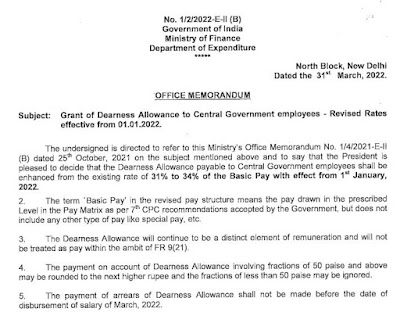
DA Jan 2022 - Grant of Dearness Allowance to Central Government employees - Revised Rates effective from 01.01.2022

 3% DA Hike - Revised Rates effective from 01.01.2022: DoE OM dated 31.03.2022 No. 1/2/2022-E-II (B) Government of India Ministry of Finance...