Showing posts with label Sixth Pay Commission. Show all posts

Tuesday, 30 May 2017

Revision of pay of the Chairpersons and Members of the Regulatory Authorities / Bodies consequent to the implementation of the 7th Central Pay Commission recommendations

Revision of pay of the Chairpersons and Members of the Regulatory Authorities / Bodies consequent to the implementation of the 7th Central Pay Commission recommendations.

7thCentralPayCommission

No. 3/4/2016-Estt.(Pay-II)
Government of India
Ministry of Personnel, Public Grievances & Pensions
Department of Personnel and Training
North Block,
New Delhi
Dated the 30th May, 2017
OFFICE MEMORANDUM

Subject: Revision of pay of the Chairpersons and Members of the Regulatory Authorities / Bodies consequent to the implementation of the 7th Central Pay Commission recommendations.

This Department had, vide OM No. 3/ 6/ 97-Estt.(Pay-II) dated 29th January 1998, issued guidelines regarding perquisites and some important terms and conditions for the Chairpersons and Members of the Regulatory Authorities and allied matters.

2. These guidelines were applicable to Chairpersons and Members of existing Regulatory Authorities also, appointed subsequent to the issue of these guidelines, unless there is a constitutional or statutory obligation to the contrary. As per the aforesaid guidelines, the Chairperson would be eligible for pay not exceeding Rs. 26,000/ - p.m. (fixed) and Members would be eligible for pay scale not exceeding Rs.22400-525-24500. The pay will be fixed in accordance with the prevailing orders, i.e. pay minus pension.

3. After implementation of the Sixth Pay Commission, in order to attract expertise available outside the Government, the full time Members of TRAI, CERC, IRDA, SEBI and CCI were granted consolidated pay packages vide orders of Ministry of Finance, Department of Expenditure. Replacement scales of Rs.80,000/- p.m. and Rs.37400-67000 (PB-4) with Grade Pay of Rs. 12000/- (since replaced with HAG scale of Rs.67000-79000) were granted respectively to Chairpersons and Members of all other Regulatory Authorities / Bodies.

 4. The 7th CPC has looked into the emoluments structure, including pay, allowances and other facilities/benefits, in cash or kind of the members of Regulatory Bodies (excluding the Reserve Bank of India) set up under Acts of Parliament, and have given their recommendations in Chapter-13 of their Report. As per recommendations of the 7th CPC, as accepted by Government of India, and also as intimated by Department of Expenditure vide OM No. 394959/ E.IIIA/ 2017 dated 211d March 2017, the pay and allowances of Chairperson and fulltime Members of Telecom Regulatory Authority of India (TRAI), Insurance Regulatory and Development Authority (IRDA), Central Electricity Regulatory Commission (CERC), Securities and Exchange Board of India (SEBI), Competition Commission of India (CCI), Pension Fund Regulatory and Development Authority (PFRDA), Petroleum and Natural Gas Regulatory Board (PNGRB), Warehousing Development and Regulatory Authority (WDRA), Airports Economic Regulatory Authority of India (AERAI), Railway Development Authority (RDA) and Insolvency & Bankruptcy Board of India (IBBI) which have been de-linked from Government salaries will be governed by the orders issued by the Department of Expenditure.

5. In respect of existing Members of remaining Regulatory Bodies set up under the Acts of Parliament, the 7th CPC has recommended normal replacement pay. This has also been accepted by the Government of India vide Resolution No.1-2/ 2016-IC dated 25th July, 2016. Accordingly, the existing Chairpersons as well as future appointees would be eligible for basic pay not exceeding Rs. 2,25,000/- (Level 17 of Pay Matrix) in revised pay structure and the existing Members as well as future appointees would be eligible for basic pay not exceeding Level 15 of Pay Matrix in the revised pay structure.

6. Existing instructions provide that Chairperson and Member(s) who on the date of his / her appointment to the Regulatory Authority/ Statutory Body/ Tribunal was in the service of the Central/ State Government shall be deemed to have retired from such service with effect from the date of his / her respective appointment as such Chairperson/ Member. In case such officers are in receipt of pension, the same shall be deducted in accordance with the prevailing orders applicable to the reemployed pensioners.

 7. The rates of all allowances shall be as admissible to Government employees of corresponding Level from time to time.

8. These orders shall take effect from 01.01.2016.
(A.K. Jain)
Deputy Secretary to the Government of India
To All Ministries/Department (As per standard list attached)

Source: http://dopt.gov.in

Wednesday, 22 February 2017

Seventh Pay Commission: Talks On Allowance Today, Report Likely Soon


Seventh Pay Commission: Talks On Allowance Today, Report Likely Soon

The government had in June accepted the recommendation of Justice AK Mathur-headed Seventh Pay Commission in respect of the hike in basic pay and pension but its suggestions relating to allowances were referred to the committee.

The panel headed by Finance Secretary Ashok Lavasa to review Seventh Pay Commission allowances is expected to soon submit its report to the government. Shiv Gopal Mishra, the convenor of National Joint Council of Action (NJCA), a joint body of unions representing central government employees, said talks in this matter are in the final leg. The employee union body will be meeting the panel members today on the issue of Housing Rent Allowance or HRA related to Seventh Pay Commission.

The government had in June accepted the recommendation of Justice AK Mathur-headed Seventh Pay Commission in respect of the hike in basic pay and pension but its suggestions relating to allowances were referred to the committee. The Seventh Pay Commission had examined a total of 196 existing allowances and, by way of rationalisation, recommended abolition of 51 allowances and subsuming of 37 allowances.
The committee on allowances was initially given a time of four months to submit its report to the finance minister. Till a final decision is taken, all existing allowances are being paid at the Sixth Pay Commission rates.
The Seventh Pay Commission had recommended that HRA be paid at the rate of 24 per cent, 16 per cent and 8 per cent of the new Basic Pay, depending on type of cities.

The Seventh Pay Commission had also recommended that the rate of HRA be revised to 27 per cent, 18 per cent and 9 per cent respectively when DA crosses 50 per cent, and further revised to 30 per cent, 20 per cent and 10 per cent when DA crosses 100 per cent.

Typically, in case of housing allowance, arrears are not paid.

Allowances form a significant chunk of government employees' salary. Some analysts had earlier said that implementation of the housing allowance portion of the Seventh Pay Commission as well as GST or Goods and Services Tax could push up average inflation.

"At worst, if the government is under pressure, this allowance can be pushed to the next year, as was done in the previous pay commissions. The housing allowance does not attract arrears," HSBC Securities had said in an earlier report.

The Cabinet had also decided to constitute two separate committees to suggest measures for streamlining the implementation of National Pension System (NPS) and to look into anomalies likely to arise out of implementation of the Commission's Report.

Source: NDTV

Tuesday, 3 November 2015

7th Pay Commission – ‘An unjustified pay hike’ - The Hindu

7th Pay Commission – ‘An unjustified pay hike’ - The Hindu


As we brace for another series of Pay Commission-mandated salary hikes, the question is if it is the best use of government resources.

As public servants get ready to enjoy the New Year’s blessing that the Seventh Pay Commission is expected to bestow, it may be a time for the rest of us to look this gift horse in the mouth. The Fourteenth Finance Commission estimates the cost of the Sixth Pay Commission at over Rs. 90,000 crore annually, since pay and allowances of Union government employees more than doubled between 2007-08 and 2011-12.

Compare this to the estimates in the economic survey for the year 2011-12, about Rs. 70,000 crore each for food subsidy, fertilizer and petroleum subsidy and less than Rs. 40,000 crore for the Mahatma Gandhi National Rural Employment Guarantee Act. Simply put, the additional Central government expenditure due to the implementation of the Sixth Pay Commission was over 40 per cent of the major subsidies. If we take into account the costs to the State governments, the tab for Sixth Pay Commission largesse is probably equivalent to all the subsidies provided by the Central government. 

As we brace for another Pay Commission-mandated salary hike, the question to ask is not whether the government can afford it but if it is the best use of government resources. Government employees receive Dearness Allowance (DA) annually to compensate for inflation; they also receive an annual performance appraisal for promotions, which brings with it salary increases. So the decadal salary increases under the Central Pay Commission (CPC) are meant to address inequities in salaries across different parts of the government, across ranks as well as between the public sector and private sector. It is the latter that has provided the greatest justification for salary increases granted under CPC in the past.  

False premise

Dizzying salary packages reported for new Indian Institute of Management graduates or Indian Institute of Technology graduates funnel a sense of discontent among public sector employees since it is hard to imagine any 25-year-old government servant receiving a package of Rs. 40 lakh per annum. This smoke and mirrors strategy masks several observations made by the Sixth Pay Commission. First, it noted that the contention of vast disparities between private sector and government employees was not borne out by data. The CPC found that compensation to Group C and D employees in government was higher than that in the private sector; for Group B it was similar and only for Group A was it lower. Group A employees form less than 5 per cent of the total Central government workforce; Group C and D are about 90 per cent. Second, it noted that a government job offers many other benefits not available in the private sector and the fear of flight away from public service towards the private sector is overblown. 

The Fourteenth Finance Commission estimates the cost of the Sixth Pay Commission at over Rs. 90,000 crore annually.
In spite of these observations, the ultimate recommendations of the Sixth CPC led to substantial increases in the salary and allowance of all public servants, first in the Central service and later on in State governments. A comparison of incomes between private sector employees and government employees using data from India Human Development Surveys (IHDS) of 2004-05 and 2011-12 is instructive in understanding the consequences of the last CPC. These surveys of over 40,000 households were jointly organised by the National Council of Applied Economic Research and the University of Maryland. The graphic shows monthly salaries for men aged 25-59 in 2011-12. Many women work part time as anganwadi workers and ASHA workers and hence are excluded from this comparison, but their inclusion will not change the fundamental results.


The results show that at every single level of education, government workers are paid more than private sector workers and more importantly, the public service advantage has increased rather than decreased after the implementation of the Sixth Pay Commission recommendations. A driver in government service earns far more than one in private service, but so does an engineer. This comparison does not include the other benefits government service provides including PF contributions, housing benefits, health insurance and, frequently, admission of children to coveted Kendriya Vidyalayas. 

One might say that the problem is not global but is concentrated in highly skilled positions. Individuals who are highly skilled may be more likely to choose the private sector. Here only the Union Public Service Commission can tell us if the qualification of the entering cohort of the Indian Administrative Service officers is declining, but at a slightly lower stratospheric level, we see no such evidence. The IHDS shows that among college graduates with a first class degree, government service still seems to be preferred. In 2004-05, among the male college graduates employed in public service, 37 per cent had a first division; this proportion had increased to 39 per cent by 2011-12. This is not to say that skill upgradation is not taking place in the private sector, where the proportion of first class degree holders among graduates has increased from 28 per cent to 35 per cent, but these figures do not suggest that government services are suffering on an average; just that the more qualified individuals are seeking salaried work and moving away from farming and small businesses benefitting both government service and the private sector. 

One might say that the problem is not global but is concentrated in highly skilled positions.
That salary increases will be bestowed by the Seventh CPC is a given. Whether it will address the real challenge, lower wages for Group A officers compared to the private sector, and recognise the public service advantage for the rest of the employees remains questionable. Let us hope that the Seventh CPC will address the challenge of government salaries with a scalpel rather than an axe.

(Sonalde Desai is senior fellow at the National Council of Applied Economic Research and Professor of Sociology at the University of Maryland. Views are personal.)

Source: TheHindu

Monday, 12 October 2015

7th Pay Commission likely to propose highest pay hike since 1947

7th Pay Commission likely to propose highest pay hike since 1947

7th pay commission
New Delhi: The Seventh Pay Commission is likely to propose pay hike for central government employees, which will be highest since first pay commission’s proposal in 1947.
The first pay commission was constituted in 1946, while its submitted its report on May, 1947 to the interim government of India. ‘Living wage’ — the guiding principle for the first Pay Commission — is long past.
‘Now is Seventh Pay Commission time’, which is also to take in to account living cost of central government employees cost of their appraisal.
The cost of living measures the annual cost of necessities for one adult to live a secure, yet modest, lifestyle by estimating the costs of housing, food, transportation, health care, other necessities, and taxes.

Every government employee likely has a six-member family including his parents. So, Seventh Pay Commission is likely to increase salaries and allowances to minimise the impact on the cost of living for 50 lakh central government employees and 56 lakh pensioners including dependents.
Inflation pushes living cost, inflation, is an economic concept. The effect of inflation is the prices of everything going up year by year. A central government employee got salary Rs 3000 in 1987 under Sixth pay commission, now he gets Rs 80,000 with two promotion, this is called inflation, the price of everything goes up. When the price goes up, the salaries go up.
Every successive Pay Commission has roughly tripled pay. This means that simply by hiking up living cost for 10 years, a government employee would have tripled his pay.
The first pay commission was recommended Rs 55 salary to the lowest earning employee, second Rs 80, third Rs 185, fourth Rs 750, fifth Rs 2550 and sixth Rs 6660.
Accordingly, the Seventh Pay Commission is likely to propose minimum basic salary Rs 20,000 of central government employees, sources in the pay panel said.
The main reason behind the proposal of Seventh Pay Commission is to hike highest pay since 1947 on the account of Dearness Allowance (DA). The central government employees will get Dearness Allowance likely 125 percent at the time implementation of Seventh pay Commission. They never got such type of Dearness Allowance hike before implementation of any Pay Commission.
Dearness Allowance always merges with salaries and allowances under every pay commission’s proposal.
“The Seventh Pay Commission is ready with recommendations and the report will be submitted soon,” according to sources.
Headed by Justice Ashok Kumar Mathur, the Seventh Pay Commission was appointed in February 2014 and its recommendations are scheduled to take effect from January 1, 2016.
The government constitutes the Pay Commission almost every 10 years to revise the pay scale of its employees and often states also implement the panel’s recommendations after some modifications. The first pay commission was constituted in 1946, second in 1957, third in 1970, fourth in 1983, fifth in 1994, sixth in 2006 and seventh in 2014.
As part of the exercise, the Seventh Pay Commission holds discussions with various stakeholders, including organisations, federations, groups representing civil employees as well as defence services.
Meena Agarwal is the secretary of the Commission. Other members are Vivek Rae, a retired IAS officer of 1978 batch and Rathin Roy, an economist.
The Sixth Pay Commission was implemented with effect from January 1, 2006, the fifth from January 1, 1996 and the fourth from January 1, 1986.

TST

Thursday, 8 October 2015

7th Pay Commission likely to link pay with productivity

Seventh Pay Commission likely to link pay with productivity

Seventh Central Pay Commission Chairman
Justice Ashok Kumar Mathur (Right)
New Delhi: The Seventh Pay Commission is likely to suggest linking pay with productivity with a focus on technology, skills and incentives, a move aimed at raising the productivity of central government employees.

The panel is also likely to recommend that in future additional remuneration be linked to increase in productivity.

The Seventh Pay Commission is expected to submit its recommendations by December and the central government asked the pay panel to look in to the issue of raising productivity and improving the overall quality of central government services in the country.

The Sixth Pay Commission had also said that steps should lead to improvement in the existing delivery mechanism by more delegation and de-layering and an emphasis on achieving quantifiable and concrete end results. Emphasis is to be on outcome rather than processes.

Accordingly, the Sixth Pay Commissions had also made several recommendations to enhance productivity and improve administration but previous UPA government failed to implement it.

Now, the central government advised the Seventh Pay Commission to be designated as Pay with a clear mandate to recommend measures to improve productivity of an employee.

The central government also said productivity per employee can be raised through the application of technology in public service delivery and in public assets created.

“Raising the skills of employees through training and capacity building also has a positive impact on productivity. The use of appropriate technology and associated skill development require incentives for employees to raise their individual productivities,” a central government financial panel said.

“The Seventh Pay Commission’s first task, therefore, would be identifying the right mix of technology and skills for different categories of employees. The next step would be to design suitable financial incentives linked to measurable performance,” an officer of the financial panel said.

Tuesday, 6 October 2015

7th Pay Commission decoded: Know all about salary increment; past pay commissions

7th Pay Commission decoded: Know all about salary increment; past pay commissions
Seventh Pay Commission is ready with its recommendations and it will soon submit its report to Finance Ministry. The recommendations are to be implemented from January 1, 2016.

The Central Government employees must be curious to know what all are in the store for them in the seventh pay commission’s recommendations.
Seventh Pay Commission
  • It was formed by previous UPA Government. The commission, headed by Justice A K Mathur was formed in February 2014.
  • The other members of the commission are Vivek Rae, a retired IAS officer of 1978
  • batch, and Rathin Roy, an economist. Meena Agarwal is  Secretary of the Commission.
  • The  committee’s recommendations are scheduled to take effect from 1 January, 2016.
  •  The government constitutes the Pay Commission almost every 10 years to revise the pay scale of its employees and often these are adopted by states after some modifications.
  • Nearly 48 lakh central government employees and 55 lakh pensioners will be befitted by the pay commission.
 Salary Increment:
  •  Reportedly, there could be a substantial increment in the current salary of the employees (around 30-40 per cent).
  • It has been proposed that the salary of the Government employees should be increased every year on July 1.
Major Recommendations
  • According to Dainik Bhaskar exclusive report, IPS, IAS and IRS rank officers’ pay band will be made equal. Currently IPS, IRS officers get less salary than IAS.
  • It has been proposed that existing 32 pay-bands should be decreased to 13.
  • For Pay band-1, the minimum salary will be 21, 200.
  •  The Cabinet secretary will get minimum 2 lakh salary.
  •  There could be an education allowance to employees whose offspring are in the school.
  • In last pay commission (6th), the minimum basic salary was increased to Rs 6660 from Rs 2550.
  •   Experts are having views that employees of lower rank will be benefited the most from the seventh pay commission.
   Financial Burden:
  •  Seventh pay commission will definitely bring a toll on the exchequer.
  • The reason being Government has to manage OROP’s expenditures too.
  •  Experts say that Central government’s salary bill will rise by 9.56% to Rs 1,00,619 crore after Seventh pay commission will come into effect.
  •  According to Mint report, as a result of the recommendations of the Sixth Pay Commission, pay and allowances of Union government employees became more than doubled between 2007-08 and 2011-1-from Rs.74,647 crore to Rs.166,792 crore.
   Past pay commissions and the minimum basic salary:
  •  First pay commission came in year 1946 and the basic salary at that time was decided to be of Rs. 35.
  •  Second pay commission came in year 1959 and basic salary was of Rs. 80.
  •  In 1973, third pay commission came into effect which decided the basic salary of Rs. 185.
  •  Fourth pay commission came in year 1986 which recommend basic salary of Rs. 750.
  •  In year 1996, fifth pay commission came, recommending basic salary of Rs. 2550.
  •  Sixth pay commission came into effect in year 2006. UPA Government at that time, fixed minimum basic salary of Rs. 6660.

#7CPC, #7th CPC News, #7th Pay Commission, #salary, #CentralGovernmentEmployees, #Increment, #SeventhPayCommission

Wednesday, 30 September 2015

Seventh Pay Commission to offer realistic view on salaries and allowances

Seventh Pay Commission to offer realistic view on salaries and allowances

The Sixth pay commission was constituted in 2006 and in the normal course, the government was expected to announce the next pay commission after a gap of 10 years. The fifth came in 1996. But with the UPA government’s image battered by a spate of corruption scandals, the date had been advanced by two years in order to recover some lost ground with the electorate.

The UPA government justified the early constitution of the commission on the ground that it will take around two years to submit its recommendations. The Sixth pay commission, for example, was constituted in October 2006 and the Centre implemented it ahead of the 2009 Lok Sabha elections, showering central government employees with a big pay hike bonanza.

The Sixth pay commission had recommended a 20 to 40 per cent jump in salary. This cheered the employees, but wreaked havoc with the government’s finances as the fiscal deficit soared to 6 per cent of the gross domestic product (GDP). The consequent burden of arrears on the central government was Rs 28,160 crore on a salary base of Rs 44,360 crore.

The cash-strapped government had disbursed the arrears in two instalments with 40 per cent given out in 2008-09 and 60 per cent in 2009-10. The arrears contributed significantly to the Centre overshooting its target in 2008-09, ending the year with a fiscal deficit of 6 per cent of GDP against the budgeted 2.5 per cent.

The fiscal deficit rose to 6.4 per cent of GDP in 2009-10 as pay commission arrears pushed up the expenditure at a time when the government was battling slowdown in revenues. With the Seventh pay commission, the situation is headed in the same direction and the country will eventually have to face the music of this populism.

Accordingly, the Seventh Pay Commission is likely to offer realistic view on increase of salaries and allowances of central government employees.
The pay panel may definitely bring also toll on the exchequer as government has to manage expenditures of One Rank One Pension (OROP) for ex-sevicemen before Seventh pay commission expenditures.
It is expected that the central government’s salary bill will rise by 9.56% to Rs 1,00,619 crore after Seventh pay commission will come into effect.
This OROP announcement will have a significant impact on Seventh pay commission report badly, especially in salary hike and increasing allowances,” said a pay panel official.

“We have to look financial health of government before submitting our report. We have to save financial position of government to run the nation smoothly. We are not only to work for pay hike.” he added.

However, the recommendations of Seventh Pay Commission, may be implemented by NDA government before the announcement of West Bengal, Assam, Kerala and Tamil Nadu states assemblies’ election in May 2016.

“The central government will decide execution time of the pay commission’s proposals after the pay panel submits its report, which will be possible pre-election “special packages” for West Bengal, Assam, Kerala and Tamil Nadu, which are all due for polls by May 2016,” an official of the Finance Ministry said, speaking on condition of anonymity.

The Seventh Pay Commission is likely to submit its report in December. The Commission has already completed discussions with various stakeholders, including organisations, federations, groups representing civil employees as well as Defence services and is in the process of finalising its recommendations.
The recommendations of the Seventh Pay Commission are scheduled to come into effect from January 1, 2016.
TST

Friday, 25 September 2015

7th Pay Commission: Salary rises should be based on performance

7th Pay Commission: Salary rises should be based on performance

New Delhi: The Seventh Pay Commission is likely to recommend to rise the salary of central government employees should be based on performance in the office, rather than just time served.

The central government urged the Seventh Pay Commission to make proposal for enhanced pay and special incentives as performance based annual increments.

Appraisals for government employees were introduced since British period but didn’t affect pay. Eight years ago, the Sixth Pay Commission asked to link the performance of central government employees with their pay.

The Sixth Pay Commission had carried out a study through the Indian Institute of Management, Ahmedabad, on a performance-based incentive system, to ostensibly improve the performance outputs of Central government employees.

The study was aimed at working out a model whereby a base salary is attached to each post based on skills and responsibility and simultaneously, a second component would be payable over and above the salary on the basis of the productivity and performance of employees, either individually or as a group.

The government employees believe pay should reflect the cost of living while private sector workers believe pay should reflect performance.

Accordingly, the Narendra Modi government plans to move towards making increment programmes based on performance rather than on time-served through the Seventh Pay Commission and automatic annual incremental pay progression would be scrapped in central government ministries and departments.

The original idea behind performance incremental pay is that every central government employee takes a while to become fully competent in a role, so government can reward them as they grow in competence and experience.

Despite the government having powers to withhold increments, but nowadays, very few do, so there is a culture of government employees moving up the pay scale irrespective of their performance.

The bottom line is if government doesn’t get rid of automatic incremental progression, the government can’t control pay, and that is what the Modi government has realised.

The central government employees can play a vital role in this way in nation building.

Therefore, the Seventh pay commission may recommend up to 5 percent performance-based increment instead of automatic annual increment for central government employees.

TST

Thursday, 24 September 2015

7th Pay Commission to submit report soon

7th Pay Commission to submit report soon
New Delhi: Seventh Pay Commission is ready with its recommendations on revising emoluments for nearly 50 lakh central government employees and 55 lakh pensioners, and will soon submit report to the Finance Ministry.

Earlier in August, the government had extended Commission’s term by another four months till December 31 to give recommendations.

“The Commission is ready with recommendations and the report will be submitted soon,” according to sources.

The Commission, whose recommendations may also have a bearing on the salaries of the state government staff, was given more time by the Union Cabinet just a day before its original 18-month term was coming to an end.

Headed by Justice A K Mathur, the Commission was appointed in February 2014 and its recommendations are scheduled to take effect from January 1, 2016.

The government constitutes the Pay Commission almost every 10 years to revise the pay scale of its employees and often states also implement the panel’s recommendations after some modifications.
As part of the exercise, the Commission holds discussions with various stakeholders, including organisations, federations, groups representing civil employees as well as defence services.

Meena Agarwal is the secretary of the Commission. Other members are Vivek Rae, a retired IAS officer of 1978 batch and Rathin Roy, an economist.

The Sixth Pay Commission was implemented with effect from January 1, 2006, the fifth from January 1, 1996 and the fourth from January 1, 1986.
PTI

Wednesday, 16 September 2015

Finance Minister Arun Jaitley to receive 6th Pay Commission report in December

Finance Minister Arun Jaitley to receive Sixth Pay Commission report in December


New Delhi : The Seventh Pay Commission headed by Justice Ashok Kumar Mathur is likely to submit its report to Union Finance Minister Arun Jaitley in December, presumably recommending a 40 per cent hike in salary for the central government employees.

Justice Mathur already told PTI on August 25, “The Commission may submit its report by the end of September.”

“We are likely to recommend something for the good of central government employees, after observation of inflation, the government’s financial position and salary structure of government employees in other countries. The Finance Minister will give the latest highlights,” a top official of the pay panel said, speaking on condition of anonymity.

He also said it has been mandated to recommend incentive schemes to reward excellence in productivity, performance and integrity, which it will do.

“Though previous Pay Commissions have talked about linking pay with productivity, the earlier governments have not accepted such recommendations. Since this government has shown strong political will, we hope they will accept our recommendations,” he added.

Over 5 million central government employees are expecting a bounty from the report which is likely to recommend major changes in salaries and terms of employment, including performance-linked pay and incentives.

“A joint secretary gets now Rs 128,000 as monthly salary with dearness allowance. I do not expect it to go up to more than Rs 160,000,” a joint secretary-level official of the Central Government said.

In his pre-budget speech in February, Jaitley said,“the Seventh Pay Commission impact may have to be absorbed in financial year 2016-17.”

The salary outgo of central government employees will increase in financial year 2016-17 at 15.79 per cent to Rs 1.16 lakh crore with the likely implementation of the Seventh Pay Commission award, said the statement tabled by Finance Minister Arun Jaitley in Parliament on August 12.

The Seventh Pay Commission, which was set up by the UPA government, was required to submit its report by August-end. The government constitutes the Pay Commission almost every 10 years to revise the pay scale of its employees and often these are adopted by states after some modifications.

The Commission has already completed discussions with various stakeholders, including organisations, federations, groups representing civil employees as well as Defence services and is in the process of finalising its recommendations.

The recommendations of the Seventh Pay Commission are scheduled to come into effect from January 1, 2016.

The Sixth Pay Commission was implemented with effect from January 1, 2006, the fifth from January 1, 1996 and the fourth from January 1, 1986.

Wednesday, 19 August 2015

Seventh Pay Commission seeks one-month extension from finance ministry

Seventh Pay Commission seeks one-month extension from finance ministry
The panel headed by A.K. Mathur is unlikely to recommend lowering of the retirement age or push for lateral entry and performance-based pay
seventh+pay+commission+seeks+one+month+extension

New Delhi: The Seventh Pay Commission, headed by justice A.K. Mathur, has sought a one-month extension from the finance ministry and is preparing to submit its report by the end of September. The commission is unlikely to recommend the lowering of the retirement age as rumoured earlier or push for lateral entry and performance-based pay.
The commission, set up once in every 10 years to review pay, allowances and other benefits for central government employees, was appointed by the previous government on 28 February 2014 and was asked to submit its report in 18 months, which falls on 31 August.
“There are some data points that are missing, which we hope to get by this month end. We are trying to submit the report by 20 September,” an official of the commission said, speaking on condition of anonymity.
The Sixth Pay Commission had submitted its report a little ahead of its deadline on 24 March 2008. The revised pay scales were implemented retrospectively starting 1 January 2006, while recommendations relating to allowances were implemented prospectively.
The finance ministry apprehends that salary and pension expenditure will both rise by around 16% in 2016-17 as a result of the implementation of the Pay Commission recommendations. This may allow capital expenditure to grow by no more than 8% during the year, leaving little room to aggressively push for an infrastructure build-up.
“The Pay Commission impact may have to be absorbed in 2016-17. The phase of consolidation, extended by one year, will also be spanning out in this period. Thus, in the medium-term framework, the fiscal position will continue to be stressed,” the finance ministry said in the 2015-16 budget presented in February.
The official cited earlier said the Pay Commission report needs to be effective from 1 January 2016, or by April 2016 at the latest.
“It will be the government’s prerogative when to implement it. But beyond 1 January 2016, there will be arrears. But then, the government will be subject to criticism. Earlier, they had hidden behind Pay Commissions giving late reports,” he added.
However, the official said the commission is likely to maintain the status quo on the retirement age of central government employees, currently 60 years. “We are not going to either recommend lowering or raising the retirement age. If we lower the age limit, the pension burden will bust the government’s medium-term fiscal targets,” he added.
Asked whether government has sent any directives to the commission on the kind of hike it can afford, the official said the message it has got broadly is to keep the hikes low. “Merge the basic with dearness allowance, don’t stretch it beyond—that is the message. But that is a good message for the government to send. But there is no pressure otherwise. In fact, there is a lot of cooperation,” he said.
The official said merging basic pay with dearness allowance, which is mandatory, would itself mean a 155% rise for central government employees. “We have to decide how much to give above that. So, it will look good if you compare basic to basic,” he added.
On whether the commission will recommend performance-based pay bands, he said it will make some feasible recommendations, though he couldn’t guess if the government would accept them. The Sixth Pay Commission had also recommended performance-based pay revisions, but the government is yet to implement them.
“Eighty-eight percent of central government employees are industrial and non-industrial workers working with railways, post, paramilitary and army. So, performance-based pay revision is the wrong instrument for them. Biggest growth in government services is in paramilitary forces, where staffs in Central Reserve Police Force and Central Industrial Security Force have gone up by 75-80% in the last 10 years. By the time we have dealt with them, the bureaucracy is an afterthought. It does not affect anything,” he added.
D.K. Joshi, chief economist at rating agency Crisil Ltd, said the government is expected to be restrained in its pay hikes this time around, given the low inflation level and tepid growth momentum. “The last two Pay Commissions had significantly bumped up demand and fiscal deficit. But the government is unlikely to be populist this time. It has already showed restraint in the hike in minimum support prices for farmers,” he said.
However, Joshi said the Pay Commission will have a permanent income effect as well as a one-time impact through the payment of arrears, which will lead to increase in demand for consumer durables.

Read at: Livemint

Monday, 17 August 2015

Finance ministry braces for 7th Pay Commission recommendations

Finance ministry braces for 7th Pay Commission recommendations: LiveMint Article
 
Salary, pension costs set to grow 15.8% and 16%, respectively, in FY17, leaving govt less money to build capital assets 
 
New Delhi: The finance ministry is apprehensive about the recommendations of the Seventh Pay Commission, expected this month, significantly increasing the revenue expenditure of the government in the next fiscal, leaving it less money to spend on building capital assets.
 
finance+ministry+braces+7th+cpc
In the medium-term expenditure framework statement laid before Parliament on Wednesday, the finance ministry said salary and pension expenditure is expected to rise by 15.8% and 16%, respectively, in 2016-17, which may leave capital expenditure room to grow by no more than 8% during the year.
 
Total revenue expenditure is expected to jump 8.1% to Rs.16.6 trillion in 2016-17 against a budgeted growth of 3.1% in 2015-16. During the same period, growth in capital expenditure is expected to slow to 8%, at Rs.2.6 trillion, from a budgeted growth of 25.4%.
 
The finance ministry said award of the Seventh Pay Commission’s suggestions, with their consequent impact on government finances, “poses a risk”.
 
The government appointed the Seventh Pay Commission on 28 February 2014 under chairman, Justice Ashok Kumar Mathur, with a time frame of 18 months to make its recommendations.
 
“The pay commission impact may have to be absorbed in 2016-17. The phase of consolidation, extended by one year, will also be spanning out in this period. Thus, in the medium-term framework, the fiscal position will continue to be stressed,” the finance ministry said in the 2015-16 budget presented in February.
 
The Union budget cut the plan expenditure for the first time in many years by Rs.2,657 crore to Rs.4.7 trillion in 2015-16 from the revised estimate of 2014-15, as the centre shared an additional Rs.1.86 trillion with states.
 
The Finance Commission has raised the united share of states in net central taxes to 42% from 32%.
 
The tight fiscal situation forced the government to revise its fiscal consolidation road map and set a less ambitious fiscal deficit target of 3.9% of the gross domestic product (GDP) for 2015-16 against the earlier target of 3.6% set in last year’s budget.
 
The Sixth Pay Commission, which was constituted in October 2006, had submitted its report in March 2008.
 
As a result of the recommendations of the Sixth Pay Commission, pay and allowances of Union government employees more than doubled between 2007-08 and 2011-12—from Rs.74,647 crore to Rs.166,792 crore, according to the Fourteenth Finance Commission (FFC) estimates.
 
“As a ratio of GDP, it jumped from a little over 0.9% in 2007-08 to 1.2% in 2008-09 and about 1.4% in 2009-10 on account of both pay revision and payment of arrears. However, it moderated to a little over 1% in 2012-13,” the Finance Commission said.
 
The recommendations of the Sixth Pay Commission were implemented by states with a delay mainly between 2009-10 and 2011-12, with “significant expenditure outgo”, FFC said.
 
FFC had said that while the finance ministry projects an increase in pension payments by 8.7% in 2015-16, a 30% increase is expected in 2016-17 on account of the impact of the Seventh Pay Commission, followed by an annual growth rate of 8% in subsequent years.
 
Read at: Live Mint

Tuesday, 11 August 2015

Benefits of 6th CPC to the employees who retired before 1.1.2006

Benefits of 6th CPC to the employees who retired before 1.1.2006

In Rajya Sabha on 6.8.2015, Minister of DoPT Shri Jitendra Singh replied in a written form to the subsequent questions regarding the benefit of minimum pension to the pensioners retired before 01.01.2006.

He said, In its order dated 01.11.2011, Hon’ble Central Administrative Tribunal (CAT), Principal Bench allowed some petitions granting the benefit of minimum pension to the pensioners retired before 01.01.2006 as per the fitment tables applicable to the employees serving as on 01.01.2006. The order dated 01.11.2011 of Hon’ble CAT was upheld by the Hon’ble High Court of Delhi vide its order dated 29.04.2013 in Writ Petition (C) No. 2348-50/2012.

The Special Leave Petition No.36148-50/2013 filed by the Government against the order dated 29.04.2013 of Hon’ble High Court of Delhi has been dismissed by Hon’ble Supreme Court on 17.03.2015.

Following the dismissal of the SLPs filed by the Government, Department of Pension & Pensioners’ Welfare has issued orders vide OM No.38/37/08-P&PW(A) dated 30.07.2015 in implementation of the orders of the Hon’ble Supreme Court.

Sunday, 15 March 2015

No Proposals To Increase Working Days To 6 Per Week

No Proposals To Increase Working Days To 6 Per Week: Centre

New Delhi: The central government today said it has no proposals to shift to six-day week working for its offices or reduce the retirement age of employees to 58 years.

“At present, there is no proposal to change working days for the Central government offices from five to six days a week or to reduce the retirement age of the Central government employees to 58 years,” Finance Minister Arun Jaitley said in a written reply to the Lok Sabha.

At present, the retirement age of the Central government employees is 60 years.

The Minister also said that the Seventh Pay Commission appointed in February 2014 is required to make its recommendations within 18 months from the date of its constitution. Former Supreme Court Justice Ashok Kumar Mathur is the Chairman of the Commission.

The government constitutes Pay Commission almost every ten years to revise the pay scales of its employees and often these are adopted by states after some modification.

The Sixth Pay Commission was implemented with effect from January 1, 2006.

PTI

Flash News

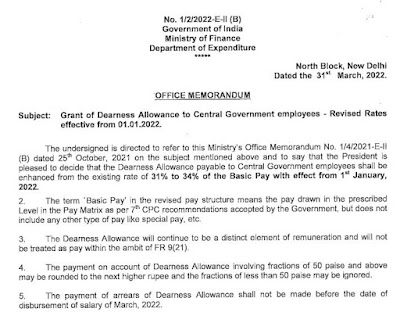
DA Jan 2022 - Grant of Dearness Allowance to Central Government employees - Revised Rates effective from 01.01.2022

 3% DA Hike - Revised Rates effective from 01.01.2022: DoE OM dated 31.03.2022 No. 1/2/2022-E-II (B) Government of India Ministry of Finance...