Showing posts with label government departments. Show all posts

Monday, 19 August 2019

LTC Review of charges realised by Indian Railways for verification of PNR details

LTC

Review of charges realised by Indian Railways for verification of PNR details

GOVERNMENT OF INDIA
MINISTRY OF RAILWAYS
(RAILWAY BOARD)
No.2016/TG-I/ 20/P/LTC
New Delhi, Dated 18.07.2019
The Principal Chief Commercial Managers,
All zonal Railways.
(COMMERCIAL CIRCULAR NO. 34 of 2019)

Sub: Review of charges realised by Indian Railways for verification of PNR details.

Ref: Letter nos. 2006/TG-I/ 20/P/ LTC dated 10.01.2007, 2006/TG-I/ 20/P/LTC dated 31.08.2010 (CC No. 40 of 2010), 2006/TG­-I/ 20/P/ LTC Pt. dated 13.12.2011 (CC No. 65 of 2011)
In supersession of above referred instructions regarding levy of charges for verification of PNR details etc., Competent Authority have now decided to adopt the following procedure for furnishing information regarding verification of journey details:

(i) Individuals seeking information for self travel under RTI Act or otherwise: It should be provided as per provisions of RTI Act subject to submission of identity proof bearing name and date of birth i.e. Aadhar/PAN card etc. to confirm that the person seeking information is one and the same as one of the passengers on the PNR.

(ii) Individuals seeking information for travel of other person under RTI Act or otherwise: Action should be taken as per relevant provisions of RTI Act and information should not be provided unless consent of third party is available.In case of requests not received under RTI Act, no information shall be provided.

(iii) Government Departments seeking information for their employees for the purpose of reimbursement of travel expenditure: It should be provided on realisation of nominal fee of Rs.50/- per PNR only on receipt of official request from the concerned Department.

(iv) Government Investigating Agencies/ Courts seeking information in connection with investigation/ Court Case: Status quo may be maintained and information shall be provided free of charge on receipt of official request of the Agency.

2. Authority to provide information and to take charges: Concerned Zonal Railways shall decide on the authority to provide information under this policy and to realise charges.
Sd/-
(Shelly Srivastava}
Director Passenger Marketing
Railway Board
Source: Indian Railways

Thursday, 15 March 2018

Absorption of Contractual Employees

Ministry of Personnel, Public Grievances & Pensions


Absorption of Contractual Employees
15 MAR 2018

The Government posts are regularly filled up in accordance with the recruitment rules. However, keeping in view the administrative exigency of work, efficiency and economy of operations and unavoidable circumstances, outsourcing through contract is also sometimes resorted to by the Ministries/Departments directly. However, such engagements can only be stop- gap arrangements. It is the responsibility of the Ministry/Department to fill up vacant posts on regular basis following due procedure.

Hon'ble Apex Court vide order dated 10.04.2006 in the Civil Appeal 3595-3612 of 1999 in the case of Uma Devi and others vs Secretary, State of Karnataka, directed that there should be no further by-passing of the Constitutional requirement and regularizing or making permanent, those not duly appointed as per the Constitutional scheme.

No certralized data regarding contractual employees working in Government Departments in maintained.

This was stated by the Union Minister of State (Independent Charge) of the Ministry of Development of North Eastern Region (DoNER), MoS PMO, Personnel, Public Grievances & Pensions, Atomic Energy and Space, Dr Jitendra Singh in a written reply in the Rajya Sabha today.

PIB

Thursday, 21 December 2017

Cabinet approves extension of term of the Commission to examine the issue of sub-categorization of Other Backward Classes

Cabinet approves extension of term of the Commission to examine the issue of sub-categorization of Other Backward Classes

The Union Cabinet chaired by Prime Minister Shri Narendra Modi has approved the extension of term of the Commission to examine the issue of sub-categorization of Other Backward Classes, by twelve weeks i.e. upto 2nd April, 2018.  The extension of tenure will enable the Commission to submit a comprehensive report on the issue of sub- categorization of OBCs, after consultation with various stakeholders.


The Commission was constituted under article 340 of the Constitution with the approval of President on 2nd October, 2017 and it was stipulated that it would submit its report within twelve weeks from the assumption of charge by the Chairperson.

Background:

The Commission, headed by Justice (Retd.) Smt. G. Rohini commenced functioning- on 11th October, 2017 and has since interacted with all the Stats/UTs having reservation for OBCs, and the State Backward Classes Commissions. The Commission has requisitioned data from 197 Higher Education Institutions regarding admission of OBCs to higher education courses during the last three years and has also sought data regarding recruitment of OBC persons in Government jobs during the last three years in Government Departments, Public Sector Banks and Financial Institutions as well as in the CPSEs, with a view to determine the inequitable distribution of benefits of reservation among the castes/communities included in the Centre List of Other Backward Classes.

Keeping in view the voluminous data involved and the time required for its analysis to prepare a comprehensive report, the Commission had sought extension of its term by twelve weeks.

PIB

Friday, 11 August 2017

Contractual appointments in Government departments

Contractual appointments in Government departments

The Government posts are to be filled in accordance with the recruitment rules. Wherever recruitment rules provide reemployment as a mode of recruitment or in cases of exigencies of work, retired Government servants are reappointed on contractual basis for a specific period.

The Central Civil Services (Fixation of Pay of re-employed Pensioners) orders, 1986 as amended from time to time govern the pay fixation of re-employed pensioners including the persons re-employed on contract basis, unless the contract provides otherwise. The interests of serving employees with regard to promotions/financial upgradations to higher post are taken care of by the respective service rules/regulations applicable to them.

This was stated by the Union Minister of State (Independent Charge) for Development of North Eastern Region (DoNER), MoS PMO, Personnel, Public Grievances, Pensions, Atomic Energy and Space Dr. Jitendra Singh in a written reply to a question by Shri M.P.Veerendra Kumar in the Rajya Sabha today.

PIB

Tuesday, 7 February 2017

E-Payments in Government Offices


E-Payments in Government Offices
GOVERNMENT OF INDIA
MINISTRY OF FINANCE
LOK SABHA
UNSTARRED QUESTION NO: 324
ANSWERED ON: 03.02.2017

E-Payments in Government Offices

K. GOPAL
A. ARUNMOZHITHEVAN
VIJAYSINH MOHITE PATIL

Will the Minister of FINANCE be pleased to state:-

(a). Whether the Government has asked its departments/offices of public sector firms and autonomous bodies to encourage their employees to use e-payments/debit cards for personal transactions to boost digital payment economy and if so, the details thereof;

(b)Whether the Government has instructed its departments/offices to stop cash payments to vendors and contractors for amounts above Rs.5000 and if so, the details thereof;

(c) Whether the Government has asked banks to promote digital banking in mission mode to boost digital economy and if so, the details thereof; and

(d).The steps taken/being taken by Government to promote e-payment in this regard?

ANSWER

THE MINISTER OF STATE IN THE MINISTRY OF FINANCE (SHRI ARJUN RAM MEGHWAL)
(a). Yes, the Department of Expenditure has issued an advisory to all Ministries/Departments to encourage its employees to make use of Debit Cards for personal transactions instead of cash vide OM No. 25 (30)/E.Coord/2016 dated 1st December 2016. Given the progress made in banking technology, it is assumed that each employee would be in possession of a Debit/ATM card linked to his/her bank account. Ensuring and encouraging government employees to maximise the usage of Debit cards for personal related transactions instead of cash would go a long way serving with the employees serving as ‘ambassadors’ for the digital push and also motivate, encourage the general public in taking up the cause. All Ministries/Departments have been requested to encourage their employees to make use of Debit Cards for personal related transactions instead of cash. Ministries/Departments should liaise with their accredited banks and set up special camps to facilitate obtaining of and ensure that all its employees are in possession of Debit Cards. Ministries/Departments may also issue similar advisories to their attached/subordinate offices, PSUs, Autonomous Bodies etc.

(b). Yes, the Controller General of Accounts, Department of Expenditure has issued instructions to all Ministries/Departments vide OM. No. 3 (2) (1)/2016/ R&P Rules/Amendments/649 dated 5th December 2016. Rs. 10, 000/- was the earlier threshold limit beyond which all payments to suppliers, contractors etc.were made through e-payment mode. In order to attain the goal of complete digitization of Government payments the existing limit of Rs. 10, 000/- has been lowered to Rs. 5,000/- beyond which all Ministries/Departments shall make payment to suppliers, contractors etc. through e-payment mode only.
(c) & (d): The steps initiated by the Government to encourage digital banking in mission mode and the other measures taken to promote e-payment is provided in Annexure - I.

ANNEXURE - I

Incentives to promote digital transactions:
To further accelerate the process of cashless transaction, the Central Government has decided on a package of incentives and measures for promotion of digital and cashless economy in the country. These include:

(A) Petroleum:
Nearly 4.5 crore customers buy petrol or diesel at such petrol pumps per day. It is estimated that petrol/diesel worth Rs.1800 crore is sold per day to the customers, out of which nearly 20% was being paid through digital means. In the month of November 2016 it has increased to 40% and the cash transaction of Rs. 360 crore per day have got shifted to cashless transaction methods.

Incentive on digital payment:
  •  The Central Government petroleum PSUs shall give incentive by offering a discount rate of 0.75% of the sale price to consumers on purchase of petrol/diesel, if payment is made through digital means.
  • The incentive scheme has the potential of shifting at least 30% more customer to digital means which will further reduce the cash requirement of nearly Rs. 2 Lakh crore per year at the petrol pumps.
(B). Expand digital payment infrastructure in rural areas:
i. To expand digital payment infrastructure in rural areas, the Central Government through NABARD will extend financial support to eligible banks for deployment of 2 POS devices each in 1 Lakh villages with population of less than 10,000. These POS machines are intended to be deployed at primary cooperative societies/milk societies/agricultural input dealers to facilitate agri-related transactions through digital means. This will benefit farmers of 1 Lakh villages covering a total population of nearly 75 crore who will have facility to transact cashlessly in their village for their agri needs.

ii. The Central Government through NABARD will also support Rural regional Banks and Cooperative Banks to issue ‘RuPay Kisan Cards’ to 4.32 crore Kisan Card holders to enable them to make digital transactions at POS machines/Micro ATMs/ATMs.

(C). Railways:
i. Seasonal or Monthly Tickets: Nearly 80 Lakh passengers use seasonal or monthly ticket on suburban railways, largely in cash spending nearly Rs. 2,000 crore per year. As more and more passengers shift to digital means, the cash requirement may get reduced by Rs.1, 000 crore per year in near future.
Incentive on digital payment:

Railways through its suburban railway network shall provide incentive by way of discount upto 0.5% to customers for monthly or seasonal tickets from January 2017, if payment is made through digital means.
ii. Free Accidental Insurance: Nearly 14 Lakh railway passengers are buying tickets everyday, out of which 58% tickets are bought online through digital means. It is expected that another 20% passengers may shift to digital payment methods of buying railway tickets.

Incentive on digital payment:
All railway passengers buying online ticket shall be given free accidental insurance cover upto Rs. 10 Lakh. Nearly 11 Lakh passengers per day will be covered under the accidental insurance scheme.
iii. Paid Services: For paid services e.g. catering, accommodation, retiring rooms etc. being offered by railways through its affiliated entities/corporations to passengers, it will provide a discount of 5% for payment of these services through digital means. All the passengers travelling on railways availing these services may avail the benefit.

(D). General Insurance Policies:
Incentive on digital payment:
Public Sector Insurance Companies will provide incentive by way of discount or credit upto 10% of the premium in general insurance policies and 8% in new life policies of Life Insurance Corporation sold through the customer portals, in case payment is made through digital means.

(E). MDR Charges
The Central Government Departments and Central Public Sector Undertakings will ensure that transaction fee/MDR charges associated with payment through digital means shall not be passed on to the consumers and all such expenses shall be borne by them. State Governments are being advised that the State Governments and its organizations should also consider to absorb the transaction fee/MDR charges related to digital payment to them and consumer should not be asked to bear it.

(F). Ceiling on monthly rental for POS
i. Public Sector banks are being advised that merchant should not be required to pay more than Rs. 100 per month as monthly rental for POS terminals/Micro ATMs/mobile POS from the merchants to bring small merchants on board the digital payment ecosystem.
ii. Neary 6.5 Lakh machines by Public Sector banks have been issued to merchants who will be benefitted by the lower rentals and promote digital transactions. With lower rentals, more merchants will install such machines and promote digital transactions.

(G). Waiver of Service Tax
No Service Tax will be charged on digital transaction charges/MDR for transactions upto Rs. 2000 per transaction.

(H). Digital Payment Incentives for Toll payments
For the payment of toll at Toll Plazas on National Highways using RFID card/Fast Tags, a discount of 10% will be available to users in year 2016-17.
Major initiatives taken for promoting digital/cashless payments so far include the following:

(A). Rationalizing MDR/Transaction Fees:

i. To encourage digital payments by citizens, Government departments have been advised to absorb transaction fees/MDR associated with such transactions to ensure that no extra burden is put on those choosing to make payments by cashless means.

ii. For purchase of fuel and petroleum products, consumers are not required to pay any transaction charge/fee for payment using Debit Card/digital means at CPSU fuel stations.

iii. Discoms and State Governments have been persuaded to facilitate payment of electricity charges by consumers through digital means without any convenience fee/charge to consumers.

iv. Merchant Discount Rate on Debit Card has been waived till 31/12/2016 in public interest. This is expected to encourage small merchants to deploy infrastructure (POS terminals) to accept digital payments.

v. Customers are not required to pay Service Charges on purchase of railway tickets through cards at railway ticketing counters for a limited period.

(B). Strengthening Acceptance Infrastructure:

i. Digital payments being accepted by over 70 Central Government departments through various electronic modes viz., netbanking, debit/credit cards, prepaid cards, Interbank Mobile Payment Service (IMPS) recording more than 1.4 crore transactions worth Rs. 3250 crores.

ii. Mobile Banking through interoperable ATMs has been launched; 81,000 ATMs of 12 Banks are already live and another 15,000 machines are expected to go live shortly.

iii. All major 45 archaeological sites having maximum footfalls/tourists have started accepting digital payments covering more than 80% of the visitors.

iv. To popularise digital payments, the acceptance infrastructure is substantially expanded by increasing deployment of POS/mobile POS machines from 14 Lakh to 25 Lakh by March 2017. A separate Task Force is closely monitoring the progress in this regard.

v. To expedite card less and pin less banking RBI has notified mandatory Aadhar Enablement of all new Point of Sale terminals.

vi. 5.5 Lakh Fair Price Shops are being equipped with micro-ATMs/POS for undertaking digital payment transactions.

vii. Electronic Toll collection system has been implemented in all Toll Plazas along with the facility to pay by credit/debit/prepaid cards. It shall be expanded to cover more lanes and wider network for distribution of Tags.

viii. For the benefit of commuters, standardized interoperable National Common Mobility card is being developed.

ix. 1000 ATMs installed in Post Offices have been permitted to be interoperable with the banks.

x. State Mission Directors of 33 identified smart cities have been issued advisories to provide for adequate deployment of digital payment infrastructure while designing smart cities.

(C). Digital Payments in Govt Departments:

i. To enable all Central Government Departments to accept digital payments without passing associated charges to citizens a separate head of expenditure has been approved.

ii. A Non-Tax Receipt Portal (bharatkosh.gov.in) has been created to enable users/citizens to make non-tax payments for as many as 237 categories of payments such as spectrum charges, RTI application fee, purchase of forms and magazines etc. online without going to banks or Government Offices.

iii. All Government organizations, Public Sector Undertakings, Authorities have been advised to review rules and regulations to support digital payments, adopt cashless payment solutions and activate payment facility through the pay.gov platform if they do not have such facility.

iv. Salary disbursal in all Central Government departments is being done through PFMS and the platform is also used for disbursal of other funds/payments.

(D). Rationalization of USSD charges
To enable mobile banking on feature phones, USSD charges have been rationalized and reduced from Rs. 1.50 per SMS to Rs. 0.50; an application for mobile phone payments (*99#) in four languages has been developed and the service providers have completely waived the charges for limited time.

(E). Rolling out of UPI
To facilitate mobile banking on smart phones, NPCI has rolled out Unified Payment Interface (UPI) application and 27 banks have already released the application to their customers.

(F). Strengthening Business Correspondents Network

i. More than 1,10,000 Business Correspondents (BCs) have been engaged by the Banks and Corporates in the country. These BCs are providing services at the door steps of the people in rural as well as in remote areas.

ii. In a major fillip to rural banking 1,25,000 Gramin Dak Sewaks of Post Offices to work as Business Correspondents of Banks.

iii. All geographical areas across the country have been mapped with Banks/Bank Mitras and dark/grey spots identified. Possibility of providing connectivity through VSAT and other means is being explored on priority.

iv. For ease of Direct Benefit Transfer (DBT), long pending issue of incentive compatible payments to Business Correspondents settled.

Besides above, the Hon’ble Prime Minister has also announced certain incentives on 31st December 2016. The proposals have also been announced in the Union Budget by the Hon’ble Finance Minister.
Source: Loksabha.nic.in

Sunday, 11 December 2016

Payment to Suppliers etc. by Government Departments through e-Payment

Payment to Suppliers etc. by Government Departments through e-Payment

F.No. 3(2)(1)/2016/R&P Rules/Amendment/649
Ministry of Finance
Department of Expenditure
O/o Controller General of Accounts
Mahalekha Niyantrak Bhawan,
GPO Complex, E-Block, INA

 New Delhi-110023
Date: 05-12-2016

 OFFICE MEMORANDUM

Subject: Payment to Suppliers etc. by Government Departments through e-Payment.

A reference is invited to this office O.M.No 1(1)/2011/TA/366 dated 1st August 2016 regarding payment to Suppliers etc. above Rs. 10,000/- by Government Departments through e-Payment.

2. In order to attain the goal of complete digitization of Government payments, the existing limit of Rs. 10,000/- prescribed in paragraph 2 of this office O.M. dated 1st August 2016 has been further reviewed. It has now been decided to lower the threshold limit to Rs. 5,000/- (Rupees five thousand only).

3. All Ministries/ Departments of the Government of India shall ensure with immediate effect that all payments above Rs. 5,000/- (Rupees five thousand only) to suppliers, contractors, grantee/loanee institutions etc. are made by issue of payment advices only.

This issues with the approval of the Finance Minister.

(Soma Roy Burman)
Joint Controller General of Accounts
Authority: www.finmin.nic.in

Sunday, 19 June 2016

Non-settlement of genuine demands of the Central Government Employees

Non-settlement of genuine demands of the Central Government Employees

Ph.: 23382286
National Council (Staff Side)
Joint Consultative Machinery
for Central government Employees
13-C, Ferozshah Road, New Delhi — 110001
E Mail : nc.jcm.np@gmail.com
No.NC/JCM/2016
Dated: June 17, 2016
Respected Sir/Madam,

Sub: Non-settlement of genuine demands of the Central Government Employees

More than 32 lakh Central Government Employees working in various ministries of the Government of India, including Railways, Postal, Defence (Ordnance Factory and other Civilian Employees), Central Secretariat, Income Tax, Audit & Accounts and other employees of the government departments are aggrieved since long on non-settlement of their various demands.

The report of the VII CPC has further made them aggrieved because of the retrograde recommendations, including non-scientific calculation of Minimum Wage and Fitment Formula. The issue of National Pension Scheme(NPS) had been very heart burning for more than 1.1 million young Central Government Employees who have been deprived from the Defined Pension/Family Pension and we are agitating this issue with the Central Government since its inception.

Under the above compelled circumstances, the National Joint Council of Action has taken a decision to go on “Indefinite Strike” from 06:00 a.m. on 11th July, 2016.

The Central Government Employees of this country have always stood for the development and good governance of the country, but do feel de-motivated because of the inaction on their pending demands.
We do have written to Hon’ble Prime Minister of India vide letter No.NC/JCM/2016/CS/PM dated 14.06.2016 (copy enclosed for ready reference) with the request that the government should immediately come forward for negotiated settlement with the NC/JCM on the demands of the Central Government Employees to avoid unnecessary confrontation.

We earnestly hope that, you will kindly lay your hands and support us in our struggle as well as put pressure on the Government of India for resolution of our genuine demands at an earliest.
Yours faithfully,
(Shiva Gopal Mishra)
Secretary, Staff Side
National Council(JCM)
Mob: 9717647594

Source: ncjcmstaffside.com
Secy-Staff-Side-demands-central-government-employees

Wednesday, 25 May 2016

Penalty for urinating in open, spitting in Central Government Offices

Penalty for urinating in open, spitting in Central Government Offices

Penalty for urinating in open, spitting in Central Government Offices

Urinating in open and spitting on the central government office premises will now attract a penalty as the Centre has issued a new Standard Operating Procedures (SOP) for ‘Swachh Bharat Mission’ to ensure a clean, hygienic and healthy work environment.

Also, littering and non-collection of construction and demolition waste by the contractor will also attract the penalty.

These SOPs have been shared with all central government ministries recently asking them to follow the new procedures to ensure complete sanitation in office premises, senior government officials said.

It mandates every department to form a sanitation committee under the chairmanship of relevant Joint Secretary looking after the charge of administration to monitor compliance to the SOP.

The SOP casts an obligation on authority concerned to “impose penalty on defaulters for littering, spitting and open urinating” besides conducting surprise inspections of the office premises to ensure a clean, hygienic and healthy work environment.

“If contractors have the obligation to collect the construction and demolition waste, it should be done immediately after all work is finished. Failure to do so will attract penalty,” says the SOPs, sent to secretaries of all central government ministries.

The central government departments have been asked to carry out self-assessment and ratings for the buildings on overall sanitation infrastructure by measuring their effort in removing paan and gutkha stains, providing dustbins and required number of urinals to meet the cleanliness needs.

Prime Minister Narendra Modi had in October 2014 launched the Swachh Bharat Mission with an aim to make the country absolutely clean by October 2, 2019.

All government departments have been asked to ensure collection of waste, rubbish and debris inside and outside the building and garden or open spaces and dispose as per set frequency, the SOP said.

An intensive cleaning of the entire office premises should be carried out at least once in two months which should also involve participation of all officials and staff (through Shramdaan) for disposal of redundant or unused hardware, furniture which can be added to inventory and re-allocated as per demand, it said.

“Weeding and recording of files should be resorted to at least once in six months. The records in the record room should be reviewed once a year and destroyed as per guidelines. This would ensure that constant space is created for keeping more recorded files. If necessary extra manpower for this purpose should be resorted to,” the SOP said.

The purpose of this SOP is to improve current cleanliness levels in the government of India offices. The primary way to achieve cleanliness is through inculcating good sanitation and hygiene practices in employees and visitors, it said.

PTI

Sunday, 29 November 2015

Double benefit in reducing government departments, says Jharkhand CM

Double benefit in reducing government departments, says Jharkhand CM

Ranchi: Jharkhand Chief Minister Raghubar Das today said bringing down government departments to 31 from 43 would not only save administrative expenditure but also make running the administration easier.

“Bringing down the departments to 31 will save expenditure and that could be spent on common people,” Das told reporters here.

Downsizing and reorganisation of Jharkhand government departments from 43 to 31 is one of the two key initiatives that attracted the attention of the Prime Minister s Office, an official statement had said yesterday.
The restructuring would also help investors, Das said.

On the PMO asking the NITI Ayog to circulate “best practice” of Jharkhand so that it could be replicated in other states, the Chief Minister attributed it to teamwork.

Das said he had a desire to make Jharkhand a role model and “now we can say Jharkhand has become a role model in the country”.

“I have been repeatedly saying that Jharkhand has an important role in making India economic super power and the state is discharging its role,” he said.

Another key initiative Jharkhand has taken is lateral entry of technocrats and advisors as special secretaries and state PSUs MDs.
PTI

Tuesday, 3 November 2015

7th Pay Commission – ‘An unjustified pay hike’ - The Hindu

7th Pay Commission – ‘An unjustified pay hike’ - The Hindu


As we brace for another series of Pay Commission-mandated salary hikes, the question is if it is the best use of government resources.

As public servants get ready to enjoy the New Year’s blessing that the Seventh Pay Commission is expected to bestow, it may be a time for the rest of us to look this gift horse in the mouth. The Fourteenth Finance Commission estimates the cost of the Sixth Pay Commission at over Rs. 90,000 crore annually, since pay and allowances of Union government employees more than doubled between 2007-08 and 2011-12.

Compare this to the estimates in the economic survey for the year 2011-12, about Rs. 70,000 crore each for food subsidy, fertilizer and petroleum subsidy and less than Rs. 40,000 crore for the Mahatma Gandhi National Rural Employment Guarantee Act. Simply put, the additional Central government expenditure due to the implementation of the Sixth Pay Commission was over 40 per cent of the major subsidies. If we take into account the costs to the State governments, the tab for Sixth Pay Commission largesse is probably equivalent to all the subsidies provided by the Central government. 

As we brace for another Pay Commission-mandated salary hike, the question to ask is not whether the government can afford it but if it is the best use of government resources. Government employees receive Dearness Allowance (DA) annually to compensate for inflation; they also receive an annual performance appraisal for promotions, which brings with it salary increases. So the decadal salary increases under the Central Pay Commission (CPC) are meant to address inequities in salaries across different parts of the government, across ranks as well as between the public sector and private sector. It is the latter that has provided the greatest justification for salary increases granted under CPC in the past.  

False premise

Dizzying salary packages reported for new Indian Institute of Management graduates or Indian Institute of Technology graduates funnel a sense of discontent among public sector employees since it is hard to imagine any 25-year-old government servant receiving a package of Rs. 40 lakh per annum. This smoke and mirrors strategy masks several observations made by the Sixth Pay Commission. First, it noted that the contention of vast disparities between private sector and government employees was not borne out by data. The CPC found that compensation to Group C and D employees in government was higher than that in the private sector; for Group B it was similar and only for Group A was it lower. Group A employees form less than 5 per cent of the total Central government workforce; Group C and D are about 90 per cent. Second, it noted that a government job offers many other benefits not available in the private sector and the fear of flight away from public service towards the private sector is overblown. 

The Fourteenth Finance Commission estimates the cost of the Sixth Pay Commission at over Rs. 90,000 crore annually.
In spite of these observations, the ultimate recommendations of the Sixth CPC led to substantial increases in the salary and allowance of all public servants, first in the Central service and later on in State governments. A comparison of incomes between private sector employees and government employees using data from India Human Development Surveys (IHDS) of 2004-05 and 2011-12 is instructive in understanding the consequences of the last CPC. These surveys of over 40,000 households were jointly organised by the National Council of Applied Economic Research and the University of Maryland. The graphic shows monthly salaries for men aged 25-59 in 2011-12. Many women work part time as anganwadi workers and ASHA workers and hence are excluded from this comparison, but their inclusion will not change the fundamental results.


The results show that at every single level of education, government workers are paid more than private sector workers and more importantly, the public service advantage has increased rather than decreased after the implementation of the Sixth Pay Commission recommendations. A driver in government service earns far more than one in private service, but so does an engineer. This comparison does not include the other benefits government service provides including PF contributions, housing benefits, health insurance and, frequently, admission of children to coveted Kendriya Vidyalayas. 

One might say that the problem is not global but is concentrated in highly skilled positions. Individuals who are highly skilled may be more likely to choose the private sector. Here only the Union Public Service Commission can tell us if the qualification of the entering cohort of the Indian Administrative Service officers is declining, but at a slightly lower stratospheric level, we see no such evidence. The IHDS shows that among college graduates with a first class degree, government service still seems to be preferred. In 2004-05, among the male college graduates employed in public service, 37 per cent had a first division; this proportion had increased to 39 per cent by 2011-12. This is not to say that skill upgradation is not taking place in the private sector, where the proportion of first class degree holders among graduates has increased from 28 per cent to 35 per cent, but these figures do not suggest that government services are suffering on an average; just that the more qualified individuals are seeking salaried work and moving away from farming and small businesses benefitting both government service and the private sector. 

One might say that the problem is not global but is concentrated in highly skilled positions.
That salary increases will be bestowed by the Seventh CPC is a given. Whether it will address the real challenge, lower wages for Group A officers compared to the private sector, and recognise the public service advantage for the rest of the employees remains questionable. Let us hope that the Seventh CPC will address the challenge of government salaries with a scalpel rather than an axe.

(Sonalde Desai is senior fellow at the National Council of Applied Economic Research and Professor of Sociology at the University of Maryland. Views are personal.)

Source: TheHindu

Flash News

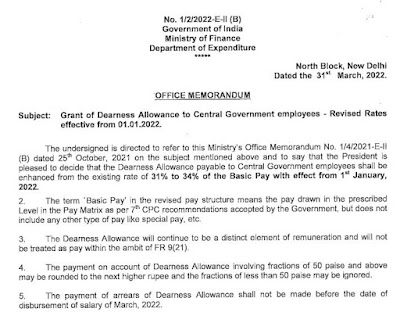
DA Jan 2022 - Grant of Dearness Allowance to Central Government employees - Revised Rates effective from 01.01.2022

 3% DA Hike - Revised Rates effective from 01.01.2022: DoE OM dated 31.03.2022 No. 1/2/2022-E-II (B) Government of India Ministry of Finance...