Showing posts with label CCS (Conduct) Rules. Show all posts

Monday, 2 March 2020

Sanction for holding an elective office under Rule 15(1)(c) of CCS(Conduct) Rules, 1964


Latest DoPT Orders 2020

Central-Government-servants-CCS-Rules


F.No.11013/1/2016-Estt.A-III
Government of India
Ministry of Personnel, Public Grievances & Pensions
Department of Personnel & Training
(Establishment A-III Desk)

North Block, New Delhi - 110001
Dated: 27 February, 2020

OFFICE MEMORANDUM

Subject: Sanction for holding an elective office under Rule 15(1)(c) of CCS(Conduct) Rules, 1964 - reg.

The undersigned is directed to refer to this Department O.M. No. 11013/1/2016-Estt.A-III dated 5.08.2019 (copy enclosed) to say that the competent authority has now approved the modification in Para 3 and Para 4 of the existing O.M. dated 5.08.2019. Para 3 and Para 4 of existing OM dated 5.08.2019 are modified as under:
"3. The policy on fixing an upper limit of the number of years for which Government servants can hold elective office in any body in their entire career has been reviewed and it has been decided that a Government servant may be allowed to hold elective office in any body, whether incorporated or not, for period of two terms or for a period of 5 years, whichever is earlier, for which prior sanction would be required when a Government servant contests an election in such body, as per existing rules.
4. It is, therefore, necessary for the Competent Authority to keep in mind all the relevant factors while granting permission under Rule 15(1)(c) of CCS (Conduct) Rules, 1964. In cases where the Government senvants have assumed charge of elected posts prior to the issuing of O.M. dated 5.08.2019, they may be allowed to complete the full period of their current tenure, except in cases where there are charges of corruption and adverse audit paras etc."
2. All Ministries/ Departments/ Offices are requested to bring the above instructions to the notice of all administrative authorities under their control.

3.In their application to the employees of Indian Audit and Accounts Department, these order are issued after consultation with Comptroller and Auditor General of India, as mandated under Article 148(5) of the Constitution

4. Hindi version will follow.

(Umesh Kumar Bhatia)
Deputy Secretary to the Govt. of India
Tel: 23094471

To
The Secretaries of All Ministries/Departments
(as per the standard list)

Also check: Amendment in Central Civil Services (Conduct) Rules, 1964 regarding acceptance of gifts by Government servants


F. No. 11013/1/2016-Estt.A-III
Government of India
Ministry of Personnel, Public Grievances & Pensions
Department of Personnel & Training
(Establishment A-III Desk)

North Block, New Delhi - 110001
Dated: 5 August, 2019

OFFICE MEMORANDUM

Subject: Sanction for holding an elective office under Rule 15(1)(c) CCS(Conduct) Rules, 1964 - reg.

The undersigned is directed to say that as per Rule 15 (1) (c) of the CCS (Conduct) Rules, 1964, no Government servant shall except with the previous sanction of the Government, hold an elective office, or canvass for a candidate or candidates for an elective office, in any body, whether incorporated or not. DoPT's O.M. No. 110 13/9/93-Estt.(A) dated 22.04. 1994 had also stipulated that no Government servant should be allowed to hold elective office in any sports association/federation for a term of more than 4 years, or for one term whichever is less. Further, according to Department of Personnel & Training's OM No. 110 13/11/2007-Estt (A) dated the 13th November, 2007, the entire time of the Government servant should be available to the Government and that no activities unconnected with his or her official duties should be allowed to interfere with the efficient discharge of such duties. All Ministries were requested to ensure that the participation of the Government servants in the activities of the cooperative societies conform to the above provisions and does not interfere with the discharge of their official duties.

2. Instances have come to notice where Government servants continue to hold elective offices in various capacities for unduly long periods. In some cases, where bye-laws of these bodies place restrictions on the number of consecutive terms a person may hold an office, Government servants are reported to have either got themselves re-elected after a gap or have got a family member/ close relative elected as a surrogate in order to keep control of such bodies. In such cases, Government servants may not be bestowing adequate attention upon their official duties and, as a result, an apprehension may arise that such Government servants also develop vested interests, particularly if the body is involved in commercial activities, directly or indirectly.

Also check: Rule 18 of the CCS Conduct Rules, 1964- regarding standard forms for intimation/ permission under the rules and expenditure incurred on repairs or minor construction work in respect of immovable property

3. The policy on fixing an upper limit of the number of years for which Government servants can hold elective office in any body in their entire career has been reviewed and it has been decided that a Government servant may be allowed to hold elective office in any body, whether incorporated or not, period of two terms or for a period of 4 years, whichever is earlier, for which prior sanction would be required when a Government servant contests an election in such body, as per existing rules.

4. It is, therefore, necessary for the Competent Authority to keep in mind all the relevant factors while granting permission under Rule 15(1)(c) of CCS(Conduct) Rules, 1964. It may also be necessary that cases of such sanctions are reviewed from time to time and permissions earlier granted revoked where Government servants have been holding office in any body, whether incorporated or not, for more than four years or in cases there are charges of corruption, adverse audit paras etc. In such cases, the Government servant concerned may be directed to resign from his office in such body immediately. He will cease to discharge any function from the date such direction is conveyed to him, irrespective of the fact whether his resignation from the body is accepted or not. This action may be taken immediately in those cases where information is already available with the Ministries and Departments. In addition, all the Ministries and Departments are also requested to obtain information from their employees in the proforma attached to this Office Memorandum for reviewing the position as well as while considering the request for sanction under Rule 15(1)(c) of CCS (Conduct) Rules, 1964 in future.

5. This O.M. issues in supersession of DoPT's 110 13/9/93-Estt.(A) dated 22.04.1994.

6. In so far as the employees of Indian Audit and Accounts Departments are concerned, this O.M. issues after consultation with Comptroller & Auditor General of India.

7. All Ministries/ Departments/ Offices are requested to bring the above instructions to the notice of all administrative authorities under their control.

8. Hindi version will follow.

(Satish Kumar)
Under Secretary to the Govt. of India

Source: DoPT

Monday, 19 August 2019

LTC Review of charges realised by Indian Railways for verification of PNR details

LTC

Review of charges realised by Indian Railways for verification of PNR details

GOVERNMENT OF INDIA
MINISTRY OF RAILWAYS
(RAILWAY BOARD)
No.2016/TG-I/ 20/P/LTC
New Delhi, Dated 18.07.2019
The Principal Chief Commercial Managers,
All zonal Railways.
(COMMERCIAL CIRCULAR NO. 34 of 2019)

Sub: Review of charges realised by Indian Railways for verification of PNR details.

Ref: Letter nos. 2006/TG-I/ 20/P/ LTC dated 10.01.2007, 2006/TG-I/ 20/P/LTC dated 31.08.2010 (CC No. 40 of 2010), 2006/TG­-I/ 20/P/ LTC Pt. dated 13.12.2011 (CC No. 65 of 2011)
In supersession of above referred instructions regarding levy of charges for verification of PNR details etc., Competent Authority have now decided to adopt the following procedure for furnishing information regarding verification of journey details:

(i) Individuals seeking information for self travel under RTI Act or otherwise: It should be provided as per provisions of RTI Act subject to submission of identity proof bearing name and date of birth i.e. Aadhar/PAN card etc. to confirm that the person seeking information is one and the same as one of the passengers on the PNR.

(ii) Individuals seeking information for travel of other person under RTI Act or otherwise: Action should be taken as per relevant provisions of RTI Act and information should not be provided unless consent of third party is available.In case of requests not received under RTI Act, no information shall be provided.

(iii) Government Departments seeking information for their employees for the purpose of reimbursement of travel expenditure: It should be provided on realisation of nominal fee of Rs.50/- per PNR only on receipt of official request from the concerned Department.

(iv) Government Investigating Agencies/ Courts seeking information in connection with investigation/ Court Case: Status quo may be maintained and information shall be provided free of charge on receipt of official request of the Agency.

2. Authority to provide information and to take charges: Concerned Zonal Railways shall decide on the authority to provide information under this policy and to realise charges.
Sd/-
(Shelly Srivastava}
Director Passenger Marketing
Railway Board
Source: Indian Railways

Monday, 17 December 2018

DoPT: Rule 18 of the CCS (Conduct) Rules, 1964- regarding standard forms for intimation/ permission under the rules and expenditure incurred on repairs or minor construction work in respect of immovable property


DoPT: Rule 18 of the CCS (Conduct) Rules, 1964- regarding standard forms for intimation/ permission under the rules and expenditure incurred on repairs or minor construction work in respect of immovable property - regarding.

F. No. 11013/2 /2018-Estt.A-JJI
Government of India
Ministry of Personnel, Public Grievances and Pension
Department of Personnel & Training
Establishment A-Ill Desk
North Block, New Delhi - 110001
Dated J December, 2018
OFFICE MEMORANDUM

Subject: Rule 18 of the CCS (Conduct) Rules, 1964- regarding standard forms for intimation/ permission under the rules and expenditure incurred on repairs or minor construction work in respect of immovable property - regarding.

The undersigned is directed to say that in accordance with the provisions of sub - rule (2) of the Rule 18 of the CCS (Conduct) Rules, 1964, all Government servants coming within the purview of these Rules are required to make a report to the prescribed authority before entering into any transaction of immovable property in their own name or in the name of a member of family. If the transaction is with a person having any official dealings with the Government servant, the Govt. Servant is required to obtain prior sanction of the prescribed authority. Sub-rule (3), ibid provides that all Govt. servants should give an intimation to the prescribed authority within one month of entering into any transaction of movable property, the value of which exceeds the monetary limits prescribed in that Rule. In case any such transaction is with a person having official dealing with the Government servant, prior sanction of the prescribed authority is necessary. All requests for obtaining prior sanction and making intimation about transactions in immovable and movable property may be made in the enclosed standard Form I and Form H, respectively.

2. Further, this Department's O.M. No. 11013/9/89-Estt.(A) dated 27/11/1990 provides, inter-alia, that where the expenditure incurred on repairs or minor constructions work in respect of any immovable property belonging to a Government Servant is estimated to exceed Rs. 10,000/-, intimation to the prescribed authority was necessary. These instructions have been reviewed and in supersession of the said O.M., it has now been decided that in respect of the expenditure incurred on repairs and minor additions to an immovable property by a Government servant, an intimation shall be necessary to be given to the prescribed authority only if the estimate exceeds the limit prescribed in Rule 18(3) of CCS (Conduct) Rules, 1964. However, prior sanction of the prescribed authority should be obtained in all cases regardless of amount involved, where the transaction regarding the material purchases or contract for such repairs or minor construction, is with a person with whom the Government servant concerned has official dealings.

4. All Ministries/ Departments/Offices are requested to bring the above guidelines to the notice of all administrative authority under their control.

5. In so far as the employees of Indian Audit and Accounts Departments are concerned, this O.M. issues after consultation with Comptroller & Auditor General of India.

6. Hindi version will follow.
(Satish Kumar)
Under Secretary to the Govt. of India
Source: DoPT

Thursday, 15 November 2018

DoPT: All India Protest Day for 26th November, 2018 - Instructions under CCS (Conduct Rules), 1964


DoPT: All India Protest Day for 26th November, 2018 - Instructions under CCS (Conduct Rules), 1964
MOST IMMEDIATE
OUT TODAY
No C-.45018/1/2017-Vig.
Government of India
Ministry of Personnel, P.G. & Pensions
Department of Personnel & Training
North Block, New Delhi,
Dated the 12th November, 2018

Subject: All India Protest Day for 26th November, 2018 - Instructions under CCS (Conduct Rules), 1964 - Regarding

It has been brought to the notice of the Government that National Movement for Old Pension Scheme (NMOPS) has decided to observe 'Gherao of Parliament House' on 26th November, 2018 in order to demand withdrawal of New Pension Scheme (NPS).

2. The instructions issued by the Department of Personnel and Training prohibit the Government servants from participating in any form of strike including mass casual leave, go slow etc. or any action that abet any form of strike/protest in violation of Rule 7 of the CCS (Conduct) Rules, 1964. Besides, in accordance with the proviso to Rule 17(1) of the Fundamental Rules, pay and allowances is not admissible to an employee for his absence from duty without any authority. As to the concomitant rights of an Association after it is formed, they cannot be different from the rights which can be claimed by the individual members of which the Association is composed. It follows that the right to form an Association does not include any guaranteed right to strike/protest. There is no statutory provision empowering the employees to go on strike. The Supreme Court has also agreed in several judgments that going on a strike is a grave misconduct under the Conduct Rules and that misconduct by the Government employees is required to be dealt with in accordance with law. Any employee going on strike in any form would face the consequences which, besides deduction of wages, may also include appropriate disciplinary action. Kind attention of all employees of this Department is also drawn to this Department's O.M. No.33012/1 /(s)/2008- Estt.(B) dated 12.9.2008, on the subject for strict compliance (enclosed as Annexure-A).

3. All officers are requested that the above instructions may be brought to the notice of the employees working under their control. All officers are also requested not to sanction Casual Leave or any other kind of leave to the officers and employees, if applied for, during the period of proposed protestlGherao, and ensure that the willing employees are allowed hindrance free entry into the office premises.

4. In case employees go on protest/Gherao, all Divisional Heads are requested to forward a report indicating the number and details of employees, who are absent from duty in the day of protest/Gherao, i.e., 26.11.2018.

Source: DoPT

Monday, 17 September 2018

Prohibition on bringing any political or outside influence by Govt. servant or by their close relatives


Prohibition on bringing any political or outside influence by Govt. servant or by their close relatives
CGDA-Government-servant

Controller General of Defence Accounts
Ulan Batar Road, Palam, Delhi Cantt 110010
No. AN/XIII/13006Nol-XXII
Dated 12.09.2018
To
The PCsDA/CsDA
The PIFAs/IFAs
(Through website)

Subject: Prohibition on bringing any political or outside influence by Govt. servant or by their close relatives in respect of service matters.
Reference: This HQrs letter bearing No. even dated 30.05.2017.

Please refer to the communication cited under reference containing guidelines regarding representation from Government servants on service matters. As per existing instructions, wherever, in any matter connected with his service rights or conditions, a Government servant wishes to press a claim or to seek redressal of a grievance, the proper course for him is to address his immediate official superior, or Head of his office, or such other authority at the appropriate level who is competent to deal with the matter in the organization.

2. However, it has been observed that instances of bringing outside as well as political influence by the official and their close relatives in matters like transfer etc. are on the rise. Such trend has been viewed seriously and the officials concerned may be liable for disciplinary action for such transgression and violation of provisions of CCS (Conduct) Rules, 1964.

3. In this context, attention is also invited to DOP&T OM bearing F.No.11013/08/2013-Est(A-111) dated 31.08.2015.

4. The contents of this communication may be disseminated to all officers/ staff serving in your organization.
(Mustaq Ahmad)
Dy. CGDA(Admin)
Source:cgda.nic.in

Monday, 6 August 2018

Review of Work Performance under FR 56(j) and Rule 48 of Central Civil Services (Pension) Rules, 1972

Review of Work Performance under FR 56(j) and Rule 48 of Central Civil Services (Pension) Rules, 1972
Review of Work Performance
The below statement said in written reply to a question in Lok Sabha on 1st August, 2018 regarding steps taken to identify dull officers and action taken against such officers…

Review of performance of Government servants is an ongoing process under Fundamental Rule 56(j) and Rule 48 of Central Civil Services (Pension) Rules, 1972, which provide that the performance of a Government servant on attaining a specified age or qualifying years of service is to be reviewed and he/she can be retired in public interest.The instructions on the procedure to be adopted and various aspects to be kept in view while conducting periodical review under provisions of the said rules have been issued from time to time.

As per available information provided by cadre controlling authorities, performance of a total of 25,082 Group 'A' and 54,873 Group 'B' officers has been reviewed up to May 2018; and provisions of Fundamental Rule 56 (j)/ relevant rules were invoked/ recommended against 93 Group 'A' and 132 Group 'B' officers out of these.

Confidential Rolls (CRs) / Performance Appraisal Reports (PARs) of IAS officers are written for each financial year or as may be specified by the Government in the form and as per the schedule prescribed in the All India Services (Performance Appraisal Report) Rules, 2007. The appraisal form of IAS officers, inter alia, provides for comments on the overall quality of officers including areas of strength and his attitude towards weaker sections.

Source: http://loksabha.nic.in/

Monday, 20 February 2017

CGA Orders: One day Strike on 16th March 2017

CGA Orders: One day Strike on 16th March 2017

No.A-12017/1/2010/MF.CGA(A)/NGE/Assoc-Agi/1224
Government of India
Ministry of Finance
Department of Expenditure
Controller General of Accounts
Mahalekha Niyantrak Bhawan
E Block, GPO complex, INA
New Delhi-110023
Dated: 13th February, 2017
Subject: One Day Strike on 16th March, 2017.

Reference is invited to this office 0M of even no.502 dated 18th January, 2017. All India Civil Accounts Employees Association has intimated that the proposed One Day Strike on 15th February, 2017 has been to 16th March, 2017.

2. Attention is invited to the provisions of Government of India (Ministry of Home Affairs) 0M No.25/23/66-Estt(A) dated 09.12.1966 (reproduced as G.l. decision No.2 below Rule 7 of CCS (Conduct) Rules, which inter-alia provides that under Rule 7 (ii) of rules ibid, a Government servant shall NOT resort to or in any way abet any form of strike in connection with any matter to his service or the service of any other Government employees. If any Government servant resorts to any action in violation of Rule 7 (ii) of CCS (Conduct) Rules, disciplinary action would have to be taken against him.

3. Attention is also invited to proviso to FR 17(I) according to which any employee(s) who is absent from duty without permission shall not be entitled to any pay and allowances during the period of absence. Further, unauthorized absence shall be deemed to cause an interruption or break in service Of the employee under FR 17(A).

4. In this regard, the following decisions of the Supreme Court may also be brought to the of the employees under your Ministry/Department. The Supreme Court has held in the Case Of T.K.Rangarajan Vs. Govt. of Tamil Nadu that no right exists with the Govt. employees to strike, whether fundamental, statutory or an equitable right. In All India Bank Employees Association Vs. National Industrial Tribunal & Ors„ (1962 (3) SCR 269) the Constitution Bench of the Suprerme Court specifically held that even very liberal interpretation of sub-clause (C) of Clause (1) of Article 19 of the Constitution cannot lead to the conclusion that the trade unions have a guaranteed right to strike, either as part of collective bargaing or otherwise. There is no statutory provision empowering the employees to go on strike. The Supreme Court also agreed that going on strike is a grave misconduct under the Conduct Rules and that misconduct by Government Employees is required to be dealt with in accordance with law. Hence, once it is proved that an employee has committed the of going on a strike in any form, the Supreme Court has held in Bank of India vs. TS Kelawala [1990 (4) SLR 249] that he will have to face the consequences which may include deduction of wages and even dismissal from service.

5. In this context, it is clarified that strike means refusal of work or stoppage or slowing down of work by a group of employees acting in combination and includes:-
vii) mass abstention from work without permission which is wrongly described mass Casual Leave.
viii) refusal to work on overtime where such overtime work is necessary in public interest.
ix) resort to practice or conduct which is likely to result in or results in the cessation or substantial retardation of work in any organization. Such practice include what are ‘go-slow’, ‘sit-down’, “pen-down’, ‘stay-in’. ‘token’, ‘sympathetic’ or any other similar strike as also absence from work for participation in a ‘Bandh’ or similar movements.
6. Accordingly, Casual Leave or any other kind of leave, if applied for, should not be sanctioned to the officers and employees during the period of proposed One Day Strike on 16th March, 2017 and it should be ensured that the striking activities are not allowed inside and around the office premises. It may also be ensured that the employees, who intend to attend their office work despite the call for the strike, are not prevented from attending the office by the striking employees. Suitable contingency plan may be worked out for carrying out the various functions in field offices and Principal Accounts Offices.

7. The above instructions may be brought to the notice of staff working under your control. All the Pr. CCAs/CCAs/CAs are requested to deal with the cases in respect of employees, Who resort to action as above, in the light of above referred instructions.

8. This issues with the approval of the competent authority.
sd/-
(Sandeep Malhotra)
Sr. Accounts Officer
Click to view the order
Authority: www.cga.nic.in

Wednesday, 14 December 2016

Submission of Immovable Property Return for the year 2016 (as on 31.12.2016) by the Officers of the Central Secretariat Services

F. No. 26/02/2015-CS.1 (PR/CMS)
Government of India
Ministry of Personnel, Public Grievances & Pensions
Department of Personnel & Training
CS-I (PR/CMS) Section
2nd Floor, Lok Nayak Bhawan,
Khan Market, New Delhi,
Dated Deeember 13, 2016
OFFICE MEMORANDUM

Subject: Submission of Immovable Property Return for the year 2016 (as on 31.12.2016) by the Officers of the Central Secretariat Services - regarding

In terms of Rule 18 of the CCS (Conduct) Rules, 1964, the Immovable Property Return (IPR) for the year 2016 (as on 31.12.2016) is required to be furnished by the CSS Officers latest by 31.01.2017. Non-submission of the IPR within the stipulated time period/date leads to the denial of vigilance clearance to the CSS officers for empanelment, deputation, cadre clearance etc.

2. It is observed that some Officers either do not file their on-line IPR in time or file the same after the stipulated time period/date, when they apply for deputation etc., This leads to administrative difficulties while processing their case(s), as filing of IPR within the stipulated time/period is mandatory.

3. It is, therefore, requested that the CSS officers may be directed to file their Immovable Property Return (IPR) for the year 2016 (as on 31.12.2016) in time by 31.01.2017 through the Web Based Cadre Management System only. IPRs received beyond the stipulated date or vide off-line mode shall not be regarded as conforming to the extant guidelines.
(Raju Saraswat)
Under Secretary to the Government of India
Tele: 24629412
To
The Deputy Secretaries/ Director of all Ministries/Departments
(through DoPT website)

Source: Persmin.nic.in

Monday, 26 October 2015

Wrong Information by Central Government Pensioners to be Treated as Criminal Offence

Wrong Information by Central Government Pensioners to be Treated as Criminal Offence

If central government pensioners provide wrong information to the government, they shall face criminal cases.
Most high-ranking Central Government employees, after retirement, usually find employment in private sectors, and non-governmental organizations. If a former Central Government employee gets employed with a non-governmental organization, he/she is required to provide information about it to the Government.

While providing the information, the person has to ensure that the organization that he/she belongs to is not involved in activities that are contrary to the government’s foreign policies, national security, and goodwill in the society, or is involved in activities or campaigns that could disrupt them.

The person has to also ensure that the agency is not involved in activities that could earn commercial gains. Criminal action will be taken against the pensioner if he/she hides such information and gives false details to the government.

In addition to these, retired officials of the Central Government will also have to provide all the details of the organization that they are employed with, the reason for accepting the employment, their PAN card number, and information on the kind of activities that the organization is involved in.

The information was provided by sources at the Central Government Employees Welfare Department.

Tuesday, 1 September 2015

Representation from Government servant on service matters – reiteration of instructions – regarding

Representation from Government servant on service matters – reiteration of instructions – regarding
F.No.11013/08/2013-Estt(A-III)
Government of India
Ministry of Personnel, Public Grievances & Pensions
Department of Personnel & Training
Establishment A-III Desk
*****

OFFICE MEMORANDUM
North Block, New Delhi
Dated August 31, 2015

Subject: Representation from Government servant on service matters – reiteration of instructions – regarding.

The undersigned is directed to refer to O.M. of even number dated 6th June, 2013 wherein instructions have been issued on submission of representation by Government servants about their service matters. In spite of these instructions, it has been observed that Government servants including officers/ officials of para military forces and Army personnel continue to represent directly to the Prime Minister, Minister, Secretary (P) and other higher authorities, directly.

2. As per the existing instructions, wherever, in any matter connected with his service rights or conditions, a Government servant wishes to press a claim or to seek redressal of a grievance, the proper course for him is to address his immediate official superior, or Head
of his office, or such other authority at the appropriate level who is competent to deal with the matter in the organisation.

3. Such submission of representations directly to other authorities by- passing the prescribed channel of communication, has to be viewed seriously and appropriate disciplinary action should be taken against those who violate these instructions. This can rightly be treated as an unbecoming conduct attracting the provisions of Rule 3 (1) (iii) of the Central Chill Services (Conduct) Rules, 1964. It is clarified that this would include all forms of communication including through e-mails or public grievances portal etc.

4. Attention in this connection is also invited to the provision of Rule 20 of CCS (Conduct) Rules, 1964 prohibiting Government servants from bringing outside influence in respect of matter pertaining to his service matter. Representation by relatives of Government servant is also treated as outside influence as clarified vide MHA OM No. F. 25/21/63-Estt.(A) dated 19.09.1963

5. It is reiterated that these instructions may be brought to the notice of all Govt servants including officers/ officials of para military forces and member of armed forces and action taken against those who violate these instructions.
(Mukesh Chaturvedi)
Director (E)
To
The Secretaries of All Ministries/Departments of Govt of India
(as per the standard list)

Source: http://ccis.nic.in/

Tuesday, 28 July 2015

Requirement of getting prior permission for going abroad on private visit – Dopt Orders on 27.7.2015

Requirement of getting prior permission for going abroad on private visit – Dopt Orders on 27.7.2015

G.I., Dept. of Per. & Trg., O.M.No.11013/8/2015-Estt.A-III, dated July 27th 2015

Subject: Requirement of taking prior permission for leaving station/ headquarters for going abroad while on leave.

Undersigned is directed to refer to the Office Memorandum mentioned in the margin and to say that as per the existing instructions, when Government servant applies for leave for going abroad on a private visit, separately prior permission of the Competent authority for such visit is also required. While granting such permission, many factors are required to be kept in view. For example, permission may be denied in the interest of security. Individuals facing investigation/inquiry on serious charges, who may try to evade apprehension by police authorities, or facing the inquiry, may also not be permitted to leave the country. On the other hand, it is also desirable that requests of Government servants for such permission are dealt with expeditiously.

2. Keeping the above in view, it has been decided that requests for permission for private visits abroad may be processed in the attached formats. As clarified vide the OM dated 1st September, 2008, the competent authority for granting permission will be as per instructions issued by the Cadre Authority/administrative Ministry/Department. In the absence of any such instructions, it is the leave sanctioning authority. In case due to specific nature of work in a Department, administrative exigencies, or some adverse factors against the Government servant etc., it is not expedient to grant permission to the Government servant, such decision for refusal should not be taken below the level of Head of Department. It may be ensure,: that the decisions are conveyed to the Government servants within 21 days of receipt of complete application to the competent authority. Any lacunae in the application should be brought to the notice of the Government servant within one week of the receipt of the application. In the event of failure on the part of the competent authority to communicate its decision to the Government employee concerned with 21 days of receipt of the application, the employee concerned shall be free to assume that permission has been granted to him.

3. If in case some modifications are considered necessary due to specialised nature of work handled by any organisation, changes may be made with the approval of this Department.

Click to view the orders
Authority: www.persmin.gov.in

Friday, 24 July 2015

Central Civil Services (Conduct) Rules, 1964 and the Lokpal and Lokayuktas Act, 2013 – Submission of Declaration of Assets and Liabilities by the Public Servant for each year – Regarding

Central Civil Services (Conduct) Rules, 1964 and the Lokpal and Lokayuktas Act, 2013 – Submission of Declaration of Assets and Liabilities by the Public Servant for each year – Regarding
F. No. 11013/7/2014-Estt.(A-III)
Government of India
Ministry of Personnel, Public Grievances & Pensions
Department of Personnel & Training
Establishment Division
North Block, New Delhi — 110001
Dated July 23rd, 2015
OFFICE MEMORANDUM

Subject: Central Civil Services (Conduct) Rules, 1964 and the Lokpal and Lokayuktas Act, 2013 – Submission of Declaration of Assets and Liabilities by the Public Servant for each year – Regarding

The undersigned is directed to refer to this Department’s OM No. 11013/3/2014 Estt.(A) dated the 17th February, 2015 regarding submission of declaration of assets and liabilities by the public servants under the Central Civil services (Conduct) rules, and the Lokapl land Lokayuktas Act, 2013 and to say that as per the rule 18 (1) (i) of the Central Civil Services (Conduct) Rules, 1964, every Government servant shall on his first appointment to any service or post submit a return of his assets and liabilities, in the form prescribed by the Government, giving the full particulars of movable, immovable and valuable property and debts and other liabilities, etc.. Similarly, Government servants other than newly appointed, belonging to Group ‘A’ and Group ‘B’ are required to submit an annual return in prescribed form giving full particulars of the immovable property inherited/ owned/ acquired by him/ her or held by him/her on lease/ mortgage either in his/ her own name or in the name of any member of his/ her family or in the name of any other persons.

2. The Lokpal and Lokayuktas Act, 2013 (Lokpal Act) notified by the Government  requires all public servants to declare, on first appointment and subsequently every year, a declaration of his/ her assets & liabilities. In exercise of powers conferred by sub-section

(1), clause (k) and clause (I) of sub-section (2) of Section 59 read with section 44 and 45 of  the Act, this Department has notified the Public Servants (Furnishing of Information and Annual Return of Assets and Liabilities and the Limits for Exemption of Assets in Filing Returns) Rules, 2014. The form for declarations is at Annexure-I. All Government servants i.e., belonging to Group A, Group B, Group C and erstwhile Group D, are now required to furnish the declaration of their assets & liabilities in the enclosed format.

3. Vide D. 0. No. 407/12/2014-AVD-IV-B dated the 30th April, 2015, this Department has informed all concerned the time-lines for filing the returns regarding assets and liabilities under the Lokpal Act, which are as follows:
(i) The first return under the Lokpal Act (as on 1st August, 2014) should be filed on or before 15th October. 2015;

ii) The next annual return under the Lokpal Act, for the year ending 31st March. 2015 should be filed on or before 15th October 2015; and

(iii) The annual returns for subsequent years as on 31st March every year should be filed on or before 31st July of that year.
4. It is, therefore, requested that all concerned may be suitably advised to file the return within the time indicated in paragraph 3. It is relevant to state here that as per section 45 of the Lokpal Act, if any public servant wilfully or for reasons which are not justifiable, fails to (a) to declare his assets; or (b) gives misleading information in respect of such assets and is found to be in possession of assets not disclosed or in respect of which misleading information was furnished, then, such assets shall, unless otherwise proved, be presumed to belong to the public servant and shall be presumed to be assets acquired by corrupt means.

(Mukesh Chaturvedi)
Director (E)
Tel: 23093176
Click to see the original order

Tuesday, 30 June 2015

Requirement of taking prior permission for leaving station/ headquarters from going abroad while on leave

Requirement of taking prior permission for leaving station/ headquarters from going abroad while on leave
 
F.No.11013/8/2015-Estt.A-III
Government of India
Ministry of Personnel, Public Grievances and Pensions
Department of Personnel & Training
Establishment A-III Desk
*******
 North Block, New Delhi — 110001
Dated June 29th, 2015


 OFFICE MEMORANDUM


Subject: Requirement of taking prior permission for leaving station/ headquarters from going abroad while on leave.

Undersigned is directed to say that a need for further streamlining the procedure for grant of permission for going abroad on private visit has been felt. A draft of instructions and the formats for grant of permission are attached. Comments/ views, if any, in this regard may be sent to the e-mail address mp.ramarao@nic.in latest by 10th July, 2015.

(M. P. Rama Rao)
Under Secretary to the Government of India
Tel: 23040264

Authority: www.persmin.gov.in

Tuesday, 23 June 2015

Disciplinary action may be taken against Central Government Employees who are habitual late attendance – Dopt Orders on 22.6.2015

Disciplinary action may be taken against Central Government Employees who are habitual late attendance – Dopt Orders on 22.6.2015

Dopt once again issued orders on the subject of punctuality in Government Offices. The order is directed to take disciplinary action against Central Government employees who are habitual late attendance.

Observance of punctuality in Government Offices – Dopt Orders

G.I., Dept. of Per.& Trg., O.M.No.11013/9/2014-Estt.A-III, dated 22.6.2015
Subject: Observance of punctuality in Government Offices.

Instructions have been issued from time to time with regard to the need to observe punctuality by Government servants. Responsibility for ensuring punctuality in respect of their employees rests within Ministries/ Departments/ Offices.

2. The decision to introduce AADHAR enabled Bio-metric Attendance System (AEBAS) in Central Government offices, including attached/ sub-ordinate offices, to replace the manual system of marking of attendance to ensure punctuality is to be implemented in all Ministries/ Departments. This Department vide O.M. of even no. dated 21.11.2014 and 28.01.2015, while recognizing that the Biometric Attendance System is only an enabling platform had, inter-alia, stated that there was no change in the instructions relating to office hours, late attendance etc.

3. In this connection attention is invited to Rule 3(1)(ii) of CCS (Conduct) Rules, 1964 which stipulates that every Government servant shall at all times maintain devotion to duty. Habitual late attendance is viewed as conduct unbecoming of a Government servant and disciplinary action may be taken against such a Government servant. It is also added that punctuality in attendance is to be observed by Government servants at all levels.

4. It is also requested that the necessary directions may be issued to all employees to mark their attendance in BAS portal on regular basis.

Click to view the original order

Authority: www.persmin.gov.i

Wednesday, 18 February 2015

Importance of following the due process in disciplinary proceedings – DOPT Orders issued on 18.2.2015

Importance of following the due process in disciplinary proceedings – DOPT Orders issued on 18.2.2015
G.I., Dep. of Per. & Trg.,
O.M.F. No.11012/3/2015-Estt.A-III,
dated 18.2.2015

Subject: Importance of following the due process in disciplinary proceedings – regarding

This Department has been emphasising the necessity of conforming with the procedures prescribed in the Central Civil Services (Classification, Control & Appeal) Rules, 1965 [CCS(CCA) Rules, 1965] while dealing with the disciplinary proceedings conducted in Ministries/ Departments. Many a times the Hon’ble Administrative Tribunals and Courts have held the proceedings non-est for non-conformity of the procedure, without even going into the merits of the case. This issue was highlighted recently in the judgement of the Hon’ble Supreme Court in the B. V. Gopinath case in SLP No. 6348/2011.

2. Procedural lapses have also been noticed in a few cases referred to this Department for advice. Two areas where procedural lapses are frequently noticed are: (i) not following the procedure prescribed in Rule 14(18) of CCS (CCA) Rules, 1965 while conducting the disciplinary inquiry; and (ii) not following the procedures laid down in Rule 9 of CCS(Pension) Rules, 1972 in the case of proceedings against retired Government servants.

3. Rule 14(18) of CCS (CCA) Rules, 1965, provides that, “the inquiring authority may, after the Government servant closes his case, and shall, if the Government servant has not examined himself, generally question him on the circumstances appearing against him in the evidence for the purpose of enabling the Government servant to explain any circumstances appearing in the evidence against him.”. This is a formal action required to be taken by the inquiry officer before closing the inquiry. It has been seen that many a times this is not formally recorded and the inquiry gets vitiated. It is imperative that the inquiry is conducted strictly in accordance with the procedures prescribed.

4. Attention is also invited to Rule 9 of the Central Civil Services (Pension) Rules, 1972, while lays down that the departmental proceedings, if instituted while the Government servant was in service, whether before his/her retirement or during his re-employment, shall, after his/her final retirement, be deemed to be proceedings under the rule and shall be continued and concluded by the authority which commenced them, in the same manner as if the Government servant had continued in service. This rule also stipulates that where the departmental proceeding is instituted by an authority subordinate to the President, that authority shall submit a report recording its findings to the President.

5. All Ministries / Departments are requested to please bring to the attention of all concerned the necessity of conforming to the procedures prescribed for conducting departmental proceedings.

6. In this regard, attention is also invited to the ISTM publication ‘Handbook for Inquiry Officers & Disciplinary Authorities, 2013′, which can be used as a reference guide in such matters. The Handbook may be accessed under ‘Publications/Reports’ on this Department’s website: http://persrnin.nic.in/DOPT.asp.

Source:  www.persmin.gov.in

Dopt orders Feb 2015: Submission of declaration of assets and liabilities by the public servants for each year

Submission of declaration of assets and liabilities by the public servants for each year – Dopt orders Feb 2015
G.I., Dep. of Per. & Trg.,
O.M.F. No. 11013/3/2014-Estt.(A),
dated 17.2.2015

Subject: Central Civil Services (Conduct) Rules, 1964 and The Lokpal and Lokayuktas Act, 2013 — Submission of declaration of assets and liabilities by the public servants for each year — regarding

The undersigned is directed to refer to this Department’ OM of even no. dated /16.01.2015 clarifying the provisions relating to submission of declaration of assets and liabilities by the public servants. As per this clarification, all Government Servants have been advised that:
(i) The annual Immovable Property Return (IPR), as on 31.12.2014, under the existing CCS(Conduct) Rules, 1964 is required to be filed on or before 31.01.2015;

(ii) The first return under the Lokpal and Lokayuktas Act, 2013 (as on 01.08.2014) should be filed on or before 30.04.2015; and

(iii) The next annual return under the Lokpal and Lokayuktas Act, 2013, for the year ending 31.03.2015, should be filed on or before 31.07.2015.
2. The Secretaries of all Ministries/ Departments have also been requested that all concerned may be suitably advised to file the IPRs and the return under the Lokpal Act as per the dates indicated above. A compliance report in respect of the IPRs filed by Group ‘A’ Officers of the Central Civil Services, as on 31.01.2015, has also been requested by 30.04.2015. It has also been requested that similar action may be taken by the authorities controlling services not covered by the Central Civil Services (Conduct) Rules, 1964.

3. In this regard it has been directed that all preparatory steps for the purpose of filing returns under the Lokpal and Lokayuktas Act, 2013, be put in place. An online system for filling the annual declarations of assets and liabilities by the public servants, as in PRISM (Property Related Information System) for IAS officers developed by NIC, may be adopted.

4. The Cadre Controlling Authorities are accordingly requested to please take immediate steps for putting in place all preparatory steps.

5. Hindi version will follow.

Source: www.persmin.gov.in

Monday, 2 February 2015

Prevention of Sexual Harassment of Women at the Workplace – Amendments to CCS(Conduct)Rules 1964

Prevention of Sexual Harassment of Women at the Workplace – Amendments to CCS(Conduct)Rules 1964

G.I., Dep. of Per. & Trg., O.M.No. 11013/2/2014-Estt (A-III), dated 2.2.2015

Subject: Central Civil Services (Conduct) Rules 1964 — Guidelines regarding prevention of sexual harassment of women at the workplace— regarding

Following the promulgation of the Sexual Harassment of Women at Workplace (Prevention, Prohibition and Redressal) Act, 2013 [SHWW(PPR) Act] and notification of the Sexual Harassment of Women at Workplace (Prevention, Prohibition and Redressal) Rules, 2013 [SHWW(PPR) Rules] on 09.12.2013., the Government has recently, on 19.11.2014, notified the amendments to Central Civil Services (Conduct) Rules 1964 and Classification, Control and Appeal Rules, 1965. The amendments and other salient features of the Act/ Rules was brought to the notice of all concerned vide Office Memorandum of even no. dated 27.11.2014. The amendments to the Central Civil Services (Conduct) Rules 1964 and Classification, Control and Appeal Rules, 1965 and the Office Memorandum dated 01.12.2014 are available on the Department’s website.

2. The following guidelines, conveying the decision of the Committee of Secretaries on this subject, were issued vide this Department’s Office Memorandum No. 11013/3/2009-Estt.(A) dated 03.08.2009, “As regards provisions for protection of women, it was suggested that the complaints committee mechanism provided under Vishakha guidelines relating to sexual harassment should be strictly in accordance with the judgment and steps should be taken to ensure that the committee is effective and functional at all times. It would also be desirable for the Committees to meet once a quarter, even if there is no live case, and review preparedness to fulfil all requirements of the Vishakha judgment in the Department/Ministry/ organization concerned.”

3. As per the guidelines issued vide Office Memorandum dated 21.07.2009, it is also to be ensured that the Complaints Committee shall at all times be in existence and changes in its composition, whenever necessary, should be made promptly and adequately publicized. The composition of the Complaints Committee should also be posted on the websites of the concerned Ministries/Departments/Offices concerned.

4. Vide the Office Memorandum dated 01.12.2014, the attention of the Ministries/Departments was also invited to the reporting requirements mentioned in the SHWW(PPR) Act and SHWW(PPR) Rules.

5. All Ministries/ Departments are requested to please review the progress of implementation of the existing above mentioned guidelines issued in the aftermath of the Vishakha judgment.

6. Attention of all Ministries is invited to Section 22 of the Act relating to including information in Annual Report, and to request that information relating to number of cases filed, if any, and their disposal may be included in the Annual Report of the Ministry / Department.

7. All Ministries / Departments are also requested to furnish an annual return (as on 31 stMarch) in the enclosed proforma to this Department by 30th April every year.

Authority : www.persmin.gov.in (DoPT)

Saturday, 17 January 2015

CCS (Conduct) Rules – Filing of annual Immovable Property Returns – Dopt Orders 2015

CCS (Conduct) Rules – Filing of annual Immovable Property Returns – Dopt Orders 2015

IMMEDIATE
F. No. 11013/3/2014-Estt.(A)
Government of India
Ministry of Personnel, Public Grievances & Pensions
Department of Personnel & Training
Establishment Division
North Block, New Delhi — 110001
Dated January 16 , 2015
OFFICE MEMORANDUM
Subject: Central Civil Services (Conduct) Rules, 1964 — Filing of annual Immovable Property Returns – regarding

The undersigned is directed to state that as per various notifications issued by this Department, relating to the Public Servants (Furnishing of Information and Annual Returns of Assets and Liabilities and the Limits for Exemption of Assets in Filing Returns) under the Lokpal and Lokayuktas Act, 2013, the public servant who has filed declaration, information and annual returns of property under the provision of the rules applicable to such public servant, should file the declaration, information and return indicating his/her assets and liabilities, as on 01.08.2014, to the competent authority on or before, 30.04.2015. The notifications are available on the Department’s website at http://persmin.gov.in/Lokpal HomePage From CCIS.asp.

2. The Central Civil Services (Conduct) Rules, 1964, are being amended to align them with the Lokpal and Lokayuktas Act, 2013. Presently, as per the Rule 18(1)(ii) of the Central Civil Services (Conduct) Rules, 1964, every Government servant belonging to any service or holding any post included in Group ‘A’ and Group ‘B’ is required to submit an annual return regarding the immovable property inherited/owned/ acquired/ held on lease or mortgage either in his own name or in the name of any family member or in the name of any other person.

3. It has, inter-alia, been clarified by this Department vide Office Memorandum No. 407/12/2014-AVD-IV(B) dated 13.01.2015 that the requirement of filing returns regarding assets and liabilities under the Lokpal Act is in addition to, and not in supersession of the requirement of filing similar returns under the existing Conduct Rules. In view of this, all Government Servants may be directed as follows:
(i) The annual Immovable Property Return, as on 31.12.2014, under the existing CCS(Conduct) Rules, 1964 is required to be filed on or before 31.01.2015;
(ii) The first return under the Lokpal Act (as on 01.08.2014) should be filed on or before 30.04.2015; and
(iii) The next annual return under the Lokpal Act, for the year ending 31.03.2015 should be filed on or before 31.07.2015.

4. It is, therefore, requested that all concerned may be suitably advised to file the Immovable Property Returns (IPRs) and the return under the Lokpal Act as per the dates indicated above, Further, in accordance with the instruction contained in this Department’s Office Memorandum No. 11013/3/2011-Estt.A dated 11.04.2011, IPRs (to be submitted by 31 st January of each year) shall be placed in public domain by 31 st March of that year. A compliance report in respect of the IPRs filed by Group ‘A’ Officers of the Central Civil Services, as on 31.01.2015, may please be furnished to this Department by 30.04.2015.

5. Similar action may kindly be taken by the authorities controlling services not covered by the Central Civil Services (Conduct) Rules, 1964.

6. Hindi version will follow.
sd/-
(J.A. Vaidyanathan)
Director (Establishment)
Telefax: 2309 3179
Source: www.persmin.gov.in

Thursday, 15 January 2015

Amendment in Fundamental Rules, 2014 – DoPT Notification on 2.1.2015

Amendment in Fundamental Rules, 2014 – DoPT Notification on 2.1.2015

FUNDAMENTAL (AMENDMENT) RULES, 2014
MINISTRY OF PERSONNEL, PUBLIC GRIEVANCES AND PENSIONS
(Department of Personnel and Training)

NOTIFICATION
New Delhi, the 2nd January, 2015

G.S.R. 6(E).—In exercise of the powers conferred by the proviso to article 309 of the Constitution, the President hereby makes the following rules further to amend the Fundamental Rules, 1922, namely:—

1. (1) These rules may be called the Fundamental (Amendment) Rules, 2014.
(2) They shall be deemed to have come into force on the 27th October, 2013.

2. In the Fundamental Rules, 1922, in rule 29, for clause (2), the following clause shall be substituted, namely:—

“(2) If a Government servant is reduced as a measure of penalty to a lower service, grade or post or to a lower time-scale, the authority ordering the reduction shall specify,—

(a) the period for which the reduction shall be effective;

(b) whether, on restoration, the period of reduction shall operate to postpone future increments and, if so, to what extent; and

(c) whether the Government servant shall regain his original seniority in the higher service, grade or post or time-scale on his restoration to the service, grade or post or time-scale from which he was reduced.”

[F. No. 6/2/2013-Estt. (Pay-I)]
MUKESH CHATURVEDI, Director (Pay)

Source Document : www.egazette.nic.in

Sunday, 23 November 2014

Timely review of suspension and expeditious completion of disciplinary proceedings – Rule 10 of CCS(CCA)Rules


Employment-News-Weekly-Report.png 

Dopt has instructed to all Ministries/Departments on the subject of ‘Suspension’ under the rule of 10 CCS(CCA)Rules, 1965…

F.No.11012/17/2013-Estt.A-III
Government of India
Ministry of Personnel, Public Grievances & Pensions
Department of Personnel and Training
Establishment Division

North Block, New Delhi – 110001
Dated November 18th, 2014

OFFICE MEMORANDUM

Subject: Central Civil Service (Classification, Control and Appeal) Rules, 1965 — Instruction regarding timely review of suspension

Rule 10 of the Central Civil Services (Classification, Control and Appeal) Rules, 1965, deals with the provisions of suspension. As per the rule, a Government servant may be placed under suspension, in the following circumstances:

(a) where a disciplinary proceeding against him is contemplated or is pending; or
(b) where, in the opinion of the authority aforesaid, he has engaged himself in activities prejudicial to the interest of the security of the State; or
(c) where a case against him in respect of any criminal offence is under investigation, inquiry or trial:

2. A Disciplinary Authority may also consider it appropriate to place a Government servant under suspension in the following circumstances. These are only intended for guidance and should not be taken as mandatory:-

(i) Cases where continuance in office of the Government servant will prejudice the investigation, trial or any inquiry (e.g. apprehended tampering with witnesses or documents);

(ii) where the continuance in office of the Government servant is likely to seriously subvert discipline in the office in which the public servant is working;

(iii) where the continuance in office of the Government servant will be against the wider public interest [other than those covered by (i) and (ii)] such as there is public scandal and it is necessary to place the Government servant under suspension to demonstrate the policy of the Government to deal strictly with officers involved in such scandals, particularly corruption;

(iv) where allegations have been made against the Government servant and preliminary inquiry has revealed that a prima facie case is made out which would justify his prosecution or is being proceeded against in departmental proceedings, and where the proceedings are likely to end in his conviction and/or dismissal, removal or compulsory retirement from service.

3. In the first three circumstances the Disciplinary Authority may exercise his discretion to place a Government servant under suspension even when the case is under investigation and before a prima facie case has been established. Suspension may be desirable in the circumstances indicated below:-

(i) any offence or conduct involving moral turpitude;
(ii) corruption, embezzlement or misappropriation of Government money, possession of disproportionate assets, misuse of official powers for personal gain;
(iii) serious negligence and dereliction of duty resulting in considerable loss to Government
(iv) desertion of duty;
(v) refusal or deliberate failure to carry out written orders of superior officers In respect of the types of misdemeanor specified in sub-clauses (iii) and (v) discretion has to be exercised with care.

3. Rules 10(6) and 10(7) of the CCS (CCA) Rules, 1965, deal with review of the suspension cases. The provision for review within ninety day is applicable to all types of suspensions. However, in cases of continued detention, the review becomes a mere formality with no consequences as a Government servant in such a situation has to continue to be under deemed suspension. A review of suspension is not necessary in such cases.

4. It has been brought to the notice of this Department that in cases of prolonged suspension period, the courts have pointed out that the suspension cannot be continued for long and that inspite of the instructions of DoP&T, the Disciplinary Authorities are not finalizing the disciplinary proceedings within the stipulated time. Also, in such cases the Government is unnecessarily paying subsistence allowance without extracting any work and if, on the culmination of the disciplinary proceedings, the charged officer is exonerated from the charges, the Government has to unnecessarily pay the full salary and treat the period of suspension as on duty etc.. It is, therefore, desirable that timely review of suspension is conducted in a just and proper manner and that the disciplinary proceedings are finalized expeditiously.

5. All Ministries/ Departments are requested to bring the existing instructions on timely review of suspension and expeditious completion of disciplinary proceedings to the notice all concerned under their control.

sd/-
(J.A.Vaidyanathan)
Direct(Establishment)
Source: www.persmin.gov.in
[http://ccis.nic.in/WriteReadData/CircularPortal/D2/D02est/11012_17_2013-Estt.A-III-18112014.pdf]

Flash News

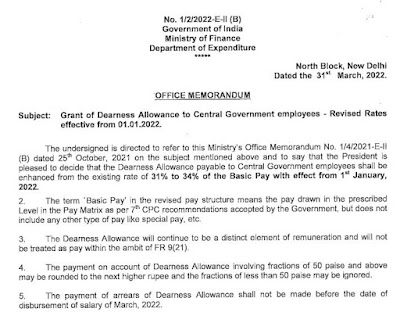
DA Jan 2022 - Grant of Dearness Allowance to Central Government employees - Revised Rates effective from 01.01.2022

 3% DA Hike - Revised Rates effective from 01.01.2022: DoE OM dated 31.03.2022 No. 1/2/2022-E-II (B) Government of India Ministry of Finance...