Showing posts with label Modi Government. Show all posts

Friday, 1 February 2019

HIGHLIGHTS OF BUDGET 2019


HIGHLIGHTS OF BUDGET 2019

Tax
1. Within 2 years, Tax assessment will be done electronically
2. IT returns processing in just 24 hours
3. Minimum 14% revenue of GST to states by Central Govt.
4. Custom duty has abolished from 36 Capital Goods
5. Recommendations to GST council for reducing GST rates for home buyers
6. Full Tax rebate upto 5 lakh annual income after all deductions.
7. Standard deduction has increase from 40000 to 50000
8. Exempt on tax on second self-occupied house
9. Ceiling Limit of TDS u/s 194A has increased from 10000 to 40000
10. Ceiling Limit of TDS u/s 194I has increased from 180000 to 240000
11. Capital tax Benefit u/s 54 has increased from investment in one residential house to two residential houses.
12. Benefit u/s 80IB has increased to one more year i.e. 2020
13. Benefit has given to unsold inventory has increased to one year to two years.

Other Areas
14. State share has increased to 42%
15. PCA restriction has abolished from 3 major banks
16. 2 lakhs seats will increase for the reservation of 10%
17. 60000 crores for manrega
18. 1.7 Lakh crore to ensure food for all
19. 22nd AIIMS has to be opened in Haryana
20. Approval has to be given to PM Kisan Yojana
21. Rs. 6000 per annum has to be given to every farmer having upto 2 hectare land. Applicable from Sept 2018. Amount will be transferred in 3 installments
22. National kamdhenu ayog for cows. Rs. 750 crores for National Gokul Mission
23. 2% interest subvention for farmers pursuing animal husbandry and also create separate department for fisheries.
24. 2% interest subvention for farmers affected by natural calamities and additional 3% interest subvention for timely payment.
25. Tax free Gratuity limit increase to 20 Lakhs from 10 Lakhs
26. Bonus will be applicable for workers earning 21000 monthly
27. The scheme, called Pradhan Mantri Shram Yogi Mandhan, will provide assured monthly pension of Rs. 3,000 with contribution of Rs. 100 per month for workers in unorganized sector after 60 years of age.
28. Our government delivered 6 crores free LPG connections under Ujjawala scheme
29. 2% interest relief for MSME GST registered person
30. 26 weeks of Maternity Leaves to empower the women
31. More than 3 Lakhs crores for defence
32. One lakh digital villages in next 5 years
33. Single window for approval of India film makers

Monday, 14 January 2019

PM greets the people on the occasion of various festivals across India

Prime Minister's Office

PM greets the people on the occasion of various festivals across India
14 JAN 2019
The Prime Minister, Shri Narendra Modi has greeted the people on the occasion of various festivals across India.

"Happy Makar Sankranti to everyone!
Best wishes on Pongal!
Greetings on the special occasion of Magh Bihu.
Happy Uttarayan.
May you all scale new heights of progress in the times to come", the Prime Minister said.

PIB

Monday, 29 May 2017

Three years of Modi government: A report card


Press Information Bureau
Government of India
President's Secretariat
26-May-2017 12:14 IST
Three years of Modi government: A report card

The record of the Bharatiya Janata Party (BJP)-led National Democratic Alliance (NDA) during its three years in power has been impressive, judging by macroeconomic parameters, especially inflation.
Politically too, the BJP has seen unprecedented ascendancy by wresting back power in Uttar Pradesh in March after a gap of 15 years and expanding its electoral footprint to the North-East. This in part explains why Prime Minister Narendra Modi remains India's most popular political leader.
Still, controversies associated with the actions of fringe saffron groups have left the BJP vulnerable to criticism. The next general election is due in 2019 and, to a large extent, the outcome will depend on Modi's management of the optics and his government's ability to generate jobs to meet the growing aspirations of voters.
Here is a look at the key themes of the NDA's three years in power.

CONNECTIVITY

Positive

1. New integrated transportation initiative for roads, railways, waterways and civil aviation.
2. Sagarmala and Bharatmala programmes for the construction of new ports and expressways.
3. UDAN (Ude Desh ka Aam Naagrik) regional connectivity scheme with fares starting at about Rs2,500.

Negative

1. Increasing number of railway accidents.
2. 23km per day of highway construction achieved vis-a-vis a target of 41km.
3. Air India's finances are still precarious. The national carrier is still grappling with legacy issues.

TERROR, DEFENCE AND FOREIGN POLICY

Positive

1. Carried out surgical strikes across the Line of Control (LoC) in Kashmir, resumed cordon and search operations in more than 20 villages in Shopian.
2. Combing operations launched against Maoists in Chhattisgarh.
Prime Minister Narendra Modi's "neighbourhood diplomacy" falling in place as relations with Bangladesh, Nepal and Sri Lanka look up.

Negative

1. No strategy to pre-empt rebel attacks on security personnel in districts where Maoists are active.
2. Ties with Pakistan and China are icy despite Prime Minister Modi making trips to both countries (a December 2015 stopover in the former).
3. Relations with Russia - India's once time-tested friend - too seem to be in the doldrums.

FARMERS

Positive

1. New crop insurance scheme and higher funding for irrigation to counter weather risks.
2. Set an ambitious goal to double farm incomes in real terms by 2022, moving away from the historical focus on increasing production.
3. Initiated a range of marketing reforms to create a "one nation, one market" in agriculture.

Negative

1. Decline in wholesale prices of vegetables and pulses has dented farm incomes.
2. A loan waiver in Uttar Pradesh led to a moral hazard problem and delay in repayment of loans in other states.
3. Acute drought in southern states led to a spike in farm suicides.

GREEN ECONOMY AND ENERGY

Positive

1. Push for electric vehicles.
2. Rs42,000 crore unlocked for afforestation with Parliament passing The Compensatory Afforestation Fund Bill, 2016.
3. Clean and renewable energy generation gets a boost.

Negative

1. Neglect of the forest and wildlife sectors. Decisions pending on a national forest policy, definition of forests, inviolate forest areas and a national wildlife action plan.
2. Activists allege that the government is favouring industries and indiscriminately giving green clearances, ignoring the toll taken on the environment.
3. Ganga clean-up is yet to gather momentum.

Positive

1. Got states on board to introduce the goods and services tax (GST), the biggest tax reform since independence.
2. Crackdown on black money leads to a surge in 2016-17 tax receipts, number of return filers.
3. Merger of railway budget with Union budget and shifting budget presentation date to 1 February from 28 February.

Negative

1. Demonetisation drive led to short-term cash crunch, hit small and medium enterprises.
2. Pending cases of retrospective taxation on past transactions still unresolved.
3. Inability to bring back black money stashed away abroad by citizens.

POLITICS

Positive

1. Getting unanimity on the economic reforms agenda with high parliamentary productivity.
2. Series of electoral gains puts the National Democratic Alliance (NDA) on the political forefront.
3. Expanding voter base of the BJP to Dalits and other backward classes, focus on expansion in the North-East.

Negative

1. Failure to get consensus on reform policies like a proposed land bill.
2. Allegations of toppling elected state governments.
3. Problems within the NDA: the Peoples Democratic Party (Jammu and Kashmir), Shiv Sena (Maharashtra) and Telugu Desam Party (Andhra Pradesh) are annoyed with the BJP leadership.

EMPOWERMENT - SOCIAL SAFETY, EDUCATION, JOBS, GENDER

Positive

1. Graded autonomy to promote quality in education.
2. Slew of social security measures to benefit the working class.
3. Six months of paid maternity leave for working women.

Negative

1. The Women's Reservation Bill is still pending.
2. New Education Policy still to be formulated.
3. Job creation yet to pick up pace.

MINDSET CHANGE

Positive

1. Swachh Bharat Abhiyan launched to eliminate open defecation and promote cleanliness.
2. Soviet-style five-year plans come to an end; 15-year vision, three-year action plan come into play.
3. Cashless economy.

Negative

1. Hyper-nationalism as seen through the lens of social media trolling and rise of vigilante groups with little regard for human life.
2. Rise of vigilante groups with political agendas who attack minorities.
3. In spite of stricter laws, greater awareness and even campaigns, violence against women continues unabated.

DIGITAL AND COMMUNICATIONS

Positive

1. Improving e-infrastructure, e-participation and government e-services for addressing transparency.
2. Unified Payments Interface (UPI) - a payment system that allows mobile-enabled money transfers between bank accounts. Promotion of the Bharat Interface for Money (BHIM) for a less-cash economy.
3. Leveraging Aadhaar for improving service delivery to citizens.

Negative

1. Call drops continue despite mobile phone services providers promising improvement.
2. Drop in digital payment transactions with the easing of a cash crunch that followed the demonetisation of high-value banknotes in November.
3. Leakage of Aadhaar data.

OPTICS

Positive

1. Doing away with the red beacon - a symbol of so-called VIP culture - from all government vehicles.
2. Extending support to ending the practice of triple talaq.
3. Introducing the Beti Bachao Beti Padhao (save the girl child, educate the girl child) scheme.

Negative

1. Rise of vigilante groups called Gau Rakshaks, who target people suspected of harming cows or consuming beef.
2. Launch of the anti-Romeo squads in Uttar Pradesh, ostensibly to protect women from harassment, but seen widely as moral policing.
3. Ghar Wapsi (homecoming), aimed at promoting the conversion of non-Hindus to Hinduism, and campaign against Love Jihad, allegedly practised by Muslim men to win over Hindu women.

Saturday, 21 January 2017

7th pay commission: This is why Modi government not giving hike to 47 lakh employees


7th pay commission: This is why Modi government not giving hike to 47 lakh employees

Reports suggest that the committee under the chairmanship of finance secretary Ashok Lavasa has finalised its report for salary hike in accordance with the recommendations of the seventh CPC, but the government is unable to pay the allowances to its employees due to cash crunch.

More than 14 months have passed since the seventh pay commission report was submitted and little less seven months have elapsed since the union cabinet approved implementation of the salary hike recommendations, but the central government employees are still awaiting the good news.
Demonetisation is said to be the reason behind the delay in announcing allowances by the Narendra Modi government for the 47 lakh employees and 53 lakh pensioners. The number of beneficiaries includes 14 lakh employees and 18 lakh pensions from the armed forces.

HOW DEMONETISATION AFFECTS PAY HIKE: THINGS TO KNOW
  1. The government has announced that it will implement the seventh pay commission's recommendations from January 1 last year. But, in the aftermath of demonetisation, the government is not in position to make the final decision.
  2. The seventh pay commission proposed a 138.71 per cent hike in housing allowance (HRA) and 49.79 per cent for other allowances.
  3. The pay commission estimated that during the current fiscal, the hike in allowances would add a burden of Rs 29,300 crore (Rs 17,200 crore under HRA and Rs 12,100 crore under other allowances). This is a huge sum but after demonetisation, the government is working hard to stave off the cash crunch that set in.
  4. The Modi government has constituted a committee to look into the recommendations regarding allowances and the manner of their implementation.
  5. Some reports suggest that the committee under the chairmanship of finance secretary Ashok Lavasa has finalised its report, but the government is unable to pay the allowances to its employees due to cash crunch.
  6. The employees' unions have been putting pressure on the finance ministry to announce hike in allowances at the earliest.
  7. The announcement of assembly elections in five states has given some time for the government as it cannot announce pay hikes till the model code of conduct is in place.
  8. The assembly elections have given the government time till March 8, by when there would be some additional cash in circulation. But, by then the budget would have been presented and accommodating over Rs 29,000 crore for salaries and pensions in the budge may pose a problem.
  9. The delay in implementation of the seventh pay commission's recommendations has caused tremendous irritation and frustration among employees.
  10. The BJP may have to face a backlash in the assembly elections in the five states, two of which is ruled by the party either directly or in alliance. Thus, demonetisation move by the Modi government may strike a double blow to the BJP in polls.
Source: Indiatoday

Saturday, 12 November 2016

What is the procedure to change the 500, 1000 notes through representative ?

What is the procedure to change the 500, 1000 notes through representative ?

In case you are not possible for you to visit the bank you may send your representative with an express mandate i.e. a written authorisation. The representative should produce authority letter and his / her valid identity proof while tendering the notes.

Proof of identity: Valid Identity proof is any of the following: Aadhaar Card, Driving License, Voter ID Card, Pass Port, NREGA Card, PAN Card, Identity Card Issued by Government Department, Public Sector Unit to its Staff.

Authority letter for change the 500, 1000 notes through representative


REQUEST LETTER FOR EXCHANGE OF OLD HIGH DENOMINATION BANK NOTES OF Rs.1000 AND Rs.500
Request-slip-for-exchange-of-old-notes


Click to download the form

Wednesday, 22 June 2016

Ministry of Railways Observes The International Day of Yoga

Ministry of Railways Observes The International Day of Yoga

Ministry of Railways organised the International Day of Yoga today on 21st June, 2016 in Rail Bhawan as per the direction of the Ministry of AYUSH.

The Union Minister for Railways, Shri Suresh Prabhakar Prabhu participated in the Yoga session along with the Chief Minister of Andhra Pradesh, Shri N. Chandra Babu Naidu, on the occasion of the 2nd International Day of Yoga at Vijayawada.

A Yoga session was organized at Rail Bhawan headquarters in new Delhi by engaging Shri Chakardhar Kushwaha, Yoga Instructor of the Morarji Desai National Institute of yoga, New Delhi. This event was attended by Railway Board officials including Chairman Railway Board Shri A. K. Mital and other Board Members.

International Yoga day was also observed in the entire Indian Railway System which included zonal Railway Headquarters, Division Railway Headquarter, Production Unit Headquarters, Railway Training Institutes and Centres, and all other Railway establishments.

Source: PIB

Saturday, 18 June 2016

7CPC: Good news for government employees! Secretary Panel submits report; recommendations implementation soon

7CPC: Good news for government employees! Secretary Panel submits report; recommendations implementation soon

New Delhi,  There is a good news for central government employees who have been ardently waiting for the implementation of 7th Pay Commission. According to a Dainik Jagran report, “The Cabinet Secretary met the PMO officials on Wednesday and apprised them about the secretaries panel’s recommendations on the salary and allowances hike recommended for central government employees.

The secretaries panel reviewing the 7th pay commission’s recommendations have submitted its report to the Finance Ministry. The Finance Ministry will prepare a note and present it before the Cabinet in the next 15 days.” Whereas according to a India.com report, “The 13-member Committee of Secretaries headed by the Cabinet Secretary Pradeep Kumar Sinha is likely to submit its final report on the recommendations proposed by the 7th Pay Commission on June 18. After panel submits its report, Cabinet is expected to give the green signal for implementation of the revised recommendations. However the government is planning to implement the recommendation made by the 7th Pay Commission regarding the salary hike of government employees from August 1.” According to latest reports, Government staff will get their six months arrears in one installment in the month of October. It is being said that Government will implement Seventh Pay Commission most likely from July. Employees will get increased payout in their July salary and it will be credited in their account on August 1. The recommendations when implemented would have bearing on remuneration of 47 lakh central government employees and 52 lakh pensioners. Subject to acceptance by the government, the recommendations will take effect from January 1, 2016.

OneIndia News

Sunday, 22 May 2016

7th Pay Commission: Euphoric Modi government to give final nod to Increment notification soon

7th Pay Commission: Euphoric Modi government to give final nod to 'Increment'; notification soon

7thCPC Increment notification

As high voltage State Assembly polls have ended now, Government is all set to implement the recommendations of Seventh Pay Commission.

Reportedly, Modi Government which is euphoric after party's victory in Assam and its good show in Kerala, looks in full mood to handover increased payout to Government staff anytime soon.

It is being believed that as model code of conduct is no longer a barrier in the way of implementing salary increment, Government could issue notification in the first week of June. Sources say that all the formalities regarding the implementation process will be done after a Cabinet meet which will be chaired by Prime Minister Narendra Modi soon. Read more: 7th Pay Commission: PMO orders early implementation of 'increment', wants 'maximum payout' for staff A website quoting Finance Ministry sources writes, "the BJP led central government is now in a pleasant mood, accordingly it may announce better pay package that recommended by Pay Commission to central government employees". Reportedly, Modi Government will give 25-30 per cent increment to Central Government employees, Sources say that increment will be handed over in July while arrears from January till that date will be paid in August.

OneIndia News

7th Pay Commission: Government doctors threaten to go on strike; want better salary, allowances

7th Pay Commission: Government doctors threaten to go on strike; want better salary, allowances

7th Pay Commission government doctors strike

The Seventh Pay Commission be implemented anytime now but before that everyone wants their demands to be met in regards with the allowances and wages. If reports are to be believed then, the doctors working in government hospitals in Delhi may go on strike if the Modi government does not meet their demands in connection with the seventh pay commission.

Government is deciding our pay scale, and does not even bother to listen to our demands. They do not even give us appropriate representation in the committee. While no doctor likes to go on strike, we will do exactly so if the existing recommendations of the 7th Pay commission are given a go ahead," Dr Pankaj Solanki, President, Federation of resident doctors association (FORDA) was quoted as saying in a ZeeNews report.

The report further adds, "FORDA is a body of 15000 resident doctors in the capital, and have said that government doctors from other organisations and states have shown their inclination towards the strike opposing the recommendations of the seventh pay commission." Doctors have said that either their demands be met by the end of or they will go on an indefinite strike. Earlier, the central government employees had also said that they are planning to strike work on July 11 so that they get higher wages and allowances under the 7th Pay Commission.

The central government employees lead by the National Council (Staff Side) Joint Consultative Machinery have also said that they will not accept unilateral decision on salary hikes under the seventh Pay Commission and would like to have more say in the way their monthly salaries and allowances are shaped up by the Empowered Committee of Secretaries.

Via OneIndia News

Monday, 7 March 2016

NFIR writes to PM to withdraw of Budget proposal to levy Income Tax on Provident Fund

NFIR writes to PM to withdraw of Budget proposal to levy Income Tax on Provident Fund

Serious resentment among employees against Budget proposal to levy Income Tax on withdrawal of 60% of provident Fund
NFIR
National Federation of Indian Railwaymen
3, CHELMSFORD ROAD, NEW DELHI – 110 055
Dated: 05/03/2016
Shri Narendra Modiji
Hon’ble Prime Minister of India,
152, South Block,
Raisina Hill
New Delhi – 110011

Sub: Serious resentment among employees against Budget proposal to levy Income Tax on withdrawal of 60% of provident Fund – reg.

The employees in general and Rail Workforce in particular are extremely unhappy over the Budget proposal presented by the Hon’ble Finance Minister to impose Income Tax on 60% of Provident Fund withdrawals. This proposal if enforced would cause harm to the workers at their fag end of service on superannuation.

Hon’ble Prime Minister may please appreciate that the employee withdraws his/her legitimate Provident Fund for meeting the requirements of Children Education, Construction of house or for the purpose of performing marriages of children. Levying Income Tax on these

withdrawals that too when the Provident Fund amount is recognized to be the property of the worker, would be unethical. The employees are deeply disappointed over the Budget proposal to impose Income Tax on P.F. withdrawal.

NFIR, therefore appeals to the Hon’ble Prime Minister to kindly intervene and see that the above proposal is reconsidered and withdrawn in the interest of industrial peace in the Country.
Yours sincerely,
sd/-
(Dr.M.Raghavaiah)
General Secretary
Source: NFIR

Friday, 18 December 2015

Abolishment of the practice of interview for Group B and C posts

Abolishment of the practice of interview for Group B and C posts

The Central Government has decided to dispense with the interview for all Group ‘C’ and non-gazetted Group ‘B’ category in Central Government by 31.12.2015. If a Department considers interview absolutely necessary for any specific posts, then clearance of Department of Personnel & Training is necessary.

Further, the State Governments have also been requested on 4th September 2015 and 29th September, 2015 to undertake similar exercise in respective States in consultation with State Public Service Commissions or other agencies involved in the recruitment for junior level posts. This issue was also deliberated during a meeting held on 8th September, 2015 and in a one day workshop organized on 16th November, 2015 in which the State Secretaries of Personnel/General Administration Department were invited.

This was stated by the Minister of State in the Ministry of Personnel, Public Grievances and Pensions and Minister of State in the Prime Minister’s Office Dr. Jitendra Singh in a written reply to a question by Shri Anil Desai in the Rajya Sabha today.

Thursday, 10 December 2015

Minimum Government and Maximum Governance

Minimum Government and Maximum Governance

A citizen friendly and accountable administration is the focus of the government. A series of steps to achieve this goal have been initiated. These include simplification of procedures, identification and repeal of obsolete/archaic laws/rules, identification and shortening of various forms, leveraging technology to bring in transparency in public interface and a robust public grievance redress system.

Doing away with the practice of submitting Affidavits for small level executive jobs in the Government and allowing Self-Certification of certificates is one important step in this regard. This has greatly led to the reduction in time and effort on the part of both the citizen as well as the officials in many Government offices.
Leveraging the power of information technology brings with it the advantage of transparency and speed for the benefit of the citizens. In this regard the Government has embarked upon a time bound Digital India Plan. The details of this plan are available on the Website of the Department of Electronics & Information Technology (www.deity.nic.in). As a part of Digital India Plan, the Department of Administrative Reforms & Public Grievances has been made the nodal ministry for implementation of e-Office in Central Ministries/Departments. The Department is regularly monitoring implementation of the e-Office project. The Ministry of Panchayati Raj has moved into 100% e-Office platform.

The Central Secretariat Manual of Office (CSMOP) has been revised and the 14th Edition of the CSMOP was brought in the form of e-Book form on 22nd May, 2015, which is available on the website www.darpg.nic.in. This is a much reduced and simplified version of the manual in comparison to the earlier editions. A number of redundant and repetitive literatures and words have been removed.

The Government of India has also taken a number of initiatives for improving ‘Ease of Doing Business’. The emphasis has been on simplification and rationalization of the existing rules and introduction of information technology to make governance more efficient and effective.

One of the focus areas of Government is to reduce the decision making layers to the minimum while allowing for faster means of information sharing/dissemination. The Government has launched a website mygov@nic.in and india.gov.in for this purpose. This is a citizen centric platform to empower people to connect with the Government and contribute towards good governance. Suggestions are also received on the PMO website. It also seeks expert advice from the people, thoughts and ideas on various topics that concern India. Citizens can join the discussion to share, debate and add value.

This was stated by Minister of State in the Ministry of Personnel, Public Grievances and Pensions and Minister of State in the Prime Minister’s Office Dr. Jitendra Singh in Lok Sabha today in a written reply to a question by Shri Nalin Kumar Kateel, Shri B.N. Chandrappa, Shri D.K. Suresh and Shri R.K. Bharati Mohan.

PIB

Friday, 25 September 2015

7th Pay Commission: Salary rises should be based on performance

7th Pay Commission: Salary rises should be based on performance

New Delhi: The Seventh Pay Commission is likely to recommend to rise the salary of central government employees should be based on performance in the office, rather than just time served.
The central government urged the Seventh Pay Commission to make proposal for enhanced pay and special incentives as performance based annual increments.

Appraisals for government employees were introduced since British period but didn’t affect pay. Eight years ago, the Sixth Pay Commission asked to link the performance of central government employees with their pay.

The Sixth Pay Commission had carried out a study through the Indian Institute of Management, Ahmedabad, on a performance-based incentive system, to ostensibly improve the performance outputs of Central government employees.

The study was aimed at working out a model whereby a base salary is attached to each post based on skills and responsibility and simultaneously, a second component would be payable over and above the salary on the basis of the productivity and performance of employees, either individually or as a group.

The government employees believe pay should reflect the cost of living while private sector workers believe pay should reflect performance.

Accordingly, the Narendra Modi government plans to move towards making increment programmes based on performance rather than on time-served through the Seventh Pay Commission and automatic annual incremental pay progression would be scrapped in central government ministries and departments.

The original idea behind performance incremental pay is that every central government employee takes a while to become fully competent in a role, so government can reward them as they grow in competence and experience.

Despite the government having powers to withhold increments, but nowadays, very few do, so there is a culture of government employees moving up the pay scale irrespective of their performance.

The bottom line is if government doesn’t get rid of automatic incremental progression, the government can’t control pay, and that is what the Modi government has realised.

The central government employees can play a vital role in this way in nation building.

Therefore, the Seventh pay commission may recommend up to 5 percent performance-based increment instead of automatic annual increment for central government employees.

TST

Friday, 2 January 2015

AIRF General Secretary writes to PM about stopping 100% FDI and Privatization in Railways

AIRF General Secretary writes to PM about stopping 100% FDI and Privatization in Railways.

The letter is reproduced and given below for ready reference for our blog viewers…

Com. Shiva Gopal Mishra writes Hon’ble Prime Minister Sh. Narendra Modi about stopping 100% FDI and Privatization in Railways

Respected Shri Narendra Modi Ji,

During recent past, Railwaymen had been feeling highly demoralized and disgusted on account of apprehensions of privatization of the Indian Railways owing to 100% Foreign Direct Investment(FDI) and constitution of a High Level Railway Restructuring Committee for Restructuring of Ministry of Railways(Railway Board). Yesterday, on 25th December, 2014, while celebrating the 91st Birth Anniversary of Hon’ble Shri Atal Bihari Vajpayee as “Sushasan Diwas” in Diesel Locomotive Workshop, Varanasi, you publically announced that there would be no privatization of the Indian Railways, rather number of Railway employees shall be increased during the time to come, for which, we, on behalf of around 13 lakh Railway employees, express our heartily thanks for giving this assurance.

Sir, though the assurance given by you that the Indian Railways shall not be privatized, has provided some relief to the Railwyamen, who were feeling hurt and discouraged for the last six months, at the same time you have mentioned that FDI is essentially required in the Indian Railways, still creates some confusion. Although, there have been constructive discussions with the Hon’ble MR, which we hope, shall continue in future also.
AIRF has always supported and contributed a lot in the development and modernization of the Indian Railways through transparent process, as such, we would urge further assurance, so that the moral of lakhs of Railwaymen is kept high. Your goodself very-well know that there has been all round development in the Indian Railways after the Independence, and not only the Indian Railways have expanded a lot, but also have touched new horizons by adopting latest technology in different spheres, by virtue of which, Indian Railways are now running over 19,000 pairs of trains per day transporting more than 20 million passengers and around 35 lakh tonne freight everyday. Obviously, there has been dedicated contribution of the Railwaymen in this endeavour, not only this, but also the dedication of the Railwaymen can be adjudged from the fact that, while performing their duties, they even sacrifice their lives, and it has been established that hundreds of Railway staff loose their lives every year, as endorsed by the High Powered Committee, headed by Dr. Anil Kakodkar, in it’s report.

We, therefore, once again request you that, with a view to boosting morale of the Railwaymen, there should be clear and specific assurance by the government that the Indian Railways shall in no way be privatized, so that the staff shall be motivated to perform their duties with even more dedication and sincerity.

Wishing you very-very Happy New Year on behalf of all the Railwaymen and their family members!

With kind regards!
Yours Sincerely,
sd/-
(Shiva Gopal Sharma)
General Secretary
Shri Narendra Modi Ji,
Hon’ble Prime Minister,
Government of India,
New Delhi

Copy to: Hon’ble MR(Government of India), Ministry of Railways, Rail Bhawan, New Delhi.
Copy to: Hon’ble MoSR(Government of India), Ministry of Railways, Rail Bhawan, New Delhi.
Copy to: GSs, all affiliated unions – for information.

Thursday, 3 July 2014

Centre Plans Changes in Labour Laws – ‘Flexible Working Hours’ implementation…

Centre Plans Changes in Labour Laws – ‘Flexible Working Hours’ implementation…

Since most of the labour laws being followed in this country were implemented prior to Independence and have therefore become redundant and outdated, the newly formed government at the centre, under the leadership of Narendra Modi, is seriously contemplating a revision of the existing laws. The Government intends to step up productivity by bringing forth these changes.

Changes in Britain: A law was recently implemented in Britain, one of the developed countries of the world. Employees working in factories and offices cannot be henceforth compelled to report to work at only a particular time. The law states that the employees shall be given flexi-time options to report to work at times that suit them and complete their tasks. For a casual observer, it might look as if the law is very pro-employee and anti-employer. But the law is actually intended to step up productivity. Experts in Britain felt that insisting on being seated for long hours or compelling workers to report to duty at a particular time or do only a particular task could be counterproductive. The changes were brought forth as a result.

Flexi-time work hours: The Indian Government too is planning to make similar changes in its labour laws. Changes like these, also known as “Flexible Working Hours”, are very likely to be implemented in India too, especially in the manufacturing sectors in order to step up the productivity. But these changes will be brought forth in such a manner that they bring forth the true potentials of the employees.

Also, changes like bringing in more and more workers within the minimum-wages slab, increasing overtime, enabling women to work in night shifts in factory environments, are also going to be implemented. The reforms are intended to minimize friction between the management and employees and thus increase productivity. As far as India is concerned, such reforms are only rarely implemented in the service sector, and almost never in the manufacturing sectors. Although India is the world’s third largest economy, more than 56% of the productivity comes from the service sector. Only 15% of the country’s productivity comes from the industrial and manufacturing sectors. In comparison, more than 45% of China’s productivity comes from its industrial workers.

The Government believes that there could be a tremendous increase in the country’s productivity by implementing reforms in the labour laws.

Source: CGEN.in
[http://centralgovernmentemployeesnews.in/2014/07/centre-plans-changes-in-labour-laws-flexible-working-hours/]

Friday, 27 June 2014

Performance Related Incentive Scheme (PRIS): About a reader’s Opinion

Performance Related Incentive Scheme (PRIS): About a reader’s Opinion

The Tamil newspaper Dinamalar recently published an opinion of one of its readers about Performance Related Incentive Scheme.

According to the write-up, based on the recommendations by the Sixth Pay Commission, the scheme had been introduced more than five years ago in select central government departments like atomic energy, space research and defence.

The scheme has already been implemented in atomic energy, space research and scientific and technical research departments under the name of “Performance Based Incentive Scheme”. As a result, there has been tremendous improvement in the productivity and output of these departments.

One can use the Right to Information Act to find out how the performance is evaluated and details regarding promotions. The annual performance appraisals submitted by the employees and the feedback and comments marked by their senior officials are now declassified and are accessible to all. The employee is evaluated based on the annual targets, and the amount of work accomplished that year.

Options have been created to constantly improve management practices. Still, there are issues that need to be addressed. There is fear that such target-based appraisals would encourage unhealthy and selfish result-obsessed-performances, and discourage team spirit and selfless acts aimed at general welfare.

In order to successfully implement these schemes, it is very important for the management to be proactive, benevolent, focused, with clear thinking process, and very impartial.

In other words, a mere rod isn’t sufficient to control an elephant. One also has to have a properly qualified and trained mahout. Similarly, mere schemes alone wouldn’t bring the required transformation in the central government departments. They also need excellent management teams to implement them successfully.

Thursday, 19 June 2014

PENDING DEMANDS AND NEW GOVERNMENT - CONFEDERATION NEWS

PENDING DEMANDS AND NEW GOVERNMENT - CONFEDERATION NEWS
"Chairman, 7th CPC, has also made it clear that unless the Government refer the issues of DA merger, Interim relief and GDS issues to the Commission, it will not consider these issues.  Hence the ball is now in the Government’s court".
PENDING DEMANDS AND NEW GOVERNMENT 
New Central Government under the leadership of Hon’ble Prime Minister Shri. Narendra Modi has taken charge with a clear majority in the Lok Sabha election.  People of the country and the Central Government employees who suffered a lot under the UPA Government, have voted for a change.  Now it is the turn of NDA Government.  Coming days will prove whether the selection made by the voters is correct or not.
Central Government employees have to take a cautious approach towards the new Government.  As the new Government has just taken over charge and expectations are very high, jumping into any sudden conclusion may not be correct on our part.  We have to give reasonable time to the new government to make its stand clear on the issues agitating the minds of the Central Government employees.  Let us hope that our past experience in the 2000 December 14 days Postal strike when the NDA Government was in power, the support extended by the party leading NDA to the UPA Government for introducing and passing the PFRDA Bill in Parliament, the infamous downsizing order of 2001 issued by the NDA Government which paved way for abolition of thousands of vacant posts in Central Government Departments and refusal to concede any of the main demands of Gramin Dak Sevaks will not be repeated by the new Government.
The maiden budget of the new Government to be presented in Parliament in July 2014 may give us an idea on the thinking of the Government and also the attitude of the Government towards the problems faced by the common people and the Central Government employees.  Confederation of Central Government Employees and Workers has placed our demands before the new Government.  JCM National Council staff side has also written to the Finance Minister and Cabinet Secretary.  Our demands are not new.  Demands raised before the UPA Government are again placed before the NDA Government.
               
While constituting 7th Central Pay Commission the UPA Government has refused to include the main demands of the Central Government employees in the terms of reference viz:
(1) Grant of merger of DA 
(2) Grant of interim relief and 
(3) inclusion of Gramin Dak Sevaks under the purview of 7th CPC.  
Confederation has conducted 48 hours strike in February 2014, just before the General Election is declared, demanding settlement of the 15 points charter of demands which includes the above three main demands also.  As General Election was declared we could not move further.  Central Government employees expect that the new Government will consider positively, the demands raised in the 48 hours strike.
               
If the new Government also take the same stand as that of previous UPA Government and refuse to concede our genuine demands, the Central Government employees will be forced to tread the path of struggle again. Before embarking upon such a struggle, our prime duty is to build up largest unity among all sections of the Central Government employees.  Confederation is making all out effort in this direction especially to build up total unity among JCM staff side organisations.  We are even ready to make certain compromises for the sake of unity.
               
We have to give enough time to the new Government and we are ready to wait.  But we cannot wait indefinitely. 7th CPC has already commenced its work and has fixed target dates for submission of memorandums by Federations and Unions/Associations.  Chairman, 7th CPC, has also made it clear that unless the Government refer the issues of DA merger, Interim relief and GDS issues to the Commission, it will not consider these issues.  Hence the ball is now in the Government’s court.  Let us see how the things move.  Let us also be ready to face any situation.
M. Krishnan
Secretary General
Source: http://confederationhq.blogspot.in/

Friday, 6 June 2014

Will Modi Government Implement PRIS?

Will Modi Government Implement PRIS?
 
One could observe that the newly sworn-in Modi Government has wasted no time to get into action. That being the case, the question now on everybody’s mind is – will the new Government implement the Performance Related Incentive Scheme (PRIS)?
 
It is worth mentioning here that Modi himself holds the portfolio of the ministry that is responsible for all decisions pertaining to the Central Government employees. 
 
News media have carried statements allegedly made by Central Government officials themselves regarding this issue. The 6th Pay Commission has recommended that the scheme that grants performance and talent based incentives to Central Government employees could be implemented. The recommendations of the previous Pay Commission were adopted by the previous Government at policy-level. Officials of the DoP&T will soon be meeting with Narendra Modi and explaining the situation to him. During this meeting, if Modi gives his assent, then a detailed guideline will be prepared soon after. A guideline has already been prepared in this regard during the previous Government’s tenure. Suitable changes and additions will be made to this in order to incorporate the recommendations and suggestions given by Modi. 
 
There are more than 50 Lakh Central Government employees spread all over the country. The Department of Personnel and Training will soon launch a series of measures that would increase the efficiency of these employees which would directly and indirectly benefit millions of others. If performance based incentive is implemented, then the salaries of the Central Government employees will differ each year based on their performance. The scheme could either be implemented based on an individual’s productivity or on the department’s performance.
 
For more details click the link…

Source: 90paisa.blogspot.in
[http://90paisa.blogspot.in/2014/06/will-modi-government-implement-pris.html]

Flash News

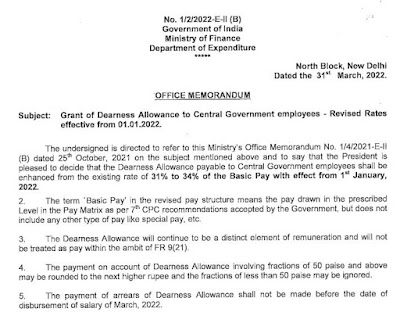
DA Jan 2022 - Grant of Dearness Allowance to Central Government employees - Revised Rates effective from 01.01.2022

 3% DA Hike - Revised Rates effective from 01.01.2022: DoE OM dated 31.03.2022 No. 1/2/2022-E-II (B) Government of India Ministry of Finance...