Showing posts with label PRIS. Show all posts

Tuesday, 1 December 2015

7th Pay Commission Recommendations on PRIS

7th Pay Commission Recommendations on PRIS – Performance Related Incentive Scheme to continue as such.  No PRIS for Non-Scientific Staff. DRDO can continue with their existing system.

7th CPC report has been submitted to Finance Ministry for implementation.  The recommendations made by the 7th CPC about PRIS is given below.

Performance Related Incentive Scheme (PRIS)

PRIS is operational in Departments of Atomic Energy and Space. PRIS is a variable component of pay and is awarded on the basis of the performance of individual/ group/organization, measured against goals set for a given period of assessment. PRIS is non- additive and non-cumulative. The form of PRIS envisaged is organization and design specific and is payable as a cash incentive either when it becomes due or on a monthly/quarterly/annual basis. It is based on the principle of differential reward for differential performance. The scheme is transparent and centrally implementable. The Scheme has three components- Organizational, Group and Individual.

Organizational PRIS

Organizational PRIS or PRIS (O) is awarded to all personnel in the department and its constituent units based on accomplishment of various objectives at the organizational level, in the form of Special Allowance at the rate of 20 percent of pay, payable on a six monthly basis and subject to fulfilling the following eligibility criteria:
  • Attendance of not less than 175 working days during the preceding financial year.
  • Incentive shall not be admissible for the period of EL/HPL/Commuted Leave etc. availed singly or in combination, in excess of 30 days during the financial year for which the organizational incentive is otherwise payable.
  • APAR grading should be Good/B+ or above.
  • Should not be under suspension or deputation.

Group PRIS

Group PRIS or PRIS (G) is awarded to all employees belonging to specific groups identified in all Units of the Department–scientific, technical, administrative and auxiliary, exhibiting excellence which have significantly contributed towards the realization of the organizational objective in a particular year, in the form of Special Allowance at the rate of 10 percent of the basic pay of the individual during the financial year, based on annual assessment and which is further subject to fulfilling the following eligibility criteria:
  • Overall grading in APAR of the preceding reporting year should be Very Good or above.
  • For SC/ST personnel, the same should be Good or above.
  • Other criteria remain the same as PRIS (O).

Individual PRIS

Individual PRIS or PRIS (I) are variable additional increments granted to all eligible Scientific and Technical personnel at the time of promotion in recognition of individual meritorious performance subject to fulfilling the following eligibility criteria:
  • Variable increments awarded to Scientific and Technical personnel are specific to the Grade.
  • An employee will enter into PRIS (I) only after the first merit promotion.
  • A promoted candidate should not get less PRIS (I) increments than what the candidate was drawing before the effective promotion date.
  • Eligibility condition of 175 working days is not applicable for grant of PRIS (I).
  • The DPC/Standing Selection Committee, after considering the total length of time taken by an employee to earn promotion, will recommend the total number of variable incentives payable under PRIS (I)
  • Up to six increments can be recommended to the officers in the grade of Scientist H and above (except Officers at Apex Scale), four increments to the officers in the grade of Scientist C to Scientist G and maximum three increments to Technical Staff.
  • Variable increment will be multiple of one increment, but subject to the ceiling of Rs.10,000 per month.
  • The amount of incentive increment payable as PRIS (I) has no relation with the normal rate of increments under pay fixation/annual increment.
The Commission has been informed that of the three components, only PRIS (O) and (I) are under implementation and that PRIS (G) is yet to be awarded.

Demands

Associations of scientific staff in Departments of Atomic Energy and Space have submitted that PRIS, as presently implemented, has gone a long way in arresting attrition and accordingly need to be continued. They have however sought an increase in the incentive percentage of PRIS (O) and PRIS (G) as lately the attrition rate has somewhat increased. They have also demanded extension of PRIS (I) to the apex level posts of the organizations presently covered under the scheme, the stated justification being that Heads of Organization have a critical role to play in the formulation and implementation of scientific policy of the government. The associations have also requested extension of PRIS (I) to the entire department instead of limiting it to the scientific cadres. Demands have also been made for exempting Medical Leave for fulfilling the conditionality of attendance for being considered eligible for grant of PRIS (O) and PRIS (G). A demand has also been placed to extend PRIS to DRDO.

In response to a query, current data on attrition rate was supplied by Departments of Atomic Energy and Space, as well as DRDO. The attrition rate, defined as the number of scientists resigning/taking VRS during a year as a percentage of total scientists on the payroll at the end of that year, is shown in the table below:

Attrition Rate of Scientists
(percentage)
 
Years
  Space   Atomic Energy   DRDO
  2010-11  
1.34
 
0.57
  0.87
  2011-12  
1.50
 
0.70
  1.16
  2012-13  
1.23
 
0.51
  0.93
  2013-14  
1.25
 
0.70
  0.82
  2014-15  
0.86
 
0.48
  0.53

From the table above it is seen that attrition rate has been on decline in all the three scientific departments which would be partly due to PRIS and partly due to salary increase after VI CPC.

Analysis and Recommendations

It is noted that contrary to the assertion by Departments of Atomic Energy and Space, the attrition rate has continued to fall. Therefore, while the Commission sees merit in continuing with PRIS for arresting attrition in these organizations, it is not in favour of increasing the incentive percentage. The PRIS (O) and PRIS (G) taken together already amount to 30 percent of the basic pay, which is substantial. This would be more so when the rise in pay levels post implementation of VII CPC recommendations is taken into account. The demand to bring apex level functionaries under PRIS (I) is not supported as Heads of Organizations have sufficient incentive to perform being in the position they are in and like others are already the beneficiaries of PRIS (O). The Commission is also not in favour of extending PRIS (I) to non-scientific staff. The demand for exempting medical leave from the eligibility conditions of PRIS is a matter that may be dealt with administratively. The Commission also does not recommend extension of PRIS to DRDO as they have a separate system of variable increments in place which is similar to PRIS (I).


Source: gconnect.in

Thursday, 3 July 2014

Bonus to Central Government employees : JCM (Staff Side) memorandum to 7th CPC

Bonus to Central Government employees : JCM (Staff Side) memorandum to 7th CPC

17.6.Bonus

The evolution of Bonus has been dealt with by the V CPC. We therefore are not reiterating those developments.

17.6.2. In our view, since Productivity Linked Bonus has been granted on the basis of a bilateral agreement, this is out of the purview of review of any commission.

17.6.3. It is only the Adhoc Bonus to those Central Government employees who are not covered by any productivity Linked Bonus agreements which is being reviewed by us in this chapter and to suggest the measures which should be taken to evolve an appropriate Bonus to such employees.

 17.6.4. A Group of Officers under the Chairmanship of Shri. Bazle Karim, the then secretary (Co-ordination) in Cabinet Secretariat was set up to consider the long pending demand for grant of Bonus to those Central Government employees who were not covered by the PLB Schemes. This group in their report expressed the view that the Government Departments constitute a single infrastructure for economy as a whole and felt that there should not be any sense of discrimination resulting in demoralization among them as a group when the service conditions were uniform all along. The Group suggested the evolution of PLB Scheme for Central Government employees as a whole. They also suggested that pending evolution of a single scheme of Bonus for all employees, the remaining employees who were not covered by the PLB were to be paid exgratia (Adhoc) Bonus equal to 15 days salary in 1982-83

17.6.5. The report of this group has not been published. It was not given even to the VCPC on demand. The Confederation of Central Government Employees and Workers, however, could supply only an extract from the said report alongwith their memorandum to the V CPC.

17.6.6 Even to get the Adhoc Bonus equal to pay of 15 days salary in 1982-83, leaders of the Confederation had to start an indefinite fast which lasted for 7 days when the Government sanctioned Adhoc Bonus equal to 15 days salary.

17.6.7. The number of days for which Adhoc Bonus has been paid to Central Government Employees not covered by PLB Scheme since 1982-83 is indicated in the following table:

Year/s No. of days
1982-83 15 days
1983-84 18 days
1984-85 &1985-86 23 days
1986-87 25 days
1987-88 to 1989-90 27 days
1990-91 to 1993-94 30 days
1994-95 to 2013-14 30 days.

 17.6.8. The Confederation’s representatives had been pressing the demand for evolution of PLB Schemes on the basis of parameters framed by the Government after discussion in the respective departmental councils. But so far the Government has not been able to frame these parameters. This item is still pending in the agenda of National Council JCM.

17.6.9. The staff side had demanded increase in Adhoc Bonus on the basis of increases In PLB Schemes every year and that was why the Adhoc Bonus from 15 days salary during 1982-83 was increased to 30 days salary in year 1994-95. For last 20 years no further increase has been allowed.

17.6.10. The V CPC recommendation that the Adhoc Bonus Schemes should be replaced by a Productivity Linked Bonus to be evolved by each department in consultation with experts in the field and the departmental council of JCM within a period of 9 months remains on paper because Government have not issued the Notification to this effect for last 16 years.

In the meantime the Sixth Pay Commission has made a sweeping suggestion that the Adhoc Bonus Scheme should cease immediately and be replaced by what they have called PRIS-Performance Related Incentive Scheme.

17.6.11. Since this Performance Related Incentive Scheme recommended by VI CPC in their Chapter 2.5 (pages 144-157) still remains to be considered by the Government in consultation with the Staff Side of National Council of JCM. the Adhoc Bonus is also continuing.

17.6.12. We are opposed to the PRIS and Government too does not appear to be in a mood to consider and implement it, we propose that VII CPC may recommend that all departments initiate negotiations in their Departmental Councils to evolve an appropriate productivity linked bonus scheme after consulting experts in the field within a period of one year from the date, the Report of VII CPC is submitted to the Government. Pending finalization of such PLB Schemes the Adhoc Bonus equal to the average increase in the number of days sanctioned under the PLB Scheme may be granted and ensure that under no condition, the number of days be less than 31.

17.6.13. Presently the PLB and adhoc bonus are calculated on the deemed provision that one’s total emoluments is only Rs. 3500/-. This is an absolutely irrational stipulation and must be removed. We request that the Commission to recommend to the Government to remove the said stipulation and grant the bonus on the basis of the actual emolument of the employee.

Friday, 27 June 2014

Performance Related Incentive Scheme (PRIS): About a reader’s Opinion

Performance Related Incentive Scheme (PRIS): About a reader’s Opinion

The Tamil newspaper Dinamalar recently published an opinion of one of its readers about Performance Related Incentive Scheme.

According to the write-up, based on the recommendations by the Sixth Pay Commission, the scheme had been introduced more than five years ago in select central government departments like atomic energy, space research and defence.

The scheme has already been implemented in atomic energy, space research and scientific and technical research departments under the name of “Performance Based Incentive Scheme”. As a result, there has been tremendous improvement in the productivity and output of these departments.

One can use the Right to Information Act to find out how the performance is evaluated and details regarding promotions. The annual performance appraisals submitted by the employees and the feedback and comments marked by their senior officials are now declassified and are accessible to all. The employee is evaluated based on the annual targets, and the amount of work accomplished that year.

Options have been created to constantly improve management practices. Still, there are issues that need to be addressed. There is fear that such target-based appraisals would encourage unhealthy and selfish result-obsessed-performances, and discourage team spirit and selfless acts aimed at general welfare.

In order to successfully implement these schemes, it is very important for the management to be proactive, benevolent, focused, with clear thinking process, and very impartial.

In other words, a mere rod isn’t sufficient to control an elephant. One also has to have a properly qualified and trained mahout. Similarly, mere schemes alone wouldn’t bring the required transformation in the central government departments. They also need excellent management teams to implement them successfully.

Friday, 6 June 2014

Will Modi Government Implement PRIS?

Will Modi Government Implement PRIS?
 
One could observe that the newly sworn-in Modi Government has wasted no time to get into action. That being the case, the question now on everybody’s mind is – will the new Government implement the Performance Related Incentive Scheme (PRIS)?
 
It is worth mentioning here that Modi himself holds the portfolio of the ministry that is responsible for all decisions pertaining to the Central Government employees. 
 
News media have carried statements allegedly made by Central Government officials themselves regarding this issue. The 6th Pay Commission has recommended that the scheme that grants performance and talent based incentives to Central Government employees could be implemented. The recommendations of the previous Pay Commission were adopted by the previous Government at policy-level. Officials of the DoP&T will soon be meeting with Narendra Modi and explaining the situation to him. During this meeting, if Modi gives his assent, then a detailed guideline will be prepared soon after. A guideline has already been prepared in this regard during the previous Government’s tenure. Suitable changes and additions will be made to this in order to incorporate the recommendations and suggestions given by Modi. 
 
There are more than 50 Lakh Central Government employees spread all over the country. The Department of Personnel and Training will soon launch a series of measures that would increase the efficiency of these employees which would directly and indirectly benefit millions of others. If performance based incentive is implemented, then the salaries of the Central Government employees will differ each year based on their performance. The scheme could either be implemented based on an individual’s productivity or on the department’s performance.
 
For more details click the link…

Source: 90paisa.blogspot.in
[http://90paisa.blogspot.in/2014/06/will-modi-government-implement-pris.html]

Flash News

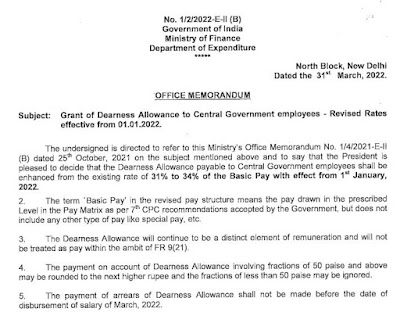
DA Jan 2022 - Grant of Dearness Allowance to Central Government employees - Revised Rates effective from 01.01.2022

 3% DA Hike - Revised Rates effective from 01.01.2022: DoE OM dated 31.03.2022 No. 1/2/2022-E-II (B) Government of India Ministry of Finance...