Showing posts with label Finance Ministry. Show all posts

Monday, 20 March 2017

Regarding Revision of Pension of Autonomous body Pensioners , Finance Ministry has clarified as follows


Regarding Revision of Pension of Autonomous body Pensioners , Finance Ministry has clarified as follows :


Central Government does not issue any instructions regarding implementation of recommendations of the Central Pay Commission PERTAINING TO PENSION IN RESPECT OF EMPLOYEES OF AUTONOMOUS BODIES. In view of this , NO ORDERS REGARDING IMPLEMENTATION OF RECOMMENDATIONS OF 7th CPC IN RESPECT OF EMPLOYEES OF AUTONOMOUS BODIES IN THE MATTER OF PENSION ARE TO BE ISSUED BY FINANCE MINISTRY. The appropriate decision is to be taken by the concerned Autonomous Body in consultation with the concerned Administrative Ministry in keeping with the practice on the previous occasions and also in the light of the Rules and Regulations/Bye-laws governing the service conditions of respective Autonomous Bodies.

M. KRISHNAN
Secretary General
Confederation
Mob & WhatsApp : 09447068125
Email : mkrishnan6854@gmail.com
Source: http://confederationhq.blogspot.in/

Thursday, 26 January 2017

Income tax exemption limit to be hiked to Rs 3 lakh


Income tax exemption limit to be hiked to Rs 3 lakh

New Delhi: The Finance Ministry is considering raising the current tax exemption limit from Rs 2.5 lakh to Rs 3 lakh.

"A core commitee for Budget 2017 has proposed to revise tax exemption limit aimed to benefit small taxpayers," a top official involved with the process of Budget told The Sen Times on the condition on anonymity.

Income of Rs 3 lakh to 5 lakh may be taxed at 10% (the current slab is Rs. 2.5-5 lakh taxed at 10%); Rs 5-10 lakh will be taxed at 20% (currently also Rs 5-10 lakh is taxed at 20%); Rs 10 lakh and above to be taxed at 30% (Currently also Rs 10 lakh and above is taxed at 30%).

"There are chances that a hike in tax exemption limit may be announced, but I am not sure if it will go up to Rs 4 lakh. Realistically the Finance Minister may announce a hike from the current Rs 2.5 lakh to Rs 3 lakh or maybe even Rs 3.5 lakh. Rs 4 lakh would be a lot, because then a lot of people who currently pay tax would go out of the ambit," said a tax expert.

The government may also propose a higher super-rich tax for those who earn more than Rs 10 crore a year.

So, Finance Minister Arun Jaitley may have some good news for the salaried people in the budget for 2017-18.

Monday, 16 January 2017

7th Pay Commission Pay revision - List of Central Government Autonomous Bodies, Quasi-government Organizations, Autonomous Organizations, Statutory Bodies, etc., covered by Finance Ministry Orders

7th Pay Commission Pay revision - List of Central Government Autonomous Bodies, Quasi-government Organizations, Autonomous Organizations, Statutory Bodies, etc., covered by Finance Ministry Orders

After a long wait Govt has issued orders for implementation of 7th Pay Commission Pay revision in the form of guidelines to the Autonomous Bodies.

The recommendations of the 7th Central Pay Commission, to the employees of the Quasi-government Organizations, Autonomous Organizations, Statutory Bodies, etc., Set up and funded/controlled by the Central Government, where pattern of emolument structure, i.e. pay scales and allowances, in particular Dearness Allowance, House Rent Allowance and Transport Allowance, are identical to those in case of the Central Government employees, has been considered by the Government and it has been decided that the revised pay scales as per the Pay Matrix, as contained in Part-A of the Schedule of the CCS(RP) Rules, 2016 as well as the principle of pay fixation as contained in the said rules, may be extended to the employees of such organizations

As per the orders issued by Finance Ministry on 13.01.2017, While Part A of 7th Pay Commission (Revised) Pay Rules 2016, will be straightaway applicable to Autonomous Bodies employees viz., Revision of existing pay as per New 7th CPC Pay Matrix, Part B and C of Rules viz., upgradation existing grade pay before 7th Pay Commission Pay revision for certain cadres may not be applicable automatically.

Following is the Ministry wise List of Autonomous Bodies coming under Central Government

Ministry of Agriculture
1 Coconut Development Board, Cochi
2 Indian Council of Agricultural Research
3 National Coop. Union of India
4 National Council for Cooperative training
5 National Dairy Development Board
6 National Horticulture Board
7 National Institute of Agricultural Marketing
8 National Institute of Agri. Extension Management
9 Veterinary Council of India
10 National Oil Seeds & Vegetable Oil Development Board

Ministry of Atomic Energy
11 Atomic Energy Education Society’s School, Mumbai
12 Institute of Mathematical Sciences, Chennai
13 Institute of Physics, Bhubaneswar
14 Institute of Plasma Research, Gandhinagar
15 Mehta Research Institute of Mathematics and Meth. Physics
16 Saha Institute of Nuclear Physics, Calcutta
17 I.I.F.R., Mumbai
18 Tata Memorial Centre, Mumba

Ministry of Chemicals and Fertilizers
19 Central Institute of Plastic Engineering & Technology
20 Institute of Pesticides Formulation Technology
21 National Institute of Pharmaceuticals Education & Res.(NIPER)

Ministry of Civil Aviation
22 Indira Gandhi Rashtriya Uran Academy

Ministry of Commerce
23 Agricultural & Processed Food Products Export Development Authority
24 Coffee Board
25 Export Inspection Council and its Agencies
26 Indian Institute of Foreign Trade
27 Indian Institute of Packing
28 Marine Products Export Development Authority
29 Rubber Board
30 Spices Board
31 Tea Board
32 Cashew Export Promotion Council
33 Tobacco Board

Ministry of Communications
34 Centre for Development of Telematics
35 T.R.A.I. General Fund

Ministry of Coal
36 Coal Miners’ PF Organisation, Dhanbad

Ministry of Culture
37 Raja Ram Mohan Roy Library
38 Allahabad Museum Society
39 Asiatic Society, Calcutta
40 Central Institute of Buddist Studies-Leh
41 Central Institute of higher Tibetan Studies-Varanasi
42 Centre for Cultural Resources & Training
43 Delhi Public Library
44 Gandhi Samriti and Darshan
45 Indian Museum, Calcutta
46 Indira Gandhi National Centre for Arts
47 Indira Gandhi Rashtriya ;Museum Sangharalaya
48 Kalakshetra Foundation
49 Khuda Bux Oriental Library Patna
50 Lalit Kala Akademy
51 Maulana Abdul Kalam Azad Institute of Asian Studies
52 National Council of Science Museum Calcutta
53 National Museum of History of Art Conservation of Museology
54 National School of Drama
55 Nav Nalanda Mahavihara
56 Nehru Memorial Museum & Library
57 Rampur Raja Library Board
58 Sahitya Akademy
59 Salarjung Museum
60 Sangeet Natak Akademy
61 Thanjavur Maharaja Sarasvati Mahal Library
62 Victoria Memorial Hall
Ministry of Defence
63 Himalayan Mountaineering Institute, Darjeeling
64 Jawahar Institute of Mountaineering & Winter Sports, Pehalgam
65 Nehru Institute of Mountaineering, Uttarkashi
Ministry of Environment & Forests
66 Central Pollution Control Board
67 Central Zoo Authority
68 G.B.Pant Himalayan Institute of Environment
69 Indian Council of Forestry Research & Education, Dehradun
70 Indian Institute of Forest Management, Bhopal
71 Indian Plywood Research & Training Institute-Bangalore
72 Wildlife Institute of India
73 National Wastelands Development Board

Ministry of External Affairs
74 Indian Council for Cultural Relations
75 Indian Council for Research on International Economic Relations
76 Indian Society of International Law
77 Society for Res. & Info. System for NAM & other Developed Countries
78 Indian Council for Social Science Research
79 Indian Council of World Affairs
80 Institute of Chinese Studies

Ministry of Finance
81 National Institute of Financial Management
82 National Institute of Public Finance & Policy
83 SEBI
84 Economic Research Institutes
85 Indian Investment Centre
86 Insurance Regulatory and Development Authority

Ministry of Food & Consumer Affairs
87 Bureau of Indian Standards

Ministry of Health & Family Welfare
88 All India Institute of Medical Sciences
89 All India Institute of Speech & Hearing
90 Cancer Institute, Chennai
91 Central Council for Indian Medicine
92 Central Council for Research in Ayurveda and Siddha
93 Central Council for Research in Unani Medicine
94 Central Council for Research in Yoga & Naturopathy
95 Central Council of Homeopathy
96 Central Council of Research in Homeopathy
97 Central Drugs Research Institute, Lucknow
98 Central Research Institute of Yoga, New Delhi
99 Chittaranjan National Cancer Institute, Calcutta
100 CSIR – Health Wing
101 Dental Council of India
102 Gujarat Cancer & Research Institute
103 Indian Council of Medical Research
104 Indian Medical Association
105 Indian Nursing Council
106 Indian Red Cross Society
107 Institute of Human Behaviour & Allied Sciences
108 Institute of Post Graduate Training, Jamnagar
109 Institute of Naturopathy Yoga & Physiotheraphy
110 International Instiute of Population Sciences, Mumbai
111 Kasturba Health Society Sevagram
112 Kidwai Memorial Institute of Oncology
113 Lala Ram Sarup Institute of Tuberculosis & Allied Diseases
114 Medical College, Thiruvananthapuram
115 Medical Council of India
116 Morarji Desai Institute of Yoga
117 National Academy of Medical Science
118 National Board of Examinations
119 National Illness Assistance Fund
120 National Institute of Ayurveda
121 National Institute of Biological Standardisation & Quality
122 National Institute of Homeopathy
123 National Institute of Mental Health & Neuro-Sciences
124 National Institute of Naturopathy, Pune
125 National Institute of Unani Medicine
126 National Instiute of Health & Family Welfare
127 National Instt.of Siddha, Channai
128 North East Indira Gandhi Institute of Health Medical Science
129 Pasteur Institute of India, Conoor
130 Pharmacy Council of India
131 Post Graduate Institute of Medical Education Research
132 Rashtriya Ayurved Vidyapeeth New Delhi
133 Regional Cancer Centre Society
134 St. Johns Ambulance Association
135 T.B. Association of India
136 Vallabh Bhai Patel Chest Institute

Ministry of Home Affairs
137 National Human Rights Commission

Ministry of Human Resource Development
138 Auroville Foundation Auroville
139 Kendriya Hindi Siksha Mandal, Agra
140 National Council for Promotion of Sindhi Language, Vadodara
141 National Council for promotion of Urdu Language
142 University Grants Commission
143 AICTE
144 Aligarh Muslim University
145 Assam University, Shillong
146 Babasaheb Bhimrao Ambedkar University, Lucknow
147 Banaras Hindu University
148 Board of Apprenticeship Training, Mumbai
149 Board of Apprenticeship, Chennai
150 Board of Apprenticeship, Kanpur
151 Board of Practical Training,Calcutta
152 Central Agricultural University,Imphal
153 Central Institute of Indian Languages
154 Central Tibetan Schools Society Administration
155 Central University Pondicherry
156 Children’s Book Trust
157 Delhi University
158 Dr. Zakir Hussain Memorial College
159 Engineering College, Jammu
160 I.G.N.O.U.
161 ICHR
162 ICSSR
163 IIIT, Allahabad
164 Indian Council of Philosophical Research
165 Indian Institute of Advanced Studies, Shimla
166 Indian Institute of Information Technology
167 Mahatma Gandhi Institute of Medical Sciences, Wardha
168 Indian Institute of Management, Bangalore
169 Indian Institute of Management, Calcutta
170 Indian Institute of Management, Lucknow
171 Indian Institute of Science, Bangalore
172 IIT, Chennai
173 IIT, Delhi
174 IIT, Guwahati
175 IIT, Kanpur
176 IIT, Kharagpur
177 IIT, Mumbai
178 Institute of Higher Learning
179 ISM, Dhanbad
180 Jamia Milia Islamia
181 Jawaharlal Nehru University
182 Kendriya Vidyalaya Sangthan
183 Laxmi Bai National Institute of Physical Education
184 LBS Rashtriya Sanskrit Vidyapeeth
185 Mahatma Gandhi Antarrashtriya Hindia Vishwavidylaya
186 Maulana Azad College of Technology, Bhopal
187 Maulana Azad National Urdu University, Hyderabad
188 Nagaland University, Kohima
189 National Bal Bhawan
190 National Book Trust
191 National Commission of Women
192 National Council of Educational Research & Training
193 National Council of Teacher Education
194 National Culture Fund
195 National Gallery of Modern Art
196 National Institute of Adult Education
197 National Institute for Training in Industrial Engineering
198 National Institute of Foundry and Forge Technology, Dhanbad
199 National Institute of Public Coop. & Child Development
200 National Library, Calcutta
201 National Literacy Mission Authority
202 National Open School
203 Navodaya Vidyalaya Samiti
204 NBDC
205 Nehru Yuva Kendra Sangthan
206 NIEPA
207 North Eastern Regional Institute of Science & Technology, Shillong
208 North Eastern Hill University, Shillong
209 Project of History of Indian Science, Philosophy and Culture
210 Punjabi University, Patiala
211 Rajiv Gandhi National Institute of Youth Development
212 Rashtriya Manav Sangrahalaya, Bhopal
213 Rashtriya Sanskrit Sansthan
214 Rashtriya Sanskrit Vidyapeeth, Tirupathi
215 Regional Engineering College, Allahabad
216 Regional Engineering College, Hamirpur
217 Regional Engineering College, Jaipur
218 Regional Engineering College, Jallandhar
219 Regional Engineering College, Kozhikode
220 Regional Engineering College, Kurekshetra
221 Regional Engineering College, Nagpur
222 Regional Engineering College, Rourkela
223 Regional Engineering College, Srinagar
224 Regional Engineering College, Surat
225 Regional Engineering College, Warangal
226 Regional Institute of Technology, Jamshedpur
227 Sant Longowal Institute of Engineering Technology
228 School of Planning and Architecture
229 Shramik Vidya Peeths
230 Sports Authority of India
231 Technical Teachers Training Institute, Bhopal
232 Technical Teachers Training Institute, Calcutta
233 Technical Teachers Training Institute, Chandigarh +
234 Technical Teachers Training Institute, Chennai
235 Tej Pur University
236 University of Allahabad
237 University of Calcutta
238 University of Hyderabad
239 University of Jadavpur
240 University of Madras
241 University of Mumbai
242 University of Mysore
243 Vishwa Bharti University Shanti Niketan
244 Zonal Cultural Centre, Allahabad
245 Zonal Cultural Centre, Udaipur+
246 Zonal Culture Centre, Calcutta
247 Zonal Culture Centre, Chennai
248 Zonal Culture Centre, Nagaland
249 Zonal Culture Centre, Nagpur
250 Zonal Culture Centre, Patiala
251 Rashtriya Ved Vidya Pratisthan

Ministry of Industry
252 Automotive Research Association of India
253 Central Manufacturing Technology Institute, Bangalore
254 Central Pulp and Paper Institute
255 Fluid Control Research Institute
256 ID of Elect Measurement, Mumbai
257 Indian Rubber Manufacturing Research Association
258 National Council for Cement & Building Material
259 National Institute of Design
260 National Productivity Council
261 National Small Industries Corporation
262 Quality Council of India
263 Development Council for Automotive & Allied Industries
264 Footwear Design & Development Institute

Ministry of Information & Broadcasting
265 Indian Institute of Mass Communication
266 F.T.I.I., Pune
267 Film Society of India
268 National Centre for Children & Young People
269 Prasar Bharti
270 Press Council of India
271 Satyajit Ray Film & Television Institute, Calcutta

Ministry of Information Technology
272 Centre for Development of Advanced Computing, Pune
273 Centre for Electronics Design & Technology of India
274 Centre for Liquid Crystal Research
275 Centre for Materials for Electronics Technology Research
276 Department of Electronics – Accreditation
277 Education and Research Network India
278 Electric & Computer Software Export Promotion Council
279 Electronics Research & Development Centre of India
280 National Centre for Software Technology
281 Society for Applied Microwave Electronic Engineering and Research
282 Society for Electronics Tests Engineering
283 Software Technology Parks of India
284 Regional Computer Centre, Chandigarh
285 Regional Computer Centre, Calcutta

Ministry of Labour
286 Central Board for Workers Education
287 Central Instructional Media Institute, Chennai
288 Employees Provident fund Organisation
289 Employees State Insurance Corporation
290 V.V.Giri National Institute of Labour
291 Advanced Training Institute, Chennai
292 Advanced Trg. Inst. for Farm Machinery and Power, Ludhiana
293 Advanced Trg. Institute for Electronics & Processed Instrumentation
294 Central Institute for Research & Training in Employment services
295 Central Staff Training & Research Institute, Calcutta
296 Foreign Training Institute, Bangalore
297 National Arbitration Promotion Board
298 National Council for Training in Vocational Studies
299 National Labour Institute, Noida
300 National Regional Vocational Training Institute

Ministry of Law, Justice & Company Affairs
301 Indian Law Institute
302 Institute of Constitutional and Parliamentary Studies
303 International Centre for Alternative Dispute Resolution
304 National Legal Service Authority

Ministry of Mines & Minerals
305 J.L.Nehru Aluminium Research Dev.& Design Centre
306 National Institute of Miners’ Health
307 National Institute of Rock Mechanics

Ministry of Non-Conventional Energy Sources
308 1 National Institute of Renewable Energy
309 2 Centre for wind Energy Technology

Ministry of Planning
310 Indian Statistical Institute
311 Institute of Applied Manpower Research

Ministry of Power
312 Central Electricity Regulatory Commission
313 Central Power Research Institute
314 National Power Training Institute
315 Energy Management Centre, Nagpur

Ministry of Railway
316 Centre for Railway Information Systems, New Delhi

Ministry of Rural Development
317 CAPART
318 National Institute of Rural Development, Hyderabad

Ministry of Social Justice & Empowerment
319 Animal Welfare Board
320 Central Adoption Research Agency
321 Central Wakf Council
322 Institute of Physically Handicapped
323 National Institute for Rehabilitation Training & Research
324 National Commission for Backward Classes
325 National Commission for Minorities
326 National Commission for Safaikaramcharis
327 National Commission for SCs/STs
328 National Institute of Mentally Handicapped
329 National Institute of Hearing Handicapped
330 National Institute of Orthopaedically Handicapped
331 National Institute of Visually Handicapped, Dehradun
332 National Trust for Mentally Retarded & Cerebral Palsy
333 Rehabilitation Council of India
334 Special office for linguistic Minorities –Allahabad
335 Dr.B.R. Ambedkar Foundation, New Delhi
336 Maulana Azad Education Foundation, New Delhi
337 Chief Commissioner for Handicapped, New Delhi

Ministry of Small Scale Industry
338 Central Footwear Training Institute, Agra
339 Central Institute of Handtools, Jalandhar
340 Central Institute of Tool Design, Hyderabad
341 Central Tool Room, Bhubaneshwar
342 Central Tool Room, Ludhiana
343 Central Toom Room Training Centre
344 Coir Board, Kochi
345 Electronics Service & Training Centre
346 Indian Institute of Entrepreneurship
347 Indo German Tool Room, Ahmedabad
348 Indo German Tool Room, Aurangabad
349 Indo-Danish Tool Room, Jamshedpur
350 Indo-German Tool Room, Indore
351 Khadi & V.I. Commission, Mumbai
352 National Institute for Entrepreneur & Small Business Development
353 Process & Product Development Centre, Agra
354 Process cum Product Development Centre, Meerut

Ministry of Surface Transport
355 Seamen’s PF Organisation
356 Calcutta Dock Labour Board
357 Calcutta Port Trust
358 Cochin Port Trust
359 DTC Employees PF Account
360 Inland Water Transport Authority of India
361 Jawaharlal Nehru Port Trust
362 Kandla Dock Labour Board
363 Kandla Port Trust
364 Madras Dock Labour Board
365 Madras Port Trust
366 Mormugao Dock Labour Board
367 Mormugao Port Trust
368 Mumbai Dock Labour Board
369 Mumbai Port Trust
370 National Highways Authority of India
371 New Mangalore Port Trust
372 Paradip Port Trust
373 Tarrif Authority; for Major Ports
374 Tuticorin Port Trust
375 Vizag Dock Labour Board
376 Vizag Port Trust

Ministry of Science & Technology
377 International Advanced Res.Centre for Powder Metallurgy & New
Materials
378 Birbal Sahni Institute of Palaeobotany, Lucknow
379 Centre for DNA Finger Printing & Diagnostics
380 Council of Scientific & Industrial Research
381 Indian National Science Academy, New Delhi
382 Indian Academy of Sciences Bangalore
383 Indian Association for the cultivation of Science, Calcutta
384 Indian Institute of Tropical Meteorology, Pune
385 Indian National Academy of Engineering
386 Indian Science Congress Association, Calcutta
387 J.L.Nehru Centre for Advanced Scientific Research, Bangalore
388 Maharashtra Association for Cultivation of Science
389 National Accreditation Board for Testing & Collaboration Laboratories
390 National Brain Research Centre
391 National Centre for Cell Sciences, Pune
392 National Centre for Plant Gerome Research
393 National Institute of Immunology
394 Raman Research Institute, Bangalore
395 S.N.Bose National Centre for Basic Sciences, Calcutta
396 Sree Chitra Tirumal Medical Inst.of S&T, Thiruvananthapuram
397 Technology Information Forecasting Assessment Council
398 Vigyan Prasar
399 Bose Institute, Calcutta
400 Indian Institute of Astro-Physics
401 Indian Institute of Geo-magnetism, Mumbai
402 National Academy of Science
403 National Atlas & Thematic & Mapping Organisation
404 Technology Development Board, New Delhi
405 Wadia Institute of Himalayan Geology, Dehradun

Ministry of Space
406 National MST Radar Facility Gadanki
407 National Remote Sensing Agency, Hyderabad
408 Physical Research Laboratory Ahmedabad

Ministry of Textiles
409 ATIRA
410 BITRA
411 Central Silk Board
412 Cotton Technology Mission
413 IJRA
414 Institute of Fashion Technology
415 Jute Manufacturers Development Council
416 MANTRA
417 National Centre for Jute Diversification
418 New NIFTs
419 NITRA
420 Silk & Art Silk Mills Research Association
421 SITRA
422 Texttiles Committee, Bombay
423 Wool Development Board
424 WRA

Ministry of Tourism
425 Indian Institute of Tourism & Hotel Management
426 Institute of Hotel Management
Ministry of Urban Development
427 DDA
428 National Institute of Urban Affairs
429 NCR Planning Board
430 Building Material and Technology Promotion Council

Ministry of Water Resources
431 Brahmputra Board
432 National Institute of Hydrology
433 National Water Development Agency

Source: GOI Web Directory

Saturday, 7 January 2017

7th Pay Commission: Top 2 developments before Budget 2017 raise hopes for Central government employees


7th Pay Commission: Top 2 developments before Budget 2017 raise hopes for Central government employees

The finance ministry seems better placed now after demonetisation to decide on raising allowances as recommended by the 7th Pay Commission.

With the dust at least partly settled over demonetisation and the subsequent disruption at the finance ministry, there seems to be renewed cheer among Central government employees of a decision on allowances as recommended by the 7th Central Pay Commission (CPC). Two developments in this regard are worth taking note of, even as Budget 2017 is about a month away.

As has been reportedly earlier, the second amnesty scheme for tax defaulters - Pradhan Mantri Garib Kalyan Yojana, 2016 - estimated to net the Modi government a substantial amount, the financial outgo of Rs 1,02,100 crore no longer seems to be a hurdle.

However, the note ban decision and the spate of activities that followed the decision about raising allowances to the back burner made employees restive.

Now they hope the government will quickly move on the issue that involves about 47 lakh Central government employees and 53 lakh pensioners, of which 14 lakh employees and 18 lakh pensioners are from the defence forces.

While a website claiming to represent bureaucrats said that the finance ministry is likely to pay the enhanced allowances (possibly along with arrears) after Budget 2017 in February, another said that employees have sought a meeting with the ministry to resolve the issue at the earliest.

"Government is very pleased to pay the higher allowances to its employees after Budget. The acute cash crunch in banks and ATMs that prevailed for a month following the demonetization move of the government has eased from January 1, as the daily withdrawal limit from ATMs has been increased from Rs 2,500 to Rs 4,500. Hence, the Finance Ministry felt it would be wiser to announce of higher allowances after Budget," the Sen Times quoted a senior finance ministry official as saying.
Another significant development is a communication by the staff side National Council of the Joint Consultative Machinery (JCM) seeking an early redressal of the issue.

"Almost four months have passed (since September 1, 2016 meeting) without any outcome. All the Central Government Employees are quite agitated as well as are having mental agony because allowances of the VII CPC, have not been implemented. You are therefore, requested to fix-up a meeting of the Committee on Allowances, at an earliest to resolve the issues placed in the memorandum of the Staff Side(JCM) on various allowances," the letter read.

The CPC examined 196 allowances and gave its recommendations on abolishing or raising some of them while recommending others to be subsumed with other perks. It had proposed 138.71 percent hike in HRA and 49.79 percent for other allowances, while submitting its voluminous report in November 2015.

The Budget for the financial year 2017-18 is likely to be presented on February 1 by Finance Minister Arun Jaitley.

Source: ibtimes.co.in

Sunday, 11 December 2016

7th Pay Commission: Finance Ministry gets extension of 2 months, may delay higher allowances notification

7th Pay Commission: Finance Ministry gets extension of 2 months, may delay higher allowances notification

New Delhi, Dec 7: The notification for the implementation of higher allowance, under the 7th Pay Commission recommendations, is likely to be issued after January 2017. The Finance Ministry has got extension of two months to issue the higher allowances notification under 7th Pay Commission recommendations. It means the higher allowance notification, under the 7th Pay Commission recommendations, may get delayed till January next year. The government intends to accept the report of 'Committee on Allowances’ after December 30, deadline for depositing demonetised notes.
The October-November month is the scheduled for issuing notification, but the Finance Ministry has got extension of two months because of the cash shortage following demonetisation drive. The government doesn’t want to increase the burden of banks that has been witnessing cash crunch due to demonetisation of Rs 500 and Rs 1000 notes. The government hopes that situation will return to normal after December 30 and it will be able to pay higher allowances to its 4.8 million employees as per the recommendations of the 7th Pay Commission.

“The October-November month is the scheduled for issuing notification for the Finance Ministry, but the time was extended by 2 months because the cash crunch on account of demonetisation, which is taking time to get normality,” a Finance Ministry official was quoted as saying by Sen Times.

“Therefor, unless the banks can begin to function with a modicum of efficiency, the government will not issue notification on higher allowances to save demonetisation chaos,” he added.

Sources in the Finance Ministry said the government is likely to issue higher allowances notification under the 7th Pay Commission recommendations from January next year, after the the cash crunch will ease. The central government employees have been waiting for fatter allowance since July when the notification for the implementation of the 7th Pay Commission recommendations was issued.
Earlier we reported that the government is planning to pay higher allowances under the 7th Pay Commission from January, 2017.The ‘Committee on Allowances’, headed by Finance Secretary Ashok Lavasa, on fatter allowances under the 7th Pay Commission recommendations is ready with its report. However the massive cash crunch post demonetisation drive has compelled the Finance Ministry to keep in abeyance the enhanced allowances till things normalize. Allowances are now being paid to the central government employees according to the 6th Pay Commission recommendations.

Source : www.india.com

Monday, 5 December 2016

Government asks staff to become ambassadors for digital push

Government asks staff to become ambassadors for digital push

New Delhi: Government has asked its employees to maximise use of debit cards for personal transactions and become 'ambassadors' for promoting digital payments.

The Finance Ministry has asked all ministries/departments to encourage their employees to make use of debit cards for personal transactions instead of cash, an official statement said.

It said that given the progress made in banking technology, it is assumed that each employee would be in possession of a debit/ATM card linked to his/her bank account.

"Ensuring and encouraging government employees to maximise the usage of debit cards for personal related transactions instead of cash would go a long way, with the employees serving as ‘ambassadors’ for the digital push, and also motivate, encourage the general public in taking up the cause," the ministry added.

Government and PSUs have been disbursing salaries to majority of their employees through electronic mode into their bank accounts.

The ministry said that in the recent years, advancements in banking technology, progress in mobile banking and innovative technologies to facilitate digital payments have enabled large number of small denomination transactions to be handled smoothly in electronic mode.

Following the announcement of demonetisation of 500 and 1000 rupee notes on November 8, the government has been taking a slew of measures to promote digital transaction.

While the Finance Ministry has asked public and private sector banks to waive off transaction costs for all payments made through debit cards, the Road Transport Ministry has asked vehicle manufacturers to provide a digital tag on all new cars for e-payments at toll plazas and check posts.
The Finance Ministry has also asked government departments to liaise with their accredited banks and set up special camps to ensure that all its employees are in possession of debit cards.

It also asked other ministries/departments to issue similar advisories to their attached offices, PSUs and autonomous bodies.

PTI

Thursday, 1 December 2016

January Salary Of Central Employees To Follow Higher Allowances: Finance Ministry

January Salary Of Central Employees To Follow Higher Allowances: Finance Ministry

Report says that a top official of the finance ministry today told on condition of anonymity that Central government employees salaries for January will be in line with the higher allowances.

When asked whether the arrears would be paid too, he said, "This depends on the cabinet. If the cabinet gives the nod higher allowances with retrospective effect from August 2016, the arrears will be paid."

"The government faces severe attack for cash crunch because of demonetisation. But the situation will return to normalcy after the deadline of December 30 for deposit of invalid Rs 500 and Rs 1,000 notes."

He added, "It's better if delayed till sufficient cash is available with the banks."

The government in June approved the 7th Pay Commission recommendations for its employees with higher basic pay, which has been paid with arrears, effective from January 1, 2016 but the hike in allowances other than dearness allowance referred to the ‘Committee on Allowances’ headed by the Finance Secretary Ashok Lavasa for examination as as the pay commission had recommended of abolishing 51 allowances and subsuming 37 others out of 196 allowances.

Until acceptance of higher allowances, existing allowances are to be paid according to the 6th Pay Commission recommendations, says an earlier official statement issued by the finance ministry.
However, the committee on allowances head Finance Secretary Ashok Lavasa said recently, "We are ready to submit our report, when the Finance Minister Arun Jaitley calls up."

Source: tkbsen.in

Wednesday, 16 November 2016

FinMin asks banks to hire retired staff to deal with cash rush

FinMin asks banks to hire retired staff to deal with cash rush

New Delhi: The finance ministry today asked banks to consider engaging retired employees to deal with the unprecedented rush for exchange of invalid currency notes and ease pressure on existing staff.

In a letter written to Indian Banks’ Association (IBA), the financial services department of the finance ministry said it should look into issues, particularly employment of retired bank staff and payment of remuneration and instruct the banks suitably at the earliest.

“In the event of extra business hours implemented to cope up with the situation, banks may require to make deployment plan of staff on shift basis so that the same person does not work for continuous long hours,” it said.

Praising commendable work done by the banking fraternity, it said banks may plan and support the officers and employees working in late hours, particularly the safety and security of women employees, with arrangements for food and conveyance.

Additional infrastructure like more terminals, separate arrangement for cash, exchange and dispensation may be implemented and services of retired persons may also be taken so that the pressure of existing staff may ease and a larger customer base is satisfied, it said.

Many employee unions have made representation to the finance ministry and IBA presented the multiple problems being faced by employees and officers on account of implementation of the demonetisation scheme.

“We are happy that the government has addressed some of the issues raised by us,” All India Bank Employees’ Association General Secretary C H Venkatachalam said in a statement.

PTI

Sunday, 13 November 2016

Highlights: Finance Ministry reviewd the position regarding availability and distribution of all denomination of bank notes


Finance Ministry has reviewed the position regarding availability and distribution of all denomination of bank notes. Some of the highlights of the review and the decisions taken.


Government of India
Ministry of Finance
Department of Economic Affairs

 November 13, 2016


Press Release


Today  (13.11.2016) Finance Ministry has  reviewed  the  position  regarding  availability and
distribution of all denomination of bank notes. Some of the highlights of the review and the decisions taken are as follows:

1. In the first four days ( from November 10th to 13th , upto 5 pm ) about Rs 3.0 lacs crores of old Rs.500/- and Rs.1000/- bank notes have been deposited in the banking system and about Rs.50,000 crores has been dispensed to customers by either withdrawal from their accounts or withdrawal from ATM’s or by exchange at the counter. Within these four days, the banking system has handled about 18 crore transactions.

2. Coordination is being continuously done by Ministry of Finance with RBI, Banks and Post Offices to make all denomination notes available at all locations.

3. Instructions have been given to the Banks and Post Offices to ensure proper distribution of all denomination notes. Banks have also been especially advised to ensure the availability and distribution of small denomination notes.

4. Chief Secretaries of the States have been requested to identify the rural pockets, if any, where availability of cash has been a problem and provide all support to the Banks and Post Offices in order to ensure the last mile distribution of small denomination of notes is done through mobile banking vans and Banking Correspondents (BCs).

5. It has been reported that certain business houses viz. Hospitals , Caterers , Tent houses etc. are not accepting Cheques/Demand Drafts and online payment transfer from customers. It is advised that in such cases customer can make a complaint to the concerned District Magistrates/District Administration for action against such establishments.

6. Government of Assam has arranged a Mobile Banking Vans with support of Banks and State Government Staff at certain Hospitals for carrying out emergency banking transactions. All Banks have now been advised to arrange mobile banking vans to the extent possible at major hospitals to carry out emergency banking transaction for patients.

7. Banks have been advised to make arrangements for separate queues for Senior citizens and Divyang persons. Separate queues will also be arranged for exchange of cash to cash and transactions against Bank accounts.

8. Government of Arunachal Pradesh has made special arrangements like cash deposits /withdrawal and opening of new bank accounts in the remotely located areas with the help of Banks and State Government staff. State Governments have been requested to facilitate opening of new Bank accounts as a part of financial inclusion programme.

9. The issuance of the new series of Rs.500/- notes has already commenced.

10. Banks have been advised to increase the Business Correspondents limit of dispensing cash to Rs.2500/- for withdrawal from bank accounts.

11. Banks have been advised to increase the exchange limit over the counter from the existing Rs.4000/- to Rs.4500/-.

12. Banks have been advised to increase the Cash Withdrawal limit at ATMs from the existing Rs.2000/- to Rs.2500/- per day in the recalibrated ATMs, other ATMs will continue to dispense Rs.50/- and Rs.100/- notes until they are recalibrated.

13. The weekly limit of Rs.20,000/- for withdrawal from Bank accounts has been increased to Rs.24,000/-. The limit of Rs.10,000/- per day has been removed.

14. Banks have been advised to increase the issuance and use of mobile wallets and debit/credit cards as also to provide them to those customers and establishments not having access to these non-cash means of payment

15. The last date for submission of the annual life certificate for the Government Pensioners which is to be submitted in November every year has been extended up to January 15, 2017.


Press Release Ministry of Finance

Monday, 29 August 2016

7th Pay Commission: Allowances committee working on inflation expectations

7th Pay Commission: Allowances committee working on inflation expectations

7th-Pay-Commission-inflation


New Delhi: Finance Ministry sources today said on condition of anonymity that committee under Finance Secretary Ashok Lavasa has been set up to examine the suggestions of the 7th Pay Commission on allowances, has been working to make the new allowances structure keeping in mind the inflation.

The sources revealed that the committee will consider the high cost of housing rent in cities while fixing the new house rent allowance (HRA) and it will submit its report on new allowances of 48 lakh central government employees. “At this moment it is difficult to say, but it will take at least one month,” they said adding that the time limit can’t be extended.

Responding to various queries and opinions sources said issues like inflation, the government’s financial position and new salary structure of government employees would also be taken into consideration before submitting the report on new allowances.

By giving house rent allowance hikes, the committee is likely to seek to encourage property owners to rent out their properties, reduce the shortage of dwellings and to provide ‘housing for all central government employees’, sources added.

Besides the basic salary, a large portion of central government employees’ salary is the house rent allowance; so no changes of percentage will be made in this category of allowance this time, they confirmed.
Accordingly, ‘X’ class cities Ahmedabad, Bangalore, Chennai, Delhi, Hyderabad, Kolkata, Mumbai and Pune, where employees will get 30 percent of their pay matrix as house rent allowance (HRA), no increasing from the existing 30 percent.

Employees posted at ‘Y’ class cities covers near about 90 stations, will receive 20 percent of pay matrix, at the existing percentage.

In other areas, the house rent allowance will be 10 percent of pay matrix, which is the existing rate of house rent allowance (HRA) of ‘Z’ class cities.

While the pay commission recommended HRA for these cities to 24%, 16% and 8% respectively of the pay matrix.

The Finance Secretary Committee on allowances will not propose to increase the rate of transport allowances of central government employees, they will go with ditto the 7th Pay Commission recommendations, they stressed.

The 7th Pay Commission had recommended abolition of 51 allowances and subsuming 37 others out of 196 existing allowances.

The representatives of the employees unions had earlier conveyed to the centre that they did not want it to approve the 7th Pay Commission recommendations on allowances without examining them further.
So cabinet referred it to the Finance Secretary committee to examine, when it cleared the recommendations of 7th Pay Commission in respect of the hike in basic pay and pension on June 29.

Finance Minister Arun Jaitley said in Rajya Sabha in this month, “The committee has been formed under Finance Secretary to look into allowances. Whatever the committee decides, it will go to the Cabinet.”

FinMin seeks status report on pay revision talks from public sector banks

FinMin seeks status report on pay revision talks from public sector banks

New Delhi: Keen to close pay negotiations in public sector banks by November 1, 2017, the Finance Ministry has asked the lenders to present status report on salary hike talks with their employee unions.

The chief executives of PSBs have been asked to intimate the ministry about “the present status/action taken by them so as to conclude the negotiations/next wage settlement by the effective date i.e November 1, 2017 positively”.

In January, the PSBs were asked to initiate the process of negotiations with the employees and conclude it prior to the effective date of November 1, 2017.

The communication to PSBs regarding wages comes in the backdrop of banks union threatening to join the strike called by trade unions on September 2 to protest against what they call anti-people policies of the government.

The wage revision of public sector bank employees has been due since November 2012. In the last wage negotiation between PSU banks employee unions and bank management, Indian Banks’ Association (IBA) had settled at 15 per cent hike.

There are 27 public sector banks in the country with a combined employee strength of about eight lakh. There are about 50,000 branches of these banks across the country.

Recently, RBI Governor Raghuram Rajan had said all public sector banks tend to over-pay at the bottom but under-pay their top executives, even as he rued, albeit jokingly, himself being “under-paid”.

PTI

Tuesday, 28 June 2016

7CPC: Bonanza for babus! 23.55% Salary hike likely for central government employees

Bonanza for babus! 23.55% Salary hike likely for central government employees

cabinet-to-take-up-pay-panel-proposal-on-29th
The total outgo if this award is implemented from January 1, 2016, is pegged at Rs 1.02 lakh crore, providing a bid demand boost to the economy.
NEW DELHI: The much-anticipated Seventh Pay Commission bonanza for the government employees is likely soon with the Union Cabinet set to consider the panel’s recommendations on Wednesday.

The committee of secretaries tasked with reviewing the recommendations has given its report that would be considered by the government before deciding on the final award.

The Seventh Pay Commission has announced 23.55% increase in pay and allowances of serving central government employees and 24% increase in pension of retired officers.

A government official confirmed that the proposal is on the cabinet agenda for Wednesday.

The total outgo if this award is implemented from January 1, 2016, is pegged at Rs 1.02 lakh crore, providing a bid demand boost to the economy.

However, in view of fiscal constraints, the government is likely to go for a lower increase and also delay the implementation of the increase in allowances.

In the budget for FY17, the government has budgeted 32% increase in salary of its employees but only a meagre 1.9% rise in allowances.

Finance ministry officials have said that the budget has adequate provision for pay commission and the fiscal deficit target of 3.5% of GDP will not be under stress from implementation of the award.
In a report after the budget, Moody’s had said “Pay Commission recommendations of a 24% hike in public sector salary, allowances and pensions, is not fully accounted for in the budget” and will be a source of spending pressure.

The government can delay the implementation of increase in allowances to a later date but the salary increases will have to be given from January 1, 2016, which means employees will get arrears for these month, a potential boost to economy.

Car and property sales tend to rise after pay commission awards.

ET

Wednesday, 22 June 2016

Finance Ministry to review domestic black money window

Finmin to review domestic black money window

New Delhi: With the first month nearing completion, the Finance Ministry will hold a high-level meeting to review the ambitious one-time compliance window that has been announced by the government to declare domestic black money.

The review meeting, scheduled later this week, will be chaired by Revenue Secretary Hasmukh Adhia with CBDT members and they will be talking to all the nodal Principal Commissioners of Income Tax department of the scheme in the country, and officials said the “strategies” and action points for the successful implementation of the window called the Income Declaration Scheme (IDS) will be discussed.

They said some other issues related to human resource management of the department will also be discussed in the same meeting.

The IDS was opened by the government on June 1 and will be in force till September 30.

Due taxes have to be paid by November 30 by the declarants.

Under the compliance window, income as declared by the eligible persons, would be taxed at the rate of 45 per cent which is 30 per cent plus a ‘Krishi Kalyan Cess’ of 25 per cent on the taxes payable and a penalty at the rate of 25 per cent of the taxes payable on the income declared.

The scheme was announced by the government with an aim to squeeze out black money from the domestic economy.

The government had come out with a similar scheme for Indians holding undisclosed income abroad last year.

The current scheme will apply to undisclosed income, in the form of investment in assets or otherwise, pertaining to Financial Year 2015-16 or earlier.

The declarations under the IDS can either be made online on the official e-filing website of the IT department or before the various regional principal commissioners.

PTI

Saturday, 18 June 2016

7CPC: Good news for government employees! Secretary Panel submits report; recommendations implementation soon

7CPC: Good news for government employees! Secretary Panel submits report; recommendations implementation soon

New Delhi,  There is a good news for central government employees who have been ardently waiting for the implementation of 7th Pay Commission. According to a Dainik Jagran report, “The Cabinet Secretary met the PMO officials on Wednesday and apprised them about the secretaries panel’s recommendations on the salary and allowances hike recommended for central government employees.

The secretaries panel reviewing the 7th pay commission’s recommendations have submitted its report to the Finance Ministry. The Finance Ministry will prepare a note and present it before the Cabinet in the next 15 days.” Whereas according to a India.com report, “The 13-member Committee of Secretaries headed by the Cabinet Secretary Pradeep Kumar Sinha is likely to submit its final report on the recommendations proposed by the 7th Pay Commission on June 18. After panel submits its report, Cabinet is expected to give the green signal for implementation of the revised recommendations. However the government is planning to implement the recommendation made by the 7th Pay Commission regarding the salary hike of government employees from August 1.” According to latest reports, Government staff will get their six months arrears in one installment in the month of October. It is being said that Government will implement Seventh Pay Commission most likely from July. Employees will get increased payout in their July salary and it will be credited in their account on August 1. The recommendations when implemented would have bearing on remuneration of 47 lakh central government employees and 52 lakh pensioners. Subject to acceptance by the government, the recommendations will take effect from January 1, 2016.

OneIndia News

Thursday, 16 June 2016

7th Pay Commission: Government staff to get arrears in one installment; likely in October

7th Pay Commission: Government staff to get arrears in one installment; likely in October

New Delhi, This news will give central government employees another reason to celebrate. Reportedly, Government staff will get their six months arrears in one installment in the month of October.

It is being said that Government will implement Seventh Pay Commission most likely from July. Employees will get increased payout in their July salary and it will be credited in their account on August 1.

Latest media reports say that six months arrears from January to July will be handed over just ahead of the Dusshera festival in October. An official working on the implementation of 7th CPC was quoted as saying, “Central government employees could get the revised pay and allowances from their August salaries and arrears are to be paid ahead of festival season in one installment”.

It is being said that P K Sinha headed Empowered Committee of Secretaries held a meeting on Tuesday. Reportedly, secy panel in its final report has recommended 30 per cent more than what was proposed by the pay panel in its November report. AK Mathur led 7th pay panel had proposed a minimum monthly basic salary of Rs. 18,000 and maximum Rs. 2,50,000 for the central government staff. With 30 per cent more, the minimum will become 23,400 and maximum at Rs. 3,25,000. Sources say that government will go by the recommendations of Secretaries panel as later has taken into account concerns of all stakeholders including employees’ unions and trade Unions.

Via OneIndia News

Saturday, 30 April 2016

Finance Ministry Blinks on PF Decision

Finance Ministry Blinks on PF Decision

Finance Ministry Blinks on PF Decision – The labour ministry had tried to persuade its finance counterpart to give in and the consultations worked, said labour minister Bandaru Dattatreya.

In a third flip-flop, the government has decided to reverse its earlier decision of reducing the interest rate on Employees’ Provident Fund deposits for 2015-16 and instead keep it at 8.8 per cent, in line with the stand of the Central Board of Trustees (CBT) of the EPF Organisation (EPFO).

The labour ministry had tried to persuade its finance counterpart to give in and the consultations worked, said labour minister Bandaru Dattatreya. The CBT had recommended 8.8 per cent in February; on Monday, the minister had informed the Lok Sabha that the finance ministry was approving only 8.7 per cent — a CBT decision has to be ratified  by the latter on this issue. It was probably the first such occasion when the finance ministry had so disagreed.

“The Finance Ministry has agreed and we will be issuing orders for 8.8 per cent interest rate to all employees as early as possible. Ultimately, (following) two rounds of meetings they are fully convinced and we are going ahead with the Central Board of Trustees recommendation,” Mr. Dattatreya said.

He added that the labour ministry will “immediately” notify 8.80 per cent interest rate to EPF subscribers.

Conceding that there was an “understanding gap” on the EPF rate within the government, Union Labour and Employment Minister Bandaru Dattatreya said that there were two reasons behind the Finance Ministry’s push for lowering the EPF rate.

In its reasoning on the interest rate, the finance ministry said EPFO’s earnings for 2015-16 were not enough to pay 8.8 per cent. Till now, it noted, the interest income earned on 90 million inoperative accounts, a total principal amount of Rs 35,500 crore, was being distributed among existing account holders but this would no longer be possible, owing to a recent CBT decision. The labour ministry gave an explanation for why this wasn’t quite so.

Also, said finance ministry sources, the labour ministry had clarified that the earnings in 2014-15 turned out to be more than the estimates, and were used to recommend 8.8 per cent.

As of end-March 2015, the EPFO had earned interest of Rs 2,800 crore on inoperative accounts, on which it had stopped paying interest since 2011.According to an official panel, EPFO would earn Rs 34,844 crore in 2015-16, sufficient to offer an interest rate of 8.95 per cent to the retirement fund body’s 50 million subscribers.

“We were able to explain to the ministry that we never touch that amount and, hence, have a cushion,” explained labour secretary Shankar Agarwal.

Trade unions had protested at the finance ministry’s stand; they marked Friday’s announcement as a victory.

Source: The Hindu

Thursday, 10 December 2015

EPFO may raise interest rate on PF from 8.75% for FY16

EPFO may raise interest rate on PF from 8.75% for FY16

EPFO may raise interest rate on PF from 8.75% for FY16


Retirement fund body EPFO is likely to increase the interest rate on PF deposits for 2015-16, from 8.75 per cent fixed for the last two financial years, during its trustees’ meet tomorrow.

Retirement fund body EPFO is likely to increase the interest rate on PF deposits for 2015-16, from 8.75 per cent fixed for the last two financial years, during its trustees’ meet tomorrow.

“Though the proposal for fixing rate of interest on PF deposits is not listed on agenda, the EPFO’s apex decision making body the Central Board of Trustee (CBT) can announce rate in its meeting scheduled tomorrow,” according to a source.
The source further said the meeting is called mainly to discuss the restructuring of Employees’ Provident Fund Organisation (EPFO), but since the EPFO has worked out income projections for the current fiscal, the rate of interest can be fixed in tomorrow’s meeting.

The income projections for the current fiscal suggest that the body can pay rate of interest which is slightly higher than 8.75 provided in 2013-14 and 2014-15.

The Finance Ministry, however, wants EPFO to retain the existing interest rate of 8.75 per cent for FY 2015-16.

During a recent meeting of top officials from the finance and labour ministries, the former urged the latter to retain the interest rate at 8.75 per cent for the current fiscal as well in view of the government’s intention to reduce rate of returns on small saving schemes and PPF, said the source.

However, fixing the interest rate solely depends on the EPFO’s apex decision making body CBT, headed by the Labour Minister, as the body provides rate of return from its own income.

Source: financialexpress.com

Monday, 10 August 2015

Central Government Employees fear delay in getting pay hike

Central Government Employees fear delay in getting pay hike

Central government employees are being promised bigger pay and allowances in fiscal 2016-17 as Finance Minister Arun Jaitley said in the Parliament on February 27, “the Seventh Pay Commission impact may have to be absorbed in 2016-17.”

The Finance Ministry and the seventh central pay commission said nothing till date about this after the above announcement was made by Jaitley in his pre-budget speech for fiscal year 2015-16.

Central government employees have expressed frustration at this, and are worried that the the seventh central pay commission’s recommendations might not be come out in time.

After getting pay panel recommendations, the finance ministry will review the recommendation and present the report to the cabinet but the car bazar and real estate markets will attempt to prevent the implementation pay panel in time because of the delayed implementation of the Pay Commission will not only employees getting more arrears but could also drive the car sales and real estate markets.

Earlier, the central government employees got arrears for more than 30 months because of the delayed implementation of the Sixth Pay Commission in October 2008; it’s resulted in robust demand for car loans and house loans. The employees paid margin amount of loans from arrears and instalments from their new hike salaries.

According to Neelkanth Mishra of Credit Suisse, nearly one-third of India’s middle class is employed by the government and as the Seventh Central Pay Commission comes through, there will be an improvement in discretionary spending.

“In Tier 3, Tier 4 towns where government employees are 50-60 per cent of the middle class, it is very likely that real estate markets will take off again,” he said.

If implantation of Seventh Pay Commission occurs in time, then car bazar and real estate markets, will have become sufferers.

So, there are miles to go before the pay panel recommendations will be implemented for Central government employees and fund allocation in the next budget and other issues like pretext of Fourteenth Finance Commission recommendations are expected to prevent implementation of pay commission in time for giving benefit to the car bazar and real estate markets at the cost of central government employees.

However, Union Railways Minister and Home Secretary have sought reforms and a better salaries and allowances for top Railways officials and paramilitary forces respectively.

TST

Monday, 1 December 2014

Prior approval of approval of Screening Committee of Secretaries before foreign tours.

Prior approval of approval of Screening Committee of Secretaries before foreign tours.

No. 7(1)/E.Coord/2014
Government of India
Ministry of Finance
Department of Expenditure

North Block, New Delhi
25th November 2014

OFFICE MEMORANDUM

Subject: Foreign tours/travels as part of Training Programmes – approval of Screening Committee of Secretaries (SCOS).

               Instructions have been issued by this Department from time to time on the need to curtail expenditure on foreign travel. In recent months it has been observed that Ministries/Departments have been proposing Foreign Study Tours (FSTs) of large delegations of officers as a part of training programmes. In keeping with the Government’s drive on economy and rationalization of expenditure and to have an objective assessment of such FSTs, it has been decided, that prior approval of the Screening Committee of Secretaries would be required for all FSTs of delegations exceeding 5 members (irrespective of level/rank of officers), where Government of India is funding such tours and which are part of career training programme(s) or stand alone tours or otherwise.

2. This has the approval of Cabinet Secretary.

(N. Radhakrishnan)
Director(E.Coord)

 Download Link Here

Friday, 29 August 2014

Confederation writes to Finance Ministry regarding Transport Allowance

Confederation writes to Finance Ministry regarding Transport Allowance to regulate to Faridabad Gurgaon, Ghaziabad and Nodia cities at par with Delhi rates

CONFEDERATION OF CENTRAL GOVT. EMPLOYEES & WORKERS
1st Floor, North Avenue PO Building, New Delhi – 110001
Website: WWW. Confederationhq.blogspot.com
Email: Confederationhq@yahoo.co.in
Ref: Conf/Genl/2014

Dated – 26.08.2014
To
The Secretary
Ministry of Finance
Department of Expenditure
New Delhi – 110001

Sub: Regulation of Transport Allowance at Faridabad Gurgaon, Ghaziabad and Nodia at par with Delhi rates.

Sir,
Your kind attention is invited to the OM No. 21(8)2010-E-II (B) dated 01.08.2012 of Ministry of Finance, Department of Expenditure regarding regulation of Transport Allowance at Faridabad, Gurgaon, Ghziabad and Noida wherein instructions have been issued to regulate the Transport Allowance at the rates applicable to ‘Other Cities’ i.e other than 13 classified cities as per the condition laid down in OM no. 21(2)12008-E-II (B) dated 29.08.2008. Issuance of the OM has created panics among the employees posted at these cities. Immediate action is required to be taken to avoid implementation of the OM.

In this connection following points are brought to your kind notice :

1. Ministry of Finance, Department of Expenditure had issued OM 2(4)-E.II (B)/65 dated 05.11.1974 vide which special dispensation was given to Faridabad at Delhi rates in respect of CCA & H RA.

2. 5th Central Pay Commission had made recommendations to grant of transport allowance to Central Government employees to compensate the cost incurred on commuting between the place of residence and the place of duty. Transport allowance was implemented vide 0M No. — 1(13)97-E-Il (B) dated 03.10.1997, according to which, transport allowance was to be regulated on the basis of classification of cities for the purpose of CCA. Para 3.1 of said order Is reproduced below-

The cities referred to as ‘A’ and ‘A-1’ in these orders shall be the same as those classified as such for the purpose of Compensatory (City) Allowance (CCA) in terms of the orders issued
separately regulating grant of CCA to the Central Government employees.

3. Vide para 4.2 8, 6 CPC had recommended abolition of CCA and increased the rates of transport allowance subsuming the element of CCA. The abolition of CCA was compensated by increasing the rates of transport allowance.

4. Faridabad has been given the status of A-1 city (as being part of the Urban Agglomerate of Delhiat par with NOIDA, Ghazia bad and Gurgan etc.) since 1974 for the purposes of HRA & CCA and since August, 1997 for the purpose of transport allowance as given above. These facilities are being extended to the Central Government employees/officers posted at Faridabad accordingly.

5. It may further be noted that, Ministry of Finance, vide No. 21 (2)/2008-E.ll dated 29.08.2008 has classified 13 cities as A-I/A which, inter-alia, includes Delhi (UA). Delhi (Urban Agglomerate) includes Faridabad, Ghaziabad, Noida & Gurgaon As such, the rates of Transport Allowance admissible for the City of Delhi, automatically stands extended to the other constituents of the Urban Agglomerate.

6. If rate of the transport allowance is reduced the rate payable to other cities, employees posted at Faridabad, Ghaziabad, Noida & Gurgaon will be deceived from the benefit given by the 6th CPC by subsuming the element of CCA in transport allowance as they were being paid CCA at Delhi rates.

7. In view of the above, it reveals that the transport allowance was being regulated on the basis of classification of cities for the purpose of CCA and payment of transport allowance at Delhi rates, to the employees posted at Faridabad is fully justified. This stands already concluded by the orders and judgments of the Hon’ble CAT Principal Bench, New Delhi (copy enclosed for ready reference) as given below-

1) OA No. 483/2005, Judgment dated 16.09.2005.

2) OA No. 2441/2005, Judgment dated 02.08,2006

3) RA No. 296/2010, Judgment dated 14.01.2011.

4) OA No. 368/2011, Judgment dated 21.07.2011.

5) OA no. 459/2011, Judgment dated 05.08.2011.

6) CP No. 302/2011, Judgment dated 30.03.2011.

8. These judgments squarely covers this issue wherein the Hon’ble CAT, Principal Bench, New Delhi had upheld the payment of Transport Allowance at par with Delhi (UA) and the said judgments were accepted by the Government and duly implemented. It appears that the Department of Expenditure has not noticed the above judicial pronouncement and issued the clarification vide OM dated 1” August, 2012, which seem to be in contravention of the directions of the Hon’ble CAT.

It is therefore, requested to kindly take cognizance of the facts and particularly the binding judgments of the Hon’bel CAT, New Delhi as mentioned above to withdraw the latest instructions issued vide ID No. 21 (8)12010-E-Il (B) dated 01.08.2012 for reducing the Transport Allowance on par with “Other Cities”.

An early action ¡n this regard is highly solicited.

DA: as above


Yours faithfully,
sd/-
(M. Krishnan)
Secretary General
Copy to: -
Corn, N. Somaiah, Vice President, Confederation of Central Government Employees & Workers c/o
Takshasila Vidyapeetham, Dasaigudam Road Shantinagar, Suryapet Dist. Nalgonda (A.P).

Source: http://confederationhq.blogspot.in/2014/08/confederation-writes-to-ministry-of.html

Flash News

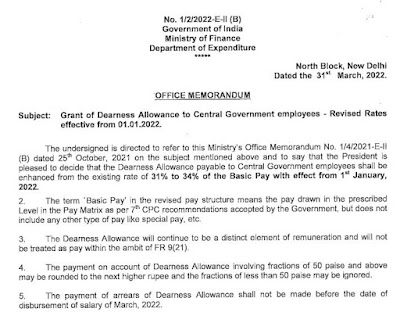
DA Jan 2022 - Grant of Dearness Allowance to Central Government employees - Revised Rates effective from 01.01.2022

 3% DA Hike - Revised Rates effective from 01.01.2022: DoE OM dated 31.03.2022 No. 1/2/2022-E-II (B) Government of India Ministry of Finance...