Showing posts with label IT Exemption. Show all posts

Friday, 1 February 2019

Budget 2019 : Income Tax exemption limit raised to Rs. 5 lakh


Budget 2019 : Income Tax exemption limit raised to Rs. 5 lakh
Budget 2019 Income Tax exemption
Finance Minister Piyush goyal has proposed that individuals with income upto Rs 5 lakh will not have to pay any income tax for FY2019-20.
In the previous budgets also, the Narendra Modi led-government provided tax relief to taxpayers. In Budget 2014, the minimum tax-exemption limit was raised from Rs 2 lakh to Rs 2.5 lakh. Along with that deduction, limit under section 80C was hiked by Rs 50,000 to Rs 1.5 lakh and deduction on interest paid on a housing loan to Rs 2 lakh.
Currently, income up to Rs 2.5 lakh for resident individuals (age below 60 years) is exempt from tax. Similarly, for senior citizens aged 60 years and above but below 80 years, income up to Rs 3 lakh is exempt from tax. Income up to Rs 5 lakh is exempt from tax for super senior citizens (age 80 years and above).

In Budget 2017, Jaitley slashed the tax rate for income between Rs 250,001 and Rs 5 lakh to 5 per cent from 10 per cent earlier. This rate cut gave a tax relief of Rs 12,500 to every taxpayer.
Income tax rates for individuals below 60 years is as follows: No tax on income up to Rs 2.5 lakh, 5 per cent tax on income between Rs 250,001 to Rs 5 lakh; 10 per cent tax on income between Rs 500,001 and Rs 10 lakh; and 30 per cent tax on income above Rs 10 lakh.

For senior citizens (aged 60 years or above but less than 80 years), income up to Rs 3 lakh is exempt from tax. Income from Rs 300,001 to Rs 5 lakh is taxed at 5 per cent, from Rs 500,001 to Rs 10 lakh at 20 per cent and above Rs 10 lakh at 30 per cent.

For super senior citizens, aged 80 years and above, income up to Rs 5 lakh is exempt from tax. Income from Rs 500,001 to Rs 10 lakh is taxed at 20 per cent and above Rs 10 lakh is taxed at 30 per cent.

Thursday, 29 March 2018

Income Tax benefits In Sukanya Samriddhi Account (SSA)


Income Tax benefits In Sukanya Samriddhi Account (SSA)

(i) Sukanya Samriddhi Account has been specified under clause (viii) of Sub Section (2) of Section 80(C) of Income Tax Act 1961 and deposits under these accounts enjoy benefit of this Income Tax Section up to the overall maximum limit of Rs. One lakh Fifty Thousand (1,50,000).

(ii) By Finance Act 2015, a new clause (11A) has been inserted under Section 10 of Income Tax Act 1961 under which any amount withdrawn from Sukanya Samriddhi Account will not be included in the total income of a previous year of a person for the purpose of calculation of Income Tax.

(iii) By Finance Act 2015, a new clause (ba) has been inserted under clause (viii) of sub-section 4 of Section SOC of Income Tax Act 1961 under which a Legal Guardian can claim Income Tax benefit for the amount deposited by him or his/her girl child under the Sukanya Samriddhi Account.

Sukanya-Samriddhi-Account


GOVERNMENT OF INDIA
MINISTRY OF FINANCE
DEPARTMENT OF REVENUE
(CENTRAL BOARD OF DIRECT TAXES)
NOTIFICATION NO. 09/2015
INCOME-TAX
Dated - 21st January, 2015
In exercise of the powers conferred by clause (viii) of sub-section (2) of section (2) of section 80C of the Income-tax Act, 1961 (43 of 1961), the Central Government hereby specifies the 'Sukanya Samriddhi Account' for the purposes of the said clause.

This notification shall come into force with effect from the date of its publication in the Official Gazette.

[F.NO.178/3/2015-ITA-1]

Monday, 13 February 2017

INCOME TAX FAQ : What are allowances? Are all allowances taxable?


INCOME TAX FAQ : What are allowances? Are all allowances taxable?

​What is considered as salary income?
​​​ section 17​​ of the Income-tax Act defines the term 'salary'. However, not going into the technical definition, generally whatever is received by an employee from an employer in cash, kind or as a facility [perquisite] is considered as salary.

What are allowances? Are all allowances taxable?
Allowances are fixed periodic amounts, apart from salary, which are paid by an employer for the purpose of meeting some particular requirements of the employee. E.g., Tiffin allowance, transport allowance, uniform allowance, etc.
There are generally three types of allowances for the purpose of Income-tax Act ;taxable allowances, fully exempted allowances and partially exempted allowances.​

My employer reimburses to me all my expenses on grocery and children's education. Would these be considered as my income?
​Yes, these are in the nature of perquisites and should be valued as per the rules prescribed in this behalf.​​
During the year I had worked with three different employers and none of them deducted any tax from salary paid to me. If all these amounts are clubbed together, my income will exceed the basic exemption limit. Do I have to pay taxes on my own?

​Yes, you will have to pay self-assessment tax and file the return of income.​

Even if no taxes have been deducted from salary, is there any need for my employer to issue Form-16 to me?
​​Form-16 is a certificate of TDS. In your case it will not apply. However, your employer can issue a salary statement.​

Is pension income taxed as salary income?
​Yes. However, pension received from the United Nations Organisation is exempt.​​

Is Family pension taxed as salary income?
​No, it is taxable as income from other sources.​

​If I receive my pension through a bank who will issue Form-16 or pension statement to me- the bank or my former employer?
​​The bank.​

Are retirement benefits like PF and Gratuity taxable?
​​In the hands of a Government employee Gratuity and PF receipts on retirement are exempt from tax. In the hands of non-Government employee, gratuity is exempt subject to the limits prescribed in this regard and PF receipts are exempt from tax, if the same are received from a recognised PF after rendering continuous service of not less than 5 years.​

Are arrears of salary taxable?
​​​​Yes. However, the benefit of spread over of income to the years to which it relates to can be availed for lower incidence of tax. This is called as relief u/s 89​ of the Income-tax Act.​​

​Can my employer consider relief u/s 89 for the purposes of calculating the TDS from salary?
​​Yes, if you are a Government employee or an employee of a PSU or company or co-operative society or local authority or university or institution or association or body. In such a case you need to furnish Form No. 10E to your employer. ​​

​My income from let out house property is negative. Can I ask my employer to consider this loss against my salary income while computing the TDS on my salary?
​Yes, however, losses other than losses under the head 'Income from house property' cannot be set-off while determining the TDS from salary.​​

​Is leave encashment taxable as salary?
​​It is taxable if received while in service. Leave encashment received at the time of retirement is exempt in the hands of the Government employee. In the hands of non-Government employee leave encashment will be exempt subject to the limit prescribed in this behalf under the Income-tax Law.​

​Are receipts from life insurance policies on maturity along with bonus taxable?​

As per section 10(10D), any amount received under a life insurance policy, including bonus is exempt from tax. However, following receipts would be subject to tax:

Any sum received under sub-section (3) of section 80DD; or
Any sum received under Keyman insurance policy; or

Any sum received in respect of policies issued on or after April 1st, 2003, in respect of which the amount of premium paid on such policy in any financial year exceeds 20% (10% in respect of policy taken on or after 1st April, 2012) of the actual capital sum assured; or

Any sum received for insurance on life of specified person (issued on or after April 1st 2013) in respect of which the amount of premium exceeds 15% of the actual capital sum assured.
*Any person who is -
i) A person with disability or severe disability specified under section 80U​; or
ii) suffering from disease or ailment as specified in the rule made under section 80DDB.
Following points should be noted in this regard:
Exemption is available only in respect of amount received from life insurance policy.
Exemption under section 10(10D)​ is unconditionally available in respect of sum received for a policy which is issued on or before March 31, 2003.

Amount received on the death of the person will continue to be exempt without any condition.​

Authority: http://www.incometaxindia.gov.in/

Thursday, 26 January 2017

Income tax exemption limit to be hiked to Rs 3 lakh


Income tax exemption limit to be hiked to Rs 3 lakh

New Delhi: The Finance Ministry is considering raising the current tax exemption limit from Rs 2.5 lakh to Rs 3 lakh.

"A core commitee for Budget 2017 has proposed to revise tax exemption limit aimed to benefit small taxpayers," a top official involved with the process of Budget told The Sen Times on the condition on anonymity.

Income of Rs 3 lakh to 5 lakh may be taxed at 10% (the current slab is Rs. 2.5-5 lakh taxed at 10%); Rs 5-10 lakh will be taxed at 20% (currently also Rs 5-10 lakh is taxed at 20%); Rs 10 lakh and above to be taxed at 30% (Currently also Rs 10 lakh and above is taxed at 30%).

"There are chances that a hike in tax exemption limit may be announced, but I am not sure if it will go up to Rs 4 lakh. Realistically the Finance Minister may announce a hike from the current Rs 2.5 lakh to Rs 3 lakh or maybe even Rs 3.5 lakh. Rs 4 lakh would be a lot, because then a lot of people who currently pay tax would go out of the ambit," said a tax expert.

The government may also propose a higher super-rich tax for those who earn more than Rs 10 crore a year.

So, Finance Minister Arun Jaitley may have some good news for the salaried people in the budget for 2017-18.

Monday, 14 November 2016

Income Tax 2016-17 (A.Year 2017-18) Rate, Exemptions, Deductions and Rebate for Salaried Employees under Section 10, Section 24, Section 89(1), Chapter VIA, and Section 87A

Income Tax 2016-17 (A.Year 2017-18) Rate, Exemptions, Deductions and Rebate for Salaried Employees under Section 10, Section 24, Section 89(1), Chapter VIA, and Section 87A

Income Tax Rate 2016-17

TAXABLE INCOME RANGERATE OF INCOME TAX
Up to RS.2,50,000NIL
Rs.2,50,001 to Rs.5,00,00010% of the amount by which the income exceeds Rs.2,50,000
Rs.5,00,001 to Rs.10,00,000Rs.25,000 plus 20% of the amount by which the income exceeds Rs.5,00,000
Above Rs.10,00,001Rs.1,25,000 plus 30% of the amount by which the income exceeds Rs.10,00,000
 Education Cess
3% on Total Income Tax Payble

Section 10 (13A) - Exemption in respect of HRA:

Under Sec. 10(13A), an employee who is in receipt of House Rent Allowance (HRA) can claim exemption, if he does not live in his own house, and pays rent in excess of 10% of his salary for his residential accommodation.
Exemption u/s 10(13A) is the least of the following
1. Actual amount of HRA received
2. 50% (for Chennai, Mumbai, Kolkata and Delhi) / 40% (for other places) of the Salary for the relevant period
3. Rent paid Less 10% of Salary for the relevant period.

Section 87A - Rebate of Income Tax for Taxable income up to Rs. 5 Lakh 

Finance Act 2016 provides for rebate of Income up to Rs. 5000/- in respect of Persons who have Taxable not exceeding Rs. 5 lakh.

Section 10(14) - Transport Allowance and Children Education Allowance (CEA)

Under Section 10(14), the Budget FY 2016-17 lets you claim Rs. 19,200 tax exemption as transport allowance and Rs. 2,400 tax exemption as Children Education Allowance (CEA) in a financial year.

Section 24(b) - Home Loan

If you have taken a Home Loan, then you can claim a tax deduction on the interest component of the loan under Section 24(b). For self-occupied properties, you can benefit from deductions of up to Rs. 2,00,000.

Section 89(1) - Income Tax relief in respect of Arrears of Salary pertaining to previous years

If arrears of salary has been received in Financial year 2016-17 related to previous years then Relief of Income Tax can be claimed u/s 89(1) by accounting income from arrears in respective years on notional basis.

Deductions allowed under Chapter VI A of Income Tax Act

Deduction Limit - Sec 80CCE. As per Section 80CCE, deduction can be claimed upto Rs. 1,50,000 for the payments / contributions made under Sections 80C, 80CCC and 80CCD

Section 80C - Subject to overall limit of Rs. 1,50,000 under Section 80CCE

For investments in specified schemes, saving instruments etc.
  1. Life insurance premium for policy:a) in case of individual, on life of assessee, assessee’s spouse and any child of assessee
    b) in case of HUF, on life of any member of the HUF
  2. Sum paid under a contract for a deferred annuity:a) in case of individual, on life of the individual, individual’s spouse and any child of the individual (however, contract should not contain an option to receive cash payment in lieu of annuity)
    b) in case of HUF, on life of any member of the HU
  3. Sum deducted from salary payable to Government servant for securing deferred annuity or making provision for his wife/children [qualifying amount limited to 20% of salary]
  4. Contributions by an individual made under Employees’ Provident Fund Scheme
  5. Contribution to Public Provident Fund Account in the name of:a) in case of individual, such individual or his spouse or any child of such individual
    b) in case of HUF, in the name of any member there of
  6. Contribution by an employee to a recognized provident fund
  7. Contribution by an employee to an approved superannuation fund
  8. Subscription to any notified security or notified deposit scheme of the Central Government.For this purpose, Sukanya Samriddhi Account Scheme has been notified vide Notification No. 9/2015, dated 21/1/2015. Any sum deposited during the year in Sukanya Samriddhi Account by an individual would be eligible for deduction. Amount can be deposited by an individual in the name of her girl child or any girl child for whom such an individual is the legal guardian.
  9. Subscription to notified savings certificates [National Savings Certificates (VIII Issue)]
  10. Contribution for participation in unit-linked Insurance Plan of UTI:a) in case of an individual, in the name of the individual, his spouse or any child of such individual
    b) in case of a HUF, in the name of any member thereof
  11. Contribution to notified unit-linked insurance plan of LIC Mutual Fund:a) in the case of an individual, in the name of the individual, his spouse or any child of such individual
    b) in the case of a HUF, in the name of any member thereof
  12. Subscription to notified deposit scheme or notified pension fund set up by National Housing Bank [Home Loan Account Scheme/National Housing Banks (Tax Saving) Term Deposit Scheme, 2008]
  13. Tuition fees (excluding development fees, donations, etc.) paid by an individual to any university, college, school or other educational institution situated in India, for full time education of any 2 of his/her children
  14. Certain payments for purchase/construction of residential house property
  15. Subscription to notified schemes of (a) public sector companies engaged in providing long-term finance for purchase/construction of houses in India for residential purposes/(b) authority constituted under any law for satisfying need for housing accommodation or for planning, development or improvement of cities, towns and villages, or for both
  16. Sum paid towards notified annuity plan of LIC or other insurer
  17. Subscription to any units of any notified [u/s 10(23D)] Mutual Fund or the UTI (Equity Linked Saving Scheme, 2005)
  18. Contribution by an individual to any pension fund set up by any mutual fund which is referred to in section 10(23D) or by the UTI (UTI Retirement Benefit Pension Fund)
  19. Subscription to equity shares or debentures forming part of any approved eligible issue of capital made by a public company or public financial institutions
  20. Subscription to any units of any approved mutual fund referred to in section 10(23D), provided amount of subscription to such units is subscribed only in ‘eligible issue of capital’ referred to above. 21. Term deposits for a fixed period of not less than 5 years with a scheduled bank, and which is in accordance with a scheme framed and notified.
  21. Subscription to notified bonds issued by the NABARD.
  22. Deposit in an account under the Senior Citizen Savings Scheme Rules, 2004 (subject to certain conditions)
  23. 5-year term deposit in an account under the Post Office Time Deposit Rules, 1981 (subject to certain conditions)

Section 80CCC - Subject to overall limit of Rs. 1,50,000 under Section 80CCE

Contribution to certain specified Pension Funds such as LIC or other authorised Insurance Companies

Section 80CCD(1) - Subject to overall limit of Rs. 1,50,000 under Section 80CCE

Deduction in respect of contributions to National Pension Scheme / System (NPS) notified by Central Government
Limit : 10% of salary in case of employees, 10% of gross total income in case of others

Section 80CCD(1B)

Deduction in respect of the deposit under a pension scheme notified by Central Government (NPS) up to Rs. 50,000/-

Section 80CCD(2)

Deduction in respect of employer contributions to NPS - National Pension Scheme / System - This deduction is available over and above the Rs. 1.5 lakh limit

Section 80 CCG

Amount invested in listed shares covered by Rajiv Gandhi Equity Equity Saving Scheme. Deduction of 50% of total investment subject to maximum of Rs. 25,000 is allowed for 3 consecutive assessment years, beginning with the assessment year relevant to the previous year in which the listed shares or list units of equity oriented funds are first acquired

Section 80D

Amount invested in Health Insurance
In case of Individual, amount paid: a) For self, spouse and dependent children: Up to Rs. 25,000 (Rs. 30,000 if specified person is a senior citizen or very senior citizen) b) For parents: additional deduction of Rs. 25,000 shall be allowed (Rs. 30,000 if parent is a senior citizen or very super senior citizen) In case of HUF, up to Rs. 25,000 (Rs. 30,000 if specified person is a senior citizen or very senior citizen).
The aggregate amount of deduction cannot exceed Rs. 60,000/- in case of an individual.

Section 80DD

Expenditure incurred for the medical treatment of a dependent (spouse, children, parents, brothers and sisters of the individual) up to Rs. 75,000 (Rs. 1,25,000 in case of severe disability)

Section 80DDB

Expenditure incurred for medical treatment of specified diseases for self, or wholly dependent spouse, children, parents, brothers and sisters up to Rs. 40,000 (Rs. 60,000 in case of senior citizen and Rs. 80,000 in case of very senior citizen)

Section 80E

Interest paid on Educational Loan with no limit

Section 80EE

Interest on loan for acquiring residential house property, sanctioned during the financial year 2016-17. The Housing Loan availed should be up to Rs. 35 lakh and should have been availed in the year 2016-17

Section 80G

Deduction in respect of donations to certain funds, charitable institutions, etc.

Section 80GG

Rent paid for residential accommodation from the income of Tax Payer / assessee who is not in receipt of HRA
Least of the following shall be exempt from tax: a) Rent paid in excess of 10% of total income*;
b) 25% of the Total Income; or
c) Rs. 5,000 per month.

Section 80 TTA

Interest on Savings Bank accounts subject to maximum of Rs. 10,000

Section 80U

Exemption of income tax for an income up Rs. 75,000 for persons with disability (Rs. 1,25,000 in case of persons with severe disability)
Source: Incometaxindia.gov.in

Monday, 30 May 2016

No TDS on Disability Pension to Armed Forces Personnel

No TDS on Disability Pension to Armed Forces Personnel
By Prashant Thakur -February 3, 2016

The tax exemption of disability pension received by Armed Force Personnel are among those exemptions under Income Tax Act for which you may not get a direct reference in the Income Tax Act.

However , such tax exemption are allowed by the executive instruction issued by either Finance Ministry notification or under the delegated powers to CBDT . Armed Forces personnel get the disability pension which is basically aggregate of two components-disability pension and service pension. Previously , this website had posted earlier 3 Types of Pension to Armed Forces Completely Tax Free!

Disability Pension to Armed Forces : What is it ? Update :

The below portion is modified as the government, has issued new circular for minimum disability pension .

The circular is applicable to all Pre-2006 Armed Forces Disability/War Injury Pensioners who were/ are in receipt of Disability Pension/ Liberalized Disability Pension/ War Injury Pension as on 24th September 2012.

Download the Circular 542 dated 27/05/2015

As per the website of Principal Controller of Defence Accounts (Pension), where an Armed Forces Personnel is invalided out of service, which is accepted as attributable to or aggravated by military service, he shall be entitled to disability pension consisting of Service Element & Disability Element as follows:-

Service Element The amount of service element shall be determined as 50% of less emoluments drawn as given in para 6 of MOD letter dt- 12.11.2008 which is subject to minimum Rs 3500/- p.m.

Disability Element The rates of disability elements for 100% disability for various ranks shall be 30% of emolument last drawn subject to Rs. 3510/- per month. Disability lower than 100% shall be computed by reducing proportionately.

Disability Element on Invalidment Where an Armed Force personnel is invalided out of service under circumstances mentioned in para 4.1 of Govt. letter dt. 31.01.01, the extent of disability shall be determined as follows for the purpose of computing the DE :- Percentage as finally assessed by Competent AuthorityPercentage to be reckoned for computing DE Between 1 to 4950 Between 50 & 7575 Between 76 &100100 Disability Element on Retirement/Discharge Where an Armed Forces personnel is retained in service despite disability and subsequently retired/ discharged on completion of tenure or on attaining the age of retirement, he shall be entitled to Disability Entitlement at the rate prescribed for 100% disablement. For disablement less than 100% but not below 20%, the rates shall be reduced proportionately.
No disability element shall be payable for disability less than 20% .

Is Disability Pension to Armed Forces Tax Free ?

Yes, although there is nothing in section 10 of the Income Tax Act , which is a general exemption section under Income tax Act , the disability pension has been made tax free through Finance Ministry notification No 878-F (Income Tax) dated 21-3-1922 .

The following instruction from CBDT explains that the entire disability pension is exempt

INSTRUCTION NO 136F.NO. 34/3/68-IT(AI)GOVT OF INDIA CENTRAL BOARD OF DIRECT TAXES NEW DELHI, DATED THE 14TH JAN 1970
FROM :SHRI S N NAUTIALSECRETARY, CBDT

TO:ALL COMMISSIONERS OF INCOME TAX

SUBJECT : EXEMPTION – SERVICE AND DISABILITY ELEMENT OF DISABILITY PENSION GRANTED TO A DISABLED OFFICER OF THE INDIAN ARMY –

WHETHER EXEMPTED FROM INCOME TAX. REFERENCE IS INVITED TO THE BOARD’S LETTER F NO 42/9/59-IT(AI), DATED THE 5TH SEPT 1960 ON THE ABOVE SUBJECT WHEREIN IT WAS MENTIONED THAT IN THE CASES FALLING UNDER ITEM (29) OF FINANCE DEPTT NOTIFICATION NO 878-F (INCOME TAX) DATED 21-3-1922, THE‘DISABILITY ELEMENT’ OF THE DISABILITY PENSION RECEIVED BY AN OFFICER OF THE ARMY WILL ONLY BE EXEMPTED FROM TAX AND THAT THE ‘SERVICE ELEMENT’ WILL BE SUBJECTED TO TAX.

2. ON RECONSIDERATION OF THE MATTER, IN CONSULTATION WITH THE MINISTRY OF LAW, THE BOARD ARE ADVISED THAT ITEM 29 OF THE NOTIFICATION DOES NOT DIFFERENTIATE BETWEEN TYPES OF PENSIONS. ACCORDINGLY IN THE CASES FALLING UNDER ITEM 29 OF THE ABOVE NOTIFICATION, ENTIRE DISABILITY PENSION WILL BE EXEMPTED FROM INCOME-TAX.

3.THE ABOVE INSTRUCTIONS MAY BE BROUGHT TO THE NOTICE OF ALL ASSESSING OFFICERS IN YOUR CHARGE. YOURS FAITHFULLY,

SD/- (S N NAUTIAL) SECRETARY ,CBDT

Confusion on Exemption Disability Pension & Service Element As the disability pension is aggregate of two elements- disability element and service element- a confusion was created in filed formation of tax authorities , whether the disability element only is tax free and not the service element. CBDT , therefore , in order to wipe out any confusion , issued another instruction

F. No. 200/51/00-ITA-1 dt. 02.7.2001 to stress that both element of disability pension is tax exempt.
Read the instruction below :

[F. NO. 200/51/00-ITA-1 DT. 02.7.2001 FROM MINISTRY OF FINANCE DEPTT. OF REVENUE CENTRAL BOARD OF DIRECT TAXES, NEW DELHI.]

SUBJECT: EXEMPTION FROM INCOME TAX TO DISABILITY PENSION, I.E. ” DISABILITY ELEMENT” AND “SERVICE ELEMENT” OF A DISABLED OFFICER OF THE INDIAN ARMED FORCES- INSTRUCTIONS REGARDING.

REFERENCE HAVE BEEN RECEIVED IN THE BOARD REGARDING EXEMPTION FROM INCOME TAX TO DISABILITY PENSION, I.E. “DISABILITY ELEMENT” AND “SERVICE ELEMENT” OF A DISABLED OFFICER OF THE INDIAN ARMED FORCES.

2. IT APPEARS THAT FIELD FORMATIONS IN CERTAIN CASES ARE NOT UNIFORMLY ALLOWING DISABILITY, PENSION IN SPITE OF BOARD’S INSTRUCTION NO.136 DATED 14TH JANUARY, 970 (F.NO.34/3/68-IT(A.1)).

3. THE MATTER HAS BEEN RE-EXAMINED IN THE BOARD AND IT HAS BEEN DECIDED TO REITERATE THAT THE ENTIRE DISABILITY PENSION, I.E. ” DISABILITY ELEMENT” AND “SERVICE ELEMENT” OF A DISABLED OFFICER OF THE INDIAN ARMED FORCES CONTINUES TO BE EXEMPT FROM INCOME TAX.

4. THIS MAY BE BOUGHT TO THE NOTICE OF ALL THE OFFICERS WORKING UNDER YOU.
SD/- B.L. SAHU OFFICER ON SPECIAL DUTY (ITA .1)

No TDS on Disability Pension to Army Personnel
As it happens in India, everyone becomes the super authorities against the common man. The government received complaint that certain banks are deducting the tax on the disability pension .

So , government issued a press release that no TDS is required on the said disability pension paid to Armed Forces personnel.
Read below the excerpt. PRESS RELEASE, DATED 20-12-2007

IT HAS BEEN REPORTED IN THE PRESS THAT SOME BANKS WERE DEDUCTING TAX FROM PENSION OF DISABLED EX-SERVICEMEN IN VIOLATION OF GOVERNMENT INSTRUCTIONS.

RBI WAS REQUESTED TO HAVE THE MATTER INVESTIGATED AND REMEDIAL ACTION TAKEN. AFTER EXAMINATION, RBI DISCOVERED THAT IN ONE SPECIFIC INSTANCE, DUE TO OVERSIGHT, THE PENSIONER’S DISABILITY PENSION WAS WRONGLY TAKEN INTO ACCOUNT WHILE CALCULATING INCOME-TAX.

RBI HAS ISSUED INSTRUCTIONS TO ALL AGENCY BANKS TO STRICTLY ADHERE TO THE PROVISIONS OF PARA 88.3 OF DEFENCE PENSION PAYMENT INSTRUCTIONS, 2005, REGARDING EXEMPTION OF INCOME-TAX OF THE DISABILITY PENSION OF THE PENSIONERS OF ARMED FORCES.

BANKS HAVE BEEN ADVISED TO ISSUE SUITABLE INSTRUCTIONS TO ALL THEIR PENSION DISBURSING BRANCHES THAT INCOME-TAX SHOULD NOT BE DEDUCTED FROM THE DISABILITY PENSION PAID TO THE PENSIONERS OF THE ARMED FORCES.

Conclusion
The disability pension given to Armed Forces Personnel are having two components-disability element & service element. Both are tax free vide Ministry of Finance notification read with clarification from CBDT and also there can not eb any TDS as the amount is fully tax free.

Thursday, 11 February 2016

Ex-servicemen gets property tax exemption after 9 year wait

Ex-servicemen gets property tax exemption after 9 year wait

An ex-servicemen from Hyderabad used the RTI act in order to get his due. As per the state government all ex-servicemen/widows are exempted from paying property tax for any one house owned by them.
An Ex-Serviceman had to struggle for 9 long years with the civic authorities to get exemption from property tax. After repeated failures to get his due, he used the RTI act and woke up the civic authorities from their slumber.
This is the story of an ex-serviceman who had to struggle with the civic authorities for 9 long years to get his due. Mr. PP Sebastian worked in the Indian Air Force and is now settled in Hyderabad. He had to run after the local municipal authorities for 9 long years to get his property tax exemption order.

The Background Story

Most state governments extend a variety of welfare measures for serving personnel and ex-servicemen. The erstwhile Andhra Pradesh Government also extended similar facilities to ex-servicemen. As per the orders of the erstwhile Andhra Pradesh State government, all serving army personnel and ex-servicemen/widows are exempted from paying property tax for any one house owned by them.
18. Exemption from property tax one house/property of Ex-Servicemen/widows/serving personnel when it is occupied by the Widows/Ex-Servicemen and by the family in case of serving personnel for their self dwelling purpose.
Application for exemption filed in 2006

Mr. Sebastian applied for property tax exemption in October 2006 in accordance to the Government Order. He submitted his application to Alwal Municipality, duly submitting all the required certificates. Instead of granting him exemption, the civic authorities kept sending him property tax bills. Moreover, the ex-serviceman received threatening calls to clear his dues
This is to bring to your kind notice that, I am ex-serviceman and had applied for tax exemption on 23rd October, 2006 as per the regulation after paying tax twice. I am yet to receive my tax exemption papers from your end.
Instead I have been receiving property tax bill every year. I had approached 4 to 5 times pertaining to my tax exemption as soon as the receipt of the property tax bill. But I have received no reply from Alwal Municipality so far.
RTI to the Rescue

Meanwhile in 2007, the Alwal Municipality was merged into the Greater Hyderabad Municipal Corporation (GHMC). After repeated trials to know the status of his earlier application, Mr. Sebastian was exhausted and was resigned to his fate.

In early 2013, Mr. Sebastian came to know of Right to Information (RTI) through an awareness workshop. As soon as he realized its power, he filed an application under RTI with the GHMC authorities to know the status of his earlier request for property tax exemption.

After repeated follow-ups and intervention from the State Information Commission, the GHMC finally admitted that they had lost his application that was filed in 2006. They also requested Mr. Sebastian to submit all the documents once again to initiate further action.
With reference to subject cited, it is to inform that the application related to Exemption of Property Tax pertains to——– situated at Temple Alwal was given in erstwhile Alwal Municipality on 23.10.2006. Efforts were made to trace out the application, but the same is not traced out. Therfore, you are requested to kindly submit the required documents for taking further necessary action for exemption of property tax of above said property.
Finally, after submitting the application once again, the GHMC issued the property tax exemption order in December 2015.
ORDER:
In exercise of the powers conferred as per the M.C.H Act 1955 and in accordance with the Government Orders, Vide Ref 2nd cited the following Property (Assessment) is hereby temporarily exempted from the payment of Property tax with effect from 01.04.2007 till further orders, since the under mentioned premises are under the possession of Ex-Serviceman/ Widow of Ex-Serviceman/Serving Army Personnel.
H.No. & Locality Name of the Assessee Exemption
effect date
Exempted
Asst.No. Amount per annum

Sri.P.P.Sebastian 01.04.2007 1124/-
‘If not for RTI, I would not have got this exemption’
‘If not for RTI, I would not have got this exemption. Thanks for my living God who guided me to that workshop’, Mr. Sebastian said. He is now a contented individual who feels that every citizen should know and use RTI.

Source: newslaundry

Tuesday, 5 January 2016

Raise income tax exemption limit to Rs 5 lakh: Unions

Raise income tax exemption limit to Rs 5 lakh: Unions

New Delhi: Trade unions today asked the government to increase the income tax exemption limit to Rs 5 lakh and the minimum wage to Rs 18,000 besides raising the minimum monthly pension to Rs 3,000 for all.

They also sought a special package for victims of the recent Tamil Nadu floods.

These demands were raised under a 15-point charter submitted by 11 central trade unions to Finance Minister Arun Jaitley during pre-Budget consultations held here. The Union Budget for the next financial year, 2016-17, is slated to be presented in Parliament in February end. It will take effect from April 1.

“We have demanded a minimum wage of Rs 18,000 per month which is higher than our earlier demand of Rs 15,000,” Bharatiya Mazdoor Sangh Zonal Organisation Secretary Pawan Kumar said after the meeting.

The Seventh Pay Commission has recommended Rs 18,000 as minimum monthly wage for central government employees and it should be the benchmark, he said.

All Indian Trade Union Congress Secretary D L Sachdev said: “We have also demanded Rs 3,000 minimum monthly pension for all and asked for a special package for flood ravaged Tamil Nadu to provide relief to workers as well as industry in the next Budget.”

Sachdev said that in view of price rise “we have also demanded from the government to increase the income tax exemption limit to Rs 5 lakh per annum”.

The union have also asked that fringe benefits like housing, medical and educational facilities and running allowances in railways should be exempted from Income Tax.

Unions also demanded that PSUs should be strengthened and expanded and the disinvestment of government shares in profit making PSUs should be stopped.

Besides, they said that the budgetary support should be provided for revival of potentially viable sick PSUs.

On the price rise, the charter said: “Take effective measures to arrest the spiralling price rise especially of food and essential items of daily use. Ban speculative forward trading in essential commodities, check on hoarding and universalise and strengthen Public Distribution System.”

Expressing concerns over steel and aluminium sectors, the unions said: “Relentless and increasing flow of import of industrial commodities including capital goods must be contained and regulated to prevent dumping and also to protect and promote domestic industries and prevent loss of employment.”

It also said that “FDI should not be allowed in crucial sectors like defence production, Railways, financial sector, retail trade and other strategic sectors. In other areas, terms and conditions for FDI should be made public.”

PTI

Monday, 16 February 2015

NMC urges FM to raise IT exemption limit to Rs 5 lakh, exclude DA from IT calculation, Merge DA in Basic Pay & Pension etc

NMC urges FM to raise IT exemption limit to Rs 5 lakh, exclude DA from IT calculation, Merge DA in Basic Pay & Pension etc

The National Mazdoor Conference today asked Union Finance Minister Arun Jaitley to raise the income tax exemption limit to Rs 5 lakh.

“We urged Union Finance Minister to raise the Income Tax exemption limit to Rs five lakh,” National Mazdoor Conference (NMC) President Subash Shastri said while addressing a series of rallies at Kanjali and Bomyal in Nagrota Block here today.

Shastri also appealed he Finance Minister to announce non inclusion of amount of DA to calculating income tax as the DA instalments are released by the government from time to time to utilise the impact of price rise and inflation.

Shastri emphasised the need for immediate merger of 50 per cent DA into basic pay and pension as per the recommendations of the Fourth Pay Commission.

He added that all these burning issues impacting both the Central and State Governments Employees and pensioners should be addressed by the Union Finance Minister while presenting the budget for 2015-16 in the coming Budget Session of Parliament beginning on 23rd of this month.

He also demanded immediate release two DA instalment of 17 per cent in favour of State Government Employees and pensioners, pointing out that while Central Government is about to release another instalment 6 per cent DA in favour of its employees and pensioners from Jammu 2015 but it is unfortunate that the salaried class in the state has not got the benefit previous two DA instalments.

He also demanded early regularisation of the 62,000 daily rated workers beside release of their wages without any further delay.

Read at: http://economictimes.indiatimes.com/

Flash News

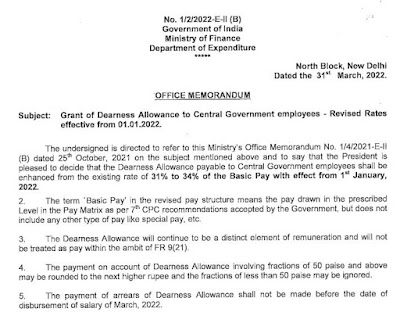
DA Jan 2022 - Grant of Dearness Allowance to Central Government employees - Revised Rates effective from 01.01.2022

 3% DA Hike - Revised Rates effective from 01.01.2022: DoE OM dated 31.03.2022 No. 1/2/2022-E-II (B) Government of India Ministry of Finance...