Showing posts with label INCOME TAX ACT. Show all posts

Saturday, 24 August 2019

CBDT issues clarification on eligibility of small Start-ups to avail tax holiday


Ministry of Finance
CBDT issues clarification on eligibility of small Start-ups to avail tax holiday
22 AUG 2019

The Central Board of Direct Taxes (CBDT) has clarified today that small start-ups with turnover upto Rs. 25 crore will continue to get the promised tax holiday as specified in Section 80-IAC of the Income Tax Act, 1961 (the ‘Act’), which provides deduction for 100 per cent of income of an eligible start-up for 3 years out of 7 years from the year of its incorporation.

CBDT further clarified that all the start-ups recognised by DPIIT which fulfilled the conditions specified in the DPIIT notification did not automatically become eligible for deduction under Section 80-IAC of the Act. A start-up has to fulfil the conditions specified in Section 80-IAC for claiming this deduction. Therefore, the turnover limit for small start-ups claiming deduction is to be determined by the provisions of Section 80-IAC of theAct and not from the DPIIT notification.
CBDT dispelled the confusion created by some media report claiming discrepancy that the I-T law was yet to reflect DPIIT’s higher turnover threshold of Rs. 100 crore. CBDT said thatthere was no contradiction in DPIIT’s notification dated 19.02.2019 and Section 80-IAC of the I.T. Act, 1961 because in para 3 of the said notification, it has clearly been mentioned that a start-up shall be eligible to apply for the certificate from the Inter-Ministerial Board of Certification for claiming deduction under Section 80-IAC of the Act, only if the start-up fulfils the conditions specified in sub-clause (i) and sub-clause (ii) of the Explanation of Section 80-IAC. Therefore, the turnover limit for eligibility for deduction under section 80-IAC of the Act, as per the DPIIT’s notification is also Rs. 25 crore.
It is further stated that Section 80-IAC contains a detailed definition of the eligible start-up which, interalia, provides that a start-up which is engaged in the eligible business shall be eligible for deduction, if (i) it is incorporated on or after 1st April 2016, (ii) its turnover does not exceed Rs. 25 crore in the year of deduction, and (iii) it holds a certificate from the Inter-Ministerial Board of Certification.

It was explained that this was the major reason as to why there was a wide difference between the number of start-ups recognised by the DPIIT and the start-ups eligible for deduction under section 80-IAC of the Act. It is pertinent to state that Section 80-IAC was inserted vide Finance Act, 2016 as an exception to the Government’s stated policy of phasing out profit-linked deduction for promoting small start-ups during their initial year of operation. Since the intention was to support the small start-ups, the turnover limit of Rs. 25 crore was considered reasonable for granting profit linking deduction.

PIB

Tuesday, 7 May 2019

What are the tax benefits of NPS?


1. What are the tax benefits of NPS?
Income Tax Act allows benefits under NPS as per the following sections:

On Employee’s contribution: Employee’s own contribution is eligible for tax deduction under sec 80 CCD (1) of Income Tax Act up to 10% of salary (Basic + DA). This is within the overall ceiling of Rs. 1.50 Lacs under Sec. 80 CCE of the Income Tax Act.

On Employer’s contribution: Up to 10% of Basic & DA (no monetary ceiling) under 80CCD (2). This rebate is over and above 80 CCE limit of Rs. 1.50 lacs.

Voluntary Contribution: Employee can voluntarily invest an additional amount of Rs. 50,000 (or more) to the NPS Tier I account and claim tax deduction on the same under section 80 CCD 1(B), subject to a maximum of Rs. 50,000.

2. Which document can a Subscriber use as investment proof in order to avail the tax benefit?
A copy of the Annual Transaction Statement (Tier I) can be used as investment proof in order to avail tax benefits.

3. Can a Subscriber get loan under NPS?
No. At present, a Subscriber cannot avail loan against NPS holdings.

4. Are NPS returns guaranteed?
There is no investment return guarantee. As per the present guidelines of Pension Fund Regulatory & Development Authority (PFRDA, the regulator for NPS), in case of government employees, contributions towards pension are invested by three Pension Fund Managers (PFMs), viz., LIC Pension Fund Limited, SBI Pension Funds Private Limited and UTI Retirement Solutions Limited as per the stipulated guidelines.

The returns under NPS are totally market based i.e. they are based on the NAV of the Pension Fund schemes. The benefits will entirely depend upon the amount contributed and the investment growth upto the point of exit from NPS.

Friday, 1 February 2019

BUDGET 2019 - Income upto Rs 5 Lakh to get full tax rebate

BUDGET 2019 - Income upto Rs 5 Lakh to get full tax rebate
 
Ministry of Finance
Income upto Rs 5 Lakh to get full tax rebate; higher standard deduction proposed
Relief of over Rs 23,000 crore to estimated 3 Crore small and middle class tax- payers
TDS threshhold on interests on small savings raised
Boost to housing and real estate sector
FM announces a slew of tax reliefs for middle class and small tax payers
01 FEB 2019
Individual taxpayers having taxable annual income up to Rs.5 lakhs will get full tax rebate and therefore will not be required to pay any income tax. While presenting the Interim Budget 2019-20 in Parliament today the Union Minister for Finance, Corporate Affairs, Railways & Coal, Shri Piyush Goyal said “Because of major tax reforms undertaken by us during last four and half years, both tax collections as well as tax base have shown significant increase, achieving a moderate taxation- high compliance regime. It is, therefore, just and fair that some benefits from the tax reforms must also be passed on to the middle class taxpayers”

As a result, the Finance Minister added that even persons having gross income up to Rs. 6.50 lakhs may not be required to pay any income tax if they make investments in provident funds, specified savings, insurance etc. In fact, with additional deductions such as interest on home loan up to Rs.2 lakh, interest on education loans, National Pension Scheme contributions, medical insurance, medical expenditure on senior citizens etc, persons having even higher income will not have to pay any tax. This will provide tax benefit of Rs.18,500 crore to an estimated 3 crore middle class taxpayers comprising self employed, small business, small traders, salary earners, pensioners and senior citizens.

STANDARD DEDUCTIONS RAISED
For salaried persons, Standard Deduction is being raised from the current Rs.40,000 to Rs.50,000. “This will provide additional tax benefit of Rs.4,700 crore to more than 3 crore salary earners and pensioners”, the Finance Minister informed.

TDS THRESHHOLD INCREASED
Tax Deduction at Source (TDS) threshold on interest earned on bank/post office deposits has been proposed to be raised from Rs.10,000 to Rs.40,000. Shri Goyal said, "This will benefit small depositors and non-working spouses". Further, the TDS threshold for deduction of tax on rent has also been proposed to be increased from Rs.1,80,000 to Rs.2,40,000 for providing relief to small taxpayers.

MORE RELIEF TO RESIDENTIAL HOUSES
It has been proposed to exempt the levy of income tax on notional rent on a second self-occupied house. Currently, income tax on notional rent is payable if one has more than one self-occupied house. Shri Goyal announced the relief considering the difficulty of the middle class having to maintain families at two locations on account of their job, children’s education, care of parents etc.
Further, the Finance Minister proposed to increase the benefit of rollover of capital gains under Section 54 of the Income Tax Act from investment in one residential house to two residential houses for a taxpayer having capital gains up to Rs. 2 crore. This benefit can be availed once in a life time. For making more homes available under affordable housing, the benefits under Section 80-IBA of the Income Tax Act is being extended for one more year, i.e., to the housing projects approved till 31st March, 2020. Also, for giving impetus to the real estate sector, the Finance Minister proposed to extend the period of exemption from levy of tax on notional rent, on unsold inventories, from one year to two years, from the end of the year in which the project is completed.

PIB

Monday, 21 January 2019

Central Board of Direct Taxes (CBDT) clarifies regarding issue of Prosecution Notices

Ministry of Finance
Central Board of Direct Taxes (CBDT) clarifies regarding issue of Prosecution Notices
21 JAN 2019
The Central Board of Direct Taxes (CBDT) has stated that certain news items that appeared in a section of media regarding enmasse issue of prosecution notices to small companies for TDS default are completely misleading and full of factual inaccuracies. CBDT clarified that Mumbai Income Tax TDS office has issued prosecution Show Cause Notices only in a limited number of big cases where more than Rs. 5 lakh of tax was collected as TDS from employees etc and yet the same was not deposited with the Income Tax Department in time.

CBDT said that some defaulter companies and vested interests are deliberately misleading the media to thwart action against themselves. Having deducted tax from employees and other taxpayers and not depositing the same in time in the Government Treasury is an offence punishable under the law. It also affects the interest of the employees from whose salary the tax has been deducted by the unscrupulous employers who have not deposited the same in time in the Government Treasury. If the TDS is not deposited in time, the employee would be ineligible for claiming credit of the tax deducted when he files his own return.

CBDT stated that in last one month, only in 50 big cases prosecution notices have been issued by Mumbai IT TDS office. Out of these, in 80% of the cases the TDS tax default is above Rs. 10 lakh and in 10 % cases, TDS default is between Rs. 5 to Rs.10 lakh. In the remaining 10% cases, TDS default is of more than Rs. 1 crore as detected in the survey. Prosecutions have also recently been launched against 4 big business houses where more than Rs 50 Crore of tax was collected by them from the tax payers and yet not deposited with the Government in time. But such legal and rightful action is being unfortunately projected in the media by the vested interests as if the Department is going overboard to harass small employers.

It would be pertinent to note that in a country of 130 Crore people where around 6 Crore returns are filed every year, only a total of 1400 prosecutions have been filed so far for various offences under the Income Tax Act during this financial year. This, by any stretch of imagination, cannot be termed as mass harassment by the income tax department. Therefore, to say that prosecution notices enmasse have been sent to taxpayers for minor defaults is completely incorrect and misleading, the CBDT added.

PIB

Monday, 24 December 2018

India Posts: Income Tax benefits from Post Office Saving Schemes

post-office-savings-scheme-india-post

 Income Tax benefits from Post Office Saving Schemes
Interest rates on these post office saving schemes move in line with the government's interest rates on small savings schemes.India Post or Department of Posts, which runs the postal network of the country, offers a number of saving schemes with income tax benefits. Using these saving schemes, investor can claim a deduction up to Rs. 1.5 lakh in a financial year from taxable income under Section 80C of the Income Tax Act. Interest rates on these post office saving schemes move in line with the government's interest rates on small savings schemes, which are revised on a quarterly basis.

Here are post office saving schemes that offer tax benefits:

Post Office Time Deposit (TD) or Fixed Deposit (FD) account
In a post office fixed deposit (FD), one can deposit a lump sum of money for a specific period and avail of features like guaranteed returns and choice of interest payout. Post office time deposit (TD) or Fixed Deposit (FD) account offers interest rates across four maturities: one year, two years, three years, and five years, noted India Post on it's official website- indiapost.gov.in. The investment under 5 years fixed deposit qualifies for the benefit of Section 80C of the Income Tax Act, 1961, mentioned India Post.

Post Office Public Provident Fund (PPF) account
Post office Public Provident Fund (PPF) account offers an investment avenue with decent returns coupled with income tax benefits. For the quarter ending December, PPF accounts fetch an interest rate of 8 per cent per annum. Interests on deposits are compounded on an annual basis, which means that it is added to the principal amount every year, noted India Post. PPF comes under the exempt, exempt, exempt (EEE) category of tax status. This means that returns, maturity amount and interest income are exempt from income tax. Deposits qualify for deduction from income under Section 80C of Income Tax Act.

Post Office Senior Citizen Savings Scheme (SCSS) account
Post Office Senior Citizen Savings Scheme (SCSS) serves as an investment avenue and helps in generating wealth for a successful retirement life. SCSS earns an interest rate of 8.7 per cent per annum, which is payable from the date of deposit on March 31/ September 30/December 31 in the first instance and thereafter, interest are payable on March 31, June 30, September 30 and December 31. Tax Deducted At Source (TDS) is deducted at source on interest if the interest amount is more than Rs. 10,000 per annum. Investment under this scheme qualifies for the benefit of Section 80C of the Income Tax Act, 1961 from April 1, 2007.

Post office National Savings Certificates (NSCs)
Post Office National savings certificates (NSCs) fetch an interest rate of 8 per cent per annum. This interest is compounded annually but payable at maturity. An NSC of Rs. 100 will offer Rs. 146.93 on maturity after five years. NSCs have a lock-in period of five years. Deposits in the National Savings Certificate qualify for deduction under Section 80C of the Income Tax Act.

Via: NDTV

Tuesday, 11 December 2018

TDS deduction under section 194A of the Income-tax Act, 1961 in case of Senior Citizens


TDS deduction under section 194A of the Income-tax Act, 1961 in case of Senior Citizens

F. No. Pr. DGIT(S)/CPC(TDS)/Notification/2018-19

Government of India
Ministry of Finance
Central Board of Direct Taxes
Directorate of Income-tax (Systems)
New Delhi
Notification No. 06 /2018
New Delhi, 06th December, 2018

Subject: - TDS deduction under section 194A of the Income-tax Act, 1961 in case of Senior Citizens - reg.

It has been brought to the notice of CBDT that in case of Senior Citizens, some TDS deductors/Banks are making TDS deductions even when the amount of income does not exceed fifty thousand rupees. The same is not in accordance with the law as the Income-tax Act provides that no tax deduction at source under section 194A shall be made in the case of Senior Citizens where the amount of such income or, the aggregate of the amounts of such income credited or paid during the financial year does not exceed fifty thousand rupees. (Please refer to the third proviso to sub-section 3 of section 194A)

2. Under sub-rule (5) of Rule 31A of the Income-tax Rules, 1962, the Director General of Income-tax (Systems) is authorized to specify the procedures, formats and standards for the purposes of furnishing and verification of the statements or claim for refund in Form 26B and shall be responsible for the day-to-day administration in relation to furnishing and verification of the statements or claim for refund in Form 26B in the manner so specified.

3. In exercise of the powers delegated by the Central Board of Direct Taxes (Board) under sub-rule (5) of Rule 31A of the Income-tax Rules, 1962, the Principal Director General of Income-tax (Systems) hereby clarifies that no tax deduction at source under section 194A shall be made in the case of Senior Citizens where the amount of such income or, the aggregate of the amounts of such income credited or paid during the financial year does not exceed fifty thousand rupees.
Sd/-
(Dewangi Marthak)
Asstt. Commissioner of Income-tax(CPC-TDS)
O/o the Pr. Director of Income-tax (Systems)
New Delhi
Source: incometaxindia.gov.in

Friday, 20 July 2018

Deduction of TDS in respect of Senior Citizens who have Invested In Sr.Citizen Savings Scheme

Deduction of TDS in respect of Senior Citizens who have Invested In Sr.Citizen Savings Scheme

F.No 79-01/2016-SB
Government of India
Ministry of Communications
Department of Posts
DakBhawan, Sansad Marg,
New Delhi-110001
Date: 29.06.2018
To
All Heads of Circles/Regions
Addl. Director General, APS, New Delhi.

Subject - Deduction of TDS in respect of Senior Citizens who have Invested In Sr.Citizen Savings Scheme regarding.

Sir / Madam,
I am directed to say that Government of India has amended Suction 194A of Income Tax Act 1961 through Finance Act 2018 and Inserted below new Proviso below Sub Section 3 of Section 194A:-
[Provided also that in case of payee being a senior citizen, the provisions of sub-clause (a), sub-clause (b), and sub-clause (c) shall have effect as if for tho words "ten thousand rupees", tho words 'fifty thousand rupees" had been substituted.

Explanation.- For the purposes of this clause, "senior citizen" means an Individual resident In India who is of the age of shay years or more at any time during the relevant previous year;)

2. With this amendment, now TDS will not be applicable on the total aggregated Interest Income up to Rs.50.000/- in a Financial year payable In case of all SCSS Accounts opened by Senior Citizens of the age of 60 years and above (who attained age of 60 years anytime during the previous financial year I.e 2017-2018). However, this limit will not be applicable to those SCSS Account holders who had opened SCSS Accounts under the relevant provisions of relaxed SCSS Rules for (I) individuals who attained the age of 65 years or more but less than 60 years and retired on superannuation or (ii) Personnel of Defence Services (excluding Civilian Defence Employees) and not attained age of 60 years during previous financial year i.e 2017.18). For such account holders, current limit of Rs.10,000/- shall continue.

3. Rules reisting to submission of Form 15G (by those who are below the age of 60 Years) and 15H(who are of 60 Years or more age) are not changed. However, due to change of tax exemption limits for certain categories, Form 15G or 15H can be accepted If total Interest payable in a Financial Year of all SCSS Accounts of an individual SCSS account holder is within the Exemption Limit mentioned below:-

Individual TypeForm TypeAgeIncome Exemption Limit
Individual15GBelow 60years2,50, 000
Senior Citizen Individual15H6040 years3,00,000
Super Senior Citizen
(lndividual)
15H80 years above5,00,000

4. It Is requested to circulate this amendment to the concerned staff for Information and necessary action Necessary changes in CBS and Sanchaya Post application* an being canted out to implement the lame In CBS Post Offices

This Meuse with the approval of competent authority
Yours Faithfully,
(P.b. Meena)
Assistant Director(SB-I)

Monday, 9 July 2018

Filling of Returns by every Government Servant - Income Tax

Filling of Returns by every Government Servant - Income Tax

Government Servant

भारत सरकार /Government of India
आयकर विभाग/Income Tax Department
आयकर आयुक्त चेन्नै-3 का कार्यालय, चेन्नै
Office of the Pr. Commissioner of Income Tax-3, Chennai
कमरा सं.410, चौथातल, आयकर भवन, 121, महात्मागांधी रोड, चेन्नै-34.
4th Floor, Main Building, 121, Mahathma Gandhi Road, Chennai- 34.

P.N.DEVADASAN, IRS
Principal Commissioner.
Chennai
19/06/2018
To
The Drawing & Disbursing Officer
O/O Dy. Director of IT(INV) Unit III
139, IOC Bhavan I Floor IOC Bhavan Nungambakkam High
Road Nungambakkam Chennai - 600034

Dear Sir/Madam,
Sub: Filing of Returns by every Government Servant - Reg.

As you might be aware, every person who is having income more than Rs.2,50,000 is bound to file his/her return of income. This includes the Government Servants also. However, the data of returns filed indicate that more than 50% of the Government Servants at Chennai are not filling their income tax returns. I hope, you will agree that as government servants, we should abide by laws and to be role models to the common citizens of our country. If we, Government servants ourselves are violating law by not filling our income tax returns, we don’t have any moral right to blame other sections of society.

From this year i.e Assessment Year 2018-19 onwards, the Parliament has amended the Income Tax Act by introducing a new section 234F for imposing late fee on every person who is not filling his/her return of income within the due date. For salaried employees, the due date is 31-07-2018. This means all the salaried employees have to file their returns of income for the Financial Year 2017-18 (Assessment Year 2018-19) on or before31-07-2018. Otherwise they all mandatorily have to pay late fee amounting between Rs.1,000 to Rs.10,000 as per the provisions of Section 234 . Also, a penalty of Rs.5,000 can be imposed under section 271F on them. In addition to this, they can be prosecuted under section 276CC of the Income Tax Act for jail terms varying between three months to seven years.

It may please be noted that these provisions are applicable to all the persons having gross income (excluding deductions) above Rs.2,50,000/-. It is understood that many persons who are claiming deductions under section 80C etc. (on GPF contribution, Life Insurance Policies, Housing Loan Repayment etc.) and adjustment of Interest on Housing Loan are under the impression that they need not file the return as their net income is below taxable limit and no TDS is deducted from their salary.
Therefore, I request you to kindly intimate and advice all the employees to whom the gross salary paid in the last year is more than Rs.2,50,000 to file their returns of income before 31-07-2018. It may also be noted that all the incomes earned by an employee such as rental income (including subletting of house/s), interest incomes, dividend from Co-operative societies and all such incomes should be declared in their returns of income. Later, if found to have omitted any such incomes, they are liable for separate penalty and prosecution for concealing those incomes.

A copy of this letter may be handed over to each of your employees who draw their salary through you. You may also discuss this issue with the Head of your Office/Department and request him/her to issue a circular to all the employees to file their return of income well in time.

In case of any clarification or suggestions, you may please contact the following Officers: Joint Commissioner Smt. Sumathy Venkataraman (8762300298), Assistant Commissioner Ms. N. Abhinaya (8939744880), Smt. Priya Ramakrishnan, ITO (9445954906), Shri Sundaramurthy, ITO (9445955554), Smt. Malarvizhy Kujur ITO (9962383336) or Shri V. Baladandayutham, ITO (9445954896).
Yours faithfully,
(P.N.DEVADASAN)
Source: Confederation

Thursday, 29 March 2018

Income Tax benefits In Sukanya Samriddhi Account (SSA)


Income Tax benefits In Sukanya Samriddhi Account (SSA)

(i) Sukanya Samriddhi Account has been specified under clause (viii) of Sub Section (2) of Section 80(C) of Income Tax Act 1961 and deposits under these accounts enjoy benefit of this Income Tax Section up to the overall maximum limit of Rs. One lakh Fifty Thousand (1,50,000).

(ii) By Finance Act 2015, a new clause (11A) has been inserted under Section 10 of Income Tax Act 1961 under which any amount withdrawn from Sukanya Samriddhi Account will not be included in the total income of a previous year of a person for the purpose of calculation of Income Tax.

(iii) By Finance Act 2015, a new clause (ba) has been inserted under clause (viii) of sub-section 4 of Section SOC of Income Tax Act 1961 under which a Legal Guardian can claim Income Tax benefit for the amount deposited by him or his/her girl child under the Sukanya Samriddhi Account.

Sukanya-Samriddhi-Account


GOVERNMENT OF INDIA
MINISTRY OF FINANCE
DEPARTMENT OF REVENUE
(CENTRAL BOARD OF DIRECT TAXES)
NOTIFICATION NO. 09/2015
INCOME-TAX
Dated - 21st January, 2015
In exercise of the powers conferred by clause (viii) of sub-section (2) of section (2) of section 80C of the Income-tax Act, 1961 (43 of 1961), the Central Government hereby specifies the 'Sukanya Samriddhi Account' for the purposes of the said clause.

This notification shall come into force with effect from the date of its publication in the Official Gazette.

[F.NO.178/3/2015-ITA-1]

Monday, 26 March 2018

The Government of India issues clarification regarding requirement for furnishing of Country-by Country Report under Section 286(4) of Income Tax Act, 1961


Ministry of Finance

The Government of India issues clarification regarding requirement for furnishing of Country-by Country Report under Section 286(4) of Income Tax Act, 1961
26 MAR 2018

In keeping with India's commitment to implement the Recommendations of the 2015 Final Report on Action 13, titled “Transfer Pricing Documentation and Country-by-Country Reporting, identified under the OECD Base Erosion and Profit Shifting (BEPS) Project, Section 286 of the Income-tax Act, 1961 (‘the Act’) was inserted vide Finance Act, 2016, which provides for furnishing of a Country-by-Country (CbC) Report in respect of an International Group.

The CbC Report is to be furnished by the ultimate parent entity of an International Group in the country or territory of its residence. As specified under sub- section (2) of Section 286, the said Report is to be furnished on or before the due date specified under Section 139(1) of the Act for furnishing of return of income for the relevant accounting year. The date for furnishing of CbC Report under sub-section (2) of Section 286 for FY 2016-17 was subsequently extended to 31stMarch, 2018 vide CBDT Circular No. 26 of 2017 dated 25th October, 2017.

Sub-section (4) of Section 286 specifies situations in which the said report shall be furnished in India by the constituent entity of an international group, resident in India, namely, those in which there is failure to obtain CbC Report on account of the parent entity being resident of a country or territory with which India does not have an agreement providing for exchange of CbC reports or where there has been a systemic failure of the country or territory and the same has been intimated to such constituent entity.

It has been brought to the notice of the Government that Constituent Entities of International Groups, resident in India, have apprehensions that the due date of furnishing of CbC Report under sub-section (4) of Section 286 is also 31st of March, 2018.

In order to allay the aforesaid apprehensions, it is hereby clarified that the due date of 31st March, 2018 applies for furnishing of CbC Report under sub-section (2) of Section 286 only and not under sub-section (4) of the said Section.

It is further stated that the Finance Bill, 2018 (as passed by the Lok Sabha) has proposed that the due date for furnishing of CbC Report under sub-section (4) of Section 286 shall be as prescribed. Accordingly, the time for furnishing of CbC Report under sub-section (4) of Section 286 of the Act is proposed to be prescribed after the enactment of Finance Bill, 2018.

PIB

Friday, 8 December 2017

CBDT extends date till 31.3.18 for linking of Aadhaar with PAN


CBDT extends date till 31.3.18 for linking of Aadhaar with PAN

Under the provisions of recently introduced section 139AA of the Income-tax Act, 1961 (the Act), with effect from 01.07.2017, all taxpayers having Aadhaar Number or Enrolment Number are required to link the same with Permanent Account Number (PAN). In view of the difficulties faced by some of the taxpayers in the process, the date for linking of Aadhaar with PAN was initially extended till 31st August, 2017 which was further extended upto 31st December, 2017.

It has come to notice that some of the taxpayers have not yet completed the linking of PAN with Aadhaar. Therefore, to facilitate the process of linking, it has been decided to further extend the time for linking of Aadhaar with PAN till 31.03.2018.

PIB

Sunday, 26 November 2017

Government to examine Rs.5 lakh tax exemption proposal for pensioners


Government to examine Rs.5 lakh tax exemption proposal for pensioners

The finance ministry has informed Congress MP Shashi Tharoor that his suggestion to increase the tax exemption limit for pension up to Rs 5 lakh would be examined during the ongoing preparations for the Union Budget 2018, according to a communication.

Responding to a letter written by Tharoor in late September, Minister of State for Finance Shiv Pratap Shukla said the suggestion that pension up to Rs 5 lakh per annum should be exempted from income tax in all cases was examined.

"The proposal would be examined during the exercise for the ensuing Union Budget 2018 and the outcome would be reflected in the Finance Bill, 2018," said the letter, which was tweeted by Tharoor.
The letter, dated November 14, said that a pensioner who is above 80 years is not required to pay tax if the total income, including pension, does not exceed Rs 5 lakh.

"The suggestion that pension up to Rs 5 lakh per annum should be exempt in all cases would require amendment to the existing provisions of the Income Tax Act, 1961," the letter said.

A pensioner, who is a senior citizen - aged 60 to 80 years - is exempt from income tax if the income, including from pension, does not exceed Rs 3 lakh.

About the letter, Tharoor tweeted, "Govt's semi- encouraging reply to my request to exempt pensioners from tax on the first 5 lakhs of income. Hope @arunjaitley will include this in his next budget".

The work for preparation of the General Budget has already commenced and Finance Minister Arun Jaitley is likely to present it to Parliament in the first week of February.

Source: Indian Express

Friday, 12 May 2017

Central Government notifies Exemption from Quoting Aadhaar / Enrolment ID to certain individuals


Central Government notifies Exemption from Quoting Aadhaar / Enrolment ID to certain individuals

The Central Government vide notification dated 11th May, 2017 has notified that the requirement of quoting of Aadhaar / Enrolment ID shall not apply to the following individuals if they do not possess the Aadhaar / Enrolment ID:
  • An individual who is residing in the state of Assam, Jammu and Kashmir and Meghalaya.
  • An individual who is a non-resident as per the Income-tax Act, 1961.
  • An individual of the age of eighty years or more at any time during the previous year.
  • An individual who is not a citizen of India.
The notification is available on the Income Tax website www.incometaxindia.gov.in.

Section 139AA of the Income-tax Act, 1961, as inserted by the Finance Act, 2017 provides for mandatory quoting of Aadhaar / Enrolment ID of Aadhaar application form for filing of return of income and for making an application for allotment of Permanent Account Number with effect from 1st July, 2017. Section 139AA

(3) of the Act empowers the Central Government to notify the person(s) or State(s) to which the requirement of quoting of Aadhaar / Enrolment ID shall not apply.

PIB

Wednesday, 12 April 2017

Centre introduces provision of taxation on NPS in Income Tax Act


Centre introduces provision of taxation on NPS in Income Tax Act

Press Information Bureau
Government Of India
Ministry Of Defence
Dated: 11-04-2017
Tax on NPS

The provision that the withdrawal from National Pension Scheme is taxed to the extent of 60 per cent has been introduced into the Income Tax Act, 1961 (Act) vide Finance Act, 2016 by inserting clause (12A) in Section 10 of the Act.

Prior to Finance Act, 2016, National Pension Scheme (NPS), referred to in section 80CCD, was under Exempt, Exempt and Tax (EET) regime i.e., the monthly/periodic contributions during the pension accumulation phase were allowed as deduction from income for tax purposes; the returns generated on these contributions during the accumulation phase were also exempt from tax but the terminal benefits on exit or superannuation, in the form of lump sum withdrawals, were taxable in the hands of the individual subscribed or his nominee in the year of receipt of such amounts unlike PPF and EPF which have been enjoying EEE regime i.e. Exempt, Exempt, Exempt.

In order to rationalize the taxability of receipts from pension plans, vide Finance Act, 2016, section 10 of the Act was amended to provide that any payment from National Pension Scheme to an employee on account of closure or his opting out of the NPS shall also be exempt from tax, to the extent it does not exceed forty percent of the total amount payable to him at the time of closure or his opting out of the scheme. Further, Finance Act, 2017 has amended section 10 of the Income-tax Act to exempt partial withdrawals by employees (to the extent of 25% of the employee’s contribution) from their NPS accounts in accordance with the guidelines prescribed under Pension Fund Regulatory and Development Authority Act, 2013.

This was stated by Shri Santosh Kumar Gangwar, Minister of State in the Ministry of Finance in written reply to a question in Rajya Sabha today.

Source: PIB

Monday, 13 February 2017

Budget 2017 - New Benefits announced for NPS Subscribers


Budget 2017 - New Benefits announced for NPS Subscribers

PENSION FUND REGULATORY AND DEVELOPMENT AUTHORITY

PRESS RELEASE

In a bid to provide further impetus to the National Pension System (NPS), the following provisions have teen introduced in the Finance bill 2017 laid down in the Parliament today.

1. Tax-exemption to partial withdrawal from National Pension System (NPS)

The existing provision of section 10(12A) of the Income Tax Act. 1961 provides payment from National Pension System (NPS) to a Subscriber on closure of his account or opting out shall be exempt up to 40% of total corpus at the time of withdrawl . The amount utilized for purchase of annuity is also tax exempt. At the time of normal exit. 40% of the total corpus is mandatorily required to be purchased for annuity. The subscriber has the option to use higher amount for purchase Of annuity.

In order to provide further relief to the subscriber of NPS, it has been proposed to Insert a new clause (12B) in the section 10 of Income Tax Act, 1961 to provide exemption on partial withdrawal not exceeding 25% of the contribution made by an employee in accordance with the terms and conditions specified under Pension Fund Regulatory and Development Authority Act. 2013 and regulations made there under.

This benefit will be effective on partial withdrawal made by the subscriber after 1st April 2017.

2. Further, Contribution up to 20% of the Gross Income of the Self-employed Individual ( Individual other than salaried class) will be deductible from the taxable income under Section 8OCCD(1) of the Income Tax Act.1961, as against 10% earlier.

This is with a view to provide parity between a salaried employee and a self- employed.

This benefit will be available on contribution made by the self employed persons on or after 1st April 2017.

This increased limit tor tax benefit will help the self-employed individuals, to save taxes on higher contribution in NPS and thereby properly plan for their old age income security.

Additional tax deduction on investment upto Rs. 50000/- under Section 80CCD(1B) will continue to remain the same for all NPS subscribers whether salaried or self-employed.

New Income Tax Rates And Deductions Applicable From April 1, 2017


New Income Tax Rates And Deductions Applicable From April 1, 2017

With some tinkering in the income tax rates for 2017-18, Finance Minister Arun Jaitley reduced the tax rate for income between Rs. 2.5 lakh and Rs. 5 lakh to 5 per cent in the Union Budget, while adding a surcharge of 10 per cent on tax for income between Rs. 50 lakh and Rs. 1 crore.

Although the basic income tax exemption limit remains the same at Rs. 2.5 lakh, there are many exemptions available in the Income Tax Act, which can substantially reduce your tax liability.

One needs to plan from the beginning of the next financial year to take maximum benefit of the income tax deductions available.

Here are the new income tax slabs for taxpayers:

General categorySenior citizensSuper senior citizens
(Up to 60 years of age)(60-80 years)(Above 80 years)
IncomeTaxIncomeTaxIncomeTax
Up to Rs. 2.5 lakhNilUp to Rs. 3 lakhNilUp to Rs. 5 lakhNil
Rs. 2,50,001-Rs. 5 lakh5%Rs. 3,00,001-Rs. 5 lakh5%Rs. 5,00,001-Rs. 10 lakh20%
Rs. 500,001-Rs. 10 lakh20%Rs. 5,00,001-Rs. 10 lakh20%Above Rs. 10 lakh30%
Above Rs. 10 lakh30%Above Rs. 10 lakh30%
# Surcharge of 10% for income between Rs. 50 lakh and Rs. 1 crore
# Surcharge of 15% for income above Rs. 1 crore
# Rebate of up to Rs. 2,500 for taxable salary up to Rs. 3.5 lakh
# Education and higher education cess of 3%
Here are the some of the deductions available for FY2017- 18: 

House Rent Allowance under Section 10 (13A) of the Income Tax Act

House Rent Allowance, commonly known as HRA, makes up a major chunk of a salaried individual’s total pay. HRA is partly exempted from tax. If you are staying in your own house or not paying any rent, your HRA will be completely taxable. However, those who stay with their parents can also claim HRA benefits by paying rent to their parents.

The amount which is allowed for exemption under HRA is calculated as minimum of:

1) Rent paid annually minus 10 per cent of basic salary plus dearness allowance
2) Actual HRA received
3) 40 per cent of basic and dearness allowance (50 per cent in case of metro cities)

Deductions under Section 80C
Section 80C of the Income Tax Act provides various provisions under which an individual can get deduction benefits up to Rs. 1.5 lakh. Employees’ Provident Fund (EPF), Public Provident Fund (PPF), Sukanya Samriddhi Account, National Savings Certificate and tax-saving fixed deposits are some of the investment options that offer benefits under Section 80C. The premium paid for life insurance plans, National Pension Scheme (NPS) and tax-saving mutual funds (ELSS) also qualify for deduction under Section 80C.
Further, one can claim tuition fees paid for up to two children, principal repayment on home loan, stamp duty and registration cost on the house bought as deduction under Section 80C.

Deductions under Section 80CCD(1B)
Introduced in Budget 2015-16, Section 80CCD (1B) provides deduction up to Rs. 50,000 for investment in NPS Tier 1 account. This deduction is over and above the deduction available in Section 80C. An individual in 30 per cent tax bracket can save up to Rs. 15,450 of tax by investing Rs. 50,000 in NPS.

Deduction of interest on housing loan (Section 24B)
Buying a house is among several other things an individual wants to do during his or her lifetime. The income tax rules also incentivise the same. Under Section 24B of the Income Tax Act, interest paid up to Rs. 2 lakh on housing loan and up to Rs. 30,000 on home improvement loan is allowable as deduction from your taxable income.

The government has however cut down tax benefits borrowers enjoyed on properties let out on rent. As per current tax laws, for properties rented out, a borrower could deduct the entire interest paid on home loan after adjusting for the rental income. On the other hand, borrowers of self-occupied properties get Rs. 2 lakh deduction on interest repayment on home loan.

However, according to the proposed change in Budget 2017, on rented properties, the borrower can only claim deduction of up to Rs. 2 lakh per year after adjusting for the rental income. And the amount above Rs. 2 lakh can be carried forward for eight assessment years.

Since the interest component of home loan repaid in initial years is higher, experts say that the borrower may not be able to fully adjust the interest paid as deduction even in subsequent years.

Deduction under Section 80EE
Under Section 80EE, an additional deduction of Rs. 50,000 is available over and above the limit of Section 24B on interest paid on home loans if the person is buying a house for the first time (the person must not own any other residential property on the date of sanction of loan). However, to avail the benefit of this section the value of the property must be below Rs. 50 lakh and the loan amount should not exceed Rs. 35 lakh. Further, the property must be bought after April 1, 2016.

Deduction under Section 80D

Premium paid for medical/health insurance for self, spouse, children and parents qualify for deduction under this Section. On can claim deduction of Rs. 25,000, if he is below 60 years of age, and Rs. 30,000 if he is above 60 years of age, towards medical insurance premium paid for self, spouse and children. Further, additional deduction of Rs. 25,000 is available if one has bought medical insurance for his parents. This deduction can go up to Rs. 30,000 if parents are above the age of 60 years.

Deduction under Section 80DD
If a tax payer has dependent parents, spouse, children or siblings who are differently-abled, then he can claim deductions up to Rs. 75,000 for expenses on their maintenance and medical treatment under this section. This deduction can increase to Rs. 1.25 lakh in case of severe disability.

Deduction under Section 80DDB
Under this section, one can claim deduction of Rs. 40,000 for treatment of certain diseases for self and dependents. The deduction can go up to Rs. 60,000 if the tax payer is above 60 years of age and if he is above 80 years of age, then the deduction amount is up to Rs. 80,000.

Deduction under Section 80E
According to the provisions of Section 80E, a taxpayer can claim deduction for interest paid on education loan for him, spouse or children. There is no upper limit on the amount of deduction. However, the loan must have been taken from a financial institutional or approved charitable institution and for full-time higher education.

Source: NDTV

INCOME TAX FAQ : What are allowances? Are all allowances taxable?


INCOME TAX FAQ : What are allowances? Are all allowances taxable?

​What is considered as salary income?
​​​ section 17​​ of the Income-tax Act defines the term 'salary'. However, not going into the technical definition, generally whatever is received by an employee from an employer in cash, kind or as a facility [perquisite] is considered as salary.

What are allowances? Are all allowances taxable?
Allowances are fixed periodic amounts, apart from salary, which are paid by an employer for the purpose of meeting some particular requirements of the employee. E.g., Tiffin allowance, transport allowance, uniform allowance, etc.
There are generally three types of allowances for the purpose of Income-tax Act ;taxable allowances, fully exempted allowances and partially exempted allowances.​

My employer reimburses to me all my expenses on grocery and children's education. Would these be considered as my income?
​Yes, these are in the nature of perquisites and should be valued as per the rules prescribed in this behalf.​​
During the year I had worked with three different employers and none of them deducted any tax from salary paid to me. If all these amounts are clubbed together, my income will exceed the basic exemption limit. Do I have to pay taxes on my own?

​Yes, you will have to pay self-assessment tax and file the return of income.​

Even if no taxes have been deducted from salary, is there any need for my employer to issue Form-16 to me?
​​Form-16 is a certificate of TDS. In your case it will not apply. However, your employer can issue a salary statement.​

Is pension income taxed as salary income?
​Yes. However, pension received from the United Nations Organisation is exempt.​​

Is Family pension taxed as salary income?
​No, it is taxable as income from other sources.​

​If I receive my pension through a bank who will issue Form-16 or pension statement to me- the bank or my former employer?
​​The bank.​

Are retirement benefits like PF and Gratuity taxable?
​​In the hands of a Government employee Gratuity and PF receipts on retirement are exempt from tax. In the hands of non-Government employee, gratuity is exempt subject to the limits prescribed in this regard and PF receipts are exempt from tax, if the same are received from a recognised PF after rendering continuous service of not less than 5 years.​

Are arrears of salary taxable?
​​​​Yes. However, the benefit of spread over of income to the years to which it relates to can be availed for lower incidence of tax. This is called as relief u/s 89​ of the Income-tax Act.​​

​Can my employer consider relief u/s 89 for the purposes of calculating the TDS from salary?
​​Yes, if you are a Government employee or an employee of a PSU or company or co-operative society or local authority or university or institution or association or body. In such a case you need to furnish Form No. 10E to your employer. ​​

​My income from let out house property is negative. Can I ask my employer to consider this loss against my salary income while computing the TDS on my salary?
​Yes, however, losses other than losses under the head 'Income from house property' cannot be set-off while determining the TDS from salary.​​

​Is leave encashment taxable as salary?
​​It is taxable if received while in service. Leave encashment received at the time of retirement is exempt in the hands of the Government employee. In the hands of non-Government employee leave encashment will be exempt subject to the limit prescribed in this behalf under the Income-tax Law.​

​Are receipts from life insurance policies on maturity along with bonus taxable?​

As per section 10(10D), any amount received under a life insurance policy, including bonus is exempt from tax. However, following receipts would be subject to tax:

Any sum received under sub-section (3) of section 80DD; or
Any sum received under Keyman insurance policy; or

Any sum received in respect of policies issued on or after April 1st, 2003, in respect of which the amount of premium paid on such policy in any financial year exceeds 20% (10% in respect of policy taken on or after 1st April, 2012) of the actual capital sum assured; or

Any sum received for insurance on life of specified person (issued on or after April 1st 2013) in respect of which the amount of premium exceeds 15% of the actual capital sum assured.
*Any person who is -
i) A person with disability or severe disability specified under section 80U​; or
ii) suffering from disease or ailment as specified in the rule made under section 80DDB.
Following points should be noted in this regard:
Exemption is available only in respect of amount received from life insurance policy.
Exemption under section 10(10D)​ is unconditionally available in respect of sum received for a policy which is issued on or before March 31, 2003.

Amount received on the death of the person will continue to be exempt without any condition.​

Authority: http://www.incometaxindia.gov.in/

Friday, 27 January 2017

Clarifications on implementation of GAAR provisions under the Income Tax Act, 1961


Clarifications on implementation of GAAR provisions under the Income Tax Act, 1961

The General Anti Avoidance Rule (GAAR) provisions shall be effective from the Assessment Year 2018-19 onwards, i.e. Financial Year 2017-18 onwards. The necessary procedures for application of GAAR and conditions under which it shall not apply, have been enumerated in Rules 10U to 10UC of the Income-tax Rules, 1962.The provisions of General Anti Avoidance Rule (GAAR) are contained in Chapter X-A of the Income Tax Act, 1961.

Stakeholders and industry associations had requested for clarifications on implementation of GAAR provisions and a Working Group was constituted by Central Board of Direct Taxes (CBDT) to examine the issues raised. Accordingly, CBDT has issued the clarifications on implementation of GAAR provisions today.

Amongst others, it has been clarified that if the jurisdiction of FPI is finalized based on non-tax commercial considerations and the main purpose of the arrangement is not to obtain tax benefit, GAAR will not apply. GAAR will not interplay with the right of the taxpayer to select or choose method of implementing a transaction. Further, grandfathering as per IT Rules will be available to compulsorily convertible instruments, bonus issuances or split / consolidation of holdings in respect of investments made prior to 1st April 2017 in the hands of same investor. It has also been clarified that adoption of anti-abuse rules in tax treaties may not be sufficient to address all tax avoidance strategies and the same are required to be tackled through domestic anti-avoidance rules. However, if a case of avoidance is sufficiently addressed by Limitation of Benefits (LoB) provisions in the tax treaty, there shall not be an occasion to invoke GAAR.

It has been clarified that if at the time of sanctioning an arrangement, the Court has explicitly and adequately considered the tax implications, GAAR will not apply to such an arrangement. It has also been clarified that GAAR will not apply if an arrangement is held as permissible by the Authority for Advance Rulings.

Further, it has been clarified that if an arrangement has been held to be permissible in one year by the PCIT/CIT/Approving Panel and the facts and circumstances remain the same, GAAR will not be invoked for that arrangement in a subsequent year.

The proposal to apply GAAR will be vetted first by the Principal Commissioner of Income Tax / Commissioner of Income Tax and at the second stage by an Approving Panel headed by a judge of High Court. The stakeholders have been assured that adequate procedural safeguards are in place to ensure that GAAR is invoked in a uniform, fair and rational manner.

Government is committed to provide certainty and clarity in tax rules. Further clarifications, if any, on doubts of stakeholders regarding GAAR implementation, will also be provided.

PIB

Thursday, 26 January 2017

Deduction of tax at source Income-tax deduction from salaries under section 192 of the Income-tax Act, 1961


Deduction of tax at source Income-tax deduction from salaries under section 192 of the Income-tax Act, 1961

CIRCULAR NO : 01/2017
F.No.275/192/2016-IT(B)
Government of India
Ministry of Finance
Department of Revenue
Central Board of Direct Taxes
North Block, New Delhi
Dated the 2nd January, 2017

SUBJECT: INCOME-TAX DEDUCTION FROM SALARIES DURING THE FINANCIAL YEAR 2016-17 UNDER SECTION 192 OF THE INCOME-TAX ACT, 1961.

Reference is invited to Circular No.20/2015 dated 02.12.2015 whereby the rates of deduction of income-tax from the payment of income under the head "Salaries" under Section 192 of the Income-tax Act, 1961 (hereinafter ‘the Act’), during the financial year 2015-16, were intimated. The present Circular contains the rates of deduction of income-tax from the payment of income chargeable under the head “Salaries” during the financial year 2016-17 and explains certain related provisions of the Act and Income-tax Rules, 1962 (hereinafter the Rules). The relevant Acts, Rules, Forms and Notifications are available at the website of the Income Tax Department- www.incometaxindia.gov.in.

2. RATES OF INCOME-TAX AS PER FINANCE ACT, 2016:
As per the Finance Act, 2016, income-tax is required to be deducted under Section 192 of the Act from income chargeable under the head “Salaries” for the financial year 2016-17 (i.e. Assessment Year 2017-18) at the following rates:

2.1 Rates of tax

A. Normal Rates of tax:
Sl.No.Total IncomeRate of tax
1.Where the total income does not exceed Rs. 2,50,000/Nil
2.Where the total income exceeds Rs. 2,50,000/- but does not exceed Rs. 5,00,000/-10 per cent of the amount by which the total income exceeds Rs. 2,50,000/-
3.Where the total income exceeds Rs. 5,00,000/- but does not exceed Rs. 10,00,000/Rs. 25,000/- plus 20 per cent of the amount by which the total income exceeds Rs. 5,00,000/-
4.Where the total income exceeds Rs. 10,00,000/Rs. 1,25,000/- plus 30 per cent of the amount by which the total income exceeds Rs. 10,00,000/-

B. Rates of tax for every individual, resident in India, who is of the age of sixty years or more but less than eighty years at any time during the financial year:
Sl.No.Total IncomeRate of tax
1.Where the total income does not exceed Rs. 3,00,000/-Nil
2.Where the total income exceeds Rs. 3,00,000 but does not exceed Rs. 5,00,000/10 per cent of the amount by which the total income exceeds Rs. 3,00,000/
3.Where the total income exceeds Rs. 5,00,000/- but does not exceed Rs. 10,00,000/-Rs. 20,000/- plus 20 per cent of the amount by which the total income exceeds Rs. 5,00,000/-
4.Where the total income exceeds Rs. 10,00,000/-Rs. 1,20,000/- plus 30 per cent of the amount by which the total income exceeds Rs. 10,00,000/

C. In case of every individual being a resident in India, who is of the age of eighty years or more at any time during the financial year:
Sl.No.Total IncomeRate of tax
1.Where the total income does not exceed Rs. 5,00,000/-Nil
2.Where the total income exceeds Rs. 5,00,000 but does not exceed Rs. 10,00,000/20 per cent of the amount by which the total income exceeds Rs. 5,00,000/
4.Where the total income exceeds Rs. 10,00,000/-Rs. 1,00,000/- plus 30 per cent of the amount by which the total income exceeds Rs. 10,00,000/-

2.2 Surcharge on Income tax:
The amount of income-tax computed in accordance with the preceding provisions of this Paragraph, or the provisions of section 111A or section 112 of the Income-tax Act, shall, in the case of every individual or Hindu undivided family or association of persons or body of individuals, whether incorporated or not, or every artificial juridical person referred to in sub-clause (vii) of clause (31) of section 2 of the Income-tax Act, having a total income exceeding one crore rupees, be increased by a surcharge for the purpose of the Union calculated at the rate of fifteen per cent of such income-tax:
Provided that in the case of persons mentioned above having total income exceeding one crore rupees, the total amount payable as income-tax and surcharge on such income shall not exceed the total amount payable as income-tax on a total income of one crore rupees by more than the amount of income that exceeds one crore rupees.

2.3.1 Education Cess on Income tax:
The amount of income-tax including the surcharge if any, shall be increased by Education Cess on Income Tax at the rate of two percent of the income-tax.

2.3.2 Secondary and Higher Education Cess on Income-tax:
An additional education cess is chargeable at the rate of one percent of income-tax including the surcharge if any, but not including the Education Cess on income tax as in 2.3.1.

Read More

Sunday, 25 December 2016

Reporting Cash Transactions under Rule 114E of Income Tax Rules, 1962

Reporting Cash Transactions under Rule 114E of Income Tax Rules, 1962

Rule 114E of Income-Tax Rules, 1962, for furnishing Statement of Financial Transactions (SFT) came into force with effect from 1st April, 2016. Any person who is liable for audit under section 44AB of the Income-Tax Act, 1961 is required to furnish a statement in respect of transaction at serial no. 11 of Rule 114E(2) relating to receipt of cash payment exceeding Rupees 2,00,000/- (Rupees Two Lakh) for sale of goods or service. Doubts were raised if such transactions are required to be aggregated for reporting.

The norms of aggregation contained in sub-rule 3 of Rule 114E have been amended vide CBDT’s Notification No. 91/2016 dated 6th October, 2016; clearly indicating that the said transactions did not require aggregation and the reporting requirement under SFT for this purpose is on receipt of cash payment exceeding Rupees Two Lakh for sale of goods or services per transaction.

PIB

Flash News

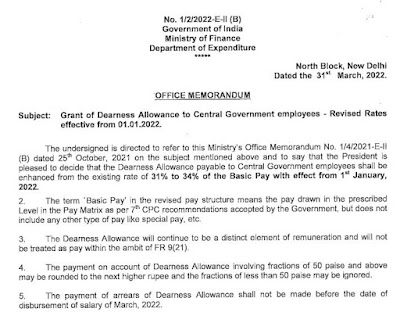
DA Jan 2022 - Grant of Dearness Allowance to Central Government employees - Revised Rates effective from 01.01.2022

 3% DA Hike - Revised Rates effective from 01.01.2022: DoE OM dated 31.03.2022 No. 1/2/2022-E-II (B) Government of India Ministry of Finance...