Showing posts with label Income Tax Deduction. Show all posts

Thursday, 26 January 2017

Deduction of tax at source Income-tax deduction from salaries under section 192 of the Income-tax Act, 1961


Deduction of tax at source Income-tax deduction from salaries under section 192 of the Income-tax Act, 1961

CIRCULAR NO : 01/2017
F.No.275/192/2016-IT(B)
Government of India
Ministry of Finance
Department of Revenue
Central Board of Direct Taxes
North Block, New Delhi
Dated the 2nd January, 2017

SUBJECT: INCOME-TAX DEDUCTION FROM SALARIES DURING THE FINANCIAL YEAR 2016-17 UNDER SECTION 192 OF THE INCOME-TAX ACT, 1961.

Reference is invited to Circular No.20/2015 dated 02.12.2015 whereby the rates of deduction of income-tax from the payment of income under the head "Salaries" under Section 192 of the Income-tax Act, 1961 (hereinafter ‘the Act’), during the financial year 2015-16, were intimated. The present Circular contains the rates of deduction of income-tax from the payment of income chargeable under the head “Salaries” during the financial year 2016-17 and explains certain related provisions of the Act and Income-tax Rules, 1962 (hereinafter the Rules). The relevant Acts, Rules, Forms and Notifications are available at the website of the Income Tax Department- www.incometaxindia.gov.in.

2. RATES OF INCOME-TAX AS PER FINANCE ACT, 2016:
As per the Finance Act, 2016, income-tax is required to be deducted under Section 192 of the Act from income chargeable under the head “Salaries” for the financial year 2016-17 (i.e. Assessment Year 2017-18) at the following rates:

2.1 Rates of tax

A. Normal Rates of tax:
Sl.No.Total IncomeRate of tax
1.Where the total income does not exceed Rs. 2,50,000/Nil
2.Where the total income exceeds Rs. 2,50,000/- but does not exceed Rs. 5,00,000/-10 per cent of the amount by which the total income exceeds Rs. 2,50,000/-
3.Where the total income exceeds Rs. 5,00,000/- but does not exceed Rs. 10,00,000/Rs. 25,000/- plus 20 per cent of the amount by which the total income exceeds Rs. 5,00,000/-
4.Where the total income exceeds Rs. 10,00,000/Rs. 1,25,000/- plus 30 per cent of the amount by which the total income exceeds Rs. 10,00,000/-

B. Rates of tax for every individual, resident in India, who is of the age of sixty years or more but less than eighty years at any time during the financial year:
Sl.No.Total IncomeRate of tax
1.Where the total income does not exceed Rs. 3,00,000/-Nil
2.Where the total income exceeds Rs. 3,00,000 but does not exceed Rs. 5,00,000/10 per cent of the amount by which the total income exceeds Rs. 3,00,000/
3.Where the total income exceeds Rs. 5,00,000/- but does not exceed Rs. 10,00,000/-Rs. 20,000/- plus 20 per cent of the amount by which the total income exceeds Rs. 5,00,000/-
4.Where the total income exceeds Rs. 10,00,000/-Rs. 1,20,000/- plus 30 per cent of the amount by which the total income exceeds Rs. 10,00,000/

C. In case of every individual being a resident in India, who is of the age of eighty years or more at any time during the financial year:
Sl.No.Total IncomeRate of tax
1.Where the total income does not exceed Rs. 5,00,000/-Nil
2.Where the total income exceeds Rs. 5,00,000 but does not exceed Rs. 10,00,000/20 per cent of the amount by which the total income exceeds Rs. 5,00,000/
4.Where the total income exceeds Rs. 10,00,000/-Rs. 1,00,000/- plus 30 per cent of the amount by which the total income exceeds Rs. 10,00,000/-

2.2 Surcharge on Income tax:
The amount of income-tax computed in accordance with the preceding provisions of this Paragraph, or the provisions of section 111A or section 112 of the Income-tax Act, shall, in the case of every individual or Hindu undivided family or association of persons or body of individuals, whether incorporated or not, or every artificial juridical person referred to in sub-clause (vii) of clause (31) of section 2 of the Income-tax Act, having a total income exceeding one crore rupees, be increased by a surcharge for the purpose of the Union calculated at the rate of fifteen per cent of such income-tax:
Provided that in the case of persons mentioned above having total income exceeding one crore rupees, the total amount payable as income-tax and surcharge on such income shall not exceed the total amount payable as income-tax on a total income of one crore rupees by more than the amount of income that exceeds one crore rupees.

2.3.1 Education Cess on Income tax:
The amount of income-tax including the surcharge if any, shall be increased by Education Cess on Income Tax at the rate of two percent of the income-tax.

2.3.2 Secondary and Higher Education Cess on Income-tax:
An additional education cess is chargeable at the rate of one percent of income-tax including the surcharge if any, but not including the Education Cess on income tax as in 2.3.1.

Read More

Wednesday, 4 May 2016

Submit proof of travel for claiming income tax deduction on LTC: CBDT

Submit proof of travel for claiming income tax deduction on LTC: CBDT

The Income Tax Department has brought out a new form making it mandatory for salaried taxpayers to furnish proof of travel for claiming income tax deduction on LTC.

The Central Board of Direct Taxes (CBDT) has brought in a Form 12BB form requiring employees to furnish to their employers with evidence in relation to house rent allowance (HRA) if it exceeds Rs 1 lakh in an assessment year.

The details to be furnished include name, address and PAN of landlord where the aggregate rent paid exceeds Rs 1 lakh, according to a CBDT order.

For claiming deduction of interest on home loan, the name, address and PAN of lender will have to be furnished.

Similarly, for claiming income tax deduction on leave travel concession (LTC), the new rule makes it mandatory for employee to furnish to his employer evidence for travel expenditure.

Also evidence of investment or expenditure will have to be provided for claiming tax deduction under Chapter VI-A.

Chapter VI-A pertains to allowable deductions under Section 80C, Section 80CCC, Section 80CCD as well as other sections like 80E, 80G and 80TTA.

These are part of new Rule 26C and Form 12BB that require employees to furnish to the employer, evidence/particulars in relation to house rent allowance (HRA), leave travel concession (LTA), deduction of interest under the head ‘income from house property’ and deduction under Chapter VI-A.

CBDT, in the same order, also extended the time limit for depositing tax deducted at source (TDS) on transfer of immovable property from 7 days to 30 days.

Also, the due date for filing quarterly TDS returns in Form 24Q, 26Q and 27Q was extended by 15 days.
The amended rules will be applicable from June 1, 2016, CBDT said.

Under section 80C, a deduction of Rs 1.5 lakh can be claimed from total taxable income if invested/spent in PPF, employee’s share of PF contribution, life insurance premium payment, children’s tuition fee, principal repayment of home loan, Sukanya Samridhi Account among others.

Section 80CC provides for deduction on amount deposited in annuity plan of LIC or any other insurer for pension while Section 80CCD is for the same purpose on contribution to Pension (Section 80CCD).

Deduction under Section 80GG is available on House Rent paid where HRA is not received and the taxpayer or his spouse or minor child does not own residential accommodation at the place of employment.
Deduction available on the count is the minimum of rent paid minus 10 per cent of total income or Rs 5000 per month or 25 per cent of total income.

Section 80E provides for deduction of interest on loan taken for pursuing higher education.

An additional deductions on home loan interest of Rs 50,000, over and above Rs 2 lakh allowed under Section 24, is allowed for first time home owners under Section 80EE is available if the value of the property purchased is less than Rs 50 lakhs and home loan is less than Rs 35 lakhs.

Section 80D provides for deduction for premium paid of up to Rs 25,000 for medical insurance.

PTI

Monday, 16 June 2014

General Budget 2014-15: NFIR Presents list of proposals to be considered

General Budget 2014-15: NFIR Presents list of proposals to be considered

NFIR has made a list of all the proposals that Central Government employees expect in the 2014-15 General Budget.


On the 11th of this month, Mr. Raghavaiah, the General Secretary of NFIR, sent a letter to the Finance Ministry, containing certain proposals that are worth considering.


The letter contains nine points that deserve serious consideration from the Ministry. These points were formulated based on the needs and demands of about 34 lakh Central Government employees, including 14 lakh Railway workers.

Income tax exemption should be raised to Rs. 5 lakhs for individuals and Rs. 7 Lakhs for senior citizens.

The 7th CPC should be instructed to submit an Interim Report on the DA Merger.
Maximum bonus limits should be raised to Rs. 10,000.

The New Pension Scheme must be discarded in accordance to the request by the Railway Ministry.

Additional pension must be granted to pensioners over the age of 70.

The longstanding demand, for exempting Transport Allowance from Income Tax calculations, must be granted.

MACP Scheme should also be extended to teachers and lecturers working in Central Government institutions.

Earned Leave and LAHP should be granted to teachers and lecturers working in Central Government institutions.

All allowances should be exempted from income tax calculations.

Source: http://90paisa.blogspot.in/
[http://90paisa.blogspot.in/2014/06/general-budget-2014-15-nfir-presents.html]

Flash News

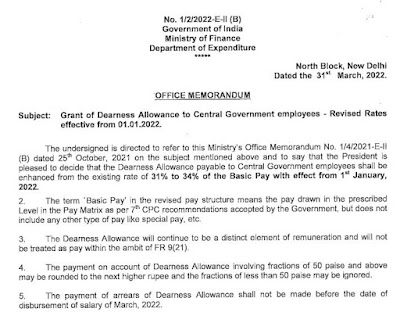
DA Jan 2022 - Grant of Dearness Allowance to Central Government employees - Revised Rates effective from 01.01.2022

 3% DA Hike - Revised Rates effective from 01.01.2022: DoE OM dated 31.03.2022 No. 1/2/2022-E-II (B) Government of India Ministry of Finance...