Showing posts with label Income Tax Department. Show all posts

Friday, 9 August 2019

Monetary limits for filing of appeals by Income Tax Department further enhanced by CBDT

Ministry of Finance

Monetary limits for filing of appeals by Income Tax Department further enhanced by CBDT

There is a substantial pendency of appeals of the Income Tax Department before various appellate fora. The CBDT is aware of the importance of litigation management and has been continuously working towards achieving the same.

To effectively reduce taxpayer grievances/litigation and help the Department focus on litigation involving complex legal issues and high tax effect, the monetary limits for filing of appeals by the Department were last revised on 11th July,2018 vide CBDT Circular No.3 of 2018. As a step towards further management of litigation by the Government,  the monetary limits for filing Departmental appeals before various appellate fora including ITAT, High Court & Supreme Court have been revised as under:

Appellate Forum
Existing Monetary Limit(Rs.)
Revised Monetary Limit(Rs.)
Before Income Tax Appellate Tribunal
20,00,000
50,00,000
Before High Court
50,00,000
1,00,00,000
Before Supreme Court
1,00,00,000
2,00,00,000

This will further reduce time, effort and resources presently deployed in litigation to focus on issues involving litigation of substantial value.
****
RCJ/HP

Source: PIB

Monday, 22 April 2019

Income Tax department revises the (Form 16) TDS certificate format issued by employers

Income Tax department revises the (Form 16) TDS certificate format issued by employers

The Income Tax department has revised Form 16 by adding various details, including income from house property and remuneration received from other employers, thereby making it more comprehensive to help check tax avoidance.

It will also include segregated information regarding deductions under various tax saving schemes, investments in tax savings instruments, different allowances received by the employee as well as income from other sources.

Form 16 is a certificate issued by employers, giving details of employees’ TDS (tax deducted at source) usually by mid June and is used in filing I-T returns.

The revised Form, which has been notified by the Income Tax department, will come into effect from May 12, 2019. This means the income tax returns for financial year 2018-19 will have to be filed on the basis of revised Form 16.

Among other things, the revised Form 16 will also include details of deductions in respect of interest on deposits in savings account, and rebates and surcharge, wherever applicable.

The I-T department has already notified income tax return forms for fiscal 2018-19. Salaried class and those who do not have to get their accounts audited, will have to file their ITRs by July 31 this year.

Meanwhile, the income tax department has also modified Form 24Q, which is furnished by employer to the tax department. It will include additional details like Permanent Account Number (PAN) of non- institutional entities from whom the employee has taken loan for buying or constructing housing property.

Nangia Advisors (Andersen Global) Director Sanjoli Maheshwari said the Form 16 and 24Q have been amended with an intent to make them more elaborative and informative. The same has been done in order to bring the Forms in parity with latest changes made in ITR Forms such as disclosure of standard deduction and exemptions claimed under section 10.

“Earlier, where the disclosure of various deductions were mentioned in a consolidated manner, ranging from 80C, 80CCD, 80E, 80G would now be required to be disclosed separately. These specific disclosures would provide ease to the tax authorities in understanding the various components of income of the taxpayer and thereby, facilitating the conduct of scrutiny more precisely,” Maheshwari said.

The changes in Form 24Q will further help in identifying any fabricated transaction undertaken with an aim of tax avoidance, she added.

PTI

Monday, 21 January 2019

Central Board of Direct Taxes (CBDT) clarifies regarding issue of Prosecution Notices

Ministry of Finance
Central Board of Direct Taxes (CBDT) clarifies regarding issue of Prosecution Notices
21 JAN 2019
The Central Board of Direct Taxes (CBDT) has stated that certain news items that appeared in a section of media regarding enmasse issue of prosecution notices to small companies for TDS default are completely misleading and full of factual inaccuracies. CBDT clarified that Mumbai Income Tax TDS office has issued prosecution Show Cause Notices only in a limited number of big cases where more than Rs. 5 lakh of tax was collected as TDS from employees etc and yet the same was not deposited with the Income Tax Department in time.

CBDT said that some defaulter companies and vested interests are deliberately misleading the media to thwart action against themselves. Having deducted tax from employees and other taxpayers and not depositing the same in time in the Government Treasury is an offence punishable under the law. It also affects the interest of the employees from whose salary the tax has been deducted by the unscrupulous employers who have not deposited the same in time in the Government Treasury. If the TDS is not deposited in time, the employee would be ineligible for claiming credit of the tax deducted when he files his own return.

CBDT stated that in last one month, only in 50 big cases prosecution notices have been issued by Mumbai IT TDS office. Out of these, in 80% of the cases the TDS tax default is above Rs. 10 lakh and in 10 % cases, TDS default is between Rs. 5 to Rs.10 lakh. In the remaining 10% cases, TDS default is of more than Rs. 1 crore as detected in the survey. Prosecutions have also recently been launched against 4 big business houses where more than Rs 50 Crore of tax was collected by them from the tax payers and yet not deposited with the Government in time. But such legal and rightful action is being unfortunately projected in the media by the vested interests as if the Department is going overboard to harass small employers.

It would be pertinent to note that in a country of 130 Crore people where around 6 Crore returns are filed every year, only a total of 1400 prosecutions have been filed so far for various offences under the Income Tax Act during this financial year. This, by any stretch of imagination, cannot be termed as mass harassment by the income tax department. Therefore, to say that prosecution notices enmasse have been sent to taxpayers for minor defaults is completely incorrect and misleading, the CBDT added.

PIB

Tuesday, 13 June 2017

ACCEPTING OF E-AADHAAR AS PRESCRIBED PROOF OF IDENTITY FOR RESERVED JOURNEY

ACCEPTING OF E-AADHAAR AS PRESCRIBED PROOF OF IDENTITY FOR RESERVED JOURNEY

Ministry of Railways has decided to incorporate downloaded Aadhaar (e-Aadhaar) as prescribed proof of identity at par with printed Aadhaar card as mentioned in the list of prescribed proofs of identity which are valid for undertaking journey in trains in reserved class. Railway passengers may carry anyone of the below identity proof while travelling in reserved class coaches :

1.Voter Photo Identity Card issued by Election Commission of India
2.Passport
3.PAN Card issued by Income Tax Department
4.Driving Licence issued by RTO
5.Photo Identity Card having serial number issued by Central/State Government.
6.Student Identity Card with photograph issued by recognized School/College for their Students.
7.Nationalised Bank Passbook with Photograph
8.Credit Cards issued by Banks with laminated photograph
9.Printed unique identification card "Aadhaar" or downloaded Aadhaar (e-Aadhaar).
10. Ration Card with photograph of passenger travelling.

Thursday, 11 May 2017

Income Tax department launches new facility to link Aadhaar with PAN


Income Tax department launches new facility to link Aadhaar with PAN

New Delhi: The Income Tax department has launched a new e-facility to link a person's Aadhaar with the Permanent Account Number (PAN), a mandatory procedure for filing IT returns now.

The department's e-filing website https://incometaxindiaefiling.gov.in/ has created a new link on its homepage making it easy" to link the two unique identities of an individual.

The link requires a person to punch in his PAN number, Aadhaar number and the exact name as given in the Aadhaar card".

After verification from the UIDAI (Unique Identification Authority of India), the linking will be confirmed. In case of any minor mismatch in Aadhaar name provided, Aadhaar OTP (one time password) will be required," the department said in its advisory to taxpayers and individuals.

The OTP will be sent on the registered mobile number and email of the individual.

It urged them to ensure that the date of birth and gender in PAN and Aadhaar are exactly the same, to ensure linking without failure.

There is no need to login or be registered on e-filing website (of the I-T department). This facility can be used by anyone to link their Aadhaar with PAN," it said.

The government, under the Finance Act 2017, has made it mandatory for taxpayers to quote Aadhaar or enrolment ID of Aadhaar application form for filing of income tax returns (ITR).

Also, Aadhaar has been made mandatory for applying for permanent account number with effect from July 1, 2017.

The department, till now, has linked over 1.18 Aadhaar with its PAN database.

While Aadhaar is issued by the UIDAI to a resident of India, PAN is a ten-digit alphanumeric number issued in the form of a laminated card by the IT department to any person, firm or entity.

PTI

Saturday, 14 January 2017

Income-tax Rules amended to provide that bank shall obtain and link PAN or Form No. 60 (where PAN is not available) in all existing bank accounts (other than BSBDA) by 28.02.2017


Income-tax Rules amended to provide that bank shall obtain and link PAN or Form No. 60 (where PAN is not available) in all existing bank accounts (other than BSBDA) by 28.02.2017.

Press Information Bureau
Government of India
Ministry of Finance
08-January-2017 18:17 IST

Income-tax Rules amended to provide that bank shall obtain and link PAN or Form No. 60 (where PAN is not available) in all existing bank accounts (other than BSBDA) by 28.02.2017.

Income-tax Rules have been amended to provide that bank shall obtain and link PAN or Form No. 60 (where PAN is not available) in all existing bank accounts (other than BSBDA) by 28.02.2017, if not already done. In this connection, it may be mentioned that RBI vide circular dated 15.12.2016 has mandated that no withdrawal shall be allowed from the accounts having substantial credit balance/deposits if PAN or Form No.60 is not provided in respect of such accounts. Therefore, persons who are having bank account but have not submitted PAN or Form No.60 are advised to submit the PAN or Form No. 60 to the bank by 28.2.2017.

The banks and post offices have also been mandated to submit information in respect of cash deposits from 1.4.2016 to 8.11.2016 in accounts where the cash deposits during the period 9.11.2016 to 30.12.2016 exceeds the specified limits.

It has also been provided that person who is required to obtain PAN or Form No.60 shall record the PAN/Form.No.60 in all the documents and quote the same in all the reports submitted to the Income-tax Department.

The notification amending the relevant rules is available on the official website of the Income-tax Department i.e. www.incometaxindia.gov.in

Wednesday, 14 December 2016

Finance Minister conveys Government's Appreciation to tax payers for their contribution towards Nation building


Finance Minister conveys Government's Appreciation to tax payers for their contribution towards Nation building
Government of India
Ministry of Finance
Department of Revenue
Central Board of Direct Taxes
New Delhi, 19th September, 2016.
Press Release

Sub: Finance Minister conveys Government's Appreciation to tax payers for their contribution towards Nation building.

The Government acknowledges the contribution of individual tax payers in paying taxes within the prescribed time and prompt filing of Income Tax Returns. The Honourable Finance Minister, Shri Arun Jaitley today handed over certificates of appreciation issued by CBDT honoring select tax payers for such contribution. While it is widely acknowledged that the Nation meets its obligations towards spending in various social sector and welfare schemes and infrastructure development out of revenues mobilized through tax payments by millions of honest tax payers, this step marks the first effort by the Government to directly communicate to the tax payer its appreciation for that contribution.
CBDT will be sending out such certificates of appreciation to individual tax payers by e-mail in various categories on the basis of the level of taxes paid by them for the current Assessment Year 2016-17 where taxes have been paid in full and tax payers have no outstanding tax liabilities and where the return is e-filed within the prescribed due date. The tax payers may display these certificates in their homes / offices.

The categories for individual taxpayers and the number of certificates being issued in the first round are:

1PlatinumTax  contributed Rs. 1 Crore and above
2GoldTax contributed Rs. 50Lakh to Rs. 1 Crore
3SilverTax contributed Rs. 10Lakh to Rs.50 Lakh
4BronzeTax contributed Rs. 1Lakh to Rs.10 Lakh

The CBDT urges taxpayers to e-file their returns in time and verify their return by submitting the Electronic Verification Code online or sending their ITR-V within the 120 day period so that they can be also acknowledged for their contribution.

The Department is committed to continuous improvement of taxpayer services and seeks the cooperation of all taxpayers in contributing their fair share of taxes voluntarily.

sd/-
(Meenakshi J Goswami)
Commissioner of Income Tax
(Media and Technical Policy)
Official Spokesperson, CBDT.
Source : http://www.incometaxindia.gov.in/

Friday, 18 November 2016

Income Tax Department lists Transactions where PAN will be Mandatory

Income Tax Department lists Transactions where PAN will be Mandatory

The Income Tax Department prescribes a list of transactions for which quoting of Permanent Account Number (PAN) is mandatory. These are listed in Rule 114B of the Income Tax Rules, 1962 which were first inserted with effect from 1st November, 1998 and have been amended from time to time. The list under Rule 114B (read the rule here -  as on date requiring PAN to be quoted includes the following banking transactions :
  • Deposit with a banking company or a co-operative bank in cash exceeding fifty thousand rupees during any one day.
  • Purchase of bank drafts or pay orders or banker's cheques from a banking company or a co-operative bank in cash for an amount exceeding fifty thousand rupees during any one day.
  • A time deposit with a banking company or a co-operative bank or a Post Office
  • Opening an account [other than a time-deposit referred to above or a Jandhan / Basic Bank Deposit Account] with a banking company or a co-operative bank.
In addition to the existing requirement of quoting of PAN in respect of cash deposits in excess of Rupees fifty thousand in a day, quoting of PAN will now also be mandatory in respect of cash deposits aggregating to Rupees two lakh fifty thousand or more during the period 09th November, 2016 to 30th December, 2016 as per an amendment notified by CBDT on 15-11-2016. 

The Department has already issued close to 25 crore PAN till date. The persons requiring a PAN for complying with the above requirement may do so by applying to the NSDL in a prescribed format with the necessary documentary proof. The link to the NSDL site  and the instructions for making the application are available on the official website of the Income-tax Department  www.incometaxindia.gov.in  under the ‘Important Links’ head  in  the lower left hand corner of the homepage.

Open Income Tax Rules 114B here

Tuesday, 20 September 2016

Observance of Joy of Giving Week between 2nd and 8th of October, 2016

Observance of "Joy of Giving Week" between 2nd and 8th of October, 2016-Appeal to officers and staff members.
F. No. 385/ 17/2016-IT (B)
Government of India
Ministry of Finance
Central Board of Direct Taxes
New Delhi, Dated: 15.09.2016
To,
All Principal Chief Commissioners of Income Tax
All Principal Directors General of Income Tax
Madam/ Sir,

Subject: - Observance of "Joy of Giving Week" between 2nd and 8th of October, 2016-Appeal to officers and staff members.

I am directed to say that it has been decided that the Income Tax Department will observe the week between 2nd October and 8th October, 2016 as “Joy of Giving Week”, to commemorate Gandhi Jayanti.
In this regard kindly find attached an “Appeal” issued by CBDT to all officers and staff members of Income Tax Department for giving wide circulation in your Region.
This issues with the approval of Chairperson (CBDT).

Yours faithfully,
sd/-
(Anand Jha)
Commissioner (IT&CT)
A P P E A L

It has been decided that the Income Tax Department will observe the week between 2nd October and 8th October, 2016 as “Joy of Giving Week”, to commemorate Gandhi Jayanti.

During this week, the officers and staff members of the Department are encouraged to donate clothes, toys, books and other useful items to people in need or to credible/ deserving charitable organizations. They may also do voluntary work with any charitable organization engaged in promotion of local causes. During this period, all the office buildings of the Department may put banners at visible locations displaying the following message:
Joy of Giving Week,
2nd to 8th October, 2016

Source: https://irsofficersonline.gov.in

Tuesday, 6 September 2016

Income Declaration Scheme 2016 – Government issues Clarifications in the form of Sixth Set of Frequently Asked Questions (FAQs)

Income Declaration Scheme 2016 – Government issues Clarifications in the form of Sixth Set of Frequently Asked Questions (FAQs)

The Income Declaration Scheme, 2016 (the Scheme) provides an opportunity to persons who have not paid full taxes in the past to come forward and declare their undisclosed income and assets. The Scheme has come into effect from 1.6.2016 and is open for declarations up to 30.9.2016. The Income Declaration Scheme, 2016 Rules (the Rules) have been notified on 19.5.2016. The amount payable under the Scheme can be paid in instalments viz. 25% of the total amount payable by 30.11.2016; another 25% by 31.3.2017 and balance 50% by 30.9.2017.

In order to address concerns of the stakeholders and to clarify the queries relating to the provisions of the Scheme, the Rules have been amended from time to time and six set of circulars (FAQs) have been issued. The following major issues addressed through Rules and FAQs are as under:
• The information in respect of a valid declaration is confidential and shall neither be shared with any law enforcement agency nor shall be enquired into by the Income-tax Department.
• The assets declared under the Scheme are to be valued at cost of acquisition or at fair market price as on 1.6.2016 as determined by the registered valuer, whichever is higher. However, an option for valuation of registered immovable property on the basis of stamp duty value of acquisition adjusted with the Cost Inflation Index has also been provided.
• Credit for unclaimed TDS made on declared income shall be allowed.
• Neither any capital gains tax nor any TDS shall be levied on transfer of declared benami property from benamidar to the declarant without consideration.
• The amount of fictitious liabilities recorded in audited balance sheet and not linked to acquisition of an asset can be disclosed under the Scheme as such.
• The period of holding of declared registered immovable assets shall be taken on the basis of the actual date of registration.
• The valuation report obtained by the declarant from a registered valuer shall not be questioned by the department. However, valuer’s accountability will remain.
• No adverse action shall be taken by FIU or the income-tax department solely on the basis of the information regarding cash deposit made consequent to the declaration under the Scheme.
• No enquiry/investigation shall be made in respect of the undisclosed income and assets declared under the Scheme even if the evidence of same is found subsequently during course of search or survey proceedings (circular No.32 dated 01.09.2016).
Further, vide Circular No. 31 dated 30.8.2016 an option has been provided to the declarants to file the declaration under the Scheme electronically under digital signature with the Commissioner of Income-tax, Centralised Processing Centre, Bengaluru [CIT(CPC)]. In case the declarant exercises the said option the declaration shall not be shared with the jurisdictional Principal Commissioner/Commissioner under the Income-tax Act.

In view of the fact that all the major queries and concerns of stakeholders have already been addressed by issue of circulars (FAQs) and also to provide stability and certainty to the Scheme, it is envisaged that no further clarifications on the Scheme shall be issued.

It is reiterated that the Scheme closes on 30.09.2016. The extension of the scheme is out of question.

PIB

Friday, 1 April 2016

Request to Taxpayers to Avail Facility for Online Rectification

Request to Taxpayers to Avail Facility for Online Rectification

Income-tax Act provides the taxpayer with an option to seek rectification of mistakes apparent from record under section 154 of the Act. The e-filing portal of the Income Tax Department provides the utility for online filing and tracking of rectification requests. Taxpayers who are not satisfied with the outcome of processing of their Income Tax Return by the Centralized Processing Centre, Bengaluru can avail of the facility of online filing and tracking of rectification requests available on https://incometaxindiaefiling.gov.in.

In case of any mistake in data entry of Tax payment or TDS details, taxpayer can select the “Rectification Request Type->Taxpayer is correcting data for Tax Credit mismatch only” and the use the option of pre-filling the correct details for the relevant Assessment Year while submitting the rectification request.
In case of data entry mistake in any other Schedule or omission of any details, taxpayer can select the option “Taxpayer is correcting Data in Rectification” and the reason for seeking rectification.

In any other case taxpayer can select the option “No further Data Correction Required, Reprocess the case” where the mistake in processing may have occurred due to non-reporting of TDS by deductor etc.
A detailed user manual for filing online rectification is available at: http://incometaxindiaefiling.gov.in/eFiling/Portal/StaticPDF/Rectifcation_Manual.pdf?0.08833787460862363.

With this utility a taxpayer can also the monitor the status of disposal of rectification request.

CPC, Bengaluru has already processed 6,53,763 online rectification requests in F.Y.2015-16 till 29th February 2016. CBDT is committed to ensuring accuracy in processing of returns and determination of refunds and seeks the active cooperation of taxpayers in ensuring correctness of data while submitting the return or rectification request.

PIB

Thursday, 10 December 2015

Income Tax Department simplifies online rectification of TDS in ITR

Income Tax Department simplifies online rectification of TDS in ITR

New Delhi: Aimed at making life easier for tax payers, the Income Tax department today said it simplified the process of online rectification of incorrect details of tax deducted at source (TDS) filed in the income tax return (ITR).

Earlier, taxpayers were required to fill in complete details of the entire TDS schedule while applying for rectification on the e-filing portal of the I-T Department.

To avoid this, the finance ministry said a new facility has been provided for pre-fillin ..

To avoid this, the finance ministry said a new facility has been provided for pre-filling of TDS schedule while submitting online rectification request on the e-filing portal to facilitate easy correction or up-dating of TDS details.

“This is expected to considerably ease the burden of compliance on the taxpayers seeking rectification due to TDS mismatch,” an official statement said.

Errors due to incomplete TDS details in rectification applications were leading to delays in processing of such applications, thereby causing hardships to taxpayers, it added.

PTI

Saturday, 5 December 2015

Government sets target to add one crore more Income Tax payers this year

Government sets target to add one crore more Income Tax payers this year

New Delhi: Government targets adding one crore new income tax payers in the current financial year, Minister of State for Finance Jayant Sinha said today.

“The government has set a target of adding one crore new Income tax payers during the financial year 2015-16. The said target has been further distributed among various field units of the Income Tax Department,” Sinha said in a written reply in the Lok Sabha.

Sinha said in this financial year over 2.4 crore income tax returns have been filed till October 31, 2015.
The respective figures for 2014-15 were 3.67 crore; 3.74 crore in 2013-14 and 3.27 crore in 2012-13.
The number of income tax payers in the income bracket of Rs 1 crore and below was 2.39 crore as of October 31, 2015. For 2014-15 it was 3.66 crore; 3.73 crore in 2013-14 and 3.26 crore in 2012-13, said the minister.

“The total net direct collection in the current financial year (up to October 2015) is Rs 3.44 lakh crore showing growth of 13.20 per cent as compared to the collection made during the corresponding period of the previous financial year,” he said.

Sinha said government has taken a number of steps to expand the income tax base.

These steps include developing strategies to identify and add new taxpayers; collection of information about high value transactions; improving compliance to TDS/TCS provisions; encouraging voluntary compliance through education, camps and seminars

PTI

Thursday, 5 November 2015

Income Tax Department issued an Advisory on Phishing, Fraudulent Refund E-mail

Income Tax Department issued an Advisory on Phishing, Fraudulent Refund E-mail

Taxpayers are requested not to respond to any email or any type of communication sent to them requesting them to furnish their personal particulars such as Bank account details, passwords, OTP etc. purported to be from the Income Tax Department.

The Income Tax Department does not seek any such information through email or any other mode of communication from the taxpayers.

If you have received any such fraud mails, kindly do not respond and register a complaint by forwarding the actual phishing email as per procedure and details given in http://www.incometaxindia.gov.in/Pages/report-phishing.aspx

Advisory :
If you receive an e-mail from someone claiming to be the authorized by Income Tax Department or directing you to an Income Tax website:

Do not reply.
Do not open any attachments. Attachments may contain malicious code that will infect your computer.

Do not click on any links. If you clicked on links in a suspicious e-mail or phishing website then do not enter confidential information like bank account, credit card details.

Do not cut and paste the link from the message into your browsers, phishers can make link look like real, but it actually send you to different websites.

Use anti-virus software, anti spyware, and a firewall and keep them updated. Some phishing e-mails contain software that can harm your computer or track your activities on the internet without your knowledge. Anti-virus & Anti-spyware software and firewall can protect you from inadvertently accepting such unwanted files.

Reporting:
If you receive an e-mail or find a website you think is pretending to be of Income Tax Department, forward the e-mail or website URL to phishing@incometax.gov.in. A copy may also be forwarded to incident@cert-in.org.in
You may forward the message as received or provide the Internet header of the e-mail. The Internet header has additional information to help us locate the sender.
After you forward the e-mail or header information to us, delete the message.
If you receive a phishing mail not pertaining to the Income Tax Department, forward the same to incident@cert-in.org.in​​​

Authority: https://incometaxindiaefiling.gov.in/

Thursday, 5 February 2015

Proposal to discontinue exemption of Rs. 1.5 lakh available for Savings under Section 80C

Proposal to discontinue exemption of Rs. 1.5 lakh available for Savings under Section 80C

It is learnt that Finance Ministry is considering to put up a proposal for discontinuing Exemption of Rs. 1.5 lakh presently available under Section 80C for Savings and Insurnace such as premium paid, investment in NSS, Mutual funds, Pension funds etc. Alternatively, the basic income tax exemption limit of Rs. 2.5 lakh would be raised to Rs. 4 lakh. Reasons behind such a bold move by Finance Ministry as per sources are:

1. Income Tax Department could not verify whether the Investments declared to be have been made to avail exemption under Section 80 C were actually made

2. To make Income Tax Law simple by raising basic Income Tax Exemption Limit and avoid complexities involved in providing Income Tax Exemption to promote savings.

As per Finance Ministry proposals, the current system allows individuals to avail of the Section 80C benefit without having made the required investments.

Most of the tax returns by individuals are processed by what is called a ‘summary assessment’, under which an adjustment in the reported income is made only in cases of arithmetic error or of a wrong claim that is apparent from the return filed. Officials do not ask questions or insist on proof of investment while processing returns. Only in cases of ‘scrutiny assessment’ and ‘assessment of income that has earlier escaped assessment’, which are done in very few cases, more information or evidence is sought to ensure that the reported income is correct.

Even in the case of salaried individuals, where the employer may insist on proof of investments, the tax authorities do not. Besides, if a salaried individual wrongly claims in his return that Section 80C investments have been made, the TDS by the employer and paid to the department is refunded by the tax authorities without asking any questions. In the case of self-employed, there is no check either by the employer or the taxman.

So the ministry feels that any individual who is actually interested in saving would anyway do it and there is really no need to incentivise the same through the tax policy.

Savings entitled to tax benefit under Section 80C include payments towards life insurance, deferred annuity, provident funds, National Savings Certificates, unit-linked investment plans of LIC Mutual Fund, pension funds set up by mutual funds, equity-linked savings plans, deposits with National Housing Bank and tuition free paid for education of children.

Source: Financial Express

Flash News

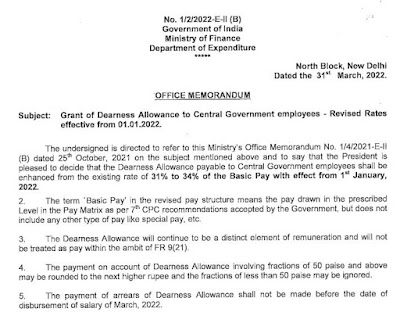
DA Jan 2022 - Grant of Dearness Allowance to Central Government employees - Revised Rates effective from 01.01.2022

 3% DA Hike - Revised Rates effective from 01.01.2022: DoE OM dated 31.03.2022 No. 1/2/2022-E-II (B) Government of India Ministry of Finance...