Showing posts with label INCOME TAX 2015-16. Show all posts

Monday, 18 January 2016

Income Tax Calculation for Interest on Housing Loan and Deduction u/s 80C with illustration

Income Tax Calculation for Interest on Housing Loan and Deduction u/s 80C with illustration

One Computation of Taxable Salary and allowances, Deduction for Interest on Housing Loan and Deduction u/s 80C.

Mr. X, a Central Govt. Officers in Delhi, is receiving Basic Pay Rs.23,720, grade Pay Rs.7,600, DA at prescribed rates, transport allowances @ Rs.3200+DA thereon, and HRA 30% of basic pay + grade pay (though living in his own house). His date of increment is Ist July. The following are other particulars of his income. Compute his taxable income and tax payable, for A.Y.2015-16.

income-tax-house-loan

Sunday, 17 January 2016

Rates of Income Tax as per Finance Act, 2015 – Financial Year 2015-16(AY 2016/17)

Rates of Income Tax as per Finance Act, 2015 – Financial Year 2015-16(AY 2016/17)

RATES OF INCOME-TAX AS PER FINANCE ACT, 2015: As per the Finance Act, 2015, income-tax is required to be deducted under Section 192 of the Act from income chargeable under the head “Salaries” for the financial year 2015-16 (i.e. Assessment Year 2016-17) at the following rates:

Rates of tax : A. Normal Rates of tax:


Rates of tax for every individual, resident in India, who is of the age of sixty years or more but less than eighty years at any time during the financial year: 


In case of every individual being a resident in India, who is of the age of eighty years or more at any time during the financial year:


Education Cess on Income tax:

The amount of income-tax including the surcharge if any, shall be increased by Education Cess on Income Tax at the rate of two percent of the income-tax.

Secondary and Higher Education Cess on Income-tax:

An additional education cess is chargeable at the rate of one percent of income-tax including the surcharge if any, but not including the Education Cess on income tax.

No related posts.


Thursday, 5 February 2015

Budget 2015 India: Wish List of Salaried Employees on Income Tax

Budget 2015 India:  Wish List of Salaried Employees on Income Tax
Budget 2015 may be yet another one, but financial comfort and rising hopes on growing Indian Economy, may provide room for the finance minister Mr. Arun Jaitley to announce more exemptions or reliefs in the income tax front in this Budget. More than additional exemptions these measures can be called as updating of Income Tax Exemption limit for various allowances which were fixed very long ago which unrealistic to present date.

Budget 2015 Wish List of Salaried Employees on Income Tax :

Basic Income Tax Exemption Limit :
Increase of Basic Income Tax Exemption Limit to Rs. 3 lakhs to meet out inflationary Trend.

Transport Allowance:
Transport Allowance is exempted to an extent of Rs. 800 per month. However, the lowest amount of Transport Allowance of Rs. 400 (plus dearness allowance) received by the employees in the Group C and MTS cadres itself is taxable. So there is a very high need for increasing exemption limit for Transport Allowance payable Government Employees.

Children Education Allowance:
Children Education Allowance is the other allowance, which is exempted to an extent of Rs. 100 per month. Of course this exemption limit was decided more than a decade ago when tuition fees of Rs. 100 was reimbursed to Central Government Employees. On implementation of sixth Pay commission recommendations, Children Education Allowance has been raised to Rs. 1000 and incremented when DA crosses 50% each time. So, there is no point in keeping the slab on IT Exemption for CEA at this low level. It is widely expected that Childen Education Allowance is to be fully exempted from Income Tax.

Medical Reimbursement by Employer:
The present Exemption Limit of Rs.15,000 as far as medical reimbursement is concerned provided by an employer needs to revised to Rs. 50,000 considering the cost of medical treatment presently.

Health Insurance premium under Section 80 D:
Salaried Employees also expect an increase of exemption limit for Health Insurance Premium paid to Rs. 50, 000 from the current level of Rs. 35,000 (Rs. 15,000 for family and Rs. 20,000 to Parents)

Re-Introduction of Standard Deduction:
As of now, Salaried Employees are treated at part with Tax Payers who are self employed and doing business of their own, as far as Income Tax is concerned. But this was not the case 10 years ago (until 2004-05). Just like Self Employed and Business related tax payers enjoy deduction of expenses made from the income, a fixed amount was exempted from total income of Salaried Employees which was termed as Standard Deduction. One of the expectations of Salaried Employees now is re-introduction of Standard Deduction for their income tax assessment.

Exemption Limit of Rs. 1.5 lakh for Savings under Section 80 C:
Also, Salaried Employees feel that Exemption of Rs. 1.5 lakh available for Savings and Insurance Insruments as wells as retirement plans is too low considering the number of investments allowed to be exempted under this category. It is expected that this Exemption limit has to be increased to Rs. 2 lakh at least.

Exemption limit on Rent Paid when no HRA is received :
Further, Rent paid by an individual is exempted now to an extent of Rs. 2000 per month if no House Rent Allowance is received. This limit was fixed in the year 1998. Needless to say house rent cost has increased enormously since 1998. So, this exemption limit needs immediate revision to match the current rental cost.

Proposal to discontinue exemption of Rs. 1.5 lakh available for Savings under Section 80C

Proposal to discontinue exemption of Rs. 1.5 lakh available for Savings under Section 80C

It is learnt that Finance Ministry is considering to put up a proposal for discontinuing Exemption of Rs. 1.5 lakh presently available under Section 80C for Savings and Insurnace such as premium paid, investment in NSS, Mutual funds, Pension funds etc. Alternatively, the basic income tax exemption limit of Rs. 2.5 lakh would be raised to Rs. 4 lakh. Reasons behind such a bold move by Finance Ministry as per sources are:

1. Income Tax Department could not verify whether the Investments declared to be have been made to avail exemption under Section 80 C were actually made

2. To make Income Tax Law simple by raising basic Income Tax Exemption Limit and avoid complexities involved in providing Income Tax Exemption to promote savings.

As per Finance Ministry proposals, the current system allows individuals to avail of the Section 80C benefit without having made the required investments.

Most of the tax returns by individuals are processed by what is called a ‘summary assessment’, under which an adjustment in the reported income is made only in cases of arithmetic error or of a wrong claim that is apparent from the return filed. Officials do not ask questions or insist on proof of investment while processing returns. Only in cases of ‘scrutiny assessment’ and ‘assessment of income that has earlier escaped assessment’, which are done in very few cases, more information or evidence is sought to ensure that the reported income is correct.

Even in the case of salaried individuals, where the employer may insist on proof of investments, the tax authorities do not. Besides, if a salaried individual wrongly claims in his return that Section 80C investments have been made, the TDS by the employer and paid to the department is refunded by the tax authorities without asking any questions. In the case of self-employed, there is no check either by the employer or the taxman.

So the ministry feels that any individual who is actually interested in saving would anyway do it and there is really no need to incentivise the same through the tax policy.

Savings entitled to tax benefit under Section 80C include payments towards life insurance, deferred annuity, provident funds, National Savings Certificates, unit-linked investment plans of LIC Mutual Fund, pension funds set up by mutual funds, equity-linked savings plans, deposits with National Housing Bank and tuition free paid for education of children.

Source: Financial Express

Flash News

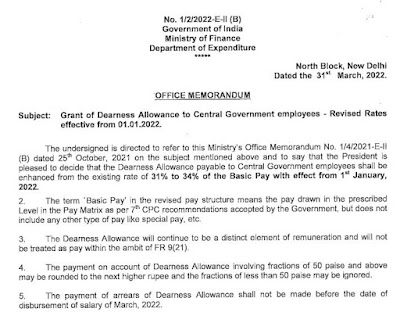
DA Jan 2022 - Grant of Dearness Allowance to Central Government employees - Revised Rates effective from 01.01.2022

 3% DA Hike - Revised Rates effective from 01.01.2022: DoE OM dated 31.03.2022 No. 1/2/2022-E-II (B) Government of India Ministry of Finance...