Showing posts with label Income Tax Exemption. Show all posts

Friday, 1 February 2019

BUDGET 2019 - Income upto Rs 5 Lakh to get full tax rebate

BUDGET 2019 - Income upto Rs 5 Lakh to get full tax rebate
 
Ministry of Finance
Income upto Rs 5 Lakh to get full tax rebate; higher standard deduction proposed
Relief of over Rs 23,000 crore to estimated 3 Crore small and middle class tax- payers
TDS threshhold on interests on small savings raised
Boost to housing and real estate sector
FM announces a slew of tax reliefs for middle class and small tax payers
01 FEB 2019
Individual taxpayers having taxable annual income up to Rs.5 lakhs will get full tax rebate and therefore will not be required to pay any income tax. While presenting the Interim Budget 2019-20 in Parliament today the Union Minister for Finance, Corporate Affairs, Railways & Coal, Shri Piyush Goyal said “Because of major tax reforms undertaken by us during last four and half years, both tax collections as well as tax base have shown significant increase, achieving a moderate taxation- high compliance regime. It is, therefore, just and fair that some benefits from the tax reforms must also be passed on to the middle class taxpayers”

As a result, the Finance Minister added that even persons having gross income up to Rs. 6.50 lakhs may not be required to pay any income tax if they make investments in provident funds, specified savings, insurance etc. In fact, with additional deductions such as interest on home loan up to Rs.2 lakh, interest on education loans, National Pension Scheme contributions, medical insurance, medical expenditure on senior citizens etc, persons having even higher income will not have to pay any tax. This will provide tax benefit of Rs.18,500 crore to an estimated 3 crore middle class taxpayers comprising self employed, small business, small traders, salary earners, pensioners and senior citizens.

STANDARD DEDUCTIONS RAISED
For salaried persons, Standard Deduction is being raised from the current Rs.40,000 to Rs.50,000. “This will provide additional tax benefit of Rs.4,700 crore to more than 3 crore salary earners and pensioners”, the Finance Minister informed.

TDS THRESHHOLD INCREASED
Tax Deduction at Source (TDS) threshold on interest earned on bank/post office deposits has been proposed to be raised from Rs.10,000 to Rs.40,000. Shri Goyal said, "This will benefit small depositors and non-working spouses". Further, the TDS threshold for deduction of tax on rent has also been proposed to be increased from Rs.1,80,000 to Rs.2,40,000 for providing relief to small taxpayers.

MORE RELIEF TO RESIDENTIAL HOUSES
It has been proposed to exempt the levy of income tax on notional rent on a second self-occupied house. Currently, income tax on notional rent is payable if one has more than one self-occupied house. Shri Goyal announced the relief considering the difficulty of the middle class having to maintain families at two locations on account of their job, children’s education, care of parents etc.
Further, the Finance Minister proposed to increase the benefit of rollover of capital gains under Section 54 of the Income Tax Act from investment in one residential house to two residential houses for a taxpayer having capital gains up to Rs. 2 crore. This benefit can be availed once in a life time. For making more homes available under affordable housing, the benefits under Section 80-IBA of the Income Tax Act is being extended for one more year, i.e., to the housing projects approved till 31st March, 2020. Also, for giving impetus to the real estate sector, the Finance Minister proposed to extend the period of exemption from levy of tax on notional rent, on unsold inventories, from one year to two years, from the end of the year in which the project is completed.

PIB

Thursday, 1 February 2018

Relief to Senior Citizens: Exemption of Interest Income on deposits increased to Rs 50,000


Ministry of Finance

Relief to Senior Citizens: Exemption of Interest Income on deposits increased to Rs 50,000

Pradhan Mantri Vaya Vandana Yojana extended up to March 2020

Existed limit on investment under PMVVY enhanced to Rs 15 lakhs

With the objective of providing a dignified life to senior citizens, the Union Minister for Finance and Corporate Affairs, Shri Arun Jaitley, announced significant incentives for senior citizens.

Presenting the General Budget 2018-19 in Parliament here today, the Finance Minister said that the exemption of interest income on deposits with banks and post offices to be increased from Rs. 10,000/- to Rs. 50,000/- and TDS shall not be required to be deducted on such income, under section 194A. This benefit shall be available also for interest from all fixed deposits schemes and recurring deposit schemes.

The Finance Minister also announced raising the limit of deduction for health insurance premium and/ or medical expenditure from Rs. 30,000/- to Rs. 50,000/-, under section 80D. All senior citizens will now be able to claim benefit of deduction up to Rs. 50,000/- per annum in respect of any health insurance premium and/or any general medical expenditure incurred.

Further, the Finance Minister proposed raising the limit of deduction for medical expenditure in respect of certain critical illness from Rs. 60,000/- in case of senior citizens and from Rs. 80,000/- in case of very senior citizens, to Rs. 1 lakh in respect of all senior citizens, under section 80DDB.
These concessions will give extra tax benefit of Rs. 4,000 crores to senior citizens.

In addition to tax concessions, the Finance Minister proposed to extend the Pradhan Mantri Vaya Vandana Yojana up to March 2020 under which an assured return of 8% is given by Life Insurance Corporation of India. The existing limit on investment of Rs. 7.5 lakh per senior citizen under this scheme is also being enhanced to Rs. 15 lakh.

PIB

Sunday, 26 November 2017

Government to examine Rs.5 lakh tax exemption proposal for pensioners


Government to examine Rs.5 lakh tax exemption proposal for pensioners

The finance ministry has informed Congress MP Shashi Tharoor that his suggestion to increase the tax exemption limit for pension up to Rs 5 lakh would be examined during the ongoing preparations for the Union Budget 2018, according to a communication.

Responding to a letter written by Tharoor in late September, Minister of State for Finance Shiv Pratap Shukla said the suggestion that pension up to Rs 5 lakh per annum should be exempted from income tax in all cases was examined.

"The proposal would be examined during the exercise for the ensuing Union Budget 2018 and the outcome would be reflected in the Finance Bill, 2018," said the letter, which was tweeted by Tharoor.
The letter, dated November 14, said that a pensioner who is above 80 years is not required to pay tax if the total income, including pension, does not exceed Rs 5 lakh.

"The suggestion that pension up to Rs 5 lakh per annum should be exempt in all cases would require amendment to the existing provisions of the Income Tax Act, 1961," the letter said.

A pensioner, who is a senior citizen - aged 60 to 80 years - is exempt from income tax if the income, including from pension, does not exceed Rs 3 lakh.

About the letter, Tharoor tweeted, "Govt's semi- encouraging reply to my request to exempt pensioners from tax on the first 5 lakhs of income. Hope @arunjaitley will include this in his next budget".

The work for preparation of the General Budget has already commenced and Finance Minister Arun Jaitley is likely to present it to Parliament in the first week of February.

Source: Indian Express

Friday, 12 May 2017

Central Government notifies Exemption from Quoting Aadhaar / Enrolment ID to certain individuals


Central Government notifies Exemption from Quoting Aadhaar / Enrolment ID to certain individuals

The Central Government vide notification dated 11th May, 2017 has notified that the requirement of quoting of Aadhaar / Enrolment ID shall not apply to the following individuals if they do not possess the Aadhaar / Enrolment ID:
  • An individual who is residing in the state of Assam, Jammu and Kashmir and Meghalaya.
  • An individual who is a non-resident as per the Income-tax Act, 1961.
  • An individual of the age of eighty years or more at any time during the previous year.
  • An individual who is not a citizen of India.
The notification is available on the Income Tax website www.incometaxindia.gov.in.

Section 139AA of the Income-tax Act, 1961, as inserted by the Finance Act, 2017 provides for mandatory quoting of Aadhaar / Enrolment ID of Aadhaar application form for filing of return of income and for making an application for allotment of Permanent Account Number with effect from 1st July, 2017. Section 139AA

(3) of the Act empowers the Central Government to notify the person(s) or State(s) to which the requirement of quoting of Aadhaar / Enrolment ID shall not apply.

PIB

Friday, 27 January 2017

Budget may bring good news for salaried people

Budget may bring good news for salaried people
Budget 2017 Good News


New Delhi: Every year when the Union finance minister presents the Budget speech, the ‘salaried people’ looks to him with expectations for reducing their tax liability.

It is possible that there would be some moves in this regard in the coming one.

The salaried people could get some relief as finance minister Arun Jaitley is likely to raise the minimum income threshold for paying personal income tax for those below 60 years of age to Rs 3 lakh a year from Rs 2.5 lakh at present and the deduction limit under Section 80C to Rs 2 lakh in the Union Budget for 2017-18, multiple sources told The Sen Times.

Currently the tax exemption slab is at Rs 2.5 lakh for individuals below 60 years, while deduction under Section 80C is Rs 1.5 lakh.

Union Finance Minister Arun Jaitley raised the personal income tax exemption limit from Rs 2 lakh to Rs 2.50 lakh on July 11, 2014 in the Union Budget for 2014-15.

Jaitley may also raise section 80C deductions limit to Rs 2.0 lakh, the sources said.

This move aimed at boosting household savings. The hike in deductions limit for investments by individuals in financial instruments to Rs 2.0 lakh would come as a sigh of relief for the salaried people blatting high inflation.

Investments under Section 80C up in popular tax saving instruments such as the general provident Fund, public provident fund, NPS, national savings scheme, unit-linked insurance plans and equity-linked savings schemes are not taxed up to the allowed threshold.

Section 80C was introduced by the UPA government in 2005-06 with a limit of Rs 1 lakh but UPA government did not revised it since then. Jaitley raised it up to Rs 1.5 lakh in the Union Budget for 2014-15.
Deduction on payment of income tax on interest paid on loans for self occupied houses may be also raised to Rs 2.5 lakh from Rs 2.0 lakh, the sources added.

Union Finance Minister will present the Union Budget on Wednesday.

TST

Thursday, 26 January 2017

Income tax exemption limit to be hiked to Rs 3 lakh


Income tax exemption limit to be hiked to Rs 3 lakh

New Delhi: The Finance Ministry is considering raising the current tax exemption limit from Rs 2.5 lakh to Rs 3 lakh.

"A core commitee for Budget 2017 has proposed to revise tax exemption limit aimed to benefit small taxpayers," a top official involved with the process of Budget told The Sen Times on the condition on anonymity.

Income of Rs 3 lakh to 5 lakh may be taxed at 10% (the current slab is Rs. 2.5-5 lakh taxed at 10%); Rs 5-10 lakh will be taxed at 20% (currently also Rs 5-10 lakh is taxed at 20%); Rs 10 lakh and above to be taxed at 30% (Currently also Rs 10 lakh and above is taxed at 30%).

"There are chances that a hike in tax exemption limit may be announced, but I am not sure if it will go up to Rs 4 lakh. Realistically the Finance Minister may announce a hike from the current Rs 2.5 lakh to Rs 3 lakh or maybe even Rs 3.5 lakh. Rs 4 lakh would be a lot, because then a lot of people who currently pay tax would go out of the ambit," said a tax expert.

The government may also propose a higher super-rich tax for those who earn more than Rs 10 crore a year.

So, Finance Minister Arun Jaitley may have some good news for the salaried people in the budget for 2017-18.

Thursday, 1 December 2016

Revised Income Tax Exemption Calculator for Interest paid on Housing Loan Income or Loss or House Property Calculation under Section 24 of the Income Tax Act


Revised Income Tax Exemption Calculator for Interest paid on Housing Loan  Income or Loss or House Property Calculation under Section 24 of the Income Tax Act.

After enactment of Finance Act 2014, maximum housing loan interest amount (Interest on house property) which can be deducted from the income of a tax payer under Section 24 of the Income Tax Act in respect of self occupied house, is Rs. 2 Lakhs (Rs. 2,00,000).

Also there is no limit specified for deduction of home loan interest amount from income in the case of House property being rented out.

How to calculate Income / loss on House Property (Deduction of Home Loan Interest from Total Income) ?

In the case of Self Occupied House Property:

Actual annual value of Interest paid on Home loan or Rs. 2,00,000 whichever is maximum

In the case of House Property rented out:
  1. Actual annual value of Interest paid on Home loan
  2. Add annual rental value of the house property
  3. Less House property Tax paid
  4. Less Rebate 30% of the Annual Value of Rent as Repairs and Maintenance
Section 80EE reintroduced in Finance Act 2016
As per Finance Act 2016, the tax payer is entitled to claim additional deduction of Rs. 50,000 under Section 80 EE if you are a first time home buyern interest. This deduction is over and above the Rs 2 lakhs limit under section 24 of the income tax act. Read more about deduction of Rs 2 lakhs on interest on home loan here.

Section 80EE was introduced effective 2013-14 and was available for 2 years, FY 2013-14 and FY 2014-15 only (assessment year 2014-15 and 2015-16). However, this section has been reintroduced effective FY 2016-17 (assessment year 2017-18).

Who can avail this Deduction?
  • This is the 1st house you have purchased
  • Value of this house is Rs 50 lakhs or less
  • Loan taken for this house is Rs 35 lakhs or less
  • Loan has been sanctioned by a Financial Institution or a Housing Finance Company
  • Loan has been sanctioned between 01.04.2016 to 31.03.2017
  • As on the date of sanction of loan no other house is owned by you

Monday, 14 November 2016

Income Tax 2016-17 (A.Year 2017-18) Rate, Exemptions, Deductions and Rebate for Salaried Employees under Section 10, Section 24, Section 89(1), Chapter VIA, and Section 87A

Income Tax 2016-17 (A.Year 2017-18) Rate, Exemptions, Deductions and Rebate for Salaried Employees under Section 10, Section 24, Section 89(1), Chapter VIA, and Section 87A

Income Tax Rate 2016-17

TAXABLE INCOME RANGERATE OF INCOME TAX
Up to RS.2,50,000NIL
Rs.2,50,001 to Rs.5,00,00010% of the amount by which the income exceeds Rs.2,50,000
Rs.5,00,001 to Rs.10,00,000Rs.25,000 plus 20% of the amount by which the income exceeds Rs.5,00,000
Above Rs.10,00,001Rs.1,25,000 plus 30% of the amount by which the income exceeds Rs.10,00,000
 Education Cess
3% on Total Income Tax Payble

Section 10 (13A) - Exemption in respect of HRA:

Under Sec. 10(13A), an employee who is in receipt of House Rent Allowance (HRA) can claim exemption, if he does not live in his own house, and pays rent in excess of 10% of his salary for his residential accommodation.
Exemption u/s 10(13A) is the least of the following
1. Actual amount of HRA received
2. 50% (for Chennai, Mumbai, Kolkata and Delhi) / 40% (for other places) of the Salary for the relevant period
3. Rent paid Less 10% of Salary for the relevant period.

Section 87A - Rebate of Income Tax for Taxable income up to Rs. 5 Lakh 

Finance Act 2016 provides for rebate of Income up to Rs. 5000/- in respect of Persons who have Taxable not exceeding Rs. 5 lakh.

Section 10(14) - Transport Allowance and Children Education Allowance (CEA)

Under Section 10(14), the Budget FY 2016-17 lets you claim Rs. 19,200 tax exemption as transport allowance and Rs. 2,400 tax exemption as Children Education Allowance (CEA) in a financial year.

Section 24(b) - Home Loan

If you have taken a Home Loan, then you can claim a tax deduction on the interest component of the loan under Section 24(b). For self-occupied properties, you can benefit from deductions of up to Rs. 2,00,000.

Section 89(1) - Income Tax relief in respect of Arrears of Salary pertaining to previous years

If arrears of salary has been received in Financial year 2016-17 related to previous years then Relief of Income Tax can be claimed u/s 89(1) by accounting income from arrears in respective years on notional basis.

Deductions allowed under Chapter VI A of Income Tax Act

Deduction Limit - Sec 80CCE. As per Section 80CCE, deduction can be claimed upto Rs. 1,50,000 for the payments / contributions made under Sections 80C, 80CCC and 80CCD

Section 80C - Subject to overall limit of Rs. 1,50,000 under Section 80CCE

For investments in specified schemes, saving instruments etc.
  1. Life insurance premium for policy:a) in case of individual, on life of assessee, assessee’s spouse and any child of assessee
    b) in case of HUF, on life of any member of the HUF
  2. Sum paid under a contract for a deferred annuity:a) in case of individual, on life of the individual, individual’s spouse and any child of the individual (however, contract should not contain an option to receive cash payment in lieu of annuity)
    b) in case of HUF, on life of any member of the HU
  3. Sum deducted from salary payable to Government servant for securing deferred annuity or making provision for his wife/children [qualifying amount limited to 20% of salary]
  4. Contributions by an individual made under Employees’ Provident Fund Scheme
  5. Contribution to Public Provident Fund Account in the name of:a) in case of individual, such individual or his spouse or any child of such individual
    b) in case of HUF, in the name of any member there of
  6. Contribution by an employee to a recognized provident fund
  7. Contribution by an employee to an approved superannuation fund
  8. Subscription to any notified security or notified deposit scheme of the Central Government.For this purpose, Sukanya Samriddhi Account Scheme has been notified vide Notification No. 9/2015, dated 21/1/2015. Any sum deposited during the year in Sukanya Samriddhi Account by an individual would be eligible for deduction. Amount can be deposited by an individual in the name of her girl child or any girl child for whom such an individual is the legal guardian.
  9. Subscription to notified savings certificates [National Savings Certificates (VIII Issue)]
  10. Contribution for participation in unit-linked Insurance Plan of UTI:a) in case of an individual, in the name of the individual, his spouse or any child of such individual
    b) in case of a HUF, in the name of any member thereof
  11. Contribution to notified unit-linked insurance plan of LIC Mutual Fund:a) in the case of an individual, in the name of the individual, his spouse or any child of such individual
    b) in the case of a HUF, in the name of any member thereof
  12. Subscription to notified deposit scheme or notified pension fund set up by National Housing Bank [Home Loan Account Scheme/National Housing Banks (Tax Saving) Term Deposit Scheme, 2008]
  13. Tuition fees (excluding development fees, donations, etc.) paid by an individual to any university, college, school or other educational institution situated in India, for full time education of any 2 of his/her children
  14. Certain payments for purchase/construction of residential house property
  15. Subscription to notified schemes of (a) public sector companies engaged in providing long-term finance for purchase/construction of houses in India for residential purposes/(b) authority constituted under any law for satisfying need for housing accommodation or for planning, development or improvement of cities, towns and villages, or for both
  16. Sum paid towards notified annuity plan of LIC or other insurer
  17. Subscription to any units of any notified [u/s 10(23D)] Mutual Fund or the UTI (Equity Linked Saving Scheme, 2005)
  18. Contribution by an individual to any pension fund set up by any mutual fund which is referred to in section 10(23D) or by the UTI (UTI Retirement Benefit Pension Fund)
  19. Subscription to equity shares or debentures forming part of any approved eligible issue of capital made by a public company or public financial institutions
  20. Subscription to any units of any approved mutual fund referred to in section 10(23D), provided amount of subscription to such units is subscribed only in ‘eligible issue of capital’ referred to above. 21. Term deposits for a fixed period of not less than 5 years with a scheduled bank, and which is in accordance with a scheme framed and notified.
  21. Subscription to notified bonds issued by the NABARD.
  22. Deposit in an account under the Senior Citizen Savings Scheme Rules, 2004 (subject to certain conditions)
  23. 5-year term deposit in an account under the Post Office Time Deposit Rules, 1981 (subject to certain conditions)

Section 80CCC - Subject to overall limit of Rs. 1,50,000 under Section 80CCE

Contribution to certain specified Pension Funds such as LIC or other authorised Insurance Companies

Section 80CCD(1) - Subject to overall limit of Rs. 1,50,000 under Section 80CCE

Deduction in respect of contributions to National Pension Scheme / System (NPS) notified by Central Government
Limit : 10% of salary in case of employees, 10% of gross total income in case of others

Section 80CCD(1B)

Deduction in respect of the deposit under a pension scheme notified by Central Government (NPS) up to Rs. 50,000/-

Section 80CCD(2)

Deduction in respect of employer contributions to NPS - National Pension Scheme / System - This deduction is available over and above the Rs. 1.5 lakh limit

Section 80 CCG

Amount invested in listed shares covered by Rajiv Gandhi Equity Equity Saving Scheme. Deduction of 50% of total investment subject to maximum of Rs. 25,000 is allowed for 3 consecutive assessment years, beginning with the assessment year relevant to the previous year in which the listed shares or list units of equity oriented funds are first acquired

Section 80D

Amount invested in Health Insurance
In case of Individual, amount paid: a) For self, spouse and dependent children: Up to Rs. 25,000 (Rs. 30,000 if specified person is a senior citizen or very senior citizen) b) For parents: additional deduction of Rs. 25,000 shall be allowed (Rs. 30,000 if parent is a senior citizen or very super senior citizen) In case of HUF, up to Rs. 25,000 (Rs. 30,000 if specified person is a senior citizen or very senior citizen).
The aggregate amount of deduction cannot exceed Rs. 60,000/- in case of an individual.

Section 80DD

Expenditure incurred for the medical treatment of a dependent (spouse, children, parents, brothers and sisters of the individual) up to Rs. 75,000 (Rs. 1,25,000 in case of severe disability)

Section 80DDB

Expenditure incurred for medical treatment of specified diseases for self, or wholly dependent spouse, children, parents, brothers and sisters up to Rs. 40,000 (Rs. 60,000 in case of senior citizen and Rs. 80,000 in case of very senior citizen)

Section 80E

Interest paid on Educational Loan with no limit

Section 80EE

Interest on loan for acquiring residential house property, sanctioned during the financial year 2016-17. The Housing Loan availed should be up to Rs. 35 lakh and should have been availed in the year 2016-17

Section 80G

Deduction in respect of donations to certain funds, charitable institutions, etc.

Section 80GG

Rent paid for residential accommodation from the income of Tax Payer / assessee who is not in receipt of HRA
Least of the following shall be exempt from tax: a) Rent paid in excess of 10% of total income*;
b) 25% of the Total Income; or
c) Rs. 5,000 per month.

Section 80 TTA

Interest on Savings Bank accounts subject to maximum of Rs. 10,000

Section 80U

Exemption of income tax for an income up Rs. 75,000 for persons with disability (Rs. 1,25,000 in case of persons with severe disability)
Source: Incometaxindia.gov.in

Monday, 31 October 2016

Income Tax 2016-17 : All Salaried Employees to declare deductions and savings under Form 12BB


Income Tax 2016-17 : All Salaried Employees to declare deductions and savings under Form 12BB : Download Form 12BB as a Word, Excel or PDF file- All Employees to file Declaration under Form 12BB to claim deduction for savings under Section 80 C, payment of house loan interest under Section 24, and HRA exemption under Section 10

The Finance Act, 2015 had introduced section 192(2D) of the Income-tax Act, 1961 (the Act) wherein the person responsible for making payment of salary (employer) was obliged to collect the necessary evidence or proof in the prescribed form and manner to allow any claim for any deduction and/or tax saving investments. However, the relevant rules and form were yet to be prescribed. The Central Board of Direct Taxes (CBDT) has come out with the relevant rules1 and also prescribed the form i.e. Form 12BB, in which salaried employees would now be required to furnish evidence of claims and tax saving investments to the employer.

Download Form 12BB as a PDF file for declaring your deductions and savings to your Employer
Download Form 12BB as a Word File
Download Form 12BB as Excel File

Till Finance Act 2016, there was no standard format for salaried employees for filing declaration with their employer to claim deduction for savings under Section 80 C, payment of house loan interest under Section 24, and HRA exemption under Section 10. In the absense of single declaration form, employees had to submit proof for each investment made in the year.

As a relief to employees and also to employer, Income Tax Department has introduced a new Form 12BB. This form, applicable from June 1, 2016, will act as a single entity that you can use to declare your to claim deduction for savings under Section 80 C, payment of house loan interest under Section 24, and HRA exemption under Section 10.

Deductions that can be declared under Form 12BB:

The standard Form 12BB is for all salaried Employees to claim tax deductions. You use can use it to claim deductions for leave travel allowance (LTA/LTC), house rent allowance (HRA), interest paid on home loans, and all other tax deductions pertaining to Chapter VI-A of the Income Tax Act.

House Rent Allowance (HRA):

With form 12BB, you can claim any HRA tax deductions under Section 10 (13A) of the Income Tax Act. Along with 12BB you will need to provide the relevant rent receipts for this deduction. You will also need to submit the name and address of the landlord. In the event the aggregate rent paid by you exceeds Rs 1 lakh, you will also need to submit the Permanent Account Number (PAN) of your landlord.

Amount claimed under Leave travel Concession (LTC)

With Form 12BB, you need to furnish amount and provide evidence of expenses made towards your travel. Unlike in the past, it is now mandatory to provide proof of all travel expenses in the form of receipts for your claim.

Interest on home loan under Section 24:

Earlier to claim deduction for interest paid on home loan, we have to submit interest certificate from the concerned bank. Now, in addtion to the same we will have to fill up Form 12BB to claim deductions under Section 24 of the Income Tax Act.

Savings / deductions under Chapter VI-A:

All tax deductions under Section 80C, Section 80CCC, and Section 80CCD, as well as other sections like 80E, 80G, and 80TTA come under Chapter VI-A of the IT Act. For deductions, fill up Form 12BB and provide details and proof of your investments and expenditures incurred related to the relevant section you are seeking deductions under.

Sunday, 6 March 2016

Confusion on EPF due to bad phrasing in Budget speech: Union Revenue Secretary Hasmukh Adhia


Confusion on EPF due to bad phrasing in Budget speech: Union Revenue Secretary Hasmukh Adhia

Union Revenue Secretary Hasmukh Adhia today defended the proposal to tax Employee’s Provident Fund withdrawals, saying the intention was only to encourage investment in pension schemes, but the phrasing in the Budget speech caused the confusion.

“The entire thing happened not because of any illogicality in the step but due to the communication gap,” Adhia said at an interaction on Budget at the Ahmedabad Management Association here.

“In the budget we try to concise the speech by minimising the words. If it goes beyond 1 hour and 30 minutes it becomes boring. When we were reducing the number of words and when it came to this paragraph we chopped it off and that is how the problem occurred,” Adhia said.

“If we had paraphrased this paragraph differently then less confusion would have been created.”

The government has in fact continued with the policy of exempting EPF at all three stages (entry, during the scheme and exit), he argued.

“We have not said that we will be taxing remaining 60 per cent (of withdrawn EPF). The first 40 per cent is totally exempt. Regarding remaining 60 per cent the expectation is you should put it in some pension scheme….To encourage people to put their money in pension products we have said if you put the remaining 60 per cent in annuity scheme it will not be taxed….original corpus after your death will go to your heir and that will also be tax exempt,” he said.

“So in a way we have continued exempt, exempt, exempt scheme, but with a time period,” he said.

“We do not wish to get anything out of this, it is not a revenue mobilisation effort,” Adiha said.

“The Finance Minister has already said that he will make the announcement on it in a very short time (in Parliament)”, he noted.

The government could not raise the Income Tax exemption limit as when it was raised the last time from Rs 2 lakh to 2.5 lakh, it lost some 40 lakh tax payers, he said to another question.

PTI

Saturday, 16 January 2016

Issue of IT Refunds of Smaller Amounts

Issue of IT Refunds of Smaller Amounts

In an initiative to reduce taxpayer grievances and enhance the taxpayer satisfaction, the Central Board of Direct Taxes had issued instructions to Central Processing Center (CPC), Bengaluru and the field officers in December, 2015 to issue refunds of amounts less than Rs.50,000/- expeditiously.

As a result of the special drive to issue smaller refunds, 18,28,627 refunds below Rs.50,000/- involving a sum of Rs.1,793 crore have been issued between 1st December, 2015 and 10th January, 2016. These refunds relate to Assessment years 2013-14 to 2015-16.

In order to further expedite the process of issue of small refunds, CBDT has also directed CPC-Bengaluru and the field units that refunds up to Rs.5,000/-, and refunds in cases where outstanding arrears are up to Rs.5,000/- may be issued without any adjustment of outstanding arrears. Office Memorandum F. No. 312/109/2015-OT dated 14th January 2016, conveying these directions of CBDT is available on the website of the Department

www.incometaxindia.gov.in.

Saturday, 14 November 2015

Enhancement of Income Tax exemption limit in the case of Running Staff in Railways

Enhancement of Income Tax exemption limit in the case of Running Staff in Railways

NFIR
National Federation of Indian Railwaymen
3, CHELMSFORD ROAD, NEW DELHI – 110 055
Affiliated to
Indian National Trade Union Congress (INTUC)
International Transport Workers’ Federation (ITF)
Dated: 13/11/2015
No. II/58/Part II
The Secretary (E),
Railway Board,
New Delhi
Dear Sir,

Sub: Enhancement of Income Tax exemption limit in the case of Running Staff in Railways-reg.

Ref: (i) NFIR’s PNM item no. 39/2012.
(ii) Railway Board’s O.M. No. F(X)I-2014/23/4 dated 23/05/2014 & 08/05/2015.
(iii) Ministry of Finance, Department of Revenue, CBDT (TPL Division)’s O.M No. 149/21/2013 TPL dated 23/07/2015 addressed to Railway Board.

On perusal of contents of O.M. dated 23/07/2015, (addressed to the Railway Board by Department of Revenue, CBDT TPL Division), copy handed over to the NFIR during the PNM meeting held on 819`” October 2015, Federation felt disappointed that the view of CBDT is unconvincing as the points raised by the Federation in the PNM agenda Item No, 39/2012 have not been taken into consideration. As a matter of fact, the CBDT has generalized the issue ignoring the Federation’s demand seeking revision of tax exemption to the specific category of Running Staff of Railways.

2. Federation however re-iterates below the key points for making proper reference by the Railway Ministry to the MoF/CBDT:-
  • In para 1507 of IREC-Vol II (sixth Edition 1987/2″ Reprint Edition 2005), it has been stipulated that the Running Allowance is granted to the Running Staff for the performance of duty directly connected with charge of moving trains and includes “kilometerage allowance” or “allowance in lieu of kilometerage” and is paid on the kilometerage basis.
  • The argument of CBDT that the exemption limit was raised from Rs. 6000 to 10,000 p.m. which takes care of progressive requirement of employees working in the different transport sector including Railway employees is not relevant as the revision of exemption sought pertains to Running Staff. Federation’s demand is that when the rates of kilometerage allowance of Running Staff on Indian Railways have been enhanced on DA reaching 50% of pay w.e.f. 01/01/2011 and again on reaching 100% as on 01/01/2014, the exemption limit of Income Tax correspondingly needs to be enhanced retrospectively as there is T.A. component in the kilometerage amount. Therefore, the present exempteq. amount of Rs. 10,000/- is grossly insufficient particularly in the context of upward revision of the rates of T.A which are not taxable.
  • The CBDT’s view that moderation of tax rates by way of increase in the basic exemption limits and widening of tax slabs has raised every individual’s exemption limit is not relevant to the issue raised by NFIR seeking revision of exemption limit in the case of Running staff in Railways.
NFIR, therefore, requests the Railway Board to write back to MoF/CBDT duly highlighting that “kilometerage amount paid to Running staff includes T.A. component towards out of pocket expenses” and urging for approval for upward revision of tax exemption limit from the existing Rs. 10,000/- to Rs. 20,000/-

Yours faithfully,
(Dr. M. Raghavaiah)
General Secretary

Source: NFIR – https://drive.google.com/file/d/0B40Q65NF2_7UNjRyY0p1NFdlM2c/view?pli=1

Thursday, 5 February 2015

Budget 2015 India: Wish List of Salaried Employees on Income Tax

Budget 2015 India:  Wish List of Salaried Employees on Income Tax
Budget 2015 may be yet another one, but financial comfort and rising hopes on growing Indian Economy, may provide room for the finance minister Mr. Arun Jaitley to announce more exemptions or reliefs in the income tax front in this Budget. More than additional exemptions these measures can be called as updating of Income Tax Exemption limit for various allowances which were fixed very long ago which unrealistic to present date.

Budget 2015 Wish List of Salaried Employees on Income Tax :

Basic Income Tax Exemption Limit :
Increase of Basic Income Tax Exemption Limit to Rs. 3 lakhs to meet out inflationary Trend.

Transport Allowance:
Transport Allowance is exempted to an extent of Rs. 800 per month. However, the lowest amount of Transport Allowance of Rs. 400 (plus dearness allowance) received by the employees in the Group C and MTS cadres itself is taxable. So there is a very high need for increasing exemption limit for Transport Allowance payable Government Employees.

Children Education Allowance:
Children Education Allowance is the other allowance, which is exempted to an extent of Rs. 100 per month. Of course this exemption limit was decided more than a decade ago when tuition fees of Rs. 100 was reimbursed to Central Government Employees. On implementation of sixth Pay commission recommendations, Children Education Allowance has been raised to Rs. 1000 and incremented when DA crosses 50% each time. So, there is no point in keeping the slab on IT Exemption for CEA at this low level. It is widely expected that Childen Education Allowance is to be fully exempted from Income Tax.

Medical Reimbursement by Employer:
The present Exemption Limit of Rs.15,000 as far as medical reimbursement is concerned provided by an employer needs to revised to Rs. 50,000 considering the cost of medical treatment presently.

Health Insurance premium under Section 80 D:
Salaried Employees also expect an increase of exemption limit for Health Insurance Premium paid to Rs. 50, 000 from the current level of Rs. 35,000 (Rs. 15,000 for family and Rs. 20,000 to Parents)

Re-Introduction of Standard Deduction:
As of now, Salaried Employees are treated at part with Tax Payers who are self employed and doing business of their own, as far as Income Tax is concerned. But this was not the case 10 years ago (until 2004-05). Just like Self Employed and Business related tax payers enjoy deduction of expenses made from the income, a fixed amount was exempted from total income of Salaried Employees which was termed as Standard Deduction. One of the expectations of Salaried Employees now is re-introduction of Standard Deduction for their income tax assessment.

Exemption Limit of Rs. 1.5 lakh for Savings under Section 80 C:
Also, Salaried Employees feel that Exemption of Rs. 1.5 lakh available for Savings and Insurance Insruments as wells as retirement plans is too low considering the number of investments allowed to be exempted under this category. It is expected that this Exemption limit has to be increased to Rs. 2 lakh at least.

Exemption limit on Rent Paid when no HRA is received :
Further, Rent paid by an individual is exempted now to an extent of Rs. 2000 per month if no House Rent Allowance is received. This limit was fixed in the year 1998. Needless to say house rent cost has increased enormously since 1998. So, this exemption limit needs immediate revision to match the current rental cost.

Wednesday, 21 January 2015

Joint Memorandum including DA Merger and 5 Lakh IT Exemption

Central Trade Unions submits Joint Memorandum including DA Merger and 5 Lakh IT Exemption to Finance Minister
CENTRAL TRADE UNIONS SUBMITS JOINT MEMORANDUM TO FINANCE MINISTER
17th January 2015
The Hon’ble Minister of Finance, Govt. of India,
North Block, New Delhi

Dear Sir,
We thank you for inviting the central trade unions representing the working people in the country in both organized and unorganized sector for this pre-budget consultation.

In the previous pre-budget consultation meeting with you held on 6th June 2014, we urged upon you to please consider a directional change in the economic policy regime from that pursued during the previous government which, you have also admitted, had landed the country’s economy in a bad situation. In fact, we had articulated our views and proposals on that premise. But we like to submit candidly that our proposals did not receive a positive response and the economic policies followed the same trajectory and made situation worse for the mass of the people during the intervening period.

Sir, the Mid Term Economic Analysis (2014-15) by Govt of India itself admitted that for the period under review despite increase in GDP growth rate, and a much bigger increase in profit of the corporate sector and big business lobby, the wages for the working people who actually create the GDP in both rural and urban areas plunged on the average. Overall standard of living of people deteriorated and unemployment situation in the country has not improved in the least. Much more jobs were lost owing to closure/lockout, retrenchment than created during the intervening period. And in the midst of such situation, the Govt has already decided to cut already budgeted expenditure in the social sector such as MNREGA, Health, Education etc which we strongly deplore. Such a phenomenon warranted serious reconsideration on directional change in the economic policy regime and we again urge you for the same.

We express our serious concern and dismay over the manner the Govt have been pushing various major economic policy related decisions through promulgation of Ordinances. At least eight Ordinances were promulgated during last eight months of the new Govt. We record our determined opposition to such practice of Ordinance route of governance. In particular we also oppose the Ordinance on coal sector, insurance sector and on Land Acquisition Act and want you to please take note of the rousing opposition and struggles by the workers and the farmers against such disastrous exercises. We demand all such Ordinances should be withdrawn forthwith.

We wish that our candid observations, considered views and concrete proposals are taken in the justify spirit and responded with all seriousness and given appropriate reflections in the ensuing budget 2014-15.
Our proposals:

Some of these specific proposals have time and again been placed by us in various policy making fora including the earlier pre-budget consultations. However, we would like to reiterate them, urging your positive response:

Take effective measures to arrest the spiraling price rise and to contain inflation; Ban speculative forward trading in commodities; Universalise and strengthen the Public Distribution System; Ensure proper check on hoarding; Rationalise, with a view to reduce the burden on people, the tax/duty/cess on petroleum products.
There must be massive investment in the infrastructure in order to stimulate the economy for job creation. The Mid Term Economic Analysis(2014-15) published by Govt of India has clearly mentioned about the failure of the PPP experiments in infrastructure development and opined for public investment. It is our considered view that the Public sector should take the leading role in this regard. The plan & non-plan expenditure should be increased in the budget to stimulate jobs creation and guarantee consistent income to people.

Minimum wage linked to Consumer Price Index must be guaranteed to all workers, taking into consideration the recommendations of the 15th Indian Labour Conference as enriched by Apex Court of the country as reiterated in 44th ILC in 2012. In any case, it should not be less than Rs.15,000/- p.m.

FDI should not be allowed in crucial sectors like defence production, telecommunications, Railways, financial sector, retail trade, education, health and media.

The public sector units played a crucial role during the year of severe contraction of private capital investment immediately following the outbreak of global financial crisis. PSUs should be strengthened and expanded. Disinvestment of shares of profit making public sector units should be stopped forthwith. Budgetary support should be given for revival of potentially viable Sick CPSUs
In view of huge joblosses and mounting unemployment problem, the ban on recruitment in Govt. deptts, PSUs and autonomous institutions (including recent Finance Ministry’s instruction to abolish those posts not filled for one year) should be lifted as recommended by 43rdSession of Indian Labour Conference.
Condition of surrender of posts in govt. departments and PSUs should be scrapped and new posts be created keeping in view the new work and increased workload.

Proper allocation of funds be made for interim relief of 20% and 100% DA merge with basic pay and allowances including neutralization percentage be paid on merged DA in view of 7th CPC to all Govt. employees. Similarly, 100% DA of PSU employees be also merged with basic pay.

The scope of MGNREGA be extended to agriculture operations and urban areas as well and employment for minimum period of 200 days with guaranteed statutory wage be provided, as unanimously recommended by 43rd Session of Indian Labour Conference. The drastic cut already inflicted on the MNREGA allocation should be restored.

The massive workforce engaged in ICDS, Mid-day meal scheme, Vidya volunteers, Guest Teachers, Siksha Mitra, the workers engaged in the Accredited Social Health Activities (ASHA) and other schemes be regularized. No to privatization of centrally funded schemes. Universalisation of ICDS be done as per Supreme Court directions by making adequate budgetary allocations.

Steps be taken for removal of all restrictive provisions based on poverty line in respect of eligibility coverage of the schemes under the Unorganised Workers Social Security Act 2008 and allocation of adequate resources for the National Fund for Unorganised Workers to provide for Social Security to all unorganized workers including the contract/casual and migrant workers in line with the recommendations of Parliamentary Standing Committee on Labour and also the 43rd Session of Indian Labour Conference.

Remunerative Prices should be ensured for the agricultural produce and Govt. investment public investment in agriculture sector must be substantially augmented as a proportion of GDP and total budgetary expenditure. It should also be ensured that benefits of the increase reach the small, marginal and medium cultivators only;

Budgetary provision should be made for providing essential services including housing, public transport, sanitation, water, schools, crèche health care etc. to workers in the new emerging industrial areas. Working women’s hostels should be set up where there is a concentration of women workers.
Requisite budgetary support for addressing crisis in traditional sectors like Jute, Textiles, Plantation, Handloom, Carpet and Coir etc.

Budgetary provision for elementary education should be increased, particularly in the context of the implementation of the ‘justify to Education’ as this is the most effective tool to combat child labour.
The system of computation of Consumer Price Index should be reviewed as the present index is causing heavy financial loss to the workers.

Income Tax exemption ceiling for the salaried persons should be raised to Rs.5 lakh per annum
and fringe benefits like housing, medical and educational facilities and running allowances, Railways Running Staff and a staff in other deptts should be exempted from the income tax net in totality.
Threshold limit of 20 employees in EPF Scheme be brought down to 10 as recommended by CBT-EPF. Pension benefits under EPS unilaterally withdrawn by the Govt. should be restored. Govt. and Employers contribution be increased to allow sustainability of Employees Pension Scheme and for provision of minimum pension of Rs.3000/- p.m.

New Pension Scheme be withdrawn and newly recruited employees of central and state govts on or after 1.1.2004 be covered under Old Pension Scheme;

Demand for Dearness Allowance merger by Central Govt. and PSUs employees be accepted and adequate allocation of fund for this be made in the budget;

All interests and social security of the domestic workers to be statutorily protected on the lines of the ILO Convention on domestic workers.

The Cess Management of the construction workers is the responsibility of the Finance Ministry under the Act and the several irregularities found in collection of cess be rectified as well as their proper utilization must be ensured.

In regard to resource mobilization, we would like to emphasize the following:

A progressive taxation system should be put in place to ensure taxing the rich and the affluent sections who have the capacity to pay at a higher degree. The corporate service sector, traders, wholesale business, private hospitals and institutions etc. should be brought under broader and higher tax net. Increase taxes on luxury goods and reduce indirect taxes on essential commodities as at present the overwhelming majority of the populations are subjected to Indirect taxes that constitute 86% of the revenue.

Concrete steps must be taken to recover huge accumulated unpaid tax arrears which has already crossed more than Rs.5 lakh crore on direct and corporate tax account alone, and has been increasing at a geometric proportion. Such huge tax-evasion over and above the liberal tax concessions already given in the last two budgets should not be allowed to continue.

The SIT constituted for unearthing black money must deliver visible result which is yet to be seen. Effective measures should be taken to unearth huge accumulation of black money in the economy including the huge unaccounted money in tax heavens abroad and within the country. Finance Minister should make provisions to bring back the illicit flows from India which are at present more than twice the current external debt of US $ 230 billion. This money should be directed towards providing social security.
Concrete measures be expedited for recovering the NPAs of the banking system which is on the increasing trend again from the willfully defaulting corporate and business houses. By making provision in Banking Regulations Act, CMDs and Executives to be made accountable for creation of NPAs.
Tax on Long term capital gains to be introduced; so also higher taxes on the security transactions to be levied.

The rate of wealth tax, corporate tax, gift tax etc. to be expanded and enhanced.

ITES, outsourcing sector, Educational Institutions and Health Services etc. run on commercial basis should be brought under Service Tax net. Govt.

Small saving instruments under postal and other agencies be encouraged by incentivizing commission agents of these scheme

OUR SERIOUS CONCERN:

We would like to express our strong resentment that the previous Govt. failed to positively respond to the collective voice of the Central Trade Unions on the very important issues concerning the working people of India, both organized and unorganized, consistently repeated in the form of a ‘10 point charter’ backed by several collective nationwide programmes. We expect that this Govt. will take initiative to discuss these issues with the Central Trade Unions in order to find a solution.

We also express our opposition to the so called Banking Reforms encouraging private sector/capitalists banking at the cost of public sector banks which saved the economy to an extent during the last global financial meltdown. We also oppose increase in limit of FDI and disinvestment of equity in insurance sector and FDI in pension. We strongly oppose the FDI in Defence and Retail Sector. Several such measures against the working men and women in this country including anti workers proposals contained in the New Manufacturing Policy have our strong opposition, as in our experience these kinds of measures have helped the growth of only a small section of the capitalists while the larger sections of the working population continue to be marginalized and impoverished.

We also oppose the hectic measures of changing labour laws in the name of labour reform both by the central and the state governments which are basically aimed at legitimizing ongoing widespread violations by the employers’ class and also throw out overwhelming majority of the workforce of the purview of the labour laws themselves at the total mercy of the employers.

POST BUDGET MEETING WITH TRADE UNIONS

Successive Finance Ministers have agreed to hold post budget meetings / consultations with the central trade unions. However, it has not been materialized except for one occasion. We understand such meetings did take place with the Corporate Associations/Employers Federations. We would like to importunate upon you to arrange such post budget meeting with trade unions also.
With regards,
Yours sincerely,
Brijesh Upadhyay-BMS S Q Jama- INTUC, Harbhajan Singh Sidhu-HMS, D L Sachdeva-AITUC
Tapan Sen-CITU, R K Sharma-AIUTUC,  S P Tewari-TUCC,  Monali-SEWA,  Santosh Roy-AICCTU
Ashok Ghosh-UCTU, Shanmugan-LPF
Source: http://aiamshq.blogspot.in/

Monday, 19 January 2015

Arun Jaitley Against High Income Tax Rate to Raise Revenues

Arun Jaitley Against High Income Tax Rate to Raise Revenues
By PTI

NEW DELHI: Ahead of the budget, Finance Minister Arun Jaitley today said the NDA government is not in favour of high taxation, instead it would want to leave more money in the hands of consumers to fuel demand and growth.

The minister also pledged to make the budgetary process more transparent so as to present the real picture of public finances before the people.

“High taxation is not the only route to achieve the target of larger revenue … we are not going to take this route,” Jaitley said while speaking at a function of private news channel CNBC Awaaz.

“We believe that the consumer should have money in hand and by spending that money, production will increase and the country will be benefited,” the minister said.

The government raised income tax exemption limit from Rs 2 lakh to Rs 2.5 lakh in the last budget, he said.
Jaitley will present his first full fledged budget in the Lok Sabha next month.

He further said that a competitive, non-adversarial and stable tax regime was necessary to attract foreign investors who have various options available to them.

Read more at : New Indian Express

Sunday, 23 November 2014

Income Tax exemption may raise further – Finance Minister

Income Tax exemption may raise further – Finance Minister

May raise tax exemption limit further: Arun Jaitley

NEW DELHI: Finance minister Arun Jaitley on Saturday said that he does not favour burdening the salaried and middle-class with more taxes but would go after the evaders in widening the net.

In fact, he would encourage more money being put in the pockets of tax payers that will lead to spending and collection of more indirect taxes.

“This widening of the tax base. What does it mean? I pay the same indirect tax as my attendant. Our volume of consumption may be different. So everybody is paying indirect taxes.

"And literally almost half your taxes are indirect taxes today. He pays excise, he pays customs duty, he pays service tax. Now as far as income tax is concerned, to bring those who evade tax is widening the tax net, I am all for it," the minister said in an interaction with PTI journalists at PTI headquarters.

He was replying to a question on whether his budget would look at widening the tax base to maximise revenue.

Jaitley, who will be presenting his first full fledged budget in February, said that in his last budget he had increased the tax exemption limit from Rs 2 lakh to Rs 2.5 lakh and would even raise it further if he had more money.

"After all what are we talking about Rs 2.5 lakh today means, taking all the deductions which we have given, somebody up to Rs 3.5-4 lakh does not have to pay tax. So we have reached the situation broadly.

"One earning Rs 35,000-40,000 per month, if the person puts some money for savings, (he) won't have to pay tax. But people falling in this bracket say that they don't save anything with salary of Rs 35,000-40,000 (with) the present cost of living, the transport cost, the fees of children and so on," Jaitley said.

Therefore, the minister said, he was against reducing the exemptions to widen the tax net. "Then that's not my approach," he added.

"So I am quite willing, if I had my way and I had more money in my pocket, I would like to expand. But today the revenue position is challenging. Last time I gave several concessions, which were actually beyond my means.

"But it's all fine to bring those who evade tax under the tax net. But to bring this vulnerable section into the tax net, that can't be the policy today. In fact if you put additional money in their pockets and allow them to spend, then I collect correspondingly more indirect taxes so I will rather encourage more economic activity."

On black money within the country, he said: "It is huge quantity and more easily traceable. Because you go to real estate, you go to land, you go to mining, you go to jewellery, you go to luxury goods, you will find the domestic (black money). You go to educational institutions, you will find it there. Therefore to trace out the buyers and the recipients is also easy."  


Source: TOI http://timesofindia.indiatimes.com/business/india-business/May-raise-tax-exemption-limit-further-Arun-Jaitley/articleshow/45240535.cms

Wednesday, 9 July 2014

Arun Jaitley May Double Tax Exemption in Maiden Budget

Arun Jaitley May Double Tax Exemption in Maiden Budget

Finance Minister Arun Jaitley is expected to double exemption limit on long-term financial savings to ease tax burden on the middle class in his maiden budget on Thursday, sources told NDTV. Currently, the income tax exemption limit on such savings is capped at Rs. 1 lakh.

Savings instruments such as housing loan repayment (principal), five-year and above tenure fixed deposits, provident funds (PFs) and life insurance policy premiums are some investment vehicles that qualify for tax exemption under Section 80C of the Income Tax Act.

If Mr Jaitley doubles the exemption limit to Rs. 2 lakh, high earners (taxable income above Rs. 10 lakh) will save Rs. 30,000 in taxes per year. Those in the mid-income category (taxable income Rs. 5-10 lakh) will save Rs. 20,000 in taxes, while individuals in the Rs. 2-5 lakh tax bracket will save Rs. 10,000 per year.

The move will incentivise domestic savings, which is an important source of low-cost funds for the government. Economists say this money could be utilised for infrastructure development, which is the top priority for the Modi government.

However, a Rs. 1 lakh hike in exemption limit will cost the government over Rs. 30,000 crore in foregone revenues. Mr Jaitley may have to compensate for the loss in revenue by hiking other taxes such as excise duty or import duty. The other option is to drastically hike the divestment target for this year from the current target of Rs. 36,925 crore.

Source: http://profit.ndtv.com/budget/arun-jaitley-may-double-tax-exemption-in-maiden-budget-585102

Tuesday, 24 June 2014

Income tax exemption on children education allowance

Income tax exemption on children education allowance

Children Education Allowance (CEA) under section 10 (14) read with Rule 2Bb(2)(5) of the Income Tax Act is Rs.I00 per month per child.

This limit as fixed more than 2 decades back when the maximum amount of Children Education AIlowance for Central Government Employees was fixed at Rs. 100/- per month per child under the IVth Central Pay Commission. Now the current rate of this allowance is Rs.1000 per child.

Para 5.4 (A)(13) of Income Tax Circular dated 16.8.2011 indicates the details w.r.t. “Tuition Fee” which can be claimed for deduction under Section 80C. The same is reproduced below:

“A. As per section 80C, an employee will be entitled to deductions for the whole of amounts paid or deposited in the current financial year in the following schemes, subject to a limit of Rs.1,00,000/-:
13. Tuition fees, whether at the time of admission or thereafter, paid to any university, college, school or other educational institution situated in India, for the purpose of full-time education of any two children of the employee.

Full-time education includes any educational course offered by any university, college, school or other educational institution to a student who is enrolled full-time for the said course. It is also clarified that full-time education includes play-school activities, pre-nursery and nursery classes.

It is clarified that the amount allowable as tuition fees shall include any payment of fee to any university, college, school or other educational institution in India except the amount representing payment in the nature of development fees or donation or capitation fees or payment of similar nature.”

Apart from Section 80c,Children’s education allowance up to Rs. 100 per month per child for a maximum of two children and Hostel expenditure allowance of Rs. 300 per month per child for a maximum of two children is exempt from Income Tax. Hence 1200 only claim in this year. However since a part of the allowance relates to previous year you can claim relief under Section 89(1).

Source: CGEN.in

Flash News

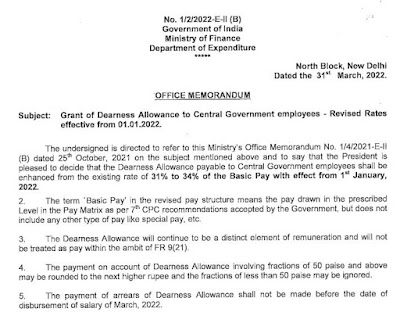
DA Jan 2022 - Grant of Dearness Allowance to Central Government employees - Revised Rates effective from 01.01.2022

 3% DA Hike - Revised Rates effective from 01.01.2022: DoE OM dated 31.03.2022 No. 1/2/2022-E-II (B) Government of India Ministry of Finance...