Showing posts with label Central Board of Direct Taxes. Show all posts

Saturday, 24 August 2019

CBDT issues clarification on eligibility of small Start-ups to avail tax holiday


Ministry of Finance
CBDT issues clarification on eligibility of small Start-ups to avail tax holiday
22 AUG 2019

The Central Board of Direct Taxes (CBDT) has clarified today that small start-ups with turnover upto Rs. 25 crore will continue to get the promised tax holiday as specified in Section 80-IAC of the Income Tax Act, 1961 (the ‘Act’), which provides deduction for 100 per cent of income of an eligible start-up for 3 years out of 7 years from the year of its incorporation.

CBDT further clarified that all the start-ups recognised by DPIIT which fulfilled the conditions specified in the DPIIT notification did not automatically become eligible for deduction under Section 80-IAC of the Act. A start-up has to fulfil the conditions specified in Section 80-IAC for claiming this deduction. Therefore, the turnover limit for small start-ups claiming deduction is to be determined by the provisions of Section 80-IAC of theAct and not from the DPIIT notification.
CBDT dispelled the confusion created by some media report claiming discrepancy that the I-T law was yet to reflect DPIIT’s higher turnover threshold of Rs. 100 crore. CBDT said thatthere was no contradiction in DPIIT’s notification dated 19.02.2019 and Section 80-IAC of the I.T. Act, 1961 because in para 3 of the said notification, it has clearly been mentioned that a start-up shall be eligible to apply for the certificate from the Inter-Ministerial Board of Certification for claiming deduction under Section 80-IAC of the Act, only if the start-up fulfils the conditions specified in sub-clause (i) and sub-clause (ii) of the Explanation of Section 80-IAC. Therefore, the turnover limit for eligibility for deduction under section 80-IAC of the Act, as per the DPIIT’s notification is also Rs. 25 crore.
It is further stated that Section 80-IAC contains a detailed definition of the eligible start-up which, interalia, provides that a start-up which is engaged in the eligible business shall be eligible for deduction, if (i) it is incorporated on or after 1st April 2016, (ii) its turnover does not exceed Rs. 25 crore in the year of deduction, and (iii) it holds a certificate from the Inter-Ministerial Board of Certification.

It was explained that this was the major reason as to why there was a wide difference between the number of start-ups recognised by the DPIIT and the start-ups eligible for deduction under section 80-IAC of the Act. It is pertinent to state that Section 80-IAC was inserted vide Finance Act, 2016 as an exception to the Government’s stated policy of phasing out profit-linked deduction for promoting small start-ups during their initial year of operation. Since the intention was to support the small start-ups, the turnover limit of Rs. 25 crore was considered reasonable for granting profit linking deduction.

PIB

Wednesday, 24 July 2019

CBDT – Order under Section 119 of the Income-tax Act, 1961

CBDT – Order under Section 119 of the Income-tax Act, 1961

CBDT

Order under Section 119 of the Income-tax Act, 1961

Extension of due date for filing of ITRs for the A.Y 2019-20 from 31st July, 2019 to 31st August, 2019

F. No. 225/157/2019/ ITA.II
Government of India
Ministry of Finance
Department of Revenue
Central Board of Direct Taxes

North-Block, ITA-II Division
New Delhi, the 23rd of July, 2019

Order under Section 119 of the Income-tax Act, 1961

The ‘due-date’ for filing income-tax returns for Assessment-Year 2019-20 is 31.07.2019 for certain categories of taxpayers. It has been reported that some of the taxpayers are facing difficulties in filing their income- tax returns due to various reasons including extension of due date for issue of Form 16 for the Assessment-Year 2019-20.

In this regard, the Central Board of Direct Taxes, in exercise of its powers conferred under section 119 of the Income-tax Act, 1961 (‘Act’), hereby extends the ‘due-date’, as prescribed under section 139(1) of the Act, for filing income-tax returns from 31st July, 2019 to 31st August, 2019 in cases of all taxpayers who are liable to file their income-tax returns by the said ‘due-date’.

sd/-
(Rajarajeswari R.)
Under Secretary to the Government of India

Source: Income tax India

Thursday, 2 May 2019

Public Consultation on the proposal for amendment of Rules for Profit attribution to Permanent Establishment

Public Consultation on the proposal for amendment of Rules for Profit attribution to Permanent Establishment
F.No.500/33/2017-FTD.I
Government of India
Ministry of Finance
Department of Revenue
Central Board of Direct Taxes
(Foreign Tax and Tax Research-I)

New Delhi, dated the 18th April, 2019

Subject: Public Consultation on the proposal for amendment of Rules for Profit attribution to Permanent Establishment-reg.

Taxation of non-residents in India is governed by the provisions of the Income-tax Act, 1961 (“the Act”) and the provisions of the Double Taxation Avoidance Agreement(s) [DTAA(s)] concluded or adopted by the central government under the 'X' wers conferred under Section 90 or 90A of the Act, respectively. Under the Act, the income tax is charged for the assessment year in respect of the total income of the previous year of every-person. In respect of a who is a non-resident, the total income includes all income from whatever source derived which is received or deemed to be received or accrues or arises or deemed to accrue or arise in India. The incomes that shall be deemed to accrue or arise in India are specified in Section 9 of the Act which. inter alia, provides that all income accruing or arising whether directly or indirectly, through or from any business connection in India shall be deemed to accrue or arise in India. However, in cases where a DTAA is also applicable, taxes on business income of a non-resident can be levied to the extent the same is permissible under such agreement. Thus, business income of a non- resident can be taxed in India if it satisfies the requisite thresholds provided under the Act as well as the threshold provided in the applicable tax treaty, by a concept of Permanent Establishment (PE). which is defined in Article 5 of Model Tax Conventions and tax treaties.

Under Article 7 in the Indian treaties, profits are to attributed to the PE as if it were a distinct and separate entity on the basis of the accounts of the PE and where such accounts are not available to enable determination of profits attributable to the PE, the profits attributable to the PE can be determined under the domestic laws. For the application of this method, the Assessing Officer in India can resort to Rule 10 of Income- tax Rules, 1962.

Recognizing the significance of issues relating to attribution of profits to a permanent establishment as well as the need to bring greater clarity and predictability in the applicable tax regime, a Committee was formed to examine the existing scheme of profit attribution to PE under Article 7 of DTAAs and recommend changes in Rule 10 of the Income-tax Rules. The Committee has submitted its report (enclosed herewith) and it has been decided to seek stakeholder’s comments on the Report of the committee.

In this regard, suggestions/comments of the stakeholders and the general public are invited on the following question:

a. What are your views on the recommendations of the Committee as contained in Section 11 of the Report? In answering this question please consider the objectives and policy rationale behind the change which have been elaborated in detail in the Report.

Comments and suggestions may sent electronically (in word format) at usfttr-1@gov.in within 30 days of the publication of this the email address document on website of the Income Tax Department

(www.incometaxindia.gov.in).
(Deepak Kapoor)
Under Secretary
Foreign Tax & Tax Research Division
Central Board of Direct Taxes

Monday, 21 January 2019

Central Board of Direct Taxes (CBDT) clarifies regarding issue of Prosecution Notices

Ministry of Finance
Central Board of Direct Taxes (CBDT) clarifies regarding issue of Prosecution Notices
21 JAN 2019
The Central Board of Direct Taxes (CBDT) has stated that certain news items that appeared in a section of media regarding enmasse issue of prosecution notices to small companies for TDS default are completely misleading and full of factual inaccuracies. CBDT clarified that Mumbai Income Tax TDS office has issued prosecution Show Cause Notices only in a limited number of big cases where more than Rs. 5 lakh of tax was collected as TDS from employees etc and yet the same was not deposited with the Income Tax Department in time.

CBDT said that some defaulter companies and vested interests are deliberately misleading the media to thwart action against themselves. Having deducted tax from employees and other taxpayers and not depositing the same in time in the Government Treasury is an offence punishable under the law. It also affects the interest of the employees from whose salary the tax has been deducted by the unscrupulous employers who have not deposited the same in time in the Government Treasury. If the TDS is not deposited in time, the employee would be ineligible for claiming credit of the tax deducted when he files his own return.

CBDT stated that in last one month, only in 50 big cases prosecution notices have been issued by Mumbai IT TDS office. Out of these, in 80% of the cases the TDS tax default is above Rs. 10 lakh and in 10 % cases, TDS default is between Rs. 5 to Rs.10 lakh. In the remaining 10% cases, TDS default is of more than Rs. 1 crore as detected in the survey. Prosecutions have also recently been launched against 4 big business houses where more than Rs 50 Crore of tax was collected by them from the tax payers and yet not deposited with the Government in time. But such legal and rightful action is being unfortunately projected in the media by the vested interests as if the Department is going overboard to harass small employers.

It would be pertinent to note that in a country of 130 Crore people where around 6 Crore returns are filed every year, only a total of 1400 prosecutions have been filed so far for various offences under the Income Tax Act during this financial year. This, by any stretch of imagination, cannot be termed as mass harassment by the income tax department. Therefore, to say that prosecution notices enmasse have been sent to taxpayers for minor defaults is completely incorrect and misleading, the CBDT added.

PIB

Monday, 22 October 2018

CBDT releases Direct Tax Statistics


CBDT releases Direct Tax Statistics

Constant growth in direct tax-GDP ratio over last three years
Growth of more than 80% in the number of returns filed in the last four financial years
Number of persons filing return of income has also increased by about 65% during this period from 3.31 crore in FY 2013-14 to 5.44 crore in FY 2017-18
22 OCT 2018
Continuing the practice of placing key statistics relating to direct tax collections and administration in public domain, the Central Board of Direct Taxes (CBDT) has further released time-series data as updated up to FY 2017-18 and income-distribution data for AY 2016-17 and AY 2017-18. The key highlights of these statistics are as under:
  • There is a constant growth in direct tax-GDP ratio over last three years and the ratio of 5.98% in FY 2017-18 is the best DT-GDP ratio in last 10 years.
  • There is a growth of more than 80% in the number of returns filed in the last four financial years from 3.79 crore in FY 2013-14 (base year) to 6.85 crore in FY 2017-18.
  • The number of persons filing return of income has also increased by about 65% during this period from 3.31 crore in FY 2013-14 to 5.44 crore in FY 2017-18.
There has been continuous increase in the amount of income declared in the returns filed by all categories of taxpayers over the last three Assessment Years (AYs). For AY 2014-15, corresponding to FY 2013-14 (base year), the return filers had declared gross total income of Rs.26.92 lakh crore, which has increased by 67% to Rs.44.88 lakh crore for AY 2017-18, showing higher level of compliance resulting from various legislative and administrative measures taken by the Government, including effective enforcement measures against tax evasion.

The total number of taxpayers (including corporates, firms, HUFs, etc.) showing income of above Rs. 1 crore has also registered sharp increase over the three-year horizon. While 88,649 taxpayers disclosed income above Rs. 1 crore in AY 2014-15, the figure was 1,40,139 for AY 2017-18 (growth of about 60%). Similarly, the number of individual taxpayers disclosing income above Rs. 1 crore increased during the period under reference from 48,416 to 81,344, which translates into a growth of 68%.

The average tax paid by corporate taxpayers has increased from Rs.32.28 lakh in AY 2014-15 to Rs.49.95 lakh in AY 2017-18 (growth of 55%). There is also an increase of 26% in the average tax paid by individual taxpayers from Rs.46,377/- in AY 2014-15 to Rs.58,576/- in AY 2017-18.
During the three-year period under reference, the number of salaried taxpayers has increased from 1.70 crore for AY 2014-15 to 2.33 crore for AY 2017-18 (up by 37%). The average income declared by the salaried taxpayers has gone up by 19% from Rs.5.76 lakh to Rs.6.84 lakh.

During the same period, there has also been a growth of 19% in the number of non-salaried individual taxpayers from 1.95 crore to 2.33 crore and the average non-salary income declared has increased by 27% from Rs. 4.11 lakh in AY 2014-15 to Rs. 5.23 lakh in AY 2017-18.

The availability of the time-series data and the income-distribution data of fairly long periods in the public domain will be found to be useful by the academicians, scholars, researchers, economists and the public at large in studying long-term trends of various indices of the effectiveness and efficiency of direct tax administration in India.

The new releases are available alongwith older publications at www.incometaxindia.gov.in.

PIB

Tuesday, 25 September 2018

Extension of date for filing of Income Tax Returns and Audit Reports from 30th September, 2018 to 15th October, 2018


Ministry of Finance
Extension of date for filing of Income Tax Returns and Audit Reports from 30th September, 2018 to 15th October, 2018
24 SEP 2018

The due date for filing of Income Tax Returns and Audit Reports for Assessment Year 2018-19 is 30th September, 2018 for certain categories of taxpayers. Upon consideration of representations from various stakeholders, the Central Board of Direct Taxes(CBDT) extends the ‘due date’ for filing of Income Tax Returns as well as reports of Audit (which were required to be filed by the said specified date) from 30th September, 2018 to 15th October, 2018 in respect of the said categories of taxpayers. However, there shall be no extension of the due date for the purpose of section 234A (Explanation 1) of the I.T. Act, 1961 pertaining to Interest for defaults in furnishing return, and the assessee shall remain liable for payment of interest as per provisions of section 234A of the Act.

PIB

Friday, 31 August 2018

Extension of date for filing of Income Tax Returns for taxpayers in Kerala


Ministry of Finance
Extension of date for filing of Income Tax Returns for taxpayers in Kerala

In view of the disruption caused due to severe floods in Kerala, the Central Board of Direct Taxes (CBDT) hereby further extends the "Due Date" for furnishing Income Tax Returns from 31st August, 2018 to 15th September, 2018 for all Income Tax assessees in the State of Kerala, who were liable to file their Income Tax Returns by 31st August, 2018.

CBDT had earlier extended the ‘Due Date’ for filing of Income Tax Returns from 31st July, 2018 to 31st August, 2018 in respect of the categories of taxpayers who were liable to file their Income Tax Returns by 31st July, 2018.

Source: PIB

Saturday, 24 June 2017

CBDT notifies new scrutiny notices with e-facility for taxpayers


CBDT notifies new scrutiny notices with e-facility for taxpayers

New Delhi: The CBDT has notified revised income tax scrutiny notices that will allow taxpayers to conduct their business with the taxman over the Internet without needing to visit the I-T office, hence reducing physical interface between them.

The new format pertains to three types of notices that are issued by the taxman under section 143(2) of the Income Tax Act (scrutiny of tax return) and the Central Board of Direct Taxes, the policy-making body of the department, has told all field I-T offices in the country that "all scrutiny notices..

., shall henceforth, be issued in these revised formats only".

"This has become necessary in view of board's (CBDT) decision to utilise e-proceeding facility for electronic conduct of assessment proceedings in a widespread manner from this financial year," the CBDT order, issued yesterday, said.

The three revised notices have been accessed by PTI and are meant for procedures of limited, complete and compulsory manual scrutiny.

A scrutiny procedure in the income tax system pertains to a case where a taxpayer is required to provide a number of documents and testimonials to the assessing officer (AO) after his or her case is picked up for a threadbare examination after study of their tax returns.

The department has said in the past that it only picks less than one per cent of the total I-T returns (ITRs) filed for examination under the long-drawn scrutiny process but this has still been a issue of grievance for many assessees.

Each of the three, one-page notices, will bear the name of the assessing officer, their designation, telephone and fax number and now, their email id too.

A taxpayer can use their account on the official e-filing website of the department (https://incometaxindiaefiling.gov.in/) or their personal email id to conduct their scrutiny assessment dealings with the AO.

"The department wants itself to be seen as a facilitator for the honest tax paying public without him or her requiring to visit the tax office and conducting their dealing with the AO with ease of the click of a computer mouse.The e-proceeding is aimed to curb complaints of harassment and corruption in tax related issues," a senior officer of the department said.

The new notices will also carry a five-point explanation about the new changes being made for the taxpayer with the ushering in of the Internet-based e-proceeding regime in the Income Tax Department.
"As part of the e-governance initiative to facilitate conduct of assessment proceedings electronically, I-T department has launched e-proceeding facility.

"It is a simple way of communication between the department and assessee, through electronic means, without the necessity to visit the income tax office for conduct of assessment proceedings. This taxpayer friendly measure would substantially reduce the compliance burden for the assessee," the note says.
However, the AO will have discretionary powers to call for additional documents and records and seek personal appearance of the taxpayer if there is a reason for him to delve deeper into the case and such a thing is not possible over the e-proceeding communication link.

The CBDT is also expected to soon implement the system of conducting the limited scrutiny cases via the 'e-proceeding' system through the official e-filing website.

PTI

Monday, 19 June 2017

CBDT Notifies Rule 10CB for Secondary Adjustments under Section 92CE of IT Act, 1961


CBDT Notifies Rule 10CB for Secondary Adjustments under Section 92CE of IT Act, 1961.

Rule 10CB for operationalising the provisions of secondary adjustment has been notified by the Central Board of Direct Taxes on 15th June, 2017. It prescribes the time limit for repatriation of excess money and the rate of interest to be applied for computing the income in case of failure to repatriate the excess money within the prescribed time limit. Separate rates of interest have been provided for international transactions denominated in Indian currency and in foreign currency. The rates of interest are applicable on an annual basis.

The time limit of 90 days for repatriation of excess money shall begin only when the primary adjustments exceeding Rupees One Crore made in respect of Assessment Year 2017-18 or later, attains finality. Where the transfer pricing order is appealed against by the taxpayer, the time limit for repatriation shall commence only after the appeal is finalised by the appellate authority.

The rule is available on the website of the Income-tax Department (www.incometaxindia.gov.in)

The Finance Act, 2017 inserted section 92CE in the Income-tax Act, 1961 with effect from 1st April, 2018 to provide for secondary adjustment by attributing income to the excess money lying in the hands of the associated enterprise, in order to make the actual allocation of funds consistent with that of the primary transfer pricing adjustment.  The provision shall apply to primary adjustments exceeding Rupees One Crore made in respect of Assessment Year 2017-18 onwards.

PIB

Requirement of tax deduction at source in case of entities whose income is exempted under Section 10 of the Income-tax Act, 1961-Exemption thereof

Requirement of tax deduction at source in case of entities whose income is exempted under Section 10 of the Income-tax Act, 1961-Exemption thereof.
CIRCULAR No. 18/2017
F. No. 385/01/2015-IT (B)
Government of India
Ministry of Finance
Department of Revenue
Central Board of Direct Taxes
North Block, New Delhi
29th May, 2017

Subject: Requirement of tax deduction at source in case of entities whose income is exempted under Section 10 of the Income-tax Act, 1961 - Exemption thereof.

The Central Board of Direct Taxes (the Board) had earlier issued Circular No. 4/2002 dated 16.07.2002 and Circular No. 7/2015 dated 23.04.2015 which laid down that in case of such entities, whose income is unconditionally exempt under Section 10 of the Income-tax Act (the Act) and who are also statutorily not required to tile return of income as per Section 139 of the Act, there would be no requirement for tax deduction at source (TDS) from the payments made to them since their income is anyway exempted from tax under the Act. The issue of whether exemption from TDS can be extended to more entities on these principles and whether the exemption is needed to be withdrawn in respect of some of the exempted entities was examined by the Board.


2. Examination of the eligibility of entities for exemption from TDS on the principle of unconditional exemption and no requirement to file return revealed that Circulars No. 4/2002 and 7/2015 are required to be updated to make the following changes:

Entities that meet both the above mentioned conditions but are not mentioned in the aforesaid Circulars need to be included in the list of exempted entities.
Entities that are mentioned in Circular No. 4/2002 but their exemption from income tax has since been withdrawn need to be removed from the list of exempted entities.
Entities that are mentioned in Circular No. 4/2002 but because of subsequent amendment they are now required to mandatorily the their returns of income u/s 139 need to be removed from the list of exempted entities.

3. In view of the above, a revised list of entities exempted from TDS has been drawn by adding entities in the first category listed above to the entities mentioned in Circular No. 4/2002 and Circular No. 7/2015 and removing entities in second and third categories from the list of existing entities eligible for exemption from TDS.

4. Accordingly, it has been decided that in case of below mentioned funds or authorities or Boards or bodies, by whatever name called, referred to in section 10 of the Income-tax Act, whose income is unconditionally exempt under that section and who are also statutorily not required to tile return of income as per section 139 of the Income-tax Act, there would be no requirement for tax deduction at source, since their income is anyway exempt under the Income-tax Act -

(i) "local authority", as referred to in the Explanation to clause (20);

(ii) Regimental Fund or Non-public Fund established by the armed forces of the Union referred to in clause (23AA);

(iii) Fund. by whatever name called, set up by the Life Insurance Corporation of India on or after 1st August, 1996, or by any other insurer referred to in clause (23AAB);

(iv) Authority (whether known as the Khadi and Village Industries Board or by any other name) referred to in clause (23BB);

(v) Body or authority referred to in clause (23BBA);

(vi) SAARC Fund for Regional Projects set up by Colombo Declaration referred to in clause (23BBC);

(vii) Insurance Regulatory and Development Authority referred to in clause (23BBE):

(viii) Central Electricity Regulatory Commission referred to in clause (23BBG);

(ix) Prasar Bharati referred to in clause (23BBH);

(x) Prime Minister's National Relief Fund referred to in sub-clause (i), Prime Minister’s Fund (Promotion of Folk Art) referred to in sub-clause (it), Prime Minister’s Aid to Students Fund referred to in sub-clause (iii), National Foundation for Communal Harmony referred to in sub-clause (ilia), Swachh Bharat Kosh referred to in sub-clause (iiiaa), Clean Ganga Fund referred to in sub-clause (iiiaaa) of clause (23C);

(xi) Provident fund to which the Provident Funds Act, 1925 (19 of 1925) referred to in sub-clause (i), recognized provident fund referred to in sub-clause (ii), approved superannuation funds referred to in sub-clause (iii), approved gratuity fund referred to in sub-clause (iv) and funds referred to in sub-clause (v) of Clause (25);

(xii) Employees' State Insurance Fund referred to in clause (25A);

(xiii) Agricultural Produce Marketing Committee referred to in clause (26AAB);

(xiv) Corporation. body, institution or association established for promoting interests of members of Scheduled Castes or Scheduled Tribes or backward classes referred to in clause (26B);

(xv) Corporation established for promoting interests of members of a minority community referred to in clause (26BB);

(xvi) Corporation established for welfare and economic upliftment of ex-servicemen referred to in clause (26BBB);

(xvii) New Pension System Trust referred to in clause (44).

4. This circular supersedes earlier Circulars on this issue e.g. Circular No. 4/2002 dated 16.07.2002 and Circular No. 7/2015 dated 23.04.2015 with effect from the date of issue of this Circular.

5. Hindi version shall follow.

(Sandeep Singh)
Under Secretary to the Govt. of India
Source: CBDT Circular

Flash News

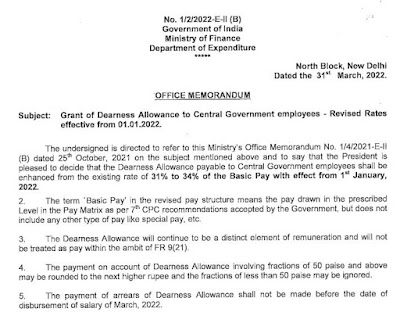
DA Jan 2022 - Grant of Dearness Allowance to Central Government employees - Revised Rates effective from 01.01.2022

 3% DA Hike - Revised Rates effective from 01.01.2022: DoE OM dated 31.03.2022 No. 1/2/2022-E-II (B) Government of India Ministry of Finance...