Showing posts with label GDP. Show all posts

Monday, 22 October 2018

CBDT releases Direct Tax Statistics


CBDT releases Direct Tax Statistics

Constant growth in direct tax-GDP ratio over last three years
Growth of more than 80% in the number of returns filed in the last four financial years
Number of persons filing return of income has also increased by about 65% during this period from 3.31 crore in FY 2013-14 to 5.44 crore in FY 2017-18
22 OCT 2018
Continuing the practice of placing key statistics relating to direct tax collections and administration in public domain, the Central Board of Direct Taxes (CBDT) has further released time-series data as updated up to FY 2017-18 and income-distribution data for AY 2016-17 and AY 2017-18. The key highlights of these statistics are as under:
  • There is a constant growth in direct tax-GDP ratio over last three years and the ratio of 5.98% in FY 2017-18 is the best DT-GDP ratio in last 10 years.
  • There is a growth of more than 80% in the number of returns filed in the last four financial years from 3.79 crore in FY 2013-14 (base year) to 6.85 crore in FY 2017-18.
  • The number of persons filing return of income has also increased by about 65% during this period from 3.31 crore in FY 2013-14 to 5.44 crore in FY 2017-18.
There has been continuous increase in the amount of income declared in the returns filed by all categories of taxpayers over the last three Assessment Years (AYs). For AY 2014-15, corresponding to FY 2013-14 (base year), the return filers had declared gross total income of Rs.26.92 lakh crore, which has increased by 67% to Rs.44.88 lakh crore for AY 2017-18, showing higher level of compliance resulting from various legislative and administrative measures taken by the Government, including effective enforcement measures against tax evasion.

The total number of taxpayers (including corporates, firms, HUFs, etc.) showing income of above Rs. 1 crore has also registered sharp increase over the three-year horizon. While 88,649 taxpayers disclosed income above Rs. 1 crore in AY 2014-15, the figure was 1,40,139 for AY 2017-18 (growth of about 60%). Similarly, the number of individual taxpayers disclosing income above Rs. 1 crore increased during the period under reference from 48,416 to 81,344, which translates into a growth of 68%.

The average tax paid by corporate taxpayers has increased from Rs.32.28 lakh in AY 2014-15 to Rs.49.95 lakh in AY 2017-18 (growth of 55%). There is also an increase of 26% in the average tax paid by individual taxpayers from Rs.46,377/- in AY 2014-15 to Rs.58,576/- in AY 2017-18.
During the three-year period under reference, the number of salaried taxpayers has increased from 1.70 crore for AY 2014-15 to 2.33 crore for AY 2017-18 (up by 37%). The average income declared by the salaried taxpayers has gone up by 19% from Rs.5.76 lakh to Rs.6.84 lakh.

During the same period, there has also been a growth of 19% in the number of non-salaried individual taxpayers from 1.95 crore to 2.33 crore and the average non-salary income declared has increased by 27% from Rs. 4.11 lakh in AY 2014-15 to Rs. 5.23 lakh in AY 2017-18.

The availability of the time-series data and the income-distribution data of fairly long periods in the public domain will be found to be useful by the academicians, scholars, researchers, economists and the public at large in studying long-term trends of various indices of the effectiveness and efficiency of direct tax administration in India.

The new releases are available alongwith older publications at www.incometaxindia.gov.in.

PIB

Wednesday, 16 August 2017

Central Government To Cut 25 Percent Government Jobs


Central Government To Cut 25 Percent Government Jobs

New Delhi: Department of Personnel and Training (DoPT) sources verified on condition of anonymity that 25 percent full-time central government jobs will be cut.

It is an attempt to improve the country's financial health system, the sources added that the job cuts are needed to sustain the government’s expenditure.

"The reality is that we are not as efficient in managing our system as other developed countries are," sources said.
The sources also stated that over the last few years, Pay, Allowances and Pension (PAP) spending constitutes around 3.6 per cent of GDP.

The sources also noted that voluntary redundancies would be offered central government employees who having put in 20 years service or above 55 years.

More than other jobs are expected to go of the central government employees, whose performance is not upto the mark. Overall, the centre will lay off 25 percent full-time central government jobs.

The central government employees unions said they will strongly oppose any government jobs cut scheme, if it is announced.

They claim the job cuts would mean the central government employees are forced to bear the impact of the country’s financial problems. The unions leaders add that budget cuts on Pay, Allowances and Pension would also lead to suffer government smooth business and public service.

However, the sources acknowledged that the central government employees are well paid but the government needs to be more transparent in decisions regarding jobs in the central government department and ministry as the government employees from junior staff to top bureaucrats are not so talent.
So, the government committed to appoint best available talent from out side on the recommendation of the Niti Aayog and the government is mulling to appoint one-fifth of the 25 percent full-time central government jobs cut staff from out side in its departments and ministries.

The central government salaries accounts Rs 128,000 crore in 2017-18 of the nation expenditure. The sources claimed that without making significant changes in salaries costs, this would affect other areas including education, health care and infrastructure.

Wednesday, 22 March 2017

GST rollout from July 1 to make goods cheaper: Jaitley


GST rollout from July 1 to make goods cheaper: Jaitley

New Delhi: Hopeful of the GST rollout from July 1, Finance Minister Arun Jaitley today said it will create one of the world's biggest single markets and make commodities cheaper and tax evasion difficult.

Speaking at the 23rd Conference of the Commonwealth Auditor General, Jaitley said India has hugely a non-tax compliant society and the government banned higher denomination notes to curb the tendency of people to deal in cash that lead to tax evasion as well as terror financing.

He said the reform measures undertaken by the government will help India clock 7-8 % growth and retain the tag of fastest growing major economy in the world, but challenges remain in volatile global oil prices, reviving private sector investment and health of state-owned banks.

With regard to GST, he said the new indirect tax regime will ensure seamless transfer of goods and services, while stronger information technology backbone will make evasion difficult.

Despite being one political entity, India currently is not a single economic entity as there are multiple layers of taxation that make goods costlier. GST -  first proposed in 2006 - will replace at last 17 state and central levies.

The biggest taxation reform what we are trying to implement from July 1 is Goods and Services Tax … It will increase the volume of taxation, there is no tax on tax and therefore makes goods, commodities and services little cheaper and far more convenient, Jaitley said.

The Union Cabinet this week cleared four supplementary GST legislations which will be introduced in Parliament in the ongoing budget session.

The laws which enable this (GST) are now before Parliament which hopefully should get cleared and once they do get cleared then by the middle of this year we hope to see the implementation as far as this law is concerned, Jaitley said.

In terms of tax compliances, he said India ranks fairly high as a non-compliant state.

Therefore, one of the efforts of the state has been how to bring non- compliance to an end. Once the GST is introduced it will be a great check as far as evasion is concerned, he said, adding that the government has amended direct taxation law by bringing in curbs on cash currency.

Jaitley, yesterday, in Parliament introduced an amendment to Finance Bill 2017 proposing to ban cash dealings above Rs 2 lakh.

Cash component of Indian economy was exorbitantly high about 12.2 per cent of GDP and of this, 86 per cent was high denominational currency and therefore the tendency to deal excessively in cash did exist and this created its own challenges for economy, he said.

Cash facilitated crime, corruption, incentivised tax non-compliance and was facilitator for funding terrorism and insurgency, he said, as he defended November 8 decision of the government to demonetise 500 and 1,000 rupee notes.

(With demonetisation) Anonymity which was attached to this high level of cash operating in market that anonymity disappeared as it had to be deposited in bank.

This has also increased the trend towards digitisation of economy, (will) act as disincentive to continuing to deal in a shadow or parallel economy and lead to a further integration of informal with formal economy, Jaitley said.

He said the size of India's GDP in the near future will be bigger, size of formal economy will increase and will be cleaner.

As regards growth, Jaitley said India would continue to remain amongst the fastest growing economies of the world.

For the last three years we have been the fastest growing major economy, we will continue to be in that phase. I think for India to achieve the growth rate of 7-8 % is reasonably logically plausible. If big growth returns to the world we probably can push upwards, he said.

Outlining the challenges for Indian economy, Jaitley said the government is now trying to address the problems plaguing the public sector banks and also increasing private investment.

We are hopeful that in the next few quarters, will probably see a better result as far as those areas are concerned, he said, adding oil prices remain an uncertainty for India.

The gross NPAs of public sector banks have risen from Rs 5.02 lakh crore at the end of March 2016 to Rs 6.06 lakh crore in December 2016.

PTI

Thursday, 22 September 2016

Cabinet approves merging of Rail budget with Union Budget


Cabinet approves merging of Rail budget with Union Budget

New Delhi: In a major overhaul, the Cabinet today approved advancing presentation of the annual Budget by a month, scrapped over nine decade old tradition of having a separate Railway Budget and removed classifications for expenditure to make the exercise simpler.

With a view to get all the legislative approvals for the annual spending and tax proposals before the beginning of the new financial year on April 1, the Cabinet headed by Prime Minister Narendra Modi approved advancing date for presentation of the General Budget by a month instead of present practice of unveiling it at the end of February.

The Cabinet also approved merging Railway Budget with the general Budget and doing away with distinction of plan and non plan expenditure, officials said.

To facilitate this, the Budget Session of parliament will be called sometime before January 25, a month ahead of the current practice.

Accordingly, the beginning of budget preparation will be advanced to early October and GDP estimates made available on January 7 instead of February 7 now.

Till now Budget was presented on the last day of February and it is not until mid-May that the Parliament approves it in two parts. And with the monsoon arriving in June, most of the schemes and spendings by states do not take off until October, leaving just half a year for their implementation.

Early presentation of Budget would mean that the entire exercise is over by March 31, and expenditure as well as tax proposals come into effect right from the beginning of new fiscal, thereby ensuring better implementation.

Also, the 92 year old practice of presenting a separate budget for Railways has been scrapped and proposals pertaining to it would now form part of the General Budget.

This would lead to presentation of a single Appropriation Bill, including the estimates of Ministry of Railways, thereby saving precious time of Parliament by not having to hold separate consideration and passing of two Appropriation Bills.

The Cabinet also approved removal of distinction between Plan and Non Plan expenditure as the present classification resulted in excessive focus on former with almost equivalent neglect to items such as maintenance which are classified as non Plan.

The Cabinet felt it is the total expenditure, irrespective of Plan or Non-Plan, that generates value for the public. Plan expenditure was for the first time presented separately in the budget for 1959 to 1960.

PTI

Wednesday, 29 June 2016

Exclusive: Union Cabinet granted Seventh Pay commission recommendations

Exclusive: Union Cabinet granted Seventh Pay commission recommendations

modi-jaitley-7th-CPC

The Cabinet has cleared all recommendations made by the Seventh Pay Commission report that will result in about 23.55 percent overall increase in salaries, allowances and pension for more than 1 crore government staff and pensioners. The move is expected to give a big boost to the economy as consumption demand in urban areas is likely rise owing to the rising income levels.

In January, the government had set up a high-powered panel headed by Cabinet Secretary PK Sinha to process the recommendations of the 7th Pay Commission which will have a bearing on the remuneration of nearly 50 lakh central government

The Sinha committee has submitted its report on the recommendations, a PTI report said.

Here's a quick look at the recommendations and the likely implications for the economy:

The recommendations

The Pay Commission recommended 23.55 percent overall increase in salaries, allowances and pension. This is estimated to put an additional burden of Rs 1.02 lakh crore, or nearly 0.7 percent of the GDP, on the government.

The panel recommended a 14.27 percent increase in basic pay, the lowest in 70 years. (The 6th Pay Commission recommended 20 percent hike. This was doubled while implementing it in 2008.)

The minimum pay in government is recommended to be set at Rs 18,000 per month. This is more than double the present Rs 7,000.

The maximum pay is set at Rs 2,25,000 per month for apex scale and Rs 2,50,000 per month for cabinet secretary and others at the same pay level (as against the current Rs 90,000 per month).

In order to bring in greater transparency, the report has recommended replacing the present system of pay bands and grade pay with a new pay matrix.

Of the total financial impact of Rs 1,02,100 crore, the increase in pay would be Rs 39,100 crore, increase in allowances Rs 29,300 crore and increase in pension Rs 33,700 crore.

Also, Rs 73,650 crore of the outgo will be borne by the general budget and Rs 28,450 crore by the Railway Budget.

Implications for economy

The Pay Commission recommendations, once implemented, are expected to boost the consumption demand, and in turn growth.

As R Jagannathan argued in this article, the recommendations could turn out to be an opportunity for prime minister Narendra Modi as the "dash of additional expenditure may be just the prod required for restarting the virtuous cycle of consumption, investment, growth, profits and all the related paraphernalia".

However, there are other issues. It is going to increase the general expenditure of the government. When these recommendations were made, inflation was moderate. But the actual implementation of these recommendations is coming at a time when inflation is rearing its head again. So, there are chances that a spike in demand supported by higher pay to the government staff may just push the inflation further up.

It also has to be remembered that crude oil prices that were benign a while back are not so now. The prices for crude are seen around $50 dollar a barrel now and a further increase cannot be ruled out. However, the only thing that may come to the rescue is a Brexit-induced global demand slowdown that will keep the commodity prices, including that of crude, under check.

The Reserve Bank of India, in its last policy statement, had raised these concerns while saying the surprise rise in April inflation has rendered uncertainty its future trajectory.

"...There are upside risks – firming international commodity prices, particularly of crude oil; the implementation of the 7th Central Pay Commission awards which will have to be factored into projections as soon as clarity on implementation emerges; the upturn in inflation expectations of households and of corporates; and the stickiness in inflation excluding food and fuel," it said.

Above all, a PTI report said citing sources that the secretaries’ panel may have recommended higher pay increase, with minimum entry level pay at Rs 23,500 a month and maximum salary of Rs 3.25 lakh.

If the government approves this, the outgo will increase further and so will the burden on government expenditure. It will also have serious repercussions on fiscal deficit of the government which has been set at 3.5 percent of GDP.

Past experience


However, Richa Gupta, senior economist, Deloitte India, thinks the net impact of the implementation of the recommendation is going to be positive on the economy.

"Overall, there are three aspects: once implemented the recommendations will result in an increase in urban demand; this may in turn lead to higher inflation and put a burden on the government spending. But past experiences tell us that the net impact of pay commission implementation has always been positive," she said.

Also, it is to be noted that the global economy may continue in a rough patch due to Brexit. In such a scenario, the only factor that could help India is the domestic demand and a 23.55 percent compensation hike for government staff will only help, Gupta added.

Source: firstpost.com

Tuesday, 21 June 2016

On 7th Pay Commission implementation, private investment, Air India and more, here’s what govt is mulling over

On 7th Pay Commission implementation, private investment, Air India and more, here’s what govt is mulling over

7thpay-orop-gdp


Besides the government staff, economic analysts are keenly awaiting when and how the Centre will implement 7th Pay Commission award, which has implications for government finances (with estimated outgo of Rs 74,000 crore in FY16) as well as on inflation.

Also, with private investments yet to show decisive signs of picking up, the government has the difficult task of keeping the tempo in public spending, especially capital investments, at a time it is losing the benefits of low crude oil prices.

Finance secretary Ashok Lavasa speaks on these issues in an interview to FE’s Prasanta Sahu. Excerpts.

GDP growth in FY16 was put by the Central Statistics Office at 7.6%, with the growth in the last quarter coming in at 7.9%. Private consumption has been the growth driver. Despite the efforts by the government, private investors are yet to shed their diffidence. Among infrastructure sectors, highways, railways etc. have seen a turnaround but mainly because of government investment. How far is this model sustainable given the Centre’s (limited) fiscal capacity?
Many infrastructure projects, in which private sector has been involved, have started moving. In highway sector, for example, the hybrid annuity model has started attracting investors. As we go forward, we feel that the initiatives that have been taken by the government – to improve the ease of doing business and integrate various clearances – would give a push to private-sector investments. In infrastructure sectors, where the government plays a key role in awarding contracts etc, we are seeing positive results too. If all the factors are favourable, the GDP growth could be close to 8% this year.

The questions about GDP data refuse to wither away. Manufacturing GDP growth and the IIP (industrial production) data aren’t quite compatible, even if one considers the fact that apart from output, value addition is now being captured more efficiently.

The Q4 results of some of the major companies show that their EBITDA has increased. The variation between manufacturing growth (9.3% in FY16) and IIP (2.4%) was mainly due to the fact that some sectors did well while some did not.

How important are lower interest rates in reviving demand?
I think it’s a question of giving a boost to demand. Sometimes people may have more expectation than what RBI could do (in terms of lowering rates). The RBI has had to consider various factors and take a considered view. It is not possible to please all people all times. It is fair to expect that whatever lowering (of rates) has been done by RBI, finds an expression in the retail lending rates. I think the governor is right in saying full transmission has not happened of the central bank’s (cumulative 150 bps) rate cut since January 2015.

What will be the guiding framework of the “prospective planning” that will replace five-year Plan?
We could divide it into three parts: the period till which one can have some predictability on availability of resources, that will be, say, a three-year action plan. Beyond this, there will be medium-term (seven-year) Plan. Besides, there can be a prospective plan for theb period till 2030. In the prospective plan, what you already have is sustainable development goals, which are part of the international commitments. Niti Aayog will look at integration of issues and prospective planning while department of expenditure will make the fund allocations for various programmes.

Will substantial additional provision be needed to meet the Pay Panel-related outgo in FY17?
It will be too early and premature to say whether budgetary provision is not adequate or not. No one knows to what extent the government will accept the Pay Commission’s report. But, there is a provision in the budget to take care of the impact of the pay commission award (According to sources, FY17 budget has provision of about Rs 54,000 crore for honouring the pay panel’s award, but Lavasa refused to comment on this ).

Will Niti Aayog’s reported suggestions on strategic disinvestments in a clutch of PSUs including Air India be taken forward this year?
We haven’t so far received the recommendations you are referring to. We have to explore all forms of divestment and strategic sale is of course one of them. The Department of Investment and Public Asset Management will be looking at all possibilities and deciding on which unit to be put on privatisation or disinvestment or strategic sale mode.

Is there any move to monetise surplus land with defence, railways and ports bodies?
This is not to be done as a central government policy. The railways have been trying to monetise land. Certainly, this is one source of revenue, but it may be not a very significant source. Whenever an entity decides to take up any piece of land for monetisation, it has to consider all the legal issues, physical condition, its own plans of utilising and ultimately, if there is a market for that (in case of sale/leasing out).

Source: FE

Tuesday, 9 February 2016

7.6% GDP says govt policies, reforms showing results: Finmin

7.6% GDP says govt policies, reforms showing results: Finmin

New Delhi: The Finance Ministry today said the projected 7.6 per cent growth rate for current fiscal is satisfactory and is a reflection of the policies and reform measures undertaken by the government in last 19 months.

“Overall, what is important is the direction of the numbers… There is improvement in the numbers which is quite satisfying.

“The policies and the reform measures the government has undertaken in last one and half years are beginning to show results. The policies and reform measures will continue,” Economic Affairs Secretary Shaktikanta Das told reporters.

He was reacting to the advance estimates for national income of 2015-16 fiscal by the Central Statistics Office (CSO) which today projected the GDP growth rate at 7.6 per cent.

According to the data, the economy grew at 7.6 per cent in first quarter, 7.7 per cent in second quarter and 7.3 per cent in the third quarter ending December 31, 2015.

“Especially satisfying and noteworthy is the industrial growth with special focus on manufacturing. Agriculture continues to be a matter of concern because of consecutive drought. Overall the direction of the numbers is very positive,” Das said.

The CSO’s estimate of 7.6 per cent growth in current fiscal is higher than the projection by RBI, Finance Ministry and IMF.

While RBI projected a growth rate of 7.4 per cent, Finance Ministry’s mid-year economic review had estimated the growth to be between 7-7.5 per cent.

Besides, IMF had said India will clock 7.3 per cent growth in 2015-16 and ADB projected it at 7.4 per cent.

PTI

Sunday, 24 January 2016

7th Pay Commission – Government to Factor in Payout of 7th CPC in Deficit Targets

7th Pay Commission – Government to Factor in Payout of 7th CPC in Deficit Targets

“The government will not be generous in the pay out this time as they already are facing pressures from various fronts like disinvestment and poor direct tax collections,” said Dharmakirti Joshi, currently the chief economist at CRISIL.

7th Pay Commission – Government to Factor in Payout of 7th CPC in Deficit Targets – It is expected that the government, while putting a final seal on the recommendations, will keep in mind the tight fiscal position of the country.
The payout of the seventh pay commission recommendations will make finance minister Arun Jaitley walk a tight rope when he announces the fiscal deficit targets for 2016-17.

Expected to incur an additional expenditure of Rs 1.02 lakh crore to pay higher salaries and pensions recommended by the commission, Rs 28,000 crore alone will go for salary hikes of railway employees. In total, the implementation will impact the fiscal deficit by 0.65% of the GDP.

Experts feel that deficit figures shared in the medium-term fiscal policy statement had stated that the fiscal deficit target for FY17 and FY18 is 3.5% and 3.0%, respectively will have a significant impact from the pay commission pay out, leaving the government with higher deficit numbers.

“Achieving these targets in view of the likely acceptance and implementation of the recommendations of the Seventh Central Pay Commission will be difficult. We expect that the fiscal deficit of FY17 to come in at 3.9% of GDP. This will push the attainment of the fiscal deficit target of 3% of GDP to FY19, a year later than envisaged in the fiscal policy statement. In the past also, pay revisions have pushed fiscal consolidation targets. Accordingly, the fiscal deficit targets are likely to be 3.9%, 3.5% and 3.0% in 2016-17, 2017-18 and 2018-19 respectively,” said Sunil Kumar Sinha, principal economist, India Ratings & Research.

However, the pay commission revisions are yet to be accepted by the high-powered panel headed by cabinet secretary PK Sinha. The recommendations have a bearing on the remuneration of 47 lakh central government employees and 52 lakh pensioners.

An empowered committee of secretaries was being decided to screen the recommendations with regard to all relevant factors of the Commission in an expeditious detailed and holistic fashion.
Though senior finance ministry officials feel that the pay-out which is likely to come only in the middle of 2016, might not be a big burden as the arrears would not be accounting to be much, unlike the past instances.

But, it is expected that the government, while putting a final seal on the recommendations, will keep in mind the tight fiscal position of the country.

“The government will not be generous in the pay out this time as they already are facing pressures from various fronts like disinvestment and poor direct tax collections,” said Dharmakirti Joshi, currently the chief economist at CRISIL.

Finance ministry till now has maintained a stand that it will be able to meet its target despite additional outgo on account of higher pay. But, finance minister Jaitley recently admitted that the impact of implementing the recommendations would last for two to three years.

The seventh pay commission had recommended an average 23.55% increase in salaries, allowances and pension, a move that will benefit 4.8 million staffers and 5.5 million pensioners. The hike will be effective from January 1, 2016.

A minimum pay of Rs 18,000 per month and a maximum of Rs 2.5 lakh has been recommended by the commission, headed by Justice (retired) AK Mathur, that presented its 900-page report to finance minister Arun Jaitley.

Source: Hindustan Times

Tuesday, 17 November 2015

Impact of 7th pay commission very different from last one

Impact of 7th pay commission very different from last one

With investments sluggish and unlikely to pick up for another year or two, many are now betting on a recovery in consumption demand to bump up GDP. The feeling is falling interest rates will prompt purchases of homes and cars, and that central government employees could turn out to be big buyers once their bank accounts have been credited with funds following the recommendations of the 7th Pay Commission. Savings to households from lower prices of oil are expected to free up cash for discretionary spends while a higher MSP (minimum support price) for wheat, if that happens, will boost farm incomes.

However, for a variety of reasons, the rise in consumption-demand this time around may not quite match the spurt seen when the 6th Pay Commission’s recommendations were implemented. As Kotak Institutional Equities points out, the economic environment at the time—the report was implemented in 2008 but effective from January 2006—was far less challenging than currently and there were many other factors that contributed to the surge in consumer demand, none of which is present today. Halving of excise duties—from 16% to 8% between February 2008 and 2009—allowed auto firms to drop prices, and a 425 bps cut in the policy rate in a span of just seven months made money significantly cheaper. Both moves were part of a stimulus package meant to revive demand after the global financial meltdown and resulted in a fall in product prices; the cost of a Maruti Swift, for instance, fell from R6.4 lakh to R5.6 lakh or by around 12%. That apart, the rural economy at the time was in far more robust shape than it is today with farm incomes rising sharply over FY05-13 driven by the MNREGA and big hikes in MSPs; the hike in MSPs for both seasons of FY09 was particularly steep given the elections were round the corner. As such, rural India was a lot more prosperous than now with real rural wages barely growing.

Moreover, consumer confidence was reasonably high as private sector investment, which rose steadily after 2004 and peaked in 2008 at 14% of GDP, had created a lot of jobs. Today, private sector investments are at 15-year lows and corporate cash flows are crimped with most companies highly leveraged. Given the far more difficult environment today, it would be unwise to expect an impact of similar magnitude on consumption demand from pay hikes following the 7th Pay Commission’s recommendations. To be sure, the impact would also depend on the quantum of the hike — the last time around, there was a total increase of 120% between FY06 and FY11, translating into a compounded annual increase of 17%, including R44,000 crore of arrears. Even if the pay hikes are as generous, since there will be no great delay in implementation, there will be no major piling up of arrears. Given that the overall environment will not be as conducive as it was at the time of the 6th Pay Commission, it is unlikely the 7th Pay Commission will pull consumer sentiment up enough to give the economy the boost it needs.

Source: PAlegacy

Wednesday, 30 September 2015

Seventh Pay Commission to offer realistic view on salaries and allowances

Seventh Pay Commission to offer realistic view on salaries and allowances

The Sixth pay commission was constituted in 2006 and in the normal course, the government was expected to announce the next pay commission after a gap of 10 years. The fifth came in 1996. But with the UPA government’s image battered by a spate of corruption scandals, the date had been advanced by two years in order to recover some lost ground with the electorate.

The UPA government justified the early constitution of the commission on the ground that it will take around two years to submit its recommendations. The Sixth pay commission, for example, was constituted in October 2006 and the Centre implemented it ahead of the 2009 Lok Sabha elections, showering central government employees with a big pay hike bonanza.

The Sixth pay commission had recommended a 20 to 40 per cent jump in salary. This cheered the employees, but wreaked havoc with the government’s finances as the fiscal deficit soared to 6 per cent of the gross domestic product (GDP). The consequent burden of arrears on the central government was Rs 28,160 crore on a salary base of Rs 44,360 crore.

The cash-strapped government had disbursed the arrears in two instalments with 40 per cent given out in 2008-09 and 60 per cent in 2009-10. The arrears contributed significantly to the Centre overshooting its target in 2008-09, ending the year with a fiscal deficit of 6 per cent of GDP against the budgeted 2.5 per cent.

The fiscal deficit rose to 6.4 per cent of GDP in 2009-10 as pay commission arrears pushed up the expenditure at a time when the government was battling slowdown in revenues. With the Seventh pay commission, the situation is headed in the same direction and the country will eventually have to face the music of this populism.

Accordingly, the Seventh Pay Commission is likely to offer realistic view on increase of salaries and allowances of central government employees.
The pay panel may definitely bring also toll on the exchequer as government has to manage expenditures of One Rank One Pension (OROP) for ex-sevicemen before Seventh pay commission expenditures.
It is expected that the central government’s salary bill will rise by 9.56% to Rs 1,00,619 crore after Seventh pay commission will come into effect.
This OROP announcement will have a significant impact on Seventh pay commission report badly, especially in salary hike and increasing allowances,” said a pay panel official.

“We have to look financial health of government before submitting our report. We have to save financial position of government to run the nation smoothly. We are not only to work for pay hike.” he added.

However, the recommendations of Seventh Pay Commission, may be implemented by NDA government before the announcement of West Bengal, Assam, Kerala and Tamil Nadu states assemblies’ election in May 2016.

“The central government will decide execution time of the pay commission’s proposals after the pay panel submits its report, which will be possible pre-election “special packages” for West Bengal, Assam, Kerala and Tamil Nadu, which are all due for polls by May 2016,” an official of the Finance Ministry said, speaking on condition of anonymity.

The Seventh Pay Commission is likely to submit its report in December. The Commission has already completed discussions with various stakeholders, including organisations, federations, groups representing civil employees as well as Defence services and is in the process of finalising its recommendations.
The recommendations of the Seventh Pay Commission are scheduled to come into effect from January 1, 2016.
TST

Sunday, 20 September 2015

7th Pay Commission: Employees’ delight, government's despair

7th Pay Commission: Employees’ delight, government's despair

New Delhi: The Seventh Pay Commission report is awaited, the new pay scales will be applicable to Central government employees with effect from January 2016.

50 lakh central government employees and 56 lakh pensioners including dependents hope to get this gift from April next year. The revised pay scales are likely to be implemented retrospectively starting 1 January 2016.

Many commentators say that the average increase in basic fair pay for all government employees will be in the region of 40-45%.

This is a very rough average because for senior level officers, like the Cabinet Secretary or officials at the secretary level, the payback could increase by more than 50%.

As the Pay Commission numbers come through there could be a 30-40 per cent increase for each central government employee.

An increase of salary and allowances would boost middle class central government employees to spend more time with their families for marketing.

The economy would get a major boost from a pickup in consumption, resulting from an increase in salaries but the flip side to the hike will be a spike in inflation.

The reports of Seventh Pay Commission will be implicated from April next year as Finance Minister Arun Jaitley said in the Parliament on February 27, “The Seventh Pay Commission impact may have to be absorbed in 2016-17.”

Finance Minister Arun Jaitley said above statement in his pre-budget speech. His statement indicates that the government may implement Seventh Pay Commission report from April 2016.

The strongest criticism of Pay Commission awards is that they play havoc with government finances. The pervious pay commissions’ rollout has been negative for fiscal balances.

The recommendations of the second pay commission were accompanied with a financial impact of about Rs 39 crore. The financial burden of the implementation of the third, fourth, fifth pay and sixth pay commission recommendations has been estimated at around Rs 144 crore, Rs 1,282 crore, Rs 17,000 crore and Rs 20,000 crore respectively.

Initial estimates suggest the seventh pay commission could add Rs 1,00,619 crore to the central government’s wage bill.

The central government pay and allowances amount to 1 per cent of GDP today. State wages amount to another 4 per cent, making for a total of 5 per cent of GDP.

The medium-term expenditure framework recently presented to Parliament by Finance Minister Jaitley, which looks at an increase in pay of 16 per cent for 2016-17 consequent to the Seventh Pay Commission award. That would amount to an increase of 0.8 per cent of GDP. This is a one-off impact.

One Rank One Pension is also a rider to enforcement of the seventh pay commission’s recommendation. The government is committed to OROP for the armed forces. This would impose an as yet undefined burden on Central government finances.
TST

Friday, 6 February 2015

One rank one pension scheme

Pros and cons of One rank one pension scheme


New Delhi, Feb 5: One Rank One Pension ‘OROP’ implies equal amount of pension for having served in the same rank and also having rendered the same length of service.
For an example, a Sepoy who retired in 1995 would get the same amount of pension as the one who retired in 1996.
Pay commission makes thing worse 
Discontent among ex-servicemen is largely because of the reason that with every successive pay commission the gap between past pensioners and their younger equivalents grows further. According to Lt Gen Raj Kadyan, who is the chairman of Indian Ex Servicemen Movement, “The stark difference can be seen after implementation of the Sixth Pay Commission”. He further says, “for equal service, a Sepoy, who retired prior to 1996, gets 82% lower pension than a Sepoy who retires after 2006. Similarly, among officers, a pre-1996 Major gets 53% lower pension than his post 2006 counterpart”.
Problems with OROP 
The OROP is not easy as it seems to some. There are several big hurdles to achieve this ambitious task. When a country has ‘zero’
GDP In a country which has zero GDP growth. 
A worker, who wants pension wealth at the age of 60, buys annuity, needs to pay a fixed amount of money every year into his pension account that will help him purchase a annuity post retirement. The magnitude of his annuity must be half his last salary.
Let assume, if the person pays Rs A (for annuity) which eventually pays him Re 1 per month, post retirement. In such a case his pension at the time of retirement will be half his final wage, Aw/2; where w is the person’s wage.
This is how all ordinary pension schemes work. If one wants an unfunded, or a `defined benefit’ pension, then the taxpayer will have to pay Aw/2 for each person.
In India today, A is roughly Rs 4000.
In simple words, if a person wants a fixed cash flow of Rs 1 per month until he/she dies, then the annuity market will charge him/her a sum of Rs A. This will be the lowest price of an annuity or simple unindexed nominal annuity.
Real annuities in a ‘zero’ GDP environment 
Now suppose, if a person wants an inflation indexed Rs 1 per month instead of getting nominal Rs 1/month. Then it becomes an inflation indexed annuity, which will cost a lot higher than A. In order to get nominal annuity, the provider invests in nominal bonds to produce a stream of cash.
But in case of an inflation-indexed annuity, the provider will have to invest in inflation-indexed bonds, which yield a lower stream of cash. Therefore, a person needs to pay much more than A to get an inflation indexed stream of Rs 1/month. In such a case the price is B, and as we know B >> A.
If a government promises an unfunded inflation-indexed annuity, it is placing an expense of Bw/2 on the tax payer.
Problems of GDP growth 
In a country with high GDP growth, where per capita growth is say 6%. In such a country GDP doubles every decade and that is where the difference emerges.
Suppose a person’s age is 60 but his wage was half of those who are getting 59-years-old. His pension remains constant when he’s 70 but those who were 59 have roughly got their wage doubled. In such a scenario, a pensioner is no match to a worker.
This was not a big deal in Western countries as they have a slow growth rate but in case of a high GDP the gap becomes a mammoth one.
A person who is at the 90th percentile of the income distribution at 60 years of age will end up at perhaps the 70th percentile of the income distribution at the age of 70.

Read at : http://www.oneindia.com

Flash News

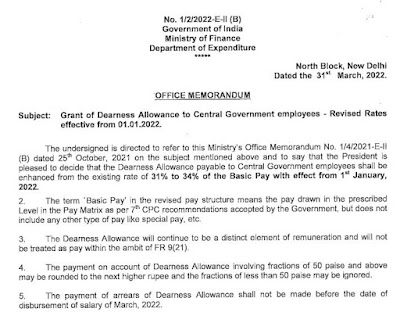
DA Jan 2022 - Grant of Dearness Allowance to Central Government employees - Revised Rates effective from 01.01.2022

 3% DA Hike - Revised Rates effective from 01.01.2022: DoE OM dated 31.03.2022 No. 1/2/2022-E-II (B) Government of India Ministry of Finance...