Showing posts with label Income-Tax Act. Show all posts

Thursday, 1 February 2018

Amendments in the income-tax act proposed to notify a new scheme for assessment in electronic mode


Press Information Bureau
Government of India
Ministry of Finance

01-February-2018 13:20 IST

Amendments in the income-tax act proposed to notify a new scheme for assessment in electronic mode.

E-assessment to be rolled-out across the country to transform age-old assessment procedure

In the General Budget 2018-19 presented in Parliament today, the Union Minister for Finance and Corporate Affairs, Shri Arun Jaitley proposed to amend the Income-tax Act to notify a new scheme for assessment. Shri Jaitley said the assessment will be done in electronic mode which will almost eliminate person to person contact leading to greater efficiency and transparency. The Finance Minister added that the e-assessment system was introduced in 2016 on a pilot basis. In 2017, it was extended to 102 cities with the objective of reducing the interface between the department and the taxpayers. "With the experience gained so far, we are now ready to roll out the E-assessment across the country, which will transform the age-old assessment procedure of the income tax department and the manner in which they interact with taxpayers and other stakeholders" Shri Jaitley said.

Monday, 19 June 2017

Requirement of tax deduction at source in case of entities whose income is exempted under Section 10 of the Income-tax Act, 1961-Exemption thereof

Requirement of tax deduction at source in case of entities whose income is exempted under Section 10 of the Income-tax Act, 1961-Exemption thereof.
CIRCULAR No. 18/2017
F. No. 385/01/2015-IT (B)
Government of India
Ministry of Finance
Department of Revenue
Central Board of Direct Taxes
North Block, New Delhi
29th May, 2017

Subject: Requirement of tax deduction at source in case of entities whose income is exempted under Section 10 of the Income-tax Act, 1961 - Exemption thereof.

The Central Board of Direct Taxes (the Board) had earlier issued Circular No. 4/2002 dated 16.07.2002 and Circular No. 7/2015 dated 23.04.2015 which laid down that in case of such entities, whose income is unconditionally exempt under Section 10 of the Income-tax Act (the Act) and who are also statutorily not required to tile return of income as per Section 139 of the Act, there would be no requirement for tax deduction at source (TDS) from the payments made to them since their income is anyway exempted from tax under the Act. The issue of whether exemption from TDS can be extended to more entities on these principles and whether the exemption is needed to be withdrawn in respect of some of the exempted entities was examined by the Board.


2. Examination of the eligibility of entities for exemption from TDS on the principle of unconditional exemption and no requirement to file return revealed that Circulars No. 4/2002 and 7/2015 are required to be updated to make the following changes:

Entities that meet both the above mentioned conditions but are not mentioned in the aforesaid Circulars need to be included in the list of exempted entities.
Entities that are mentioned in Circular No. 4/2002 but their exemption from income tax has since been withdrawn need to be removed from the list of exempted entities.
Entities that are mentioned in Circular No. 4/2002 but because of subsequent amendment they are now required to mandatorily the their returns of income u/s 139 need to be removed from the list of exempted entities.

3. In view of the above, a revised list of entities exempted from TDS has been drawn by adding entities in the first category listed above to the entities mentioned in Circular No. 4/2002 and Circular No. 7/2015 and removing entities in second and third categories from the list of existing entities eligible for exemption from TDS.

4. Accordingly, it has been decided that in case of below mentioned funds or authorities or Boards or bodies, by whatever name called, referred to in section 10 of the Income-tax Act, whose income is unconditionally exempt under that section and who are also statutorily not required to tile return of income as per section 139 of the Income-tax Act, there would be no requirement for tax deduction at source, since their income is anyway exempt under the Income-tax Act -

(i) "local authority", as referred to in the Explanation to clause (20);

(ii) Regimental Fund or Non-public Fund established by the armed forces of the Union referred to in clause (23AA);

(iii) Fund. by whatever name called, set up by the Life Insurance Corporation of India on or after 1st August, 1996, or by any other insurer referred to in clause (23AAB);

(iv) Authority (whether known as the Khadi and Village Industries Board or by any other name) referred to in clause (23BB);

(v) Body or authority referred to in clause (23BBA);

(vi) SAARC Fund for Regional Projects set up by Colombo Declaration referred to in clause (23BBC);

(vii) Insurance Regulatory and Development Authority referred to in clause (23BBE):

(viii) Central Electricity Regulatory Commission referred to in clause (23BBG);

(ix) Prasar Bharati referred to in clause (23BBH);

(x) Prime Minister's National Relief Fund referred to in sub-clause (i), Prime Minister’s Fund (Promotion of Folk Art) referred to in sub-clause (it), Prime Minister’s Aid to Students Fund referred to in sub-clause (iii), National Foundation for Communal Harmony referred to in sub-clause (ilia), Swachh Bharat Kosh referred to in sub-clause (iiiaa), Clean Ganga Fund referred to in sub-clause (iiiaaa) of clause (23C);

(xi) Provident fund to which the Provident Funds Act, 1925 (19 of 1925) referred to in sub-clause (i), recognized provident fund referred to in sub-clause (ii), approved superannuation funds referred to in sub-clause (iii), approved gratuity fund referred to in sub-clause (iv) and funds referred to in sub-clause (v) of Clause (25);

(xii) Employees' State Insurance Fund referred to in clause (25A);

(xiii) Agricultural Produce Marketing Committee referred to in clause (26AAB);

(xiv) Corporation. body, institution or association established for promoting interests of members of Scheduled Castes or Scheduled Tribes or backward classes referred to in clause (26B);

(xv) Corporation established for promoting interests of members of a minority community referred to in clause (26BB);

(xvi) Corporation established for welfare and economic upliftment of ex-servicemen referred to in clause (26BBB);

(xvii) New Pension System Trust referred to in clause (44).

4. This circular supersedes earlier Circulars on this issue e.g. Circular No. 4/2002 dated 16.07.2002 and Circular No. 7/2015 dated 23.04.2015 with effect from the date of issue of this Circular.

5. Hindi version shall follow.

(Sandeep Singh)
Under Secretary to the Govt. of India
Source: CBDT Circular

Saturday, 28 January 2017

TDS on approved Provident and Superannuation Funds as per Income-Tax Act

TDS on approved Provident and Superannuation Funds as per Income-Tax Act

income-tax-deduction-2017


TDS on payment of accumulated balance under recognised provident fund and contribution from approved superannuation fund

Ministry of Finance has issued a circular about details of TDS on approved Provident and Superannuation Funds as per Income-Tax Act

TDS ON PAYMENT OF ACCUMULATED BALANCE UNDER RECOGNISED PROVIDENT FUND AND CONTRIBUTION FROM APPROVED SUPERANNUATION FUND:

    The   trustees of a Recognized Provident Fund, or any person   authorized   by the regulations of the Fund   to  make payment of  accumulated   balances due   to  employees, shall   in   cases where sub-rule(1) of Rule 9 of Part A of the Fourth Schedule   to the Act applies, at the time   when the accumulated   balance due to an employee is paid, make therefrom   the deduction specified in Rule 10 of Part A of the Fourth Schedule to the Act.

The accumulated balance is treated as income chargeable under the head “Salaries”.

Where any contribution   made by an  employer,  including   interest on  such  contributions,  if any, in  an approved Superannuation Fund is paid to the employee,  tax on the  amount so paid shall be deducted by the trustees of the Fund  to the extent provided in Rule 6 of Part B of the Fourth Schedule to the Act. TDS should be at the average rate of tax at which, the employee was liable to be taxed during the preceding three years or during the period, if that period is less than three years, when he was member of the fund.

The deductor shall remain liable to deduct tax on any sum paid on account of returned contributions (including interest, if any)  even if a fund or part of a fund ceases to be an approved Superannuation fund.

As per section 192A of the Act, w. e. f. 01.06.2015 the trustees of the EPF Scheme 1952 framed under section 5 of the EPF & Misc. Provisions Act, 1952 or any person authorized under the scheme to make payment of accumulated balance due to employees, shall, in a case where the accumulated balance due to an employee participating in a recognized provident fund is includible in his total income owing to the provisions of Rule 8  of Part A of Fourth Schedule not being applicable at the time of payment of accumulated balance due to the employee, deduct income tax thereon @ 10% if the amount of such payment or aggregate of such payment exceeds Rs 50,000/-. In case the employee does not provide his/her PAN No., then the deduction will have to be made at maximum marginal rate.

Check the Circular

Tuesday, 12 July 2016

7th Pay Commission Pay Out – Best Tax Saving Investment Options


There are a large variety of tax-saving options available under Section 80C of the Income-Tax Act. However, the key issues are the safety, returns and tax status while investing.

7th Pay Commission Pay Out – Best Tax Saving Investment Options – The increased pay packet by the 7th pay commission will come with its own set of concerns on managing the money.

The 7th Pay Commission payout is all set to begin with central government employees to get higher salaries and arrear payments soon.

The increased pay packet by the 7th pay commission will come with its own set of concerns on managing the money. While there will be a portion for expenditure that has been pending, you need to have a definite plan of setting aside a decent amount as long-term savings and invest it in appropriate instruments. One portion of investment would be for tax-saving purposes.

You will have nearly eight months till March 31, 2017 to make your investment for tax-saving purposes but it is always good to start investing early. So, what are the options before you and what should you look for while investing for saving tax?

“There are a large variety of tax-saving options available under Section 80C of the Income-Tax Act. However, the key issues are the safety, returns and tax status while investing. You also have to consider the periodic returns and at the time of maturity or redemption,” Sanjeev Govila, CEO, Hum Fauji Initiative, told FeMoney.

Govila suggests Public Provident Fund (PPF) figures among the top of the list. “PPF is the best tax- saving avenue for the risk averse as it gives decent interest of 8.1 per cent as on date and enjoys the E-E-E (Exempt ExemptExempt) status. If someone finds the returns low and are prepared to accept some volatility of returns, tax saving mutual funds (called ELSS – Equity Linked Savings Scheme) are very good. They also have E-E-E status. If chosen carefully ELSS are likely to provide higher returns than PPF,” Govila said.

Though ELSS have the shortest lock-in period of all tax-saving investments of just three years, you can continue investing for as long as you want. Also contributions can be made regularly through automatic ECS from bank account. Govila, however, warns that ELSS returns are market linked.

“Apart from these, five year tax-saving bank FDs, insurance policies and NSC also are 80C investments. But low returns take their sheen off. NSC are E-E-E provided the interest received is shown re-invested in the I-T Returns each year (except the last year when it matures) and bank FDs are in the E-T-T bracket,” says Govila.

FeMoney spoke to leading personal finance advisor, Anil Rego, CEO and Founder, Rights Horizons to bring to you snapshot of the most-favoured tax-savings options under Section 80C as a ready reckoner.

Equity-linked Savings Scheme – Has lock-in of 3 years; can be invested up to be a maximum of Rs.1.5 lakhs under 80C and others.

Public Provident Fund – Has lock-in of 7 years, investments are eligible for tax exemption u/s 80C.

Sukanya Samridhi Scheme (If the investor has a girl child) – Investments can be withdrawn only after girl turns 21 or 50 per cent of the corpus when girl turns 18 or gets married.

National savings certificates – NSC-VIII has a lock in period for 5 years and NSC-IX has lock in for 10 years. There is no maximum limit of investment in NSC, but you can claim a tax deduction for Rs 1.5 lakhs under section 80C.

Tax free bonds – These bonds are not eligible for deduction under section 80C. It means that the interest earned on tax-free bonds is exempted from taxation. However, the bonds are subject to capital gains tax. Usually these bonds have a lock in period of 5 years.

Insurance policies – Though these can be used for tax savings under Section 80C, Rego advises that the principal aim of insurance should be to cover life risk rather than as an investment instrument.

Source: FE

Flash News

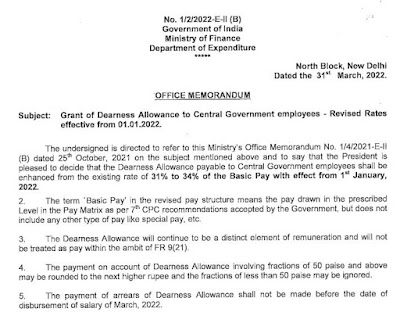
DA Jan 2022 - Grant of Dearness Allowance to Central Government employees - Revised Rates effective from 01.01.2022

 3% DA Hike - Revised Rates effective from 01.01.2022: DoE OM dated 31.03.2022 No. 1/2/2022-E-II (B) Government of India Ministry of Finance...