Showing posts with label Provident Fund. Show all posts

Friday, 6 April 2018

Current Pension rate of Contributory Provident Fund (CPF) Pensioners


Current Pension rate of Contributory Provident Fund (CPF) Pensioners

Ministry of Finance
Current Pension rate of Contributory Provident Fund (CPF) pensioners

The Central Government employees who are covered by CPF Rules (India) 1962 and who retired on or after 01.01.1986 are not entitled to any monthly pension/ex-gratia amount. However, the Government employees under CPF who retired between 18.11.1960 and 31.12.1985 are entitled to monthly ex-gratia amount of the following rates:

S.
No
Group of Service to which CPF retirees belonged at the time of retirementEnhanced amount of basic monthly ex-gratia
1Group A ServiceRs. 3,000/-
2Group B ServiceRs. 1,000/-
3Group C ServiceRs. 750/-
4Group D ServiceRs. 650/-
5Widows and dependent children of the deceased CPF beneficiaryRs. 645/-

Dearness ex-gratia equal to 50% of the amount of ex-gratia and Dearness Relief, as notified from time to time as per 5th Central Pay Commission series, on the sums of amount of ex-gratia and dearness ex- gratia is being paid to them. There is no proposal to increase the aforesaid rates.
This was stated by Shri Shiv Pratap Shukla, Minister of State for Finance in a written reply to a question in Lok Sabha today.

PIB

Tuesday, 25 July 2017

Inoperative EPF Accounts


Inoperative EPF Accounts

The Government vide notification no. G.S.R. 1065 (E) dated 11.11.2016 has amended paragraph 72(6) of the Employees’ Provident Funds (EPF) Scheme, 1952 wherein changes have been made in the conditions leading to a Provident Fund (PF) account becoming an Inoperative Account. As per amended definition of Inoperative Account (w.e.f. 11.11.2016), an account becomes inoperative after the age of 58 years, i.e., 36 months after the retirement age of 55 years. The details of inoperative accounts and amounts involved therein, consequent upon implementation of the above notification, have not been ascertained by Employees' Provident Fund Organisation (EPFO) presently as the date of birth in respect of many employees is not available in the EPFO database presently.

As per paragraph 60(6) of EPF Scheme, 1952, interest shall not be credited to the account of a member from the date on which it has become an inoperative account under paragraph 72(6) of EPF Scheme, 1952. However, as per amended definition, an account shall be classified as Inoperative after the member attains the age of 58 years. Hence, interest shall be credited to the account of a member upto the age of 58 years.
This information was given by Shri Bandaru Dattatreya the Minister of State (IC) for Labour and Employment, in a written reply to a question in Lok Sabha, today.

Monday, 20 February 2017

General Provident Fund (Tamilnadu) : Rate of interest for the period 01.01.2017 to 31.03.2017


General Provident Fund (Tamilnadu) : Rate of interest for the period 01.01.2017 to 31.03.2017

PROVIDENT FUND : General Provident Fund (Tamilnadu) : Rate of interest for the period 01.01.2017 to 31.03.2017 - Orders - Issued.

Read the following:- 1. G.O.Ms.No.276, Finance (Allowances) Department, dated 24.10.2016.
2. From the Government of India, Ministry of Finance, Department of Economic Affairs, (Budget Division) New Delhi, Resolution No.5(1)-B(PD)/2016, dated 18.01.2017.

ORDER:
In the Government Order read above, orders were issued fixing interest for the accumulation at the credit of the subscribers to the General Provident Fund (Tamil Nadu) at 8.0% for the period from 1st October 2016 to 31st December, 2016.

2. In its order second read above, the Government of India has announced that during the year 2016-2017 accumulations at the credit of subscribers to the General Provident Fund and other similar funds shall carry interest at the rate of 8.0% with effect from 1st January 2017 to 31st March 2017.

3. The Government now direct that the rate of interest on the accumulation at the credit of the subscribers to the General Provident Fund (Tamil Nadu) shall carry interest at the rate of 8.0% (Eight point zero per cent) during the period from 1st January 2017 to 31st March 2017.

4. The rate of interest on belated final payment of General Provident Fund accumulations remaining unpaid for more than three months of its becoming payable shall be at the same rate as ordered in para 3 above.
(BY ORDER OF THE GOVERNOR)
K. SHANMUGAM ADDITIONAL
CHIEF SECRETARY TO GOVERNMENT
Click to view the original order
Authority: www.tn.gov.in

Saturday, 28 January 2017

TDS on approved Provident and Superannuation Funds as per Income-Tax Act

TDS on approved Provident and Superannuation Funds as per Income-Tax Act

income-tax-deduction-2017


TDS on payment of accumulated balance under recognised provident fund and contribution from approved superannuation fund

Ministry of Finance has issued a circular about details of TDS on approved Provident and Superannuation Funds as per Income-Tax Act

TDS ON PAYMENT OF ACCUMULATED BALANCE UNDER RECOGNISED PROVIDENT FUND AND CONTRIBUTION FROM APPROVED SUPERANNUATION FUND:

    The   trustees of a Recognized Provident Fund, or any person   authorized   by the regulations of the Fund   to  make payment of  accumulated   balances due   to  employees, shall   in   cases where sub-rule(1) of Rule 9 of Part A of the Fourth Schedule   to the Act applies, at the time   when the accumulated   balance due to an employee is paid, make therefrom   the deduction specified in Rule 10 of Part A of the Fourth Schedule to the Act.

The accumulated balance is treated as income chargeable under the head “Salaries”.

Where any contribution   made by an  employer,  including   interest on  such  contributions,  if any, in  an approved Superannuation Fund is paid to the employee,  tax on the  amount so paid shall be deducted by the trustees of the Fund  to the extent provided in Rule 6 of Part B of the Fourth Schedule to the Act. TDS should be at the average rate of tax at which, the employee was liable to be taxed during the preceding three years or during the period, if that period is less than three years, when he was member of the fund.

The deductor shall remain liable to deduct tax on any sum paid on account of returned contributions (including interest, if any)  even if a fund or part of a fund ceases to be an approved Superannuation fund.

As per section 192A of the Act, w. e. f. 01.06.2015 the trustees of the EPF Scheme 1952 framed under section 5 of the EPF & Misc. Provisions Act, 1952 or any person authorized under the scheme to make payment of accumulated balance due to employees, shall, in a case where the accumulated balance due to an employee participating in a recognized provident fund is includible in his total income owing to the provisions of Rule 8  of Part A of Fourth Schedule not being applicable at the time of payment of accumulated balance due to the employee, deduct income tax thereon @ 10% if the amount of such payment or aggregate of such payment exceeds Rs 50,000/-. In case the employee does not provide his/her PAN No., then the deduction will have to be made at maximum marginal rate.

Check the Circular

Tuesday, 20 December 2016

CBT recommends 8.65% interest on EPF to its subscribers for the year 2016- 17

Press Information Bureau
Government of India
Ministry of Labour & Employment
19-December-2016 16:54 IST

Shri Bandaru Dattatreya chaired the 215th meeting of the Central Board of Trustees (EPF)

CBT recommends 8.65% interest on EPF to its subscribers for the year 2016- 17

The Minister of State for Labour and Employment (Independent Charge) Shri Bandaru Dattatreya chaired the 215th meeting of the Central Board of Trustees (EPF) in Bengaluru today.

Following are the key decisions of the Board.

1. The Board adopted the 63rd Annual Report on the work and activities of the EPFO for the year 2015-16 for placing it before the Parliament.

2. Paragraph 60(1) of Employees’ Provident Funds Scheme 1952, requires EPFO to credit to the account of each member interest at such rate as determined by the Central Government in consultation with the Central Board. The interest is credited to the members account on monthly running balances basis with effect from the last day in each year. Interest rates are dependent on return on investments done following the pattern of investment prescribed by the Central Government from time to time under Para 52 of the Scheme.

To recommend the rate of interest for the year 2016-17, the status of estimated amount to the credit of the members as on 01.04.2016, budget estimates (BE) of the Contributions and Withdrawals during 2016-17 and the estimated income from the investment holdings are taken into consideration. Interest income from Provident Fund investments for the year 2016-17 has been estimated mainly on the basis of interest income received/receivable in the financial year 2016-17 including surplus from previous year of Rs 410 crore. It may be noted that the last year income included a surplus from previous year of Rs 1604 crore.

Taking into account relevant factors, the Central Board decided to recommend 8.65% interest to its subscribers for the year 2016-17. Roughly 17 crore subscribers’ accounts will be updated with this interest rate upon acceptance by the Government.

3. Enrolment and Establishment coverage campaign 2017

This special campaign will be run in the following manner:

For effective monitoring and implementation the Zonal Addl. CPFCs shall lead the campaign. District Offices of EPFO will be activated and sufficient number of officers will be exclusively engaged.
Meetings with the stakeholders namely Employer & Employee associations and State Governments will be held to make it a success. During the campaign wide publicity of PMRPY and PMPRPY benefits will also be undertaken. Online enrollment facilities to workers will form a key feature of the campaign.
Window will be provided from 01.01.2017 till 31.03.2017.

Following recommendation will be made for approval of the Government.
i. A nominal rate of levy of damages from the establishment for payment of contribution for the past period during the campaign for enrolment will be Rs one (Rs.1) per annum.

ii. Any employer during the campaign period, may send declaration for membership of the employees who were required or entitled to become members of the fund on or after the 1st day of April, 2009 but before the 1st day of January, 2017 who could not be enrolled for any reason.

iii. For the declaration made under this campaign, the employer shall be responsible to remit the contributions and interest payable in accordance with the provisions of the Act and the Schemes read with special provisions notified by the Central Government for enrolment campaign.

iv. No administrative charges will be leviable for the past period in respect of the employees enrolled during the campaign. The necessary amendments will be carried out under the relevant provisions of EPF & EDLI Scheme

v. The interest of workers enrolled under the campaign will be fully protected and they shall be eligible to get all eligible interest and benefits as laid down in the Schemes.

vi. To have uniform and nominal rate of levy of damages from the establishment for payment of contribution for the past period during the campaign for enrolment shall be fixed at Rs one (Rs.1) per annum. Enabling provision shall be inserted under para 32(a) of the EPF Scheme 1952 and under para (5) of Employees Pension Scheme, 1995 and para 8-A of EDLI Scheme, 1976.
This campaign will be suitably staffed and resourced so that employers who come forth to extend social security to their employees receive all possible assistance from EPFO. The action will meet the twin objectives of increasing the enrolment, extending social security benefits to all workers and reducing litigation.

4. The Board approved a set of guidelines for streamlining process of surrender of exemption granted to establishments. Surrender of exemption is a situation where an establishment requests to discontinue the exemption granted to it. As the Act and Scheme is silent regarding the procedure of surrender of exemption by an establishment, the decision assumes importance in helping ease of doing business.

5. The Supreme Court in SLP no.33032-33033 in the matter of R. C. Gupta & others has passed certain orders of credit of amounts in the EPF accounts to the previous accounts of employees in respect of wages more than the statutory wage limit. The orders are to the effect that if amounts exceeding statutory wage ceiling have been credited to EPFO, the classification thereon shall be at the joint option of employers and employees. In accordance, the Central Board approved a proposal for facilitating compliance. The 8.33% of the employer’s contribution proportionate to the salary of employees in excess of Rs.6500/- shall now be credited to the pension scheme along with the interest accrued in the provident fund account The employees however shall be required submit joint application along with their employer wherever the same has not been done. This will be applicable only in those case where the members/pensioners have contributed on higher wages than the statutory wage ceiling of Rs.6500/- with or without exercise of option prior to the issue of notification for increase of wage ceiling to Rs.15000/- effective from 01.09.2014.

6. The administration cost of the Employees’ Provident Fund (EPF) and Employees’ Deposit Linked Insurance Scheme (EDLI), 1976, is met from the administrative and inspection charges collected from the employers of un-exempted and exempted establishments. No charges however are levied to run Employees’ Pension Scheme (EPS), 1995.

The Central Government in consultation with the Central Board of Trustees, EPF fixes the administrative charges from time to time. The administrative charges were last reduced from 1.10% to 0.85% with effect from 1st January, 2015.Considering the need to promote the “Ease of Doing Business in India” and to make Indian business more competitive, and in response to the financial efficiency gained by EPFO, the Central Board decided to recommend further reduction of administrative charges to 0.65 %. It also recommended to abolish administrative charges levied in implementing the EDLI Scheme, 1976 passing on the benefits of efficiency and computerisation to employers. The Central Board also decided to constitute a sub-committee of CBT with members drawn from employees and employer representatives to make a pragmatic study of employment trends for next 10 years and recommend appropriate administrative charges to the Central Board.

7. The Chairman, CBT and the Minister of State for Labour and Employment (Independent charge) announced that Organisational Restructuring has been approved by the Union Government for implementation. This includes Cadre Restructuring which will ensure career progression of 20,000 staff/officers of EPFO. The Minister announced that this will be implemented as a New Year gift.

Monday, 24 October 2016

State Railway Provident Fund - Rate of interest during the year 2016-17 (October, 2016 - December, 2016)


State Railway Provident Fund - Rate of interest during the year 2016-17 (October, 2016 - December, 2016)

RBE No. 121/2016
GOVERNMENT OF INDIA (BHARAT SARKAR)
MINISTRY OF RAILWAYS (RAIL MANTRALAYA)
(RAILWAY BOARD)
No. F(E)III/2003/PF/1/1
New Delhi, Dated : 13.10.2016
The GMs/FA&CAOs,
All Indian Railways/Production Units,
(As per mailing list)

Subject: State Railway Provident Fund - Rate of interest during the year 2016-17 (October, 2016 - December, 2016).
******
A copy of Government’s Resolution No. 5(1)-B(PD)/2016 dated 3rd October, 2016 issued by the Ministry of Finance (Department of Economic Affairs) prescribing interest at the rate of 8.0% (Eight per cent) w.e.f. 1st October, 2016 to 31st December, 2016 on accumulations at the credit of the subscribers to State Railway Provident Fund, is enclosed, for information and necessary action.

2. Please acknowledge receipt
(Sanjay Prashar)
Deputy Director, Finance (Estt.) III
Railway Board.

(PUBLISHED PART I SECTION 1 of Gazette of India)
F.NO 5(1)-B(PD)/2016
Government of India
Ministry of Finance
Departments of Economic Affairs
(Budget Division)
New Delhi, the 3rd October, 2016

RESOLUTION

It is announced for general information that during the year 2016-2017, accumulations at the credit of subscribers to the General Provident Fund and other similar funds shall carry interest at the rate of 8.0% (Eight per cent) w.e.f.1st October, 2016 to 31st December 2016. This rate will in force w.e.f. 1st October 2016. The Funds concerned are :

1. The General Provident Fund (Central Services)
2. The Contributory Provident Fund (India)
3. The All India Services Provident Fund
4. The State Railway Provident Fund’
5. The General Provident Fund (Defence Services)
6. The Indian Ordnance Department Provident Fund.
7. The India Ordnance Factories Workmen’s Provident Fund
8. The Indian Naval Dockyard Workmen’s Provident Fund
9. The Defence Services Officers Provident Fund.
10.The Armed Forces Personnel Provident Fund

2. Ordered that the Resolution be published in Gazette of India
(Vyasan.R)
Deputy Secretary (Budget)
Source : NFIR

Tuesday, 16 August 2016

Pledging PF to buy home may soon become a reality

Pledging PF to buy home may soon become a reality

Retirement fund body EPFO may soon introduce a scheme to allow its over 4 crore subscribers to pledge their provident fund to buy low-cost houses and use the account to pay equated monthly installments.
“We are working on a housing scheme for members of the Employees’ Provident Fund Organisation (EPFO). Under it, members will be allowed to pledge their PF accumulations to buy homes,” Labour Secretary Shankar Aggarwal told PTI.

He added that the proposal will be placed before the EPFO’s Central Board of Trustees meeting expected next month. Once approved by the CBT, the scheme will be available for the subscribers.

Finer points of the scheme, as to what extent subscribers will be eligible to avail loans and what will qualify as a low cost house, are yet to be worked out.

Aggarwal further said: “We don’t want to impose anything on the subscribers. Therefore, we will not buy land or build houses for them. They will be free to choose their own homes from the open market.”

The panel had suggested this scheme for low income formal workers who are EPFO subscribers and could not buy a house during their entire service period.

Under the proposed scheme, there will be a tripartite agreement between member, bank/housing agency and EPFO for pledging future PF contributions as EMI payment.

Last year, the proposal for facilitating the EPFO subscribers to buy low cost homes was listed on the agenda of the CBT meeting held on September 16.

A report of an expert committee on housing facility for the subscribers was also presented to the trustees during the meeting.

The committee has unanimously recommended a scheme to facilitate subscribers to buy houses where they will get an advance from their PF accumulation and will be allowed to pledge their future PF contribution as EMI (Equated Monthly Instalment) payment.

The panel had suggested that subscribers will purchase a dwelling unit with loans from bank or housing finance companies and hypothecation of property in favour of the latter.

It was suggested the benefits under the scheme of Ministry of Housing and Urban Poverty Alleviation can also be extended to the beneficiaries of the scheme.

In May, Labour Minister Bandaru Dattatreya had told Lok Sabha in a written reply: “Government is exploring the possibility for providing a suitable low-cost housing scheme for subscribers of Employees’ Pension Fund. It is in preliminary discussion stage.”

Source : ET

Monday, 2 May 2016

Relaxation in EPFO scheme

Relaxation in EPFO scheme

The Government proposes to relax/amend the Employees' Provident Fund Scheme to enable loss-making and sick PSUs to continue to run their own Provident Fund Trusts.

The proposal is being examined in consultation with Central Board of Trustees, Employees’ Provident Fund.

The said relaxation will not be applicable to the private firms and their employees.

Provident Fund Trusts of exempted establishments are custodian of the hard-earned money of the workers which needs to be protected. The private companies do not have the sovereign guarantee behind them as enjoyed by the Public Sector Undertakings of both the Central Government and the State Governments. Therefore, the proposed amendment is not intended to extend this advantage to private companies, so as to protect the interest of the workers.

This information given by Shri Bandaru Dattatreya, the Minister of State (IC) for Labour and Employment, in reply to a question in Lok Sabha today.

Wednesday, 20 April 2016

Government puts on hold new Provident Fund withdrawal norms till July 31

Government puts on hold new Provident Fund withdrawal norms till July 31

The Government puts on hold new Provident Fund withdrawal norms till July 31. New PF withdrawal norms proposes to bar withdrawal of employer’s contribution to the provident fund corpus until the employee attains the age of 58 years.

On the issue of new Provident Fund withdrawal norms, the government today decided to keep the implementation of new norms in abeyance for three more months till July 31st.

The announcement comes in the midst of protest by labour unions in several parts of the country against the new norms.

People have also launched online campaign against the decision, which was to be implemented from February 10 but was later put on hold till April 30.

In February, the ministry had issued a notification restricting 100 per cent withdrawal of provident fund by members after unemployment of more than two months.

Source: DDI News

Saturday, 19 March 2016

Interest Rate Reduction on Public Provident Fund cut to 8.1% from 8.7%

Interest Rate Reduction on Public Provident Fund cut to 8.1% from 8.7%

In a move that will hit the common man, the government today slashed interest rates payable on small savings including PPF and Kisan Vikas Patra (KVP) in a bid to align them closer to market rates.

As a part of its February 16 decision to revise interest rates on small savings every quarter, the interest rate on Public Provident Fund (PPF) scheme will be cut to 8.1 per cent for the period April 1 to June 30, from 8.7 per cent, at present.

Similarly, the interest rate on KVP will be cut to 7.8 per cent from 8.7 per cent, according to Finance Ministry Order F.No.1/04/2016-NS.II, issued today.

While the interest rate on Post Office savings has been retained at 4 per cent, the same for term deposits of one to five years has been cut. The popular five-Year National Savings Certificates will earn an interest rate of 8.1 per cent from April 1 as against 8.5 per cent, at present.

A five-year Monthly Income Account will fetch 7.8 per cent as opposed to 8.4 per cent now. Girl-child saving scheme, Sukanya Samriddhi Account will see interest rate of 8.6 per cent as against 9.2 per cent.

Senior citizen savings scheme of five-year would earn 8.6 per cent interest compared with 9.3 per cent.

“On the basis of the decisions of the government, interest rates for small savings schemes are to be notified on quarterly basis,” the order said announcing the rates for the first quarter of fiscal 2016-17.

Post Office term deposits of one, two and three years command an interest rate of 8.4 per cent but from April 1, a 1-year Time Deposit will get 7.1 per cent, 2-year Time Deposit will earn 7.2 per cent and 3-Year Time Deposit will attract interest of 7.4 per cent.

Five-year time deposit will fetch 7.9 per cent interest in the first quarter as against 8.5 per cent while the same on five-year recurring deposit has been slashed to 7.4 per cent from 8.4 per cent.

The government had on February 16 announced moving small saving interest rates closer to market rates. On that day, rates on short-term post office deposits was cut by 0.25 per cent but long-term instruments such as MIS, PPF, senior citizen and girl child schemes were left untouched.

Post office savings of 1, 2 and 3 year term deposits, Kisan Vikas Patra (KVP) as well as 5-year Recurring Deposits till now earned 0.25 per cent higher interest than the government securities of similar tenures.

This advantage has been withdrawn with effect from April 1, 2016, the Finance Ministry said. On February 16, the government had left Sukanya Samriddhi Yojana, Senior Citizen Savings Scheme and the Monthly Income Scheme (MIS) — which command 0.75 per cent, 1 per cent and 0.25 per cent higher interest rate respectively than G-secs — untouched, saying they are linked to social security goals.

Similarly, long-term instruments such as 5-year term deposit and similar tenure National Saving Certificates as well as Public Provident Fund (PPF) had been left unchanged. But today, the interest rates on all these deposits have been cut.

Kisan Vikas Patra or KVP that currently provides for doubling of principal in 100 months (8 years and 4 months) will now be doubled in 110 months (9 years and 2 months) after the interest rate revision.

In February, the government had stated that the cut in small savings interest rate would help the economy move to “a lower overall interest rate regime eventually and thereby help all, particularly low-income and salaried classes”.

The government has also permitted premature closure of PPF accounts “in genuine cases”, like serious ailment or higher education of children.

“This shall be permitted with a penalty of 1 per cent reduction in interest payable on the whole deposit and only for the accounts having completed five years from the date of opening,” it added.

The interest rate for every quarter would be decided on the 15th of the preceding month.

So, for the April-June quarter, rates should have been set on March 15 but they were delayed. The rates for April-June quarter are based on G-Sec rates that prevailed in the previous three months — that is December, January and February.

PTI

Monday, 7 March 2016

Centre decides to withdraw tax on Provident Fund

Centre decides to withdraw tax on Provident Fund

News have surfaced that the Prime Minister has instructed the Finance Minister to put a hold on the proposed plan to impose taxes on PF withdrawals. Finance Minister Arun Jaitley is expected to make an official announcement in this regard shortly.

Employee unions all over the country have been vehemently opposing the proposed tax on the withdrawals made on the most important savings of a worker, from the moment the announcement was made. Most employees depend on their provident fund savings to meet some of the most important expenses of their lives, like medical, marriages, building a house, etc. The decision to impose tax on these withdrawals was condemned by all.

Jaitley had announced a tax on 60 percent of the Employee Provident Fund, and Public Provident Fund. The government has now said that they had planned to impose tax only on the PF Interest. But, there was strong opposition for this too. Demands were made to withdraw this tax.

According to information available, Jaitley had informed at the meeting of the MPs that the Prime Minister will have to decide on this. Meanwhile, the Prime Minister has recommended the Finance Minister to stop the tax on the PF withdrawals, and to conduct a thorough study on this. Arun Jaitley is expected to take the required action after consulting with the officials of his ministry. The Prime Minister’s intervention has restored the peace of mind of more than 60 lakh Government employees.

Saturday, 5 March 2016

Deduction of Income Tax on withdrawal of Provident Fund 60%

Deduction of Income Tax on withdrawal of Provident Fund 60%

NATIONAL COUNCIL (STAFF SIDE)
Joint Consultative Machinery for Central Government Employees
13-C, Ferozshah Road, New Delhi – 110001
E Mail: nc.jchm.np@gmail.com
No. NC-JCM/2016
Dated:- 1st March, 2016
To
The Hon’ble Finance Minister,
Government of India,
North Block,
New Delhi.

Dear Sir,
Sub: Deduction of Income Tax on withdrawal of P.F. 60%

We are deeply shocked to learn about imposing of tax on withdrawal of P.F.(Provident Fund) which is our hard earn money which used to be utilized in all emergencies for medical, educational, building of house, marriage of daughters etc.

Imposition of tax on that had created all round agitation among govt. employees.

On behalf of National Council/JCM it is very humbly requested that this tax proposal should be withdrawn immediately to stop the mental agony of government employees.

I hope Central Govt. will not give any chance of serious agitation on this issue and will not disturb industrial peace as a whole.
Thanking you ,
Yours faithfully,
sd/-
(Shiv Gopal Mishra)
Source: www.ncjcmstaffside.com

Tuesday, 1 March 2016

Clarification about Changes made in the Tax Treatment for Recognised Provident Fund & National Pension System (NPS)

Clarification about Changes made in the Tax Treatment for Recognised Provident Fund & National Pension System (NPS)

There seems to be some amount of lack of understanding about the changes made in the General Budget 2016-17 in the tax treatment for recognised Provident Fund & NPS.

The following clarifications are given in this matter:-
(i) The purpose of this reform of making the change in tax regime is to encourage more number of private sector employees to go for pension security after retirement instead of withdrawing the entire money from the Provident Fund Account.
(ii) Towards this objective, the Government has announced that Forty Percent(40%) of the total corpus withdrawn at the time of retirement will be tax exempt both under recognised Provident Fund and NPS.
(iii) It is expected that the employees of private companies will place the remaining 60% of the Corpus in Annuity, out of which they can get regular pension. When this 60% of the remaining Corpus is invested in Annuity, no tax is chargeable. So what it means is that the entire corpus will be tax free, if invested in annuity.
(iv) The Government in this Budget has also made another change which says that when the person investing in Annuity dies and when the original Corpus goes in the hands of his heirs, then again there will be no tax.
(v) The idea behind this mechanism is to encourage people to invest in pension products rather than withdraw and use the entire Corpus after retirement.
(vi) The main category of people for whom EPF scheme was created are the members of EPFO who are within the statutory wage limit of Rs.15,000 per month. Out of around 3.7 crores contributing members of EPFO as on today, around 3 crore subscribers are in this category. For this category of people, there is not going to be any change in the new dispensation.
(vii) However, in EPFO, there are about 60 lakh contributing members who have accepted EPF voluntarily and they are highly – paid employees of private sector companies. For this category of people, amount at present can be withdrawn without any tax liability. We are changing this. What we are saying is that such employee can withdraw without tax liability provided he contributes 60% in annuity product so that pension security can be created for him according to his earning level. However, if he chooses not to put any amount in Annuity product the tax would not be charged on 40%.
(viii) There is no change in the existing tax treatment of Public Provident Fund (PPF).
(ix) Currently there is no monetary ceilings on the employer contribution under EPF with only ceiling being that it would be 12% of the salary of the employee member. Similarly, there is no monetary ceiling on the employer contribution under NPS, except that it would be 10% of salary. 
(x) Now the Finance Bill 2016 provides that there would be monetary ceiling of Rs1.5 lakh on employer contribution considered with the ceiling of the 12% rate of employer contribution, whichever is less. 
(xi) We have received representations today from various sections suggesting that if the amount of 60% of corpus is not invested in the annuity products, the tax should be levied only on accumulated returns on the corpus and not on the contributed amount. We have also received representations asking for not having any monetary limit on the employer contribution under EPF, because such a limit is not there in NPS. The Finance Minister would be considering all these suggestions and taking a view on it in due course.

Friday, 12 February 2016

Budget 2016 – High Chances of Boost in Take Home Salary

“We are in favour of waiving the employees’ contribution altogether up to a certain level of income. This will boost the take-home salary of such employees rather than force them to park so much of their monthly income into their EPF account for retirement,” said the official.

Budget 2016 – High Chances of Boost in Take Home Salary – An analyst said this could also help arrest the trend of higher job creation in the informal sector and jobs of informal nature in the formal sector.

The Union Budget 2016-17 is likely to announce measures to put more money into the hands of employees with a monthly income up to a certain threshold, like Rs.10,000, for instance, by doing away with their mandatory 12 per cent contribution for Provident Fund (PF) savings, a government official said on condition of anonymity.

“We are in favour of waiving the employees’ contribution altogether up to a certain level of income. This will boost the take-home salary of such employees rather than force them to park so much of their monthly income into their EPF account for retirement,” said the official, who had participated in the deliberations of a Committee of Secretaries, set up by Prime Minister Narendra Modi, that has endorsed the idea.

Presently, 24 per cent of salaries of all employees in the formal sector earning up to Rs.15,000 a month, are deducted towards the employees’ PF account — with 12 per cent counted as employer’s share and 12 per cent as employee’s contribution.

Employers would continue to pay their 12 per cent share towards employees’ retirement savings account and other administrative charges, including those related to the employees’ deposit-linked insurance scheme that EPF account holders are automatically enrolled into. EPF contributions are mandatory for all firms employing twenty persons or more.

If the employees’ contribution is waived for those earning up to Rs.15,000 a month or Rs.1.8 lakh a year, the current ceiling for statutory EPF contributions, it would increase take home salaries for such employees by Rs.1,800 a month or Rs.21,600 a year. Officials said this would be the equivalent of a tax break to such beneficiaries as they are anyway not liable to pay any income tax. Personal income upto Rs.2.5 lakh a year is exempt from income tax.

While the government hopes this could spur domestic consumption and demand and play a part in reviving the investment cycle, it is also keen on doing away with the system of imposing high forced savings on low income workers through the statutory EPF contributions. The labour ministry as well as the Employees’ Provident Fund Organisation that administers the scheme have been consulted over the proposal and have concurred with it.

An analyst said this could also help arrest the trend of higher job creation in the informal sector and jobs of informal nature in the formal sector.

“In a formal sector job, if you earn Rs.15,000 a month, 44.3 per cent of your salary is deducted towards statutory benefits like EPF and employees’ State insurance. For someone earning Rs.55,000 a month, the same number is just 8 per cent,” said Rituparna Chakraborty, Senior Vice-President at Teamlease.

A lot of young entrants into the workforce prefer to opt for informal work contracts with no benefits in order to ensure that their take-home salaries remain high.

“Employers can’t raise their cost to company for employees, while the young workers starting their careers want more money in hand to take care of rent, commuting costs and daily meals. And once they start their career informally, it is difficult to change track,” said Ms. Chakraborty, adding that the reduction in statutory contributions for EPF would incentivise the creation of more formal jobs.

Source: The Hindu

Thursday, 16 October 2014

Dedication of Portability through Universal Account Number (UAN) for Employees Provident Fund

Dedication of Portability through Universal Account Number (UAN) for Employees Provident Fund
 
“The minimum pension for employees has been introduced first time so that employees’ pension is not less than Rs. 1000 per month. The wage ceiling has been raised from Rs. 6500 to Rs. 15000 per month to ensure that vulnerable groups are covered under EPF Scheme”.

Under the scheme complete information for approximately 4 crore subscribers of EPF has been centrally compiled and digitized and a UAN has been allotted to all. The UAN is being seeded with Bank account and Aadhar Card and other KYC details for financial inclusion of vulnerable section of society and their unique identification.

Camps are being organized to facilitate opening of bank account and Aadhar card for those subscribers who have no bank account or Aadhar card as on date. This will ensure portability of the Social Security Benefits to the labour of organised sector across the jobs and geographic areas. The EPF account of employee will be now be updated monthly and at the same time he will be informed through sms.

Finally it will ensure that each of the 4 crore or more EPF account holders have direct access to their EPF accounts and will also enable them to consolidate all their previous accounts (approximately Rs 27000 Crore are currently lying with EPFO in inoperative accounts). By 16th October, 2014, approximately 2 crore subscribers will have the benefit of portability through UAN. Subscribers have been informed through sms/email immediately on inauguration.

The minimum pension for employees has been introduced first time so that employees’ pension is not less than Rs. 1000 per month. The wage ceiling has been raised from Rs. 6500 to Rs. 15000 per month to ensure that vulnerable groups are covered under EPF Scheme.

Source: PIB News

Flash News

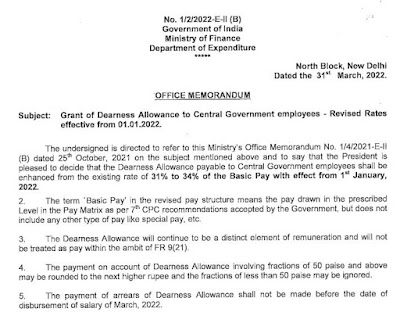
DA Jan 2022 - Grant of Dearness Allowance to Central Government employees - Revised Rates effective from 01.01.2022

 3% DA Hike - Revised Rates effective from 01.01.2022: DoE OM dated 31.03.2022 No. 1/2/2022-E-II (B) Government of India Ministry of Finance...