Showing posts with label PPF. Show all posts

Wednesday, 17 October 2018

Government Hikes GPF Interest Rate To 8% For October-December quarter


Government Hikes GPF Interest Rate To 8% For October-December quarter.

The government has increased the rate of interest for General Provident Fund (GPF) and other related schemes by 0.4 percentage points to 8 per cent for the October-December quarter.
The rate is in line with that for Public Provident Fund.

The interest rate on GPF was 7.6 per cent for the July-September quarter of 2018-19.

"… during the year 2018-2019, accumulations at the credit of subscribers to the General Provident Fund and other similar funds shall carry interest at the rate of 8 per cent with effect from October 1, 2018, to December 31, 2018," a Department of Economic Affairs' notification said.

The interest rate would apply on Provident Funds of central government employees, railways and defence forces.

Last month, the government announced that the interest on small savings, including NSC and PPF, will be hiked by up to 0.4 percentage point for the October-December quarter, to align it with rising deposit rates in the banks.

PTI

Monday, 12 March 2018

Public Provident Fund (PPF) account


Ministry of Finance
Public Provident Fund (PPF) account
09 MAR 2018
At present, premature closure of a Public Provident Fund (PPF) account is permitted on specified grounds on completion of five financial years from the date of opening of account. Opening of accounts in the name of a minor is permitted under all the small savings scheme except the Senior Citizens' Savings Scheme.

There are some ambiguities due to multiple Acts and rules for small savings schemes and the same are as under:
i. Certain provisions are not uniform in the existing three Acts.
ii. Some provisions have become redundant with time, which have been proposed to be deleted, with a view to simplify and avoid confusion.
iii. Some provisions are not clearly defined in existing Acts, leading to legal issues.
The Government proposed to merge Government Savings Certificates Act, 1959 and Public Provident Fund Act, 1968 with the Government Savings Banks Act, 1873. The main objective of the common act is to bring uniformity in the provisions of different small savings schemes presently governed by the three Acts.

The grievances relating to small savings are addressed by the banks and Department of Posts. Some grievances are also handled by Ministry of Finance.

This was stated by Shri P. Radhakrishnan, Minister of State for Finance in written reply to a question in Lok Sabha today.

PIB

Saturday, 30 September 2017

Aadhaar linking and interoperability of General Provident Fund (GPF), Public Provident Fund (PPF) and Employees Provident Fund (EPF)


Aadhaar linking and interoperability of General Provident Fund (GPF), Public Provident Fund (PPF) and Employees Provident Fund (EPF)

No.CAIU/011(44)2016/Aadhar/10273
Date: 22 SEP 2017
To
All ACCs (Zones) including ACC (ASD),
All RPFC-I/ RPFC 11 (Regional Offices),

Sub: Aadhaar linking and interoperability of General Provident Fund (GPF), Public Provident Fund (PPF) and Employees Provident Fund (EPF) -regarding.

Sir,
Please find enclosed herewith a letter No.D-11011/36/2016-DBT (Cab.) dated 29.08.2017 received from Assistant Director, Cabinet Secretariat, DBT Mission forwarding therewith record of discussions of the meeting held under the Chairmanship of Joint Secretary, DBT Mission on 25.08.2017, wherein it has been directed that all the Departments should ensure 100% of Aadhaar seeding by December 31,2017.

2. It is requested to implement the instructions issued by the Cabinet Secretariat, DBT Mission, New Delhi for seeding of Aadhaar by December 31, 2017.

[This issues with the approval of ACC-II (CAIU)].
Yours faithfully,
Encl: As above
(A.K. Mandal)
Authority: www.efpindia.com

Wednesday, 12 April 2017

GPF Rules


GPF Rules

With effect from 7th March 2017, Government has simplified and liberalised the conditions for taking advance from the fund by the subscribers for education, illness, purchase of consumer durables. Conditions and procedures for withdrawal from the fund for the purpose of education, illness, housing, purchase of motor vehicles etc. have also been liberalised. No documentary proof is required to be submitted now for advance and withdrawal applications. A simple declaration by the subscriber is sufficient. A time limit for sanction and payment of advance/withdrawal has also been fixed.

There is no proposal under consideration of Government to increase/link the rate of interest on GPF at parity with that of EPF. The interest rates on EPF are decided on the recommendations of the Central Board of Trustee (EPF) taking into account the yearly income from the investment made by EPFO. The GPF interest rate is presently fixed at par with that of PPF interest rate.

This was stated by the Minister of State in the Ministry of Personnel, Public Grievances and Pensions and Minister of State in the Prime Minister's Office, Dr. Jitendra Singh in a written reply to question by Dr. Sunil Baliram Gaikwad, Kunwar Haribansh Singh, Shri T. Radhakrishnan, Shri Gajanan Kirtikar and Shri Bidyut Baran Mahato in the Lok Sabha today.

PIB

Tuesday, 12 July 2016

7th Pay Commission Pay Out – Best Tax Saving Investment Options


There are a large variety of tax-saving options available under Section 80C of the Income-Tax Act. However, the key issues are the safety, returns and tax status while investing.

7th Pay Commission Pay Out – Best Tax Saving Investment Options – The increased pay packet by the 7th pay commission will come with its own set of concerns on managing the money.

The 7th Pay Commission payout is all set to begin with central government employees to get higher salaries and arrear payments soon.

The increased pay packet by the 7th pay commission will come with its own set of concerns on managing the money. While there will be a portion for expenditure that has been pending, you need to have a definite plan of setting aside a decent amount as long-term savings and invest it in appropriate instruments. One portion of investment would be for tax-saving purposes.

You will have nearly eight months till March 31, 2017 to make your investment for tax-saving purposes but it is always good to start investing early. So, what are the options before you and what should you look for while investing for saving tax?

“There are a large variety of tax-saving options available under Section 80C of the Income-Tax Act. However, the key issues are the safety, returns and tax status while investing. You also have to consider the periodic returns and at the time of maturity or redemption,” Sanjeev Govila, CEO, Hum Fauji Initiative, told FeMoney.

Govila suggests Public Provident Fund (PPF) figures among the top of the list. “PPF is the best tax- saving avenue for the risk averse as it gives decent interest of 8.1 per cent as on date and enjoys the E-E-E (Exempt ExemptExempt) status. If someone finds the returns low and are prepared to accept some volatility of returns, tax saving mutual funds (called ELSS – Equity Linked Savings Scheme) are very good. They also have E-E-E status. If chosen carefully ELSS are likely to provide higher returns than PPF,” Govila said.

Though ELSS have the shortest lock-in period of all tax-saving investments of just three years, you can continue investing for as long as you want. Also contributions can be made regularly through automatic ECS from bank account. Govila, however, warns that ELSS returns are market linked.

“Apart from these, five year tax-saving bank FDs, insurance policies and NSC also are 80C investments. But low returns take their sheen off. NSC are E-E-E provided the interest received is shown re-invested in the I-T Returns each year (except the last year when it matures) and bank FDs are in the E-T-T bracket,” says Govila.

FeMoney spoke to leading personal finance advisor, Anil Rego, CEO and Founder, Rights Horizons to bring to you snapshot of the most-favoured tax-savings options under Section 80C as a ready reckoner.

Equity-linked Savings Scheme – Has lock-in of 3 years; can be invested up to be a maximum of Rs.1.5 lakhs under 80C and others.

Public Provident Fund – Has lock-in of 7 years, investments are eligible for tax exemption u/s 80C.

Sukanya Samridhi Scheme (If the investor has a girl child) – Investments can be withdrawn only after girl turns 21 or 50 per cent of the corpus when girl turns 18 or gets married.

National savings certificates – NSC-VIII has a lock in period for 5 years and NSC-IX has lock in for 10 years. There is no maximum limit of investment in NSC, but you can claim a tax deduction for Rs 1.5 lakhs under section 80C.

Tax free bonds – These bonds are not eligible for deduction under section 80C. It means that the interest earned on tax-free bonds is exempted from taxation. However, the bonds are subject to capital gains tax. Usually these bonds have a lock in period of 5 years.

Insurance policies – Though these can be used for tax savings under Section 80C, Rego advises that the principal aim of insurance should be to cover life risk rather than as an investment instrument.

Source: FE

Saturday, 19 March 2016

Interest Rate Reduction on Public Provident Fund cut to 8.1% from 8.7%

Interest Rate Reduction on Public Provident Fund cut to 8.1% from 8.7%

In a move that will hit the common man, the government today slashed interest rates payable on small savings including PPF and Kisan Vikas Patra (KVP) in a bid to align them closer to market rates.

As a part of its February 16 decision to revise interest rates on small savings every quarter, the interest rate on Public Provident Fund (PPF) scheme will be cut to 8.1 per cent for the period April 1 to June 30, from 8.7 per cent, at present.

Similarly, the interest rate on KVP will be cut to 7.8 per cent from 8.7 per cent, according to Finance Ministry Order F.No.1/04/2016-NS.II, issued today.

While the interest rate on Post Office savings has been retained at 4 per cent, the same for term deposits of one to five years has been cut. The popular five-Year National Savings Certificates will earn an interest rate of 8.1 per cent from April 1 as against 8.5 per cent, at present.

A five-year Monthly Income Account will fetch 7.8 per cent as opposed to 8.4 per cent now. Girl-child saving scheme, Sukanya Samriddhi Account will see interest rate of 8.6 per cent as against 9.2 per cent.

Senior citizen savings scheme of five-year would earn 8.6 per cent interest compared with 9.3 per cent.

“On the basis of the decisions of the government, interest rates for small savings schemes are to be notified on quarterly basis,” the order said announcing the rates for the first quarter of fiscal 2016-17.

Post Office term deposits of one, two and three years command an interest rate of 8.4 per cent but from April 1, a 1-year Time Deposit will get 7.1 per cent, 2-year Time Deposit will earn 7.2 per cent and 3-Year Time Deposit will attract interest of 7.4 per cent.

Five-year time deposit will fetch 7.9 per cent interest in the first quarter as against 8.5 per cent while the same on five-year recurring deposit has been slashed to 7.4 per cent from 8.4 per cent.

The government had on February 16 announced moving small saving interest rates closer to market rates. On that day, rates on short-term post office deposits was cut by 0.25 per cent but long-term instruments such as MIS, PPF, senior citizen and girl child schemes were left untouched.

Post office savings of 1, 2 and 3 year term deposits, Kisan Vikas Patra (KVP) as well as 5-year Recurring Deposits till now earned 0.25 per cent higher interest than the government securities of similar tenures.

This advantage has been withdrawn with effect from April 1, 2016, the Finance Ministry said. On February 16, the government had left Sukanya Samriddhi Yojana, Senior Citizen Savings Scheme and the Monthly Income Scheme (MIS) — which command 0.75 per cent, 1 per cent and 0.25 per cent higher interest rate respectively than G-secs — untouched, saying they are linked to social security goals.

Similarly, long-term instruments such as 5-year term deposit and similar tenure National Saving Certificates as well as Public Provident Fund (PPF) had been left unchanged. But today, the interest rates on all these deposits have been cut.

Kisan Vikas Patra or KVP that currently provides for doubling of principal in 100 months (8 years and 4 months) will now be doubled in 110 months (9 years and 2 months) after the interest rate revision.

In February, the government had stated that the cut in small savings interest rate would help the economy move to “a lower overall interest rate regime eventually and thereby help all, particularly low-income and salaried classes”.

The government has also permitted premature closure of PPF accounts “in genuine cases”, like serious ailment or higher education of children.

“This shall be permitted with a penalty of 1 per cent reduction in interest payable on the whole deposit and only for the accounts having completed five years from the date of opening,” it added.

The interest rate for every quarter would be decided on the 15th of the preceding month.

So, for the April-June quarter, rates should have been set on March 15 but they were delayed. The rates for April-June quarter are based on G-Sec rates that prevailed in the previous three months — that is December, January and February.

PTI

Tuesday, 1 March 2016

Online Petition Against Retirement Tax Goes Viral

Online petition against retirement tax goes viral

An online petition against retirement tax has gone viral on social media with nearly 3,000 signups seeking urgent and immediate withdrawal of Provident Fund Tax just a day after it was announced in the Budget.
The petition was started by a finance professional from Gurgaon, Vaibhav Aggarwal, and nearly 3,000 people have already supported his appeal to Finance Minister Arun Jaitley to immediately withdraw the decision to tax EPF.

Budget for 2016-17 seeks to impose a retirement tax at the time of final withdrawal on 60 per cent of contributions made after April 1, 2016, to EPF and other schemes.

“This is a draconian act and will be a killer blow to the already tax burdened salaried class which pays 30 per cent income tax and 30 per cent taxes in indirect form customs, excise, service tax etc,” the petition said.
Meanwhile, the government today said PPF will not be taxed on withdrawal and only the interest accrued on contributions to employee provident fund made after April 1 will be taxed while the principal will continue to remain tax exempt.

Revenue Secretary Hasmukh Adhia said the proposal, is to tax the interest accrued on Provident Fund contributions made after April 1, 2016. “The principal amount will not be taxed and will continue to remain tax exempt on withdrawal. What we have said is 40 per cent of the interest accrued on contributions made after April 1 will be tax exempt and its remaining 60 per cent will be taxed.”

Aggarwal in the petition, said that “the money which is left after paying more direct/indirect taxes is saved into PPF/EPF and used for retirement planning. But, now even this corpus will be snatched away to a major extent”.

Commenting on the petition, Preethi Herman, Country Lead of Change.org said, “Taxing a huge chunk of that fund will affect crores of people. The fact that this Change.org petition by Vaibhav Aggarwal is gathering so much support so rapidly is indicative of the deep unhappiness people are feeling about this move.

PTI

Clarification about Changes made in the Tax Treatment for Recognised Provident Fund & National Pension System (NPS)

Clarification about Changes made in the Tax Treatment for Recognised Provident Fund & National Pension System (NPS)

There seems to be some amount of lack of understanding about the changes made in the General Budget 2016-17 in the tax treatment for recognised Provident Fund & NPS.

The following clarifications are given in this matter:-
(i) The purpose of this reform of making the change in tax regime is to encourage more number of private sector employees to go for pension security after retirement instead of withdrawing the entire money from the Provident Fund Account.
(ii) Towards this objective, the Government has announced that Forty Percent(40%) of the total corpus withdrawn at the time of retirement will be tax exempt both under recognised Provident Fund and NPS.
(iii) It is expected that the employees of private companies will place the remaining 60% of the Corpus in Annuity, out of which they can get regular pension. When this 60% of the remaining Corpus is invested in Annuity, no tax is chargeable. So what it means is that the entire corpus will be tax free, if invested in annuity.
(iv) The Government in this Budget has also made another change which says that when the person investing in Annuity dies and when the original Corpus goes in the hands of his heirs, then again there will be no tax.
(v) The idea behind this mechanism is to encourage people to invest in pension products rather than withdraw and use the entire Corpus after retirement.
(vi) The main category of people for whom EPF scheme was created are the members of EPFO who are within the statutory wage limit of Rs.15,000 per month. Out of around 3.7 crores contributing members of EPFO as on today, around 3 crore subscribers are in this category. For this category of people, there is not going to be any change in the new dispensation.
(vii) However, in EPFO, there are about 60 lakh contributing members who have accepted EPF voluntarily and they are highly – paid employees of private sector companies. For this category of people, amount at present can be withdrawn without any tax liability. We are changing this. What we are saying is that such employee can withdraw without tax liability provided he contributes 60% in annuity product so that pension security can be created for him according to his earning level. However, if he chooses not to put any amount in Annuity product the tax would not be charged on 40%.
(viii) There is no change in the existing tax treatment of Public Provident Fund (PPF).
(ix) Currently there is no monetary ceilings on the employer contribution under EPF with only ceiling being that it would be 12% of the salary of the employee member. Similarly, there is no monetary ceiling on the employer contribution under NPS, except that it would be 10% of salary. 
(x) Now the Finance Bill 2016 provides that there would be monetary ceiling of Rs1.5 lakh on employer contribution considered with the ceiling of the 12% rate of employer contribution, whichever is less. 
(xi) We have received representations today from various sections suggesting that if the amount of 60% of corpus is not invested in the annuity products, the tax should be levied only on accumulated returns on the corpus and not on the contributed amount. We have also received representations asking for not having any monetary limit on the employer contribution under EPF, because such a limit is not there in NPS. The Finance Minister would be considering all these suggestions and taking a view on it in due course.

Wednesday, 11 November 2015

EPFO Likely to Announce Interest on PF for 2015-16 on Nov 24

EPFO Likely to Announce Interest on PF for 2015-16 on Nov 24

After RBI cut interest rate by half a percentage point in September end, finance ministry had said that it will review rate of interest on small savings scheme.

Retirement body EPFO is likely to announce interest rate on PF deposit for 2015-16 at its trustees’ meeting on November 24.

“The proposal for fixing rate of interest on PF deposits for 2015-16 is likely be discussed and approved in the 209th meeting of EPFO’s Central Board of Trustees (CBT) on November 24, 2015,” a source said.
The Employees’ Provident Fund Organisation (EPFO) had provided 8.75 per cent interest on PF deposits for 2013-14 and 2014-15.

Speculation are rife that interest rate on savings schemes can come down in view of interest rate cuts by the Reserve Bank of India earlier this year.

Lowering of interest on rates on savings scheme will help government to nudge banks to bring down lending rates.

After RBI cut interest rate by half a percentage point in September end, finance ministry had said that it will review rate of interest on small savings scheme.

These schemes include Post Office Monthly Income Scheme (MIS), Public Provident Fund (PPF), Post Office Time Deposit Scheme, Senior Citizen’s Savings Scheme, Post Office Savings Account, and Sukanya Samriddhi Accounts.

“It has also been decided that the government will undertake a review of small saving interest rate also,” Economic Affairs Secretary Shaktikanta Das had said.

However, fixing the interest on EPF solely depends on the EPFO’s apex decision making body CBT headed by the Labour Minister as the body provides rate of return from its own income.

Once the rate of interest is decided and announced by the CBT, it is sent to the Finance Ministry for concurrence. The latter approves the proposal if EPFO has sufficient income to provides the proposed rate of interest on PF from its income during the year without any shortfall.

After the approval of Finance Ministry, the rate of interest is notified and credited to the accounts of over five crore subscribers of the body.

Apart from rates of interest, the CBT may also take up two separate proposals to allow its subscribers to pledge their future PF contribution to buy low cost houses and to reduce administrative charges from 0.85 per cent to 0.65 per cent of basic wages.

These two proposal for housing and reduction of administrative charges paid by employers were on agenda for discussion in last meeting of CBT held on September 16.

EPFO had reduced the administrative charges from 1.10 per cent of basic wages to 0.85 per cent in March this year. The further reduction to 0.65 per cent will help companies save around Rs 2,000 crore annually.

Source: The Economic Times

Wednesday, 24 June 2015

Clarifications on different scenarios being faced or likely to be faced by Post Offices after implementations of CBS

Clarifications on different scenarios being faced or likely to be faced by Post Offices after implementations of CBS
process+under+cbs+post+office
SB Order No. 7/2015
Government of India
Ministry of Communication & IT
Department of Posts
Dak Bhawan, Sansad Marg,
New Delhi-110001.
Date: 18.06.2015
To
All Heads of Circles/Regions
Addl. Director General APS, New Delhi.
Subject- Clarifications on different scenarios being faced or likely to be faced by Post Offices after implementations of CBS.
Sir/ Madam.
The undersigned is directed to refer to this office letter of even number dated 06.08.2014 (SB Order No.8/2014) & 14.08.2014 (Addendum to SB Order No. 8/2014) on the subject.

2. The competent authority has reviewed the process of all the 14 scenarios circulated vide above reference in the light of roll out of CBS HOs and 1790 SOs across the country as well as change in the process of Circle Processing Centres (CPC). Process mentioned in the scenario No. 2,3,5,6,10,11 and 14 have been revised. Revised process pertaining to these scenarios is attached as ANNEXURE with this letter. This will supersede the process circulated vide SB Order No. 8/1014 and Addendum to SB Order No.8/2014

3. This may kindly be circulated to all post offices for guidance and necessary action.
Yours faithfully,
(Kawal Jit Singh)
AD (SB-II)
ANNEXURE
Revised procedure to be followed in ease of following scenarios which will supersede the existing procedure.
2.Scenario:- When a Certificate holder attends any CBS Post Office to encash certificates either on maturity or for premature closure where certificates were purchased from other CBS Post Office. 

The Counter PA should first go to HACLI and see that Certificates are genuine and stand in Finacle. He/She will verify signatures of the holder(s) on the certificates with that available in Finacle. Once, it is confirmed from the signatures that holder is genuine, holder should be asked to fill NC-32 and give fresh ID as well as Address Proof and Mobile number. After proper verification of KYC documents. Certificates first be transferred IN by using HACXFSOL. Customer’s new address and mobile number should be entered through account modification menu and it should be verified by Supervisor. Then payment should be mode by crossed cheque or credit to savings account. Payment should not be made by cash in any case
An intimation of Transfer/Discharge should be sent to the office of issue by service registered post which will make Transfer/Discharge entry in the Purchase Application (in case of old certificates) or AOF.
NC-32 and KYC documents should he preserved in the CBS Post Office in a A4 size Ring Guard File.

3.Scenario:- When any claimant (In ease of death of holder) presents certificates issued by another CBS Office alongwith claim application form for payment or transfer to the claimant’s name.
In CBS environment claim form can be submitted at any CBS post office. What such a claim is presented at any CBS post office. first of all. user has to enter date of death in the CIF and supervisor has to verify. Then procedure of settlement of deceased claim case has to be followed. After sanction of claim. if claimant wants payment, procedure mentioned in scenario 2 should be followed. If claimant wants to transfer of certificates in his/her Mine. open new CIF in his/her name hosed on new AOF (if no CIF is available in his/her name) and attach the existing Certificates (Accounts) with new CIF. Name of holder can he changed through menu HAALM.

In this case also, an intimation of Sanction of Claim/Transfer/Discharge alongwith copy of sanction memo should be sent to the office of issue by service registered post which will make Death/Transfer/Discharge entry in the Purchase Application (in case old certificates) or AOF.

Claim Application Form and KYC documents of claimant and Account Opening Form (AOF) should be preserved in the CBS Post Office. If certificates are transferred in the name of claimant. KYC Form NB to be taken from the claimant and sent to CPC of the office where claim is sanctioned CPC will scan the Photograph and signature and attach the same with new CIF.

3. Scenario:- When Account Holder of MlS/SCSS/TD scheme approaches any CBS Post Office for taking Interest or closing accounts.
The Counter PA should fast go to HACLI and see that Accounts) are genuine and stand in Finacle. He/She will verify signatures of the holder) on the withdrawal Form or Account Closure Form with that available in Finacle. Once. it is continued from the signatures that holder is genuine, payment of interest should be made to the account holder as per process being followed for normal withdrawal. If account closure is requested. take SB10(b) form, fresh ID as well as Address Proof. After proper verification of KYC documents. Accounts(s) first to be transferred IN by using HACXFSOL. Whenever any account is closed at the office other than the office where account was opened. In any case. payment should not be ade by cash and payment should either be made by crossed cheque or credit to savings account (where required KYC documents have been taken and signatures are available in the system) only.

SB10(b) and fresh KYC documents obtained should be preserved in the CBS Post Office where payment is made. An intimation of Transfer/Closure should be sent to the office from where the account was transferred by service registered post which will make Transfer/Closure entry in the original AOF.

6.Scenario:- When any claimant presents documents {or preferring claim (In case of death of depositor) in respect of any MlS/SCSS/TD/RD/PPF accounts stand at another CBS Office alongwith claim application form for payment or transfer of account (RD/TD/SCSS) {only spouse}) in the name of claimant.

Death should be noted in the relewmt field in CIF of deceased depositor. Follow the procedure laid down for settlement of deceased claim case. After sanction of claim. follow the procedure mentioned in scenario 5 above. If claimant wants to transfer RD/TD/SCSS (only spouse) account in his/her name. open new CIF (based on new Account Opening Form (AOF)} in his/her name (if not already exists) and attach the existing Accounts with new CIF. Name of holder can be changed through menu HAALM.
Claim Application Form and KYC documents of claimant or Account Opening Form (AOF) should be preserved in the CBS Post Office and in case account(s) is/are transferred in the name of claimant. KYC Form has to be obtained and sent to CPC of the office where claim is sanctioned. CPC will scan the Photograph and Signature and attach the same with new CIF.

10.Scenario:- An account holder of a CBS Post Office applies for transfer of account to any Non CBS Post Office or any account holder of non-CBS post Office to a CBS Post Office.

Transfer of account from CBS Post Office to Non-CBS Post Office and vice verse is not allowed. However, Postmaster or Sub Postmaster of SOIHO where transfer of account is applied will go to DMCC Chennai website to see list of CBS Post Offices and confirm that post office to which transfer is applied is a CBS Office or not. If SO is completely manual and unable to see the I’m. it will be the duty of HO that before issue of AT, list should be consulted and if that post office is already in the list of CBS Post Offices. AT should not be issued.

In case transfer is sought from CBS to a non CBS Post Office. Account holder should be advised to select a nearby CBS Post Office (from the list) and get account transferred or avail services of that CBS Post Office
In case transfer is sought from a non CBS Post Office to a CBS Post Office. account holder should be advised to get his/her account transferred to a nearby non CBS Sub Post office.

11. Scenario:-Inter CBS Post office Transactions (INTERSOL TRANSACTIONS)
In CBS environment. transactions can be initiated in any CBS Post Office. Any depositor of Savings. RD. TD. MIS. SCSS. PPF or Certificates can initiate Financial Transactions at any CBS Post Office. Transaction will appear in the Report No.19 i.e Common Counter Wise Transactions Report-Inter Branch of the office where transaction is initiated Amount of the transaction would also appear in Consolidation of the same office. No transaction would appear in the office where account/certificate stands. Extra care should be taken at the time of such transactions. In respect of withdrawal from savings Account for more than for Rs. 50,000.’- , it should be allowed only if signatures are available in the system and are tallied In respect of accepting deposits. no extra care is required to be taken. As regards, payment of maturity value of MIS/RD/SCSS/TD/PPF/Certificates procedure given in the relevant scenario should be followed.

Non Financial transaction like modification in account or ClF can be made only the office where account stands and it should be supported by documentary proof. In case of change in name or photograph or address, fresh KYC Form (in duplicate) has to be obtained with documents and one copy of KYC Form has to be sent to CPC for scanning of fresh photograph or signature. Please ensure that all Financial or Non Financial Transactions should be verified by Supervisor/89M at the same office when initiated by PA.

14. Scenario:- A customer wants to do re-investment of matured amount in CBS post office. 
In case. depositor wants re-investment from one scheme’s maturity value to another scheme. customer should be asked if he/she has a Savings Account in any CBS Post Office. If yes, then signature in that account available in the system should be tallied with the signature on the Closure Form or Certificate & if not, customer should be asked to open new savings account under the same CIF (fresh KYC documents and Form should be taken if account/certificate matured belong to pre-migration period). Customer should write on the receipt side of the Account Closure Form or Certificate, the amount to be re-invested. name of scheme and Savings Account number under his/her signatures. In case of new AOF presented for re-investment. under the tiled “Mode of Deposit”. He/she has to write savings account number. In such a case. no separate withdrawal form is required to be given and this transaction has to be treated as non-cash transaction for the purpose of eligibility of commission to agents (if AOF contains detail of agent). Once Postmaster/Sub Postmaster is sure about genuineness of the depositor (from signatures/photograph/any other identification). total maturity value+interest should be credited into that Savings Account and then amount to be re-invested should be debited/withdrawn from this savings account and credited/deposited in the concerned new account while funding.

No re-investment should be accepted if customer does not have a savings account in a CBS Post Office or customer is not ready to open new savings account. in such a case, payment should be made by Postmaster Cheque only.

Source: http://www.staffnews.in/

Flash News

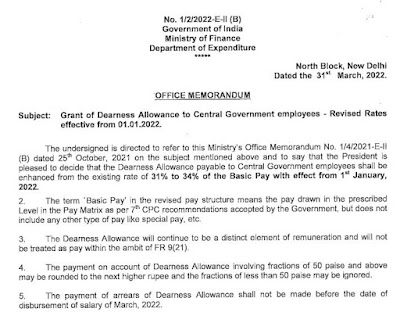
DA Jan 2022 - Grant of Dearness Allowance to Central Government employees - Revised Rates effective from 01.01.2022

 3% DA Hike - Revised Rates effective from 01.01.2022: DoE OM dated 31.03.2022 No. 1/2/2022-E-II (B) Government of India Ministry of Finance...