All about 7th Central Pay Commission for Central Government Employees. Dearness Allowance for Government Employees, CENTRAL GOVERNMENT EMPLOYEES NEWS - DOPT, DOPT Orders, Expected DA & more.
Consumer Price Index for Industrial Workers (2016=100) – November 2020
The All-India CPI-IW for November, 2020 increased by 0.4 points and
stood at 119.9 (one hundred nineteen and point nine). On 1-month
percentage change, it increased by (+) 0.33 per cent between October and
November, 2020 compared to (+) 0.92 per cent increase between
corresponding months of previous year.
The maximum upward pressure in current index came from Food &
Beverages group contributing (+) 0.25 percentage points to the total
change. At item level, Rice, Arhar Dal, Fish Fresh, Milk, Mustard Oil,
Soyabean Oil, Sunflower Oil, Onion, Potato, Chillies Dry, Tea Leaf,
Cooked Meal, etc. are responsible for the increase in index. However,
this increase was checked by Poultry (Chicken), Tomato, Brinjal, Carrot,
Cauliflower, Ginger, Gourd, Green Coriander Leaves, Lady Finger, Peas,
Orange, etc., putting downward pressure on the index.
At centre level, Puducherry recorded the maximum increase of 4
points. Among others, 3 points increase was observed in 4 centres, 2
points in 7 centres and 1 point in 30 centres. On the contrary, Guntur,
Bhilai, Udham Singh Nagar and Vadodara recorded a maximum decrease of 2
points each. Among others, 1 point fall was observed in 17 centres. Rest
of 25 centres’ indices remained stationary.
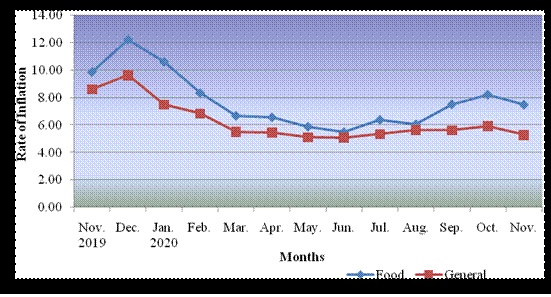
Year-on-year inflation based on all-items stood at 5.27 per cent for
November, 2020 as compared to 5.91 per cent for the previous month and
8.61 per cent during the corresponding month of the previous year.
Similarly, Food inflation stood at 7.48 per cent against 8.21 per cent
of the previous month and 9.87 per cent during the corresponding month a
year ago.
Y-o-Y Inflation based on CPI-IW (Food and General)
All-India Group-wise CPI-IW for October and November, 2020
Sr. No.
Groups
Oct, 2020
Nov, 2020
I
Food & Beverages
123.0
123.6
II
Pan, Supari, Tobacco & Intoxicants
132.5*
133.1
III
Clothing & Footwear
117.4
117.4
IV
Housing
113.5*
113.5*
V
Fuel & Light
126.4
126.8
VI
Miscellaneous
117.0
117.2
General Index
119.5
119.9
Expected DA January 2021 – AICPIN for November 2020 increased by 0.4 points
*Rounded up from second decimal place.
CPI-IW: Groups Indices
Speaking about the latest index, Shri Santosh Gangwar, Minister of
State (I/C) for Labour and Employment said, “The rise in index coupled
with fall in annual inflation will have dual impact in terms of
increasing income and purchasing power of the workers. He added that the
effect is mainly due to vegetables which had good supply in the market
and provided respite to the consumers.
Shri DPS Negi, Director General of Labour Bureau while releasing the
index said, “The rise in index during November, 2020 and fall in
inflation rate are in line with other price indices compiled and
released by other Government agencies”.
He further said that Rise in index is mainly on account of increase
in prices of Rice, Arhar Dal, Fish Fresh, Milk, Mustard Oil, Soyabean
Oil, Sunflower Oil, Onion, Potato, Chillies Dry, Tea Leaf, Cooked Meal,
Cooking Gas, Household Goods & Services etc.
The next issue of CPI-IW for the month of December, 2020 will be
released on Friday 29th January, 2021. The same will also be available
on the office website www.labourbureaunew.gov.in.
The Labour Bureau, an attached office of the M/o Labour &
Employment, has been compiling Consumer Price Index for Industrial
Workers every month on the basis of retail prices collected from 317
markets spread over 88 industrially important centres in the country.
The index is compiled for 88 centres and All-India and is released on
the last working day of succeeding month.
Booking of Central GovtHoliday Homes - Allotment for over One Lakh Government Residential Accommodations Integrated on New Platform - E-Sampada
Booking of Holiday Homes
Ministry of Housing & Urban Affairs
Booking of Holiday Homes, Social Function Venues Like 5 Ashoka Road,
Allotment for over One Lakh Government Residential Accommodations
Integrated on New Platform
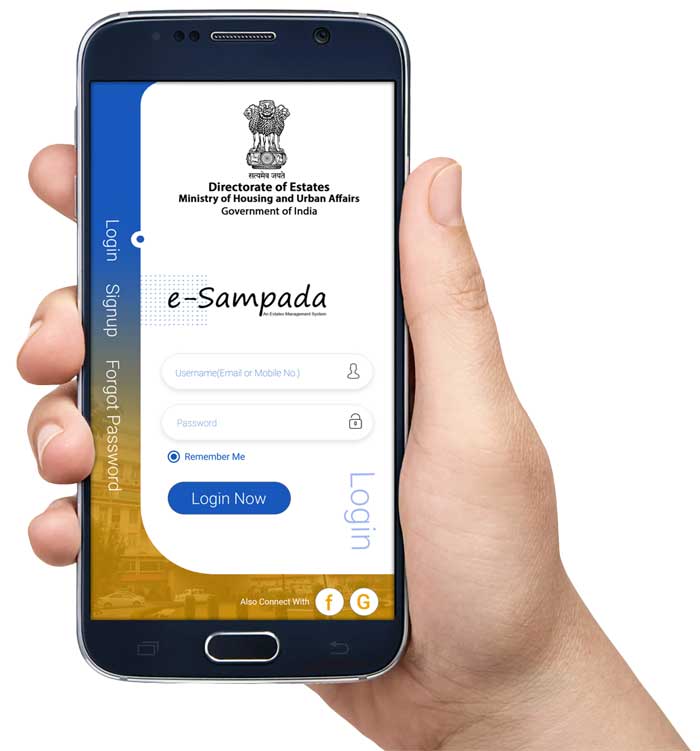
E-Sampada- New Web Portal & Mobile App Launched on Good
Governance Day – To Simplify Processes & Bring Uniformity In Systems
Across India
Four Websites & Two Mobile Apps of Directorate of Estates
Integrated into one – all services on same Platform throughout Country
E-Governance to Boost Transparency & Accountability in Providing Various Estate Services
25 DEC 2020
Good governance day is celebrated annually on 25 December, the
anniversary of the birth of former Prime Minister Atal Bihari Vajpayee.
In line with the objectives of boosting transparency and
accountability while ensuring ease of living for the citizens, the
Directorate of Estates, Ministry of Housing and Urban Affairs today
dedicated to the nation, a new Web Portal and Mobile App, e-Sampada.
The new application provides a single window for all these services
including allotment for over one lakh government residential
accommodations, office space allotment to government organisations in 45
office complexes in 28 cities, booking of 1,176 holiday home rooms and
venues like 5, Ashoka Road for social functions etc.
In its endeavour to provide ‘One Nation, One System’, the erstwhile
four websites (gpra.nic.in, eawas.nic.in, estates.gov.in,
holidayhomes.nic.in), and two Mobile Apps (m-Awas & m-Ashoka5) of
the Directorate of Estates have been integrated into one, which paves
the way for all services on the same platform throughout the country.
The website and mobile app was launched by Shri Hardeep S Puri, Minister
of State(I/C) for Housing & Urban Affairs in the presence of Shri
Durga Shanker Mishra, Secretary, MoHUA and other senior officials here
today.
Addressing the media in a program organised on virtual platform, Shri
Hardeep S Puri said that this is a significant step towards promotion
of e-governance to boost transparency and accountability in providing
various Estate Services like allotment, retention, regularisation, no
dues certificate etc.
He further said that E-Sampada is developed to simplify processes and
bring uniformity in the system across India. This will promote ease of
living for Government of India officers / Departments as all services
can be availed online on a single window with a live tracking of
applications. Real time information on utilisation of assets and
delivery of service will facilitate optimum utilisation of resources.
The automated processes will minimize human intervention and will lead
to greater transparency.
Shri Durga Shanker Mishra, Secretary said that E-Sampada equips users
with very specialised features like personalised dashboard, service
usage archive and real time status on licence fees/dues. All payments /
dues are to be made cashless through digital modes. It is user friendly
and is device responsive. Users will have visual experience of services
and will be able to give feedback online.
The portal provides online facility to users across India to lodge
complaints, submit documents and appear for virtual hearing. It will
reduce administrative cost and will save time and resources by reducing
visits to Directorate of Estate. e-Sampada Mobile App and Chatbot
facility has been provided for better user experience. Service level
benchmarks and activity log for officials are incorporated to ensure
accountability.
E-Sampada to benefit all services, across India : Online, Paperless, Cashless
1,09,474 Government Residential Accommodation at 40 locations
1.25 crore sq.ft Office Space Allotment in 45 office complexes at 28 locations
1,176 Holiday Home Rooms/Suits at 62 locations
Booking of Vigyan Bhawan
Booking of venues for social functions
The
new Web Portal and Mobile App have been developed by NIC. The Mobile
App will be available for Android as well as iOS platforms. The Web
Portal can be accessed at www.esampada.mohua.gov.in and Mobile App can be downloaded from Android Play Store / Apple App Store.
Persmin Year End Review 2020 - Ministry of Personnel, Public Grievances and Pensions - PIB News
Persmin Year End Review 2020
Persmin Year End Review 2020
Ministry of Personnel, Public Grievances & Pensions
Year End Review 2020- Ministry of Personnel, Public Grievances and Pensions
Cabinet
approved creation of National Recruitment Agency (NRA), paving the way
for a transformational reform in the recruitment process for central
government jobs
Centre launched “Mission Karmayogi”- National Programme for Civil Services Capacity Building (NPCSCB)
Doorstep Service for submission of Digital Life Certificate through Postman launched
Revamped Scheme for PM’s Awards for Excellence in Public Administration 2020 launched
Interviews for jobs abolished in 23 States and 8 UTs in India so far
31 DEC 2020
Following are the initiatives of the Ministry of Personnel, Public Grievances and Pensions during the year 2020:
Cabinet approved creation of National Recruitment Agency
(NRA), paving the way for a transformational reform in the recruitment
process for central government jobs
The Union Cabinet chaired by the Prime Minister, Shri Narendra Modi
has given its approval in August, 2020 for creation of National
Recruitment Agency (NRA), paving the way for a transformational reform
in the recruitment process for central government jobs.
Recruitment Reform – a major boon for the youth
At present, candidates seeking government jobs have to appear for
separate examinations conducted by multiple recruiting agencies for
various posts, for which similar eligibility conditions have been
prescribed. Candidates have to pay fee to multiple recruiting agencies
and also have to travel long distances for appearing in various exams.
These multiple recruitment examinations are a burden on the candidates,
as also on the respective recruitment agencies, involving avoidable
/repetitive expenditure, law and order/security related issues and venue
related problems. On an average, 2.5 crore to 3 crore candidates appear
in each of these examinations. A common eligibility Test would enable
these candidates to appear once and apply to any or all of these
recruitment agencies for the higher level of examination. This would
indeed be a boon to all the candidates.
National Recruitment Agency (NRA)
A multi-agency body called the National Recruitment Agency (NRA) will
conduct a Common Eligibility Test (CET) to screen/shortlist candidates
for the Group B and C (non-technical) posts. NRA will have
representatives of Ministry of Railways, Ministry of Finance/Department
of Financial Services, the SSC, RRB & IBPS. It is envisioned that
the NRA would be a specialist body bringing the state-of-the-art
technology and best practices to the field of Central Government
recruitment.
Access to Examination Centres
Examination Centres in every District of the country would greatly
enhance access to the candidates located in far-flung areas. Special
focus on creating examination infrastructure in the 117 Aspirational
Districts would go a long way in affording access to candidates at a
place nearer to where they reside. The benefits in terms of cost,
effort, safety and much more would be immense. The proposal will not
only ease access to rural candidates, it will also motivate the rural
candidates residing in the far-flung areas to take the examination and
thereby, enhance their representation in Central Government jobs. Taking
job opportunities closer to the people is a radical step that would
greatly enhance ease of living for the youth.
Major Relief to poor Candidates
Presently, the candidates have to appear in multiple examinations
conducted by multiple agencies. Apart from the examination fees,
candidates have to incur additional expenses for travel, boarding,
lodging and other such. A single examination would reduce the financial
burden on candidates to a large extent.
Women candidates to benefit greatly
Women candidates especially from rural areas face constraints in
appearing in multiple examinations as they have to arrange for
transportation and places to stay in places that are far away. They
sometimes have to find suitable persons to accompany them to these
Centres that are located far away. The location of test centres in every
District would greatly benefit candidates from rural areas in general
and women candidates in particular.
Bonanza for Candidates from Rural Areas
Given the financial and other constraints, the candidates from rural
background have to make a choice as to which examination they want to
appear in. Under the NRA, the candidates by appearing in one examination
will get an opportunity to compete for many posts. NRA will conduct the
first-level /Tier I Examination which is the stepping stone for many
other selections.
CET Score to be valid for three years, no bar on attempts
The CET score of the candidate shall be valid for a period of three
years from the date of declaration of the result. The best of the valid
scores shall be deemed to be the current score of the candidate. There
shall be no restriction on the number of attempts to be taken by a
candidate to appear in the CET subject to the upper age limit.
Relaxation in the upper age limit shall be given to candidates of
SC/ST/OBC and other categories as per the extant policy of the
Government. This would go a long way in mitigating the hardship of
candidates who spend a considerable amount of time, money and effort
preparing and giving these examinations every year.
Standardised Testing
NRA shall conduct a separate CET each for the three levels of
graduate, higher secondary (12th pass) and the matriculate (10th pass)
candidates for those non-technical posts to which recruitment is
presently carried out by the Staff Selection Commission (SSC), the
Railway Recruitment Boards (RRBs) and by the Institute of Banking
Personnel Selection (IBPS). Based on the screening done at the CET score
level, final selection for recruitment shall be made through separate
specialised Tiers (II, III etc) of examination which shall be conducted
by the respective recruitment agencies. The curriculum for this test
would be common as would be the standard. This would greatly ease the
burden of candidates who are at present required to prepare for each of
the examinations separately as per different curriculum.
Scheduling Tests and choosing Centres
Candidates would have the facility of registering on a common portal
and give a choice of Centres. Based on availability, they would be
allotted Centres. The ultimate aim is to reach a stage wherein
candidates can schedule their own tests at Centres of their choice.
OUTREACH ACTIVITIES BY NRA
Multiple languages
The CET would be available in a number of languages. This would
greatly facilitate people from different parts of the country to take
the exam and have an equal opportunity of being selected.
Scores – access to multiple recruitment agencies
Initially the scores would be used by the three major recruitment
agencies. However, over a period of time it is expected that other
recruitment agencies in the Central Government would adopt the same.
Further, it would be open for other agencies in the public as well as
private domain to adopt it if they so choose. Thus, in the long run, the
CET score could be shared with other recruiting agencies in the Central
Government, State Governments/Union Territories, Public Sector
Undertaking and Private Sector. This would help such organizations in
saving costs and time spent on recruitment.
Shortening the recruitment cycle
A single eligibility test would significantly reduce the recruitment
cycle. Some Departments have indicated their intention to do away with
any second level test and go ahead with recruitment on the basis of CET
scores, Physical Tests and Medical examination. This would greatly
reduce the cycle and benefit a large section of youth.
Financial Outlay
The Government has sanctioned a sum of Rs. 1517.57 crore for the
National Recruitment Agency (NRA). The expenditure will be undertaken
over a period of three years. Apart from setting up the NRA, costs will
be incurred for setting up examination infrastructure in the 117
Aspirational Districts.
Cabinet approved “Mission Karmayogi”- National Programme for Civil Services Capacity Building (NPCSCB)
The Union Cabinet chaired by the Prime Minister, Shri Narendra Modi has approved launching of a National Programme for Civil Services Capacity Building (NPCSCB) with the following institutional framework in September, 2020: –
Prime Minister’s Public Human Resources (HR) Council,
Capacity Building Commission.
Special Purpose Vehicle for owning and operating the digital assets
and the technological platform for online training,
Coordination Unit headed by the Cabinet Secretary.
Salient Features
NPCSCB has been carefully designed to lay the foundations for
capacity building for Civil Servants so that they remain entrenched in
Indian Culture and sensibilities and remain connected, with their roots,
while they learn from the best institutions and practices across the
world. The Programme will be delivered by setting up an Integrated Government Online Training- iGOT Karmayogi Platform. The core guiding principles of the Programme will be:
Supporting Transition from ‘Rules based’ to ‘Roles based* HR
Management.Aligning work allocation of civil servants by matching their
competencies tothe requirements of the post.
To emphasize on ‘on-site learning’ to complement the ‘off-site’ learning,
To create an ecosystem of shared training infrastructure including that of learning materials, institutions and personnel,
To
calibrate all Civil Service positions to a Framework of Roles,
Activities and Competencies (FRACs) approach and to create and deliver
learning content relevant to the identified FRACs in every Government
entity,
To make available to all civil servants, an opportunity
to continuously build and strengthen their Behavioral, Functional and
Domain Competencies in their self-driven and mandated learning paths.
To
enable all the Central Ministries and Departments and their
Organizations to directly invest their resources towards co-creation and
sharing the collaborative and common ecosystem of learning through an
annual financial subscription for every employee,
To encourage
and partner with the best-in-class learning content creators including
public training institutions, universities, start-tips and individual
experts,
To undertake data analytics in respect of data emit
provided by iGOT- Karmayogi pertaining to various aspects of capacity
building, content creation, user feedback and mapping of competencies
and identify areas for policy reforms.
Objectives
It is also proposed to set up a Capacity Building Commission,
with a view to ensure a uniform approach in managing and regulating the
capacity building ecosystem on collaborative and co-sharing basis.
The role of Commission will be as under-
To assist the PM Public Human Resources Council in approving the Annual Capacity Building Plans.
To exercise functional supervision over all Central Training Institutions dealing with civil services capacity building.
To create shared learning resources, including internal and external faculty and resource centers.
To coordinate and supervise the implementation of the Capacity Building Plans with the stakeholder Departments.
To make recommendations on standardization of training and capacity building, pedagogy and methodology
To set norms for common mid-career training programs across all civil services.
To suggest policy interventions required in the areas of HR Management and Capacity Building to the Government.
iGOT- Karmayogi platform brings the scale and
state-of-the-art infrastructure to augment the capacities of over two
crore officials in India. The platform is expected to evolve into a
vibrant and world-class market place for content where carefully curated
and vetted digital e-learning material will be made available. Besides
capacity building, service matters like confirmation after probation
period, deployment, work assignment and notification of vacancies etc.
would eventually be integrated with the proposed competency framework.
Mission Karmayogi aims to prepare the Indian Civil Servant for the
future by making him more creative, constructive, imaginative,
innovative, proactive, professional, progressive, energetic, enabling,
transparent and technology-enabled. Empowered with specific
role-competencies, the civil servant will be able to ensure efficient
service delivery of the highest quality standards.
Financial implications
To cover around 46 lakh Central employees, a sum of Rs.510.86 crore
will be spent over a period of 5 years from 2020-21 to 2024-25. The
expenditure is partly funded by multilateral assistance to the tune of
USD 50 million. A wholly owned Special Purpose Vehicle (SPV) for NPCSCB
will be set up under Section 8 of the Companies Act, 2013. The SPV will
be a “not-for-profit” company and will own and manage iGOT- Karmayogi platform. The SPV will create and operationalize the content, market place and manage key business services of iGOT- Karmayogi
platform, relating to content validation, independent proctored
assessments and telemetry data availability. The SPV will own all
Intellectual Property Rights on behalf of the Government of India. An
appropriate monitoring and evaluation framework will also be put in
place for performance evaluation of all users of the iGOT– Karmayogi platform so as to generate a dashboard view of Key Performance Indicators.
Background
Capacity of Civil Services plays a vital role in rendering a wide
variety of services, implementing welfare programs and performing core
governance functions. A transformational change in Civil Service
Capacity is proposed to be affected by organically linking the
transformation of work culture, strengthening public institutions and
adopting modern technology to build civil service capacity with the
overall aim of ensuring efficient delivery of services to citizens.
A Public Human Resources Council comprising of
select Union Ministers, Chief Ministers, eminent public HR
practitioners, thinkers, global thought leaders and Public Service
functionaries under the Chairmanship of Hon’ble Prime Minister will
serve as the apex body for providing strategic direction to the task of
Civil Services Reform and capacity building.
Doorstep Service for submission of Digital Life Certificate through Postman launched Huge relief for pensioners to submit Life certificate while staying at home.
India Post Payments Bank, IPPB of Department of Posts & Meity
have successfully launched the initiative of the Department of Pension
& Pensioners’ Welfare: “Doorstep Service for submission of Digital
Life Certificate through Postman” in November, 2020. The facility to
submit life certificate online through Jeevan Pramaan Portal was
launched by the Hon’ble Prime Minister in November, 2014 with the
objective to provide a convenient and transparent facility to pensioners
for submission of Life Certificate.
Ever since, DoPPW, under the able guidance of Dr. Jitendra Singh,
Minister of State, Ministry of Personnel, PG & Pensions, has been
leveraging technology year after year, to make the system seamless and
more and more convenient for the elderly Pensioners.
In order to make this facility available across the country, DoPPW
roped in the India Post Payments Bank (IPPB) and utilise its huge
network of Postmen and Gramin Dak Sevaks in providing doorstep facility
to pensioners for submission of life certificate digitally.
IPPB
has customized its Bank software and dovetailed the same with Jeevan
Pramaan software of Ministry of Electronics & Information Technology
(MeitY) and UIDAI, to provide DLC services at the doorstep of
Pensioners. This facility shall be in addition to other facilities such
as withdrawal of money from bank account etc. while sitting at home.
IPPB is utilising its national network of more than 1,36,000 access
points in Post Offices and more than 1,89,000 Postmen & Gramin Dak
Sevaks with smart phones and biometric devices to provide Doorstep
Banking Services. As a result a huge number of pensioners across the
country shall be able to avail doorstep service through Postmen/ Gramin
Dak Sevak, without visiting to bank branch or standing in a queue
outside the bank branches.
In order to avail “doorstep service for submission of DLC”
through IPPB, pensioners can get detailed information on
ippbonline.com. It is a chargeable service and will be available to all
Central Government Pensioners across the country irrespective of the
fact their pension accounts are in different bank. The process to avail “doorstep service of DLC”
through IPPB can be viewed @ Youtube(Pension DOPPW) and facebook of D/o
Pension & Pensioners Welfare . In view of current pandemic, it is a
huge relief for pensioners to submit Life certificate while staying at
home.
Union Minister Dr. Jitendra Singh launched the
revamped Scheme for PM’s Awards for Excellence in Public Administration
2020 and web portal www.pmawards.gov.in
In July, 2020, the Union Minister of State (Independent Charge) Development of North Eastern Region (DoNER),
MoS PMO, Personnel, Public Grievances, Pensions, Atomic Energy and
Space, Dr Jitendra Singh launched the revamped PM’s Awards for
Excellence in Public Administration and the web portal
www.pmawards.gov.in. Addressing the Central Ministries and State/ UT
Governments on this occasion, Dr. Jitendra Singh said that the Scheme
has been revamped in tune with Prime Minister Shri Narendra Modi’s
governance model of citizen participation. He said that the Mantra of
“Maximum Governance, Minimum Government” is incomplete without citizen
participation and citizen centricity and added that transparency and
accountability are its twin hallmark.
The Scheme Prime Minister’s Awards for Excellence in Public
Administration 2020, has been revamped to recognize the performance of
the District Collectors towards outcome indicators, economic
development, peoples’ participation and redressal of public grievances.
Nominations have been called in four major categories – District
Performance Indicators Programme, Innovation General Category,
Aspirational Districts Program and Namami Gange Program. Under the
District Performance Indicators Programme, District Collectors would be
evaluated on their contribution to Inclusive Development through credit
flow to priority sector, Promoting peoples movements – Jan Bhagidari
through effective implementation of priority sector schemes of SBM
(Gramin) and SBM (Urban) programs, Improving service delivery and
redressal of Public Grievances. The Innovations category of the Scheme
has been broad-based to provide separate award categories for
innovations at National, State and District level. The period of
consideration for the awards is 1st April 2018 to 31st March 2020. In
all 15 Awards would be conferred under the Scheme in 2020.
Interviews for jobs abolished in 23 States and 8 UTs in India so far
Interview for jobs has been abolished in 23 States and 8 Union
Territories of India. This is a follow up to the abolition of interview
for Group-B (Non- Gazetted) and Group – C posts in the Central
Government ever since 2016.
It was on the 15th of August 2015, while speaking from the rampart of
Red Fort on the occasion of Independence Day, Prime Minister Narendra
Modi had suggested abolition of interview and making the job selection
totally on the basis of written test because whenever an interview call
was received by a candidate, his entire family would get disturbed with
apprehension and anxiety. On a quick follow up to the Prime Minister’s
advice, the DoPT undertook an expeditious exercise and within three
months completed the entire process to announce abolition of interview
for recruitment in Central Government with effect from 1st January,
2016.
Three new Information Commissioners administered oath of office in November
The Chief Information Commissioner Shri Y.K. Sinha administered the
oath of office to Information Commissioners Shri Heeralal Samariya, Ms.
Saroj Punhani and Shri Uday Mahurkar at a swearing-in ceremony organized
in Central Information Commission in November this year. With their
induction, the total number of Information Commissioners including the
Chief Information Commissioner has risen to 8 in the Central Information
Commission.
Shri Heeralal Samariya, a former IAS officer, was Secretary, Ministry
of Labour & Employment in Government of India before retirement. He
holds a Bachelor’s degree in Civil Engineering. His area of expertise
includes Administration and Governance.
Ms. Saroj Punhani, an IA&AS officer, before joining as
Information Commissioner in the Central Information Commission, was
holding the post of Deputy Comptroller & Auditor General (HR &
Training) in Government of India. She holds a Bachelor’s degree in
Humanities. Her area of expertise includes Administration and
Governance.
Shri Uday Mahurkar, a veteran journalist, before joining as
Information Commissioner in the Central Information Commission, was
functioning as Senior Deputy Editor with a leading media house. He
graduated from Maharaja Sayajirao University in Indian History, Culture
and Archaeology. His area of expertise includes his vast experience in
media.
DoP 2020 - YEAR END REVIEW 2020 DEPARTMENT OF POSTS
Ministry of Communications
YEAR END REVIEW 2020 DEPARTMENT OF POSTS
New version of DARPAN-PLI App deployed in Core Integration System
(CIS) with facility of processing various financial and non-financial
requests of PLI/RPLI insurants at 127115 Branch Post Offices
17,092 villages brought under the coverage of Bima Gram Yojana (BGY) From January, 2020 to November, 2020
Over 7 lakh Passport applications and more than 99 lakh requests for
Aadhar enrollments / updations processed from January, 2020 to
November, 2020
India Post tied-ups with Indian Drug Manufacturers Association,
Director General of Health Services and a number of private firms and
online pharmaceutical companies for delivery of medicines from their
facilities to hospitals and beneficiaries during COVID-19
31 crore financial transactions enabled through Post Office and IPPB accounts during COVID 19 period
India Post won India Today Healthgiri Award for providing the best logistic services during COVID 19
Posted On: 29 DEC 2020
YEAR END REVIEW 2020 DEPARTMENT OF POSTS
For more than 150 years, the Department of Posts
(DoP) has been the backbone of the country’s communication and has
played a crucial role in the country’s social economic development. It
touches the lives of Indian citizens in many ways: delivering mails,
accepting deposits under Small Savings Schemes, providing life insurance
cover under Postal Life Insurance (PLI) and Rural Postal Life Insurance
(RPLI) and providing retail services like bill collection, sale of
forms, etc. The DoP also acts as an agent for Government of India in
discharging other services for citizens such as Mahatma Gandhi National
Rural Employment Guarantee Scheme (MGNREGS) wage disbursement and old
age pension payments. In the year 2020, the Department strengthened its
supply chain through capacity upgradation and expanding Road Transport
Network. It played important role in countering impact of COVID-19
pandemic by enabling doorstep delivery of financial services and
medicines etc. The Year End Review for Department of Posts highlights
the achievements, and progress on various initiatives of department in
the year 2020.
Supply Chain and e-Commerce: Mail, Express Services and Parcel:
Capacity upgradation: Parcel handling capacity has increased from 6.0 crore per annum to 7.5 crore per
annum.
Road Transport Network:
National level dedicated Road Transport Network rolled out on 56 routes
touching 80 cities. Approx. 15000 bags containing 75 tonnes of parcels
are being carried daily through the setup network.
Improvement in Pan – India Average Transit Time for Speed Post:
Average Transit time of Speed Post reduced from 105 hrs. in July,2019 to 81 hrs. in Feb,2020.
Real-Time updation of
Delivery:
Postman Mobile App implemented in 1.47 Lakh POs including 98,454 post
offices in rural areas. Real time delivery status of 14 crore Speed Post
and Registered articles done through the Postman Mobile App.
E-Commerce exports:
‘DakGharNiryat Kendra’ are being established at around 800 Post Offices
covering all District headquarters to promote exports of MSMEs.
International
Tracked Packet Service extended to 3 more countries Mongolia, Bhutan
and Sri Lanka taking the total from 12 to 15 countries.
Banking Services and Financial Inclusion:
Digital Financial empowerment of the public at large:
DOP serves more than 50 crore POSB customers through 1.56 lakh post
offices across length & breadth of the country and have an
outstanding balance of Rs. 10,81,293 crore under Post Office Savings
Bank (POSB) Schemes. The Post Office CBS system is the largest network
in the world with 23,483 Post Offices already on this network. Further
1,29,151 Branch Post Offices have been also enabled to access the
network on real time basis. The CBS has enabled the DOP in providing
24×7 services through ATMs, Internet & Mobile Banking.
Financial Empowerment of Rural Populace:
All the 9 Small Savings Schemes of MoF are available in 1.56 lakh Post
Offices. 5 Schemes, namely, Monthly Income Scheme, Senior Citizens
Savings Scheme, Public Provident Fund, National Savings Certificate
& KisanVikas Patra have been introduced in BOs through SB Order
27/2020 dated 23.07.2020. People living in rural India will not be
required to come to town & cities to do any Post Office Savings Bank
(POSB) transaction. The same will be available at their doorstep
through local Branch Post Offices.
Economic Empowerment of Girl Child:
Sukanya Samriddhi Account (SSA) scheme is also known as girl child
prosperity scheme and was launched by Prime Minister Shri Narendra Modi
Ji on 22nd January, 2015 in Panipat, Haryana. SSA scheme ensures a
bright future for girl children. This scheme has facilitated them in
proper education, marriage expenses and securing their future. The
Sukanya Samriddhi Account can be opened in any post office. A total of
1.83 Crore Sukanya Samriddhi Accounts have been opened with deposits
amounting to Rs. 58,822.62 Crore, by the Department of Posts, till
November, 2020 since introduction of the scheme.
Insurance and Pension coverage of masses at reasonable rates:
The PM Jan Suraksha Schemes, namely, Pradhan Mantri Suraksha Bima
Yojana (PMSBY), Pradhan Mantri Jeewan Jyoti Bima Yojana (PMJJBY) &
Atal Pension Yojana (APY) were launched by Hon’ble Prime Minister in
May, 2015. The DOP has been playing an active role under these
Government of India flagship schemes and had made 3.2 Lakh Atal Pension
Yojana (APY), 5.9 Lakh Pradhan Mantri Jeevan Jyoti Bima Yojana (PMJJBY)
and 1.17 crore Pradhan Mantri Suraksha Bima Yojana (PMSBY) enrolments so
far.
Simplified processing of deceased claim cases to expedite
deceased claim settlement process and help claimants to get the claim
amount expeditiously.
Post Bank of India: More
than 1.36 Lakhs Access Points enables for India Post Payments Bank
(IPPB) transactions thus creating largest single bank network across the
country. More than 2.90 Lakhs Gramin Dak Sewaks (GDS) and Postmen
enables to act as Doorstep Banking Service Providers taking Banking
services to the doorstep. More than 3.61 crore people benefitted from
Aadhar enabled Payment System (AePS) transactions involving an amount of
Rs.7,667 crore, majority of them during COVID-19 lockdown.
Direct Benefit Transfer (DBT):
More than 3.99 crores transactions were performed involving an amount
of Rs. 4,040 crore for a period from January, 2020 to November, 2020.
Disbursed benefits of more than 275 schemes of different Ministries to
beneficiaries including those in remote and rural areas.
Digital Inclusion: 1,29,159
Branch Post offices are using SIM based handheld POS devices. 40 crore
digital transactions have been facilitated through promotion of Remotely
Managed Franking Machines for a period from January, 2020 to November,
2020.
Postal Life Insurance (PLI)/ Rural Postal Life Insurance (RPLI) :
Bonus of PLI for the financial years 2016-17,
2017-18, 2018-19, 2019-20 and 2020-21 have been declared in the month of
March, 2020. Similarly, Bonus of RPLI for the financial years 2016-17,
2017-18, 2018-19, 2019-20 and 2020-21 have been declared in the month of
April, 2020.
A total of 26,54,652 transactions were done in
respect of PLI/ RPLI amounting to Rs. 5,15,14,03,966/- in the month of
April, 2020, inspite of nation-wide lockdown and extension of premium
payment period to June, 2020.
Since, April, 2020, there has been 48% increase in monthly PLI/RPLI online transactions.
Inspite
of lockdown and severe restrictions on transportation and staff
attendance in offices, more than 90% of Central Processing Centres
(CPCs) across the country were functional, more than 70,000 new
proposals were processed and more than 40,000 claims were sanctioned in
the month of April, 2020.
Wirecard, the then existing payment
gateway has been replaced by PayU for online premia payment, offering
multiple channel of payment by customers, namely Debit Card, Credit
Card, Net Banking, Wallets and UPI.
To simplify the process of
acceptance of new proposals and facilitate settlement of claims within
citizen charter’ norms, approver limits for acceptance of new proposals
and settlements of claims have been revised and has been decentralized
to Head Post Office/ GPO/ Divisional Level (except for early death
claims involving inquiry, for which approving authority is Director).
Accordingly, Rules 55, 55(1), 55(2), 58(1) and 59(2) of PLI (Postal Life
Insurance) Rules, 2011 were amended.
The process of settlement
of Death Claim, Maturity Claim and handing of Loan requests in PLI/ RPLI
has been simplified by prescribing Comprehensive Standard Operating
Procedure (SoP) for each.
To facilitate faster processing of
death claim cases, Rule 39 of PLI (Postal Life Insurance) Rules, 2011
has been amended keeping in line with the existing Industry practice.
A
new version of DARPAN-PLI App has been deployed in Core Integration
System (CIS) with facility of processing various financial and
non-financial requests of PLI/RPLI insurants at level of 127115 Branch
Post Offices including those in remote and rural areas.
Department has brought in more transparency in communication with customer by
adding more SMSs relating to policy servicing.
Department
has removed 2 revival restrictions during the policy contract. Along
with this, provision for revival of policy in instalments has been
provisioned in the PLI system.
Business Performance of PLI and RPLI: As
on 30-11-2020, there were a total of 96.79 lakh active PLI and RPLI
policies with an aggregate sum assured of Rs. 2.05 lakh crores.
Investment Functions of PLI / RPLI Fund: The total
corpus of PLI / RPLI fund has reached Rs 1.13 lakh crore by 30-11-2020.
Bima Gram Yojana:
From January, 2020 to November, 2020, 17,092 villages brought under the
coverage of Bima Gram Yojana (BGY). Each BGY village has at least 100
households covered by one RPLI policy.
Citizen Centric Services:
Post Office Passport Seva Kendras (PoPSK): With
the growing need of its citizens for a passport for various purposes,
Ministry of External Affairs and Department of Posts mutually agreed for
setting up Post Office Passport Seva Kendras (PoPSKs) in post offices
to utilise the post office infrastructure and reach for delivering
passport services. 426 PoPSKs have been made operational till date, of
which 02 PoPSKs opened in 2020 namely (i) Seoni, Madhya Pradesh and (ii)
Port Blair, Andaman & Nicobar Island. 7,27,329 applications have
been processed through PoPSKs from January, 2020 to November, 2020.
Aadhar Enrolment and Updation Centres:
The facility has brought convenience to the citizens by way of
generating new Aadhaar and updating their Aadhaar cards in case of any
change/ mis-match. More than 42,000 Postal Officials/ MTS/ GDS have been
trained/ certified to perform Aadhaar operations. The Aadhaar
Enrolments are done free of cost. A sum of Rs. 100/- is reimbursed by
UIDAI for every successful Aadhaar Enrolment to India Post. Aadhaar
Updations are chargeable and a sum of Rs. 50/- is collected from the
citizens for every demographic updation and Rs. 100/- is collected from
the citizens for every biometric updation.13,352 Post Office Aadhaar
Centres have been set up across the country. 99,25,630requests for
enrollments / updations have been processed by these Centres from
January, 2020 to November, 2020.
A total no of 3,43,296 Gangajal Bottles have been supplied for the period from January, 2020 to
November, 2020.
Digital Advancement of Rural Post Offices for a New India (DARPAN): Carried
out 17.41 crores online Postal and financial transactions involving Rs.
23,251/- crores for a period from January, 2020 to November, 2020
through 1.29 lakh Branch Post Offices in the rural areas of the country.
More than 1.5 crores transactions per month are taking place through
DARPAN devices.
PO-CSC (Post Office-Common Service Centres):
A convergence of Post Offices and Common Service Centres (Part of CSC
e-Governance Services India Limited under Ministry of Electronics &
Information Technology) for effective delivery of various citizen
centric services is a part of the five-year Vision Document of the
Department of Posts. Accordingly,10136 Post Offices are now providing
services of Common Service Centres through the Digital Sewa portal of
CSC. As on 30.11.2020, 48234 transactions worth Rs. 4.62 Crore were
delivered through these Post Offices.
There are 100+ CSC
Services which are offered through these post offices which include
Government to Citizen Schemes(G2C) such as Pradhan Manthri Street
Vendors’ Athma nirbhar Nidhi Yojana (PMSVANIDHI), Pradhan Manthri Jan
Arogya Yojana (Ayushman Bharat), Pradhan ManthriShram Yogi
Maan-dhanYojana (PM-SYM), Pradhan Mantri Laghu Vyapari Maan-dhan Yojana
(PM-LVM), The Election Card Printing, E-Stamp Service, and Various
e-District Services. Some of B2C (Business to Citizens) Services offered
includes Bharat Bill Payment System Bills (Electric, Gas, Water bills
etc…), Renewal Premium collection for Life Insurance Policies and
General Insurance such as Motor Vehicle, Health and Fire Insurance etc,
Third party services such as EMI collections for various loans offered
by financial institutions and submission of online application forms for
loans and Travel services such as Ticket booking service is available
for Flight, Train and Bus Tickets.
Opening of new Branch Post Offices (BOs) in 90 identified Left Wing Extremism (LWE) affected districts in the country:
In pursuance of the Ministry of Home Affairs (MHA) Note for Cabinet
Committee on Security(CCS), a proposal for opening of 4903 new Branch
Post Offices (BOs) in 90 identified LWE districts in the country was
under taken. In the first Phase, 1789 Branch Post Offices in Panchayats
not having post offices opened in LWE districts across the country, of
which 16 Branch Post Offices have been opened from January, 2020 to
November, 2020.
Public Grievances:
Centralized Public Grievance Redress and Monitoring System (CPGRAMS):
Department of Posts processes complaints registered by consumers of
postal services in the Centralized Public Grievance Redress and
Monitoring System (CPGRAMS). Streamlining of CPGRAMS was done by mapping
over 1.55 lakh Post Offices till the level of Branch Post Offices by
intuitive navigation of complaints to the line-end offices for faster
resolution. This was done in collaboration with Department of
Administrative Reforms & Public Grievances (DARPG) and the new
version 7.0 was successfully launched in September 2019. Department of
Posts is the only Department selected for the pilot study for the
revamping by DARPG. The details of the complaints handled in 2020 upto
30.11.2020 are as under:
S. No.
Year
Complaints received
during the period
Complaints settled during the period
% of
settlement
Average disposal time (days)
1
01.01.2020 to
30.11.2020
57604
56935
98.8%
16
Social Media Cell: Social media Cell is an
independent entity and deals with the Twitter and Facebook accounts of
the Department of Posts. The social media cell monitors the complaints
sent to all the Circles on daily basis. The average first response time
is approximately 4 hours. The details of the complaints handled in 2020
upto 30.11.2020 are as under: –
S. No.
Year
Complaints received
during the period
Complaints settled during the period
% of
settlement
1
01.01.2020 to
30.11.2020
197801
195896
99%
India Post Call Centre (IPCC): ln wake of the
initiatives taken up by Prime Minister to bring transparency and
accountability in the Government, Department of Posts established
2ndIndia Post Call Centre with 24x7x365 IVRS (Interactive Voice Response
System) facility for the citizens in Patna on 01.07.2019. IPCC is
working in the four languages namely Hindi, English, Odiya and Bengali
for the convenience of the citizens. 36,72,136 calls were received in
IPCC from 01.01.2020 to 30.11.2020.
Implementation of Dynamic Queue Management System (DQMS) in Post Offices: Dynamic
Queue Management System (DQMS) has been installed in 57 Head Post
Offices in the last one year having six or more than six working
counters. Overall DQMS have been installed in 340 Post Offices. The
Objectives & scope of DQMS are given below:-
To reduce waiting time.
To increase processing capacity.
To reduce
miscommunication among customers.
To give a comfort level to staff and customers.
To monitor customer flow.
Initiatives taken by the Department in the COVID-19 situation:
Postal services were identified as essential services during
lockdown. The vast network of post offices had been galvanized to
respond to the challenges in coordination with State Governments and
local bodies. Control Rooms at India Post HQ and Circle (State) HQs were
established to manage, receive and respond for immediate needs.
Supply Chain: Road
Transport Network connecting 56 routes and 75 cities was commenced in
April, 2020 utilizing Departmental Mail Vans. The network came handy to
delivery essentials, medicines and medical equipment including
ventilators, defibrillators, COVID 19
testing kits, masks and PPE kits. Around 36,000 tonnes of material were
delivered through postal channels which also include use of Parcel
Trains. Supply chain arrangements were also made for farmers to connect
their farm produce to markets.
Financial Inclusion:
During lockdown and initial phase of unlocking more than 33.95 crore
transactions valuing around Rs. 7.02 lakh crore were made through POSB
accounts. Around 78 lakh POSB ATM transactions amounting to Rs. 2389
crore were made.
Instructions issued during lockdown for the ease of customers:
Waive
off penalty/ revival fee (default fee) in RD/ PPF/ SSA Accounts for the
deposits due in FY 2019-20 and April, 2020, till June, 2020.
Relaxation in guidelines in respect of PPF/ SSA Accounts for a Single
Deposit pertaining to FY 2019-20 till June, 2020.
Extension
of the prescribed time limit of one month post retirement for retirees,
of Feb 2020 to April 2020, to invest in Senior Citizen Savings Scheme
(SCSS) till June, 2020.
Relaxation in provisions for rebate on
RD Advance deposits & default fee for the month of March 2020 to
May, 2020 without default/ revival fee, till June, 2020.
Reduction in TDS rate in POSB Schemes for the period from 14.05.2020 to March,
2021.
Various relaxation under POSB schemes extended till 30.07.2020 instead of 30.06.2020.
India Post tied-ups with Indian Drug Manufacturers Association,
Director General of Health Services and a number of private firms and
online pharmaceutical companies for delivery of medicines from their
facilities to hospitals and beneficiaries.
During COVID period,
Rs. 5200 crore disbursed to 2.5 crore beneficiaries through AePS at the
doorstep who were not able to access banking facilities.
31 crore financial transactions enabled during COVID19 period through Post
Office and IPPB accounts.
Taking
initiative in public interest, special features have been added to Post
info App for accepting emergent service requests from people. More than
60,000 service requests have been attended by Department of Posts
during lockdown.
Activated Mobile Post Offices across the country to provide basic postal services, food and masks distribution
etc.
Free distribution of around 10 lakhs food and ration packets was made to the needy.
Launched
dedicated Road Transport Network in April, 2020 on 56 long haul routes
and connected farm produce of farmers to markets by activating postal
supply chain.
India Post won India Today Health giri Award for
providing the best logistic services during COVID19. The selfless
service of the employees of India Post did not go unnoticed!
Special
Covers, Post Cards and Special Impressions were issued with messages to
create awareness about social distancing and to express gratitude to
Corona Warriors.
A grace period was provided to all the
Registered Newspapers from March, 2020 to November, 2020 for printing
and posting of their editions as per their convenience.
Department
of Posts has extended the Postal Life Insurance (PLI) / Rural Postal
Life Insurance (RPLI) premium payment period due on March, 2020, April,
2020 and May, 2020 upto 30.06.2020 without penalty/default fee due to
outbreak of COVID19.Due to outbreak of COVID19, date for revival of
lapsed policies, in which premia have not been paid during the last 5
years, was extended in phases.
CPGRAMS Portal: A
separate category for ‘COVID-19’ grievances was created on CPGRAMS to
address and monitor grievances of the public with regard to their postal
needs in the backdrop of the pandemic. 1235 grievances have been
resolved within the prescribed timeline of 3 days since the creation of
the category i.e. from 30.03.2020.
Social Media: Social
Media (Twitter handle of India Post) had a mitigating effect in this
pandemic by providing immediate relief to the citizens by redressing
their concerns in booking and delivering medicines and arranging
financial transactions in post offices. 1.54 lakh grievances have been
resolved during the period of lockdown.
Separate category of
COVID 19 Grievances provided on the Online portal. IPPC services over 25
Lakh calls during COVID 19 lockdown.
Miscellaneous:
Human Resource Management: The Department has
conducted various training sessions and a total no of 92,824 officers /
officials were trained for the period from January, 2020 to November,
2020.
AICPIN for the month of August 2020 – Expected DA 2020 – Central Government Employees News
Consumer Price Index for Industrial Workers (CPI-IW) – August, 2020
The Labour Bureau, an attached office of the M/o Labour &
Employment, has been compiling Consumer Price Index for Industrial
Workers every month on the basis of the retail prices of selected items
collected from 289 markets spread over 78 industrially important centres
in the country. The index is compiled for 78 centres and All-India and
is released on the last working day of succeeding month. The index for
the month of August, 2020 is being released in this press release.
The All-India CPI-IW for August, 2020 increased by 2 points and stood at 338 (three
hundred and thirty eight). On 1-month percentage change, it increased
by (+) 0.60 per cent between July and August, 2020 compared to (+) 0.31
per cent increase between corresponding months of previous year.
The maximum upward pressure in current index came from Food group
contributing (+) 1.14 percentage points to the total change. At item
level, Rice, Mustard Oil, Milk (Buffalo), Chillies Green, Onion,
Brinjal, Carrot, French Bean, Gourd, Green Coriander Leaves, Lady
Finger, Palak, Parval, Potato, Banana, Mango (Ripe), Tea (Readymade),
Flowers/Flower Garlands, etc. are responsible for the increase in index.
However, this increase was checked by Wheat, Wheat Atta, Fish Fresh,
Goat Meat, Poultry (Chicken), Tomato, Guava, etc., putting downward
pressure on the index.
At centre level, Coimbatore recorded the maximum increase of 9 points
followed by Salem (7 points) and Madurai (6 points). Among others, 5
points increase was observed in 3 centres, 4 points in another 3
centres, 3 points in 12 centres, 2 points in 14 centres and 1 point in
16 centres. On the contrary, Labac-Silchar recorded the maximum decrease
of 4 points. Among others, 2 points decrease was observed in 3 centres
and 1 point in 8 centres. Rest of 15 centres’ indices remained
stationary.
The indices of 31 centres are above All-India Index and 47 centres’ indices are below national average.
Year-on-year inflation based on all-items stood at 5.63 per cent for
August, 2020 as compared to 5.33 per cent for the previous month and
6.31 per cent during the corresponding month of the previous year.
Similarly, Food inflation stood at 6.67 per cent against 6.38 per cent
of the previous month and 5.10 per cent during the corresponding month a
year ago.
India Post delivers Covid-19 testing kits from ICMR regional depots to testing labs across the country including remote
areas
08 MAY 2020
India Post has entered into a tie up with ICMR for delivery of its Covid-19 testing Kits from its 16 regional depots to the 200 additional labs designated for Covid-19 Testing
across the length and breadth of the country. Indian Council of Medical Research (ICMR) has set a target of carrying out around 1 lakh tests
across the country per day. For this crucial work, India Post with its vast network of 1,56,000 post offices has once again geared up for
performing as a strong COVID warrior. India Post has delivered consignments to remote areas such as Imphal, Aizawl apart from Dungarpur, Churu,
Jhalawar, Kolkata, Bhubaneshwar, Ranchi, Jodhpur, Udaipur, Kota and other places.
Union Minister of Communications, E & IT and Law and Justice Shri Ravi Shankar Prasad appreciated the renewed commitment and partnership
between ICMR and Department of Posts. He said that India Post has been delivering mails, medicines, financial assistance at doorsteps and even
distributing food and ration to needy during lockdown. He further acknowledged that postmen of India Posts Department have risen to the occasion
and stood shoulder to shoulder with the nation during these challenging times.
The Government is taking all measures to ensure timely delivery of kits. Special arrangements has been made by India Post with ICMR for kits
being delivered from 16 depots (located in 14 postal Circles/ States), to 200 labs located across the country even in remote areas such as
Shivamogga, Tirunelveli, Dharmapuri, Tirupati, Darjeeling, Gangtok, Leh, Jammu, Udhampur, Jhalawar, Bhavnagar Sholapur , Darbhanga, Rishikesh,
Faridkot to mention a few. These kits are being delivered packed in dry ice.
The India Post staff
is working round the clock to ensure timely deliveries. Rising to the call of duty, deliveries are being made even at 11:30 pm. India Post is
committed to ensure that the delivery of kits is made as per requirements even in far flung areas like Zoram Medical College , Mizoram.
Nodal officers have been identified from both the agencies (DoP & ICMR ) for each regional depot to ensure smooth operations . The Circles
have made necessary arrangements with timelines for the priority transportation of the consignments to the concerned laboratories either as per
the existing system or new arrangements depending on the requirement and have communicated the same to the ICMR nodal officers.
Each booking circle has opened a BNPL (Book Now Pay Later) account of Speed Post with the concerned Depot to make the arrangement hassle free
for the agency. The delivery information is shared with the labs on daily basis through whatsapp. A Google spreadsheet has been shared with all
nodal officers to update the details of booking and delivery of the testing kits to flag any operational glitches.
Union Minister of Communications, E & IT and Law and Justice Shri Ravi Shankar Prasad called upon the Department to continue with its good
work and leave no stone unturned in making timely delivery of medicines, testing kits and other medical equipments. He asked the Department to
galvanise its vast network and leave no gaps in delivery of essential items.
16 Depots of ICMR are NIMR, New Delhi, PGI Chandigarh, KGMU Lucknow, RMRI Patna, NIRNCD Jodhpur, NIOH Ahmedabad, NIREH Bhopal, NICED Kolkata,
NIV Pune, NIV field unit Bangalore, NIN Hyderabad, NIE Chennai, RMRC Dibrugarh, RMRC Bhubaneswar, NIRRH Mumbai, GMC Guwahati.
Ministry of Labour & Employment EPFO settles 1.37 Lakh EPF withdrawal claims to fight Covid-19 in less than 10
days
10 APR 2020
Employees Provident Fund Organisation (EPFO), an statutory body under Union Ministry of Labour & Employment has processed about 1.37 lakh claims
across the country disbursing an amount of Rs. 279.65 crore under a new provision especially formulated by amending the EPF Scheme to help
subscribers fight Covid-19. The remittances of the moneys has already started taking place. The system as it stands today is processing all
applications which are fully KYC compliant within less than 72 hours. Members, who have applied for claims in some other category, can also file
claim to fight pandemic and depending upon the KYC compliance condition of each member, every effort is being made to settle claims at the
earliest.
The provision for a special withdrawal from the EPF Scheme to fight Covid-19 pandemic is part of the PMGKY scheme announced by the government and
an urgent notification on the matter was made to introduce a para 68 L (3) of the EPF Scheme on 28th March 2020. Under this provision non-
refundable withdrawal to the extent of the basic wages and dearness allowances for three months or up to 75% of the amount standing to member's
credit in the EPF account, whichever is less, is provided. The member can apply for lesser amount also. This, being an advance, does not attract
income tax deductions.
Anticipating the huge surge in the demand, EPFO came out with acompletely new software which has been developed from scratch and a receipt module
for on-line receipt of the claims was introduced within 24 hours and deployed on 29th March 2020. Further, the application was required to be in
paperless form to curtail any physical movement in view of social distancing. It was decided to introduce a system of settling claims in auto mode
directly by the system in respect of all such members whose KYC requirements was complete in all respects.
The COVID-19 pandemic has posed a
serious threat and considering dire need of money in these trying times, it has been decided to process advance to fight COVID-19 pandemic on top
priority.
Claims for availing advance to fight pandemic are filed online, necessitating every EPF account to be KYC complaint as pre-cursor. EPFO has
relaxed date of birth correction criteria to ease KYC compliance enabling submission of claim to fight pandemic online. EPFO would accept the date
of birth recorded in the Aadhaar card of a subscriber as a valid proof for rectification of the date of birth in PF records. All cases with
variation in date of birth up to three years are now being accepted by EPFO.
Ministry of Consumer Affairs, Food & Public Distribution Government approves ex-gratia compensation for more than one lakh FCI
employees in case of death due to COVID-19
10 APR 2020
The Government has approved the proposal for grant of ex-gratia monetary compensation to 1,08,714 workers and officers of the Food Corporation of
India (FCI) including 80,000 labour who are working 24x7 to supply food grains across the country amidst the outbreak of Coronavirus pandemic.
Presently, families of FCI employees are entitled to compensation in the event of death due to terrorist attack, bomb blast, mob attack or natural
disaster, but the Regular and Contractual Labour of FCI are not covered under its provisions. Keeping this in view, the Government has decided to
provide ex-gratia monetary compensation to all employees and labour of FCI who are working tirelessly despite the threat of infection due to
Coronavirus COVID-19.
Under its provisions, during the six month period from March 24, 2020 to 23 September, 2020 if anybody dies due to COVID-19 infection while on duty
with FCI, the Regular FCI Labour will get an ex-gratia of Rupees 15 lakh, Contractual Labour will be entitled to Rs.10 lakh, Category 1
Officers Rs.35 lakh, Category 2 - Rs.30 lakh and Category 3 & 4 workers Rs.25 lakh.
Announcing this, the Union Minister for Consumer Affairs, Food and Public Distribution, Shri Ram Vilas Paswan said the Government is committed to
provide all possible security to our Corona-warriors engaged in providing essentials and services to the common man during these times of
crisis.
Ministry of Personnel, Public Grievances & Pensions
Implementation of RTI Act
04 MAR 2020
The Central Government is fully committed to implement the Right to Information (RTI) Act in respect of public authorities under it. Each State Government is
responsible for implementation of the Right to Information Act in respect of the public authorities in the
State concerned.
In respect of the Central Information Commissions, the appointment process has been conducted duly as and
when vacancies were required to be filled up and has not been at preliminary stage.
The Hon’ble Supreme Court vide its Order dated 16.12.2019 in M.A. No. 1979 of 2019 in WP (C) No. 436 of
2018: Ms Anjali Bhardwaj & Others Vs. Union of India and Others pertaining to fill up the vacancies in
Central Information Commissions, has inter-alia directed that the Government complete the process of
appointment in 3 months.
The process has reached an advanced stage for appointment of the Chief Information Commissioner and one
Information Commission in Central Information Commission.
This information was provided by the Union Minister of State (Independent Charge) Development of North-
Eastern Region (DoNER), MoS PMO, Personnel, Public Grievances & Pensions, Atomic Energy
and Space, Dr Jitendra Singh in written reply to a question in Lok Sabha today.
The norms for establishment of new Wellness Centre under CGHS are as under:-
I. In an existing CGHS City:-
For opening of a new CGHS Wellness Centre in an existing CGHS City, there has to be a minimum of 2000 Card holders (serving employees of Central Government and Central Civil Pensioners).
For extension of CGHS to a new City, there has to be a minimum of 6000 Card holders.
At present, there is no such proposal. Opening of new CGHS Wellness Centre is considered as per the extant norms in this regard, subject to availability of resources.
The Minister of State (Health and Family Welfare), Sh Ashwini Kumar Choubey stated this in a written reply in the Lok Sabha here today.
Ministry of Personnel, Public Grievances & Pensions
Policy for Non-Performing Civil Servants
The provisions of Fundamental Rules (FR) 56(j), Rule 48 of Central Civil Services (CCS) (Pension) Rules, 1972 and Rule 16(3) (Amended) of All India Services (Death-cum-Retirement Benefits) [AIS (DCRB)] Rules, 1958 lay down the policy of periodic review and premature retirement of Government servants, which is a continuous process. As per these, the Government has the absolute right to retire Government officials prematurely on the ground of lack of integrity or ineffectiveness, in public interest.
For the period July 2014-May 2019, a total of 36,756 Group-A and 82,654 Group-B officers have been reviewed under FR 56(j)/similar provisions, out of which FR 56(j)/ similar provisions have been invoked /recommended against 125 Group-A and 187 Group B officers.
This information was provided by the Union Minister of State (Independent Charge) Development of North-Eastern Region (DoNER), MoS PMO, Personnel, Public Grievances & Pensions, Atomic Energy and Space, Dr Jitendra Singh in written reply to a question in Lok Sabha today.
Press Information Bureau
Government of India
Ministry of Defence
18-June-2019
Restoration of ‘Rations in Kind’ for Officers of The Defence Services Posted in Peace
Raksha Mantri Shri Rajnath Singh, today announced the restoration of the ‘ration in kind’ for the officers of the three Armed Forces posted in peace areas.
Now all officers of the Armed Forces including those in peace stations will be getting ration. A lot of effort from all levels in the Defence Ministry and the Armed Forces has resulted in this restoration.
PIB: Media reports Malign GoI to the Armed Forces through NFFU / NFU
Press Information Bureau
Government of India
Ministry of Defence
25-March-2019
Media Reports Maligning GoI over NFFU/NFU to Armed Forces
Certain section of media is attempting to generate motivated controversy on the NFFU/NFU for Armed
Forces while the case is still subjudice in the Apex Court. The targeting of Govt officials
ascribing false statements to them with an intent to pressurise them is highly condemnable. In case
of complicated policies with long term and wider consequences, there may be times when agreement is
not easy to build not only between two parties but also within a party, such cases are debated for
merit in judicial Courts as per the law of the land. This process must not be attempted to be
highjacked by publically targeting the reputation of individuals discharging their duties as the
authorised representatives of one side, GoI in this case. In the instant case, the recourse to
judicial review was taken as per the existing policies and at the decision of the GoI.
Certain facts have been twisted and misrepresented in media with the purpose of misleading uniformed
community and the general public. One, the Central Pay Commission has been incorrectly quoted to
have recommended NFFU/ NFU for the Armed Forces. Two, there has been no attempt to malign the
uniformed community or quote them as staying in ‘palatial houses’ as the hardships faced by military
fraternity are well known and deeply respected by everyone including those in the Govt. The counsel
of GoI has only read out the recommendations of the 7th CPC as the argument of the case in the Apex
Court. Three, the originators of smearing campaign have not spared even a uniformed veteran
representing GoI in judicial matters but who has no connection with the instant case. Four, the
delay is not at the behest of the Govt but because of the Apex Court asking the Govt to serve the
notices to remaining petitioners so that they can also be heard.
MoD requests all to allow the legal procedure in the Apex Court to complete. It is reiterated that
Govt stands by its uniformed fraternity and is custodian of its high morale and operational
effectiveness.
Press Information Bureau
Government of India
Ministry of Finance
02-March-2019
Government decides to allow one more opportunity to employees of Public Sector Insurance Companies who joined on
or before 28th June, 1995
The Government of India has decided to allow one more opportunity to employees of Public Sector Insurance Companies
(PSICs) who joined on or before 28th June 1995, to opt for Pension, as a retirement benefit.
Pension was introduced as a retirement benefit in PSICs with effect from 28th June 1995. In April 1997, employees of LIC
and Public Sector General Insurance Companies namely, GIC, NICL, OICL, UIICL and NIACL, who joined service on or before
28th June 1995 were given another opportunity to opt for Pension, as a retirement benefit.
However, many eligible employees could not exercise the option and there has been a long standing demand from them to be
given another option.
In order to mitigate the hardship of such employees of whom many have retired, Government has decided as a welfare
measure, to allow one more opportunity to employees of PSICs who joined service on or before 28th June 1995, to opt for
the Pension scheme of their respective organizations, in lieu of Contributory Provident Fund.
This decision is expected to benefit 42,720 employees (serving and retired) of which 24,595 are of LIC and 18,125 of
PSGICs.
Approval for regularization of Pay scales of below Board Level Executives in NHPC, NEEPCO, THDC & SJVN
Press Information Bureau
Government of India
Cabinet
16-January-2019
Cabinet approves regularisation of Pay Scales of below Board Level Executives in NHPC Ltd., North East Electric Power Corporation, THDC India Ltd. and SJVN Ltd. w.e.f. 1.1.97
The Union Cabinet, chaired by the Prime Minister Shri Narendra Modi, has given its approval for regularization of Pay scales of below Board Level Executives in National Hydroelectric Power Corporation Ltd. (NHPC), North East Electric Power Corporation (NEEPCO), THDC India Ltd. (formerly Tehri Hydro Development Corporation Ltd.) and Satluj Jal Vidhyut Nigam Ltd. (SJVN), w.e.f. 01.01.1997 adopted by them consequent upon the orders of Ministry of Power dated 04.04.2006 and 01.09.2006.
Implementation strategy:
After the approval, the pay scales adopted by Hydro CPSEs consequent upon the order of the Ministry of Power dated 04.04.2006 and 01.09.2006 shall be regularized.
Impact:
About 5,254 Executives of Hydro CPSEs enrolled before 01.01.2007 will be benefitted by this approval. It will motivate and boost the morale the Executives of Hydro CPSEs,
Expenditure:
The total expenditure to the tune of Rs. 323 crore will be incurred for the regularisation of pay scales.
Background:
Anomalies existed in the pay scales of Executives of NHPC, NEEPCO, THDCIL and SJVNL w.e.f. 01.01.1997 due to revision of pay scales of unionized category of workmen/non-executives in line with the NTPC/Oil sector within the organizations. The pay scales of workmen and Supervisors were higher than the pay scale of Executives in the E-1 grade.
The proposal was earlier considered by the Committee of Secretaries (CoS) and the Cabinet on several occasion. The Cabinet in December, 2013 decided as below:
The deviant pay scales fixed w.e.f. 01.01.1997 shall not be regularized.
However, no recovery shall be made for the excess pay drawn from 01.01,1997onwards considering the difficulties in effecting recovery and also considering that such a recovery may de-motivate the staff.
The pay scales shall be fitted w.e.f. 01.01.2007 after correcting the aberration in payscales fixed w.e.f. 01.01.1997.
Aggrieved with the order, various Employee Associations of Hydro PSEs filed Writ Petitions in different High Courts. The High Court of Uttarakhand&Meghalaya quashed the above decision. SLP was filed in Supreme Court on-12.04.2017 against the judgment of High Court of Uttarakhand which was dismissed on 08.05.2017. A Contempt petition has been filed in the High Courts of Meghalaya and Uttarakhand. Ministry of Power is left with no option other than seeking approval of Cabinet for regularizing the pay scales of NHPC, SJVNL, NEEPCO and THDCIL w.e.f. 01.01.1997 adopted by them consequent upon the orders of Ministry of Power dated 04.04.2006 and 01.09.2006.
PIB - Two New Facilities for ESIC Beneficiaries Launched
Press Information Bureau
Government of India
Ministry of Labour & Employment
23-August-2018 17:42 IST
Two New Facilities for ESIC Beneficiaries Launched
In
order to empower Insured Persons and their beneficiaries and create
awareness among other Stakeholders, ESIC has come up with two new user
friendly initiatives. The initiatives include the facility of ‘IVR
(Interactive Voice Response)/Help Desk' for ESIC Toll Free No. -
1XXX-XX-2526 and production of seven Audio-Visual clips on ESI Benefits.
ESIC
has started recently a landmark facility with ‘Launching of IVR / Help
Desk' for ESIC Toll Free No. - 1XXX-XX-2526. Apart from on the spot
redressal of callers' queries, this facility also receives the
complaints/grievances simultaneously. Complaints requiring longer period
are given unique ticket number and forwarded to PG Portal of ESIC for
early redressal. The callers are satisfied and happy to experience
interactive response from ‘Help Desk' for the first time. On an average,
more than 1000 calls are received daily and are attended to the utmost
satisfaction of the callers.
To educate and spread awareness about
ESI Benefits among the Stakeholders, mainly the workforce, ESIC has
produced seven Audio-Visuals using infographics and simple language.
These Audio-Visuals are already available on You Tube (ESIC HQ You Tube
Channel) and the response is very encouraging.
The Audio-Visual
clips have been produced for ‘UMANG' platform of Govt. of India which
will host the ESIC Mobile App ‘Chinta Se Mukti'. The App will be
launched very shortly. The Audio-Visual clips are also being produced in
English and all other major regional languages for the benefit of ESIC
Insured Persons spread across the country.
The Clips will help all
the Stakeholders, Insured Persons and their family members, employers
and employees of ESIC to understand the various benefits being provided
under ESI Scheme.
Union Minister of State for Labour &
Employment Shri Santosh Kumar Gangwar has expressed hope that the launch
of user friendly initiatives by ESIC will certainly empower the work
force of the country.
Press Information Bureau
Government of India
Ministry of Defence
Army Persons to buy Personal Clothing
07 JUN 2018
The Seventh Pay Commission has awarded monetary
compensation to jawans for allowing purchase of
personal clothing items of uniform to be purchased
under arrangement to be made by the Army. An annual
remuneration of Rs 10,000/- has been paid to all jawans
in lieu of selected items of personal clothing.
Accordingly, Army has made arrangements for purchase of
quality cloth to be made available through CSD outlets
and stitching to be carried out under unit arrangements
or any other means that the individual jawans may wish
to get their clothing stitched as per authorized
specifications. This provision is applicable to Central
Armed Police Forces as well. It is, therefore,
incorrect and inappropriate to single out Army on this
issue through inadequately researched articles in the
media.
All Police officers should be re-trained on
various aspects of sexual offences
Smt
Maneka Sanjay Gandhi writes to Chief Ministers of all
States/UTs
highlighting necessary steps for dealing with sexual
offences
In a
letter addressed to Chief Ministers of all the
States/UTs, Smt. Maneka
Sanjay Gandhi, Union Minister for Women and Child
Development has
outlined various steps to be taken by the States/UTs in
preventing and
curbing the crimes against women and children. Some of
the steps
mentioned in the letter are:
All police officers should be
re-trained on various aspects of sexual offences
particularly those
related to collection and preservation of evidence.
Instructions
may be issued to all police officers that utmost
priority is to be given
to complete the investigation of cases of sexual
offences against
children strictly as per the timelines of Law.
State Governments
must take strict action against those police officers
who are found to
be obstructing the investigation or colluding with the
perpetrators of
such cases.
A quick and timely professional investigation is the
only method in which a potential offender can be
deterred but this can
be done only by the states as the police department is
the state
subject. Forming a special cell only for sexual
offences or specially
for sexual offences on children, would be a significant
step in this
regard.
The Women and Child Development Minister offered help
to
State Governments in establishing Forensic Laboratories
in states which
can be used for forensic analysis of evidence in the
investigation of
sexual offences.
The WCD Minister has requested the states to
generate awareness among the children in using the e-
box set up under
POCSO with child-help line number 1098. The Minister
also highlighted
that till date 175 One stop centres for women affected
by violence have
been set up by the Ministry of Women and Child
Development. One Stop
Centres are to help those women who have no access to
either police or
medical facilities or are not able to visit a police
station in times of
distress.
The letter also stressed that Section 21 of the POCSO
Act may be invoked in all cases wherever failure to
report or record is
noted. Section 21 states that any officer who fails to
report or record
the commission of an offence under section 19/20 of the
Act is liable
for punishment.
The WCD Minister called for suggestions from the state
Governments on dealing with the crimes against women
and children.
Press Information Bureau Government of
India Ministry of Women and Child
Development
Schemes for
welfare of Women and Children
05 APR 2018
Ministry
of Women and Child Development (MWCD) implements
several schemes
supporting for the welfare of the women and children
including SC/ST and
minority of different age groups.
SwadharGreh Scheme
MWCD
implements SwadharGreh Scheme which targets the women
victims of
unfortunate circumstances who are in need of
institutional support for
rehabilitation so that they could lead their life with
dignity. The
Scheme envisages providing shelter, food, clothing and
health as well as
economic and social security for the women victims of
difficult
circumstances which includes widows, destitute women
and aged women. The
total women benefitted under SwadharGreh scheme during
2016-17 is
16,530 and during 2017-18 is 17,291.
Ujjawala Scheme
Ujjawala
Scheme is being implemented for Prevention of
trafficking and for
Rescue, Rehabilitation, Re-integration and Repatriation
of victims of
trafficking for commercial sexual exploitation. The
number of
beneficiaries under the scheme in the year 2017-18 and
2016-17 each is
6,175.
'Support to Training and Employment Programme
for Women (STEP) Scheme'
The
Ministry is administering 'Support to Training and
Employment Programme
for Women (STEP) Scheme' to provide skills that give
employability to
women and to provide competencies and skill that enable
women to become
self-employed/entrepreneurs. The Scheme is intended to
benefit women who
are in the age group of 16 years and above across the
country.
National Nutrition Mission (NNM)
Government
of India has approved for setting up of National
Nutrition Mission
(NNM) on 30.11.2017, which aims to achieve improvement
in nutritional
status of Children, pregnant women and lactating
mothers and reduce
anemia among children and women. It strives to reduce
the level of
stunting, under-nutrition, anemia and low birth weight
babies. It will
create synergy, ensure better monitoring, issue alerts
for timely
action, and encourage States/UTs to perform, guide and
supervise the
line Ministries and the States/ UTs to achieve the
targeted goals.
Scheme for Adolescent Girls
The
Government on 16.11.2017 approved continuation of the
Scheme for
Adolescent Girls for out of school adolescent girls of
age 11-14 years
for a period of one year i.e. up to 30.11.2018. The
scheme aims at
providing supplementary nutrition containing 600
calories, 18-20 grams
of protein and micronutrients per beneficiary per day
for 300 days in a
year, motivating out of school girls to go back to
formal schooling or
skill training under non-nutrition component of the
scheme. The cost
norms for nutrition have also been revised from
existing rates of
Rs.5.00 per beneficiary per day to Rs.9.5 per
beneficiary per day.
Government has also approved phased expansion and
universalisation of
the Scheme for Adolescent Girls i.e. in additional 303
districts in
2017-18 and the remaining districts in 2018-19 with the
simultaneous
phasing out of Kishori Shakti Yojana. The scheme has
been extended to
all the districts of the country w.e.f. 01.04.2018.
Integrated Child Development Scheme (ICDS)
Further,
under the Integrated Child Development Scheme (ICDS),
1,82,68,917
pregnant women and lactating mothers got benefit during
the year 2016-17
and 1,63,10,379 during the year 2017-18 (as on
31.12.2017). Also, the
number of Children (6 Months-6 years of age) including
girl child who
got benefit under ICDS Scheme during the year 2017-18
(as on 31.12.2017)
is 6,81,38,809.
One Stop Centre (OSC)
One
Stop Centre (OSC) scheme is being implemented by the
Ministry to support
women affected by violence w.e.f. 1st April, 2015,
which aims to
facilitate access to an integrated range of services
including medical
aid, police assistance, legal aid/case management,
psychosocial
counseling and temporary support services. At present,
170 OSCs are
functional in various districts in 32 States. 97,961
cases have been
registered as on 07.02.2018.
Universalisation of Women Helpline
The
Ministry also implements the scheme of
Universalisation of Women
Helpline through States/UTs Government since 1st April,
2015 to provide
24-hour emergency and non-emergency response to women
affected by
violence. Women Helplines are functional in 28 States.
As on date, a
total of 12,14,763 complaints have been addressed from
the Women
Helplines.
This information was given by Union Minister for Women
and Child Development, SmtManeka Sanjay Gandhi in reply
to a question in
Rajya Sabha today.
Press Information Bureau Government of
India Ministry of Labour &
Employment
Pensioner's Portal at EPFO
website
28 MAR 2018
EPFO
has launched the pensioner's portal
https://mis.epfindia.gov.in/PensionPaymentEnquiry. The
pensioner's
portal is recently launched service, available at EPFO
website by which
all EPFO pensioners may get the details of pension
related information
like Pension payment order number, Pensioner's Payment
Order details,
Pensioner's passbook information & other related
information such as
date of credit of pension, submission of pensioner’s
life certificate
etc.
It is helpful to know the status of their life
certificate,
in case of non-submission/rejection of life certificate
of the
pensioners. It also provides the details and the reason
of stoppage of
pension.
Track e KYC:
The enhanced "Track
eKYC" facility for the convenience of members have
been launched to
check the status of Aadhaar seeded against their UAN
and to figure out
the specific mismatch details.
The facility has been made
available at EPFO's website www.epfindia.gov.in
>> Online Services
>> e-KYC Portal>> TRACK eKYC.
Using the facility,
EPFO members can online track the status of Aadhaar
seeded against his/
her UAN. While using the facility, the member will have
to provide
his/her UAN. After entering his/ her UAN the member can
click the "Track
eKYC" button and the exact status in respect of
his/her UAN will be
displayed on the screen.