Showing posts with label PF. Show all posts

Saturday, 12 May 2018

NFIR: TA/DA, PF, Pass, Medical and accommodation facilities to the contract Para-Medical Staff working in Railways


NFIR: TA/DA, PF, Pass, Medical and accommodation facilities to the contract Para-Medical Staff working in Railways

No.II/57/Part I
 Dated: 08/05/2018

The Secretary (E),
Railway Board,
New Delhi

Dear Sir,
Sub: TA/DA, PF, Pass, Medical and accommodation facilities to the contract Para-Medical Staff working in Railways-reg.

Federation is thankful to the Railway Board for issuing instructions vide letter No. 2017/Trans/01/Policy/Pt. I dated 12/04/2018 to revise the remuneration of Para-Medical Staff on contracts basis working in the Railway Health Units/Hospitals on Indian Railways.

Federation however feels that the Para-Medical Staff, working on contract basis deserve to be granted following facilities which are presently denied to them:-
  • No TA/DA is paid to these staff when they are sent on duty to other places,
  • No Provident Fund is deducted from their monthly remuneration and credited to respective EPFO,
  • These staff are not granted the facility of Pass/PTo, Medical, accommodation etc., though they have been performing duties similar to the regular Para-Medical Railway Staff. They are also not provided periodic rest other than Sunday while they have been performing duties of 12 hours in a day.
Federation also contends that the Para-Medical Staff working on contract basis are entitled for above facilities in terms of the extant provisions of Contract Labour R&A Act, 1970.

NFIR, therefor, requests the Railway Board to kindly consider above points and issue instructions to the GMs of Zonal Railways to grant facilities to the Para-Medical Staff working on contract basis and mitigate their hardships.

A copy of instructions issued may also be endorsed to the Federation.

Yours faithfully,
S/d,
(Dr.M.Raghavaiah)
General Secretary
Source: NFIR

Sunday, 17 September 2017

Conference on Portability from Superannuation and Recognized Provident Funds to National Pension System (NPS); NPS has more than 1.71 crore subscribers with total Asset under Management (AUM) of more than Rs. 2.04 lakh crores


Conference on Portability from Superannuation and Recognized Provident Funds to National Pension System (NPS); NPS has more than 1.71 crore subscribers with total Asset under Management (AUM) of more than Rs. 2.04 lakh crores.

A Conference on Portability from Superannuation and recognized Provident Funds to National Pension System (NPS) was organized by the Pension Fund Regulatory and Development Authority (PFRDA) in coordination with Willis Towers Watson in national capital. The Prime objective of the Conference was to provide a knowledge base platform to the Corporate by providing solutions to address the issues / challenges of portability of superannuation funds to NPS.

160 participants comprising Corporate, Points of Presence (POPs), Pension Funds, Central Record Keeping Agencies (CRAs) participated in the Conference.

Dr. B. S. Bhandari, Whole Time Member (Economics), PFRDA, highlighted the need to expand the coverage of NPS in an efficient and sustainable way. He asserted the fact that there are more employees in the Corporate - Private sector than in the government sector and hence there is a great potential for NPS in the corporate sector. PFRDA has been constantly engaging with its stake holders in the NPS and has been working with industry associations for promotion of NPS in the Corporate - Private sector. To make NPS entry easy and the interface user friendly, various modifications have been carried out in the product.
Shri Rohit Jain, Head, Willis Towers Watson (India), speaking on the occasion, told that the average life expectancy of persons in India has risen and hence there is a greater need for a retirement / pension product for all. Traditional pension products cover only 30% of the population. In this changing scenario there is a latent demand for product like NPS as there is no universal pension product.

Shri Hemant Contractor, Chairman, PFRDA in his key note address, informed that, earlier, people used to retire from the same job not only in the government sector but also in private sector. With opening up of economy people started getting more job opportunities switching jobs suitable to their skills and talents. Job switching has become more frequent and people seek more controls on their finances, when they start moving jobs and place from one to another. The concept of portability came in and people started thinking about having better control on their retirement savings.

Defined Benefit Pension schemes, which were predominant, became unsustainable not only for the government sector but also for the private sector because of various factors. A Defined Contribution scheme was therefore launched in 2004 which was initially only for Central Government employees, but which was later extended to State Government employees and later to the private sector. This scheme is the National Pension System (NPS), which is regulated by PFRDA.

NPS addressed the concerns of subscribers relating to portability and freedom of choice, and gradually started to pick up momentum in the private sector. The other features of NPS, namely, low cost, attractive returns, transparency, flexibility and domain expertise in each area of pension activity were the other factors which appealed to the private sector. Innovations and changes are made from time to time in the NPS product and processes, some recent examples being, introduction of two new life cycle funds, inclusion of alternative assets in investment portfolio, online entry and exit etc.

The entry age to NPS is now proposed to be increased to 65 years from 60 years and there is an option to continue up to age of 70 years.

The Chairman also mentioned that NPS should also be explored, as an additional retirement benefit, for corporates where superannuation funds are not available and employees are covered only under the mandatory EPFO schemes.

He highlighted the growth of 47% in AUM and 26% in number of subscribers in the last financial year (2016-17). He also made a reference to Atal Pension Yojana, the pension platform available for unorganized segment through Government of India / PFRDA and its year on year growth indicating the underlying demand for pension products in India.

During the conference, a panel discussion comprising industry experts such as Willis Towers Watson, HDFC Pension Funds, Siemens Limited, Vedanta Group and NSDL e-Governance Infrastructure Limited eyeing the opportunities, addressing the challenges / issues and preparation of necessary guidelines on superannuation funds and NPS portability was conducted.

In the second half, a Conference for Point of Presence (PoPs), the distribution channel for NPS, was conducted.

Shri Hemant Contractor, Chairman, PFRDA, in his keynote address stressed on the need for robust distribution of the NPS through the current distribution network being managed by POPs which are Banks and other financial institutions. He also laid emphasis on the fact that, the key to last mile connectivity is increased distribution network by the POPs by registration and activation of more branches and through awareness campaigns. He informed that PFRDA has empanelled IL&FS Skill Development Corporation Limited as its training agency to impart training on NPS to POPs and Corporate and urged the POPs to utilise the services of the Training Agency for training of their staff member on NPS.
During this conference, awards were distributed to the POPs, for their performance in FY 2016-17 under various categories.

Currently, NPS has more than 1.71 crore subscribers with total Asset under Management (AUM) of more than Rs. 2.04 lakh crores.

PIB

Tuesday, 25 July 2017

Inoperative EPF Accounts


Inoperative EPF Accounts

The Government vide notification no. G.S.R. 1065 (E) dated 11.11.2016 has amended paragraph 72(6) of the Employees’ Provident Funds (EPF) Scheme, 1952 wherein changes have been made in the conditions leading to a Provident Fund (PF) account becoming an Inoperative Account. As per amended definition of Inoperative Account (w.e.f. 11.11.2016), an account becomes inoperative after the age of 58 years, i.e., 36 months after the retirement age of 55 years. The details of inoperative accounts and amounts involved therein, consequent upon implementation of the above notification, have not been ascertained by Employees' Provident Fund Organisation (EPFO) presently as the date of birth in respect of many employees is not available in the EPFO database presently.

As per paragraph 60(6) of EPF Scheme, 1952, interest shall not be credited to the account of a member from the date on which it has become an inoperative account under paragraph 72(6) of EPF Scheme, 1952. However, as per amended definition, an account shall be classified as Inoperative after the member attains the age of 58 years. Hence, interest shall be credited to the account of a member upto the age of 58 years.
This information was given by Shri Bandaru Dattatreya the Minister of State (IC) for Labour and Employment, in a written reply to a question in Lok Sabha, today.

Monday, 29 May 2017

Withdrawal under paragraph 68-BD of EPF Scheme, 1952 for housing needs of the PF members


Withdrawal under paragraph 68-BD of EPF Scheme, 1952 for housing needs of the PF members

Employees Provident Fund Organisation
(Ministry of Labour & Employment, Govt. of India)
Head Office
Bhavishya Nidhi Bhawan, 14-Bhikaiji Cama Place, New Delhi-110066

No: WSU/39(1)2017/Housing Scheme/4106
Date: 24.05.2017
To
All Addl. CPFC (HQ/ Zone),
Regional P.F. Commissioners-incharge of
Regional Offices.

Sub: Withdrawal under paragraph 68-BD of EPF Scheme, 1952 for housing needs of the PF members.
Ref: HO circular dated of even numbers dated 21.04.2017, 02.05.2017 & 19.05.2017

Sir,
Please refer to the above said subject.
  1. There are a number of State Housing Boards or other authorities owned by the Government which construct and sell houses. In certain cases their houses remain unsold. Considering this, it is advised that RPFCs-incharge of ROs should contact all such Housing Board/authorities in their jurisdiction and persuade them for allotment of such unsold houses directly to the PF Workers' Cooperative Societies but EPFO shall not recommend or be associated in the agreement with any particular housing agency/housing society. RPFCs should also discuss the issue with PF Workers' Union and employers of establishments for formation of cooperative societies so that the concerned society may also negotiate with such Housing Board/ authorities.
  1. Accordingly, it is advised that provisions of paragraph 68-BD of EPF Scheme, 1952 be given due focus and publicity by all such possible means in the interest of the workers.

Yours faithfully,
S/d,
(K.L. Taneja)
Addl. Central P.F. Commission (Housing)
Source: epfindia.gov.in

Monday, 27 March 2017

Death Claim settled within 20 days from the date of receipt


Death Claim settled within 20 days from the date of receipt

GOVERNMENT OF INDIA
MINISTRY OF LABOUR AND EMPLOYMENT
LOK SABHA
UNSTARRED QUESTION NO: 3931

ANSWERED ON: 27.03.2017

Death Claims

G. HARI
Will the Minister of LABOUR AND EMPLOYMENT be pleased to state:-
(a) whether the Employees Provident Fund Organisation (EPFO) proposes to settle PF money claimed after death of an employee within seven days from 20 days at present;
(b)if so, the details thereof;
(c)whether all the death cases claims will be given top priority and officers in charge at all EPF offices will personally monitor such claims on day-to-day basis; and
(d) if so, the details thereof?

ANSWER

MINISTER OF STATE (IC) FOR LABOUR AND EMPLOYMENT
(SHRI BANDARU DATTATREYA)

(a) & (b): As per paragraph 72(7) of the Employees’ Provident Funds (EPF) Scheme, 1952, the claim complete in all respects submitted along with the requisite documents shall be settled and benefit amount paid to the beneficiaries within 20 days from the date of its receipt by the Commissioner. The field offices of Employees’ Provident Fund Organisation (EPFO) have been directed to settle claims in cases of deaths within seven days of receipt of such claims.

(c) & (d): Yes, Madam. Public Relation Officer and officials in the Facilitation Centres of EPFO have been instructed to scrutinise the claim forms received in respect of death cases and guide the claimants for submission of all required documents in one go only. An official has been specially earmarked to handle such claims. Regional Provident Fund Commissioners have been directed to personally monitor the death cases on day-to-day basis.

Loksabha Q&A

Friday, 3 March 2017

Allowing multiple choice to the subscribers/corporates to change Investment Option - PFRDA

Allowing multiple choice to the subscribers/corporates to change Investment Option and Asset Allocation Ratio during the Financial Year

Allowing multiple choice to the subscribers/corporates to change Investment Option - PFRDA

PENSION FUND REGULATORY AND DEVELOPMENT AUTHORITY
B-14/A, Chhatrapati Shivaji Bhawan
Qutab Institutional Area,
Katwaria Sarai,
New Delhi-110016
Phone : 011-26517503
Fax : 011-26517507
Website : www.pfrda.org.in
01 March 2017
CIRCULAR
PFRDA/2017/8/PD/2
To,
All Stakeholder in the National Pension System

Subject: Allowing multiple choice to the subscribers/corporates to change Investment Option and Asset Allocation Ratio during the Financial Year

1. As per the extant guidelines, subscriber can change his/her existing Pension Fund (PF), the investment option(Active or Auto choice) as well as asset allocation ratio (allocation among asset class-Equity/Corporate Bonds/Government securities/Alternate investment ) once in a financial year. This scheme preference is applicable to the existing pension corpus as well as to the prospective subscriptions. Similarly in the NPS-Corporate Model where the choice of Pension Fund and Investment Options is exercised at Corporate level, the Corporates also have the option to change the pension fund and investment option and also asset allocation ratio once in a financial year.

2. In order to provide more choices in terms of investment option and asset allocation, the following has been decided:
(i) The subscribers/corporates will have the choice for change of the investment option (Active or Auto choice) as well as asset allocation ratio (allocation among asset class-Equity/Corporate Bonds/Government Securities/Alternate Investment) two times in a financial year.
This scheme preference will be applicable to the existing pension corpus as well as to the prospective subscriptions. The option will be available separately for Tier I and Tier II accounts.
(ii) The choice of change of Pension Fund shall remain once in a financial year.
4. The changes will come into effect from 01st April 2017.
Yours faithful
(Akhilesh Kumar)
Deputy General Manager
Signed copy

Saturday, 28 January 2017

TDS on approved Provident and Superannuation Funds as per Income-Tax Act

TDS on approved Provident and Superannuation Funds as per Income-Tax Act

income-tax-deduction-2017


TDS on payment of accumulated balance under recognised provident fund and contribution from approved superannuation fund

Ministry of Finance has issued a circular about details of TDS on approved Provident and Superannuation Funds as per Income-Tax Act

TDS ON PAYMENT OF ACCUMULATED BALANCE UNDER RECOGNISED PROVIDENT FUND AND CONTRIBUTION FROM APPROVED SUPERANNUATION FUND:

    The   trustees of a Recognized Provident Fund, or any person   authorized   by the regulations of the Fund   to  make payment of  accumulated   balances due   to  employees, shall   in   cases where sub-rule(1) of Rule 9 of Part A of the Fourth Schedule   to the Act applies, at the time   when the accumulated   balance due to an employee is paid, make therefrom   the deduction specified in Rule 10 of Part A of the Fourth Schedule to the Act.

The accumulated balance is treated as income chargeable under the head “Salaries”.

Where any contribution   made by an  employer,  including   interest on  such  contributions,  if any, in  an approved Superannuation Fund is paid to the employee,  tax on the  amount so paid shall be deducted by the trustees of the Fund  to the extent provided in Rule 6 of Part B of the Fourth Schedule to the Act. TDS should be at the average rate of tax at which, the employee was liable to be taxed during the preceding three years or during the period, if that period is less than three years, when he was member of the fund.

The deductor shall remain liable to deduct tax on any sum paid on account of returned contributions (including interest, if any)  even if a fund or part of a fund ceases to be an approved Superannuation fund.

As per section 192A of the Act, w. e. f. 01.06.2015 the trustees of the EPF Scheme 1952 framed under section 5 of the EPF & Misc. Provisions Act, 1952 or any person authorized under the scheme to make payment of accumulated balance due to employees, shall, in a case where the accumulated balance due to an employee participating in a recognized provident fund is includible in his total income owing to the provisions of Rule 8  of Part A of Fourth Schedule not being applicable at the time of payment of accumulated balance due to the employee, deduct income tax thereon @ 10% if the amount of such payment or aggregate of such payment exceeds Rs 50,000/-. In case the employee does not provide his/her PAN No., then the deduction will have to be made at maximum marginal rate.

Check the Circular

Monday, 24 October 2016

State Railway Provident Fund - Rate of interest during the year 2016-17 (October, 2016 - December, 2016)


State Railway Provident Fund - Rate of interest during the year 2016-17 (October, 2016 - December, 2016)

RBE No. 121/2016
GOVERNMENT OF INDIA (BHARAT SARKAR)
MINISTRY OF RAILWAYS (RAIL MANTRALAYA)
(RAILWAY BOARD)
No. F(E)III/2003/PF/1/1
New Delhi, Dated : 13.10.2016
The GMs/FA&CAOs,
All Indian Railways/Production Units,
(As per mailing list)

Subject: State Railway Provident Fund - Rate of interest during the year 2016-17 (October, 2016 - December, 2016).
******
A copy of Government’s Resolution No. 5(1)-B(PD)/2016 dated 3rd October, 2016 issued by the Ministry of Finance (Department of Economic Affairs) prescribing interest at the rate of 8.0% (Eight per cent) w.e.f. 1st October, 2016 to 31st December, 2016 on accumulations at the credit of the subscribers to State Railway Provident Fund, is enclosed, for information and necessary action.

2. Please acknowledge receipt
(Sanjay Prashar)
Deputy Director, Finance (Estt.) III
Railway Board.

(PUBLISHED PART I SECTION 1 of Gazette of India)
F.NO 5(1)-B(PD)/2016
Government of India
Ministry of Finance
Departments of Economic Affairs
(Budget Division)
New Delhi, the 3rd October, 2016

RESOLUTION

It is announced for general information that during the year 2016-2017, accumulations at the credit of subscribers to the General Provident Fund and other similar funds shall carry interest at the rate of 8.0% (Eight per cent) w.e.f.1st October, 2016 to 31st December 2016. This rate will in force w.e.f. 1st October 2016. The Funds concerned are :

1. The General Provident Fund (Central Services)
2. The Contributory Provident Fund (India)
3. The All India Services Provident Fund
4. The State Railway Provident Fund’
5. The General Provident Fund (Defence Services)
6. The Indian Ordnance Department Provident Fund.
7. The India Ordnance Factories Workmen’s Provident Fund
8. The Indian Naval Dockyard Workmen’s Provident Fund
9. The Defence Services Officers Provident Fund.
10.The Armed Forces Personnel Provident Fund

2. Ordered that the Resolution be published in Gazette of India
(Vyasan.R)
Deputy Secretary (Budget)
Source : NFIR

Tuesday, 17 May 2016

EPFO disbursed Rs. 47,630 crore as member benefits and Rs. 8,200 crore as monthly pensions in 2015-16

EPFO disbursed Rs. 47,630 crore as member benefits and Rs. 8,200 crore as monthly pensions in 2015-16

In 2015-16, EPFO disbursed approximately Rs. 47,630 crore as member benefits and Rs. 8,200 crore as monthly pensions.

To monitor the status of enrolment of contractual employees especially in municipalities, EPFO has taken steps towards putting in place a system where principal employers including government bodies who enroll workers directly or through contractors can view details of contractors including the amount paid towards PF dues on real time basis. Now, EPFO will be in a position to compare the PF dues reimbursed to contractors and the PF dues actually remitted by contractors. Mismatch in the amounts would indicate possible specific evasion that can be followed up towards seeking compliance. A facility already exists in public domain wherein all principal employers can check the amounts remitted by contactors’ establishments. Any person through this report can also check if her / his name appears in the list of employees submitted by contractor to EPFO on a monthly basis. EPFO is also in the process of digitizing compliance reporting system. It is expected that reporting in Compliance area shall be online and real time by the second quarter of this financial year.

The process of seeding EPS pensioners’ data with Aadhaar is underway in EPFO. While seeding the data, it has been noticed that in certain cases there is data mismatch between EPF data and Aadhaar data in respect of date of birth and name of pensioner. To rectify it, pensioners / members are being advised to correct either their details provided to EPFO offices or to correct the details given in Aadhaar, whichever is correct.
It is also seen that a number of online transfer applications by members are pending with the employers for attestation and verification of member details by the employers Field offices of EPFO have been directed to take up the matter with employers to clear this on priority.

On the occasion of International Labour Day, EPFO launched a special mission consolidation drive “One –Employee-One – EPF Account”. The drive is to consolidate multiple accounts of members so that they are able to access variety of IT enabled services such as e-mail / SMS alerts, access to e-passbook at their leisure. Shri Bandaru Dattatreya, Union Minister of State for Labour & Employment (Independent Charge) while presiding over the function marking International Labour Day stated that this drive would result in EPF members having lifelong one EPF account and multiple conveniences. The Universal Account Number (UAN) that is Aadhaar seeded will consolidate multiple past service accounts, across various spells of employment of an EPF member.

The month of April also saw withdrawal of notification dated 10th February 2016 on amendment in Paragraph 68 NN, 68-O and 69 and insertion of new Para 68 –NNNN in the EPF Scheme, 1952. The interest rate of 8.8% to be credited to members’ accounts for the financial year 2015-16 was also finalized by the Government as recommended by the Central Board of Trustees, EPF.

PIB

Wednesday, 20 April 2016

Government puts on hold new Provident Fund withdrawal norms till July 31

Government puts on hold new Provident Fund withdrawal norms till July 31

The Government puts on hold new Provident Fund withdrawal norms till July 31. New PF withdrawal norms proposes to bar withdrawal of employer’s contribution to the provident fund corpus until the employee attains the age of 58 years.

On the issue of new Provident Fund withdrawal norms, the government today decided to keep the implementation of new norms in abeyance for three more months till July 31st.

The announcement comes in the midst of protest by labour unions in several parts of the country against the new norms.

People have also launched online campaign against the decision, which was to be implemented from February 10 but was later put on hold till April 30.

In February, the ministry had issued a notification restricting 100 per cent withdrawal of provident fund by members after unemployment of more than two months.

Source: DDI News

Friday, 12 February 2016

Budget 2016 – High Chances of Boost in Take Home Salary

“We are in favour of waiving the employees’ contribution altogether up to a certain level of income. This will boost the take-home salary of such employees rather than force them to park so much of their monthly income into their EPF account for retirement,” said the official.

Budget 2016 – High Chances of Boost in Take Home Salary – An analyst said this could also help arrest the trend of higher job creation in the informal sector and jobs of informal nature in the formal sector.

The Union Budget 2016-17 is likely to announce measures to put more money into the hands of employees with a monthly income up to a certain threshold, like Rs.10,000, for instance, by doing away with their mandatory 12 per cent contribution for Provident Fund (PF) savings, a government official said on condition of anonymity.

“We are in favour of waiving the employees’ contribution altogether up to a certain level of income. This will boost the take-home salary of such employees rather than force them to park so much of their monthly income into their EPF account for retirement,” said the official, who had participated in the deliberations of a Committee of Secretaries, set up by Prime Minister Narendra Modi, that has endorsed the idea.

Presently, 24 per cent of salaries of all employees in the formal sector earning up to Rs.15,000 a month, are deducted towards the employees’ PF account — with 12 per cent counted as employer’s share and 12 per cent as employee’s contribution.

Employers would continue to pay their 12 per cent share towards employees’ retirement savings account and other administrative charges, including those related to the employees’ deposit-linked insurance scheme that EPF account holders are automatically enrolled into. EPF contributions are mandatory for all firms employing twenty persons or more.

If the employees’ contribution is waived for those earning up to Rs.15,000 a month or Rs.1.8 lakh a year, the current ceiling for statutory EPF contributions, it would increase take home salaries for such employees by Rs.1,800 a month or Rs.21,600 a year. Officials said this would be the equivalent of a tax break to such beneficiaries as they are anyway not liable to pay any income tax. Personal income upto Rs.2.5 lakh a year is exempt from income tax.

While the government hopes this could spur domestic consumption and demand and play a part in reviving the investment cycle, it is also keen on doing away with the system of imposing high forced savings on low income workers through the statutory EPF contributions. The labour ministry as well as the Employees’ Provident Fund Organisation that administers the scheme have been consulted over the proposal and have concurred with it.

An analyst said this could also help arrest the trend of higher job creation in the informal sector and jobs of informal nature in the formal sector.

“In a formal sector job, if you earn Rs.15,000 a month, 44.3 per cent of your salary is deducted towards statutory benefits like EPF and employees’ State insurance. For someone earning Rs.55,000 a month, the same number is just 8 per cent,” said Rituparna Chakraborty, Senior Vice-President at Teamlease.

A lot of young entrants into the workforce prefer to opt for informal work contracts with no benefits in order to ensure that their take-home salaries remain high.

“Employers can’t raise their cost to company for employees, while the young workers starting their careers want more money in hand to take care of rent, commuting costs and daily meals. And once they start their career informally, it is difficult to change track,” said Ms. Chakraborty, adding that the reduction in statutory contributions for EPF would incentivise the creation of more formal jobs.

Source: The Hindu

Sunday, 24 January 2016

EPFO may pay 9% interest on PF deposits for 2015-16

EPFO may pay 9% interest on PF deposits for 2015-16

Retirement fund body EPFO may provide 9 per cent interest on PF deposits for this fiscal, which is higher compared to 8.75 per cent provided in previous two fiscals to its over five crore subscribers.

The Employees Provident Fund Organisation’s (EPFO) finance panel has recommended raising the interest rate on statutory savings of over 5 crore subscribers from 8.75% to 8.95% during the current fiscal.

“The income projection of Rs 34,844.42 crore for the current fiscal is expected to be revised upward. Thus the body can provide 9 per cent rate of interest on PF deposits for 2015-16,” an EPFO trustee and Bharatiya Mazdoor Sangh Secretary P J Banasure told PTI.

The Employees Provident Fund Organisation’s (EPFO) Finance Audit and Investment committee (FAIC) recommended 8.95 per cent interest on PF deposits for the current fiscal in its meeting earlier this week.

Banasure, who is also a member of FAIC said:”If the EPFO provides 8.95 per cent interest rate on PF deposits for 2015-16, it will leave a surplus of Rs 91 crore as per income projections worked out in September last year. But the FAIC will meet again later this month to vet the latest income estimate which is likely to be revised upward.”

According to EPFO income projections worked out in September, providing 9 per cent interest on PF will result in a deficit of Rs 100 crore. “We are expecting that there will be a surplus of Rs 100 crore on providing 9 per cent rate of interest on PF deposits when EPFO will work out the latest estimates. FAIC can change its recommendation in the next meeting and suggest 9 per cent interest rate for 2015-16,” he said.

The proposal has to be endorsed by the Central Board of Trustees (CBT) before the Finance Ministry notifies it.

However, there has been indications from the Finance Ministry that it will slash interest rate on small savings like public provident fund in view of the rate cut by Reserve Bank of India.

The EPFO provides rate of interest from the earning on investments of formal sector workers’ funds without any assistance from the government.

Source: EOT

Thursday, 10 December 2015

EPFO may raise interest rate on PF from 8.75% for FY16

EPFO may raise interest rate on PF from 8.75% for FY16

EPFO may raise interest rate on PF from 8.75% for FY16


Retirement fund body EPFO is likely to increase the interest rate on PF deposits for 2015-16, from 8.75 per cent fixed for the last two financial years, during its trustees’ meet tomorrow.

Retirement fund body EPFO is likely to increase the interest rate on PF deposits for 2015-16, from 8.75 per cent fixed for the last two financial years, during its trustees’ meet tomorrow.

“Though the proposal for fixing rate of interest on PF deposits is not listed on agenda, the EPFO’s apex decision making body the Central Board of Trustee (CBT) can announce rate in its meeting scheduled tomorrow,” according to a source.
The source further said the meeting is called mainly to discuss the restructuring of Employees’ Provident Fund Organisation (EPFO), but since the EPFO has worked out income projections for the current fiscal, the rate of interest can be fixed in tomorrow’s meeting.

The income projections for the current fiscal suggest that the body can pay rate of interest which is slightly higher than 8.75 provided in 2013-14 and 2014-15.

The Finance Ministry, however, wants EPFO to retain the existing interest rate of 8.75 per cent for FY 2015-16.

During a recent meeting of top officials from the finance and labour ministries, the former urged the latter to retain the interest rate at 8.75 per cent for the current fiscal as well in view of the government’s intention to reduce rate of returns on small saving schemes and PPF, said the source.

However, fixing the interest rate solely depends on the EPFO’s apex decision making body CBT, headed by the Labour Minister, as the body provides rate of return from its own income.

Source: financialexpress.com

Saturday, 4 April 2015

Second Round of Tripartite Consultations on EPF & MP Act Amendments Held

Second Round of Tripartite Consultations on EPF & MP Act Amendments Held

Bandaru Dattatreya Chairs Tripartite Consultations

The Second Round of Tripartite Consultations on Employees Provident Fund and Miscellaneous Provisions Act,1952 (EPF &MP Act) Amendments was held here yesterday. Shri Bandaru Dattatreya, the Minister of State, Labour & Employment (I/C) chaired the second round of tripartite consultations on EPF & MP Act Amendments. The consultations gain greater importance in view of the new amendments proposed in the backdrop of the Union budget proposals impacting the functioning of EPFO.

Inaugurating the consultations, Shri Dattatreya briefly dwelt upon the major changes being mulled in the proposals. They include bringing down the minimum no. of employees required for coverage under the Act from the existing 20 to 10, doing away with the Schedule Head for coverage and bringing in a negative list instead, special provisions for encouraging the functioning of small-scale units, provisions for setting up of multiple Appellate Authorities under the Act, removing ambiguities in the implementation of the Act, ensuring greater clarity in the definitions under the Act, especially with regard to wages which qualify for deduction for the purposes of the Act, introducing greater transparency and accountability in the enforcement of the Act by having an objective inspection scheme, introducing a scheme for unorganized workers and providing a choice to the worker by giving an option to join NPS / EPFO, which is in tune with the proposals mentioned in the Union Budget.

Taking part in the discussions, the representatives of the employers’ associations and federations generally welcomed the various proposals contained in the amendments under consideration. They generally voiced the opinion that the introduction of NPS would mean greater choice for the worker. However, there were also views that NPS cannot match the benefits offered by EPFO and therefore, are not comparable. It was also felt that the amendments would help in sharpening the competitiveness of Indian Industry and would enable India to become a manufacturing hub. However, there was a need to further encourage the concessions granted to the small-scale industries. Increase of coverage also received wide acceptance, both from employers’ and employees’ side.

Opposing certain amendments proposed, representatives of the Trade Unions expressed reservations especially to the move to introduce NPS as a substitute to EPFO. They also expressed reservations regarding the inspection scheme which they argued brought about centralization in the decision making process which is contrary to the prevailing wisdom which favours decentralization.

Summing up the discussions, Shri Shankar Aggarwal, Secretary, MOL&E assured that the concerns of all stakeholders will be addressed when giving final touches to the legislative amendments. Further, the objective behind bringing in the changes is to further strengthen the delivery of social security benefits.

In his concluding remarks, Shri Dattatreya stressed upon the need to focus on the unorganized sector of the workforce which constitutes 93% of the total workforce. He said that the need of the hour is to include more segments of the workforce like Anganwadi works into the ambit of social security legislations. He also informed that the Ministry is contemplating issue of smart cards to the labour workforce so that social security benefits reach each intended beneficiary. He also assured that the Act would be amended taking into account the sensitivities of all concerned.

Shri Sharad Patil, EFI (Employers Federation of India), Shri S.S. Patil, AIMA (All India Manufacturers Association), Shri Bhardwaj, Laghu Udhyog Bharati, Shri Sushant Singh, CII (Confederation of Indian Industries), Shri A.K. Padmanabhan, CITU, Shri A.D. Nagpal, HMS, Shri B.L Sachdeva, AITUC, Shri Ashok Singh, INTUC were some of the notable representatives of employers’ associations and employees’ associations (trade unions) who took part in the deliberations in addition to the representatives of various state governments.

Source: PIB News

Saturday, 17 January 2015

7% Dearness Allowance increased to Kerala Government Employees

Dearness Allowance for Kerala Government Employees – 7% of DA/DR hiked

As per the media information, the State Government of Kerala has increased seven percent of Dearness allowance for its employees from July 2014. This benefit will also applicable for state pensioners and the total DA/DR is now increased to 80%.

The Finance Minister K.M.Mani said, the new Dearness allowance would have retrospective effect from July 2014 and also said that with the increase, the employees and pensioners in the state would get the same benefit as that of the Central Government employees and Pensioners.

The increased DA would be disbursed from March 2015. However, the arrears of employees from July 2014 to March 2015 would be merged with the Provident Fund.

Tuesday, 6 January 2015

Amendment to PFRDA (Appointment of Auditors) Guidance Note-2012

Amendment to PFRDA (Appointment of Auditors) Guidance Note-2012

Pension Fund Regulatory
& Development Authority
1st Floor, ICADR Building,
Plot No. 6, Vasant Kunj
Institutional Area, Phase – II,
New Delhi – 110070
Tel : 011-26897948/26897949
Fax : 011-26897938
CIRCULAR
PFRDA/2015/02/PFM/02
Date: 05 Jan. 2015
To,
All Pension Fund Managers
CRA
Custodian Trustee bank NPS Trust Auditors

Subject: Amendment to PFRDA (Appointment of Auditors) Guidance Note-2012

Part B – Clause 2 of the PFRDA (Appointment of Auditors)Guidance Note-2012 -has been amended to –
Appointment of auditors and their fee will have to be approved by the Board of NPS Trust.

The recovery of the audit fee and the appointment of auditor would be applicable as per Clause 6 of ‘PFRDA (Preparation of Financial Statements and Auditor’s Report of Schemes under National Pension System) Guidelines-2012 ’.which is reproduced hereunder for ready reference:

‘Every PF shall have the financial statements of scheme audited by an external auditor who is not in any way associated with the audit of the PF or sponsor of the concerned PF or any other PF or schemes of any other PF. Scheme Auditor will be appointed by the NPS Trust and audit fee will be paid by the Pension Fund after obtaining approval for payment from NPS Trust’.
sd/-
Sumeet Kaur Kapoor
(General Manager)
http://www.pfrda.org.in/MyAuth/Admin/showimg.cshtml?ID=568
Source: http://www.pfrda.org.in/

Thursday, 27 November 2014

No plan to launch housing scheme for EPFO members: Government

No plan to launch housing scheme for EPFO members: Government

 New Delhi, Nov 26:

Retirement fund body EPFO has no plans to launch a housing scheme for its over five crore subscribers on additional contribution by its members, Parliament was informed today.

“No Sir,” Labour Minister Bandaru Dattatreya said in a written reply to the Rajya Sabha on a question whether Employees’ Provident Fund Organisation (EPFO) has chalked out a scheme for providing housing to its subscribers on additional contribution.

The idea to provide housing by EPFO on additional contribution 10 per cent of subscribers’ basic wages was mooted earlier this year by Labour Minister Oscar Fernandes during a function of the body in January.


Addressing the gathering, Fernandes who was also heading the EPFO trustee’s board had said, “EPFO can deduct extra 10 per cent of their basic wages over the mandatory contribution of 12 per cent made by them at present. The money can be used to provide them housing facility.”

The Minister had also said, “Most of the workers throughout their working life live in rented accommodation and their entire saving on retirement is spent on purchasing a house.”

At present, all workers covered under the EPFO schemes, pay 12 per cent of their basic wages toward PF contribution every month. The basic wages include basic pay and dearness allowance.

Read more at Hindu Businessline

Sunday, 8 June 2014

EPFO likely to provide 9% interest for 2014-15 - Economic Times

EPFO likely to provide 9% interest for 2014-15 - Economic Times
By PTI | 7 Jun, 2014

NEW DELHI: Retirement fund body EPFO is likely to provide nine per cent rate of interest on PF deposits for the current fiscal to its over five crore subscribers, slightly higher than 8.75 per cent paid in 2013-14.

"The initial estimates indicate that the Employees' Provident Fund Organisation (EPFO) can easily provide nine per cent rate of interest on PF deposits for 2014-15," a source said.

According to him, the improved market conditions, especially after the formation of a new government at Centre last month, have raised expectations of higher yields on various investments by the body.

EPFO manages a corpus of over Rs 5 lakh crore. It has received Rs 71,195 crore as incremental deposits from its subscribers under social security schemes run by it during 2013-14, which is 16 per cent higher than Rs 61,143 crore collected by it in 2012-13.

The source said EPFO also plans to unlock its investment of around Rs 55,000 crore in Special Deposit Scheme (SDS). The government pays a fixed rate of eight per cent on SDS to EPFO which is lower than other investment options available in the present legal frame work.


EPFO is also expected to improve yields or returns on its investment under the new norms prescribed under an investment pattern notified by the Labour Ministry last year.

According to the new pattern, EPFO can invest up to 55 per cent of its funds in debt securities issued by banks and financial institution and other body corporates.

The new investment pattern also allows EPFO to invest up to five per cent of its corpus into money market instruments, including units of mutual funds, equity linked schemes regulated by Securities and Exchange Board of India.

The new investment norms also provide for parking up to 55 per cent of the EPFO funds in a new category comprising government and state bonds.

Source: http://economictimes.indiatimes.com

Flash News

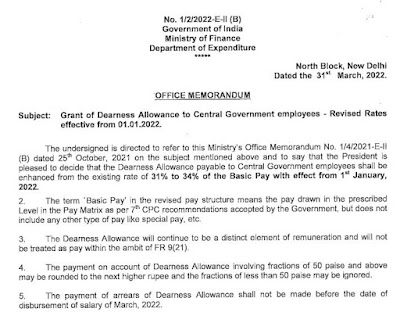
DA Jan 2022 - Grant of Dearness Allowance to Central Government employees - Revised Rates effective from 01.01.2022

 3% DA Hike - Revised Rates effective from 01.01.2022: DoE OM dated 31.03.2022 No. 1/2/2022-E-II (B) Government of India Ministry of Finance...