Showing posts with label IT. Show all posts

Thursday, 11 May 2017

Income Tax department launches new facility to link Aadhaar with PAN


Income Tax department launches new facility to link Aadhaar with PAN

New Delhi: The Income Tax department has launched a new e-facility to link a person's Aadhaar with the Permanent Account Number (PAN), a mandatory procedure for filing IT returns now.

The department's e-filing website https://incometaxindiaefiling.gov.in/ has created a new link on its homepage making it easy" to link the two unique identities of an individual.

The link requires a person to punch in his PAN number, Aadhaar number and the exact name as given in the Aadhaar card".

After verification from the UIDAI (Unique Identification Authority of India), the linking will be confirmed. In case of any minor mismatch in Aadhaar name provided, Aadhaar OTP (one time password) will be required," the department said in its advisory to taxpayers and individuals.

The OTP will be sent on the registered mobile number and email of the individual.

It urged them to ensure that the date of birth and gender in PAN and Aadhaar are exactly the same, to ensure linking without failure.

There is no need to login or be registered on e-filing website (of the I-T department). This facility can be used by anyone to link their Aadhaar with PAN," it said.

The government, under the Finance Act 2017, has made it mandatory for taxpayers to quote Aadhaar or enrolment ID of Aadhaar application form for filing of income tax returns (ITR).

Also, Aadhaar has been made mandatory for applying for permanent account number with effect from July 1, 2017.

The department, till now, has linked over 1.18 Aadhaar with its PAN database.

While Aadhaar is issued by the UIDAI to a resident of India, PAN is a ten-digit alphanumeric number issued in the form of a laminated card by the IT department to any person, firm or entity.

PTI

Sunday, 20 September 2015

NPS returns are market linked - Tax Benefit on NPS

NPS returns are market linked

An investor within the scheme has an option to choose funds based on her level of safety and risk in addition to choosing her own fund manager

The National Pension System (NPS) has been advertising a lot about the new tax deduction of Rs.50,000 for tax payers. I wanted to know more about the new deduction under section 80CCD(1)(b). Is this available only for people whose employers are investing in NPS on their behalf, or is this available for general public as well? How does the deduction work with respect to other tax benefits?
—Praveen Aggarwal

NPS is a voluntary pension scheme regulated by the Pension Fund Regulatory & Development Authority (PFRDA). It was introduced as an investment option to provide for the country’s growing working community to ensure that they have an option to save for their retirement needs. The purpose was to replace the existing system of defined benefit pension to a defined contribution-based pension system.
An investor within the scheme has an option to choose funds based on her level of safety and risk in addition to choosing her own fund manager. The returns are market-linked and, hence, do not give any form of guarantee.

NPS follows an EET (exempt-exempt-tax) model—exempt at the time of contribution or investment, exempt at the time of earnings and taxable at the time of withdrawals.

Section 80CCD under the Income-tax Act, 1961, provides the tax incentive at the first stage of investment—for getting the benefit of deduction for contributions made towards NPS.
This deduction is available to all individuals—salaried as well as non-salaried. This deduction was earlier restricted to Rs.1 lakh for each financial year under section 80CCD(1) and was subsequently increased to Rs.1.50 lakh.

To further boost savings, in Budget 2015, a new section, 80CCD 1B, was introduced, under which an additional deduction of up to Rs.50,000 was allowed for contribution made towards NPS. This made the total deduction under section 80CCD to Rs.2 lakh.

If we go through the provisions of section 80CCD, there is a lack of clarity whether the additional deduction of Rs.50,000 is after exhausting the limit of 10% of salary. Is the cap on deduction of up to 10% of salary (basic + dearness allowance) under section 80CCD (1) and within the overall ceiling of Rs.1.50 lakh or is it over and above the ceiling of Rs.1.50 lakh?

While this ambiguity remains, the intent was clarified in an example quoted by the finance minister in his budget speech this year, in which it was clarified that the assessee can claim additional deduction and the deduction of Rs.50,000 was over and above the ceiling of Rs.1.50 lakh.

Let’s take an example. If you have exhausted your Rs.1.50 lakh limit of deduction under section 80C by savings in Public Provident Fund (PPF), insurance premiums, repayment of housing loan, among other things, you can further increase your tax savings by contributing up to Rs.50,000 towards NPS.
You could open an NPS Tier I account, which is the first level, to claim the tax benefits.

Source: LiveMint

Flash News

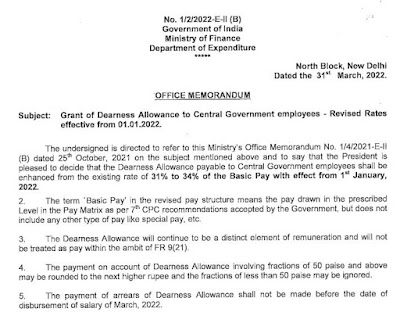
DA Jan 2022 - Grant of Dearness Allowance to Central Government employees - Revised Rates effective from 01.01.2022

 3% DA Hike - Revised Rates effective from 01.01.2022: DoE OM dated 31.03.2022 No. 1/2/2022-E-II (B) Government of India Ministry of Finance...