Showing posts with label Income Tax Exemption Limit. Show all posts

Friday, 1 February 2019

Budget 2019 : Income Tax exemption limit raised to Rs. 5 lakh


Budget 2019 : Income Tax exemption limit raised to Rs. 5 lakh
Budget 2019 Income Tax exemption
Finance Minister Piyush goyal has proposed that individuals with income upto Rs 5 lakh will not have to pay any income tax for FY2019-20.
In the previous budgets also, the Narendra Modi led-government provided tax relief to taxpayers. In Budget 2014, the minimum tax-exemption limit was raised from Rs 2 lakh to Rs 2.5 lakh. Along with that deduction, limit under section 80C was hiked by Rs 50,000 to Rs 1.5 lakh and deduction on interest paid on a housing loan to Rs 2 lakh.
Currently, income up to Rs 2.5 lakh for resident individuals (age below 60 years) is exempt from tax. Similarly, for senior citizens aged 60 years and above but below 80 years, income up to Rs 3 lakh is exempt from tax. Income up to Rs 5 lakh is exempt from tax for super senior citizens (age 80 years and above).

In Budget 2017, Jaitley slashed the tax rate for income between Rs 250,001 and Rs 5 lakh to 5 per cent from 10 per cent earlier. This rate cut gave a tax relief of Rs 12,500 to every taxpayer.
Income tax rates for individuals below 60 years is as follows: No tax on income up to Rs 2.5 lakh, 5 per cent tax on income between Rs 250,001 to Rs 5 lakh; 10 per cent tax on income between Rs 500,001 and Rs 10 lakh; and 30 per cent tax on income above Rs 10 lakh.

For senior citizens (aged 60 years or above but less than 80 years), income up to Rs 3 lakh is exempt from tax. Income from Rs 300,001 to Rs 5 lakh is taxed at 5 per cent, from Rs 500,001 to Rs 10 lakh at 20 per cent and above Rs 10 lakh at 30 per cent.

For super senior citizens, aged 80 years and above, income up to Rs 5 lakh is exempt from tax. Income from Rs 500,001 to Rs 10 lakh is taxed at 20 per cent and above Rs 10 lakh is taxed at 30 per cent.

Tuesday, 5 January 2016

Raise income tax exemption limit to Rs 5 lakh: Unions

Raise income tax exemption limit to Rs 5 lakh: Unions

New Delhi: Trade unions today asked the government to increase the income tax exemption limit to Rs 5 lakh and the minimum wage to Rs 18,000 besides raising the minimum monthly pension to Rs 3,000 for all.

They also sought a special package for victims of the recent Tamil Nadu floods.

These demands were raised under a 15-point charter submitted by 11 central trade unions to Finance Minister Arun Jaitley during pre-Budget consultations held here. The Union Budget for the next financial year, 2016-17, is slated to be presented in Parliament in February end. It will take effect from April 1.

“We have demanded a minimum wage of Rs 18,000 per month which is higher than our earlier demand of Rs 15,000,” Bharatiya Mazdoor Sangh Zonal Organisation Secretary Pawan Kumar said after the meeting.

The Seventh Pay Commission has recommended Rs 18,000 as minimum monthly wage for central government employees and it should be the benchmark, he said.

All Indian Trade Union Congress Secretary D L Sachdev said: “We have also demanded Rs 3,000 minimum monthly pension for all and asked for a special package for flood ravaged Tamil Nadu to provide relief to workers as well as industry in the next Budget.”

Sachdev said that in view of price rise “we have also demanded from the government to increase the income tax exemption limit to Rs 5 lakh per annum”.

The union have also asked that fringe benefits like housing, medical and educational facilities and running allowances in railways should be exempted from Income Tax.

Unions also demanded that PSUs should be strengthened and expanded and the disinvestment of government shares in profit making PSUs should be stopped.

Besides, they said that the budgetary support should be provided for revival of potentially viable sick PSUs.

On the price rise, the charter said: “Take effective measures to arrest the spiralling price rise especially of food and essential items of daily use. Ban speculative forward trading in essential commodities, check on hoarding and universalise and strengthen Public Distribution System.”

Expressing concerns over steel and aluminium sectors, the unions said: “Relentless and increasing flow of import of industrial commodities including capital goods must be contained and regulated to prevent dumping and also to protect and promote domestic industries and prevent loss of employment.”

It also said that “FDI should not be allowed in crucial sectors like defence production, Railways, financial sector, retail trade and other strategic sectors. In other areas, terms and conditions for FDI should be made public.”

PTI

Monday, 23 February 2015

Income Tax Expectations: Here’s What India Wants

Income Tax Expectations: Here’s What India Wants

A survey carried out by industry body Assocham has found that a majority of salaried employees want Finance Minister Arun Jaitley to increase the income tax exemption in the forthcoming Budget.

A hike in income tax exemption from Rs. 2.5 lakh to Rs. 3 lakh will lead to savings of up to Rs. 5,000 for those who fall in the Rs. 2.5 lakh to Rs. 5 lakh tax bracket. Those in the Rs. 5 lakh to Rs. 10 lakh tax bracket will save up to Rs. 10,000, while those in the highest tax bracket can save up to Rs. 15,000.

Any increase in exemption in income tax would leave more money in the hands of people and will increase their purchasing power, Assocham said.

If Mr Jaitley hikes income tax exemption limit, it will be for the second time in two years that salaried employees will get a relief on taxes.

The other big expectation is about exemption on housing loans. 78 per cent of those surveyed want interest exemption on home loans to go up to Rs. 5 lakh from Rs. 2 lakh.

Property prices in the country have gone up sharply over the years and many individuals have to pay large amounts as interest for home loans. Exemption on interest on home loan was hiked by Rs. 50,000 to Rs. 2 lakh in the previous Budget.

A large number of respondents in the survey also voted for hiking exemption limit under section 80C of the Income Tax Act; the section makes investments worth Rs. 1.5 lakh on saving instruments such as fixed deposits, national saving certificates and public provident funds exempt from taxes.

“Hike in exemption limits will boost the savings rate in the Indian economy to 35 per cent of GDP from below 30 per cent currently,” said Assocham secretary general D S Rawat.

88 per cent of respondents want the government to reduce the record-high duty on gold import. Import duty on gold was hiked to 10 per cent in 2013 when the economy was struggling with a high current account deficit and volatile rupee.

Nearly 82 per cent of the salaried class expects a separate deduction of Rs. 50,000 for the payment towards annuity or pension plans. Deduction of the amount paid towards annuity plans u/s 80CCC and NPS u/s 80CCD come under the threshold limit of section 80C currently.

Around 55 per cent of the survey respondents were between 25 and 29 year-old; 26 per cent fell between 30 and 39 years; 16 per cent were between 40 and 49 years. The survey was carried out among employees from 18 broad sectors, with maximum share contributed by employees from IT/ITes sector (17 per cent). It was conducted across Delhi, Mumbai, Kolkata, Chennai, Ahmedabad, Hyderabad, Pune, Chandigarh, Dehradun, etc. About 500 salaried employees from the different sectors were covered by the survey from each city on an average.

Monday, 16 February 2015

NMC urges FM to raise IT exemption limit to Rs 5 lakh, exclude DA from IT calculation, Merge DA in Basic Pay & Pension etc

NMC urges FM to raise IT exemption limit to Rs 5 lakh, exclude DA from IT calculation, Merge DA in Basic Pay & Pension etc

The National Mazdoor Conference today asked Union Finance Minister Arun Jaitley to raise the income tax exemption limit to Rs 5 lakh.

“We urged Union Finance Minister to raise the Income Tax exemption limit to Rs five lakh,” National Mazdoor Conference (NMC) President Subash Shastri said while addressing a series of rallies at Kanjali and Bomyal in Nagrota Block here today.

Shastri also appealed he Finance Minister to announce non inclusion of amount of DA to calculating income tax as the DA instalments are released by the government from time to time to utilise the impact of price rise and inflation.

Shastri emphasised the need for immediate merger of 50 per cent DA into basic pay and pension as per the recommendations of the Fourth Pay Commission.

He added that all these burning issues impacting both the Central and State Governments Employees and pensioners should be addressed by the Union Finance Minister while presenting the budget for 2015-16 in the coming Budget Session of Parliament beginning on 23rd of this month.

He also demanded immediate release two DA instalment of 17 per cent in favour of State Government Employees and pensioners, pointing out that while Central Government is about to release another instalment 6 per cent DA in favour of its employees and pensioners from Jammu 2015 but it is unfortunate that the salaried class in the state has not got the benefit previous two DA instalments.

He also demanded early regularisation of the 62,000 daily rated workers beside release of their wages without any further delay.

Read at: http://economictimes.indiatimes.com/

Thursday, 29 January 2015

Income Tax Exemption Limit can be increased upto Rs 3 Lac

Expected Potential Relief in Income Tax – 10% Tax on 3 to 10 Lakh


Income Tax Exemption Limit can be increased upto Rs 3 Lac

Finance minister Arun Jaitley may announce during the Budget

The Modi government may declare a raise in the Income Tax Exemption limit from the current 2.5 lacs to 3 lacs.

Finance Minister Arun Jaitley may announce an increase in the Income Tax Exemption limit to 3 lacs in the 2015-16 budget meeting, which will be a great relief to the taxpayers, particularly for Central Government Employees.

If this proposal is accepted, then there are chances that changes are made in the Income Tax Rate slab, which may also provide relief to the people of the High Income group.

It is being understood that the government can give a tax exemption up to an annual income of Rs 3 lacs; where a 10% tax was paid for an income between 2.5 to 5 lacs, there it is expected that people with an annual income of Rs 3 lacs to 10 lacs will have to pay a tax of 10%. Similarly, where people with an annual income of Rs 5-10 lacs had to pay a tax of 20%, it is expected that this tax rate would be extended for the income group of 10-20 lacs.

Similarly, the 30% tax rate for the income above 10 lacs is expected to be increased to a limit between 20 lacs and 1 crore for implementation. It has been told that the government is making easy the path of the High Income group and for above 1 crore, and is in the process of collecting a lump sum of 33% instead of the interest over 30% and surcharge of 10%.

According to sources, the special Investigation team formed in relation to black money has recommended a maximum cash possession limit of approximately 15 lacs which may also be declared.

Expected Potential Relief in Income Tax

Present Income Tax Slab
Total amount of Income Rate (Percentage)
Up to Rs 2.5 Lacs Nil
2.5 lacs to 5 lacs 10
Rs 5 Lacs to 10 Lacs 20
Above 10 Lacs 30
Above 1 Crore 30 plus 10 percent surcharge

Proposed Income Tax Slab
Total amount of Income Rate (Percentage)
Up to Rs 3 Lacs Nil
3 lacs to 10 lacs 10
Rs 10 Lacs to 20 Lacs 20
Rs 20 Lacs to 1 Crore 30
Above 1 Crore 33

Saturday, 21 June 2014

Raise IT Exemption to 5 Lakh, Merge DA, Scrap NPS, Funds for Interim Relief: NC(JCM) writes to Finance Minister

NC(JCM) Secretary writes to FM regarding the important major issues of Central Government Employees as Pre-Budget Consultation:-

Shiva Gopal Mishra
Secretary
National Council (Staff Side)
Joint Consultative Machinery
Central Government Employees
13-C, Ferozshah Road, New Delhi – 110001
No.NC/JCM/2014
Dated: June 17, 2014
Hon’ble Minister of Finance,
(Government of India), Ministry of Finance,
North Block, New Delhi

Respected Sir,
Reg.: Pre-budget consultation

I, on behalf of National Council (Joint Consultative Machinery), representing more than 36 lakh Central Government Employees’, once again congratulate and welcome you on your taking over as Finance Minister of the new government, recently formed on the verdict of the people of this country.

We take this opportunity to bring to your kind notice some important major issues that need to be taken into consideration while finalising the General Budget of our country for the year 2014-15. This would definitely boost the morale of the Central Government Employees and simultaneously help a lot in overall development of our nation.

Some of the important issues are appended below for your kind consideration;

(i) Effective measures need to be taken to arrest the skyrocketing price rice, particularly of essential commodities effecting common man and to contain inflation, ban speculative forward trading in commodities, strengthen the Public Distribution System, ensure proper check on unlawful hoardings and rationalise the tax dutylcess on petroleum products with a view to minimise burden on common people.
(ii) Adequate allocation be ensurd in infrastructure development in order to stimulate the economy for job creation. Necessary measures are required to be taken for strengthening the Public Sector for job creation and rapid development of the country as this sector plays vital role in this regard. Plan and non-plan expenditure should be adequately increased to stimulate job creation and ensuring consistent income of the people.
(iii) Minimum Wage linked to Consumer Price Index need to be guaranteed to all workers, complying the recommendation of the 15 Indian Labour Conference as envisaged by the apex court of the country and reiterated in the 44th Indian Labour Conference held in 2012, and it should be minimum Rs 15000 p.m.
(iv) In the context of huge job losses and mounting unemployment problem, the ban imposed on recruitment in Government Departments, Public Sector Undertakings and Autonomous Bodies should be lifted as per recommendation of the 43 Session of the Indian Labour Conference, Instructions of the Finance Ministry to abolish the posts which are not filled for one year should be withdrawn and thumb rule surrender of posts in Government Departments and Public Sector Undertakings be stopped, while new posts be created fornew assets and increased workload without imposing any conditn of “Matching Saving” etc.
(v) In the wake of appointment of VII CPC by the former government, allocation of requiste funds be made for Interim Relief and to implement the recommendations of the VII CPC.
(vi) All the restrictive provisions based on poverty line in respect of eligibility coverage of the schemes under the Unorganised Workers’ Social Secuñty Act, 2008 need to be done awaywith and adequate resources be allocated for the National Fund for Unorganised Workers with a view to provide Social Security to all Unorganised Workers, including Contractual/Casual Workers in ne with the recommendations of the Parliamentary Standing Committee on Labour as also the 43rd Session of the Indian Labour Conference, for which the word “Below Poverty Line” need to be re-defined at the earliest.
(vii) Necessary provision in the budget be made for providing essential services, viz, housing, public transport, sanitation, water, schools/colleges, creche for children, healthcare for the workers in the new emerging industrial areas as also separate women hostels for women workers where their participation is high.
(viii) Budget provision is required to be increased for elementary education, particularly in the wake of implementation of the justify to Education, as the same can be proved an effective tool to combat Child Labour.
(ix) The prevalent system of computation of Consumer Pñce Index needs to be reviewed owing to heavy financial loss to the workers in the present system.
(x) The ceiling limit for exemption of Income Tax for the salaried employees be raised to atleast 5 lakh per annum and fringe benefits, like housing, medical aid education facilities, Running Allowances, be exempted from Income Tax net in totality.
(xi) New Pension Scheme be withdrawn, being detrimental for Social Security, and all employees under the Central Government, State Government, PSUs, Autonomous Bodies etc. recruited on or after 01.01.2004 be covered under Old Pension Scheme. Any National Pension Scheme should be made optional in addition to Old Pension Scheme.
(xii) The genuine demand for Merger of Dearness Allowance with Pay be accepted and adequate allocation of funds for this purpose be made in the budget.

We also put-forth the following suggestions in regard to resource mobilisation for the purpose of fulfilment of the aspirations of the common people of the country in general and the working class in particular:-

  • A Progressive Taxation System should be put in place to ensure taxing the rich and the affluent sections who have the capacity to pay at a higher degree. Corporate service sector, traders, wholesale business, private hospitals and institutions etc. should be brought under broader and higher tax net Increase taxes on luxury goods and reduce Indirect Taxes on essential commodities, as at present overwhelming majority of the population are subjected lo Indirect Taxes that constitute 86% of the revenue.
  • Concrete steps must be taken to recover huge accumulated unpaid tax arrears which has already crossed more than Rs.5 lakh crore on Direct and Corporate Tax account alone, and has been increasing at a geometric proportion. Such huge tax evasion over and above the liberal tax concessions, already given in the last two budgets, should not be allowed to continue.
  • The steps taken by the new Central Government, constituting Special Investigation Team(SIT) for recovering black money are praiseworthy and we urge for speedy action in the matter.
  • Effective measures need to be taken to unearth huge accumulation of black money in the economy, including heavy amount of uncounted money in the tax heavens abroad and within the country, and necessary provisions be made to bring back illicit flow from India, which are at present more than twice current external debt of US$ 230 billion. This huge money be directed towards providing Social Security lo the working class.
We do hope, the above-mentioned views would receive due consideration from your good-self. Besides the, there is an urgent need for continuous dialogue with the Central Government Employees, for which, the National Council(JCM), being ai effective tool, has always played a vital role during the past, however., it is quite unfortunate that the same has been made ineffective during the recent years. It is our considered view that, in the larger interest of the development of the nation, continuous dialogue on the problems of the Central Government Employees through the JCM is necessary.

It is, therefore, earnestly requested that, dialogue in the pre-budget discussion with the JCM(Staff Side) should also be ensured, so that the views expressed by them can also be taken Into account while finalising the Budget.

With kind regards!
Yours faithfully,
sd/-
(Shiva Gopal Mishra)

Source: http://ncjcmstaffside.com/wp-content/uploads/2014/06/Pre-Budget-Consultations_17.06.2014.pdf

Tuesday, 10 June 2014

Raising of exemption limit for Income Tax and exemption of all allowances from Income Tax: NC JCM writes to Finance Minister

Raising of exemption limit for Income Tax and exemption of all allowances from Income Tax: NC JCM writes to Finance Minister

 Raising of exemption limit of Income Tax to Rs. 5 lakh for Individuals, Rs. 7 lakh for Senior Citizens above 60 years and Rs. 10 lakh for the very old and exemption of all allowances from Income Tax – Com. Shiva Gopal Mishra Secy/NC JCM writes to Finance Minister for including this demand into Union Budget

Shiva Gopal Mishra
Secretary
National Council (Staff Side)
Joint Consultative Machinery
for Central Government Employee
13-C, Ferozshah Road, New Delhi - 110001
No.Nc-JCM/2014/IT
Dated: June 9, 2014
Shri Arun Jaitley,
Hon’ble Minister of Finance,
Ministry of Finance,
North Block, New Delhi

Resp. Sir,

Sub: Raising of exemption limit for Income Tax and exemption of all allowances from Income Tax

Exemption limit from Income Tax is very low and neither realistic nor justified. It is not linked with Inflation nor is it appropriately revised every year.

Fixing of exemption limit for Income Tax is done arbitrarily. No systematic norms are followed while fixing the same. There is no transparency about the norms or policy adopted for fixing the Exemption limit for Income Tax.

Low ceiling of exemption is one of the root cause of build up of huge amounts of Black Money.

It is also a major impediment in the growth and development of the National economy as the spending by the common man gets restricted due to the low ceiling of Income Tax. This, according to experts, adversely affects the National Development as a whole.

Taxing of Dearness Allowance, House Rent Allowance and Transport Allowance etc., erodes the real income of the Salaried Class, as these Allowances are compensatory in nature and as such should be exempted from Income Tax, as recommended by the Fifth Central Pay Commission(vide Chapter 167 of their Report).

Taxing of Pension of Senior Citizens, especially Additional Pension of the very old Senior Citizens, is totally unjustified, and as such should be exempted from Income Tax, as recommended by the Fifth Central Pay Commission.

It is, therefore, requested that:-

(i) Exemption limit for Income Tax be raised to Rs. 5 lakh for Individuals, Rs. 7 lakh for Senior Citizens above 60 years and Rs. 10 lakh for the very old - above 80 years of age.

(ii) All the allowances, i.e. Dearness Allowance/Dearness Relief, HRA and Transport Allowance, may please be exempted from the Income Tax to avoid erosion of real wages as recommended by the Fifth Pay Commission vide Chapter 167 of their Report and Para 95 of Summary of Recommendations (Please see excerpts of Fifth CPC Report attached herewith as Annexure).

(iii) Fixed Medical Allowance to Pensioners may please be exempted from Income Tax as it is reimbursement of the expenses for day-to-day medical treatment.


Yours faithfully,
Sd/-
(Shiva Gopal Mishra)
Secretary(Staff Side)
NC/JCM
Encl: Excerpts of the recommendations of Fifth CPC

Copy to: All Constituent Organizations of the National Council, JCM(Staff Side) - for information.

ANNEXURE

EXCERPTS FROM THE REPORT OF FIFTH PAY COMMISSION REG. EXEMPTION OF ALL ALLOWANCES FROM INCOME TAX

The Fifth Pay Commission vide Chapter 167 & Para 95 of Summary of Recommendation had recommended as under:-

“Para 95 The Commission has felt that the salaries and pensions recommended by it are not really adequate if they are to be fully taxed. Accordingly, it has recommended that all Allowances and Pensions should be paid Net of Taxes”.

The Fifth CPC in Para 167.7 had observed as under:-

‘‘If such Allowances are taxed, then either the Basic Salary gets eroded in its real value from Year to Year or the partial Reimbursement of Expenditure incurred on certain items becomes less and less with the passage of time.  In both the cases, the objective of giving Allowances is partially nullified”.

The Fifth CPC further observed in Para 167.8 that -

“We have observed that Ministry of External Affairs pays ‘Net of Tax’ Salaries to its employees on Foreign Posting. Provision for paying Net of Tax Salary already exists Under Sec.195A of the Income Tax Act. Under the Section, employees do not have to pay Income Tax on the salaries received by them and it is the liability of the employer to pay the same to the Income Tax Department.”

“The solution to the problem of the Central Government Employees in general lies in the application of this legal provision” (Fifth CPC - Para 167.9).

Source: http://ncjcmstaffside.com/2014/raising-of-exemption-limit-of-income-tax-exemption-of-all-allowances-from-income-tax/

Flash News

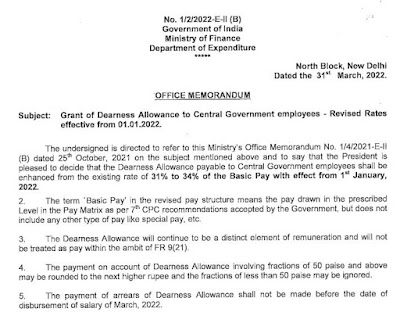
DA Jan 2022 - Grant of Dearness Allowance to Central Government employees - Revised Rates effective from 01.01.2022

 3% DA Hike - Revised Rates effective from 01.01.2022: DoE OM dated 31.03.2022 No. 1/2/2022-E-II (B) Government of India Ministry of Finance...