Showing posts with label Demonetisation. Show all posts

Saturday, 7 January 2017

7th Pay Commission: Top 2 developments before Budget 2017 raise hopes for Central government employees


7th Pay Commission: Top 2 developments before Budget 2017 raise hopes for Central government employees

The finance ministry seems better placed now after demonetisation to decide on raising allowances as recommended by the 7th Pay Commission.

With the dust at least partly settled over demonetisation and the subsequent disruption at the finance ministry, there seems to be renewed cheer among Central government employees of a decision on allowances as recommended by the 7th Central Pay Commission (CPC). Two developments in this regard are worth taking note of, even as Budget 2017 is about a month away.

As has been reportedly earlier, the second amnesty scheme for tax defaulters - Pradhan Mantri Garib Kalyan Yojana, 2016 - estimated to net the Modi government a substantial amount, the financial outgo of Rs 1,02,100 crore no longer seems to be a hurdle.

However, the note ban decision and the spate of activities that followed the decision about raising allowances to the back burner made employees restive.

Now they hope the government will quickly move on the issue that involves about 47 lakh Central government employees and 53 lakh pensioners, of which 14 lakh employees and 18 lakh pensioners are from the defence forces.

While a website claiming to represent bureaucrats said that the finance ministry is likely to pay the enhanced allowances (possibly along with arrears) after Budget 2017 in February, another said that employees have sought a meeting with the ministry to resolve the issue at the earliest.

"Government is very pleased to pay the higher allowances to its employees after Budget. The acute cash crunch in banks and ATMs that prevailed for a month following the demonetization move of the government has eased from January 1, as the daily withdrawal limit from ATMs has been increased from Rs 2,500 to Rs 4,500. Hence, the Finance Ministry felt it would be wiser to announce of higher allowances after Budget," the Sen Times quoted a senior finance ministry official as saying.
Another significant development is a communication by the staff side National Council of the Joint Consultative Machinery (JCM) seeking an early redressal of the issue.

"Almost four months have passed (since September 1, 2016 meeting) without any outcome. All the Central Government Employees are quite agitated as well as are having mental agony because allowances of the VII CPC, have not been implemented. You are therefore, requested to fix-up a meeting of the Committee on Allowances, at an earliest to resolve the issues placed in the memorandum of the Staff Side(JCM) on various allowances," the letter read.

The CPC examined 196 allowances and gave its recommendations on abolishing or raising some of them while recommending others to be subsumed with other perks. It had proposed 138.71 percent hike in HRA and 49.79 percent for other allowances, while submitting its voluminous report in November 2015.

The Budget for the financial year 2017-18 is likely to be presented on February 1 by Finance Minister Arun Jaitley.

Source: ibtimes.co.in

Sunday, 25 December 2016

Demonetisation is short term pain for long term gain: PM Narendra Modi

Demonetisation is short term pain for long term gain: PM Narendra Modi

Raigad (Maharashtra): Prime Minister Narendra Modi on Saturday articulated that demonetisation is only short term pain for long term gain, adding that the present regime would not shy away from taking difficult decisions that are in the interest of the country.

"Demonetisation is only short term pain for a long term gain. We will continue with sound economic policies to ensure India’s bright future in the long run," he said.

Speaking at the inaugural function the National Institute of Securities Markets (NISM) in Raigad, Prime Minister Modi said that India is being seen as bright spot and to see how far India has travelled one should look back to 2012-13 when the currency was falling sharply.

"India has earned a good name for its well regulated securities markets," Prime Minister Modi said.
The Prime Minister Modi also expressed the view that public investment has increased in the last three years and progress has been made in ease of doing business.

"Constitutional amendments on GST that remained pending for years has been passed and the long awaited GST will soon be a reality," he said.

"For financial markets to function successfully, participants need to be well informed," he added.
Prime Minister Modi further said that those who profit from financial markets must make a fair contribution to nation-building through taxes.

Highlighting the progress made by the Indian economy the Prime Minister said, " SEBI should work for closer linkage between spot markets like e-NAM and derivatives markets to benefit farmers. The country has made progress and improved the ease of doing business as foreign direct investment(FDI) has now reached record levels."

The Prime Minister asked stock markets to raise capital in innovative ways for projects in agriculture.
"Government is very keen to encourage start-ups as stock markets are essential for the start-up ecosystem," he added.

Earlier, Prime Minister Modi arrived in Raigad to inaugurate the new campus of the National Institute of Securities Markets in Panvel.

During his one-day-visit to the state, the Prime Minister will also lay the foundation stone for the grand memorial of Maratha warrior king Chhatrapati Shivaji Maharaj on an island in the Arabian Sea off Mumbai and a metro project in Pune.

ANI

State Bank to grant two-day special leave to employees

State Bank to grant two-day special leave to employees

State Bank of India will grant special leave of two days to its employees as reward for having taken additional stress since November 8 when demonetisation was announced.

Employees would be able to avail this leave any time until March 2018, said SBI Chairman Arundhati Bhattacharya in Mumbai on Wednesday.

"Our employees will get rewarded, I am sure. We are looking into what can be done. We have already given overtime wherever it is due."

On the issue of new currency notes being diverted by some bank employees, Bhattacharya clarified that in any system there would be a few bad examples.

She observed that such incidents of Rs.100-200 crore being diverted to a select few had created doubts in the minds of people. The banking sector had dispensed Rs.7 lakh crore worth of money in the system during this period. But those who are guilty of such malpractices will be dealt in accordance with law, she said.

Bankers have been going about their job silently and without being given credit for implementing such a challenging task, she said.

They had been putting in late hours and many could not go home in the initial few days, she said.
The SBI chief said that there were checks and balances in place but if checks were tightened further, banks would not be able to serve their customers.

SBI was using analytics to ascertain the number of notes received by the bank versus the number issued to customers, besides reporting suspicious transactions on a daily basis, Bhattacharya said.

Source : The Hindu

Thursday, 22 December 2016

Centre okays ordinance for wage payment via e-mode, cheques

Centre okays ordinance for wage payment via e-mode, cheques

New Delhi: Promoting less-cash economy, the government today brought in an ordinance to enable industries covered under the Payment of Wages Act to pay workers through cheques or crediting money into their bank accounts, although employers will have the option to pay in cash.

Labour Minister Bandaru Dattatreya had introduced The Payment of Wages (Amendment) Bill, 2016 in Lok Sabha on December 15 but it could not be passed because of continued disruption of the Winter Session of Parliament due to ruckus over demonetisation.

The decision to adopt ordinance route to amend the Act was taken by the Union Cabinet.

Trying to clear the air, Dattatreya told reporters at a press conference after the Cabinet meeting that employers will have the option of paying wages in cash after notification of industries by Centre and states.

Confusion prevailed earlier in the day whether it would be mandatory for employers of the industries notified by the Centre and states, to pay wages through cheques or by crediting the same into employees bank account.

The bill however clearly states that "appropriate Government may, by notification in the Official Gazette, specify the industrial or other establishment, the employer of which shall pay to every person employed in such industrial or other establishment, the wages only by cheque or by crediting the wages in his bank account”.

The amendment enables the Centre as well as state governments to notify industries where employers shall have pay wages either through cheque or crediting that into workers’ bank account.

Despite repeated queries the minister maintained that employers will have the option to pay wages in cash after the amendment in the Act through ordinance as well as the bill.

Dattatreya said however that the government has adopted the ordinance route because it was long pending demand of the trade unions.

Centre of Indian Trade Unions (CITU) General Secretary Tapen Kumar Sen said: “They are lying. The bill introduced in the Parliament clearly bars payment of wages in cash by industries notified by Centre and States. They just want to please Prime Minister Narendra Modi.”

He also said, “It is not correct to take away workers’ right to demand wages in cash amid currency crunch when the entire banking service in the country is in disorder facing an abnormal situation.

“This is not the right time for bringing this ordinance as workers are already going through tough times due to currency crunch following demonetisation.
In a statement, CITU said: “This right to consent is

important for workers since at least 35 per cent of the habitations in the country are still out of the coverage of bank branches in the vicinity and also a big majority of workers including those in urban areas, particularly those in low-paid unorganised sector, do not have bank accounts. And in case of compulsory bank payment of wages, the migrant workers will be put in serious difficulty.”

As per the Bill, the new procedure will serve the objective of “digital and less-cash economy”.

The Act had come into force on April 23, 1936, providing for payment of wages in coin or currency notes, or in both. The provision for payment of wages by cheque or crediting it into bank account after obtaining the requisite authorisation of employee was inserted in 1975.

At present, the Act covers all those employees in certain categories of establishments whose wage does not exceed Rs 18,000 per month.

The Centre can make rules regarding payment of wages in relation to railways, air transport services, mines, oil fields and its establishments while states take a call on all other cases.

By making state-level amendments to the Act, Andhra Pradesh, Uttarakhand, Punjab, Kerala and Haryana have already made provisions for payment of wages through cheque and electronic transfer.

At present, with the written authorisation of an employee, wages can be given through cheque or transferred to his or her bank account.

PTI

Thursday, 15 December 2016

Post Offices Exchanged Notes Worth Rs 3,680 Crore Till Dec 7

Post Offices Exchanged Notes Worth Rs 3,680 Crore Till Dec 7

New Delhi: Post offices have exchanged currency worth Rs 3,680.99 crore till December 7, after the government scrapped old Rs 500 and Rs 1,000 notes last month, Parliament was informed today.

"The total amount exchanged in the post offices after demonetisation is Rs 3,680.99 crore till December 7, 2016,” Communications Minister Manoj Sinha said in a written reply to Lok Sabha.

The total amount deposited in the post offices after demonetisation is Rs 38,630.06 crore till December 7, 2016, he added. The demonetisation of high value currency took effect from November 9.

Responding to another query, Sinha said a total of over 79.75 lakh subscribers have ported out and 60.51 lakh subscribers have ported in to the mobile network of Bharat Sanchar Nigam Ltd (BSNL).

"A total of 4,41,879 subscribers have ported out and 1,21,219 subscribers have ported in to the mobile network of Mahanagar Telephone Nigam Ltd (MTNL)," he said.

A total of 2,479 complaints have been received by different TERM Cells against various telecom service providers (TSPs) across the country regarding keeping MNP request of subscribers pending or cancelled and thereby not complying with the MNP scheme during year 2015 and current year 2016 (up to September 30, 2016), he said.

Out of these complaints, a total of 2,320 number of complaints have been received against private cellular operators.

The highest number of complaints was against Airtel (651), followed by Vodafone (555), Idea (444), Reliance (342) and Aircel (195).

PTI

Tuesday, 13 December 2016

7th Pay Commission: Demonetisation delays higher allowances


7th Pay Commission: Demonetisation delays higher allowances

7th-Pay-Commission-demonetisation-allowance


New Delhi: Higher allowances under 7th pay commission recommendations is set to be delayed as the cash crunch brought on by demonetisation has hit government’s major announcement for central government employees.

The committee on allowances has finalized the report on the allowances and the government has also sanctioned the funds, but the government is unable to pay it to its employees. On the other hand, the Finance Ministry is facing pressure from the central government employees’ unions which want immediate announcement of higher allowances.

“One of the the government major announcements that has got get affected in the cash crunch process is ‘fatter allowances’ for the central government employees. The announcement has now been postponed, We expect things to normalise January onwards from the current uncertainty, if things settle down, the announcement will be made.” a top official involved with the process of higher allowances told The Sen Times on the condition on anonymity.

He added that the decision on this matter to push since payments to the employees are made in ease and without facing cash crunch. Hence, the Finance Ministry felt it would be wiser to announce of higher allowances when things settle down.

Currently, the central government employees are getting allowances according to the 6th Pay Commission recommendations while the government implemented hike in basic pay with retrospective effect from January 2016 in new pay structure under the recommendations of the 7th Pay Commission for central government employees.

The government approved hike in basic pay in June but referred hike in allowances other than dearness allowance to the ‘Committee on Allowances’ headed by the Finance Secretary Ashok Lavasa for examination as the pay commission had recommended of abolishing 51 allowances and subsuming 37 others out of 196 allowances.

However, the 7th pay commission had recommended 138.71 percent hike in House Rent Allowance (HRA) and 49.79 percent for other allowances and the committee on allowances sticks with the 7th Pay Commission’s recommendations, the official confirmed.

After the cabinet approval, Finance Minister Arun Jaitley had congratulated central government officers, employees and pensioners on a historic rise in their salary and allowances through the 7th pay commission recommendations but the central government employees have so far not been paid higher allowances.

TST

Flash News

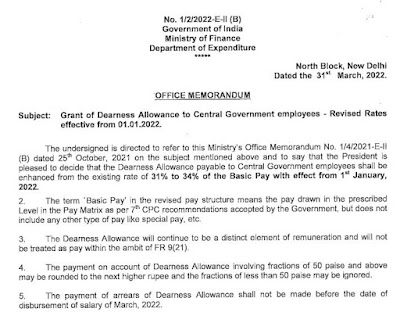
DA Jan 2022 - Grant of Dearness Allowance to Central Government employees - Revised Rates effective from 01.01.2022

 3% DA Hike - Revised Rates effective from 01.01.2022: DoE OM dated 31.03.2022 No. 1/2/2022-E-II (B) Government of India Ministry of Finance...