Showing posts with label Government. Show all posts

Wednesday, 7 February 2018

Outsourcing of jobs in Government Departments

Departments, Outsourcing government jobs, Outsourcing jobs, PENSIONS
Ministry of Personnel, Public Grievances & Pensions
 Outsourcing of jobs in Government Departments
outsourcing-central-government-jobs

Posted On: 07 FEB 2018 1:17PM by PIB Delhi

A Ministry or Department may procure certain non- consulting services in the interest of economy and efficiency and prescribe detailed instructions and procedures for this purpose without, however, contravening the basic guidelines provided in rule 199 to 206 of "General Financial Rules 2017" (GFR 2017). As each Ministry/Department is competent to procure services at their level to meet seasonal or short-term requirements, the centralised data is not maintained in this regard.

There are detailed procedures laid down for procurement of such non-consulting services including e-procurement in Chapter 6 of the GFR 2017 and the "Manual for Procurement of Consultancy & Other Services, 2017".  Ministries are competent to decide the mode depending on the nature of work, nature of competency required etc. Any deviation or violation can be dealt by the Ministry appropriately. The wages for the persons engaged on contract/outsourcing cannot be less than the minimum wage fixed/notified by the concerned State Government.

The Government posts are regularly filled up in accordance with the recruitment rules. Each Ministry/Department is responsible for appointment of regular employees against vacant posts after completing all procedural formalities. The centralised data of vacancies and backlog vacancies is not maintained.

This was stated by the Union Minister of State (Independent Charge) of the Ministry of Development of North Eastern Region (DoNER), MoS PMO, Personnel, Public Grievances & Pensions, AtomicDr Jitendra Singh in a written reply to a question in the Lok Sabha today

PIB

Thursday, 23 March 2017

Government may table 4 GST bills in Parliament today: Minister


Government may table 4 GST bills in Parliament today: Minister

New Delhi: The government may table four GST supplementary legislations in Parliament today, a union minister said.

We can do it today as well. A meeting on GST will be chaired by Finance Minister Arun Jaitley today, Minister of State for Finance Arjun Ram Meghwal said when asked about tabling of the four GST bills in the Lok Sabha.

He was speaking to reporters on the sidelines of an infrastructure event here.

The Cabinet on Monday cleared the four GST related bills to enable roll out of the Goods and Services Tax from July 1.

The four bills are: the Central Goods and Services Tax Bill 2017, the Integrated Goods and Services Tax Bill 2017, the Union Territory Goods and Services Tax Bill 2017 and the Goods and Services Tax (Compensation to the States) Bill 2017.

A source had told that the bills would be introduced as money bills in Parliament this week.

Yesterday, Finance Minister Arun Jaitley said that he was hopeful of rolling out GST from July 1 which will create one of the world's biggest single markets and make commodities cheaper and tax evasion difficult.

Jaitley said India has "hugely" a non-tax compliant society and the government banned higher denomination notes to curb the tendency of people to deal in cash that lead to tax evasion as well as terror financing.

PTI

Wednesday, 15 March 2017

Cabinet nod likely to double gratuity cap to Rs 20 lakh


Cabinet nod likely to double gratuity cap to Rs 20 lakh

Besides, the bill seeks to enable the central government to change the ceiling for tax free gratuity after factoring in rise in income levels by an executive order bypassing Parliament route to amend the law.
The Union Cabinet is likely to consider tomorrow a draft amendment bill which seeks to double the ceiling of tax-free gratuity to Rs 20 lakh under the Payment of Gratuity Act.

Besides, the bill seeks to enable the central government to change the ceiling for tax free gratuity after factoring in rise in income levels by an executive order bypassing Parliament route to amend the law.
"The bill to amend the Payment of Gratuity Act is likely to be considered and approved by the Union Cabinet in its meeting scheduled tomorrow," a source said.

After the amendment in the Act, formal sector workers would be eligible for up to Rs 20 lakh tax-free gratuity. Last month, the central trade unions had agreed on the proposal in a tripartite consultation with the Labour Ministry.

However, the unions had demanded the removal of conditions asking to have at least 10 employees in an establishment and minimum five years of service for payment of gratuity.

At present, as per the Payment of Gratuity Act, an employee is required to do minimum service of five years to become eligible for gratuity amount. Moreover, the Act applies to those establishments where the number of employees is not less than 10.

Trade unions had demanded that the amended provision regarding maximum amount should be made effective from January 1, 2016, as done in the case of central government employees.

Besides that rate of 15 days wages for each completed year of service be raised to 30 days wages, the unions had said during the tripartite meeting.

The proposed amendment to the Payment of Gratuity Act as circulated by the government only deals with enhancing the ceiling of maximum amount under Section 4(3) of the Act from Rs 10 lakh to Rs 20 lakh.
The proposed amendment is being brought to bring the maximum ceiling amount to Rs 20 lakh in line with the 7th Central Pay Commission's recommendations as accepted by the government.

The relevant amendment for central government employees was notified on July 25, 2016 and the enhanced amount ceiling was made effective from January 1, 2016.

The unions were of the view that the delay of eight months for employees covered under the Payment of Gratuity Act should not result in adversely affecting the interest of the concerned employees.
The employers as well as state representatives had also agreed to the proposal of raising the amount of gratuity to Rs 20 lakh in the tripartite meeting held last month.

Source: Money Control

Tuesday, 28 February 2017

7th CPC Allowance Committee Report Submitted to the Government or not?


Was the 7th CPC Allowance Committee Report submitted to the government as early as February 22?

7th CPC Allowance Committee Report Submitted to the Government or not?

Was the 7th CPC Allowance Committee Report submitted to the government as early as February 22?
A high-level committee, under the chairmanship of Finance Secretary Ashok Lavasa was constituted by the Central Government to review the Seventh Pay Commission’s recommendations regarding the allowances being given to the Central Government employees. According to information, the committee had already submitted its report on February 22.

Irrespective of who possesses the report now - the committee or the government - what is more intriguing is the recommendations that it contains.

One could see that the 7th Pay Commission suggested either rationalization or simplification at many places. An example is the Pay Matrix Table, which has now brought the entire Pay Structure of more than 35 lakh employees under one Table. Although there are some anomalies, the system has dramatically simplified the process of annual increment calculation and also pay fixation on Promotion or MACP.

At present 196 different kinds of allowances are being given to the Central Government employees. Some modifications have been recommended in these too as part of the rationalization and simplification drive. The Seventh Pay Commission has recommended the abolition of 52 allowances. And another 36 allowances have been abolished as separate identities, but subsumed either in an existing allowance or in newly proposed allowances.

The Commission said that the entire range of allowances is administered in broadly four ways. Fully DA indexed Allowances, Partially or Semi DA indexed Allowances, No DA indexation Allowances and Percentage based Allowances. House Rent Allowance is being under the category of Percentage based Allowances. The Commission also said that the compensation towards the housing needs of Central Government employees is covered in many ways. The Commission finally suggested that the percentage based allowances by a factor of 0.8, the Commission recommends that HRA should be rationalized to 24 percent, 16 percent and 8 percent of the Basic Pay for Class X, Y and Z cities respectively.

The big irritation, or rather disappointment to the Central Government employees was the recommendation to reduce the percentage of House Rent Allowance (HRA).

All trade unions have expressed their harsh opposition to the proposed cuts in HRA. The Central Government employees’ Federations also expressed their disappointment through various protest. Finally the Central Government accepted to constitute a high level committee to examine the recommendations of 7th Pay Commission regarding Allowances.

Now, sources claim that the committee has already submitted its report to the government.

The government can announce its final decision on the recommendations of the committee any day. But, many believe that there could be a delay in the announcements due to the state elections that are being held in various parts of the country and the election commission’s guidelines that are being enforced now.
Unconfirmed reports say that the committee has recommended the percentage rates of HRA as per 6th CPC and changes in the method of calculating Transport Allowances also.

The biggest mystery however is - will these recommendations be given retrospective effect and will arrears be given?

Three dates are currently being suggested - January 1, 2016; August 1, 2016; and April 1, 2017.
Only the Central Government has all the answers right now.

Wednesday, 22 February 2017

Central Government launches free anti-virus for PC, mobile phones


Central Government launches free anti-virus for PC, mobile phones

New Delhi: The IT Ministry today launched botnet cleaning and anti-malware analysis centre for Rs 90 crore to provide free anti-virus to computers and mobile phones for removing malicious softwares "I would like ISPs (Internet Service Provider) to encourage their consumers to come on board, there is a free service available. Come and use it in the event some malware has sneaked in to the system," IT Minister Ravi Shankar Prasad said at the launch of Botnet Cleaning and Malware Analysis Centre.

The Indian Computer Emergency Response Team (Cert-In) will collect data of infected systems and send it to ISPs and banks. These ISPs and banks will identify the user and provide them the link of the centre, launched in name of Cyber Swachhta Kendra.

The user will be able to download anti-virus or anti-malware tools to disinfect their devices.

"The project has budget outlay of Rs 90 crore spread over period of 5 years," CertIn Director General Sanjay Bahl said.

As of now 58 ISPs and 13 banks have come on board to use this system.

The ministry also launched M-Kavach for security and anti-theft solution for mobile phones, USB Pratirodh to ensure only authorised person is able to access pen drive and AppSamvid for identifying genuine applications at the time of installations on computers.

The minister directed Cert-In to also set up National Cyber Coordination Centre (NCCC) by June.
The government has approved Rs 900 crore for NCCC which will monitor and handle cyber attacks on Indian internet space in real time.

"Safety and security is integral. As the Prime Minister said cyber threat is akin to bloodless war. I don’t have slightest doubt cyber security is not only going to be big area of Digital Swachh Bharat but also going to be big area of digital growth, digital employment and digital commerce," Prasad said.

To encourage startups in the field of cyber security, the minister announced that government has reduced testing fee for their product by half.

At present Standardisation Testing and Quality Certification (STQC), a division under the Ministry of Electronics and IT, charges testing fee in the range of Rs 8-10 lakh per case but startups in the field of cyber security will need to pay only around 4-5 lakhs.

To strengthen cyber security ecosystem in the country, Prasad said that CERTs will be set up at state level as well and 10 more STQC testing facilities will set up.

PTI

Friday, 10 February 2017

7th Pay Commission: How Jaitley saved Crores of Rupees this Financial year


7th Pay Commission: How Jaitley saved Crores of Rupees this Financial year.

It has been more than six months since the Narendra Modi government cleared the recommendations of the 7th Pay Commission

Government employees are, however, yet to enjoy the full benefits of the recommendations with the decision on allowances still to be announced.

The 7th pay commission recommendations cover more than one crore government employees and pensioners. The commission recommended a 14.27 per cent hike in basic pay.

HOW MR. ARUN JAITLEY SAVED CRORES FOR THE GOVERNMENT:

1. The hike in basic pay has resulted in a marginal increase in the total salary drawn by government employees. This is because allowances form a sizeable chunk of their pay.

2. Till date, the government has not made announcements on when exactly does it plan to start giving out the allowances to its employees.

3. The government had asked the Committee on Allowances headed by Finance Secretary Ashok Lavasa to review the recommendations of the 7th Pay Commission on allowances.

4. The government has given the committee an extension up to February 22, 2017 to submit its report on higher allowances. In October last year, Finance Secretary Ashok Lavasa had said the committee was ready with its report.
However, no extension of period was asked by the committee, but still the government delayed the implementation by this extension.

5. The government’s dilly-dally on allowances has largely been attributed to demonetisation and the Assembly elections in five states. The 7th Pay Commission has recommended scrapping 53 of the 196 allowances, and merging a few others.

6. The hiked salary, as per the recommendations of the pay commission, is given in two parts. The increase in the basic salary is calculated from the time the government implements the recommendations of the commission, i.e. on a back date basis. As a result, employees are eligible for arrears on their basic pay.

7. The increase in allowances, however, is applicable from the date the government decides to disburse it. Therefore, government employees are not entitled to arrears.

8. Usually, once the recommendations of the pay commission are approved, the increase in basic pay is followed by an increase in allowances.

9. It is widely believed that the government will decide on a hike in allowances once the Assembly elections are over. In other words, employees can expect to get allowances from April, which marks the beginning of the new financial year.

So, finally the government has acted smart, the government has effectively saved a lot of money this financial year by not making an announcement on allowances. Government employees, on the other hand, have expressed their disappointment over being denied the full remuneration for a long time, but who cares about it!

Source: India Today

Government Hopeful of Passing GST Bills in next phase of Budget Session


Government Hopeful of Passing GST Bills in next phase of Budget Session

New Delhi: Government is hopeful of getting the supporting legislations of Goods and Services Tax (GST) passed by Parliament in the second phase of the Budget session for rolling out the new indirect tax regime by July.

Replying to a question on GST bill, Parliamentary Affairs Minister Ananth Kumar on Thursday said, “That is on the plate. GST council is meeting on 18th and it will be decided after that, but we are hopeful that supporting GST bills will be passed in the next phase of the session.”

The government is hopeful of getting Central GST (CGST) and Integrated GST (IGST) draft legislations approved at the next GST Council meeting on February 18 and bring them in the second half of the ongoing Budget Session along with GST Compensation Act.

While the CGST will subsume central taxes of excise, central sales tax and service tax, IGST is to be charged on movement of goods and services from one state to another.

States will also have to enact SGST or State Goods and Service Tax laws with minor variation incorporating state based exemptions.

Also, a GST Compensation Act needs to be approved by Parliament to provide for compensation to states that lose revenue because of implementation of GST in the first five years.

The GST bill was passed by the Rajya Sabha during the monsoon session last year.

PTI

Saturday, 14 January 2017

Defence panel raises retirement age of soldiers by TWO years to 'cut new recruitment cost


Defence panel raises retirement age of soldiers by TWO years to 'cut new recruitment cost

Recommendations of the Lt Gen Shekatkar Committee were submitted to defence minister Manohar Parrikar

The report also touches upon the creation of the post of Chief of Defence Staff

In order to enhance their combat capabilities, a key defence ministry panel has made several recommendations including increasing the retirement age of jawans by two years, doing away with manpower in non-combat arms and shutting down military farms.

The recommendations of the Lt Gen Shekatkar Committee were submitted to defence minister Manohar Parrikar almost three weeks ago.

The report also touches upon the creation of the post of Chief of Defence Staff - who would be the single point contact for the military with the government.

The main aim of the committee was to suggest means to cut down on useless expenditure and use the savings to acquire and enhance fighting capabilities of the army.

One of the most important recommendations of the committee was to increase the retirement age of jawans by two years, which will help the army save a significant amount on pensions and training of personnel.

Army jawans retire after serving a minimum of 17 years and depending upon their promotion while in service.

'If the recommendations are accepted, jawans and junior commissioned officers till the rank of subedar major will get two more years of service,' ministry sources told Mail Today.

'This will reduce the cost of training new jawans along with the problem of providing them reemployment. Of the one million jawans in the army, almost 60,000 retire every year.

'For two years, the forces can also save on recruiting new manpower,' they said.

The Shekatkar committee has also suggested ‘optimising’ non-combat support arms in the army such as supply corps, ordnance and electrical and mechanical engineers who service cars and heavy vehicles.

'Even in remote areas of Arunachal Pradesh and Rajasthan, one can get private agencies close to the border to service and repair army vehicles,' the sources said.

Same applies for certain functions of the supply and ordnance corps like supplying rations and clothes to the forces.

Their roles can be limited to during war and other critical assignments.

The committee has also recommended abolishing military and dairy farms, where several thousand army personnel and a considerable number of officers are involved in mundane tasks like cattle rearing and growing vegetables.

The committee has also called for downsizing the remount veterinary corps, which looks after horses and mules for ceremonial as well as operations in the higher Himalayan regions of J&K and Arunachal Pradesh.

'With helicopters and road networks allowing vehicles to reach the last points of border areas and mountains, there is no need to maintain such a large force of mules,' the sources said.

The NCC is also on the radar of the Shekatkar committee as a large number of officers from the Army are sent there.

'The committee feels that retiring personnel can be trained and sent there as re-employment. This will save the army the regular personnel for operational duties,' the sources said.

Source : dailymail.co.uk

Sunday, 8 January 2017

Retired Central Employees Win War in Supreme Court - Alas! Stalled by the Government : Pension News

Retired Central Employees Win War in Supreme Court - Alas! Stalled by the Government : Pension News

Three decades after their battle began, and despite a victory in the Supreme Court in September, several thousand retired central government employees are yet to get their pension restored.

Unwilling to let the octogenarians celebrate with pension benefits, the Centre filed a review petition in the top court last month and decided to implement the restoration subject to its outcome. The Union ministry of personnel, public grievances and pensions issued an office memorandum on December 21to give former central government employees who had litigated for years, including K Ganesan, a spearheading litigant who died during the process, this bittersweet news.

The issue centres around a pension rule that permitted central government employees to shift en masse from the 1960s to the 1980s to public sector undertakings (PSUs) that needed experienced workers at the time. To aid and promote the move, the Centre allowed the employees to avail of 100% lump sum pension in advance for 15 years.

The rules had till then permitted a partial one third commutation. Acomplicated formula is at work for pension calculations.Essentially, such employees who had claimed a lump sum upfront in a particular year, went on to fight for restoration of pension (effectively arrears) as per service years, after accounting for the lump sum payment made earlier. The issue was a fight against effective downgrade of pension slabs.

Several legal battles ensued, beginning in 1983. In 1987, the SC first allowed one-third restoration for Central government employees after a 15-year period, and a decade later extended the benefit to those who had shifted to PSUs.

K Ganesan, who was with the finance ministry and in 1986 moved to BHEL, a PSU, after availing of lump sum pension in advance, launched a fight in the Madras high court.In 2007, the court upheld the plea.

It significantly held that the Centre cannot wipe away the rights of an employee for restoration. It said an employee remains a pensioner under the Pensions Act, 1871. Navi Mumbai resident Satish Kate, part of another association and who worked with the Indian Bureau of Mines and retired in 2006 from Indian Oil Corporation, is among those awaiting restoration.

"Many of the 7,000-odd pensioners are aged over 80. They may not live to enjoy pension in their lifetime if the legal battle continues," he said. " The SC order applies to all of us who were absorbed by PSUs.The PM heads the ministry of personnel, public grievances and pension.”

Source: TOI

Wednesday, 28 December 2016

Air Chief asserted that One Rank One Pension (OROP) scheme of the government is reasonably good


Air Chief asserted that One Rank One Pension (OROP) scheme of the government is reasonably good

New Delhi: Chief of Air Staff, Air Chief Marshal Arup Raha, on Wednesday asserted that One Rank, One Pension (OROP) scheme of the government is reasonably good and said that one should accept it.
"The OROP by the government is reasonably good. We should accept it. The anomalies are being resolved by one-judge committee. Some of the anomalies and the discrepancies which cropped up from the transition from the sixth to seventh pay commission have been resolved… others will also be resolved," he added.

Prime Minister Narendra Modi yesterday accused the Congress Party of betraying the jawans by not fulfilling the long-pending OROP demand in the last 40 years.

Addressing a parivartan rally in Dehradun, Prime Minister Modi said, "My Army jawans were demanding OROP for the last 40 years, the party that ruled the country then never thought of their demands."

"In reality, the budget for OROP is over Rs. 10,000 crore. Why did they (Congress) betray the Jawans by allocating 500 crore for this," he added.

He said the Centre was always clear that from day one that the Jawans must get their due and therefore, his government always stated that OROP will be a reality.

Defence Minister Manohar Parrikar earlier last month said 95 percent of veterans have already got the benefits of the OROP scheme and they are happy with it.

The scheme, announced in September 2015, is meant to ensure equal pension to servicemen who retired on the same rank and after the same duration of service, regardless of the year of retirement.
However, retired soldiers have been alleging that the government has not addressed their concerns fully about disparity in pension payments.

ANI

Thursday, 22 December 2016

Centre okays ordinance for wage payment via e-mode, cheques

Centre okays ordinance for wage payment via e-mode, cheques

New Delhi: Promoting less-cash economy, the government today brought in an ordinance to enable industries covered under the Payment of Wages Act to pay workers through cheques or crediting money into their bank accounts, although employers will have the option to pay in cash.

Labour Minister Bandaru Dattatreya had introduced The Payment of Wages (Amendment) Bill, 2016 in Lok Sabha on December 15 but it could not be passed because of continued disruption of the Winter Session of Parliament due to ruckus over demonetisation.

The decision to adopt ordinance route to amend the Act was taken by the Union Cabinet.

Trying to clear the air, Dattatreya told reporters at a press conference after the Cabinet meeting that employers will have the option of paying wages in cash after notification of industries by Centre and states.

Confusion prevailed earlier in the day whether it would be mandatory for employers of the industries notified by the Centre and states, to pay wages through cheques or by crediting the same into employees bank account.

The bill however clearly states that "appropriate Government may, by notification in the Official Gazette, specify the industrial or other establishment, the employer of which shall pay to every person employed in such industrial or other establishment, the wages only by cheque or by crediting the wages in his bank account”.

The amendment enables the Centre as well as state governments to notify industries where employers shall have pay wages either through cheque or crediting that into workers’ bank account.

Despite repeated queries the minister maintained that employers will have the option to pay wages in cash after the amendment in the Act through ordinance as well as the bill.

Dattatreya said however that the government has adopted the ordinance route because it was long pending demand of the trade unions.

Centre of Indian Trade Unions (CITU) General Secretary Tapen Kumar Sen said: “They are lying. The bill introduced in the Parliament clearly bars payment of wages in cash by industries notified by Centre and States. They just want to please Prime Minister Narendra Modi.”

He also said, “It is not correct to take away workers’ right to demand wages in cash amid currency crunch when the entire banking service in the country is in disorder facing an abnormal situation.

“This is not the right time for bringing this ordinance as workers are already going through tough times due to currency crunch following demonetisation.
In a statement, CITU said: “This right to consent is

important for workers since at least 35 per cent of the habitations in the country are still out of the coverage of bank branches in the vicinity and also a big majority of workers including those in urban areas, particularly those in low-paid unorganised sector, do not have bank accounts. And in case of compulsory bank payment of wages, the migrant workers will be put in serious difficulty.”

As per the Bill, the new procedure will serve the objective of “digital and less-cash economy”.

The Act had come into force on April 23, 1936, providing for payment of wages in coin or currency notes, or in both. The provision for payment of wages by cheque or crediting it into bank account after obtaining the requisite authorisation of employee was inserted in 1975.

At present, the Act covers all those employees in certain categories of establishments whose wage does not exceed Rs 18,000 per month.

The Centre can make rules regarding payment of wages in relation to railways, air transport services, mines, oil fields and its establishments while states take a call on all other cases.

By making state-level amendments to the Act, Andhra Pradesh, Uttarakhand, Punjab, Kerala and Haryana have already made provisions for payment of wages through cheque and electronic transfer.

At present, with the written authorisation of an employee, wages can be given through cheque or transferred to his or her bank account.

PTI

Wednesday, 21 December 2016

Government Clarification on Amendment to Payment of Wages Act

Government Clarification on Amendment to Payment of Wages Act

It is seen from the media reports that there is a general impression that is being created that the Government is bringing an amendment to the Payment of Wages Act to make mandatory the payment of wages to the workers only through cheque or accounts transfers. This is not the correct position.
It is clarified that the government proposes to bring an amendment to Section 6 of the Payment of Wages Act which will further provide crediting the wages in the bank account of the employees or payment through cheque along with the existing provisions of payment in current coin or currency notes.

This is being done to facilitate the employers from making payment of wages using the banking facilities also in addition to the existing modes of payment of wages in current coin or currency notes.
Also, the appropriate Government (Centre or State) will have to come up with the notification to specify the industrial or other establishments where the employer shall pay wages through cheque or by crediting the wages in employees’ bank account. It is, therefore, clear that the option of payment through cash is still available with the employers for payment of wages.

It may be understood that the Payment of Wages Act was passed in the year 1936 (eighty years ago) and the situation prevailing at that point of time has completely undergone a technological revolution. Most of the transactions now take place through the banking channels. The proposal of Ministry of Labour and Employment to bring an amendment to Section 6 of the Act is an additional facility of crediting the wages in the bank account of the employees or payment through cheque along with the existing provisions of payment in current coin or currency notes.

The above proposed amendment will also ensure that minimum wages are paid to the employees and their social security rights can be protected. Thus the employers can no longer under-quote the number of employees employed by them in their establishments to avoid becoming a subscriber to the EPFO or ESIC schemes.

It is also pointed out that the states like Andhra Pradesh/Telangana, Kerala, Uttarakhand, Punjab and Haryana have already come out with notifications to provide for payment through banking channels.

PIB

Friday, 16 December 2016

Government, RBI taking steps to lower digital transaction cost: FM

Government, RBI taking steps to lower digital transaction cost: FM

Finance Minister Arun Jaitley today said the government and the Reserve Bank are taking measures to bring down the digital transaction cost with an aim to move towards a less-cash economy.

Chairing the 5th Meeting of the Consultative Committee attached to his ministry, Jaitley said digital transactions are a parallel mechanism, not a substitute, for cash transactions and "cashless economy is actually a less cash economy as no economy can be fully cashless".

He told the participating Members of Parliament (MPs) that the government is trying to encourage digitisation as much as possible because an excessive cash economy has its own social and economic costs and consequences.

Less cash, he said, can be gradually substituted to the possible extent through digital transactions.
According to an official release, Jaitley said the Centre has announced various incentives to attract people to shift to digital mode of payment and the response is quite positive so far in this regard.
Jaitley further said the government and the RBI have taken various steps to bring down the cost of digital transactions and specifically mentioned about MDR charges.
The Finance Minister added that 55 per cent petrol pumps in the country are accepting payment through digital means and with the government providing incentives, more people are switching to this mode.

Jaitley further said the government is conscious of the need of cyber security of high level to secure digital payments.

He told the MPs that the government and RBI are fully aware of cyber security challenges and ensuring strong firewalls around the systems.

As part of efforts to promote e-payments, the Finance Minister said the government is providing various incentives for digital transactions including on debit card use.

Regarding the availability of POS machines, he said POS machines are manufactured by two companies in China and the government has waived duties on them so that these machines become cheaper and reach the shopkeepers easily.

PTI

Thursday, 8 December 2016

Implementation of recommendations of Administrative Reforms Commission

Implementation of recommendations of Administrative Reforms Commission

The reforms in the functioning of Government is a continuous ongoing process. Schemes like Pradhan Mantri Jan DhanYojana, e-Governance based services, Digital India, Direct Benefit Transfer for LPG, (DBT), Swachh Bharat Abhiyan, SwachhVidyalaya, Soil Health Card, Pradhan Mantri Fasal BimaYojna, Atal Pension Yojna etc. are some of the recent initiatives in this direction.

The Second Administrative Reforms Commission (2nd ARC) presented the following 15 Reports to the Government for consideration:


(i) Right to Information: Master Key to Good Governance.
(ii) Unlocking human capital: Entitlements and Governance - a Case Study.
(iii) Crisis Management: From Despair to Hope.
(iv) Ethics in Governance.
(v) Public Order: Justice for each.
(vi) Local Governance.
(vii) Capacity Building for Conflict Resolution - Friction to Fusion.
(viii) Combating Terrorism.
(ix) Social Capital - A Shared Destiny.
(x) Refurbishing of Personnel Administration - Scaling New Heights.
(xi) Promoting e-Governance - The Smart Way Forward.
(xii) Citizen Centric Administration - The Heart of Governance.
(xiii) Organizational structure of Government of India.
(xiv) Strengthening Financial Management System.
(xv) State and District Administration.

Barring the 8th Report on the subject of  'Combatting Terrorism' all other 14 reports were considered by the Government. In these 14 reports there were 1514 recommendations, out of which 1183 were accepted, 228 not accepted and 59 deferred and 21 referred to other foras. Decisions on the accepted recommendations had been conveyed to all concerned Central Ministries/Departments and States/Union territories’ Government for implementation. Reforms in the public administration by nature are a continuous process and cover a wide range of activities. It may be through simplification of procedures, issue of executive instruction, enactment of laws etc.

This was stated by the Minister of State in the Ministry of Personnel, Public Grievances and Pensions and Minister of State in the Prime Minister's Office Dr. Jitendra Singh in a written reply to a question by Shri Harivansh in the Rajya Sabha today.

PIB

Saturday, 15 October 2016

Government to come up with national policy for senior citizens soon

Government to come up with national policy for senior citizens soon

New Delhi: In order to improve the standard of living of senior citizens, the government will soon come up with a national policy, which will focus on providing benefits of health care and accommodation to the elderly people.

A note in this regard has been prepared and it will be taken up by the Cabinet soon, a source said.

The note has been prepared by the Social Justice and Empowerment Ministry in consultation with various ministries and departments of the central government.

The note has taken into consideration the changing demographic pattern, socio-economic needs of the senior citizens, social value system, the source added.

This new and comprehensive national policy for senior citizens is based on the National Policy on Older Persons, 1999.

As a person grows old, his or her health becomes a major issue. Therefore, in the policy, special attention is being given to this aspect. The policy also talks about accommodation facilities for the senior citizens.

Another major thrust of the policy is to make the society and its younger generation sensitive towards their elders and at the same time, involve them in taking care of them, the source said.

According to the 2011 Census, the population of senior citizens in the country is 10.38 crore, which is about 8.6 per cent of the total population.

PTI

Sunday, 10 January 2016

Government considering Aadhaar Card for NRIs: Swaraj

Government considering Aadhaar Card for NRIs: Swaraj

The government is considering giving Aadhaar cards to Non-Resident Indians and a decision on it will be taken soon, External Affairs Minister Sushma Swaraj said today while inviting the diaspora community to actively participate in India’s growth story.

In her address to the first limited edition of Pravasi Bhartiya Divas, Swaraj said it has been decided that women workers will be allowed to go to Gulf countries for employment only through government agencies to ensure they are not duped by recruiting agents or firms.

The PBD, webcast by almost all Indian Missions and Posts, was organised for the first time by External Affairs Ministry (MEA) after the government’s decision to merge Ministry of Overseas Indian Affairs (MOIA) with it.

Earlier MOIA used to host the event. January 9 was chosen as the day for PBD as it was on this day in 1915 that Mahatma Gandhi, the “greatest Pravasi”, returned home from South Africa to lead India’s freedom struggle.

Asking the diaspora to participate in government’s various flagship programmes including Skill India, Digital India and Clean Ganga initiatives, she said Prime Minister Narendra Modi wants the Aadhaar card scheme to be extended to NRIs.

“So far Aadhar card has been given to those Indians who live in India. It is not for non-resident Indians. But you will be happy to know that the Prime Minister wants the card to be given to the NRIs the way it is issued to people living in India.

“He even wants it for OCI (Overseas Citizens of India card) holders. The matter is under our consideration. No decision has been taken as discussions on it are underway. I hope soon you will hear about it,” Swaraj said during an interaction following her address.

The government has so far issued Aadhaar cards to over 92 crore citizens. Under the programme, every citizen is to be provided with a 12-digit unique identification number for which biometric information is collected.

On restricting women from going to Gulf countries through the recruiting agencies, she said the decision has been taken to stop them from getting duped.

“We will send women only through government agencies,” Swaraj said during an interactive session with Indian missions abroad.

Calling upon the diaspora to be part of the India growth story, she said “It is time for you to come back to India.”

Effusive in praise of the Prime Minister, Swaraj said India’s engagement with the overseas Indians has increased manifold because of his constant endevour to reach out to the community. Swaraj also mentioned Modi’s Madison Square address in the US and at the Wembly in London.

“Your achievements in the countries of your adoption are a matter of pride… It is our responsibility to protect you and take care of you. Indeed, we are you and you are us,” she said.

PTI

Wednesday, 30 September 2015

OROP: Why ex-servicemen continue to protest

OROP: Why ex-servicemen continue to protest

The definition of OROP accepted by the government in Parliament has equal pension for officers retiring in the same rank with equal length of service.
The Centre has informed the Supreme Court that it has complied with a 2008 judgment regarding the implementation of the One Rank One Pension (OROP) on Tuesday, but almost three weeks after the government announced an OROP roll out, the ex-servicemen’s agitation at Jantar Mantar is far from dying down. The ex servicemen claim that the government-announced scheme is anything but OROP.
The definition of OROP accepted by the government in Parliament has equal pension for officers retiring in the same rank with equal length of service. In his September 5 announcement, the Defence Minister Manohar Parrikar said that OROP would be implemented with retrospective effect from July 2014 and with 2013 as the base year. What this essentially meant was that that the veterans’ pensions shall match the pensions of those retiring in 2013 and that they would be given the arrears from July 2014.

The government also announced a one-member judicial committee to address the likely anomalies in the scheme. Most importantly, the scheme, written order of which is slated to be rolled out within a month, will involve revision of pensions every five years.
The government’s interpretation of OROP is unacceptable to the ex- servicemen community. They believe that each of these clauses is a violation of the basic definition of OROP as outlined by the Bhagat Singh Koshiyari Committee in 2012.
For instance, the five-year revision of pensions implies that a veteran’s pension will remain unchanged for five years. This will create multiple pensions for officers of one rank given that for five years – the gap between two revisions – many new retirees will leave the services with different pensions.
The ex-servicemen jokingly term the government’s five-year revision proposal as One Rank Many Pensions and still demand an annual revision.
Disagreement also continues over the judicial committee, as the ex- servicemen are seeking a five-member committee rather than the proposed one-man committee — with three of their own members, one representative from the government and one nominated member.
Last but not the least, there is a strong distrust of the bureaucracy. In fact, the government’s announcement to omit premature retirees from OROP – a clause which was reversed later – was viewed by veterans as a “last minute effort by bureaucrats to create troubles” in OROP.
For its part, the government has remained silent on the subject since its announcement of the roll out on September 5. Everything now depends on its final call in the order expected in October.

Source: Indian Express

Flash News

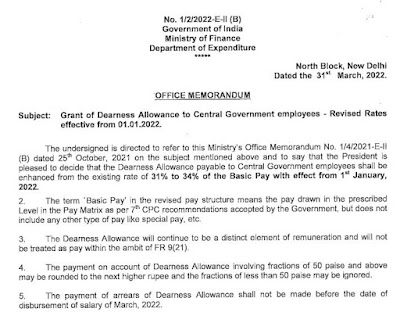
DA Jan 2022 - Grant of Dearness Allowance to Central Government employees - Revised Rates effective from 01.01.2022

 3% DA Hike - Revised Rates effective from 01.01.2022: DoE OM dated 31.03.2022 No. 1/2/2022-E-II (B) Government of India Ministry of Finance...