Showing posts with label Union Cabinet. Show all posts

Wednesday, 29 January 2020

Cabinet approved the Medical Termination of Pregnancy Amendment Bill 2020

Cabinet approved the Medical Termination of Pregnancy Amendment Bill 2020

Cabinet approved the Medical Termination of Pregnancy Amendment Bill 2020

Chaired by Prime Minister Shri Narendra Modi, the Union Cabinet has approved the Medical Termination of Pregnancy (Amendment) Bill, 2020, to amend the Medical Termination of Pregnancy Act, 1971. The Bill will be introduced at the subsequent Parliamentary session.

Special features of the planned modifications
  • Proposing requirement for opinion of one provider for termination of pregnancy, up to 20 weeks of gestation and introducing the requirement of opinion of two providers for termination of pregnancy of 20-24 weeks of gestation.
  • Enhancing the upper gestation limit from 20 to 24 weeks for special categories of women which will be defined in the amendments to the MTP Rules and would include 'vulnerable women including survivors of rape, victims of incest and other vulnerable women (like differently-abled women, Minors) etc.
  • Upper gestation limit not to apply in cases of substantial foetal abnormalities diagnosed by Medical Board. The composition, functions and other details of Medical Board to be prescribed subsequently in Rules under the Act.
  • Name and other particulars of a woman whose pregnancy has been terminated shall not be revealed except to a person authorised in any law for the time being in force.
Also check: Amendment in the CCS (Leave) Rules, 1972 consequent upon the implementation of the recommendations of 7th CPC

The Medical Termination of Pregnancy (Amendment) Bill, 2020 is for expanding access of women to safe and legal abortion services on therapeutic, eugenic, humanitarianor social grounds. The proposed amendments includesubstitution of certainsub-sections, insertion of certain new clauses under some sections in the existing Medical Termination of Pregnancy Act, 1971, with a view to increase upper gestation limit for termination of pregnancy under certain conditions and to strengthen access to comprehensiveabortioncare, under strict conditions, without compromisingservice andquality of safe abortion.

It is a step towards safety and well-being of the women and many women will be benefitted by this. Recently several petitions were received by the Courts seeking permission for aborting pregnancies at a gestational age beyond the present permissible limit on grounds of foetal abnormalities or pregnancies due to sexual violence faced by women. The proposed increase in gestational age will ensure dignity, autonomy, confidentiality and justice for women who need to terminate pregnancy.
In orderto increase access of women to safe abortion services and taking into account the advances in medical technology, the Ministry of Health and Family Welfare proposed amendments after extensive consultation with various stake holders and several ministries.

PIB

Saturday, 21 April 2018

Union cabinet approves ordinance for death penalty for rape of children


Union cabinet approves ordinance for death penalty for rape of children

Union cabinet approves ordinance for death penalty for rape of children

The Union Cabinet on Saturday approved an ordinance to allow courts to award death penalty to those convicted of raping children up to 12 years of age.

Official sources said here that the criminal law amendment ordinance seeks to amend the Indian Penal Code (IPC), the Evidence Act, the Code of Criminal Procedure (CrPC) and the Protection of Children from Sexual Offences (POCSO) Act to introduce a new provision to sentence convicts of such crimes punishment of death

The move comes against the backdrop of the alleged rape and murder of girls in Jammu and Kashmir's Kathua and Gujarat’s Surat district recently

The rape of a minor in Uttar Pradesh's Unnao district had also outraged the nation
The ordinance would be now sent to the President for his approval.

PTI

Thursday, 24 August 2017

Cabinet approves setting up of a Commission to examine the Sub-Categorization within OBCs


Cabinet approves setting up of a Commission to examine the Sub-Categorization within OBCs 

The Union Cabinet chaired by Prime Minister Shri Narendra Modi today approved a proposal for setting up of a Commission under article 340 of the Constitution to examine the issue of sub-categorization of the Other Backward Classes (OBCs).

The Commission shall submit its report within 12 weeks from the date of appointment of the Chairperson of the Commission. The Commission shall be known as the Commission to examine the sub-categorization of Other Backward Classes.

The proposed terms of references of the Commission are as follows:
(i) To examine the extent of inequitable distribution of benefits of reservation among the castes/ communities included in the broad category of OBCs, with reference to the OBCs included in the Central list.
(ii) To work out the mechanism, criteria, norms and parameters, in a scientific approach, for sub-categorization within such OBCs, and,
(iii) To take up the exercise of identifying the respective castes/communities/ sub-castes/ synonyms in the Central List of OBCs and classifying them into their respective sub-categories.
The Supreme Court in its order dated 16.11.1992 in WP(C) No. 930/1990 (Indra Sawhney and others vs. Union of India) observed that there is no Constitutional or legal bar to a State categorizing backward classes as backward or more backward and had further observed that if a State chooses to do it (sub-categorization), it is not impermissible in law.

Nine States of the country viz., Andhra Pradesh, Telangana, Puducherry, Karnataka, Haryana, Jharkhand, West Bengal, Bihar, Maharashtra and Tamil Nadu have already carried out sub-categorization of Other Backward Classes.

PIB

Wednesday, 14 June 2017

Cabinet approves proposal to introduce the Financial Resolution and Deposit Insurance Bill 2017

Cabinet approves proposal to introduce the Financial Resolution and Deposit Insurance Bill 2017

The Union Cabinet chaired by the Prime Minister Shri Narendra Modi has approved the proposal to introduce a Financial Resolution and Deposit Insurance Bill, 2017. The Bill would provide for a comprehensive resolution framework for specified financial sector entities to deal with bankruptcy situation in banks, insurance companies and financial sector entities.

The Financial Resolution and Deposit Insurance, Bill 2017 when enacted, will pave the way for setting up of the Resolution Corporation. It would lead to repeal or amendment of resolution-related provisions in sectoral Acts as listed in Schedules of the Bill. It will also result in the repealing of the Deposit Insurance and Credit Guarantee Corporation Act, 1961 to transfer the deposit insurance powers and responsibilities to the Resolution Corporation.

The Resolution Corporation would protect the stability and resilience of the financial system; protecting the consumers of covered obligations up to a reasonable limit; and protecting public funds, to the extent possible.
The Government has recently enacted the Insolvency and Bankruptcy Code, 2016 ("Code") for the insolvency resolution of non- financial entities. The proposed Bill complements the Code by providing a resolution framework for the financial sector. Once implemented, this Bill together with the Code will provide a comprehensive resolution framework for the economy.

The Financial Resolution and Deposit Insurance Bill, 2017 seeks to give comfort to the consumers of financial service providers in financial distress. It also aims to inculcate discipline among financial service providers in the event of financial crises by limiting the use of public money to bail out distressed entities. It would help in maintaining financial stability in the economy by ensuring adequate preventive measures, while at the same time providing the necessary instruments for dealing with an event of crisis. The Bill aims to strengthen and streamline the current framework of deposit insurance for the benefit of a large number of retail depositors. Further, this Bill seeks to decrease the time and costs involved in resolving distressed financial entities.

PIB

Wednesday, 3 May 2017

Cabinet approves modifications in the 7th CPC recommendations on pay and pensionary benefits

Cabinet approves modifications in the 7th CPC recommendations on pay and pensionary benefits

7th CPC recommendations on pay and pensionary benefits


The Union Cabinet chaired by the Prime Minister Shri Narendra Modi approved important proposals relating to modifications in the 7th CPC (Central Pay Commission) recommendations on pay and pensionary benefits in the course of their implementation. Earlier, in June, 2016, the Cabinet had approved implementation of the recommendations with an additional financial outgo of Rs 84,933 crore for 2016-17 (including arrears for 2 months of 2015-16).

The benefit of the proposed modifications will be available with effect from 1st January, 2016, i.e., the date of implementation of 7th CPC recommendations. With the increase approved by the Cabinet, the annual pension bill alone of the Central Government is likely to be Rs.1,76,071 crore.  Some of the important decisions of the Cabinet are mentioned below:

1. Revision of pension of pre - 2016 pensioners and family pensioners
The Cabinet approved modifications in the recommendations of the 7th CPC relating to the method of revision of pension of pre-2016 pensioners and family pensioners based on suggestions made by the Committee chaired by Secretary (Pensions) constituted with the approval of the Cabinet.  The modified formulation of pension revision approved by the Cabinet will entail an additional benefit to the pensioners and an additional expenditure of approximately Rs.5031 crore for 2016-17 over and above the expenditure already incurred in revision of pension as per the second formulation based on fitment factor.  It will benefit over 55 lakh pre-2016 civil and defence pensioners and family pensioners.

While approving the implementation of the 7th CPC recommendations on 29th June, 2016, the Cabinet had approved the changed method of pension revision recommended by the 7th CPC for pre-2016 pensioners, comprising of two alternative formulations, subject to the feasibility of the first formulation which was to be examined by the Committee.
In terms of the Cabinet decision, pensions of pre-2016 pensioners were revised as per the second formulation multiplying existing pension by a fitment factor of 2.57, though the pensioners were to be given the option of choosing the more beneficial of the two formulations as per the 7th CPC recommendations.

In order to provide the more beneficial option to the pensioners, Cabinet has accepted the recommendations of the Committee, which has suggested revision of pension based on information contained in the Pension Payment Order (PPO) issued to every pensioner.  The revised procedure of fixation of notional pay is more scientific, rational and implementable in all the cases.  The Committee reached its findings based on an analysis of hundreds of live pension cases.  The modified formulation will be beneficial to more pensioners than the first formulation recommended by the 7th CPC, which was not found to be feasible to implement on account of non-availability of records in a large number of cases and was also found to be prone to several anomalies.
2. Disability Pension for Defence Pensioners
The Cabinet also approved the retention of percentage-based regime of disability pension implemented post 6th CPC, which the 7th CPC had recommended to be replaced by a slab-based system.

The issue of disability pension was referred to the National Anomaly Committee by the Ministry of Defence on account of the representation received from the Defence Forces to retain the slab-based system, as it would have resulted in reduction in the amount of disability pension for existing pensioners and a reduction in the amount of disability pension for future retirees when compared to percentage-based disability pension.

The decision which will benefit existing and future Defence pensioners would entail an additional expenditure of approximately Rs. 130 crore per annum.
Source: PIB

Wednesday, 15 March 2017

Cabinet nod likely to double gratuity cap to Rs 20 lakh


Cabinet nod likely to double gratuity cap to Rs 20 lakh

Besides, the bill seeks to enable the central government to change the ceiling for tax free gratuity after factoring in rise in income levels by an executive order bypassing Parliament route to amend the law.
The Union Cabinet is likely to consider tomorrow a draft amendment bill which seeks to double the ceiling of tax-free gratuity to Rs 20 lakh under the Payment of Gratuity Act.

Besides, the bill seeks to enable the central government to change the ceiling for tax free gratuity after factoring in rise in income levels by an executive order bypassing Parliament route to amend the law.
"The bill to amend the Payment of Gratuity Act is likely to be considered and approved by the Union Cabinet in its meeting scheduled tomorrow," a source said.

After the amendment in the Act, formal sector workers would be eligible for up to Rs 20 lakh tax-free gratuity. Last month, the central trade unions had agreed on the proposal in a tripartite consultation with the Labour Ministry.

However, the unions had demanded the removal of conditions asking to have at least 10 employees in an establishment and minimum five years of service for payment of gratuity.

At present, as per the Payment of Gratuity Act, an employee is required to do minimum service of five years to become eligible for gratuity amount. Moreover, the Act applies to those establishments where the number of employees is not less than 10.

Trade unions had demanded that the amended provision regarding maximum amount should be made effective from January 1, 2016, as done in the case of central government employees.

Besides that rate of 15 days wages for each completed year of service be raised to 30 days wages, the unions had said during the tripartite meeting.

The proposed amendment to the Payment of Gratuity Act as circulated by the government only deals with enhancing the ceiling of maximum amount under Section 4(3) of the Act from Rs 10 lakh to Rs 20 lakh.
The proposed amendment is being brought to bring the maximum ceiling amount to Rs 20 lakh in line with the 7th Central Pay Commission's recommendations as accepted by the government.

The relevant amendment for central government employees was notified on July 25, 2016 and the enhanced amount ceiling was made effective from January 1, 2016.

The unions were of the view that the delay of eight months for employees covered under the Payment of Gratuity Act should not result in adversely affecting the interest of the concerned employees.
The employers as well as state representatives had also agreed to the proposal of raising the amount of gratuity to Rs 20 lakh in the tripartite meeting held last month.

Source: Money Control

Thursday, 22 December 2016

Centre okays ordinance for wage payment via e-mode, cheques

Centre okays ordinance for wage payment via e-mode, cheques

New Delhi: Promoting less-cash economy, the government today brought in an ordinance to enable industries covered under the Payment of Wages Act to pay workers through cheques or crediting money into their bank accounts, although employers will have the option to pay in cash.

Labour Minister Bandaru Dattatreya had introduced The Payment of Wages (Amendment) Bill, 2016 in Lok Sabha on December 15 but it could not be passed because of continued disruption of the Winter Session of Parliament due to ruckus over demonetisation.

The decision to adopt ordinance route to amend the Act was taken by the Union Cabinet.

Trying to clear the air, Dattatreya told reporters at a press conference after the Cabinet meeting that employers will have the option of paying wages in cash after notification of industries by Centre and states.

Confusion prevailed earlier in the day whether it would be mandatory for employers of the industries notified by the Centre and states, to pay wages through cheques or by crediting the same into employees bank account.

The bill however clearly states that "appropriate Government may, by notification in the Official Gazette, specify the industrial or other establishment, the employer of which shall pay to every person employed in such industrial or other establishment, the wages only by cheque or by crediting the wages in his bank account”.

The amendment enables the Centre as well as state governments to notify industries where employers shall have pay wages either through cheque or crediting that into workers’ bank account.

Despite repeated queries the minister maintained that employers will have the option to pay wages in cash after the amendment in the Act through ordinance as well as the bill.

Dattatreya said however that the government has adopted the ordinance route because it was long pending demand of the trade unions.

Centre of Indian Trade Unions (CITU) General Secretary Tapen Kumar Sen said: “They are lying. The bill introduced in the Parliament clearly bars payment of wages in cash by industries notified by Centre and States. They just want to please Prime Minister Narendra Modi.”

He also said, “It is not correct to take away workers’ right to demand wages in cash amid currency crunch when the entire banking service in the country is in disorder facing an abnormal situation.

“This is not the right time for bringing this ordinance as workers are already going through tough times due to currency crunch following demonetisation.
In a statement, CITU said: “This right to consent is

important for workers since at least 35 per cent of the habitations in the country are still out of the coverage of bank branches in the vicinity and also a big majority of workers including those in urban areas, particularly those in low-paid unorganised sector, do not have bank accounts. And in case of compulsory bank payment of wages, the migrant workers will be put in serious difficulty.”

As per the Bill, the new procedure will serve the objective of “digital and less-cash economy”.

The Act had come into force on April 23, 1936, providing for payment of wages in coin or currency notes, or in both. The provision for payment of wages by cheque or crediting it into bank account after obtaining the requisite authorisation of employee was inserted in 1975.

At present, the Act covers all those employees in certain categories of establishments whose wage does not exceed Rs 18,000 per month.

The Centre can make rules regarding payment of wages in relation to railways, air transport services, mines, oil fields and its establishments while states take a call on all other cases.

By making state-level amendments to the Act, Andhra Pradesh, Uttarakhand, Punjab, Kerala and Haryana have already made provisions for payment of wages through cheque and electronic transfer.

At present, with the written authorisation of an employee, wages can be given through cheque or transferred to his or her bank account.

PTI

Tuesday, 13 September 2016

Cabinet approves creation of GST Council and its Secretariat

Cabinet approves creation of GST Council and its Secretariat

The Union Cabinet under the Chairmanship of Prime Minister Shri Narendra Modi has approved setting up of GST Council and setting up its Secretariat as per the following details:
(a) Creation of the GST Council as per Article 279A of the amended Constitution;
(b) Creation of the GST Council Secretariat, with its office at New Delhi;
(c) Appointment of the Secretary (Revenue) as the Ex-officio Secretary to the GST Council;
(d) Inclusion of the Chairperson, Central Board of Excise and Customs (CBEC), as a permanent invitee (non-voting) to all proceedings of the GST Council;
(e) Create one post of Additional Secretary to the GST Council in the GST Council Secretariat (at the level of Additional Secretary to the Government of India), and four posts of Commissioner in the GST Council Secretariat (at the level of Joint Secretary to the Government of India).
The Cabinet also decided to provide for adequate funds for meeting the recurring and non-recurring expenses of the GST Council Secretariat, the entire cost for which shall be borne by the Central Government. The GST Council Secretariat shall be manned by officers taken on deputation from both the Central and State Governments.

The steps required in the direction of implementation of GST are being taken ahead of the schedule so far.
The Finance Minister has also decided to call the first meeting of the GST Council on 22nd and 23rd September 2016 in New Delhi.

Background:
The Constitution (One Hundred and Twenty-second Amendment) Bill, 2016, for introduction of Goods and Services tax in the country was accorded assent by the President on 8th September, 2016, and the same has been notified as the Constitution (One Hundred and First Amendment) Act, 2016. As per Article 279A (1) of the amended Constitution, the GST Council has to be constituted by the President within 60 days of the commencement of Article 279A. The notification for bringing into force Article 279A with effect from 12th September, 2016 was issued on 10th September, 2016.

As per Article 279A of the amended Constitution, the GST Council which will be a joint forum of the Centre and the States, shall consist of the following members: -
a) Union Finance Minister - Chairperson
b) The Union Minister of State,
in-charge of Revenue of finance - Member
c) The Minister In-charge of finance or
taxation or any other Minister nominated
by each State Government - Members
As per Article 279A (4), the Council will make recommendations to the Union and the States on important issues related to GST, like the goods and services that may be subjected or exempted from GST, model GST Laws, principles that govern Place of Supply, threshold limits, GST rates including the floor rates with bands, special rates for raising additional resources during natural calamities/disasters, special provisions for certain States, etc.
*****
PIB

Friday, 12 August 2016

Cabinet approves introduction of Pension and Post-Retirement Medical Schemes as part of superannuation benefits for Employees of Food Corporation of India

Cabinet approves introduction of Pension and Post-Retirement Medical Schemes as part of superannuation benefits for Employees of Food Corporation of India

The Union Cabinet chaired by the Prime Minister Shri Narendra Modi has given its approval for introduction of Pension and Post-Retirement Medical Schemes as part of superannuation benefits for Employees of Food Corporation of India (FCI) as per guidelines of Department of Public Enterprises (DPE).

The annual financial implication for both schemes combined would be around Rs. 134.4 crore at present level of salaries of the employees.

Salient Features of New Pension Scheme for Employees of FCI
1. Coverage - All employees. (Category I, II, III and IV) of the Corporation on the payroll as on 1.12.2008 or appointed thereafter are covered under the scheme.
2. Eligibility - Minimum service period of 15 years before superannuation except in case of death.
3. Effective date of implementation - 01.12.2008. (as per effective date of wage revised allowances.
4. Employer's Contribution - 10% of Basic pay and DA per month in respect of all existing employees as on 01.12.2008 or appointed thereafter.
5. Employees' Mandatory Contribution - 2% of basic pay + DA per month. Employees' Voluntary Contribution - upto 25% of basic pay + DA per month
6. Benefits - Pension (Annuity) on superannuation and Death Cover.

Salient Features of New Post-Retirement Medical Scheme for employees of FCI
1. Applicability - All employees Category I, II, III & IV employees of the Corporation including retired employees who are members of the current employee funded Medical Health Scheme for Retirees.
2. Eligibility - Minimum service period of 15 years before superannuation except in case of death.
3. Employer contribution - 3.83% of Basic + DA w.e.f. 01.04.2016.
4. Employee Contribution - Last drawn Basic pay and DA at the time of retirement / death during service (for spouse), subject to minimum of Rs.10,000.
5. Coverage - The Scheme would cover the medical expenses of retired member, his/her spouse and dependent disabled child at any hospital in India subject to the overall annual ceiling.
Background:
FCI was established in 1965 under the Food Corporations Act, 1964 for the purpose of procurement, storage, distribution and sale of foodgrains and other foodstuffs. Over the years it has played a pivotal role in achieving the objective of food security for the country. Given its strategic importance, size of operations and other parameters, FCI has been recognised as Schedule 'A' Central Public Sector Enterprises (CPSEs).

PIB

Wednesday, 29 June 2016

PRASAR BHARATI : Union Cabinet approves recommendations of 7th Pay Commission

PRASAR BHARATI : Union Cabinet approves recommendations of 7th Pay Commission

Union Cabinet today approved the recommendations of the 7th Pay Commission.

AIR correspondent quoting sources reports it will be implemented from 1st January this year.

Detail of the pay commission will be announced later in a press conference.

The 7th Pay Commission was set up in February last year to revise remuneration of over one crore central government employees and pensioners.


Tuesday, 28 June 2016

7CPC: Bonanza for babus! 23.55% Salary hike likely for central government employees

Bonanza for babus! 23.55% Salary hike likely for central government employees

cabinet-to-take-up-pay-panel-proposal-on-29th
The total outgo if this award is implemented from January 1, 2016, is pegged at Rs 1.02 lakh crore, providing a bid demand boost to the economy.
NEW DELHI: The much-anticipated Seventh Pay Commission bonanza for the government employees is likely soon with the Union Cabinet set to consider the panel’s recommendations on Wednesday.

The committee of secretaries tasked with reviewing the recommendations has given its report that would be considered by the government before deciding on the final award.

The Seventh Pay Commission has announced 23.55% increase in pay and allowances of serving central government employees and 24% increase in pension of retired officers.

A government official confirmed that the proposal is on the cabinet agenda for Wednesday.

The total outgo if this award is implemented from January 1, 2016, is pegged at Rs 1.02 lakh crore, providing a bid demand boost to the economy.

However, in view of fiscal constraints, the government is likely to go for a lower increase and also delay the implementation of the increase in allowances.

In the budget for FY17, the government has budgeted 32% increase in salary of its employees but only a meagre 1.9% rise in allowances.

Finance ministry officials have said that the budget has adequate provision for pay commission and the fiscal deficit target of 3.5% of GDP will not be under stress from implementation of the award.
In a report after the budget, Moody’s had said “Pay Commission recommendations of a 24% hike in public sector salary, allowances and pensions, is not fully accounted for in the budget” and will be a source of spending pressure.

The government can delay the implementation of increase in allowances to a later date but the salary increases will have to be given from January 1, 2016, which means employees will get arrears for these month, a potential boost to economy.

Car and property sales tend to rise after pay commission awards.

ET

Thursday, 23 June 2016

Incentives announced for textiles will help create jobs

Incentives announced for textiles will help create jobs

The “extra push” given to the textiles industry through an incentive package will help create more jobs and push exports, Commerce and Industry Minister Nirmala Sitharaman said today.

“It is a sector where India has gained a lot of advantage … It has a great potential for job creation,” the minister told reporters here.

This “extra push” was given to the sector due to various global developments, she said.

The Union Cabinet yesterday approved a Rs 6,000 crore package for textiles and apparel sector with an aim to create one crore new jobs in three years and attract investments of USD 11 billion while eyeing USD 30 billion in exports.

Textiles exports contribute significantly to the country’s total exports at about USD 17 billion in 2014-15. The sector is witnessing huge competition from small countries like Bangladesh and Vietnam, which have access to developed markets at lower tariffs.

When asked about the impact of Brexit (possible exit of Britain from European Union) on India, Sitharaman said that the government is “watching the situation”.

“We will be observing the developments. It is too early for me to comment (on its impact),” she added.
Talking about the stalled India-EU free trade agreement, the minister said India is waiting for the dates to resume the talks.

“We are waiting for the dates. It is my doubt that if because they are waiting for the outcome of Brexit, they have not yet given the dates as yet. The moment they give the dates, we will be keenly wanting to continue the talks to reach the conclusion at the earliest,” she added.

Launched in June 2007, the negotiations for the proposed agreement have witnessed many hurdles with both sides having major differences on crucial issues like intellectual property rights, duty cut in automobile and spirits, and liberal visa regime.

The pact is aimed at reducing or significantly eliminating tariffs on goods, facilitating trade in services and boosting investments between the two sides.

When asked about Apple Inc’s proposal to open single brand retail stores in the country after announcement of the tweaked FDI policy in the sector, Sitharaman said: “We have announced the policy. We will wait to hear from them”.

The ministry has stated that it will give exemption to foreign firms such as Apple Inc coming with state-of-the-art technology from the mandatory local sourcing norms in the single-brand retail sector for up to three years.

PTI

Wednesday, 16 April 2014

Decision on hiking dearness allowance deferred

Decision on hiking dearness allowance deferred
NEW DELHI: The government on Tuesday deferred a decision on hiking dearness allowance (DA) of central government employees to 80 per cent, from 72 per cent at present.
An increase in DA would have benefitted about 50 lakh employees and 30 lakh pensioners.


"The proposal on DA has been deferred as the Finance Minister was not present," Information and Broadcasting Minister Manish Tewari told reporters after the Cabinet meeting chaired by Prime Minister Manmohan Singh here.
Finance Minister P Chidambaram is on an official visit to Japan.
A hike in DA has been proposed with effect from January 1, 2013, according to sources.
The government had hiked DA to 72 per cent in September last year. The increase was with effect from July 1, 2012.
The Confederation of Central Government Employees has demanded merger of up to 50 per cent DA with the basic pay and setting up the seventh pay commission at the earliest.
As per the practice, the DA is merged with basic pay when it breaches the 50 per cent cap. This helps employees get higher allowances as those are paid as proportion to the basic pay.

Flash News

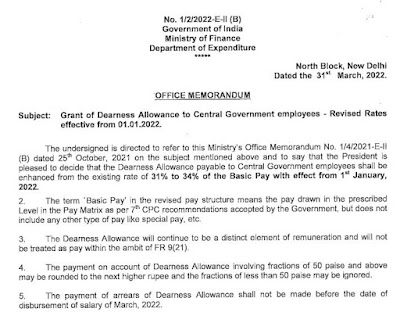
DA Jan 2022 - Grant of Dearness Allowance to Central Government employees - Revised Rates effective from 01.01.2022

 3% DA Hike - Revised Rates effective from 01.01.2022: DoE OM dated 31.03.2022 No. 1/2/2022-E-II (B) Government of India Ministry of Finance...