Showing posts with label DA Calculation. Show all posts

Saturday, 29 June 2019

5% DA increase from July 2019 confirmed for Central Government Employees. 12% becomes 17% due to high inflation

5% DA increase from July 2019 confirmed for Central Government Employees. 12% becomes 17% due to high inflation

AICPIN May 2019 Two Points Increase - Expected DA Fixed at Next Level

All India Consumer Price Index for the month of May 2019 has been released by the Labour Bureau on 28th of this month and the CPI(IW) index has jumped to 314 by adding of two points, due to the pressure from Food Group index. At item level, Wheat Atta, Arhar Dal, Groundnut Oil, Poultry (Chicken), Milk Buffallo, Chillies Green, Garlic, Ginger, Onion, Banana, Brinjal, Carrot, French Bean, Green Coriander Leaves, Lemon, Potato, Tomato, Electricity Charges, Medicine­ Allopathic, etc. are responsible for the increase in index.

Out of 6 months of AICPIN needs to calculate the Dearness allowance and Dearness relief, we received 5 months statistics only. The 5th month i.e. May 2019 index is increased 2 points is remarkable. Along with the increase, the percentage of additional dearness allowance from july 2019 is kept in next level.

MONTHAICPINDA%
Jan-1930713.39
Feb-19 30714.02
Mar-1930914.73
Apr-1931215.49
May-1931416.29
Jun-19314 (Expected)17.02 (Expected)

After 7th Pay Commission implementation, this is the highest percentage in additional allowance for Central Government employees, Civil and Defence Pensioners and Family Pensioners.

5% of additional Dearness Allowance and Dearness Relief may increase from July 2019 to all central civil and defence pensioners and family pensioners with minimum amount of Rs.450 per month.

7th CPC Dearness Allowance Rates 

Date from which payableDA %
1st July 201917% (Expected)
1st Jan 201912%
1st July 20189%
1st Jan 20187%
1st July 20175%
1st Jan 20174%
1st July 20162%
1st Jan 2016

Friday, 1 March 2019

Expected DA: 6 points increase in AICPI (CPI-IW) for the Month of January 2019


Expected DA: 6 points increase in AICPI (CPI-IW) for the Month of January 2019

No.5/1/2019-CPI
GOVERNMENT OF INDIA
MINISTRY OF LABOUR & EMPLOYMENT
LABOUR BUREAU
'CLEREMONT', SHIMLA-171004
DATED: 28th February, 2019
Press Release

Consumer Price Index for Industrial Workers (CPI-IW) - January, 2019

The All-India CPI-IW for January, 2019 increased by 6 points and pegged at 307 (three hundred and seven). On 1-month percentage change, it increased by (+) 1.99 per cent between December, 2018 and January, 2019 when compared with the increase of (+) 0.70 per cent for the corresponding months of last year.

The maximum upward pressure to the change in current index came from Housing group contributing (+) 5.16 percentage points to the total change. At item level, Wheat, Arhar Dal, Fish Frsh, Goat Meat, Coconut, Lady’s Finger, Tomato, Flowers/Flower Garlands, etc. are responsible for the increase in index. However, this increase was checked by Onion, Brinjal, Cabbage, Carrot, Cauliflower, Gourd, Peas, Potato, Cooking Gas, Electricity Charges, etc., putting downward pressure on the index.

The year-on-year inflation based on CPI-IW stood at 6.60 per cent for January, 201-9 as compared to 5.24 per cent for the previous month and 5.11 per cent during the corresponding month of the previous year. Similarly, the Food inflation stood at (+) 0.97 per cent against (-) 0.96 per cent of the previous month and 3.36 per cent during the corresponding month of the previous year.

At centre level Nagpur reported the maximum increase of 21 points followed by Nasik (17 points), Amritsar, Quilon, Jharia (13 points each) and Jaipur (12 points). Among others, 11 points increase was observed in 3 centres, 10 points in 7 centres, 9 points in 3 centres, 8 points in 5 centres, 6 points in 9 centres, 5 points in 6 centres, 4 points in 7 centres, 3 points in 7 centres, 2 points in 7 centres and 1 point in 6 centres. On the contrary, Darjeeling recorded a maximum decrease of 4 points followed by Siliguri (3 points). Among others, 2 points decrease was observed in 4 centres and 1 point in 2 centres. Rest of the 4 centres’ indices remained stationary.

The indices of 35 centres are above All-India Index and 42 centres’ indices are below national average. The index of Rourkela centre remained at par with All-India Index.

The next issue of CPI-IW for the month of February, 2019 will be released on Friday, 29th March, 2019. The same will also be available on the office website www.labourbureaunew.gov.in.

(AMRI LAL JANGID)
DEPUTY DIRECTOR
Source: labour bureau new

Wednesday, 31 October 2018

Expected DA Table for Jan 2019


Expected DA Table for Jan 2019
DA Calculation as per 7th CPC
Month YearAICPIN12 Months Total12 Months AverageIncreased Over 261.42DA %
Jan-162693152262.670.48
Feb-162673166263.330.92
Mar-162683180265.001.37
Apr-162713195266.251.85
May-162753212267.672.39
Jun-162773228269.002.902
Jul-162803245270.423.44
Aug-162783259271.583.89
Sep-162773270272.054.24
Oct-162783279273.254.53
Nov-162773286273.834.75
Dec-162753292274.334.944
Jan-172743297274.755.10
Feb-172743304275.335.33
Mar-172753311275.925.55
Apr-172773317276.415.74
May-172783320276.665.84
Jun-172803323276.915.935
Jul-172853328277.336.10
Aug-172853335277.926.31
Sep-172853343278.586.56
Oct-172873352279.336.85
Nov-172883363280.257.20
Dec-172863374281.177.557
Jan-182883388282.338.00
Feb-182873401283.428.42
Mar-182873413284.428.80
Apr-182883424285.339.15
May-182893435286.259.50
Jun-182913446287.179.859
Jul-183013462288.5010.36
Aug-183013478289.8310.87
Sep-18
Oct-18
Nov-18
Dec-18

Saturday, 1 October 2016

DA Calculation with AICPIN: Labour Bureau released Index for August 2016

DA Calculation with AICPIN: Labour Bureau released Index for August 2016

DA Calculation with AICPIN


Consumer Price Index Numbers for Industrial Workers on Base 2001=100

CPI(IW) Base 2001=100 Monthly Index Letter : August 2016

Month / Year CPI(IW)
JANUARY 2016 269
FEBRUARY 2016 267
MARCH 2016 268
APRIL 2016 271
MAY 2016 275
JUNE 2016 277
JULY 2016 280
AUGUST 2016 278

The All India CPI-IW for August, 2016 decreased by 2 points and pegged at 278 (two hundred and seventy eight). On 1 month percentage change, it decreased by (-) 0.71 per cent between July, 2016 and August, 2016 when compared with the increase of (+) 0.38 per cent between the same two months a year ago.

Authority: http://labourbureau.nic.in/

Wednesday, 23 March 2016

Cabinet approved 6% DA and DR for Central Govt Employees and Pensioners due from 1.1.2016

Cabinet approved 6% DA and DR for Central Govt Employees and Pensioners due from 1.1.2016
Release of additional instalment of Dearness Allowance to Central Government employees and Dearness Relief to Pensioners due from 1.1.2016
DA-DR-Central-Government-Employees-Pensioners

Press Information Bureau
Government of India
23-March, 2016

The Union Cabinet, chaired by the Prime Minister Shri Narendra Modi, has approved release of an additional instalment of Dearness Allowance (DA) to Central Government employees and Dearness Relief (DR) to Pensioners w.e.f. 01.01.2016. This represents an increase of 6 percent over the existing rate of 119 percent of the Basic Pay/Pension, to compensate for price rise.

This will benefit about 50 lakh Government employees and 58 lakh pensioners.

The increase is in accordance with the accepted formula, which is based on the recommendations of the 6th Central Pay Commission (CPC). The combined impact on the exchequer on account of both Dearness Allowance and Dearness Relief would be of Rs. 6796.50 crore per annum and Rs.7929.24 crore respectively, in the financial year 2016-17 (for a period of 14 months from January, 2016 to February, 2017).

PIB

Wednesday, 17 June 2015

Dearness Allowance: Centre to survey spending patters of working class to finalise CPI numbers

Dearness Allowance: Centre to survey spending patters of working class to finalise CPI numbers.

Centre to survey spending patterns of working class

In a bid to understand the spending patterns and living conditions of working class, the Centre has decided to conduct a survey of workers’ family income and expenditure.

The survey, which will be conducted by the National Sample Survey Organisation, a Government of India body, will be used to finalise consumer price index (CPI) numbers for the working class. The CPI is the base for deciding dearness allowances (DA) of the working class.

“The Working Class Family Income and Exemption Survey-2015 will cover workers engaged in seven organised sectors of employment-registered factories, mines, plantations, ports & docks, public motor transport undertakings, electricity generating and distributing establishments, and railways,” an official from NSSO told Deccan Herald.

The survey will be conducted in 88 centres spreading across 28 states and union territories including Delhi, Karnataka, Andhra Pradesh and Uttar Pradesh. The survey will be conducted in eight places in Karnataka — Bengaluru, Belagavi, Chikkamagaluru, Davangere-Harihar, Hubballi-Dharwad, Kodagu, Mysuru and Mangaluru.

Read more at: Deccan Herald

Monday, 4 May 2015

REVISION OF DA CALCULATION FORMAT – INSTANT OF JUNE AND DEC, WE PROPOSED APRIL AND OCTOBER

REVISION OF DA CALCULATION FORMAT – INSTANT OF JUNE AND DEC, WE PROPOSED APRIL AND OCTOBER

It is a well-known fact that every six months, the Central Government increases the Dearness allowance for its employees during the months of January and July. The increased amount is calculated on the price index (CPI IW BY 2001=100) of essential commodities. Rise in the Dearness allowance is being calculated on the basis of the changes in the prices of the essential commodities during the periods between January and June and the period between July and December.

But, it takes around three months since the release of the price index for the months of June and December to arrive at the calculation for the increase in the Dearness allowance. With the result that the increase due from the month of July is being given only from the month of October and the amount due from January is being given only from the month of April.

And, because of this situation, the amount due for the left-behind period of two months is to be settled as arrears. Practical problems arise in the calculation of the arrears amount and also problem arises in clarifying the doubts of the beneficiaries. Pensioners especially, are more tensed up over this procedure.

To avoid this situation, the price index during the periods from November to April and from May to October can be taken into account and the increase in the Dearness allowance calculated based on the information relevant to these periods. The amount can be disbursed from the months of January and July as per this calculation so that there’s no due as arrears.

We imaginatively tested this method to find out the result. It was found out that there was no tangible change in the increase amount if calculated on the basis of the price index obtained during the months of April and October.
DA TABLE REVISED FORMAT
Source: http://centralgovernmentemployeesnews.in

Wednesday, 22 April 2015

6% DA for TamilNadu State Government Employees from Jan 2015

6% DA for TamilNadu State Government Employees from Jan 2015

An another announcement of hiking in Dearness allowance to the employees of State Government of Tamil Nadu today.

Tamilnadu Chief Minister announces an additional DA to state employees from 1.1.2015.

More than eighteen lakh state government employees will get the hike, which is effective from 1.1.2015.

Following the Central Government, the state government has declared DA to its employees from the existing rate of 107% to 113% with effect from 1.1.2015.

Monday, 13 April 2015

6th Central Pay Commission (2006 – 2015) – Why was it special?

6th Central Pay Commission (2006 – 2015) – Why was it special?

Six Pay Commissions were formulated by the Central Government until now. The 6th Pay Commission had some salient features that were never seen before. Let’s find out why this particular Pay Commission was so monumental.

The recommendations made by the previous five Pay Commissions were interrelated to each other. People who had studied these would know that despite the similarities, the recommendations were not exactly generous.

Weightage” was the most-frequently used terminology in all previous pay commissions. New employees wouldn’t be aware of this. Weightage was all about calculating a certain percentage of the basic pay and adding it to the new basic pay (Basic Pay Weightage, Fitment Weightage or Fitment Benefit). This was the method prescribed by the five Pay Commissions before.

Even more pathetic was “Increment Weightage”. Particularly the 5th Pay Commission didn’t consider all the increments that the employee had received. According to the recommendations of 5th Pay Commission, it was given on the basis of one out of three increments.

As well, those were the days when promotions were rare. For years, employees were getting meager amount as annual increment. Only disappointment remained because the employees felt as if their ten years’ progress was unfairly evaluated.

Since no significant changes were made in the calculation of DA in the 5th Pay Commission, for the entire ten years, percentage of Dearness Allowance had increased by only 74%.

Until the 5th Pay Commission, House Rent Allowance was given in four categories – 5%, 7.5%, 15%, and 30% or as consolidated amount.

Lack of generosity was also obvious in areas like Tuition Fees, Transport Allowance, and Leave Travel Concession.

The 6th Central Pay Commission was special because it was radically different from its predecessors.
“Grade Pay was introduced, and, although there were MACP confusions due to the new Hierarchy system, since its pluses outnumbered its minuses, we feel that there is nothing wrong in recollecting the good points that the Commission had recommended. This article will help the next generation employees understand why the 6th Pay Commission was so unique.”
Multiplication Factor : This is considered by many as a transparent approach.

Children’s Education Allowance : From a meager Rs.40 per month, it was raised to Rs.1000. This reflected genuine interest and concern about the future generation.

3% Increment : The decision to calculate the annual increment at 3% of the current basic pay continues to be applauded even now.

Transport Allowance : Although Convenience Allowance was clubbed with this, it was a good decision to have made the revision of transport allowance dependent on the dearness allowance.

Leave Travel Concession : Which was until then, given only for Class II travel, was elevated to AC- Tier III, and Tier II.

Child Care Leave : It was a blessing for female employees.
Military Service Pay : First time recommendation for the Armed Forces Personnel by 6th Pay Commission.

DA Calculation : The Dearness Allowance was calculated based on the All India Consumer Price Index published by Labour Bureau. Calculation method for arriving the percentage of additional Dearness Allowance was recommended by 6th CPC with important average index factor of 115.76 instead of 306.33. Dearness Allowance went up as high as 10% and earned an increase of about 120% in its ten years’ tenure.
Finally, All Central Government Employees Unions and Federations played a very important role in the revolutionary changes and liberal recommendations that were being offered to the employees. Let us not forget that it was our unified voice and determination that made it all possible.
Source: http://centralgovernmentemployeesnews.in/

Monday, 17 November 2014

7th CPC DA Calculation – Important factor of AICPI (IW) BY 2001 continue or not..?

7th CPC DA Calculation – Important factor of AICPI (IW) BY 2001 continue or not..?
 
Dearness Allowance is one of the important issues that the Pay Commission deals with. The calculation method that was recommended by the 6th Pay Commission was radically different from the ones suggested by all the previous Pay Commissions. Dearness Allowance, which was increasing by 1 or 2% until the 5th Pay Commission suddenly shot up to the peak of double-digit numbers.

Until the 5th CPC, the Consumer Price Index Number for Industrial Workers 1982 = 100 was used for calculating dearness allowance. From the 6th Pay Commission onwards, CPI (IW) 2001=100 was used for calculating the DA.

 There was another crucial change that the 6th CPC made. It recommended that the Reference Base Index be changed from 306.33. As a result, 115.76 became the new Reference Base Index from 01.01.2006 onwards.

Will the 7th CPC introduce a new CPI (IW)? Or will it bring about changes in the Reference Base Index?

This is something that everybody wants to know.

Just watch the difference between 5th and 6th CPC DA Calculation methods…


5th CPC calculation method is given below…

The extant formula for calculation of DA till 1-1-2004 was:

12 Monthly Average – 306.33
——————————————————–  x 100 = percentage increase in prices
306.33

The Fifth Pay Commission had recommended that DA should be converted into DP each time the CPI increased by 50% over the base index. The Government merged 50% of DA with the
basic pay w.e.f. 1-4-2004. The formula for calculation of DA for the period from 1-7-2004 is:

12 Monthly Average – 306.33
{  ————————————————  x 100} – 50 = percentage increase in prices
306.33

6th CPC calculation method is given below…
(12 Monthly Average) – 115.76
——————————————————–      x 100 = percentage increase in prices
115.76

Source: http://7thpaycommissionnews.in/

Tuesday, 4 November 2014

Expected DA from Jan 2015 – Comparison of DA Calculation from 2006 to 2014

Expected DA from Jan 2015 – Comparison of DA Calculation from 2006 to 2014

Expected-DA-jan-2015
Expected DA from Jan 2015 – AICPIN Points for September Released – Remains Unchanged at 253


One of the most important department functioning under the Central Government is the Labour Bureau. The department releases a number of important statistics and conducts surveys. In the year 1872, the department had successfully conducted the population census of the entire country. This census gave not only the count of number of persons, but also the number of gainfully employed. Since then every census has thrown useful data on workers in different industries and occupations every 10 years. The bureau also releases official information, economic indicators like Consumer Price Index Numbers for Industrial, Agricultural and Rural Labourers; wage rate indices and data on industrial relations etc. that are followed by a number of government departments.
One such indicator is the monthly Consumer Price Index Numbers (Industrial Workers 2001=100), which is used to calculate the Dearness Allowance for Central Government employees. Prices of 24 essential commodities (from rice to bathing soap) are observed in 78 cities all over the country in order to calculate the average index of CPI(IW).
It is based on these statistics that, once every six months, the Centre announces Dearness Allowance for its employees. Based on the AICPIN(All India Consumer Price Index Numbers) between January and June, and between July and December, the Finance Ministry decides the percentage of hike in Dearness allowance and Dearness Relief according to the recommendations of 6th CPC and informs the Government. The Centre makes its decision after discussing the recommendation during the cabinet meeting.
Now, ‘Expected DA from Jan 2015′ is the first installment of next year and only three months’ data have been collected as of now, for the Dearness Allowance. Accurate D.A percentage can be calculated only after the remaining 3 months’ AICPIN points are announced.
But, we believe that based on October’s AICPIN points, we can conclude if the next D.A hike is going to be for 6% or 7%.
The Dearness Allowance announcements since 2006 have been tabulated and presented, as additional information.
Year wise DA Calculation tables form 2006 to 2014…
DA-Calculation-for-Jan-2006           DA-Calculation-for-Jul-20061
DA-Calculation-for-Jan-2007          DA-Calculation-for-Jul-20071
DA-Calculation-for-Jan-2008          DA-Calculation-for-Jul-20081
DA-Calculation-for-Jan-2009         DA-Calculation-for-Jul-20091
DA-Calculation-for-Jan-2010         DA-Calculation-for-Jul-20101
DA-Calculation-for-Jan-2011         DA-Calculation-for-Jul-20111
DA-Calculation-for-Jan-2012         DA-Calculation-for-Jul-2012
DA-Calculation-for-Jan-2013         DA-Calculation-for-Jul-2013
DA-Calculation-for-Jan-2014        
DA-Calculation-for-Jul-2014 

Friday, 18 April 2014

FINANCE MINISTRY DA ORDER JAN 2014 -WHEN IT WILL COME-DA ARREARS CALCULATOR

FINANCE MINISTRY DA ORDER JAN 2014 -WHEN IT WILL COME-DA ARREARS CALCULATOR


FINANCE MINISTRY DA ORDER JAN 2014 -WHEN IT WILL COME

No one can deny the fact that DA is a very important allowance as of now. This applies to both state and central government employees. On the 28th of February 2014, 10 % DA increase was approved by the cabinet and then the announcement about the same came out. In the past, mostly, this announcement and the Finance Ministry order have come out in the month of March. Hardly, has this ever changed so far. So the finance ministry order on DA is expected to come soon.


After the order on the 10% DA is received, the corresponding DA value will be paid as arrears for the first two months and then it will paid along with the month’s salary. Similarly, every time when the DA touches 50%, some allowances can increase up to 25%. We have already got the benefits of the 50% DA increase. Now, as it has reached 100%, a formal announcement is expected to come out soon. Everyone can easily calculate the benefits that we’ll get from a 10% increase. However, for your convenience, I have attached a calculator to help you to find out how much you will get as two month’s arrears and the other benefits that you will get due to the DA increase.

Thursday, 17 April 2014

Statement of Srikant Kumar Jena on Consumer Price Index

Statement of Srikant Kumar Jena on Consumer Price Index 

Press Information Bureau 
Government of India
Ministry of Statistics & Programme Implementation 
14-October-2013 17:31 IST
Statement of Srikant Kumar Jena on Consumer Price Index 
Shri Srikant Kumar Jena, Minister of State (Independent charge), Ministry of Statistics and Programme Implementation announced the release of the monthly provisional Consumer Price Index (CPI) on Base 2010=100 along with annual inflation rates for September 2013, compiled by the Central Statistics Office. Final CPI numbers for the month of August 2013 have also been released. 

All India General (all groups) CPI numbers of September 2013 for rural, urban and combined are 137.8, 134.0 and 136.2 respectively.
Provisional annual inflation rate based on all India general CPI (Combined) for September 2013 on point to point basis (September 2013 over September 2012) is 9.84%. The corresponding inflation rates (provisional) for rural and urban areas are 9.71% and 9.93% respectively. Inflation rates (final) for rural, urban and combined for August 2013 are 8.93%, 10.32% and 9.52% respectively.
Provisional annual inflation rates of September 2013 for rural, urban and combined in respect of ‘food and beverages’ are 11.48%, 11.36% and 11.44% respectively.
Source: PIB News

Flash News

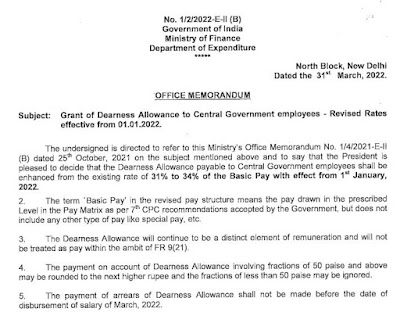
DA Jan 2022 - Grant of Dearness Allowance to Central Government employees - Revised Rates effective from 01.01.2022

 3% DA Hike - Revised Rates effective from 01.01.2022: DoE OM dated 31.03.2022 No. 1/2/2022-E-II (B) Government of India Ministry of Finance...