Showing posts with label Latest News. Show all posts

Monday, 13 July 2015

OROP: One Rank One Pension Scheme should be implemented with in six weeks – Hon’ble Supreme Court

OROP: One Rank One Pension Scheme should be implemented with in six weeks – Hon’ble Supreme Court

Hon’ble Supreme Court granted 6 weeks time Central Government to grant One Rank One Pension to retired Armed Forces Personnel on the request of Govt Justice T S Thakur accepted to take up the case after six weeks as per the request made by Additional Solicitor General on behalf of Government Side.
It is expected that time given now may be final as Hon’ble Supreme Court ordered for implementation of One Rank One Pension in the year 2008 itself which is yet to be implemented by Govt. This six weeks was granted on the grounds that Govt needs to work out the modalities for granting OROP.

A contempt petition has been filed by retired Major General S P S Vains in this issue in which hearing is on. Earlier Apex Court has observed that One Rank One Pension is one of the points in Election manifesto of NDA Government. Hon’ble court said “This was part of your manifesto for the Lok Sabha elections. You must keep your word,”

While hearing the Contempt Petition, Defence Ministry has been called upon to provide its explanation for non-implementation of OROP

In Febrary itself, when fixing the next hearing after 3 months Apex Court said “We make it clear that no further time will be granted for the purpose of implementation of the impugned judgment.”

Now, six more weeks have been given as additional time for implementing One Rank One Pension to Ex-Servicemen.

Source: The Indian Express

Tuesday, 31 March 2015

What central government employees can expect from the 7th Pay Commission

What central government employees can expect from the 7th Pay Commission

Sounds odd, but the highest paid Indian bureaucrat till 1959 was the railway board chairman and not the cabinet secretary. The top rail bureaucrat, who was earlier called chief commissioner of railways, drew a basic salary of Rs 3,250 per month, a smart 8.3% more than that of the cabinet secretary, the senior-most bureaucrat in India. But as the fortunes of Indian Railways dwindled over the years — its market share in freight movement has shrunk from 90% in 1950 to 30% now — the clout of the rail bosses and their corresponding rank and pay have also slipped.


Today, the railway board chairman and eight other top rail babus receive a salary equivalent to a government of India secretary, a scale which as many as 230 Indian Administrative Service (IAS) and 40 Indian Police Service (IPS) officers also draw. For good measure, the cabinet secretary now not only draws a higher salary than the railway board chairman, his superior rank comes with better perks including a bungalow at Prithviraj Road located in the heart of Lutyens' Delhi.

Meanwhile, the Indian Revenue Service (IRS), a 5,541 officers-strong cadre responsible for collecting direct taxes in India, now claims that IRS should get better pay and perks than IAS. The entry-level salary for all Group A Central services is the same now, but thanks to two more increments and faster promotions, IAS maintains an edge over others. The basis for this claim? "Today, IRS — not IAS — is the revenue collector for the government. So, it's logical that that the edge given to IAS  should be given to us," says Jayant Misra, Income-Tax commissioner and general secretary of IRS Association. In a 58-page-long memorandum to the 7th Central Pay Commission (CPC), which is now examining a pay hike for Central government employees, the IRS Association argued that the primary reason for higher pay to the Indian Civil Service (ICS) of the British era and its successor service, IAS, was that they were revenue collectors. But now, the dynamics have changed, they claim.


IRS has argued that the net direct tax collection has grown 9.35 times between 2000-01 and 2013-14, an impressive piece of statistics in the backdrop of only 5.4 times expansion of GDP during the corresponding period. Also, the cost of revenue collection in India is one of the lowest in the world, which according to IRS officers is yet another reason for demanding a good deal from the CPC. For every Rs 100 they collect, the tax department spends merely 57 paisa. In percentage terms, the cost of  revenue collection in India is one of the lowest in the world, which according to IRS officers is yet another reason for demanding a good deal from the CPC. For every Rs 100 they collect, the tax department spends merely 57 paisa. In percentage terms, the cost of revenue collection in India is 0.57% as against 1.58% in Japan, 1.35% in France, 1.17% in Canada and 1.05% in Australia.


Welcome to the behind-the-scenes manoeuvring before the Big Sarkari Pay Hike. With a new pay scale for 36 lakh Central government employees, and also pensioners, likely to come into effect from January 1, 2016, the officers and non-gazetted staff of various services have been lobbying hard to get a good deal from the 7th CPC. Unlike in the private sector, the pay hike in government is a once-in-10-years-affair, making every CPC, right from the first that submitted its report in 1947, a hugely powerful agency. No doubt, government employees have to undergo an annual appraisal process called Annual Performance Appraisal Report (APAR), but that exercise is important only for promotion, and not for any pay hike. Government employees do get a regular hike in dearness allowance, a measure meant for offsetting inflationary pressure on their earnings, but at the end of the day it is the CPC that fixes the bureaucrats' pay for 10 long years.


That's precisely why officers and staff of every service can't afford to ignore the CPC. Constituted in February 2014 under the chairmanship of retired Supreme Court judge Ashok Kumar Mathur, the 7th CPC has an economist and two bureaucrats as its members. Most of the employees' associations have already had at least one round of talks with the Commission. And some are waiting for Round II.


The Ripple Effects

A cursory glance at the memorandum submitted by IPS Central Association on behalf of Indian Police Service (IPS) will throw light on the importance attached to a pay commission. The 137-page memorandum, a copy of which was reviewed by ET Magazine, is well designed and comparable to any standard report prepared by a global consultancy firm. PV Rama Sastry, an Inspector General of Police at National Investigation Agency (NIA) and secretary of IPS Central Association says the memorandum  is the result of intense in-house research, factoring in the macro environment of growth, development, equity and justice vis-a-vis the role of a police officer. Though Sastry is the spokesperson of 4,720 IPS officers, the memorandum prepared by his team encompasses the role and needs of 30 lakh police personnel across India out of which 10 lakh come under the gamut of the pay commission. As the CPC recommendations are often accepted by the state governments as well, the remaining 20 lakh  police personnel too may eventually benefit.


The IPS memorandum has quoted a number of reports to suggest that the tough life of a cop justifies the demand for a fatter hike. For example, it has quoted articles published in two journals — Global Journal of Medicine and Public Health and International Journal of Pharma and Bio-Sciences — to conclude that one of two cops in India suffers from sleep disturbances and anxiety whereas chances of cardiovascular problems increase by 38% after a person joins as a police officer. Among other demands (see What it Expects), IPS wants better life and health insurance cover, an overtime allowance and also a new perk called allowance for "un-social" hours (for duty between 8 pm and 6 am).

Railway officers too cite round-the-clock work demands as a reason for better salary. "A railway officer may be called to join duty any time during the night. The pressure always remains as it's a 24x7 work," says RR Prasad, an Indian Railway Personnel Service officer and secretary general of Federation of Railways Officers' Association. The Indian Railways is a gigantic organisation with over 13 lakh employees, 16,000 of whom are officers. Both the officers and staff associations have made their representations to the 7th CPC. The officers want non-gazetted staff to get their dues but they demand the proportion of the pay of the lowest and the highestpaid employee should increase from current 1:12 to 1:18


To be sure, a formula towards pay parity has been the hallmark of the last few pay commissions. A government entry-level peon now gets a monthly pay of Rs 14,000, if dearness allowance is factored in. Similarly, a mid-level government driver's monthly salary, including allowances, is Rs 30,000, at least two times that of his counterpart in a private sector company. And that's why the salary gap between the lowest and highest paid government servant has drastically decreased over the last three decades.


The pay commissions have also reduced the disparity among the officers of various services. Till the late 1980s, an IAS officer used to receive a salary that's 25% higher than that of a Group A service officer. Today, the pay for all officers, at least at the entry level, is same. But IAS and Indian Foreign Service (IFS) officers still maintain an edge over others as their empanelment process (a step to get higher posts) is much faster.


Balancing Act

An IPS officer can become a joint secretary to government of India only two years after an IAS of the same batch can reach that level. Similarly, there has been a nine-yearlong gap in joint secretary empanelment between IAS and IRS, something many services claim is a continuation of the British legacy. Today, IAS officers at the level of deputy secretary and director at the Centre constitute about only 13% of the total officers. But as the hierarchy goes up, the percentage of IAS vis-a-vis others also rises. For example, 75% joint secretaries to government of India belong to IAS and IFS, and the percentage of IAS and IFS goes further up to 95 in case of government of India secretaries.

"The edge that the IAS has must continue. Why will a person join the IAS after quitting a job in HSBC Bank if that edge is missing? IAS officers have work experiences at Tehsil, sub-divisions, district, state and Central government levels. We interact with the political executives at all levels. IAS should remain a premium service," says Sanjay R Bhoosreddy, a joint-secretary-ranked officer and secretary to IAS (Central) Association.

On its part, the Indian Economic Service (IES) which has a cadre strength of 511 officers, represented in 55 Central government departments, has demanded parity in pay, perks and promotions of all services, including IAS, so that the "officers deliver what they have been employed for rather than fret over their pay and promotion prospects".

The question is how far the 7th CPC will go in changing the pay and associated service conditions like empanelment and promotions. IAS officers have pulled out a 1991 Supreme Court judgement (Mohan Kumar Singhania and Others vs Union of India and Others) where it was said that other services should not approach the pay commissions and attempt to change the rules of career progressions and push for a case for parity with the premier service. But other services are continuing their demand for pay parity and also for the creation of more departments where the IAS can't dictate. At present, only three major ministries — railways, external affairs and post — are not headed by IAS but run by their own cadres. Now, IPS wants a new department of internal security headed by a cop and IRS wants a separate direct tax department headed by a taxman.

Will the 7th CPC venture into such nuances? Or will it, like the past few pay commissions have, adopt a simple formula of Multiplier 3 under which the basic salary is hiked by three times or more depending on the economic health of the nation. If that is the case, it won't be too hazardous to make a prediction: A secretary to government of India will get a basic monthly salary (excluding DA) of Rs 2.4 lakh (current basic salary multiplied by three) and the cabinet secretary Rs 2.7 lakh from  January 1, 2016. And, yes, perks, DA and other allowances will be extra.

Source: http://economictimes.indiatimes.com/

Friday, 27 February 2015

Outcome of the meeting with 7th Pay Commission on 25.2.2015 – AIRF

Outcome of the meeting with 7th Pay Commission on 25.2.2015 – AIRF

A.I.R.F.
All India Railwaymen’s Federation
4, State Entry Road, New Delhi – 110055
No.AIRF/60
Dated: February 24, 2015
The General Secretaries,
All Affiliated Unions,
Dear Comrades,

Sub: Feedback of meeting with Seventh Pay Commission on 25.02.2015

Today, We met pay commission and demanded for interim report on merger of DA and Interim relief.
The pay commission told us that it has no such reference from Government and wanted us to demand the same from central government. However they agreed to write DO letter to Government of India in respect of our demands.

They informed us that Pay Commission will submit its report within stipulated time to Government. They proposed to us to send small groups from various departments for submission of their demands to them and asked JCM to make small groups to discuss important items in JCM memorandum for which we have agreed.
Yours sincerely,
sd/-
(Shiva Gopal Mishra)
General Secretary
Source: NRMU

Tuesday, 10 February 2015

Interaction Meeting with Seventh Central Pay Commission on NFIR’s Memorandum

Interaction Meeting with Seventh Central Pay Commission on NFIR’s Memorandum:-

NFIR
National Federation of Indian Railwaymen
3, CHELMSFORD ROAD, NEW DELHI -110055
 
No. IV/NHR/7th CPC/CORRES/Pt. V
Dated: 05/02/2015
The Chairman,
Seventh Central Pay Commission,
Chhatrapati Shivaji Bhawan,
IIFT, Block B (B-14/A),
Qutab Institutional Area,
New Delhi 110016
(Post Box No. 4599-Hauz Khas P.O)
 
Dear Sir,
Sub: Inter-action meeting with the Seventh Central Pay Commission on NFIR’s memorandum-reg.
Ref: NFIR’s letter No.IV/NFIR/7th CPC/CORRES/Pt. V dated 02/08/2014.
Federation vide its letter dated 02/08/2014, addressed to the Secretary, Seventh Central Pay Commission had made following suggestions with regard to holding interaction meetings:
a) Inter-action meetings may be fixed giving us reasonable advance intimation to enable us to reschedule our other programmes,
b) Meeting/hearing may be fixed department wise to facilitate us to meet the Pay Commission along with the representatives of the conccrned department/category.
c) In the Railways, there are eight major departments with hundreds of categories. Eight different dates for explaining our case may kindly be considered.
d) Inter-action meetings may also be convened for explaining the case of miscellaneous and isolated categories in Railways.
e) Separate date and time be provided to facilitate the NFIR to explain uniqueness of railways as well unique nature of duties of railway employee in general.
Federation is yet to receive response from the Seventh Central Pay Commission.
 
In this connection, NFIR desires to mention that the 6th CPC had allotted a total time of 28 hours to us in different spells/different dates to explain the case of Railway employees belonging to various categories in different departments. Federation trusts that similar time slots would be provided to us by the 7th CPC as well.
 
NFIR. therefore, once again requests the Hon’ble Chairman Seventh Central Pay Commission to arrange to allot adequate time slots and convey to the Federation.
Yours faithfully,
sd/-
(Dr.M.Raghavaiah)
General Secretary
Source: NFIR

Sunday, 1 February 2015

6% hike in DA/DR from January, 2015 is Final: December, 2014 AICPIN released

6% hike in DA/DR from January, 2015 is Final: December, 2014 AICPIN released

The 6% hike in DA/DR from January, 2015 with total 113% is now FINAL after release of December, 2014 AICPIN.  All Central Government Employees & Pensioner are now eligible to get 6% hike in current DA/DR which is 107%.  All India Consumer Price Index Number (AICPIN) for Industrial Worker is remained stationery at 253 (two hundred and fifty three) for the month of December, 2014.   The additional installment of 6% DA/DR from January, 2015 will be approved by the Govt. in the month of March, 2015 and the arrears of the month from January to March, 2015 will be paid in the staring of next financial year i.e. April, 2015.

The Final table is for calculation of DA/DR for the month from January, 2015 is given below:-
Expect-
ation
Increase/ Decrease
Index
Month Base Year
2001
100
Total of 12
Months
Twelve monthly
Average
% increase over 115.76
for   DA
DA announced
or will be
announced

-4 Dec,13 239 2786 232.17 100.56% 100%
DA/DR from
July, 2014
-2 Jan,14 237 2802 233.5 101.71% 107%
1 Feb,14 238 2817 234.75 102.79%
1 Mar,14 239 2832 236 103.87%
3 Apr,14 242 2848 237.33 105.02%
2 May,14 244 2864 238.67 106.17%
2 Jun,14 246 2879 239.92 107.25%
JUL+AICPIN 6 Jul,14 252 2896 241.33 108.48% 113%
Aug+AICPIN 1 Aug,14 253 2912 242.67 109.63%
Sep+AICPIN 0 Sep,14 253 2927 243.92 110.71%
Oct+AICPIN 0 Oct,14 253 2939 244.92 111.57%
Nov+AICPIN 0 Nov,14 253 2949 245.75 112.29%
Dec+AICPIN 0 Dec,14 253 2963 246.92 113.30%
Dearness Allowance/Relief from January, 2015 will be

You may also download/save the excel sheet for self calculation.  The link for excel sheet is given below:

DOWNLOAD: EXCEL FILE FOR EXPECTED DEARNESS CALCULATION TO CALCULATE YOURSELF 

Press Release for CPI(IW) Base 2001=100 Monthly Index Letter – DECEMBER 2014

No. 5/1/2014- CPI
GOVERNMENT OF INDIA
MINISTRY OF LABOUR & EMPLOYMENT
LABOUR BUREAU
 ‘CLEREMONT’, SHIMLA-171004
DATED: the 30th January, 2015
 Press Release
Consumer Price Index for Industrial Workers (CPHW) – December, 2014

The All-India CPHW for December, 2014 remained stationary at 253 (two hundred and fifty three). On l-month percentage change, it remained static between November, 2014 and December, 2014 when compared with the decrease of (-) 1.65 per cent between the same two months a year ago.
The largest downward pressure to the change in current index came from Food group contributing (-) 1.09 percentage points to the total change. At item level, Coconut Oil, Poultry (Chicken), Chillies Green, Ginger, Onion, Vegetable & Fruit items, Sugar, Petrol, etc. are responsible for the decrease in index. However, this decrease was restricted to some extent by Rice, Wheat, Wheat Atta, Arhar Dal, Masur Dal, Moong Dal, Mustard Oil, Fish Fresh,’Goat Meat, Eggs (Hen), Dairy Milk, Milk (Cow & Buffalo), Tea (Readymade), Cigarette, Electricity Charges, Firewood, E.S.I. Contribution, Cable Charges, Private Tuition Fee, Taxi Fare, Barber Charges, Flower/F lower Garlands, etc., putting upward pressure on the index.
The year-on-year inflation measured by monthly CPHW stood at 5.86 per cent for December, 2014 as compared to 4.12 per cent for the previous month and 9.13 per cent during the corresponding month of the previous year. Similarly, the Food inflation stood at 5.73 per cent against 2.56 per cent of the previous month and 11.49 per cent during the corresponding month of the previous year.
At centre level, Kodarma reported a maximum decrease of 12 points followed by Ranchi Hatia (7 points), Tripura (6 points) and Varanasi & Agra (5 points each). Among others, 4 points fall was observed in 5 centres, 3 points in 4 centres, 2 points in 18 centres and 1 point in 16 centres. On the contrary, Bhilwara & Tiruchirapally recorded maximum increase of 5 points each followed by Mumbai & Puduchery (3 points each). Among others, 2 points rise was registered in 5 centres and 1 point in 9 centres. Rest of the 12 centres’ indices remained stationary.
The indices of 38 centres are below and other 39 centres’ indices are above national average. The index of Varanasi centre remained at par with all-India index.

The next index of CPI-1W for the month of January, 2015 will be released on Friday, 27 February, 2015. The same will also be available on the office website www. labourbureau. gov. in.
sd/-
(S.S. NEGI)
DIRECTOR
Source: http://labourbureau.nic.in/press%20note%20eng%20dec%202014.pdf

Thursday, 5 June 2014

Central Government Officers may have to work 6 days a week

News: 6 Days a week workdays in central government offices
Central Government Officers may have to work 6 days a week
Deccan Chronical | June 03, 2014

New Delhi: Speculation is rife in various union ministries that the new government under Narendra Modi may revert back to the six-days a week workdays in central government offices after about three decades.

Although there is no move yet by the government in this regard the issue is subject of much discussion among the bureaucrats. It was former PM Rajiv Gandhi who, in the mid-1980s, had decided to go in for the five-day week.

The aim at that time was to promote efficiency since it gave the bureaucrats much-needed rest over the weekend on the assumption that the work-culture would improve during week-days.

The closure of Government offices on Saturdays also resulted in saving of electricity and other expenses of the Centre. But despite the current five-day week, some of the ministers even in the previous UPA-2 government were known to attend office on Saturdays and attend to files and other important work.


Source: http://www.deccanchronicle.com/140603/nation-current-affairs/article/central-government-officers-may-have-work-6-days-week

Wednesday, 30 April 2014

List of Allowances increased @ 25%(over original 6th CPC rate) after 100% DA: Railway Board Order

 List of Allowances increased @ 25%(over original 6th CPC rate) after 100% DA: Railway Board Order

List of the various allowances that increased at the rate of 25% (over original 6th CPC rate)  w.e.f. 01.01.2014 on account of enhancement in the rate of DA to 100% – Railway Board’s Order RBE No. 39/2014:-
Government of India/Bharat Sarkar
Ministry of Railways /Rail Mantraraya
(Railway Board)
PC-VI No. 336
RBE No. 39/2014
No.F(E)1/2011/AL-28/18
New Delhi, dated 29.04.2014
The General Managers,
All Indian Railways etc.
(As per Standard Mailing List)

Sub: Enhancement in the rate of various allowances by 25% as a result of enhancement of Dearness allowance upto 100% w.e.f 01.01.2014.

In accordance with the recommendations of 6th CPC, the rates of various allowances admissible to different categories of railway staff were revised/doubled. The 6th CPC had also recommended that the rates of these
allowances will be increased by 25% every time the Dearness Allowance goes up by 50%.  Railway Board, accordingly, issued instructions in respect of increase in rates of various allowances by 25% vide Board’s letter of even number dated 13.06.2011.

2.    Subsequent to enhancement in the rate of Dearness Allowance to 100% w.e.f. 01.01.2014 queries are being received from some of the Railways regarding further enhancement of rates of these allowances. The matter has been examined and It is clarified that the rates of allowances listed in the enclosed Annexure shall increase by a further 25% (over original 6th CPC rate prescribed by Ministry of Railways) with Dearness Allowance now having gone up to 100% w.e.f. 01.01.2014.

3.    The terms and conditions for grant of these allowances will remain the same.

4.    Hindi version is enclosed.

5.    Kindly acknowledge receipts

DA: as above
(Amir Chand Jain)
Dy. Dirs Finance(Estt)
Railway Board

LIST OF THE VARIOUS ALLOWANCES THAT STAND REVISED W.E.F. 01.01.2014 ON ACCOUNT OF ENHANCEMENT IN THE RATE OF DA TO 100%

Sl. No. Name of Allowance Authority number and date
1. Daily Allowance F(E)I/2008/AL-28/14 dated 01.12.2008 (Para 3 of the Annexure to the letter)
2. Mileage for road journey by taxi/own car/auto-rickshaw/own scooter/bicycle etc. F(E)I/2008/AL-28/14 dated 01.12.2008 (para 2 D (b) and (c) of the Annexure to the letter
3. Road Mileage Allowance and rates for transportation of House-hold effects on transfer F(E)1/2008/AL-28/15 dated 01.12.2008 (Para A (3) & (4) and para C of the Annexure to the letter)
4. Fixed Conveyance Allowance F(E)I/2008/AL-7/3 dated 03.10.2008
5. Cycle Maintenance Allowance F(E)I/2008/AL-7/2 dated 18.09.2008
6. Washing Allowance F(E)I/2008/AL-29/1. dated 30.09.2008
7. Special Compensatory (Scheduled/ Tribal Area) Allowance F(E)I/2008/AL-4/7 dated 18.09.2008
8 Special Compensatory (Hill Area) Allowance F(E)1/2008/AL-4/4 dated 16.09.2008
9. Special Compensatory (Bad Climate) Allowance F(E)1/2008/AL4/5 dated 16.09.2008
10. Special Compensatory (Remote Locality) Allowance F(E)I/2008/AL-4/6 dated 22.09.2008

Source: AIRF
[http://www.airfindia.com/Orders%202014/RBE%2039_2014.pdf]

Flash News

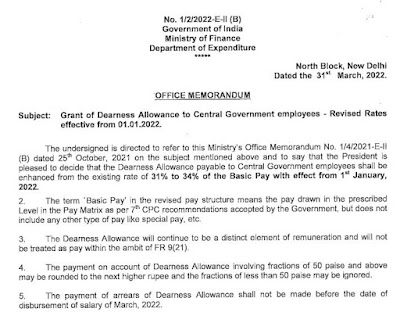
DA Jan 2022 - Grant of Dearness Allowance to Central Government employees - Revised Rates effective from 01.01.2022

 3% DA Hike - Revised Rates effective from 01.01.2022: DoE OM dated 31.03.2022 No. 1/2/2022-E-II (B) Government of India Ministry of Finance...