Showing posts with label PSUs. Show all posts

Wednesday, 27 November 2019

PSUs: Order Books of Defence Public Sector Units


PSUs: Order Books of Defence Public Sector Units
Order Books of Defence Public Sector Units (PSUs)

Ministry of Defence
Order Books of Defence PSUs

27 NOV 2019

The status of current order books of Defence PSUs is as under:


S.NO.NAME OF ORGANISATIONCURRENT ORDER BOOK VALUE (Rs. In Crore)
1HINDUSTAN AERONAUTICS LIMITED (HAL)59832
2BHARAT ELECTRONICS LIMITED (BEL)56300
3BEML LIMITED (BEML)9568
4BHARAT DYNAMICS LIMITED (BDL)7200
5MISHRA DHATU NIGAM LIMITED (MIDHANI)1800
6MAZAGON DOCK SHIPBUILDERS LIMITED (MDL)52113
7GARDEN REACH SHIPBUILDERS & ENGINEERS LIMITED (GRSE)27407
8GOA SHIPYARD LIMITED (GSL)14956
9HINDUSTAN SHIPYARD LIMITED (HSL)2805
The order book volume of Defence PSUs depends on the customers which is primarily the Armed Forces and export opportunities in the International market. The steps taken to improve the order book position includes modernization of production capacity and infrastructure; emphasis on import substitution and indigenisation; promotion of exports; introduction of new technologies; product diversification; setting up of JVs with foreign companies and preference being given to ‘Buy (Indian - Indigenously Designed, Developed and Manufactured)’ equipment under Capital Acquisition in Defence Procurement Procedure 2016.

Also check: ENCASHMENT OF EARNED LEAVE ON JOINING CENTRAL GOVERNMENT EMPLOYEES FROM PSUS & VICE VERSA

This information was given by Raksha Rajya Mantri Shri Shripad Naik in a written reply to Shri Sudhakar Tukaram Shrangare and Smt Pratima Bhoumik in Lok Sabha today.

PIB

Wednesday, 20 November 2019

Provisions regarding reservation under the Central Government


Provisions regarding reservation under the Central Government

Provisions regarding reservation under the Central Government


Ministry of Personnel, Public Grievances & Pensions
Provisions relating to Reservations
20 NOV 2019
The instructions issued by Government on India under Article 16 (4) and 16 (4A) of the Constitution are, mutatis mutandis, followed by the Public Sector Undertakings (PSUs), Financial Institutions including the Public Sector Banks under the Central Government. Implementation of the reservation provisions are insisted upon as a pre-condition to receive grants-in-aid by the voluntary organizations, autonomous bodies /institutions etc. where:-

Also check: MACP FOR THE CENTRAL GOVERNMENT CIVILIAN EMPLOYEES - DOPT CONSOLIDATED GUIDELINES
  • the recipient body employs more than 20 persons on a regular basis and at least 50% of its recurring expenditure is met from grants-in-aid from Central Government; and
  • the body is registered society of a cooperative institution and is in receipt of a general purpose annual grants-in-aid of Rs. 2 lakhs and above from the Consolidated Fund of India.
Ministries/Departments have been directed to include suitable clause in the terms and conditions under which voluntary agencies / organizations etc. are given grants-in-aid by the Government for reservation for SCs/ STs/ OBCs in the posts and services under such organisations or agencies. It has further being provided that while sanctioning further grants, the progress made in employing SCs/ STs/ OBCs should be kept in view.

This information was provided by the Union Minister of State (Independent Charge) Development of North-Eastern Region (DoNER), MoS PMO, Personnel, Public Grievances & Pensions, Atomic Energy and Space, Dr Jitendra Singh in written reply to a question in Lok Sabha today.

PIB

Thursday, 4 January 2018

7th CPC Revision of Remunerations of pre-2016 retired Government Servant engaged in PSUs viz BSNL, MTNL etc


7th CPC Revision of Remunerations of pre-2016 retired Government Servant engaged in PSUs viz BSNL, MTNL etc
File No. 03/11/2016/SEA-I (Pt-I)/Fin
Government of India
Ministry of Communications
Department of Telecommunications
(Finance Branch)
Room No. 717, Sanchar Bhawan,
20, Ashok Road, New Delhi - 110 001
Dated 23 December 2017
OFFICE MEMORANDUM

The undersigned has been directed to convey the Approval of the Competent Authority towards revision of remunerations being paid to, the retired Government servants engaged in Department of Telecommunications(Head Quarters) with effect from 1st January, 2016 as under:

(a) In the case of Government servants retired after 01.01.2016 engaged as consultant:

The consolidated fee/ remunerations for the consultants shall be restricted to an amount equal to the difference between the last basic pay (as per 7th CPC) drawn by the retired officer and basic pension (as per 7th CPC), plus dearness allowance on the difference as applicable to the Central Government Servants from time to time.

(b) In the case of Government servants retired prior to 01.01.2016:

In case of those engaged as consultants in DOT H Qrs. who retired prior to 01.01.2016 i.e. before implementation of 7th CPC, their last pay drawn shall be fixed notionally in accordance with para 4 of DOP&PW OM No.38/37/2016-P&PW(A) dated 12.05.2017 i.e., their last pay may be fixed notionally in the pay matrix recommended by the 7th CPC in the level corresponding to the pay in the pay band A and grade pay at which they retired. The consolidated fee/ remunerations for the consultants shall be restricted to an amount equal to the difference between the last basic pay arrived as above and basic pension (as per 7th CPC), plus dearness allowance on the difference as applicable to the Central Government Servants from time to time.

(c) In the case of retired officers from PSUs viz. BSNL, MTNL etc.
The remunerations of such PSU employees engaged as consultants may be fixed by multiplying both the notional basic pay as per 6th CPC and basic pension of PSU retirees by factor 2.57 and their difference plus Dearness Allowance on the difference as per 7 CPC at the rate applicable to Central Government Servants from time to time or the existing remunerations, whichever is higher.


2. Para 4 of OM No. 3-2/2009-SEA-I dated nil February, 2010 and para 1 (iv) of the approved policy for “Engagement of Consultants” issued vide OM No. 03-10/2014-SEA-I/Fin. Dated 28.02.2015 stands modified to the extent stated in para 1 of this OM w. e. f. 01.01.2016.

3. The nodal sections/wings of DOT HQ will revise the consolidated fee/remunerations in respect of the consultants Working in their wings on the basis of copy of the letter from the Department/Ministry from which they retired (giving details of revision of pension) addressed to CPAO with copy given to pensioners. The remuneration so revised should be got vetted for the first time from IFD before making payment.

4. The above revision of the consolidated fee/ remunerations as per 7th CPC and its implementation will be applicable in respect of consultants engaged in various wings of DOT HQs was well as in CCA Offices.
(Manish K Gupta)
Director (F)

Thursday, 21 December 2017

Diversification of portfolios by PSUs

Diversification of portfolios by PSUs

Proposals for diversification of portfolios to maintain business performance are taken up by the Boards of Central Public Sector Enterprises (CPSEs) with the approval of competent authority after considering their techno-economic feasibility and viability. In addition, the Boards of Maharatna and Navratna CPSEs have been delegated powers, inter-alia, to (i) incur capital expenditure without Government approval on purchase of new items or for replacement, to take up new projects, modernization, etc., (ii) make equity investment to establish financial joint ventures and wholly owned subsidiaries, and (iii) undertake mergers & acquisitions subject to laid down conditions. The Boards of Maharatna and Navratna CPSEs have also been delegated powers to raise debt from domestic and international markets.

This information was given by Minister of State in the Ministry of Heavy Industries and Public Enterprises Shri Babul Supriyo in reply to a written question in the Rajya Sabha today.

Thursday, 30 November 2017

Highlights of the Monthly Account of the Government of India upto October 2017


Highlights of the Monthly Account of the Government of India upto October 2017

The Monthly Account of the Government of India upto October 2017 has been consolidated and reports published. Highlights of the same are given below:

The Government of India has received Rs.7,67327 crore (47.9% of corresponding BE 17-18 of Total Receipts) upto October 2017 comprising Rs. 6,33,617 crore Tax Revenues (Net to Centre), Rs. 95,151 crore of Non-Tax Revenues and Rs.38,559 crore of Non-Debt Capital Receipts. Non-Debt Capital Receipts consists of Recovery of Loans (Rs. 8,394 crore) and Disinvestment of PSUs (Rs. 30,165 crore).

Rs.3,37,280 crore has been transferred to the State Governments as Devolution of Share of Taxes by Government of India in this period.

Total Expenditure incurred by Government of India is Rs.12,92,648 crore (60.2% of corresponding BE 17-18), out of which Rs.11,29,853 crore is on Revenue Account and Rs.1,62,795 crore is on Capital Account. Out of the total Revenue Expenditure, Rs.2,57,909 crore is on account of Interest Payments and Rs.1,91,336 crore is on account of Major Subsidies.

PIB

Monday, 18 September 2017

Procedure for empanelment of retired officers as the Inquiry Officers for conducting Departmental Inquiries


Procedure for empanelment of retired officers as the Inquiry Officers for conducting Departmental Inquiries - reg.

F.No.142/40/2015-AVD.I
Government of India Ministry of Personnel,
Public Grievances and Pensions
Department of Personnel and Training
New Delhi
Dated, the 15th September, 2017
OFFICE MEMORANDUM
Subject: Procedure for empanelment of retired officers as the Inquiry Officers for conducting Departmental Inquiries- reg.

The undersigned is directed to state that the issue of utilizing the services of retired officers for conducting departmental inquiries had been under consideration of the Department. It has now been decided that panels of retired officers from the Ministries/Departments under Government of India and PSUs would be created and maintained by the respective Cadre Controlling Authorities for conducting Departmental Inquiries against the delinquent officials.

2. Procedure for empanelment of retired officers as the Inquiry Officers - Panels of retired officers not below the rank of Deputy Secretary in Central Government and equivalent officer in the State Governments/PSUs to be appointed as the Inquiry Officer for the purpose of conducting departmental inquiries would be maintained level/rank wise and place-specific by each cadre controlling authority where its offices are located.

3. Validity of the panel - The panel of the retired officers created for the purpose of appointing Inquiry Officers for conducting departmental inquiry will be valid for a period of three years. The respective Cadre Controlling Authority will ensure that a panel of retired Inquiry Officers is available with them.
4. Following are the eligibility conditions for appointment of willing retired officers as the Inquiry Officers to conduct departmental inquiries:-
(i) Retired officers who are willing to serve as Inquiry Officer.
(ii) He/she should not have been penalized in a Disciplinary Proceeding case (no penalty in DP or prosecution in criminal case)
5. The respective Cadre Controlling Authority will immediately take necessary action for inviting applications from willing and eligible retired officers to serve as the Inquiry Officer for conducting departmental inquiry. In this regard, a format for inviting applications is annexed.

6. A three-member committee consisting of Joint Secretary level officers including CVO of the concerned Ministry/Departments/PSUs would be constituted by the respective cadre controlling authority. The other two members can be from the same Ministry/Department or from the attached or subordinate office. After receipt of willingness of the retired officers, names of the officers will be screened by the committee so constituted. The formation of panel will be a continuous and ongoing process. The DA will decide on the appointment of the JO based on willingness for a case, experience in the sector and status of residence. Committee constituted for making panels of retired officers as the Inquiry Officer has to keep in mind that applications of retired officers willing to serve as an Inquiry Officer should be scrutinized carefully to ensure that the applicant meets the eligibility criteria.

7. The number of disciplinary cases assigned to an Inquiry Officer may be restricted to 8 cases in a year, with not more than 4 cases at a time.

8. Terms and conditions for appointment of retired officers as the Inquiry Officer.
The designated Inquiry Officer shall require to give an undertaking as follows:-
(i) that he/she is not a witness or a complainant in the matter to be inquired into or a close relative or a known friend of the delinquent Government officer. A certificate to this effect will be obtained from the Inquiry Officer with respect to every inquiry and placed on record
(ii) shall maintain strict secrecy in relation to the documents he/she receives or information/data collected by him/her in connection with the inquiry and utilize the same only for the purpose of inquiry in the case entrusted to him/her.
9. No such documents/information or data shall be divulged to anyone during the Inquiry or after presentation of the Inquiry Report. All the records, reports etc. available with the Inquiry Officer shall be duly returned to the authority which appointed him/her as such, at the time of presentation of the Inquiry Report.

10. The Inquiry Officer shall conduct the inquiry proceedings at a location taking into account the availability of records, station/place where the misconduct occurred as well as the convenience of the witnesses/ PO etc. Video Conferencing should be utilized to the maximum extent possible to minimize travel undertaken by the IO/PO/CO. The cadre controlling authorities will facilitate necessary arrangements for the Video Conferencing.

11.The Inquiry Officer shall undertake travel for conducting inquiry (in unavoidable circumstances) with the approval of an authority as may be nominated by the concerned Ministry/Department.

12.The Inquiry Officer shall submit the inquiry report after completing the inquiry within 180 days from the date of his/her appointment as the Inquiry Officer. Extension of time beyond 180 days can be granted only by the Authority as may be prescribed.

13. The rates of honorarium and other allowances payable to the Inquiry Officer will be as under:-

retired-officers-dopt


50% will be paid on submission of the Inquiry Report. Remaining amount will be paid within 45 days. In case it is not possible to proceed with the matter due to stay by courts etc., the Inquiry Officer may be discharged from his/her duties and payment of honorarium and other allowances will be made on pro rata basis.
14. Before the payment is received by the Inquiry Officer, it will be his/her responsibility to ensure that:-
(a)All case records and inquiry report (two ink signed copies) properly documented and arranged is handed over to the office of Disciplinary Authority.

(b)The report returns findings on each of the Articles of Charge which has been enquired into should specifically deal and address each of the procedural objections, if any, raised by the charged officers as per the extant rules and instructions.

(c)There should not be any ambiguity in the inquiry report and therefore every care should be taken to ensure that all procedures for conducting departmental inquiries have been followed in accordance with the relevant rules/instructions of disciplinary and appeal Rules to which the delinquent Government officials are governed.
15. Letter regarding engaging a retired officer as the Inquiry Officer will only be issued with the approval of the Disciplinary Authority of the Ministry/Department/ Office concerned.

16. A review of every empanelled Inquiry Officer will be done after receipt of 2 inquiry reports where adherence to time lines and the procedure and quality of work will be assessed by the concerned Ministry. Subsequent allocation of work may be done only after such evaluation. The services of Inquiry Officers whose performance is not upto the mark will be terminated with the approval of appointing authority.

17.Any issue arising out of this O.M. between the Inquiring Officer and the Disciplinary Authority will be decided by the Secretary , DoPT whose decision shall be final and binding on both parties.

18.These guidelines are issued for internal use of DoPT and other Cadre controlling authorities may adopt the same with suitable amendments.
(K. Srinivasan)
Under Secretary to the Govt. of India
Te1:23092957
Source: Dowmload PDF -DOPT ORDER

Wednesday, 30 August 2017

OBC reservations: Cabinet approves equivalence of posts in Central Public Sector Undertakings (PSUs), Banks, Insurance Institutions with Posts in Government


Cabinet approves equivalence of posts in Central Public Sector Undertakings (PSUs), Banks, Insurance Institutions with Posts in Government so that the children of those serving in lower categories in PSUs and other institutions can get the benefit of OBC reservations 

The Union Cabinet chaired by Prime Minister Shri Narendra Modi has given its approval to the norms for establishing equivalence of posts in Government and posts in PSUs, PSBs etc. for claiming benefit of OBC reservations. This addresses an issue pending for nearly 24 years. This will ensure that the children of those serving in lower categories in PSUs and other institutions can get the benefit of OBC reservations, on par with children of people serving in lower categories in Government. This will also prevent children of those in senior positions in such institutions, who, owing to absence of equivalence of posts, may have been treated as non Creamy Layer by virtue of wrong interpretation of income standards from cornering government posts reserved for OBCs and denying the genuine non creamy layer candidates a level playing field.

The Union Cabinet also approved the increase in the present income criterion of Rs. 6 lakh per annum for applying the Creamy Layer restriction throughout the country, for excluding Socially Advanced Persons/Sections (Creamy Layer) from the purview of reservation of Other Backward Classes (OBCs). The new income criterion will be Rs. 8 lakh per annum. The increase in the income limit to exclude the Creamy Layer is in keeping with the increase in the Consumer Price Index and will enable more persons to take advantage of reservation benefits extended to OBCs in government services and admission to central educational institutions.

These measures are a part of the Government's efforts to ensure greater social justice and inclusion for members of the Other Backward Classes. The Government has already introduced in Parliament, a bill to provide Constitutional status to the National Commission for Backward Classes. It has also decided to set up a Commission, under section 340 of the Constitution, to sub categorize the OBCs, so that the more backward among the OBC communities can also access the benefits of reservation for educational institutions and government jobs. All these decisions, taken together, are expected to ensure greater representation of OBCs in educational institutions and jobs, while also ensuring that the more under-privileged within the category are not denied their chance of social mobility.

Background:
In its judgment dated 16.11.1992 in WP(C) 930/1990 (IndraSawhney case) the Supreme Court had directed the Government to specify the basis, for exclusion of socially and economically advanced persons from Other Backward Classes by applying the relevant and requisite socio-economic criteria.
An Expert Committee was constituted in February 1993 which submitted its report on 10.03.1993 specifying the criteria for identification of socially advanced persons among OBCs i.e. the Creamy Layer. The report was accepted by the then Ministry of Welfare and forwarded to DoPT which issued an OM dated 08.09.1993 on exclusion from the Creamy Layer.

The OM of 08.09.1993 specifies six categories for identifying Creamy Layer (a) Constitutional/Statutory post (b) Group 'A' and Group 'B' Officers of Central and State Governments, employees of PSUs and Statutory bodies, universities, (c) Colonel and above in armed forces and equivalent in paramilitary forces (d) professionals like Doctors, Lawyers, Management Consultants, Engineers etc. (e) Property owners with agricultural holdings or vacant land and/or buildings and (f) income/wealth tax asessee.

The OM further stipulates that the said parameters would apply mutatis mutandis to officers holding equivalent or comparable posts in PSUs, Banks, Insurance Organizations, Universities, etc. and Government was required to determine equivalence of positions in these organizations with those in Government.
Pending the equivalence to the established in these institutions Income criteria would apply for the officers in these Institutions.

However, this exercise of determining the equivalence of posts in Government and posts in PSUs, PSBs etc. had not been initiated. The determination of equivalence of posts has been thus pending for almost 24 years.
The matter of formulating equivalence has since been examined in detail. In PSUs, all Executive level posts i.e. Board level executives and managerial level posts would be treated as equivalent to group 'A' posts in Government and will be considered Creamy Layer. Junior Management Grade Scale-1 and above of Public Sector Banks, Financial Institutions and Public Sector Insurance Corporations will be treated as equivalent to Group 'A' in the Government of India and considered as Creamy Layer. For Clerks and Peons in PSBs, FIs and PSICs, the Income Test as revised from time to time will be applicable. These are the broad guidelines and each individual Bank, PSU, Insurance Company would place the matter before their respective board to identify individual posts.

PIB

Saturday, 22 July 2017

Vacant Posts in PSUs

Vacant Posts in PSUs

The recruitment to below Board level posts in Central Public Sector Enterprises (CPSEs) is done by the Management of respective CPSEs and the details of vacant posts in CPSEs are not maintained centrally in the Department of Public Enterprises (DPE). However, as per Public Enterprises Survey 2015-16 which was laid on the Table of both the Houses of Parliament on 21.03.2017, the representation of reserved / unreserved categories of employees in the operating CPSEs as on 31.3.2016 was as under:

Total No. of Employees
Representation of SCs/STs/OBCs 
Total Reservation (2+4+6)
Others
SCs No.
%
STs  No.
%
OBCs No.
%
No.
%
No.
%
1
2
3
4
5
6
7
8
9
10
11
1232161
214132
17.38
104888
8.51
205385
16.67
524405
42.56
707756
57.44

CPSEs are under the administrative control of different administrative Ministries / Departments and the compliance of guidelines / statutory provisions in CPSEs including filling up of reserved posts is monitored by the concerned administrative Ministries / Departments and Board of these CPSEs. DPE has also issued instructions from time-to- time to all the administrative Ministries / Departments to advice the CPSEs under their administrative control to take steps to fill up the unfilled / backlog of reserved posts in accordance with the Government instructions.

This information was given by Minister of State in the Ministry of Heavy Industries and Public Enterprises Shri Babul Supriyo in reply to a written question in the Lok Sabha today.

PIB

Flash News

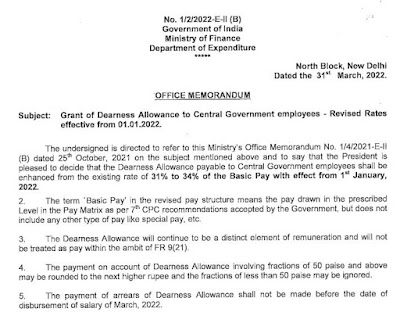
DA Jan 2022 - Grant of Dearness Allowance to Central Government employees - Revised Rates effective from 01.01.2022

 3% DA Hike - Revised Rates effective from 01.01.2022: DoE OM dated 31.03.2022 No. 1/2/2022-E-II (B) Government of India Ministry of Finance...