Showing posts with label ccl. Show all posts

Tuesday, 17 September 2019

Amendment in the CCS Leave Rules 1972 consequent upon the implementation of the recommendations of 7th CPC

DoPT Orders 2019

Amendment in the CCS Leave Rules 1972 consequent upon the implementation of the recommendations of 7th CPC
No. 11020/01/2017-Estt. (L)
Government of India
Ministry of Personnel PG & Pensions
Department of Personnel & Training
Old JNU Campus, New Delhi
Date: 30.8.2019
OFFICE MEMORANDUM
Sub: Amendment in the CCS (Leave) Rules, 1972 consequent upon the implementation of the recommendations of 7th CPC.

The undersigned is directed to say that the Government has accepted the recommendations of the 7th CPC and implemented the same vide Notification dated 11.12.2018. This Notification has been uploaded in the Department's website also at the address. However, despite issue of the notification in this regard, some employees have been seeking formal and informal clarifications with regard to the amendments carried through the above Notification. Keeping this in view, following clarifications specifying the amendments carried out in the CCS (Leave) Rules, 1972 vide the above said Notification are issued:

Also check: TYPES OF LEAVE ADMISSIBLE: Leave Rules – CCS (Leave) Rules, 1972

I. The amendments made in the CCS (Leave) Rules, 1972 vide Notification dated 11.12.2018, have come into force w.e.f. 14.12.2018 when the Notification was published in the official gazette.

II. Government servants serving in a Vacation Department have been allowed Earned Leave in place of Half Pay Leave by amending Rule 28 and Rule 29.

III. With the amendment of Rule 43-C relating to Child Care Leave (CCL), following changes have been made:-
(a) CCL may be granted at 100% of the leave salary for the first 365 days and 80% of the leave salary for the next 365 days.
(b) CCL may be extended to single male parents who may include unmarried or widower or divorcee employees.
(c) For single female Government servants, the CCL may be granted for six spells in a calendar year. However, for other eligible Government servants, it will continue to be granted for a maximum of 3 spells in a calendar year.
IV. "Special Disability Leave for injury intentionally inflicted" under Rule 44 has been substituted by a new Leave named "Work Related Illness and Injury Leave (WRIIL)" which may be granted to a Government servant (whether permanent or temporary), who suffers illness or injury that is attributable to or aggravated in the performance of her or his official duties or in consequence of her or his official position. With the introduction of WRIIL, "Special Disability Leave for accidental injury" (under Rule 45) and Hospital Leave (under Rule 46) have been deleted. WRIIL has foil owing provisions:-

Also check: Child Care Leave - DoPT

(a) Full pay and allowances will be granted to all. employees during the entire period of hospitalization on account of WRIIL.

(b) Beyond hospitalization, WRIIL will be governed as follows:
(i) Government servants (other than military officers) will be paid full pay and allowances for the 6 months immediately following hospitalization and Half Pay only for 12 months beyond that period. The Half Pay period may be commuted to full pay with corresponding number of days of HPL debited from the employee's leave account.
(ii) For officers of the Central Armed Police Forces (GAFF), full pay and allowances will be paid for the 6 months immediately following hospitalization, and full pay only for the next 24 months.
(iii) Personnel below the rank of officers of GAFF will be paid full pay and allowances, with no limit regarding the period of leave.
(iv) In the case of persons to whom the Workmen's Compensation Act, 1923 applies, the amount of leave salary payable imder WRIIL shall be reduced by the amount of compensation payable under the Act.
(v) No EL or HPL will be credited during the period that employee is on WRIIL.
(Rajendra Prasad Tewari)
Under Secretary to the Government of India
Tele. No. 26164316
To,
All Ministries/ Departments of the Central Government

Source: DoPT

Monday, 12 August 2019

Central Government approves extension of benefits of Child Care Leave to single male civilian employees

CCL

Central Government approves extension of benefits of Child Care Leave to single male civilian employees

Raksha Mantri Shri Rajnath Singh has approved extension of benefits of Child Care Leave (CCL) to single male service personnel and certain relaxations of CCL provisions in case of woman officers of defence forces, in line with a recent DoPT order extending similar benefits of CCL to civilian employees.

Presently, CCL is being granted to woman officers in defence forces. Recently, DoPT has made certain amendments for grant of CCL to civilian employees, whereby the CCL granted to woman employees till now has been extended to single male government servants also. The age limit of 22 years prescribed earlier in the case of a child with 40 percent disability has been removed for the purpose of availing CCL. Further, the minimum period of CCL that can be availed at a time has been reduced to 05 days instead of 15 days.

Now the proposal of Ministry of Defence extending similar benefits to Defence personnel has been approved by Raksha Mantri Shri Rajnath Singh. With this, single male service personnel will be able to avail the benefit of CCL. Single male service personnel and woman officers of defence forces will also be able to avail CCL in respect of child with 40 percent disability without any restriction of age limit of the child. Further, the minimum period of CCL that can be availed in each spell has been reduced to 05 days from the earlier limit of 15 days.

PIB

Tuesday, 12 February 2019

Child Care Leave (CCL) - Amendment to the Indian Railway Establishment Code, Volume-I, 1985 Edition (Reprint Edition 2008) Chapter V - Indian railways

Child Care Leave (CCL) - Amendment to the Indian Railway Establishment Code, Volume-I, 1985 Edition (Reprint Edition 2008) Chapter V - Indian railways

GOVERNMENT OF INDIA
MINISTRY OF RAILWAYS
(RAILWAY BOARD)
RBE No.18/2019
No.E(P&A)I-2008/CPC/LE-8
New Delhi dated 05.02.2019
The General Managers/Principal Financial Advisers,
All Indian Railways and Production Units.

Sub: Amendment to the Indian Railway Establishment Code, Volume-I, 1985 Edition (Reprint Edition 2008) Chapter V - Child Care Leave (CCL).

In exercise of the powers conferred by the proviso to Article 309 of the Constitution, the President is pleased to direct that Rule No. 551(E) of the Indian Railway Establishment Code, Volume-I, 1985 Edition (Reprint Edition- 2008) may be amended as in the enclosed Advanced Correction Slip No.136
  1. This issues with the concurrence of the Finance Directorate of the Ministry of Railways.
  2. Please acknowledge receipt.
DA:- Correction Slip.
(N P Singh)
Joint Director Estt.(P&A),
Railway Board

ADVANCE CORRECTION SLIP TO THE INDIAN RAILWAY ESTABLISHMENT CODE, VOLUME-I, 1985 Edition - (THIRD REPRINT EDITION - 2008)

Advance Correction Slip No.135
The following amendments may be made to Rule No.551 (E) of the Indian Railway Establishment Code, Volume-I,1985 Edition (Reprint Edition - 2008):-

551(E) - Child Care Leave.

(a) In point No.(1) for the words "upto the age of 22 years in case of disabled Children", the words "an offspring of any age in case of disabled Children" shall be substituted.

(b) In Point No.(5), for the Words "less than 15 days", the words "ess than 5 days" shall be substituted.

Source: Indian Railways

Thursday, 27 December 2018

Single Central Government Male Employees to get Child Care Leave - Gazette Notification issued

Single Central Government Male Employees to get Child Care Leave - Gazette Notification issued

MINISTRY OF PERSONNEL, PUBLIC GRIEVANCES AND PENSIONS
(Department of Personnel and Training)

NOTIFICATION
New Delhi, the 11th December, 2018

G.S.R. 1209(E).- In exercise of the powers conferred by the proviso to article 309 read with clause (5) of article 148 of the Constitution and after consultation with the Comptroller and Auditor General of India in relation to persons serving in the Indian Audit and Accounts Department, the President hereby makes the following rules further to amend the Central Civil Services (Leave) Rules, 1972, namely:-

1. (1) These rules may be called the Central Civil Services (Leave) (Fourth Amendment) Rules, 2018.

(2) They shall come into force on the date of their publication in the Official Gazette.

2. In the Central Civil Services (Leave) Rules, 1972,
(A) in rule 28, in sub-rule (1) for clauses (a), (b) and (c), the following clauses shall be substituted, namely:-

"(a) The leave account of every Government servant (other than a military officer) who is serving in a Vacation Department shall be credited with earned leave, in advance’ in two installments of five days each on the first day of January and July of every calendar year.

(b) In respect of any year in which a Government Servant avails a portion of the vacation, he shall be entitled to additional earned leave in such proportion of twenty days, as the number of days of vacation not taken bears to the full vacation, provided the total earned leave credited shall not exceed thirty days in a calendar year.

(c) If, in any year, the Government servant does not avail any vacation, earned leave will be as per Rule 26 instead of clauses (a) and (b).";

(B) in rule 29, for sub-rule (1), the following sub-rule shall be substituted, namely:—
"(1) The half pay leave account of every Government servant (other than a military officer and a Government servant serving in a Vacation Department) shall be credited with half pay leave in advance, in two installments of ten days each on the first day of January and July of every calendar year.”;

(C) in rule 43-C. (a) for sub-rule (1), the following sub-rule shall be substituted, namely”;
"(1) Subject to the provisions of this rule, a female Government servant and single male Government servant may be granted child care leave by an authority competent to grant leave for a maximum period of seven hundred and thirty days during entire service for taking care of two eldest surviving children, whether for rearing or for looking after any of their needs, such as education, sickness and the like." ;

(b) for sub-rules (3) and (4), the following sub-rules shall be substituted, namely:-

"(3) Grant of child care leave to a female Government servant and a single male Government servant under sub-rule (1) shall be subject to the following conditions, namely:-

(i) it shall not be granted for more than three spells in a calendar year;

(ii) in case of a single female Government servant, the grant of leave in three spells in a calendar year shall be extended to six spells in a calendar year.

(iii) it shall not ordinarily be granted during the probation period except in case of certain extreme situations where the leave sanctioning authority is satisfied about the need of child care leave to the probationer, provided that the period for which such leave is sanctioned is minimal.

(iv) child care leave may not be granted for a period less than five days at a time.

(4) During the period of child care leave, a female Government servant and a single male Government servant shall be paid one hundred percent of the salary for the first three hundred and sixty five days, and at eighty percent of the salary for the next three hundred and sixty five days.
Explanation.-Single Male Government Servant' means – an unmarried or widower or divorcee Government servant.";

(D) for rule 44, the following rule shall be substituted, namely:-

"44. Work Related Illness and Injury Leave:-

The authority competent to grant leave may grant Work Related Illness and Injury Leave ( herein after referred to as WRIIL) to a Government servant (whether permanent or temporary), who suffers illness or injury that is attributable to or aggravated in the performance of her or his official duties or in consequence of her or his official position subject to the provisions contained in sub-rule (1) of rule 19 of these rules, on the following conditions, namely :

(1) Full pay and allowances shall be granted to all employees during the entire period of hospitalisation on account of WRIIL.

(2) Beyond hospitalization, WRIIL shall be governed as follows:

(a) A Government servant (other than a military officer) full pay and  allowances for the six months immediately following hospitalisation and Half Pay for twelve months beyond the said period of six months. The Half Pay period may be commuted to full pay with corresponding number of days of Half Pay Leave debited from the employees leave account.

(b) For officers of Central Armed Police Forces full pay and allowances for six months immediately following the hospitalisation and full pay only for the next twenty four months.
(c) For personnel below the rank of officer of the Central Armed Police Forces full pay and allowances, with no limit regarding period.

(3) In the case of persons to whom the Workmen’s Compensation Act, 1923 applies, the amount of leave salary payable under WRIIL shall be reduced by the amount of compensation paid under the Act.

(4) No Earned Leave or Half Pay Leave shall be credited during the period that employee is on WRIIL.".

(E) rules 45 and 46 shall be omitted.
[F. No. 11020/01/2017 -Estt(L)]
GYANENDRA DEV TRIPATHI Jt. Secy.

Wednesday, 31 October 2018

Clarification on Child Care Leave - Railway Board


Clarification on Child Care Leave - Railway Board

Removal of the limit of 22 years in case of a disabled child for the purpose of Child Care Leave

GOVERNMENT OF INDIA
MINISTRY OF RAILWAYS
(RAILWAY BOARD)
RBE No. 162/2018
New Delhi dated 17.10.2018

No. E(P&A)I-2008/CPC/LE-8

The General Managers/Principal Financial Advisers,
All Indian Railways and Production Units.

Sub: Child Care Leave (CCL) - reg.

In pursuance of the decision taken by the Government, the Ministry of Railways have decided that the limit of 22 years in case of a disabled child for the purpose of Child Care Leave under the provisions of Rule 551 (E) of Chapter-5 of Indian Railway Establishment Code (IREC), Volume-I be removed. It has also been decided that Child Care Leave may not be granted for a period less than five days at a time.

2. This order shall take effect from 13th June, 2018.

3. There is no change as regards other terms and conditions of this leave.

4. This issues with the concurrence of the Finance Directorate of the Ministry of Railways.

5. Please acknowledge receipt.
sd/-
(N P Singh)
Joint Director Estt.(P&A),
Railway Board
Source: Railway Board

Friday, 10 August 2018

Alternative Arrangement in Place of Employees on Child Care Leave


Alternative Arrangement in Place of Employees on Child Care Leave

GOVERNMENT OF INDIA
MINISTRY OF PERSONNEL, PUBLIC GRIEVANCES AND PENSIONS
LOK SABHA

UNSTARRED QUESTION NO: 3587
ANSWERED ON: 08.08.2018

Alternative Arrangement in Place of Employees on Child Care Leave

NAGARAJAN P.  Will the Minister of
PERSONNEL, PUBLIC GRIEVANCES AND PENSIONS be pleased to state:-

(a) whether the Union Government is aware of the fact that the office work is being totally disrupted due to absence of women employees on account of the long paid maternity leave and child care leave;
(b) if so, the details thereof;

(c) whether the Government has calculated days and assessed working during maternity/child care leave for making provisions of staff to overcome the shortage or cope up with the work in the absence of women employees who are on maternity and child care leave;
(d) if so, the details thereof; and

(e) if not, the reasons therefor?

ANSWER

MINISTER OF STATE IN THE MINISTRY OF PERSONNEL, PUBLIC GRIEVANCES AND PENSIONS AND MINISTER OF STATE IN THE PRIME MINISTER’S OFFICE
(DR. JITENDRA SINGH)

(a) to (e) : Disruption in the office work due to absence of women employees on account of the long paid Maternity Leave and Child Care Leave has not come to the notice of the Government. Ministries/Departments are authorized to make suitable leave arrangements to cope up the loss of work hours when an employee proceeds on any kind of leave including Maternity and Child Care Leave. There is also provision for creation of leave reserve posts to cover the leave vacancies. No centralized data is maintained in this regard.

Source : LokSabha

Monday, 9 April 2018

Child Care Leave (CCL) Permitted leave headquarters , LTC , Foreign travel


Child Care Leave (CCL) Permitted leave headquarters , LTC , Foreign travel
Child-Care-Leave-CCL-Central-Government-Employees


No. 13018/6/2013-Estt(L)
Government of India
Ministry of Personnel, Public Grievances and Pensions
Department of Personnel & Training
Old JNU Campus, New Delhi 110 067
Dated: 3rd April, 2018
OFFICE MEMORANDUM

Subject: Child Care Leave (CCL) - Clarification Reg.

The undersigned is directed to refer to DoP'Ts O.M. No. 21011/08/2013- Estt.(AL), dated 25.03.2013 and to say that references have been received with regard to leaving Head Quarters/Station while on CCL and availing LTC during CCL.

2. In this regard, it is has now been decided that:
(i) An employee on CCL may be permitted to leave headquarters with the prior approval of appropriate competent authority.
(ii) LTC may be availed while an employee is on CCL.
(iii) An employee on CCL may proceed on foreign travel provided clearances from appropriate competent authorities are taken in advance.
3 Hindi version will follow.
(Sandeep Saxena)
Under Secretary to the Government of India

Wednesday, 9 August 2017

Child Care Leave - recommendations of the 7th CPC

Child Care Leave - recommendations of the 7th CPC
7thCPC-Child-Care-Leave-CCL

No.NC/JCM/2017
Dated: August 4, 2017
The Secretary(DoP&T),
Ministry of Personnel, Public Grievances and Pensions
(Department of Personnel & Training)
North Block, New Delhi

Dear Sir,
Sub: Child Care Leave - recommendations of the 7th CPC

It may please be recalled that, the 6th CPC, accepting the consistent demand of the Staff Side for grant of Child Care Leave to Women Central Government Employees, had recommended maximum two years CCL for women government employees for taking care of maximum two children, as a welfare measure the women government employee for taking care of maximum two children as a welfare measure. Women government employees were availing this specific leave for taking care of their children with 100% salary for a maximum period of two years, owing to certain difficulties having being experienced by the employer, certain conditions were subsequently laid down to avail CCL by women government employees.

One of the subsequently introduced conditions was that, they can avail their leave in maximum 3 spell during in a calendar year. While 7th CPC has duly acknowledged the requirement of CCL for women government employees as well as single male employees and recommended that the practice should continue as hitherto, additionally entitling single male employee to avail the same, but unfortunately, imposed another new condition that, although for the first 365 CCL 100% salary would be payable. However, for subsequent 365 days only 80% of their salary to be paid.

It may be appreciated that, provision of CCL to women government employees with the sole motto of taking care of their children, particularly at the time the children are in grave need of the same, a welfare measure at the same was being granted with 100% salary before the report of the 7th CPC came in the effect.

Therefore, imposition of the condition of 80% salary payable in the 2nd spell of 365 days is grossly unjustified and uncalled for and would result in withdrawal of a well acknowledged welfare measure.

It is, therefore, requested that the issue may be looked into in the light of the foregoing the earlier practice of payment of 100% salary of the entire 2 years may please be restored as a noble employer.
Comradely yours
(Shiva Gopal Mishra)
Secretary (Staff Side)
NC/JCM
&
Convener
Source : NCJCM

Sunday, 15 January 2017

Child care leave to be applied for in advance: High Court


Child care leave to be applied for in advance: High Court

The Punjab and Haryana High Court has made it clear that child care leave has to be applied for in advance by a woman employee working with the Haryana Government.

Justice Rajiv Narain Raina of the High Court has also made it clear that it can be availed after the go-ahead by the authorities concerned. The permission for child care leave cannot be granted ex post facto (with retrospective force).

The development is significant as Haryana Government rules make it clear that child care leave is admissible to a woman government employee for a maximum period of two years or 730 days during her entire service for taking care of her surviving children.

It is permissible only for the first two children of the government employee. Their age has to be below 18 years for the mother to avail the leave.

The ruling by Justice Raina came on a petition by Shashi Bala against the state and other respondents. A government employee, she moved the High Court after the department concerned refused to grant ex post facto permission for child care leave.

Taking up her petition, Justice Raina asserted that by the very nature of things, child care leave has to be applied for in advance and due permission needs to be accorded. The right was valuable, because a woman employee would get full salary for the period of child care leave.

"It cannot be applied for to act retrospectively and therefore, there is nothing wrong in the department holding that ex post facto permission cannot be granted," Justice Raina asserted.

Before parting with the order, Justice Raina observed that the first request in the case in hand was made on April 6, 2011, for granting backdated child care leave with effect from November 30, 2010, to March 30, 2011. Dismissing the plea, Justice Raina added that there was no merit therein.

Haryana Government rules suggest that child care leave cannot be demanded as a matter of right and no one can, under any circumstances, proceed on child care leave without prior proper sanction by the competent authority.

Child care leave is also admissible during the probation period, provided the probation period is extended by the period of child care leave availed. Besides this, the leave may not be availed for a period of less than 30 days.

IN THE HIGH COURT OF PUNJAB AND HARYANA AT CHANDIGARH
CWP No.26951 of 2016
Date of decision:22.12.2016
Shashi Bala
… Petitioner
Versus
State of Haryana and others
..Respondents.

CORAM:- HON'BLE MR. JUSTICE RAJIV NARAIN RAINA
Present: Mr.Ravinder Malik (Ravi), Advocate for the petitioner.
RAJIV NARAIN RAINA, J.(Oral)

By the very nature of things, Child Care Leave has to be applied for in advance and due permission accorded. The right is valuable because female employee gets full salary for the period of Child Care Leave. Child Care Leave cannot be applied for to act retrospectively and therefore, there is nothing wrong in the Department holding that ex post facto permission cannot be granted. In this case first request was made on 6.4.2011 for granting backdated Child Care Leave w.e.f 30.11.2010 to 30.3.2011.
No merit.
Dismissed.
(RAJIV NARAIN RAINA)
JUDGE
22.12.2016
Meenu

Monday, 4 April 2016

Proposals on Child Care Leave (CCL) and Maternity Leave — Reg.

No. 13018/1/2014-Estt(L)
Government of India
Ministry of Personnel, Public Grievances and Pensions
Department of Personnel & Training
****
Old JNU Campus, New Delhi 110 067
Dated: 01.04.2016
OFFICE MEMORANDUM

Subject:- Proposals on Child Care Leave (CCL) and Maternity Leave — Reg.

child-care-leave-CCL-Maternity-Leave-DoPT


This is regarding proposals on the subject of Maternity Leave and CCL that are under consideration in this Department. In this connection, a workshop was held in DoPT on 28.01.2016 with the stakeholder Departments on the following issues and the consensus emerged as follows:

(a) Maternity/CCL in case of surrogacy: There is no provision at present for any kind of Leave for surrogate/commissioning mothers. It is proposed that 180 days maternity leave may be granted to the surrogate as well as commissioning mothers, in case either/both of them are Government servants. The commissioning mother also requires time for bonding with her child and to take care of him/her and hence would also become eligible for Child Care Leave. Paternity Leave may also be granted in case of surrogacy.

(b) Age Limit for CCL in case of disabled children: It is proposed that the age limit for CCL in case of disabled children needs to be done away with since the requirement of parental care may be more/stronger when the disabled child grows older. It may therefore be allowed to provide for CCL in the case of disabled children — the ‘disability’ being clearly defined by the Ministry of Social Justice & Empowerment – without any age limit provided the maximum CCL that can be availed remains within the ceiling of 730 days.

(c) Leaving HQ/availing LTC while on CCL: At present leaving headquarters or availing LTC are not permissible during CCL. The underlying intent of CCL is to allow care of up to two children whether for rearing or to look after any of their needs like examination, sickness etc. Thus, it is not restricted to exam and sickness alone. Taking care may also include ensuring their rest and recreation and towards that objective leaving headquarters or availing LTC can be allowed. It is thus proposed that the employees may be permitted to leave headquarters/avail LTC while they are on CCL, provided clearances from appropriate competent authorities are taken while proceeding on foreign travel.

(d) CCL minimum for at least five days: Vide this Department O.M. No.13018/6/2013-Estt.(L) dated  5th June, 2014 the stipulation of the requirement of minimum period of 15 days’ CCL has been removed. It is now proposed to introduce a minimum period of five days of CCL i.e., CCL henceforth may not be granted for less than 5 days.

2. Comments on the above proposals are solicited please.
(Mukul Ratra)
Director
To:
1. All Ministries/Departments of Government of India
2. NIC, DOPT for uploading on the Ministry’s website.

DoPT Circular

Thursday, 18 February 2016

West Bengal Government allows child care leave to male government employees

West Bengal Government allows child care leave to male government employees

In a major policy decision, West Bengal Government today allowed paternity-cum-child care leave of 30 days for its male employees which can be availed either during child birth or until their children turn 18.

Announcing this at the State Secretariat Nabanna, Chief Minister Mamata Banerjee said the decision was taken at a cabinet meeting today to enable male employees to discharge their parental responsibilities.

The state government had earlier allowed maternity leave for 180 days and child care leave for 730 days to female employees of the state government and Panchayat Raj, besides other local bodies, boards, corporations, undertakings, companies, state aided universities, sponsored and non-government aided schools and colleges, Banerjee said.

The scheme would be implemented with immediate effect, she added.

PTI

Saturday, 21 November 2015

Child Care Leave (CCL) for single male parent recommended by 7th Pay Commission report.

Child Care Leave (CCL) for single male parent recommended by 7th Pay Commission report.

New Delhi: The Seventh Pay Commission report has recommended Child Care Leave (CCL) for single male parent, which is currently given to only women employees.

CCL is granted to women employees for a maximum period of two years (730 days) during their entire service for taking care of their minor children (up to eighteen years of age).

The Pay Commission, headed by Justice A K Mathur, submitted its recommendations to Finance Minister Arun Jaitley yesterday.

“The Commission notes that in the event a male employee is single, the onus of rearing and nurturing the children falls squarely on his shoulders.

“Hence extension of CCL to single male parents is recommended,” the report said.

It also recommended CCL at 100 per cent of the salary for the first 365 days, and 80 per cent of the salary for the next 365 days.

CCL was first introduced by 6th Central Pay Commission.

The report also said there is a “palpable need” to bring in some inhibiting feature so as to ensure that only genuinely affected employees avail of this scheme.

“Towards this end, the Commission recommends that CCL should be granted at 100 per cent of the salary for the first 365 days, but at 80 per cent of the salary for the next 365 days,” the report said.
The report further said that the Commission recognises the additional responsibility on the shoulders of employees who are single mothers.

“Accordingly, it is recommended that for such employees, the conditionality of three spells in a calendar year should be relaxed to six spells in a calendar year,” the 900-page report said.

In making the recommendation, the Commission said it has also kept in mind the fact the concept of a paid (whether 100 per cent or 80 per cent) leave solely for child care for a period of two years, “is a liberal measure unmatched anywhere else”.

PTI

Friday, 24 July 2015

Jammu and Kashmir government women employees can now get 2-years child care leave

Jammu and Kashmir government women employees can now get 2-years child care leave

Srinagar: In a major welfare measure for women employees in Jammu and Kashmir, the state government today approved Child Care leave for them for a period of two years to look after their children.

The Government issued a notification allowing the Child Care leave for its women employees. As per the new provision, a women employee can avail a maximum period of 730 days of child care leave during her entire service for taking care of her two eldest children, an official spokesman said.

He said the leave can be taken to look after the children’s education, illness and other similar requirements. The spokesman said after approval by Chief Minister Mufti Mohammad Sayeed, the Finance Department has issued the notification incorporating the child care leave in the Jammu and Kashmir Civil Services (Leave) Rules.

During the period of child care leave, a woman employee shall be paid leave salary equal to pay drawn immediately before proceeding on leave and the child care leave can be combined with any other kind of leave, the spokesman said.

However, the leave shall not be granted for more than three spells in a calendar year, he said. The spokesman said though child care leave can be claimed only after completion of probation period by the employee, yet as a humanitarian gesture, some minimum child care leave can be allowed to a probationer in certain extreme circumstances.

The present PDP-BJP coalition Government in its first budget had announced that the child care leave shall be introduced in the State Leave Rules so that the difficulties faced by working mothers is resolved and women employees get this benefit at par with Central Government employees.

PTI

Wednesday, 2 July 2014

Confederation writes for removal of limit of 3 spells for Child Care leave in a calender year

Confederation writes for removal of limit of 3 spells for Child Care leave in a calender year

CONFEDERATION OF CENTRAL GOVT. EMPLOYEES & WORKERS
1st Floor, North Avenue PO Building, New Delhi – 110001
Website : www.confederationhq.blogspot.com
Ref: Confd./GENL/2014
Dated – 30.06.2014
To
The Secretary (Personnel)
Department of Personnel & Training
Ministry of Personnel Public Greivances
North Block, New Delhi – 110001

Sir,
Sub: – Child Care Leave for removal of limit of 3 spell in a calendar year – reg.
Ref: – DOPT OM No. 13018/6/2013-Estt (L) dated 05.06.2014

A kind reference is invited on the above cited OM. While we welcome the removal of earlier stipulation of child care leave for minimum period of 15 days at a time, it is requested now to dispense the limitation of three spells in a calendar year.

The condition spelled in the DOPT OM No. 13018/1/2010-Estt (Leave) dated 07.09.2010 limiting the grant of three spells in a calendar year now become a constraint to the less leave takers and needs a revision. It is quite beneficial both to the administration and staff to enhance the three spells limit to more or without limit. This will encourage the beneficiaries to utilize their CCL to the extent of optimal level.
Hence, it is requested to-remove the condition of limiting three spells in a calendar for availing child care leave in the backdrop of removal of 15 days condition for each spell.

Early response in this regard is highly solicited.
With profound regards,
Yours faithfully,
sd/-
(M.Krishnan)
Secretary General
Source : www.confederationhq.blogspot.in

Thursday, 5 June 2014

Child Care Leave Clarification by DoPT: Removal of requirement of minimum period of 15 Days

Child Care Leave Clarification by DoPT: Removal of requirement of minimum period of 15 Days

No.13018/6/2013-Estt.(L)
Government of India
Ministry of Personnel, Public Grievances and Pension
[Department of Personnel & Training]
New Delhi, the 5th June, 2014
OFFICE MEMORANDUM

        Subject: Child Care Leave (CCL) in respect of Central Government Employees as a result of Sixth Central Pay Commission recommendations – Clarification – regarding.

The undersigned is directed to refer to this Department’s O.M. No.13018/2/2008-Estt.(L) dated 11/09/2008 regarding introduction of Child Care Leave(CCL) in respect of Central Government employees.
Subsequently, clarifications have been issued vide OMs dated 29.9.2008, 18.11.2008, 02.12.2008 and dated 07.09.2010. Child Care Leave at present is allowed for a minimum period of 15 days. References have been received from various quarters seeking a review of this stipulation.

2. The matter has been considered in consultation with Department of Expenditure, and it has been decided to remove the requirement of minimum period of 15 days’ CCL. There is no change as regards other conditions of this leave.

3. These orders take effect from the date of issue of this Office Memorandum.

4. Hindi version will follow.
sd/-
S.G. Mulchandaney)
Under Secretary to the Government of India
Source: DoPT
[http://ccis.nic.in/WriteReadData/CircularPortal/D2/D02est/13018_6_2013-Estt.L-05062014.pdf

Tuesday, 22 April 2014

Child Care Leave, introduced by the 6th CPC, was a boon for women employees.

Child Care Leave, introduced by the 6th CPC, was a boon for women employees.

Women employees have for long, been entitled to Maternity Leave. The 90 days paid leave granted as maternity leave was extended to 135 days by the 5th CPC. The 6th CPC further increased it to 180 days.
Based on the very reasonable request presented by ATMAJA (Association of Adoptive Parents), the Government announced ‘Child Adoption Leave’ for female employees in 2006. Orders were issued to grant 135 days leave for female employees who adopt child upto one year of age. 

The 6th CPC introduced a family welfare privilege for female employees. Consequent upon the decisions taken by the Government on the recommendations of the 6th CPC relating to Maternity Leave and Child Care Leave, the Central Govt decided that the existing provisions of Maternity Leave enhanced to 180 days.
Leave of the kind due and admissible (including commuted leave for a period not exceeding 60 days and leave not due) that can be granted in continuation with Maternity Leave provided in Rule 43(4)(b) shall be increased to 2 years.

Women employees having minor children may be granted Child Care Leave for a maximum period of two years (i.e. 730 days) during their entire service for taking care of upto two children whether for rearing or to look after any of their needs like examination, sickness etc.

Only female employees were entitled to these leaves in order to provide health care and education supervision requirements for her two children. Although there were difficulties in implementing this decision, the announcement was welcomed by women employees. 

But this also created a sense of longing among the male employees. 

Were they not concerned about their family’s welfare? 

Was their presence not required in health and education related issues of their children? 

‘Why are we being denied this allowance?’. Men employees were wondered. 

But some male staff themselves wondered, it was impossible to give the same privilege to male employees too, who constitute 90% of the government workforce.

One could also hear demands that if not 730 days, at least half of it should be given to the male employees.
Some suggest that the allowance should be made in genuine cases after necessary enquiries.
Some also suggest that in cases where the husband and wife are employed, the leave should be given to both. 

Everybody has a right to demand…!

The request to give this privilege to men who have lost their wives, to look after their children sounds very reasonable. 

Children who have lost their mothers require the care and presence of their fathers. 

Will the 7th CPC consider this demand?

Source: www.employeesnews.in
[http://www.employeesnews.in/2014/04/will-7th-cpc-extend-child-care-leave.html]

Flash News

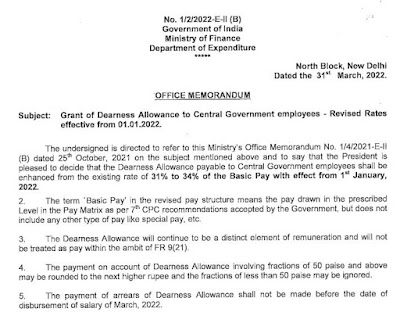
DA Jan 2022 - Grant of Dearness Allowance to Central Government employees - Revised Rates effective from 01.01.2022

 3% DA Hike - Revised Rates effective from 01.01.2022: DoE OM dated 31.03.2022 No. 1/2/2022-E-II (B) Government of India Ministry of Finance...