Showing posts with label Government Employees News. Show all posts

Sunday, 6 September 2015

Government Announces One Rank One Pension Scheme for Ex-Servicemen

Government Announces One Rank One Pension Scheme for Ex-Servicemen 

The Government has announced the One Rank One Pension scheme for the Ex-Servicemen. This was announced by the Defence Minister Shri Manohar Parrikar here today. The following is the statement of the Defence Minister:

“Government of India respects its Defence Forces and Ex-Servicemen for their valour, patriotism and sacrifices. The Government is proud of their devotion to duty and bravery. Our forces, besides vigilantly and gallantly defending the nation, have displayed exemplary standards of courage and bravery in natural calamities, law and order situations and other difficult circumstances.

The issue of “One Rank One Pension” (OROP) has been pending for nearly four decades. It is a matter of deep anguish that the various governments remained ambivalent on the issue of OROP. In February 2014, the then Government stated that OROP would be implemented in 2014-15, but did not specify what OROP would be, how it would be implemented or how much it would cost. An estimated Rs. 500 crore provided for OROP in the budget presented in February 2014 by the then government was not based on any thorough analysis. It is pertinent to mention that the then Minister of State for Defence in 2009 had, in reply to a question, informed Parliament that there are administrative, technical and financial difficulties in implementing OROP. It is for these reasons that the present government took some time to fulfil its promise.

Prime Minister Shri Narendra Modi has, on various occasions, reiterated the Government’s commitment to implement OROP for Ex-Servicemen under military pension. As stated above, the previous government has estimated that OROP would be implemented with a budget provision of a mere Rs. 500 crore. The reality, however, is that to implement OROP, the estimated cost to the exchequer would be Rs. 8,000 to 10,000 crore at present, and will increase further in future.

The Government held extensive consultations with experts and Ex-Servicemen. The main argument for OROP is that the Defence personnel retire early and thus are not able to get the benefits of serving till normal retirement age. Despite the huge fiscal burden, given its commitment to the welfare of Ex-Servicemen, the Government has taken a decision to implement the OROP.

In simple terms, OROP implies that uniform pension be paid to the Armed Forces personnel retiring in the same rank with the same length of service, regardless of their date of retirement. Future enhancements in the rates of pension would be automatically passed on to the past pensioners. This implies bridging the gap between the rate of pension of current and past pensioners at periodic intervals.

Under this definition, it has been decided that the gap between rate of pension of current pensioners and past pensioners will be bridged every 5 years.

Under the OROP Scheme:
The benefit will be given with effect from 1st July, 2014. The present government assumed office on 26th May, 2014 and therefore, it has been decided to make the scheme effective from a date immediately after.
Arrears will be paid in four half-yearly instalments. All widows, including war widows, will be paid arrears in one instalment.

To begin with, OROP would be fixed on the basis of calendar year 2013.

Pension will be re-fixed for all pensioners retiring in the same rank and with the same length of service as the average of minimum and maximum pension in 2013. Those drawing pensions above the average will be protected.

Personnel who voluntarily retire will not be covered under the OROP scheme.

In future, the pension would be re-fixed every 5 years.

It is estimated that the expenditure on arrears alone would be ten to twelve thousand crores of rupees. Apart from the fact that the previous government had provided for only Rs. 500 crore in the budget, it is noteworthy that the Koshiyari Committee had accepted the estimate of Rs. 235 crore as additional financial burden to implement OROP. The present government has accepted OROP in true spirit without being constrained by these inaccurate estimates.

OROP is a complex issue. A thorough examination of interests of retirees of different periods and different ranks is needed. The inter-service issues of the three Forces also require consideration. This is not an administrative matter alone. Therefore, it has also been decided that a One Member Judicial Committee would be constituted which will give its report in six months.

Prime Minister Shri Modi has fulfilled his commitment and approved OROP for Armed Forces personnel. Ministry of Defence will soon issue detailed Government Order.”


PIB

Saturday, 5 September 2015

Trade unions eye Rs 15,000 per month minimum wage as national baseline

Trade unions eye Rs 15,000 per month minimum wage as national baseline
By Subodh Varma, TNN

One of the key issues on which the negotiations between the government and the 10 central trade unions that had called for a general strike on Wednesday broke down was that of minimum wages. A labour ministry document circulated amongst the trade unions days before the strike, argued that by current norms, prices and calorific needs, Rs.6330 per month is the monthly wage adequate for an unskilled worker with a wife and two small children.

The trade unions and various other federations that represent 15 crore workers had demanded Rs.15,000 per month minimum wage as a national level floor wage. Striking a generous posture, the government modestly increased its proposal to Rs.7098 per month.

What the government had proposed was less than half of what was demanded. This was one of the contributory factors to the breakdown of negotiations. Other demands of the workers included social security coverage, non-interference with existing labour laws, etc.

How did the government calculate their proposal? A look at the fine print shows a slew of gross under-estimations and the use of an archaic formula first spelled out way back in 1957. Some of the food items' prices are far from reality. For instance dal is costed at Rs.65 but only one of the various dals in the market - chana or gram dal - comes in this range. Arhar (tur) is Rs.135 per kg, urad is Rs.117.5, masur is Rs.95. All these current retail prices are from the consumer affairs ministry's price monitoring data spanning 81 cities and towns.

Mutton is priced at a bizarre Rs.80 per kg, although it doesn't really matter because only 50 g is allowed. This is convertible to 250 grams of vegetables which are priced at an imaginary Rs.16 per kg. In the real world mutton is selling at anywhere between Rs.300 to Rs.400 per kg. And rarely if any vegetable sells at Rs.16 per kg.


 But the real rub comes in the non-food items. Just Rs.390 is supposed to be spent on rent every month. And, fuel for cooking and utilities like electricity etc. are all supposed to be covered under a meagre Rs.780.

All education, medical expenses, marriages, care of elderly, recreation etc. is lumped together and costed at 25 percent of the food expenditure. This practice started after the Supreme Court in a landmark judgement in 1991 directed as much saying that if such a minimum wage cannot be guaranteed then the managements have no right to run their business. But even this works out to a mere Rs.980 per month.

Costs of education and healthcare have risen tremendously in the past several years and even one major episode of sickness in the family would be devastating. The government's wage calculation seems to be blissfully unaware of this.

Recent government data shows that real wages, that is, after adjusting for inflation are dipping while the share of wages to profits is also dipping in the organized sector. In the unorganized sector which employs over 90 percent of India's workforce, wages are abysmally low and conditions of work onerous. Small wonder then that the trade unions were unwilling to accept the government's proposals.


Source : The Economic Times

Thursday, 3 September 2015

Out of 12 Central Trade Unions, Seven Unions went on strike – PIB Report

Out of 12 Central Trade Unions, Seven Unions went on strike – PIB Report

Press Information Bureau
Government of India
Ministry of Labour & Employment
02-September-2015 19:09 IST

Normal Life not Affected by Labour Unions’ Strike
Government Committed to Ensure Welfare of Workers

The impact of the strike call given by some of the Central Trade Unions has not been felt much in the most parts of the country as per information received from all over the country.

The situation remained, by and large, normal and peaceful across the country. Most of the employees attended their offices. Trains, buses, auto rickshaws, lorries plied as usual. There has been minimal effect in banking, coal, major ports & defence production units. The essential services functioned more or less normally.

The Inter-Ministerial Committee constituted by the Prime Minister had held several rounds of meetings with the representatives of Central Trade Unions to discuss their demands. The Government is positive on many of their demands without any pressure and expressed its commitment to ensure the welfare of workers.

Out of 12 Central Trade Unions, two Unions did not join the strike, three Unions remained neutral and seven Unions went on strike. It indicates that the workers want to settle their demands through the dialogue and discussion.

The workers are in agreement with the Government and are looking forward to positive steps taken by the Government on nine of their twelve demands which will be met as per their aspirations.

Source: PIB News

Friday, 24 July 2015

Jammu and Kashmir government women employees can now get 2-years child care leave

Jammu and Kashmir government women employees can now get 2-years child care leave

Srinagar: In a major welfare measure for women employees in Jammu and Kashmir, the state government today approved Child Care leave for them for a period of two years to look after their children.

The Government issued a notification allowing the Child Care leave for its women employees. As per the new provision, a women employee can avail a maximum period of 730 days of child care leave during her entire service for taking care of her two eldest children, an official spokesman said.

He said the leave can be taken to look after the children’s education, illness and other similar requirements. The spokesman said after approval by Chief Minister Mufti Mohammad Sayeed, the Finance Department has issued the notification incorporating the child care leave in the Jammu and Kashmir Civil Services (Leave) Rules.

During the period of child care leave, a woman employee shall be paid leave salary equal to pay drawn immediately before proceeding on leave and the child care leave can be combined with any other kind of leave, the spokesman said.

However, the leave shall not be granted for more than three spells in a calendar year, he said. The spokesman said though child care leave can be claimed only after completion of probation period by the employee, yet as a humanitarian gesture, some minimum child care leave can be allowed to a probationer in certain extreme circumstances.

The present PDP-BJP coalition Government in its first budget had announced that the child care leave shall be introduced in the State Leave Rules so that the difficulties faced by working mothers is resolved and women employees get this benefit at par with Central Government employees.

PTI

Saturday, 4 July 2015

Revised Bio-data / Curriculum Vitae (CV) proforma for submission by the candidate for appointment by deputation — issue of instructions — regarding

G.I., Dept. of Per. & Trg., O.M.F.No.AB.14017/28/2014-Estt.(RR), dated 2.7.2015
Subject: Revised Bio-data / Curriculum Vitae (CV) proforma for submission by the candidate for appointment by deputation — issue of instructions — regarding.

The consolidated instructions on the procedure to be followed in cases where appointment is to be made by transfer on deputation / transfer basis (now termed as deputation / absorption) issued by this Department vide OM No. AB-14017/71/89 — Estt. (RR) dated 3.10.89. In terms of para 4.8 of the instruction, while calling for application for appointment on deputation/absorption basis, Ministries/ Departments are required to call for Bio-data / Curriculum Vitae (CV) of the candidates in the proforma at Annexure A of the OM dated 3.10.89.

2. The revised Bio-data / Curriculum Vitae (CV) proforma was issued by this Department vide OM No. AB-14017/10/2000 — Estt. (RR) dated 29.8.2005. The proforma has been reviewed by UPSC, keeping in view the changes took place due to implementation of 6th Pay Commission recommendation and with the objective to reflect the complete profile of the candidate. The revised proforma suggested by the Commission is at Annexure-I.

3. The modified Bio-data / Curriculum Vitae (CV) proforma is enclosed with the request that this modified proforma may be utilized while calling for applications for appointment on deputation / absorption basis. The administrative Ministries / Departments are also advised to pay attention towards the points indicated in Annexure-II at the time of inviting application and preparation of the deputation proposal before sending the same for the consideration of the Commission.

4. It is requested that these instructions may be circulated to all the subordinate formations of the Ministries / Departments.

Click to view the order

Authority : www.persmin.gov.in

Friday, 14 November 2014

Empanelment of Private hospitals (including dental clinics and eye centres) and diagnostic centres under CGHS Delhi & NCR.

CGHS Delhi, NCR: Additional List of Private hospitals (including dental clinics and eye centres) and diagnostic centres

Addition to the list of the hospitals (including dental clinics & eye centres) and diagnostic laboratories already empanelled, the hospitals (including dental clinics & eye centres) and diagnostic laboratories: CGHS Order dated 12 Nov, 2014


No: S.11045/36/2012-CGHS (HEC)
Government of India
Directorate General of Central Government Health Scheme
Department of Health & Family Welfare


Nirman Bhawan, New Delhi.
Dated the 12th November, 2014
OFFICE ORDER

Subject: Empanelment of Private hospitals (including dental clinics and eye centres) and diagnostic centres under CGHS Delhi & NCR.

In continuation of this Directorate’s Office Memorandum of even no. dated 01.10.2014 on the above mentioned subject, the undersigned is directed to convey that in addition to the list of the hospitals (including dental clinics & eye centres) and diagnostic laboratories already empanelled, the hospitals (including dental clinics & eye centres) and diagnostic laboratories as per the list attached have also been empanelled under CGHS in Delhi & NCR. The newly empanelled hospitals (including dental clinics & eye centres) and diagnostic laboratories may be treated as included in the existing list with same terms and conditions as have been indicated in the Office Memorandum dated 01.10.2014. I

Encl: As above
sd/-
[Dr. (Mrs) Sharda Verma]
Director (CGHS)

Read full memorandum : http://msotransparent.nic.in/writereaddata/cghsdata/linkimages/0319680416.pdf

Comparison of New Pension Scheme (National Pension Scheme) and Central Government Pension


Comparison of New Pension Scheme (National Pension Scheme) and Central Government Pension

Comparison of New Pension Scheme (National Pension Scheme) and Central Government Pension

The Central Government employees who have joined after 1/1/2004 and are put under National Pension Scheme(NPS)  have been demanding abolition of NPS and have been persuading the Central Government to make the government pension scheme applicable to them.

This only exhibits their ignorance of the fact that the New Pension Scheme is highly lucrative and make the government employees who joined after 1/1/2004 far richer than the government employees who enjoy government pension scheme.  By doing so they are in the process of ruining the great fortunes that lies in store under New Pension Scheme. Let me compare both the scheme:

Benefits under NPS

Let me take a case of Upper Division Clerk(UDC) who joins government service in 2014 at the age of 25  and renders 35 years  of service till attaining 60 years of age. He / She gets 3% annual increment every year and gets one promotion every 10 year under M.A.C.P.  Although he / she is likely to get 14 to 20% increase in D.A every year as per Consumer Price Index I just take 12%(assuming 6 + 6%) 2 times D.A in a year

YEAR D.A. assumed @12% Per
annum
PAY + GRADEPAY with 3% annual increment D.A TOTAL TotalMonthly Subscription
(employee and Govt)
AnnualSubscription Annual Appreciationof Investments @8.7% Only TOTALPENSION WEALTH
2014
107%
9910
10604
20514
4102
49224
2320
51,544
2015
119%
10210
12150
22360
4471
53652
7012
1,12,208
2016
131%
10520
13781
24301
4860
58320
 12511
 183039
2017
143%
10840
15501
26341
5268
63216
 18903
 265158
2018
155%
11170
17314
28484
5696
68352
 26290
 359800
2019
167%
11510
19222
30732
6146
73752
 34779
 468331
2020
179%
11860
21229
33089
6618
79416
 44487
 592234
2021
191%
12220
23340
35560
7112
85344
 55546
 733124
2022
203%
12590
25558
38148
7630
91560
 68097
 892781
2023
215%
12970
27886
40856
8172
98064
 82293
 1073138
2024*
227%
14130
32075
46205
9240
110880
 98589
 1282607
2025
239%
14560
34798
49358
9872
118464
 117170
 1518241
2026
251%
15000
37650
52650
10530
126360
 138041
 1782642
2027
263%
15450
40634
56084
11216
134592
 161433
 2078667
2028
275%
15920
43780
59700
11940
143280
 187596
 2409543
2029
287%
16400
47068
63468
12694
152328
 216809
 2778680
2030
299%
16900
50531
67431
13486
161832
 249371
 3189883
2031
311%
17410
54145
71555
14312
171744
 285614
 3647241
2032
323%
17940
57946
75886
15178
182136
 325893
 4155270
2033
335%
18480
61908
80388
16078
192936
 370601
 4718807
2034*
347%
21060
73078
94138
18828
225936
 421184
 5365927
2035
359%
21700
77903
99603
19920
239040
 478101
 6083068
2036
371%
22360
82956
105316
21064
252768
 541139
 6876975
2037
383%
23030
88205
111235
22248
266976
 610878
 7754829
2038
395%
23730
93734
117464
23492
281904
 687954
 8724687
2039
407%
24450
99512
123962
24792
297504
 773068
 9795259
2040
419%
25190
105546
130736
26148
313776
 866975
 10976010
2041
431%
25950
111845
137795
27560
330720
 970498
 12277228
2042
443%
26730
118414
145144
29028
348336
 1084535
 13710099
2043
455%
27540
125307
152847
30570
366840
 1210066
 15287005
2044*
467%
29640
138419
168059
33612
403344
 1348977
 17039326
2045
479%
30530
146239
176769
35354
424248
 1501283
 18940857
2046
491%
31450
154420
185870
37174
446088
 1668876
 21055821
2047
503%
32400
162972
195372
39074
468888
 1853953
 23378662
2048
515%
33380
171907
205287
41058
492696
 2057162
 25928520
2049
527%
34390
181235
215625
43126
517512
 2280169

 28726201

* MACP / Promotion Years
(A) Therefore, the total pension wealth of a government servant who joined in 2014 and retiring under New Pension Scheme shall at the time of his retirement be Rs. 2,87,26,201/-

(B) 60% of the lump-sum pension wealth which he / she will be  getting on retirement:
Rs.1,72,35.720

(C) 40%   invested in an annuity scheme  which he / she can receive before 70 years:
Rs.1,14,90,481

(D) Earned Leave Encashment:  Rs. 215625 x 10 months        : Rs.   21,56,250

TOTAL of (A) (B) (C) and (D) will be            Rs. 3,08,82,451

Death Gratuity:

Although not entitled for retirement gratuity, but eligible for Death Gratuity  If died during the service

Monthly Pension:

At the assumed Interest at the rate of 8.7% per annum on  the other 40%  of pension wealth of Rs.1,14,90,481  invested in annuity shall fetch
monthly pension of  at least  :            Rs.83,306/ –

Not only this, before he / she attains the age of 70 he / she can withdraw the remaining  40% of his pension wealth of Rs. 1,14,90,481/- which if invested in Fixed Deposit of a nationalised bank can fetch interest and take care of not only of his wife and children but his descendants also for generations to come.
This is just a tip of the iceberg. If we consider the other  4 pay commission benefits that materialize on 1/1/2016, 1/1/2026, 1/1/2036 and 1/1/2046 which a NPS pensioner who joins as UDC shall be getting  before his retirement in 2049,his total pension wealth will be undoubtedly double the above amount which comes to more than Rs.5 crores. While a person who joins as U.D.C. gets this much, one will be rocked out of stupor to know what a Group A officer who renders 35 years of service may get – undoubtedly his total pensionwealth will be more than Rs.10 crores.

Benefits under Central Government Pension Scheme

Now let us see what will be the retirement benefits of the above person if he / she is put in government pension scheme:

1.Gratuity for 16.5 months :

Rs.2,15,625 x 16.5 months = Rs.35,57,812/- Restricted to  Rs.10,00,000

2. Earned Leave Encashment:

Rs. 215625 x 10 months :     Rs.21,56,250

3. Pension Commutation:

Rs.17195 x 40% = Rs.6878 x 12 x  8.194 years   Rs  6,76,300

Total Benefits under Central Government Pension Scheme:         Rs.38,32,550

4. GPF Balance:

As it is a general tendency of the government servants to withdraw from GPF frequently, there will be very little left at the time of retirement

5. Monthly pension

i) Rs.34390 / 2    =  Rs.17195 (basic pension being 50% of pay and grade pay Less 40% of basic pension towards commutation (Rs 6878) which will be restored after 15 years

Balance basic pension       is Rs. 10317

ii) DA @ 527% of basic pension of Rs.17195  = Rs. 90617 (subject to increase in DA every 6 months based on consumer price index)

Total pension                        is Rs.1,00,934 per month.

After the death of government servant  say after 67 years, spouse can take only 60% of the basic pension i.e.Rs.17195 x 60% = Rs.10317 plus D.A.at the prevailing rates. After spouse’s death children are unlikely to draw the pension as they would have already crossed the age limit.  Thus, unlike the dependents of NPS pensioners, there will be nothing left for financial security  of the dependents of the government pensioners .
Thus it is unwise on the part of government servants who have joined after 1/1/2004 to demand for abolition of NPS scheme and grant of government pension.

Mr.M.Dorai
Deputy Director
ESIC Model Hospital,
Bangalore (Ministry of Labour, Government of India) is the author of this Article.

Source: http://www.gconnect.in

Flash News

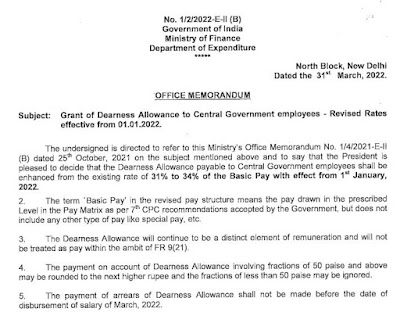
DA Jan 2022 - Grant of Dearness Allowance to Central Government employees - Revised Rates effective from 01.01.2022

 3% DA Hike - Revised Rates effective from 01.01.2022: DoE OM dated 31.03.2022 No. 1/2/2022-E-II (B) Government of India Ministry of Finance...