Showing posts with label 7th Pay Commission Report. Show all posts

Tuesday, 31 July 2018

7th Pay Commission Report, Burden On Finance/Exchequer, Productivity Linked Pay Hike And Any Alternative Of Future Pay Commission


7th Pay Commission Report, Burden On Finance/Exchequer, Productivity Linked Pay Hike And Any Alternative Of Future Pay Commission

GOVERNMENT OF INDIA
MINISTRY OF FINANCE
LOK SABHA

UNSTARRED QUESTION NO: 1652
ANSWERED ON: 27.07.2018

Pay Commission Reports
RAJENDRA AGRAWAL
Will the Minister of FINANCE be pleased to state:-

(a) whether the reports of successive Pay Commissions have been increasing the burden on Government finances/exchequer in partially accepting their recommendations for increase in wages and if so, the details thereof;

(b) whether the last Pay Commission has suggested productivity linked pay hike to the deserving employees to eliminate below average or mediocre performance and if so, the details thereof;

(c) whether such periodic hikes in wages resulting from Pay Commission recommendations trigger similar demands from the State Government/public utility employees, imposing burden on already strained State finances and if so, the details thereof; and

(d) whether the Government is considering an alternative for increasing the salaries and allowances of Central Government employees and pensioners in future instead of forming Pay Commission and if so, the details thereof?

ANSWER

MINISTER OF STATE IN THE MINISTRY OF FINANCE (SHRI P. RADHAKRISHNAN)

(a) The financial impact of the recommendations of the Central Pay Commission, as accepted by the Government, is normally pronounced in the initial year and gradually it tapers off as the growth in the economy picks up and fiscal space is widened. While implementing the recommendations of the last Central Pay Commission, i.e., the Seventh Central Pay Commission, the Government staggered its implementation in two financial years. While the recommendations on pay and pension were implemented with effect from 01.01.2016, the recommendations in respect of allowances after an examination by a Committee have been implemented with effect from 01.07.2017. This has moderated the financial impact of the recommendations. Moreover, unlike the previous 6th Pay Commission, which entailed substantial impact on account of arrears, the impact in the year 2016-17 on account of element of arrears of revised pay and pension on the present occasion of the 7th Central Pay Commission pertained to only 2 months of the previous financial year of 2015-16.

(b) The Seventh Central Pay Commission in Para 5.1.46 of its Report proposed withholding of annual increment in the case of those employees who are not able to meet the benchmark either for Modified Assured Career Progression (MACP) or regular promotion within the first 20 years of their service.

(c) The service conditions of employees of State Governments fall within the exclusive domain of the respective State Governments who are federally independent of the Central Government. Therefore, the concerned State Governments have to independently take a view in the matter.

(d) No such proposal is under consideration of the Government.

Source: http://nfpe.blogspot.com/

Monday, 13 March 2017

Implementation of 7th Pay Commission Report


Implementation of 7th Pay Commission Report

The following steps have been taken to implement the recommendations of 7th Pay Commission Report in respect of Armed Forces personnel:
(i) Issue of Resolution dated 25th July 2016 by Ministry of Finance.
(ii) Issue of Resolution dated 5th September 2016 by Ministry of Defence.
(iii) Issue of orders dated 10th October, 2016 by Ministry of Defence for payment of ad-hoc arrears equal to 10% Basic Pay and Dearness Allowance.
The order for revision of pension to ex-servicemen pursuant to the recommendations of 7th Pay Commission Report was issued on 29th October, 2016. As per information available in respect of pre-2016 pensioners, 24 public sector banks have revised pension of 18,99,697 pensioners and have paid Rs.5883.27 crore (approx) on account of arrears of pension / family pension.

This information was given by Minister of State for Defence Dr. Subhash Bhamre in a written reply to Shri Arvind Sawant in Lok Sabha today.

PIB

Saturday, 7 January 2017

DA from January 2017 will be 4% or 5% - Dearness Allowance Estimation


DA from January 2017 will be 4% or 5% - Dearness Allowance Estimation

DA from January 2017 will be 4% or 5% based on Consumer Price Index (Industrial Workers) from January 2016 to December 2016 - Net increase in DA with effect from January 2017 is estimated to be 2% or 3%

All India Consumer Price Index (Industrial Workers) for the month of November 2016 has been released by Ministry of Labour few days back.

What do we need for estimating DA from January 2017 ?

After implementation of 7th Pay Commission report, same inflation index i.e Consumer Price Index (Industrial Workers) with base year 2001=100, which was used for 6th Pay Commission Pay, is adopted for determining Dearness Allowance of Central Government Employees and Pensioners.
The only difference in DA calculation as far as DA from January 2016 will be, will be taking the Average of CPI-IW recorded in 2015 in the place of Average of CPI-IW recorded in 2005 which was used in 6th CPC DA calculation

Dearness Allowance payable after implementation of 7th Pay Commission= (Avg of CPI-IW for the past 12 months - Average of CPI-IW recorded in 2015)*100/(Average of CPI-IW recorded in 2015)

In order to determine DA with effect from January 2017, based on the above formula we need Consumer Price Index for the months from January 2016 to December 2016

Now that Consumer Price Index for the months from January 2016 to November 2016 is available, we have made an attempt to estimate Dearness Allowance applicable to Central Government Employees and Pensioners with effect from 1st January 2016, by assuming the possible CPI (IW) for the month of December 2016.
MonthActual AICPI-IW
Jan-2016269
Feb-2016267
Mar-2016268
Apr-2016271
May-2016275
Jun-2016277
Jul-2016280
Aug-2016278
Sep-2016277
Oct-2016278
Nov-2016277
Dec-2016Yet to be released

Estimation of DA from 1st January 2017:

Scenario 1 : No increase in AICPI (IW) in December 2016

AICPI (IW) for November 2016 is 277. If AICPI (IW) for December 2016 remains the same as November 2016, there will be additional 1% increase in DA from January 2017 which would make overall DA as 5%.

DA with effect from 1st January 2017= [ (269+267+268+271+
275+277+280+278+
277+278+277+277)/12]-(261.4)
X100/261.4
= 5 %

Scenario 2: Decrease in AICPI (IW) in December 2016
Even if All India Consumer Price Index (Industrial Workers) decreases by 31 point and pegged at 246 in the month of December 2016, DA from January 2017 will be 4% . At the same time even for 1 point decrease in the index for December 2016 will result in lesser DA increase from January 2017 compared to Sceanrio 1 in which index is unaltered in Dec 2016.
DA with effect from 1st January 2017= [ (269+267+268+271+
275+277+280+278+
277+278+277+246)/12]-(261.4)
X100/261.4
= 4 %
DA with effect from 1st January 2017= [ (269+267+268+271+
275+277+280+278+
277+278+277+276)/12]-(261.4)
X100/261.4
= 4 %

Scenario 3 : Increase in AICPI (IW) in December 2016

It is very interesting to note here that, even for increase in consumer price index in the month of December up to 31 points, i.e Increase in AICPI (IW) for December 2016 to 308 points from 277 points in November 2016, DA from January 2017 will be 5% only.

DA with effect from 1st January 2017= [ (269+267+268+271+
275+277+280+278+277+
278+277+308)/12]-(261.4)
X100/261.4
= 5 %

The other scenario that increase of more than 31 points in AICPI (IW) in the month of December 2016 for making DA with effect from January 2017 more than 5% is most unlikely.

Hence, it is more logical to conclude that DA from January 2017 will be either 4% or 5%.

Tuesday, 4 October 2016

Who are entitled to 7th Pay Commission additional Bunching increment ?

Who are entitled to 7th Pay Commission Bunching Benefit as per Para 5.1.36 of Pay Commission report ?  The meaning of Stage defined now in the OM dated 07.09.2016

In Para 5.1.36 of its report, 7th Pay Commission had recommended that one additional increment will be given while fixing of every two stages of pre-revised basic pay (pay in pay band and Grade pay) or scale  in the same pay in the new pay matrix.  This recommendation has been accepted by Govt and an OM has been issued on 7th September 2016 to this effect.

Check the following link to read OM dated 7th September 2016 on Bunching benefits

The Govt has also defined now the meaning of "Stage" in the OM dated 7th September 2016.  Pay drawn by two Government servants in a given Pay Band and Grade pay or scale where the higher pay is at least 3% more than the lower pay shall constitute two stages.

The illustration provided in 7th Pay Commission report for the purpose of granting Bunching Increment was relating to Entry Pay only in the the new Pay Matrix viz., As per Illustration provided in the report Employees in GP 10,000 who are fitted in to minimum of Level 14 of New Pay Matrix will be eligible for one additional increment and would be fitted in to next cell of Level 14.

However, as per the OM dated 7th September 2016, which has clearly defined the meaning of Stage as far as 6th CPC pay is concerned, the bunching benefit will also be applicable to fixation of 7th CPC pay for all the indices of new pay matrix in addition to entry pay.

7th Pay Commission Pay Fixation:

As per Para 5.1.28 of 7th Pay Commission Report, pay fixation in the new pay structure will have to be made as follows

Step 1: Identify Basic Pay (Pay in the pay band plus Grade Pay) drawn by an employee as on the date of implementation. This figure is 'A'.
Step 2: Multiply 'A' with 2.57, round-off to the nearest rupee, and obtain result 'B'.
Step 3: The figure so arrived at, i.e., 'B' or the next higher figure closest to it in the Level assigned to his/her grade pay, will be the new pay in the new pay matrix. In case the value of 'B' is less than the starting pay of the Level, then the pay will be equal to the starting pay of that level

7th Pay Commission bunching Benefit:

In addition to above, 7th Pay Commission proposes bunching benefit in Para 5.1.36 whenever more than two stages are bunched together for fixation of pay in 7th CPC pay matrix, one additional increment equal to 3 percent may be given for every two stages bunched, and pay fixed in the subsequent cell in the pay matrix.
Further, Para 5.1.37 of the report provides an illustration for fixation of pay of two employees who are drawing pay of Rs.53,000 and Rs.54,590 in the GP 10000.

As per this illustration, after applying 7CPC multiplication factor of 2.57, both of these employees will have to be fixed in first cell of level 15 in the pay of Rs.1,44,200 as their revisesd pay are worked out to Rs.1,36,210 and Rs.1,40,296 respectively which are not more than the first cell of level 15 (Rs.1,44,200)
But to avoid bunching of these two stages of pay, the person drawing pay of Rs.54,590 will get fixed in second cell of level 15 in the pay of Rs.1,48,500, while the other who is drawing pay of Rs. 53,000 will have to be fixed in Rs.1,44,200.

Based on this illustration, a table containing Entry pay of Rs. 53,000 in GP 10000, subsequent stages for this pay (pay with increment of 3% for every year) and 7th Pay Commission pay fixation for the same has been prepared as below.

Applying same principles, we could find that next stage in entry pay in respect of Grade Pay 1800, 1900. 2000, PB-3-5400, 6600, 7600 and 8900 would be entitled to one additional increment as bunching benefit.

7th Pay Commission Pay with Bunching Benefit in respect of 6th CPC Pay in Pay band with GP of 10,000/- (Pay Band (Rs. 37400-67000)

6cpc Basic Pay7CPC pay fixationGP 10000
bp*2.577CPC pay fixation with bunching benefit
53000136210144200144200
54590140296144200148500
56230144511148500153000
57920148854153000157600
59660153326157600162300
61450157927162300167200
63300162681167200172200
65200167564172200177400
67160172601177400182700
69180177793182700188200
71260183138188200193800
73400188638193800199600
75610194318199600205600
77880200152205600211800
80220206165211800218200

7th Pay Commission Pay with Bunching Benefit in respect of 6th CPC Pay in Pay band with GP of Rs. 8900/- (Pay Band 4 - Rs. 37400 to 67000)

GP 8900
6cpc Basic pay6cpc*2.577cpc pay fixation7CPC pay fixation with bunching benefit
49100126187131100131100
50580129991131100135000
52100133897135000139100
53670137932139100143300
55290142095143300147600
56950146362147600152000
58660150756152000156600
60420155279156600161300
62240159957161300166100
64110164763166100171100
66040169723171100176200
68030174837176200181500
70080180106181500186900
72190185528186900192500
74360191105192500198300
76600196862198300204200
78900202773204200210300
81270208864210300216600

7th Pay Commission Pay with Bunching Benefit in respect of 6th CPC Pay in Pay band with GP of of Rs 7600/- (Pay Band 3 - Rs. 15600 - 39100)

GP 7600
6cpc Basic pay6cpc*2.577cpc pay fixation7CPC pay fixation with bunching benefit
29500758157880078800
30390781027880081200
31310804678120083600
32250828838360086100
33220853758610088700
34220879458870091400
35250905939140094100
36310933179410096900
37400961189690099800
385309902299800102800
39690102003102800105900
40890105087105900109100
42120108248109100112400
43390111512112400115800
44700114879115800119300
46050118349119300122900
47440121921122900126600
48870125596126600130400
50340129374130400134300
51860133280134300138300
53420137289138300142400
55030141427142400146700
56690145693146700151100
58400150088151100155600
60160154611155600160300
61970159263160300165100
63830164043165100170100
65750168978170100175200
67730174066175200180500
69770179309180500185900
71870184706185900191500
74030190257191500197200
76260195988197200203100
78550201874203100209200

7th Pay Commission Pay with Bunching Benefit in respect of 6th CPC Pay in Pay band with GP of Rs. 6600/- (Pay Band 3 - Rs. 15600 - 39100)

GP 6600
6cpc Basic pay6cpc*2.577cpc pay fixation7CPC pay fixation with bunching benefit
25350651506770067700
26120671286770069700
26910691596970071800
27720712407180074000
28560733997400076200
29420756097620078500
30310778977850080900
31220802358090083300
32160826518330085800
33130851448580088400
34130877148840091100
35160903619110093800
36220930859380096600
37310958879660099500
384309876599500102500
39590101746102500105600
40780104805105600108800
42010107966108800112100
43280111230112100115500
44580114571115500119000
45920118014119000122600
47300121561122600126300
48720125210126300130100
50190128988130100134000
51700132869134000138000
53260136878138000142100
54860140990142100146400
56510145231146400150800
58210149600150800155300
59960154097155300160000
61760158723160000164800
63620163503164800169700
65530168412169700174800
67500173475174800180000
69530178692180000185400
71620184063185400191000
73770189589191000196700
75990195294196700202600
78270201154202600208700

7th Pay Commission Pay with Bunching Benefit in respect of 6th CPC Pay in Pay band with GP of Rs. 5400/- (Pay Band 3 - Rs. 15600 - 39100)

GP 5400
6cpc Basic pay6cpc*2.577cpc pay fixation7CPC pay fixation with bunching benefit
21000539705610056100
21630555895610057800
22280572605780059500
22950589825950061300
23640607556130063100
24350625806310065000
25090644816500067000
25850664356700069000
26630684396900071100
27430704957110073200
28260726287320075400
29110748137540077700
29990770747770080000
30890793878000082400
31820817778240084900
32780842458490087400
33770867898740090000
34790894109000092700
35840921099270095500
36920948849550098400
380309773798400101400
39180100693101400104400
40360103725104400107500
41580106861107500110700
42830110073110700114000
44120113388114000117400
45450116807117400120900
46820120327120900124500
48230123951124500128200
49680127678128200132000
51180131533132000136000
52720135490136000140100
54310139577140100144300
55940143766144300148600
57620148083148600153100
59350152530153100157700
61140157130157700162400
62980161859162400167300
64870166716167300172300
66820171727172300177500

7th Pay Commission Pay with Bunching Benefit in respect of 6th CPC Pay in Pay band with GP of Rs. 2400/- (Pay Band 1 - Rs. 5200 - 20200)

GP 2400
6cpc Basic pay6cpc*2.577cpc pay fixation7CPC pay fixation with bunching benefit
9910254692550025500
10210262402630026300
10520270362710027100
10840278592790027900
11170287072960029600
11510295813050030500
11860304803050031400
12220314053230032300
12590323563330033300
12970333333430034300
13360343353530035300
13770353893640036400
14190364683750037500
14620375733860038600
15060387043980039800
15520398864100041000
15990410944220042200
16470423284350043500
16970436134480044800
17480449244610046100
18010462864750047500
18560476994890048900
19120491385040050400
19700506295190051900
20300521715350053500
20910537395510055100
21540553585680056800
22190570285850058500
22860587506030060300
23550605246210062100
24260623486400064000
24990642246590065900
25740661526790067900
26520681566990069900
27320702127200072000
28140723207420074200
28990745047640076400
29860767407870078700
30760790538110081100

7th Pay Commission Pay with Bunching Benefit in respect of 6th CPC Pay in Pay band with GP of Rs. 2000/- (Pay Band 1 - Rs. 5200 - 20200)

GP 2000
6cpc Basic pay6cpc*2.577cpc pay fixation7CPC pay fixation with bunching benefit
8460217422240022400
8720224102310023100
8990231042380023800
9260237982380024500
9540245182520025200
9830252632600026000
10130260342680026800
10440268312760027600
10760276532840028400
11090285012930029300
11430293753020030200
11780302753110031100
12140312003200032000
12510321513300033000
12890331273400034000
13280341303500035000
13680351583610036100
14100362373720037200
14530373423830038300
14970384733940039400
15420396294060040600
15890408374180041800
16370420714310043100
16870433564440044400
17380446674570045700
17910460294710047100
18450474174850048500
19010488565000050000
19590503465150051500
20180518635300053000
20790534305460054600
21420550495620056200
22070567205790057900
22740584425960059600
23430602156140061400
24140620406320063200
24870639166510065100
25620658436710067100
26390678226910069100

7th Pay Commission Pay with Bunching Benefit in respect of 6th CPC Pay in Pay band with GP of Rs. 1900/-

GP 1900
6cpc Basic pay6cpc*2.577cpc pay fixation7CPC pay fixation with bunching benefit
7730198661990019900
7970204832050020500
8210211002110021100
8460217422170022400
8720224102240023100
8990231042310023800
9260237982380024500
9540245182520025200
9830252632600026000
10130260342680026800
10440268312760027600
10760276532840028400
11090285012930029300
11430293753020030200
11780302753110031100
12140312003200032000
12510321513300033000
12890331273400034000
13280341303500035000
13680351583610036100
14100362373720037200
14530373423830038300
14970384733940039400
15420396294060040600
15890408374180041800
16370420714310043100
16870433564440044400
17380446674570045700
17910460294710047100
18450474174850048500
19010488565000050000
19590503465150051500
20180518635300053000
20790534305460054600
21420550495620056200
22070567205790057900
22740584425960059600
23430602156140061400
24140620406320063200

7th Pay Commission Pay with Bunching Benefit in respect of 6th CPC Pay in Pay band with GP of Rs. 1800/-

GP 1800
6cpc Basic pay6cpc*2.577cpc pay fixation7CPC pay fixation with bunching benefit
7000179901800018000
7210185301910019100
7430190951910019700
7660196861970020300
7890202772030020900
8130208942090021500
8380215372210022100
8640222052280022800
8900228732350023500
9170235672420024200
9450242872490024900
9740250322560025600
10040258032640026400
10350266002720027200
10670274222800028000
11000282702880028800
11330291182970029700
11670299923060030600
12030309173150031500
12400318683240032400
12780328453340033400
13170338473440034400
13570348753540035400
13980359293650036500
14400370083760037600
14840381393870038700
15290392953990039900
15750404784110041100
16230417114230042300
16720429704360043600
17230442814490044900
17750456184620046200
18290470054760047600
18840484194900049000
19410498845050050500
20000514005200052000
20600529425360053600
21220545355520055200
21860561805690056900

7th Pay Commission Report submitted - Download Report

Monday, 29 August 2016

7th Pay Commission – Aggrieved CG Employees pin hope in meeting between Committee of Secretaries and NJAC on Sept 1

7th Pay Commission – Aggrieved CG Employees pin hope in meeting – The leading employee union, National Joint Council of Action, headed by Shiv Gopal Mishra, has been invited in the meeting

Committee of Secretaries will hold their second meeting regarding the resolution of anomalies in the implementation of 7th Pay Commission. The meeting is scheduled on September 1.

The leading employee union, National Joint Council of Action, headed by Shiv Gopal Mishra, has been invited in the meeting. Aggrieved central government employees pin their hope in the outcome of the meeting. However, many among them have turned increasingly pessimistic, after reports floated earlier in the week stating that the government would not be increasing the minimum salary which has been fixed as Rs 18,000.

Shiv Gopal Mishra is expected to pitch the demands of the government employees before the high-powered committee. As of now, it is not clear whether government would pitch for a compromise with the union. However, the committee members are scheduled to hear the grievances of the employees as raised by the Unions.

One of the foremost demands raised by NJAC is that the government should use 3.68 fitment factor, instead of 2.57 in calculating the minimum salary, as well as the hike in allowances. The minimum salary of government employees as per 6th Pay Commission was Rs 7,000. This was increased by the Justice AK Mathur led panel to Rs 18,000, using the 2.57 fitment factor. If the 3.68 fitment factor would be applied, the entry-level pay would be hiked to Rs 26,000.

The 7th Pay Commission report prepared by Justice (Retd) AK Mathur had suggested the abolition of 51 out of the 194 existing allowances. A total of 27 allowances were subsumed.

Apart from the civilian employees, the armed forces have also marked their objection as the pay panel has refrained from incorporating their demand related to the creation of a uniform pay matrix.

The Defence Pay Matrix has only 24 pay levels, on the other hand, their bureaucratic counterparts enjoy 40 pay levels. Due to this, the armed forces personnel receive less opportunity of salary hikes. Their income gets stagnated at certain points, and even after retirement, they end up drawing Rs 20,000 less as pension, as compared to their civilian counterpart. Similarly, the demand to include Tier-II employees among beneficiaries in the technical allowance has not been paid heed.

The all-important meeting scheduled by the government comes a day before the pan-India strike called by several employee unions across organized sectors against the recommendations of the 7th pay commission.

Source: India.com

Friday, 26 August 2016

7th Pay Commission report: New panel set up, controversy hit IAS cadre under scanner

7th Pay Commission report: New panel set up, controversy hit IAS cadre under scanner

The 7th Pay Commission report is still grabbing headlines as the various permutations and combinations are still being bandied about and discussed threadbare and now it spans a big controversy that has to do with the near monopoly currently enjoyed by the IAS and how to end it, once and for all. Moving forward, as per the requirement of the report, the Narendra Modi government has set up a task force to review the cadre structure of all Organised Group A Central Services. This controversy has acquired increased urgency after the turf war between the officers of the Indian administrative and revenue services (IAS and IRS) recently reached a flashpoint after several IRS officers huddled together in Mumbai last month bringing matters to a head and this set alarm bells ringing at the highest echelons of the government. (PTI)

The 7th Pay Commission task force will be headed by Department of Personnel and Training additional secretary T Jacob and he will submit the report in 3 months. What he will have on his hands will deal with 4 basic factors that include 1) the ideal structure for posts of joint secretary and above, 2) percentage of reserves in organised Group A services, 3) ideal recruitment policy and 4) way forward in mitigating stagnation level. There are 49 Organised Group A Services ranging from the IFS, the Indian Postal Service, the five Accounts services and Indian Revenue Service (IT) to the 13 engineering services under the railways, CPWD, telecom, power, water and defence forces. (PTI)

This move comes courtesy 7th Pay Commission panel chairman, Justice (retired) A K Mathur calling for an end to the dominance of IAS officials. However, there were divergent views in the panel on ending the IAS superiority. Under the scanner especially was the joint secretary-and-above-level positions in the central staff. The 7th Pay Commission threw up the data: out of a total of 91 secretary level posts, 73 (80%) were occupied by IAS; out of 107 additional secretary level posts, 98 (92%) were with the IAS and of 391 joint secretary level posts, 249 (64%) were with the IAS. (PTI)

The 7th Pay Commission said IAS officers get two extra increments at promotion stages and it wanted to extend the same to the IPS and the Indian Forest Service. Other all-India services and central services (Group A) are not getting proper representation either. The IAS officers always had a two-year edge compared to other services. (PTI)

The solution that the 7th Pay Commission panel unveiled said that all personnel who have put in 17 years of service should be given equal opportunity for central staff. The panel was overwhelmed by the reactions of Group A Services, who demanded that the services should have equal opportunities to man the senior-most posts and it should not be the preserve of a small group. (PTI)

Wednesday, 29 June 2016

Unhappy with 7th Pay Commission hike, government employees to go on strike on July 11

Unhappy with 7th Pay Commission hike, government employees to go on strike on July 11

Govt Employees Strike

The 7th Pay Commission report that received a nod from the Cabinet chaired by Prime Minister Narendra Modi, will levy a pay hike of 23.55%.
Nearly 32 lakh central government employees have announced they will be going on a strike starting July 11, protesting against the 23.55% salary hike approved by the Cabinet on Wednesday, Zee Business channel news frash indicated.

Earlier in the day the Cabinet approved the recommendations put forth by the 7th Pay Commission panel, which will impact the salaries of one crore government employees.

Under the final approval, the basic salary of government employees will be hiked by 15% and the overall 7th Pay Commission pay hike stands at 23.55%. The central government employees, unhappy with the rate of pay hike had warned earlier that they will stage a strike on July 11, demanding a pay rise of atleast 30%.

At current levels, the salary hike is the lowest in 70 years, but a senior government official stated tight fiscal situation as the reason, stating that a provision to increase it to 18-20% was still open.

On July 4, M Krishnan, Secretary General of the Confederation of Central Government Employees and Workers issued a notice to the employees who are member and affiliated organisations regarding the pursuance of an indefinite strike from July 11 2016.

Krishnan had earlier said that if the government adopts delayed tactics or issue unilateral orders rejecting our demands, then confrontation shall become inevitable.

The Confederation of Central Government Employees & Workers on June 27, also put up a notice calling for an indefinite strike from July 11 and demonstrations and rallies in front of all important government offices and centres from July 4 to July 10.

Source: dnaindia

7th Pay Commission report: Government set to accept all recommendations; deny retro effect

7th Pay Commission report: Govt set to accept all recommendations; deny retro effect

pay-commission-award-7th-CPC

The Cabinet is likely to approve the 7th Pay Commission award in its entirety soon. Although the pay increases recommended by the commission will take effect from January 1, 2016, the Centre may choose to disburse the increased allowances only prospectively, official sources said.

If the revised allowances take effect only from, say, September this year, the savings to the exchequer would be to the tune of Rs 11,000 crore. Additionally, if the railway ministry decided to toe the Centre’s line, the national transporter will save around Rs 3,800 crore.

The salary revision, which will benefit about 50 lakh government employees and 58 lakh pensioners, is expected to boost consumption demand and help achieve higher economic growth in FY17.

Allowances are currently roughly half of the Centre’s salary bill; as per the pay panel’s award, the steepest increase — 63% — was in allowances, while the overall rise in pay, allowances and pensions recommended was 23.55%.

The Budget in February had provided `53,500 crore towards the pay panel-induced overall rise in pay, allowances and pension (PAP) and also to finance the one-rank-one-pension scheme for the armed forces. The commission, in its November 2015 report, had estimated the additional outgo in FY17 due to its award at `73,650 crore.

“A Committee of Secretaries (headed by the Cabinet secretary PK Sinha), has finalised its report on Pay Commission recommendations… We will soon make a draft Cabinet note based on the report,” finance secretary Ashok Lavasa said. Sources said the report will be considered by the Cabinet as early as Wednesday. The committee was set up in January.

While there is no official word on the exact provision made in budget for higher pay, Lavasa in a recent interview to FE said that its premature to say whether the provisions made in the budget are adequate or not to meet the pay panel requirements.


Tuesday, 28 June 2016

7th Pay Commission: Cabinet may clear higher increase tomorrow

7th Pay Commission: Cabinet may clear higher increase tomorrow

Latest-7th-Pay-Commission-News
New Delhi: The Cabinet tomorrow is likely to approve higher increase in basic pay than the nearly 15 per cent recommended by the 7th Pay Commission for over 1 crore government employees and pensioners.

The pay panel had in November last year recommended 14.27 per cent hike in basic pay at junior levels, the lowest in 70 years. The previous 6th Pay Commission had recommended a 20 per cent hike which the government doubled while implementing it in 2008.

After considering the increase proposed in allowances, the hike in remunerations comes to 23.55 per cent.

“Considering the tight fiscal position this year, the government may improve upon the Pay Commission recommendation for basic pay to 18 per cent or at best 20 per cent,” a senior official said.

The 7th Pay Commission report will be effective from January 1, he said, adding that the Cabinet will decide if the arrears for the six months have to be paid in one go or in installments.

A secretaries’ panel, headed Cabinet Secretary P K Sinha, has already vetted the 7th Pay Commission recommendation and its report is being translated into a note for Cabinet.

“It in most likelihood will come up before the Cabinet tomorrow,” the official said.

The government had in January set up the high-powered panel to process the recommendations of the 7th Pay Commission which will have bearing on the remuneration of nearly 50 lakh central government employees and 58 lakh pensioners.

The Commission had recommended 23.55 per cent overall hike in salaries, allowances and pension involving an additional burden of Rs 1.02 lakh crore or nearly 0.7 per cent of the GDP.

The entry level pay has been recommended to be raised to Rs 18,000 per month from current Rs 7,000 while the maximum pay, drawn by the Cabinet Secretary, has been fixed at Rs 2.5 lakh per month from current Rs 90,000.

The secretaries’ panel may have recommended raising minimum entry level pay at Rs 23,500 a month and maximum salary of Rs 3.25 lakh.

While the Budget for 2016-17 fiscal did not provide an explicit provision for implementation of the 7th Pay Commission, the government had said the once-in-a-decade pay hike for government employees has been built in as interim allocation for different ministries.

Around Rs 70,000 crore has been provisioned for it, the official said.

PTI

Monday, 27 June 2016

Secretaries committee submits report on 7th Pay Commission, govt to soon announce it

Secretaries committee submits report on 7th Pay Commission, govt to soon announce it

New Delhi:The government is likely to soon announce the implementation of 7th Pay Commission that would hike the salaries and allowances for over 1 crore government employees and pensioners by at least 23.5 per cent.

A Secretaries committee headed by Cabinet Secretary P K Sinha has submitted its report on the recommendations of the 7th Pay Commission which may be accepted, a financial ministry official said.

Based on the panel’s report, the Finance Ministry is preparing a Cabinet note and the issue may come up for approval by the Cabinet as early as June 29.

“Committee of Secretaries (CoS) has finalised its report on Pay Commission recommendations… We will soon (file) draft Cabinet note based on the report,” Finance Secretary Ashok Lavasa said here today.

The government had in January set up a high-powered panel headed by Cabinet Secretary to process the recommendations of the 7th Pay Commission which will have bearing on the remuneration of nearly 50 lakh central government employees and 58 lakh pensioners.

The Pay Commission had recommended 23.55 per cent overall hike in salaries, allowances and pension involving an additional burden of Rs 1.02 lakh crore or nearly 0.7 per cent of the GDP.

The panel recommended a 14.27 per cent increase in basic pay, the lowest in 70 years. The previous 6th Pay Commission had recommended a 20 per cent hike which the government doubled while implementing it in 2008.

The 23.55 per cent increase includes hike in allowances.

The entry level pay has been recommended to be raised to Rs 18,000 per month from current Rs 7,000 while the maximum pay, drawn by the Cabinet Secretary, has been fixed at Rs 2.5 lakh per month from current Rs 90,000.

Sources said the secretaries’ panel may have recommended higher pay increase, with minimum entry level pay at Rs 23,500 a month and maximum salary of Rs 3.25 lakh.

While the Budget for 2016-17 fiscal did not provide an explicit provision for implementation of the 7th Pay Commission, the government had said the once-in-a-decade pay hike for government employees has been built in as interim allocation for different ministries.

Around Rs 70,000 crore has been provisioned for it, officials said.

Lavasa said the 7th Pay Commission report will be effective from January 1.

PTI

Friday, 17 June 2016

7th Pay Commission Latest News – Increase in Basic Pay meagre but expected gains out of other compensation, a solace

7th Pay Commission Latest News – Increase in Basic Pay meagre but expected gains out of other compensation, a solace

Here are some areas of 7th Pay Commission report which are much beneficial to Central Government Employees. If Govt accepts these recommendations as such overall compensation package of Central Government Employees will be more attractive.

7th Pay Commission Latest News – Increase in Basic pay of 14.22% which is lowest increase out of any Pay Commission – However, certain Positive Aspects of Recommendations made in the 7th CPC Report mainly in the areas of Central Government Employees Welfare measures and Retirement Schemes may be solace to Central Government Employees

After a long wait of 10 years, Basic Pay of Central Government Employees has been proposed for an increase of 14.22%. In any standards, this quantum of increase can not be justified to be adequate. In fact this is the lowest increase out of any pay commission constituted in India so far. Let’s wait and see whether Empowered Committee formed by the Govt to process the present pay commission report make any positive changes to it.

Though 7th Pay Commission report failed to convince Central Government Employees in pay and allowances front, there are certain positive aspects in the recommendations which mainly relate to welfare measures, compensation and Retirement benefits. In the following paragraphs we would be discussing those which might surely improve overall Compensation package of central government employees in the long run.

7th Pay Commission’s decision to retain CPI-IW with base Year 2001=100 for determining Dear Allowance rate:
As demanded by various Central Government Employees Federations 7th CPC has proposed for retaining All India Consumer Price Index (Industrial Workers) with base year 2001=100. This means the allowance offered by govt to compensate inflation would continue to be calculated in the same as it is done presently, after deducting the quantum of DA (@ 125% for 126%) that is to be merged with pre-revised pay.
Dearness Allowance with effect from 1st January 2016 =[ (Avg of AICPI for the period from January 2015 to December 2015 – 115.76)*100/115.76] – 125 (or) 126

Interestingly, the earlier Pay Commission (6CPC) had proposed for adopting to new series of index (CPI-IW with base year 2001=100) which was later accepted by Govt. This measure needed adjustment in the calculation formula in respect of dearness allowance with effect from 1st January 2006 in the form of linking factor of 4.63 between base year 1982=100 and 2001=100
7th Pay Commission as well as Govt could justify in retaining CPI-IW with base year 2001=100 as new series of the index with base year 2015=100 is yet to be unveiled.

A new series of CPI-IW for DA Calculation means adjustments from old base year to new base year using linking factor and rounding-off which would surely put breaks on higher DA to Central Government Employees. So, 7th Pay Commission’s recommendations on retaining the present series of CPI-IW for DA purpose is welcome one.

Enhanced Central Government Employees General Insurance Scheme Coverage up to Rs. 50 lakh:

7th Pay Commission Recommended Rates of CGEGIS
Level of Employee                 
Monthly Deduction
(Rs.)
Insurance Amount
(Rs.)
10 and above
5000
50,00,000
6 to 9
2500
25,00,000
1 to 5
1500
15,00,000

Increase in Gratuity ceiling to Rs. 20 lakh with DA indexed Gratuity for the first time:

7th Pay Commission proposed that ceiling in respect of Gratuity will have to be increased from the existing Rs.10 lakh to Rs.20 lakh.

Moreover, for the first time DA indexed Gratuity viz., increase by 25 percent whenever DA rises by 50 percent has been introduced by the Commission. This measure would surely compensate the inflation factor as gratuity of Rs. 20 lakh received by a retiring employee in 2016 will never be equal to the same amount received by another in 2025.

Further, 7th Pay Commission has proposed that 20 times of monthly emoluments is to be paid as gratuity for employees who intend to retire after serving 10 year of service but before 20 years of service. Presently, 10 times of monthly emoluments is being paid for length of service between 10 years to 20 years.

Child Care Leave extended Single Male Central Government Employees also:

Child Care Leave (CCL) is granted to women employees presently for a maximum period of two years (i.e., 730 days) during their entire service for taking care of their minor children (up to eighteen years of age).
In addtion to women employees, 7th CPC has propsed that a male employee who is single, will also be entited to Child Care Leave.

House Building Advance (HBA) – Loan Ceiling increased to Rs. 25 lakh:

As far Housing loan extended by Govt to its employees is concerned the Commission proposes 34 times of Basic Pay or Rs.25 lakh OR anticipated price of house, whichever is least. This is more than three times higher than the present level.

Children Education Allowance and Hostel Subsidy increased by 1.5 times – whenever DA increases by 50%, these two reimbursements will be increased by 25%

CEA (Rs. pm) 1500×1.5 = 2250 Whenever DA increases by 50%, CEA shall increase by 25%
Hostel Subsidy (Rs. pm) 4500 x 1.5 = 6750 (ceiling) Whenever DA increases by 50%, Hostel
Subsidy shall increase by 25%

7th Pay Commission recommends Higher Grade Pay for certain Posts in Central Government Service considering the service conditions:

On the basis of nature of work and anomalies, 7th Pay Commission has recommended higher grade pay for certain cadres.
Post wise higher grade pay recommended list is given below:

Sl.No Ministry / Dept Name of the Post Present 6cpc Grade Pay (Rs.) New Grade Pay recommended by 7th Pay Commission (Rs)
1. Railways Dietitians 4200 4600
2. Railways Senior Dietitians 4600 4800
3. Railways Assistant Dietetic Officer 4800 5400 (in PB-2)
4. Andaman and Nicobar Administration Junior Radiographer 2000 2800
5. Railways Perfusionists 2400 4200
6. CGHS Dental Hygienists 2400 4200
7. Defence Russian Officers Translators 4600 5400
8. Defence Russian Senior Officers Translators 5400 6600
9. Defence Russian Editors 6600 7600
10. Central Sheep Breeding Farm Sheep Shearer cum Supervisor 1800 2400
11 Indian Postal Service Inspector 4200 4600
12. Indian Postal Service ASPOs 4800 5400
13.
National Archives of India
Assistant Archivists 4200 4600
14. National Archives of India Archivists 4600 4800
15. National Archives of India Scientific Officer 4600 4800, 5400(12 yrs)
16. All Ministries Officers in organised accounts cadres 4800 5400
17. Dr. RML Hospital Junior ECG Technician/Junior Cardiac Technician 2400 2800
18. Andaman and Nicobar Administration Junior Agriculture Assistant/Junior Soil    Conservation    Assistant 2400 2800
19. Andaman and Nicobar Administration Bus Conductors 1800 1900
20. Mines Senior Technical Assistants (STAs) 4200 4600
21.
JTA, Store Keeper, 2800 4200
22.
Assistant Store Keeper 1900 2400
23.
Electrical Supervisor 2800 4200
24
Laboratory Assistant 2400 2800
25
Machine Man, Junior Press Assistant 1800 1900
26 CBI Sub Inspector 4200 4600
27
Inspector 4600 4800
28 Railways Assistant Station Master (ASM) 2800 4200
29 Railways Commercial Clerks + Enquiry Cum Reservation Clerks (ECRCs)+Ticket Checking staff (TTEs and TCs)= Commercial and Ticketing Staff 19002400 20002800
30 Railways Accounts 4800 5400
31 Railways Chemical  and  Metallurgical  Assistants 4600 5400
32 Shipping Head Light Keeper 4200 4600
33 Shipping Navigational Assistant Gr.II 2800 4200
34 Shipping Navigational Assistant Gr.III 2400 2800
35 Shipping Light House Attendant 1800 1900
36 Statistics Director General, Central Statistics Office HAG+ L17
37 Textiles Technical Officers 4200 4600
38 Textiles Assistant Director Gr. II (Technical) 4600 4800
39 Town and CountryPlanning Organisation Planning Assistants 4200 4600
40 Central Water Commission (CWC) Senior Research Assistant 4200 4600
41 Central Water Commission (CWC) Assistant Research Officer 4600 4800
42 Central Ground Water Board (CGWB) Technical Operator (Drilling) 1800 1900
43 National Academies heads of National Academies
Apex Scale Rs.80000
44
Intelligence Bureau (IB)
ACIO-II 4600 4800
45 Intelligence Bureau (IB) ACIO-I 4200 4600

Thursday, 16 June 2016

Paramilitary chiefs meet Rajnath, discuss 7th Pay Commission report

 Paramilitary chiefs meet Rajnath, discuss 7th Pay Commission report

Archana-Ramasundaram
Archana Ramasundaram among the five paramilitary chiefs met Home Minister Rajnath Singh over 7th Pay Commission anamolies on Wednesday.

New Delhi: Concerned over increasing pay disparity between Paramilitary personnel and their defence and civilian counterparts, the five paramilitary chiefs on Wednesday met Union Home Minister Rajnath Singh and discussed issues related to “anamolies and shortcomings” in the Seventh Pay Commission report.

Five chiefs, including Krishna Chaudhary (ITBP), K Durga Prasad (CRPF), Archana Ramasundaram (SSB), Surender Singh (CISF) and O P Singh (NDRF), met the Singh at his office in South Block here and before discussion, they presented a memorandum to him.

The government in January had set up a 13-member Empowered Committee of Secretaries (CoS) headed by the Cabinet Secretary for processing the recommendations of the 7th Pay Commission, which has bearing on remuneration of 48 lakh central government employees and 52 lakh pensioners.

The Empowered Committee of Secretaries is functioning as a Screening Committee to process the recommendations with regard to all relevant factors of the Commission in an expeditious detailed and holistic fashion.

TST

Wednesday, 8 June 2016

7th Pay Commission – Empowered Committee Expected to Submit Report by This Week End

7th Pay Commission – Empowered Committee Expected to Submit Report by This Week End

Empowered Committee of Secretaries headed by Cabinet Secretary PK Sinha is all set to meet on coming Saturday (June 11) to give final shape to the changes on 7th Pay Commission recommendation.

7th Pay Commission – Empowered Committee Expected to Submit Report by This Week End – This will give the much needed boost to lakhs of government employees.

Empowered Committee of Secretaries headed by Cabinet Secretary PK Sinha is all set to meet on coming Saturday (June 11) to give final shape to the changes on 7th Pay Commission recommendation.

This will give the much needed boost to lakhs of government employees who are anxiously waiting for the implementation of the recommendation of the 7th Pay Commission.

The secretaries group is expected to meet on June 11 to finally wrap up its report on the remuneration of government employees.

Reliable Sources further state that it will take only a few days afterwards by the finance ministry to implement the higher pay package for central government employees.

Reliable sources add, the secretaries group has recommended between Rs 2,70,000 and Rs 21,000 hike for the higher and the lower level. This is twenty thousand more in the upper limit prescribed by the 7th CPC and three thousand more in the lower level set by the commission.

It may be recalled that the government had set up a high-powered panel headed by Cabinet Secretary P K Sinha to process the recommendations of the 7th Pay Commission which will have bearing on the remuneration of 47 lakh central government employees and 52 lakh pensioners.

Source: Zee News

Tuesday, 7 June 2016

7th Pay Commission News – Parity of Pension of Pre-2016 Pensioners with Post-2016 Pensioners

7th Pay Commission News – Parity of Pension of Pre-2016 Pensioners with Post-2016 Pensioners

RSCWS requests Govt to implement Seventh CPC regarding option I for fixation of Pension of Pre-2016 Pensioners

7th Pay Commission News – RSCWS representation to Govt pointing out the Parity of Pension of Pre-2016 Pensioners with Post-2016 Pensioners

Railway Senior Citizens Welfare Society has submitted a memorandum to the Cabinet Secretary with regard to parity in pension of pre-2016 pensioners with post-2016 pensioners

RAILWAY SENIOR CITIZENS WELFARE SOCIETY
(Estd. 1991, Regd. No. 1881 – Under Registration of Societies Act),
Head Office: 32, Phase- 6, Mohali, Chandigarh -160055
Website http://rscws.com Email: rscws1991@gmail.com
Identified & Recognised by DOP&PW GOI under Pensioners Portal
No.RSCWS/ CHD/Memo/2016-9
Dated: 06-06-2016
Cabinet Secretary, Government of India &
CHAIRMAN, EMPOWERED COMMITTEE OF SECRETARIES ON 7TH CPC,
Cabinet Secretariat, Rashtrapati Bhawan, New Delhi – 110 004

CC to: cabinet@nic.in

Dear Sir,

Subject:- Parity of Pension of Pre-2016 Pensioners with Post-2016 Pensioners – as per Recommendations of Seventh Pay Commission. Reference: Para 10.1.67 of Seventh Pay Commission Report

1. We are deeply anguished and shocked to learn from the Secretary Staff Side, JCM, that you had indicated in the meeting with the representatives of JCM Staff Side on 26-5-2016, that the Departments of Pension and Defence were of the view that the first option recommended by the 7th CPC to bring about the parity with the past pensioners is unfeasible and impracticable – due to the non-availability of the requisite records.

2. Denial of Parity to Past Pensioners is going to cause a major financial loss to the Past Pensioners and would naturally agitate them seriously. The issue, therefore, needs reconsideration especially in view of the following points:
i) Service Records are protected documents and cannot be destroyed without specific orders of the competent authority.

ii) The views of the DOP&PW & Defence about the non-availability of the requisite records are too vague, unfounded and unjustified;

iii) Even if the Service Records of some of the Pensioners were not available, the same can be reconstructed/recast as per prescribed procedures and as per directions of various courts issued from time to time in such cases.

iv) All the Past Pensioners cannot be made to suffer heavy financial loss due to some missing records – which can in any way be reconstructed as stated above.

v) 5th & 6th Pay Commissions had recommended for grant of Modified Parity to past Pensioners. The orders were implemented on the basis of service records.
 vi) Fifth CPC while evolving the norm of modified parity had mentioned in its Report that further improvements could be brought about by future Pay Commissions. It is after 20 years that 7th CPC taking a step in this direction recommended consideration of number of increments earned in that level while in service. The recommendation cannot be set aside on the plea of non-availability of record.

vii) Recommendations of the 7th CPC in Para 10.1.67 (option 1) for Parity of Pension of Past (Pre-2016) Pensioners were based on legal and Constitutional grounds and, as such, the same may please be implemented.

3. It is, therefore, requested that:
a) Recommendation of the Seventh CPC regarding option I for fixation of Pension of Pre-2016 Pensioners may please be implemented – keeping in view the above submissions.

b) Pay Matrix may please be modified so as to give equitable rise at all levels through same Index for fixation of Pay & Pension of Pre-2016 Pensioners.

c) Pension of Pre-2016 Pensioners who were senior and retired in higher Level of Posts may please be revised at par with the junior Post 2016 Pensioners who may get higher pension due to merger of Pay scales or having longer years of service in lower scale.
Yours truly,
(Harchandan Singh)
Secretary General,
RSCWS
Download RCWS Memorandum dated 06.06.2016

Saturday, 28 May 2016

7th Pay Commission report to be put up before Cabinet in June

Government is exploring options for meeting the additional payout over and above what was recommended by the 7th pay panel. It is is exploring options for meeting the additional payout over and above what was recommended by the 7th pay panel

7th Pay Commission report to be put up before Cabinet in June – 7th CPC implementation Notification to come at the earliest

Central government employees can expect to get some good news trickling in from government sources towards the end of June.

As per reports, the Finance Ministry is likely to table the 7th Pay Commission report to the Cabinet for approval in the last week of June.

The 7th pay panel headed by AK Mathur had recommended the minimum salary for central government employees at Rs 18,000 and maximum salary at Rs 2,50,000. As employees protested against the wage hike calling it the “lowest ever” raise, the government set up the Empowered Committee of Secretaries group to review the AK Mathur-panel’s recommendations.

The Empowered Committee of Secretaries on the Seventh Central Pay Commission is expected to soon wrap up its report on the remuneration of government employees.

Sources added that even the Prime Minister’s Office is keen on a favourable pay hike for the central government employees, so the panel is likely to recommend a minimum salary at Rs 24,000 and the highest salary at Rs 2,70,000.

Sources added that the government is exploring options for meeting the additional payout over and above what was recommended by the 7th pay panel. The payout could be substantial with salary hike and arrears adding up to a Rs 1.02 lakh crore burden on government finances.

Report add that once the report moves from the table of the empowered group of committee to the cabinet, there is no reason why the cabinet would inordinately delay it.

The Finance Ministry is keen that higher salaries reach government employees just before the festive season starting mid-August, as spurt in consumption during the festive period will have a domino effect on the economy.

Source: Zee News

Friday, 20 May 2016

7th Pay Commission Report – Areas which require Revision / Modification by Empowered Committee

7th Pay Commission having been tabled already, now it is left to Empowered Committee (appointed for examining the report of the Commission) to consider the demands of Staff Side.

7thPayCommissionReport-revision

7th Pay Commission Report – Areas which require Revision / Modification by Empowered Committee as per Staff Side demands – Minimum Pay, Fitment Formula, Annual Rate of Increment, Date of Effect, Ratio between Minimum Pay and Maximum Pay, Fixation of Pay on Promotion etc.

After 7th Pay Commission formed in February 2014, staff side JCM consisting of members who are also office bearers of various staff organisations had submitted detailed memorandum to the Commission  and suggested the quantum of Minimum Pay, Fitment Formula, Annual Rate of Increment, Date of Effect, Ratio between Minimum Pay and Maximum Pay, Fixation of Pay on Promotion etc., for taking in consideration by 7th Pay Commission in its recommendations.

However, many of the demands of the staff side were not favourbly considered by the 7th Pay Commission in its recommendations.

Now, Staff Side have been impressing upon Empowered Committee, the need for rectification / modification / revision of many of retrograde recommendations of 7th Pay Commission

We provide here a brief of the areas with respect to which Staff Side members will have to demand for revision / modification of the recommendations of 7th Pay Commission.

1. Minimum 7th Pay Commission Pay and Ratio between Minimum and Maximum Pay:

7th Pay Commission has proposed a basic pay of Rs. 18000 as minimum entry pay in Central Government Service (Pay of MTS). However, Staff Side JCM is of the view that as per approved methods such as Dr.Aykroyd Formula, minimum pay in Central Government Service should be Rs. 26,000.


2. Date of Effect and Fitment Formula:

Staff Side JCM had put forth before 7th Pay Commission that uniform fitment formula / multiplication factor of 3.7 to be applied while fixing the basic pay of existing employees.

With regard to Date of effect of 7th Pay Commission pay and allowances, members representing staff side submitted before 7th CPC that Central Government Employees are due for pay revision every ten years and that in order to rectify the delay in implementation of pay commission award in the past, the present pay commission award has to be given effect from 1st January 2014.

Contrary to Staff Side JCM’s suggestions, 7th Pay Commission has fixed the fitment formula / multiplication factor as 2.57. While mere merger of DA with existing pay in pay band and Grade pay would require a multiplication factor of 2.25, 7CPC proposed fitment formula / multiplication factor of 2.57 would result in increase in basic pay to an extent of 14.22% only.

Hence, convincing 7th CPC empowered committee for a higher multiplication factor / fitment formula would be the foremost concern of Staff Side JCM.

As far as date of effect of 7th Pay Commission award is concerned, the commission has not accepted the suggestion of Staff Side. It has observed that since the previous pay commission was given effect from 1st January 2006, the present pay commission award will have to be made effect only from 1st January 2016.


3. Annual Rate of Increment and Date of Increment:

Staff JCM in its memorandum before 7th Pay Commission suggested that since most of the PSUs including the banking industries provide the incremental rate at 5% and over a period of time it raised the salary level of the personnel, rate of  annual increment for Central Government Employees will have to be fixed at 5%.

Further, uniform date of increment prescribed by the 6th CPC resulted in many anomalies, Staff Side JCM submitted that two specific dates as increment dates, Viz. 1st January and 1st July will have to be introduced.  Those recruited/appointed/promoted during the period between 1st January and 30th June will have their increment date on 1st January and those recruited/appointed/promoted between 1st  July and 31st  December will have it on 1st  July next year.

Also, staff side required that those who retire on 30th June or 31st December are granted one increment on the last day of their service, since they serve the entire one year of service required for an increment as on the date of retirement

Recommendation of 7th Pay Commission on the rate of increment:

In spite of valid argument of staff side for recommending annual increment rate of 5%, 7th Pay Commission has not made revision in annual increment and Promotional increment which have been recommended at the rate of 3% of basic pay.

4. Scrapping of NPS:

Staff Side JCM is of the view that New Pension system (NPS) has to be scrapped and all the employees who have joined in Govt Servic on or after 01.01.2004, are to be brought to defined pension scheme.

However, 7th Pay Commission observed that the NPS will have to be continued; that Govt should frame necessary law / Policy for proper investment of NPS fund in Equity and that a strong grievance redressel will have to be formed to serve NPS employees.

5. Transport Allowance:

With regard to Transport Allowance, Staff Side JCM presented the demand that if at all Transport allowance is meant to defray transport charges then low paid employees ought to have been paid higher transport allowance then higher level officers as they only travel from long distances to reach office. Hence, it was suggested by Staff Side that uniform transport allowance be paid irrespective of level of the cadre

Pay Range X class cities other places
Up to Rs.75,000 Rs. 7500 plus DA Rs. 3750 plus DA

 However, 7th Pay Commission has not modified the structure of Transport allowance on the basis of pay level. The existing DA on Transport Allowance has been proposed to be merged. The new rates of Transport Allowance suggested are as follows:

Pay Level
Higher TPTA Cities
(Rs. pm)
Other Places
(Rs. pm)
9 and above 7200+DA 3600+DA
3 to 8
3600+DA 1800+DA
1 and 2
1350+DA 900+DA


6. MACP:

It has been demanded by Staff Side JCM that five hierarchical promotions to be granted under MACP. Presently only 3 financial upgradations either in the form of promotion or time bound financial upgradation to next grade pay are being ensured under MACP.

7th Pay Commission has not made any proposal for revising the number of upgradations under MACP which is three at present.

With regard to the benchmark for performance appraisal for MACP as well as for regular promotion, 7th Pay Commission has recommended that in the interest of improving performance level, the same has to be enhanced from ‘Good’ to ‘Very Good.’

7th Pay Commission has also noted that introduction of more stringent  criteria such as  clearing of departmental examinations or mandatory training before grant of MACP can also be considered by the government.

Withholding Annual Increments of Non-performers:

7th Pay Commission has proposed that employees who do not meet the laid down performance criterion should not be allowed to earn future annual increments.

The Commission has proposed for withholding of annual increments in the case of those employees who are not able to meet the benchmark either for MACP or a regular promotion within the first 20 years of their service.

7. House Building Advance:

Staff Side JCM had demanded for increasing the advance to 50 times of the Salary and fixing the rate of interest not more than 5%.

As per 7th Pay Commission’s recommendations, 34 times of Basic Pay OR Rs.25 lakh OR anticipated price of house, whichever is least can be availed as House Building Advance.

The requirement of minimum 10 years of continuous service to avail of HBA has been proposed to be reduced to 5 years.

If both spouses are government servants, 7CPC has proposed that HBA should be admissible to both separately. Existing employees who have already taken Home Loans from banks and other financial institutions would be allowed to migrate to this scheme, as recommended by 7CPC.

8. Children Education Allowance:

Suggestions of Staff Side:

Presently the allowance is admissible for two children, for studying in a recognised school up to XII standard. The maximum ceiling  is stipulated at Rs.18000/- since this allowance had been hiked by 50% because of the DA component in salary having been crossed 100% on 1.1.2014. It is suggested that doubling of this allowance and increasing the same by 50 % whenever the DA crosses over by 50%

Further, it has been suggested that the CEA scheme may be extended to cover children studying for Graduate/Post Graduate and Professional courses.

7th Pay Commission’s recommendations on Children Education Allowance:


CEA (Rs. pm) 1500×1.5 = 2250 Whenever DA increases by 50%, CEA shall increase by 25%
Hostel Subsidy (Rs. pm) 4500 x 1.5 = 6750 (ceiling) Whenever DA increases by 50%, Hostel
Subsidy shall increase by 25%

7th Pay Commission has not accepted the Staff Side’s demand that CEA to be applicable for children beyond class 12.

9. HRA:

House Rent Allowance suggested by Staff Side JCM

X classified cities 60%
Y classified towns 40%
Z classified/unclassified  places  20%

House Rent Allowance recommended by 7th Pay Commission
Population of
Cities/Towns
Class of
Cities/Towns
HRA rates as % of Basic Pay
(including MSP and NPA)
50 lakh and above
X
24
50–5 lakh
Y
16
Below 5 lakh
Z
8

HRA when DA crosses 50%
Population of
Cities/Towns
Class of
Cities/Towns
HRA rates as % of Basic Pay
(including MSP and NPA)
50 lakh and above
X
27
50–5 lakh
Y
18
Below 5 lakh
Z
9

HRA when crosses 100%
Population of
Cities/Towns
Class of
Cities/Towns
HRA rates as % of Basic Pay
(including MSP and NPA)
50 lakh and above
X
30
50–5 lakh
Y
20
Below 5 lakh
Z
10

10. LTC:

Staff Side JCM demanded the following as far as Leave Travel Concession applicable to Central Government Employees is concerned

1. Permission for air journey for all categories of employees to and from NE Region.

2. Permission for personnel posted in NE Region for a journey within NE Region.

3. To increase the periodicity of the LTC once in two years.

4. Explore the possibility of allowing an employer to undertake tour outside India once in a service career  in lieu of the LTC.

7th Pay Commission Report on LTC:

It could be found that suggestions of Staff Side JCM such as increasing the frequency of All India LTC, permission for air travel for all categories of employees in respect of NE Region etc., were not discussed in the report of 7th Pay Commission.

The proposal to split hometown LTC has been considered and it is recommended that splitting of hometown LTC should be allowed in case of employees posted in North East, Ladakh and Island territories of Andaman, Nicobar and Lakshadweep.

Also, it is obsered by 7th Pay Commission that LTC to foreign countries is not in the ambit of this Commission.


11. Gratuity:

Suggestions of Staff Side JCM:

Staff Side JCM suggested that in respect of gratuity payable to employees ceiling of 16.5 times and the quantum limit of Rs. 10 lakhs should also be removed. It was pointed out that in the banking industry there is no such ceiling of 16.5 months‟ salary but the retiring bank employees are getting at the rate of ½ a month salary for every year of service even over and above 33 years of service. Hence, in respect of Central Government Employees also for a service span exceeding 33 years, the gratuity should be higher and the above ceiling be withdrawn.

7th Pay Commission’s recommendations on Gratuity:

It has been recommended by 7th Pay Commission that ceiling of gratuity is to be raised from the existing Rs.10 lakh to Rs. 20 lakh from 01.01.2016. Further, as per Commission’s recommendations, Gratuity is to be partially indexed to Dearness Allowance. It is proposed that the ceiling on gratuity may increase by 25% whenever DA rises by 50 percent.

Via gconnect.in

Flash News

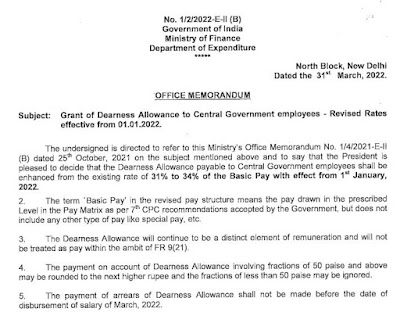
DA Jan 2022 - Grant of Dearness Allowance to Central Government employees - Revised Rates effective from 01.01.2022

 3% DA Hike - Revised Rates effective from 01.01.2022: DoE OM dated 31.03.2022 No. 1/2/2022-E-II (B) Government of India Ministry of Finance...