Showing posts with label Government employee. Show all posts

Tuesday, 16 July 2019

Strengthening of administration Periodic review of Central Government Employees under Fundamental Rule (FR) 56(j)/(l) and Rule 48 of CCS (pension) Rules, 1972

Strengthening of administration Periodic review of Central Government Employees under Fundamental Rule (FR) 56(j)/(l) and Rule 48 of CCS (pension) Rules, 1972

NFIR

No.25013/3/2019-Estt.A-IV
Government of India
Ministry of personnel, public Grievances & Pensions
Department of Personnel & Training
Establishment A-IV Desk

North Block, New Delhi
New Delhi, 20th June, 2019

Office MEMORANDUM

Subject: Strengthening of administration Periodic review of Central Government Employees under Fundamental Rule (FR) 56(j)/(l) and Rule 48 of CCS (pension) Rules, 1972

The undersigned is directed to refer to this Department’s O.M No.25013/1/2013-Estt.A dated 21.3.2014, OM No.25013/1/2013-Estt.A-IV dated 11.9.2015, 11.03.2016 and 10.8.2017 for periodic review of Central Government Employees for strengthening of administration under Fundamental Rule (FR) 56(j)/(l) and Rule 48 of CCS (pension) Rules, 1972.

The detailed guidelines on the above sunjeci are already in public domain at http://dopt.gov.in under Notifications -> OM & Orders -> Establishment -> Premature Retirement.

All Ministries / Departments are requested to undertake the periodic reviews in letter and spirit, including in public sector undertakings (PSUs) / Banks and Autonomous institutions, under their administrative control. Department of Public Enterprises will also compile and countercheck with all concerned Ministries / Departments.

The Ministries / Departments should ensure that the prescribed procedure like forming of opinion to retire a Government employee prematurely in public interest is strictly adhered to, and that the decision is not an arbitrary one, and is not based on collateral grounds as per the order of the Hon’ble Supreme Court in case of UOI & Col, J.N.Sinha [1571 SCR (1) 791].

All the Ministries / Departments shall furnish a report to Dop&T in the format given below by 15th day of each month starting from 15th July, 2019. Department of Public Enterprises are requested to also compile and countercheck the data with all concerned administrative Ministries / Departments in respect of PSUs before furnishing the report to DoP&T.

Number of employees to be reviewed under FR 56 (j) group-wise (A/B/C) – 1

Number of employees reviewed under FR 56 (j) group-wise (A/B/C) – 2

Number of employees reviewed and against whom FR 56 (j) invoked/ recommended group-wise (A/B/C) – 3

Number of employees retired prematurely under FR 56 (j) group-wise (A/B/C) – 4

(Surya Narayan Jha)
Under Secretary to the Government of India

Source: NFIR

Tuesday, 9 October 2018

Exemption from the routine exercise of transfer/ rotational transfer who who is a care-giver of dependent with Specified Disability: DoPT Order

Exemption from the routine exercise of transfer/ rotational transfer who who is a care-giver of dependent with Specified Disability: DoPT Order

F.No.42011/3/2014-Estt.(Res)
Government of India
Ministry of Personnel, Public Grievances & Pensions
Department of Personnel and Training
North Block, New Delhi
dated the 08th October, 2018
OFFICE MEMORANDUM
Subject: Exemption from the routine exercise of transfer/ rotational transfer.

Considering that transfer of a Government employee who serves as the main care giver of persons with disability would have a bearing on the systematic rehabilitation of persons with disabilities, the Government issued OM of even number dated June 6, 2014 to exempt such employee from routine exercise of transfer/rotational transfer, subject to administrative constraints.

2. The scope of disability initially had covered (i) blindness or low vision (ii) hearing impairment (iii) locomotor disability or cerebral Palsy (iv) leprosy cured (v) mental retardation (vi) mental illness and (vii) multiple disabilities, which subsequently, vide OMs of even number dated November 17, 2014 and January 5, 2016, was further extended to include 'Autism', 'Thalassemia' and 'Haemophilia'.

3. With the enactment of the Rights of Persons with Disabilities Act, 2016 on April 17, 2017, the following instructions are issued in supersession of the above-mentioned OMs of even number dated June 6, 2014, November 17, 2014 and January 5, 2016 with regard to the eligibility for seeking exemption from routine exercise of transfer/rotational transfer:
(i) A Government employee who is a care-giver of dependent daughter/son/parents/spouse/brother/sister with Specified Disability, as certified by the certifying authority as a Person with Benchmark Disability as defined under Section 2(r) of the Rights of Persons with Disabilities Act, 2016 may be exempted from the routine exercise of transfer/rotational transfer subject to the administrative constratints.

(ii) The term "Specified Disability" as defined in the Schedule to the Rights of Persons with Disabilities Act, 2016, covers (i) Locomotor disability including leprosy cured person, cerebral palsy, dwarfism, muscular dystrophy and Acid attack victims (ii) Blindness (iii) Low-vision (iv) Deaf (v) Hard of hearing (vi) Speech and language disabilities (vii) Intellectual disability including specific learning disabilities and autism spectrum disorder (viii) Mental illness (ix) Disability caused due to: (a) Neurological conditions such as Multiple sclerosis and Parkinson’s disease (b) Blood disorder- Haemophilia, Thalassemia and Sickle cell-disease and (x) Multiple disabilities (more than one of the above specified disabilities) including deaf blindness and any other category of disabilities as may be notified by the Central Government.

(iii) The term 'Specified Disability' as defined herein is applicable as grounds only for the purpose of seeking exemption from routine transfer/ rotational transfer by a Government employee, who is a care-giver of dependent daughter/son/parents/spouse/brother/sister as stated in Para 3(i) above.

4. All the Ministries/Departments are requested to bring these instructions to the notice of all concerned under their control.
Sd/-
(G.Srinivasan)
Director (Res)
Download Order

Friday, 6 July 2018

Interest bearing advances/ Seventh Central Pay commission recommendation on House Building Advance - enhancement in past cases


Interest bearing advances/ Seventh Central Pay commission recommendation on House Building Advance - enhancement in past cases

I-17011/11(4)/2016-H.III
Government of India
Ministry of Housing & Urban Affairs
Housing-III Section

Nirman Bhawan, New Delhi,
Dated : 29.06.2018

OFFICE MEMORANDUM

Subject: Interest bearing advances/ Seventh Central Pay commission recommendation on House Building Advance - enhancement in past cases regarding.

The undersigned is directed to invite attention to this Ministry's OM No. I- 17011/11(4)/2016-H.III dated 09.11.2017 on the above-mentioned subject and to say that it has been decided in consultation with Ministry of Finance to make the aforesaid orders applicable with effect from 1st January, 2016. Accordingly, it has been decided that an enhancement of House Building Advance, if applied for, would be granted to government employee for an amount equivalent to the difference between the previously sanctioned amount and the new eligible amount determined on the basis of basic pay as per 7th CPC, in past cases, where HBA was sanctioned on or after 01.01.2016 but before 09.11.2017 subject to complying following conditions :
a) The Government employee should not have drawn the entire amount of HBA sanctioned under earlier orders and/ or where construction is not completed/full cost towards acquisition of house/ flat is yet to be paid.

b) There will be no deviation from the approved plan of construction on the basis of which the original sanction of House Building Advance was accorded. The revised cost of the original plan can, however, be considered for determining the additional amount, subject to the prescribed maximum limits.

c) Supplementary Mortgage Deed, Personal Bond and Sureties will be drawn and executed at the expense of the loanee.

d) The actual entitlement will be restricted to the repaying capacity computed on the basis of the formula laid down in this Ministry’s OM No I-17011/11(4)/2016-H.III dated 09.11.2017. It should be ensured that the entire amount of advance with interest is recovered before retirement of the Government servant
e) Rate of interest:
The rate of interest will be at 8.50% from the financial year 2017-18 onwards. This will be reviewed every three years to be notified in consultation with Ministry of Finance. However, the new rate of interest would be chargeable only on collective amount that would remain outstanding on grant of enhancement of HBA, i.e., the unpaid portion of previously sanctioned HBA plus the enhancement so granted. Thus, the amount of HBA that has already been re-paid on old rates will not attract the fresh interest charges.
2. However, the existing limit of maximum admissible amount of Rs. 25 lakhs for the purpose of construction/ purchase of new house/ flat and Rs. 10 lakhs for expansion of existing house/ flat would remain unchanged. In other words, the sum total of previously, sanctioned House Building Advance and the enhancement granted under these orders cannot exceed the aforesaid limits. In any case, not more than one enhancement is admissible to a Government employee.

3. The applications for enhanced House Building Advance should be submitted within six months from the date of issue of this order.

4. Ministries/ Departments with branch offices in the far-flung areas are be advised to give wider publicity to these orders through modern communication means so that there is no occasion for any representation for extending the time limit of six months on the grounds of late receipt of these orders.

5. This issues in supersession of all the earlier orders on the subject.
S/d,
(Shailendra Vikram Singh)
Director (IFD)
Tel: 23062798
To,
All the Ministries and Departments of the Government of India as per standard distribution list.

Monday, 27 November 2017

Eligibility of Divorced Daughter of Armed Forces Personnel for Grant of Family Pension


Eligibility of Divorced Daughter of Armed Forces Personnel for Grant of Family Pension

As per Ministry of Defence (MoD) letter of September 2015, presently only those children who are dependent and meet other conditions of eligibility for family pension at the time of death of the Government servant or his/her spouse, whichever is later, are eligible for family pension. Accordingly, divorced daughters who fulfil other conditions are eligible for family pension if a decree of divorce had been issued by the competent court during the life time of at least one of the parents.

The Government has been receiving grievances from various quarters that the divorce proceedings are a long drawn procedure which take many years before attaining finality. There are many cases in which the divorce proceedings of a daughter of a Government employee/pensioner had been instituted in the competent court during the life time of one or both but none was alive by the time the decree of divorce was granted by the competent authority.

The matter has been examined and it has been decided vide Ministry of Defence letter dated 17 November 2017 to grant family pension to a divorced daughter of Armed Forces personnel in such cases where the divorce proceedings has been filed in a competent court during the life time of the employee/pensioner or his/her spouse but divorce took place after their death - provided that the claimant fulfils all other conditions for grant of family pension. In such cases, the family pension will commence from the date of divorce.

PIB

Tuesday, 2 May 2017

Fixation of pay in case of employees who seek transfer to a lower post under FR 15(a)

Fixation of pay in case of employees who seek transfer to a lower post under FR 15(a)

Dated: 01/05/2017
No. I/2/Part IV
The Secretary (E),
Railway Board,
New Delhi

Dear Sir,
Sub: Fixation of pay in case of employees who seek transfer to a lower post under FR 15(a) - clarification regarding.

Ref: DoP&T's OM No. 12/1/2016-Estt (Pay I) dated 31st March, 2017.

Kind attention of Railway Board is invited to DoP&T's OM dated 31st March, 2017 (quoted under reference) on the subject pertaining to fixation of pay in the case of employees who seek transfer to a lower post under FR 15(a), copy enclosed.

According to the DoP&T OM dated 21st October 2009, 05th November 2012 & 31st March 2017, the method of pay fixation in respect of Government employee transferred to a lower post on his/her request shall be as under:-

"The pay of the Government employee holding a post on regular basis will be fixed in the revised pay structure at the stage equal to the pay drawn by him/her in the higher level of post held regularly. If no such stage is available, the pay will be fixed at the stage next below in the lower level with respect to the pay drawn by him/her in the higher level of posts held regularly and the difference in the pay may be granted as personal pay to be absorbed in future increments."

From the OMs issued by the DoP&T pursuant to the implementation of the 6th CPC pay structure as well 7th CPC pay matrices w.e.f. 01/01/2006 and 01/01/2016 respectively, the pay fixation on joining lower post shall be with reference to pay drawn in higher level of post.

On Zonal Railways etc., pay fixation to those who joined in lower Grade Pay/Pay Matrix at their request is not being allowed inspite of DoP&T's OMs cited above, (i.e. ensuring pay protection),It is also noticed that Railway Board have not issued corresponding instructions on the basis of DoP&T OM dated 31st March 2017 till now.

NFIR, therefore, urges upon the Railway Board to kindly consider the above facts and issue clarification on the lines of the OMs of DoP&T for granting pay fixation in those cases of employees who joined on transfer to a lower post at their request.

DA/As above
Yours faithfully,
S/d,
(Dr. M. Raghavaiah)
General Secretary
Source : NFIR

Sunday, 15 January 2017

Child care leave to be applied for in advance: High Court


Child care leave to be applied for in advance: High Court

The Punjab and Haryana High Court has made it clear that child care leave has to be applied for in advance by a woman employee working with the Haryana Government.

Justice Rajiv Narain Raina of the High Court has also made it clear that it can be availed after the go-ahead by the authorities concerned. The permission for child care leave cannot be granted ex post facto (with retrospective force).

The development is significant as Haryana Government rules make it clear that child care leave is admissible to a woman government employee for a maximum period of two years or 730 days during her entire service for taking care of her surviving children.

It is permissible only for the first two children of the government employee. Their age has to be below 18 years for the mother to avail the leave.

The ruling by Justice Raina came on a petition by Shashi Bala against the state and other respondents. A government employee, she moved the High Court after the department concerned refused to grant ex post facto permission for child care leave.

Taking up her petition, Justice Raina asserted that by the very nature of things, child care leave has to be applied for in advance and due permission needs to be accorded. The right was valuable, because a woman employee would get full salary for the period of child care leave.

"It cannot be applied for to act retrospectively and therefore, there is nothing wrong in the department holding that ex post facto permission cannot be granted," Justice Raina asserted.

Before parting with the order, Justice Raina observed that the first request in the case in hand was made on April 6, 2011, for granting backdated child care leave with effect from November 30, 2010, to March 30, 2011. Dismissing the plea, Justice Raina added that there was no merit therein.

Haryana Government rules suggest that child care leave cannot be demanded as a matter of right and no one can, under any circumstances, proceed on child care leave without prior proper sanction by the competent authority.

Child care leave is also admissible during the probation period, provided the probation period is extended by the period of child care leave availed. Besides this, the leave may not be availed for a period of less than 30 days.

IN THE HIGH COURT OF PUNJAB AND HARYANA AT CHANDIGARH
CWP No.26951 of 2016
Date of decision:22.12.2016
Shashi Bala
… Petitioner
Versus
State of Haryana and others
..Respondents.

CORAM:- HON'BLE MR. JUSTICE RAJIV NARAIN RAINA
Present: Mr.Ravinder Malik (Ravi), Advocate for the petitioner.
RAJIV NARAIN RAINA, J.(Oral)

By the very nature of things, Child Care Leave has to be applied for in advance and due permission accorded. The right is valuable because female employee gets full salary for the period of Child Care Leave. Child Care Leave cannot be applied for to act retrospectively and therefore, there is nothing wrong in the Department holding that ex post facto permission cannot be granted. In this case first request was made on 6.4.2011 for granting backdated Child Care Leave w.e.f 30.11.2010 to 30.3.2011.
No merit.
Dismissed.
(RAJIV NARAIN RAINA)
JUDGE
22.12.2016
Meenu

Friday, 19 February 2016

Government announced the Leave Travel Concession (LTC) rules for easy settlement of the LTC claims

Government announced the Leave Travel Concession (LTC) rules for easy settlement of the LTC claims

The amended Office Memorandum No.31011/3/2015-Estt(A.IV) seek to ease the procedural difficulties faced by government employees while applying for and settling LTC claims.

Setting outer time-limits for various LTC procedures, the DoPT today said leave or sanction of LTC leave advance would take no more than five days each. This would be extendable by three days where the government employee is away for the headquarters.

Besides, the administration will take no more than 10 days (13 where the employee is away from headquarters) to verify LTC claims after the LTC bill is submitted by the government employee.

The government also proposes to allow its employees to self-certify their proposed LTC journey. Under existing CCS (LTC) Rules, government employees are required to inform their controlling officer before the journey on LTC is to be undertaken.

Also, whenever a government employee applies for LTC, he /she may be provided with a copy of the guidelines to be followed while availing of the concession.

A government servant is allowed to avail of LTC once in a block of two years to visit his/her hometown, while LTC to any place in India can be availed once in a four-year block. If not availed during these blocks, the LTC may also be availed in the first year of the following block.

Wednesday, 18 February 2015

Supreme Court sets bar on suspension of government employees

Supreme Court sets bar on suspension of government employees
 
A government employee can’t be kept suspended for more than three months if not formally informed about the charges, the Supreme Court said Monday.
 
Based on the principle of human dignity and the right to speedy trial, the landmark verdict is expected to affect lakhs of government employees across India, many of whom are under suspension for years pending departmental proceedings.
 
“Suspension, specially preceding the formulation of charges, is essentially transitory or temporary in nature, and must perforce be of short duration,” a bench headed by justice Vikramjit Sen said.
If the charge sheet or memorandum of charges was served within three month, the suspension could be extended, it ruled.
 
“If it (suspension) is for an indeterminate period or if its renewal is not based on sound reasoning…, this would render it punitive in nature,” the court said.
 
It agreed with petitioner’s senior counsel Nidhesh Gupta that a suspension order can’t continue for an unreasonably long period.
 
Protracted periods of suspension had become the norm and not the exception that they ought to be, the court said. It drew a parallel with criminal investigation wherein a person accused of heinous crime is released from jail after the expiry of 90 days if police fail to file the charge sheet.
 
The suspended persons suffers even before being charged and “his torment is his knowledge that if and when charged, it will inexorably take an inordinate time for the inquisition or inquiry to come to its culmination”. “Much too often this has now become an accompaniment to retirement,” the court said, setting aside a direction of the central vigilance commission that required departmental proceedings to be kept in abeyance pending a criminal investigation.
 
The government, however, was free to transfer the officer concerned to any department in any of its offices to ensure the employee did not misuse contacts for obstructing the probe, the court said.
 
The order came on a petition filed by defence estate officer Ajay Kumar Choudhary, who was suspended in September 2011 for allegedly issuing wrong no-objection certificates for the use of a four-acre land parcel in Kashmir. After failing to get relief from the Delhi high court, Choudhary had moved the top court in 2013.
 
Since a charge sheet had already been served on Choudhary, these directions would not apply to his case, the court said.
 
Read at Hindustan Times

Monday, 3 November 2014

Inclusion of Aadhaar (Unique Identification) number in Service Book of Government servants

Inclusion of Aadhaar (Unique Identification) number in Service Book of Government servants

It has been decided to include the respective Aadhaar numbers also of all Government servants in their Service Books. The e-Service Book format already provides fields for Aadhaar number of the Government servant. DoPT Order:-


No.Z-20025/9/2014-Estt.(AL)
Government of India
Ministry of Personnel, Public Grievances & Pensions
Department of Personnel & Training


Block-IV, Old JNU Campus,
New Delhi, November 3rd 2014


OFFICE MEMORANDUM

    Subject: Inclusion of Aadhaar (Unique Identification) number in Service Book of Government servants

The undersigned is directed to invite attention to the provisions of the Supplementary Rules which relate to maintaining records of service of a Government employee. As per provisions of SR 199 every step in a Government servants’ official life must be recorded in his Service Book and each entry attested by the Head Of Office. As per SR 202, Heads of Offices are to obtain the signatures of the Government servants in token of their having inspected their Service Books annually. Further Rule32 of the CCS (Pension) Rules 1972 provides for issuing a communication on completion of 18 years of service, as part of preparatory work for sanctioning pensionary benefits. The Service Books at present contains details of bio data, posting details, qualifying service, security details, HBA, CGHS, CGEGIS, LTC, etc.

2. It has been decided to include the respective Aadhaar numbers also of all Government servants in their Service Books. The e-Service Book format already provides fields for Aadhaar number of the Government servant.

3. All Ministries/Departments of the Government of India are requested to ensure that the Service Books of all employees have an entry of the employees’ Aadhaar number. The attached and subordinate offices under their control may also be suitably instructed for compliance,


(Mukul Ratra)
Director
Source: www.persmin.nic.in
[http://ccis.nic.in/WriteReadData/CircularPortal/D2/D02est/Z-20025_9_2014-Estt-AL..pdf]

Flash News

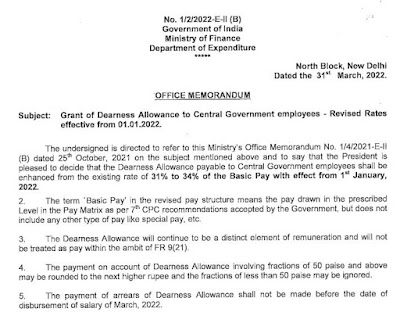
DA Jan 2022 - Grant of Dearness Allowance to Central Government employees - Revised Rates effective from 01.01.2022

 3% DA Hike - Revised Rates effective from 01.01.2022: DoE OM dated 31.03.2022 No. 1/2/2022-E-II (B) Government of India Ministry of Finance...