Showing posts with label Pay. Show all posts

Thursday, 6 February 2020

Second National Judicial Pay Commission has filed the subject of Pay, Pension and Allowances, in Supreme Court on 29.01.2020

Second National Judicial Pay Commission has filed the subject of Pay, Pension and Allowances, in Supreme Court on 29.01.2020.
Latest-Central-Government-Employees-News-pay-commission-pay-pension-allowances

Ministry of Labour & Employment
Second National Judicial Pay Commission submits its Report

06 FEB 2020

The Second National Judicial Pay Commission has filed the main part of the Report in 4 volumes covering the subject of Pay, Pension and Allowances, in the Registry of the Supreme Court on 29.01.2020. The Commission has been constituted pursuant to the Order of the Supreme Court in All India Judges Association case and the Government of India, Ministry of Law & Justice issued a Notification dated 16.11.2017 in this regard. Shri Justice P.V. Reddi, former Judge of the Supreme Court is the Chairman, Shri Justice R. Basant, former Judge of Kerala High Court is the Member and Shri Vinay Kumar Gupta, District Judge of Delhi Higher Judicial Service is the Member-Secretary of the Commission.

Also check: 7th Pay Commission Latest News 2020

The Interim Report was submitted by the Commission in 2018.

The salient recommendations are:

PAY: The Commission having considered various alternative methodologies has recommended the adoption of Pay Matrix which has been drawn up by applying the multiplier of 2.81 to the existing pay, commensurate with the percentage of increase of pay of High Court Judges. @ 3% cumulative has been applied.

As per the revised pay structure evolved by the Commission, the Junior Civil Judge / First Class Magistrate whose staring pay is Rs.27,700/- will now get Rs.77,840/-. The next higher post of Senior Civil Judge starts with the pay of Rs.1,11,000/- and that of the District Judge Rs.1,44,840/-. The highest pay which a District Judge (STS) will get, is Rs.2,24,100/-.

The percentage of Selection Grade and Super Time Scale District Judges proposed to be increased by 10% and 5% respectively.

The revised pay and pension will be effective from 01.01.2016. Arrears will be paid during the Calendar year 2020 after adjusting the interim relief.

PENSION: Pension at 50% of last drawn pay worked out on the basis of proposed revised pay scales is recommended w. e. f. 1-1-2016. The family pension will be 30% of the last drawn pay. Additional quantum of pension will commence on completing the age of 75 years (instead of 80 years) and percentages at various stages thereafter are increased. The existing ceiling of retirement gratuity and death gratuity will be increased by 25% when the DA reaches 50%.

Nodal officers will be nominated by the District Judges to assist the pensioners / family pensioners.
Recommendation has been made to discontinue the New Pension Scheme (NPS) which is being applied to those entering service during or after 2004. The old pension system, which is more beneficial, will be revived.

ALLOWANCES: The existing allowances have been suitably increased and certain new features have been added. However, the CCA is proposed to be discontinued.

Recommendations are made to improve the medical facilities and to simplify the reimbursement procedure. Medical facilities will be granted to pensioners and family pensioners also.

Certain new allowances viz. children education allowance, home orderly allowances, transport allowance in lieu of pool car facility, have been proposed. HRA proposed to be increased uniformly in all States. Steps to ensure proper maintenance of official quarters recommended.

The recommendations made by the Commission are applicable to the Judicial officers throughout the country.

Supreme Court will have to issue directions regarding the implementation of recommendations after hearing the stakeholders.

PIB

Wednesday, 15 November 2017

Stepping up of pay of senior Assistants of CSS drawing less pay on promotion in the Section Officers Grade than their juniors


Stepping up of pay of senior Assistants of CSS drawing less pay on promotion in the Section Officers Grade than their juniors

F.No.18/2/2014-CS-I(S)
Government of India
Ministry of Personnel, PG & Pensions
Department of Personnel & Training


2nd Floor, A Wing, Lok Nayak Bhawan, Khan Market
New Delhi, the 6 November, 2017


OFFICE MEMORANDUM

Subject: Stepping up of pay of senior Assistants of CSS drawing less pay on promotion in the Section Officers Grade than their juniors - regarding.


Ref: OM No.18/2/2007-CS-l dated 20.05.2014 & 08.07.2014 and OM No.18/212014-CS.l(S) dated 27.12.20216.

Representations have been received from some CSS officers in whose case re-fixation and recovery orders have been issued by concerned Ministries/Departments in pursuance to DOPT OM dated 20.05.2014, requesting withdrawal of the OMs referred above.

2. It is once again clarified that OM No.5/16/80-CS.I dated 13.4.1988 was issued on acceptance of award by Board of Arbitration in CA Reference No.7 of 1984 which allowed stepping up of pay of an Assistant of CSS, who is senior by virtue of having been recruited through an earlier examination but is drawing less pay on promotion in the Grade of Section Officer than his junior recruited through a later examination, up to a level equal to the pay of such junior Section Officer in the same cadre i.e. senior DR Assistant to junior DR Assistant of later exam on their promotion as Section Officer. Vide OM No.5/21/92-CS.I dated 23.2.1994 this benefit of stepping up was extended to Section Officers appointed through Limited Departmental Competitive Examination (LDCE) (again applicable to DR Assistants only). OM No.5/1/96-CS.I dated 8.10.1996 further extended this benefit in case of promotee Assistants and also to the cases where both junior and senior have been recruited on the basis of the same Select List Assistants Grade Examination, as the case may be in accordance with judgements of CAT in OA No. 365/90 (Shri K.C. Sehgal VS UOI and CA No. 869/91 (Shri L.K. Chawla VS UOI), which were upheld by the Hon’ble Supreme Court.

3. That there are general guidelines of stepping up of pay issued by the Ministry of Finance vide OM No.F.2(78)-E.III(A) dated 0 .02.1966 and this Department vide OM dated 04.11.1993. One of the conditions of the general guidelines for allowing stepping up of pay to a senior govt. servant with reference to a junior is that the senior should have drawn more pay than the junior in the lower grade also.

4. However, certain clarifications were issued by CS-I Division, DoPT in 2007 and 2008 to individual Ministries/Departments, on references received from them, which were at variance with the general conditions of stepping up of pay i.e. stepping up of pay was allowed even if junior was drawing more pay than the senior in the lower grade i.e. in Assistant/Grade. Therefore, vide OM dated 29.5.2009, the clarification issued in 2007 & 2008 were withdrawn and Ministries/Departments were advised to strictly allow stepping up enforcing conditions laid down in OM dated 8.10.1996. Departments were also informed vide OM dated 21.05.2010 that as the matter was still under consideration, status-quo, as on date, might be maintained in the matter of stepping up of pay of Section Officers of CSS till the matter attains finality. Eventually, the matter attained finality and a consolidated OM as vetted by the Estt..(Pay) Division of this Department and Department of Expenditure was issued on 20.05.2014.

5. The Ministries/Departments were requested vide OM dated 20.05.14 that stepping up of pay already allowed in cases where the individuals are not covered by the OMs dated 13.04.1988, 23.02.1994 and 08.10.1996 and general conditions as laid down in OM dated 04.11.193, should be reviewed and pay re- fixed accordingly. That excess payments made to the employees in the cases of wrong stepping up of pay should be recovered in terms of DOP&T’s OM No.18/26/2011-Estt(Pay-l) dated 06.02.2014 and a compliance report in this regard furnished to this Department. It was further clarified vide OM dated 08.7.2014 that all the three OMs and general conditions of stepping up of pay are not exclusive of each other and the three OMs are to be read with and subject to the general conditions reiterated vide OM dated 4.11.1993, therefore, stepping up of pay is not to be allowed where junior was drawing more pay than the senior in the lower grade.

6. As regards, OA No.2884/2015 and similar OAs filed in this regard, it is observed that only applicants in these cases have been granted interim stay by the Learned CAT. That the said OAs have been filed by the applicants in the individual capacity. Thus in all those cases where stepping up of pay has been allowed, but where the benefited individuals were not covered by the OMs dated 13.4.88, 23.2.94 and 8.10.96 and the general conditions of stepping up of pay as laid down in the DOP&T's OM No. 4/7/92-Estt(Pay-1) dated 04.11.93, pay will have to be re-fixed and recovery of excess payment, if any, is to be made.

7. Therefore, vide reminder OM dated 27.12.16, the Ministries/Departments were requested to expedite the compliance reports as requested vide OM dated 20.05.2014 except in those cases where matter of recovery is subjudice/stayed by order of any competent court.

8. It may be mentioned that one of the similarly placed officers, in whose case orders for stepping up of pay with reference to a promotee assistant was issued but not implemented, had approached CA (PB) through OA No.1199/2014(H.C. Rai vs. UOI). The CAT vide its order dated 28.03.17 while dismissing the OA had categorically ruled that the stepping up of his pay was not in consonance with the provisions of OM dated 20.05.2014 i.e. OMs dated 13.4.88, 23.2.94 and 8.10.96.

9. With regards difficulty being faced by some Ministries/Departments in establishing links/chain of officers in refixation/recovery matters, it is hereby mentioned that many Ministries/Departments have already issued re-fixation orders establishing links by themselves as per the instructions issued by this Department.

10. All the Ministries/Departments are thus again requested to furnish the compliance reports in the prescribed proforma, latest by 15th November 2017.

11. In view of above, the representations/OMS of following have no merit and are accordingly disposed off:

Please click on source file to view the list of representations.


(Anil Tripathi)
Under Secretary to the Govt. of India
Source : DoPT

Tuesday, 11 July 2017

7th Pay Commission: Pay, allowances raise new hopes for central government employees


7th Pay Commission: Pay, allowances raise new hopes for central government employees

New Delhi: After long wait, the 7th Pay Commission award has been fully implemented including allowances, which has been implemented from July 1, it has increased new hopes among the central government employees that their allowances has been hiked.

The Union Cabinet cleared the recommendations of 7th Pay Commission in respect of the hike in basic pay and pension on June 29 and government notified higher allowances on July 7, 2017 for its 4.8 million employees and 5.2 million pensioners, in a bid to ease the inflationary pressure.

"Allowances contribute 63 percent in the pay hike recommendation. The allowances which the commission proposed is very substantial. So, the central government employees now not only get 14.28 per cent hike in pay but also to get new allowances, which providing for full compensation to the central government employees," a top Finance Ministry's official told.

Government jobs in India have been less rewarding in terms of pay and allowances. Apart from a sense of job security and perceived power, most of the employees have to struggle to make ends meet with the cost of living going up every year.

The central government employees are seeing inflation catch up with their pay rises as the cost of living rises faster despite of government figure.

With the current basic pay hike and steep inflation, it is not possible for central government employees to make ends meet. It is also impossible to sustain with their current basic pay without hike in allowances. Inflation has climbed steadily over the past few years, which the new allowances will help to compensate.

Accordingly, the new allowances will hopefully attract central government employees to live with dignity and the quality of service delivery in central government offices is expected to improve which will in turn contribute to higher productivity and growth for the nation.

Friday, 5 May 2017

Modifications in the 7th CPC recommendations on pay and pensionary benefits approved by the Cabinet on 3rd May, 2017

Modifications in the 7th CPC recommendations on pay and pensionary benefits approved by the Cabinet on 3rd May, 2017

The Union Cabinet chaired by the Prime Minister Shri Narendra Modi approved important proposals relating to modifications in the 7th CPC (Central Pay Commission) recommendations on pay and pensionary benefits in the course of their implementation. Earlier, on 29th June, 2016, the Cabinet had approved implementation of the recommendations with an additional financial outgo of Rs.84,933 crore for 2016-17 (including arrears for 2 months of 2015-16).

The benefit of the proposed modifications will be available with effect from 1stJanuary, 2016, i.e., the date of implementation of 7th CPC recommendations. With the increase approved by the Cabinet, the annual pension bill alone of the Central Government is likely to be Rs.1,76,071 crore. Some of the important decisions of the Cabinet are mentioned below:

1. Revision of pension of pre -2016 pensioners and family pensioners
The Cabinet approved modifications in the recommendations of the 7th CPC relating to the method of revision of pension of pre-2016 pensioners and family pensioners based on suggestions made by the Committee chaired by Secretary (Pensions) constituted with the approval of the Cabinet. The modified formulation of pension revision approved by the Cabinet will entail an additional benefit to the pensioners and an additional expenditure of approximately Rs.5031 crore for 2016-17 over and above the expenditure already incurred in revision of pension as per the second formulation based on fitment factor. It will benefit over 55 lakh pre-2016 civil and defence pensioners and family pensioners.

While approving the implementation of the 7th CPC recommendations on 29thJune, 2016,the Cabinet had approved the changed method of pension revision recommended by the 7th CPC for pre-2016 pensioners, comprising of two alternative formulations, subject to the feasibility of the first formulation which was to be examined by the Committee.

In terms of the Cabinet decision, pensions of pre-2016 pensioners were revised as per the second formulation multiplying existing pension by a fitment factor of 2.57, though the pensioners were to be given the option of choosing the more beneficial of the two formulations as per the 7th CPC recommendations.
In order to provide the more beneficial option to the pensioners, Cabinet has accepted the recommendations of the Committee, which has suggested revision of pension based on information contained in the Pension Payment Order (PPO) issued to every pensioner. The revised procedure of fixation of notional pay is more scientific, rational and implementable in all the cases. The Committee reached its findings based on an analysis of hundreds of live pension cases. The modified formulation will be beneficial to more pensioners than the first formulation recommended by the 7th CPC, which was not found to be feasible to implement on account of non-availability of records in a large number of cases and was also found to be prone to several anomalies.

2. Disability Pension for Defence Pensioners
The Cabinet also approved the retention of percentage-based regime of disability pension implemented post 6thCPC, which the 7th CPC had recommended to be replaced by a slab-based system.

The issue of disability pension was referred to the National Anomaly Committee by the Ministry of Defence on account of the representation received from the Defence Forces to retain the slab-based system, as it would have resulted in reduction in the amount of disability pension for existing pensioners and a reduction in the amount of disability pension for future retirees when compared to percentage-based disability pension.
The decision which will benefit existing and future Defence pensioners would entailan additional expenditure of approximately Rs.130 crore per annum.

3. Changes in Pay Structure and Revision of the three Pay Matrices:
The Cabinet, while approving the 7th CPC recommendations for their implementation on 29thJune, had made two modifications in the Defence Pay Matrix as under:
(i) Index of Rationalisation (IOR) of Level 13A (Brigadier) may be increased from 2.57 to 2.67.

(ii) Additional 3 stages in Levels 12A (Lt. Col.) , 3 stages in Level 13 (Colonel) and 2 stages in Level 13A (Brigadier) may be added.
The Cabinet has now approved further modifications in the pay structure and the three Pay Matrices, i.e. Civil, Defence and Military Nursing Service (MNS). The modifications are listed below:

(i) Defence Pay Matrixhas been extended to 40 stages similar to the Civil Pay Matrix: The 7th CPC had recommended a compact Pay Matrix for Defence Forces personnel keeping in view the number of levels, age and retirement profiles of the service personnel.Ministry of Defence raised the issue that the compact nature of the Defence Pay Matrix may lead to stagnation for JCOs in Defence Forces and proposed that the Defence Pay Matrix be extended to 40 stages. The Cabinet decision to extend the Defence Pay Matrix will benefit the JCOs who can continue in service without facing any stagnation till their retirement age of 57 years.

(ii) IOR for Levels 12 A(Lt. Col. and equivalent)and 13(Colonel and equivalent)in the Defence Pay Matrix and Level 13 (Director and equivalent)in the Civil Pay Matrix has been increased from 2.57 to 2.67: Variable IOR ranging from 2.57 to 2.81 has been applied by the 7th CPC to arrive at Minimum Pay in each Level on the premise that with enhancement of Levels from PayBand 1 to 2, 2 to 3 and onwards, the role, responsibility and accountability increases at each step in the hierarchy. This principle has not been applied in respect of Levels 12A (Lt. Col. and equivalent), 13 (Colonel and equivalent) and 13A (Brigadier and equivalent) of Defence Pay Matrix and Level 13 (Director and equivalent) of the Civil Pay Matrix on the ground that there was a disproportionate increase in entry pay at the level pertaining to GP 8700 in the 6thCPC regime. The IOR for Level 13A (Brigadier and equivalent) in the Defence Pay Matrix has already been revised upwards with the approval of the Cabinet earlier. In view of the request from Ministry of Defence for raising the IOR for Levels 12 A and 13 of the Defence Pay Matrix and requests from others, the IOR for these levels has been revised upwards to ensure uniformity of approach in determining the IOR.

(iii) To give effect to the decisions to extend the Defence Pay Matrix and to enhance the IORs, the three Pay Matrices -Civil, Defence and MNS -have also been revised. While doing so, two calculation errors noticed in the MNS Pay Matrix have also been rectified.

(iv) To ensure against reduction in pay, benefit of pay protection in the form of Personal Pay was earlier extended to officers when posted on deputation under Central Staffing Scheme (CSS) with the approval of Cabinet. The benefit will also be available to officers coming on Central Deputation on posts not covered under the CSS.

Saturday, 17 December 2016

Fixation of pay of re-employed Pensioners-Treatment of Military Service Pay

Fixation of pay of re-employed Pensioners-Treatment of Military Service Pay
RBE No.153/2016
Government of India
Ministry Of Railways
Railway Board
No.E(G)2013/EM 1-5
New Delhi, Dated 15-12-2016
The General Managers
All Zonal Railways and PUs etc.
(as per Standard list)

Subject: Fixation of pay of re-employed Pensioners-Treatment of Military Service Pay

Attention is invited to instructions contained in DOP&T’s OM No.3/19/2009-Estt: Pay-II dated 8/11/2010 on the above subject which was circulated to the Railways for implementation vide Railway Board’s letter No.E(G)/2013/EM 1/4 dated 24/7/2013.

However, Federation (NFIR) has pointed out that aforesaid instructions are not being complied with by the Zonal Railways/PUs etc.

Therefore, Board desire that the aforesaid instructions should be complied with strictly while fixing the pay of ex-servicemen who are re-employed on the Zonal Railways/PUs etc.
Please acknowledge receipt.
sd/-
(D.Joseph)
Dy.Dir./Estt.(Genl)
Source: NFIR

Tuesday, 8 November 2016

Central Government Employees disappointed for poor pay, allowances

Poor 7th Pay Commission Pay and allowances - Central Govt Employees disappointed

Poor 7th Pay Commission Pay and allowances - Confederation of Central Government Employees and Workers Karnataka expresses disappointment of Central Government Employees

Central Government Employees disappointed for poor pay, allowances

New Delhi: Central government employees are feeling let down by the political authority of the country for denying them their due in terms of better monthly salary and allowances.

Despite representations to the Prime Minister, Home Minister, Finance Minister, Railways Minister, Departmental heads and Committees set up by the government to look into the pay and allowances related grievances, the employees have expressed utter disappointment that they have not been heard so far.
“ We had sought a minimum pay of Rs 26,000, they gave us Rs 18,000. After every meeting they do not say anything. We ask, how much you can improve upon, you tell us how much you can go, buy they don’t say anything, said K. K. N. Kutty, President, Confederation of Central Government employees and Workers, on the discussions the union has had over Allowances.

“There is no discussion in real terms, they simply listen to us and do not commit anything. We think the political authority, we don’t know, it could be Prime Minister, has not authorized the bureaucracy to commit anything to us,”added Kutty.

When around 33 lakh central government employees threatened to go on strike on July 11 protesting the implementation of 7th Pay Commission, the Finance Ministry had agreed to set up Anomalies Committee, and Allowances Committee who would be mandated to go through the fine print of the 7th Pay Commission.
Even after the formation of 22-member Anomalies Committee headed by Secretary, Department of Personnel and Training (DoPT) with members from both the official and staff side, and Allowances Committee headed by Finance Secretary, no settlement on the wage hike or allowances issue appears in sight.

The Government is yet to set up the high level committee on minimum wage, fitment formula revision and other main demands of central government employees as assured by Cabinet Ministers in July 2016.
The National Joint Council of Action, a front formed by six government staff unions, including Confederation of Central Government Employees (CCGE), All India Defence Employee Federation and National Coordination Committee of Pensioners Association representing the staff side of the central government employees have even threatened to go on a large scale agitation and hold a march up to the Parliament on December 15, if government fails to improve on pay and allowances over what has been implemented under 7th Pay Commission.

As per the notification for the implementation of the 7th Pay Commission, central government employees got 14.27 percent hike in basic pay at junior levels, which is said to be the lowest in 70 years.

The salary hikes of government employees indeed appear meager when compared to the 100 percent hike expected by the Members of Parliament soon.

The point not to be missed is that, while the salaries of central government employees were revised after 10 years, the MPs’ salaries were last revised in 2010.

Source : karnatakacoc

Wednesday, 14 September 2016

7th Pay Commission: Good news for central government employees as Centre sets up committee to address pay related anomalies

7th Pay Commission: Good news for central government employees as Centre sets up committee to address pay related anomalies

New Delhi: Central government has finally set up a committee to look into various pay related anomalies arising out of the implementation of the Seventh Central Pay Commission's recommendations under immense pressure from the employees unions.

The committees is expected to examine individual, post and cadre-specific anomalies arising out of implementation of the recommendations of 7th Central Pay Commission.

“Anomalies committees will be set up by Department of Personnel and Training to examine individual, post specific and cadre specific anomalies arising out of implementation of the recommendations of the Commission,” the Finance Ministry had said in an order notifying implementation of the pay panel’s recommendations in July.

The committee will have members from the government as well as from the National Council (Joint Consultative Machinery) consisting of representatives of the official side and the staff side.

The panel will be headed by Secretary, Department of Personnel and Training (DoPT) and will have around 22 members,

The members from the government side will have Member (Staff) Railway Board, secretaries of Department of Telecommunications and Department of Posts, Financial Adviser(Defence Ministry) two joint secretaries from DoPT and Joint Secretary (Personnel) in Finance Ministry will also be part of the panel. A Deputy Secretary of the DoPT will be Member-Secretary of the panel. There will be 13 members from the staff side.

Source: Zee news

Friday, 19 August 2016

7th Pay Commission: Salary arrears to Central government employees estimated at Rs. 34,600 crore

7th Pay Commission: Salary arrears to Central govt employees estimated at Rs. 34,600 crore

The outgo on account of salary arrears and payments for August for Central government employees has been pegged at Rs. 34,600 crore by ratings agency India Ratings.

The 7th Central Pay Commission (CPC) recommendations implemented by the Central government will entail a payment of Rs. 34,600 crore towards salary arrears for seven months and August wages to employees, according to a ratings agency.

The hike in the salary component as recommended by the 7th Central Pay Commission (CPC) was accepted with retrospective effect from January 1, 2016.

“The combined outgo for the center on account of arrears for January to July and payments for August will total to Rs. 346 bn (Rs. 34,600 crore),” India Ratings and Research Pvt Ltd. (Ind-Ra) said in a statement on Wednesday.

On the flip side, this is likely to result in a “go slow” approach by the Narendra Modi government, according to the agency.

“The government is likely to go slow on spending as it gears up to meet lumpy payments (other than regular payments),” Ind-Ra said in its statement.

However, the impact won’t be much on the government’s finances. “The outgo due to a hike in salaries and pensions, in line with the Seventh Central Pay Commission’s (7CPC) recommendations, is unlikely to cause significant systemic liquidity disruptions,” the ratings agency said.

The salary hike announced by the Modi government in accordance with the recommendations of the 7th CPC covers about 1 crore employees and pensioners. There are about 53 lakh pensioners and 47 lakh Central government employees, of which 14 lakh employees and 18 lakh pensioners are from the defence forces.

A decision on increasing allowances will be taken approximately by November, according to an official statement by the government in June.

“Given the significant changes in the existing provisions for Allowances which may have wide ranging implications, the Cabinet decided to constitute a Committee headed by Finance Secretary for further examination of the recommendations of 7th CPC on Allowances. The Committee will complete its work in a time bound manner and submit its reports within a period of 4 months. Till a final decision, all existing Allowances will continue to be paid at the existing rates,” the June 29 statement said.

The pay commission had recommended abolition of 51 allowances and subsuming 37 others after examining 196 allowances.

Source : ibtimes

Monday, 8 August 2016

Implementation of recommendations of the VII CPC – issue of Resolution by the Ministry of Finance (Deptt of Expenditure)

Implementation of recommendations of the VII CPC – issue of Resolution by the Ministry of Finance (Deptt of Expenditure)

 Government of India
Ministry of Defence
D(Civ-I)

Subject : Implementation of recommendations of the VII CPC – issue of Resolution by the Ministry of Finance (Deptt of Expenditure)

Ministry of Finance has issued the Resolution dt. 25.07.2016 regarding acceptance of the recommendations of the VII CPC by the Government of India. The Resolution provides, interalia, as under

(a) The Government, after consideration, has decided to accept the recommendations of the Commission in respect of the categories of employees covered in its Terms of Reference contained in the aforesaid Resolution dated the 28th February, 2014 in the manner as specified hereinafter.

(b) The recommendations on allowances (except Dearness Allowance ) will be referred to a Committee comprising Finance Secretary and Secretary (Expenditure) as Chairman and Secretaries of Home Affairs, Defence, Health and Family Welfare, Personnel and Training, Posts and Chairman, Railway Board as Members, The Committee will submit its report within a period of four months. Till a final decision on Allowances is taken based on the recommendations of this committee, all Allowances will continue to be paid at existing rates in existing pay structure, as if the pay had not been revised with effect from 1st January, 2016.

(c) The Government has accepted the recommendations of the Commission on upgrading of posts except for those specified at Annexure III of the Resolutions. The recommendations on the upgradations specified at Annexure Ill will be separately examined by Department of Personnel and Training for taking a comprehensive view in the matter. These are as under:

SI. No.Name of Posts
(Para No. of 7 CPC Report)
Present
Grade
Pay
Grade Pay recommended by 7th CPC
Upgradation other than Apex Level
1.Assistant Accounts Officer,Finance Div of Defence, MoD
(11.12.140)
48005400 (PB-2) on completionof 4 years service
Up-gradation to Apex scale
2.       Director General (Indian Coast Guard) (11.12.27)

(d) Recommendations not relating to pay, pension and allowances and other administrative issues specific to Departments/Cadres/Posts will be examined by the Ministries/Departments concerned as per the Allocation of Business Rules or Transaction of Business Rules.

(e) Anomalies committees will be set up by Department of Personnel and Training to examine individual, post-specific and cadre-specific anomalies arising out of implementation of the recommendations of the Commission.

2. The above provisions of the Resolution are brought to the knowledge of all the Administrative Division of MoD for their information and for taking necessary action in respect of the posts/cadres existing under their control. The copy of the Resolution is available for download at the website of finmin.nic.in.
sd/-
(Gurdeep Singh)
Under Secretary to the Govt. of India

Monday, 25 July 2016

Taxable and Non-Taxable Elements of Pay and Allowances

Taxable and Non-Taxable Elements of Pay and Allowances

List of Taxable Elements of Pay

Taxable Element of Pay : Provisions are applicable equally for monthly payment of Allowances as well as arrears for the said head of Pay/Allowances.

Non-Taxable Elements of Pay : Salary for this purpose includes Pay in Pay Band + Grade Pay + MSP (w.e.f. 01 Sep 08) + DA + NPA (if any).
Sl. No.Taxable Elements of Pay
1.Pay in the Pay Band
2.Grade Pay
3.Military Service Pay
4.Dearness Allowance
5.Non-Practicing Allowance (if any)
6.Hazard/Special Hazard Pay
7.Para Allowance/Para Reserve Allowance/Special Commando Allowance
8.City Compensatory Allowance
9.Deputation (Duty) Allowance (If any)
10.Reimbursement of Furniture
11.Reimbursement of Water
12.Reimbursement of Electricity
13.Technical Allowance
14.Qualification Pay
15.Special Action Group Allowance (on posting to National Security
Guard)
16.Technical Pay
17.Language Allowance
18.Qualification Grant
19.Language Award
20.Flying Allowance
21.Leave Encashment on LTC
22.Specialist Allowance
23.Test Pilot Allowance
24.Instructor Allowance
25.Flight Test Allowance
26.Security Allowance
27.Strategic Force Allowance
Sl No.Non-Taxable element of PayAuthorityLimit of Exemption
1.Gallantary AwardA.O. 46/79;U/S 10 (18)(i) of IT Actsw.e.f. 1947Fully Exempt
2.Entertainment AllowanceU/S 16 (ii) of IT Act w.e.f.01/04/81A sums equal to1/5th of
salary(excluding any allowance/benefit) orRs.5000/- per annum whichever isless.
3.Leave Travel Concession (LTC)U/S 10 (5) of IT Act w.e.f.01/04/89Actual Expenditure upto the limit of entitlement
4.Foreign AllowanceU/S 10 (7) of IT ActFully Exempt
5.Bhutan Compensatory Allowance (BCA)AO 395/74and U/S 10(7) of IT ActFully Exempt
6.Servant Wages Allowance along with BCAAO 395/74 and U/S 10 (7) of IT
Act
Fully Exempt
7.Purchase of Crockery/Cutlery/GlasswareU/S 10 (7) of IT ActFully Exempt
8.Outfit allowance on posting to EmbassyU/S 10 (7) of IT ActFully Exempt
9.Arrears of Cash Grant – Foreign Allowance (Nepal)U/S 10 (7) of IT ActFully Exempt
10.Myanmar AllowanceU/S 10 (7) of IT ActFully Exempt
11.Representation Grant for use of crockery setU/S 10 (7) of ActFully Exempt
12.Encashment of Leave on retirement whether on superannuation/voluntary
retirement/release/invalidment etc.
U/S 10 (10AA) (i) of IT Act w.e.f. 01/04/78Fully Exempt
13.House Rent Allowance/House Rent Reimbursement (HRA/HRR)U/S 10 (13A) of IT Act w.e.f. 06/10/1964;
Limit of exemption as per Rule 2A of IT Rules
*Quantum of exemption is least of the following – a) For
Bombay/Kolkata/Delhi Chennai i) Allowance actually received. ii) Rent paid in
excess of 10% of salary iii) 50% of salary b) For other cities i) Allowance
actually received. ii) Rent paid in excess of 10% of salary. iii) 40% of
salary
14.Children Education AllowanceU/S 10 (14) (ii) of IT Act and Rule 2BB (2) – Table Sl No.5 of the IT
Rules
Rs.100/- per month per child upto a maximum of 2 children.
15.Hostel SubsidyU/S 10 (14) (ii) of IT Act and Rule2BB (2) – Table Sl No.6 of the IT Rules, Rs.300/- per month per child
upto a maximum of 2 children
16.Siachen AllowanceU/S 10 (14) (ii) of IT Act and Rule 2BB (2) –Table Sl No.1 (II) of
the IT Rules
Rs.7000/ per month w.e.f. 01/08/1997
17.Special Compensatory (Remote Locality) AllowanceU/S 10 (14) (ii) of IT Act and Rule 2BB (2) – Table Sl.No.2 of the IT
Rules
Category I – SCA ‘A’ – Rs.1300/- per month Category III – SCA ‘B’ –
Rs.1050/- per month. Category IV – SCA ‘C’ – Rs.750/- per month. Category VI
– SCA ‘D’ – Rs.200/- per month.
18.Compensatory Field Area Allowance(CFAA) U/S 10 (14) (ii) of IT
Act and Rule
2BB (2) – Table Sl No.7 of the IT Rules Rs.2600/- per month w.e.f.
01/05/1999
19.Compensatory Modified Field
Area Allowance (CMFAA)
U/S 10 (14) (ii) of IT Act and
Rule 2BB (2) – Table Sl No.8 of the IT Rules
Rs.1000/- per month w.e.f. 01/05/1999
20.Any Special Allowance in the nature of Counter Insurgency Allowance
(SCCIA)
U/S 10 (14) (ii) of IT Act and
Rule 2BB (2) – Table Sl.No.9 of the IT Rules
Rs.3900/- per month w.e.f. 01/05/1999
21.Transport Allowance granted to
meet expenditure for the purpose of commuting between place of residence and
duty
U/S 10 (14) (ii) of IT Act and Rule 2BB (2) – Table Sl.No.10 of the
IT Rules
For whole of India – Rs.1600/-
per month
22.Transport Allowance granted to
a blind or orthopedically handicapped employee with disability of lower
extremities to meet expenditure for
the purpose of commuting between place of residence and duty
U/S 10 (14) (ii) of IT Act and RuleFor Whole of India – Rs.3200/- per month 2BB (2) – Table Sl.No.11 of the
IT Rules
23.High Altitude Uncongenial Climate Allowance (HAUCA)U/S 10 (14) (ii) of IT Act and Rule 2BB (2) Table Sl.No.13 of the IT
Rules
For areas of (a)Altitude of 9000 to 15000 feet (HAUCA ‘I) – Rs.1060/-
per month w.e.f. 01/05/1999. (b)Altitude above 15000 feet (HAUCA ‘II’ &
‘III) – Rs.1600/- per month w.e.f. 01/05/1999.
24.Highly Active Field Area
Allowance (HAFA)
U/S 10 (14) (ii) of IT Act and Rule 2BB (2) –Table Sl.No.14 of the IT
Rules
Rs.4200/- per month
25.Island (duty) Allowance granted to the members of Armed ForcesU/S 10 (14) (ii) of IT Act and Rule 2BB (2) – Table Sl.No.15 of the
IT Rules.
For Andaman & Nicobar and Lakshadweep group of islands –
Rs.3250/- per month inserted w.e.f. 29/02/2000.
26.Outfit Allowance (Initial/Renewal)U/S 10 (14) (i) of IT Act and
Rule 2BB (1) (f) of IT Rules.
Fully Exempt
27.Compensation for the change of uniformU/S 10 (14) (i) of IT Act and Rule 2BB (1) (f) of the IT RulesFully Exempt
28. Kit Maintenance AllowanceU/S 10 (14) (i) of IT Act and Rule 2 BB (1) (f) of the IT RulesFully Exempt
29.Uniform Allowance (MNS)U/S 10 (14) (i) of IT Act and Rule 2BB (1) (f) of the IT RulesFully Exempt
30.Special Winter Uniform AllowanceU/S 10 (14) (i) of IT Act and
Rule 2BB (1) (f) of the IT Rules
Fully Exempt
31.Reimbursement of Medical
Expenses
U/S 17 (2) (viii) (v) of IT ActActual expenditure upto Rs.15000/- per annum.
32.Any payment from Provident FundU/S 10 (11) of IT ActFully Exempt
33.Payment of Compensation – Disability PensionCBDT F.No. 200/51/99- ITA1 dated 02 Jul 2001Fully Exempt.

DISCLAIMER: The above provisions are with the understanding and interpretation of IT Act 1961/IT Rules as amended and instructions issued by CBDT from time to time. Rules, provisions, further amendments and clarifications are issued by IT department/CBDT only and this office does not have any role in framing the same except IT deductions at source with reference to them.

Authority: www.pcdaopune.gov.in

Wednesday, 22 June 2016

Report of the committee to decide reassessment of CVO positions in CPSEs and other organizations under Ministries/Departments and rationalization of pay, incentive, allowances etc. of CVOs

Report of the committee to decide reassessment of CVO positions in CPSEs and other organizations under Ministries/Departments and rationalization of pay, incentive, allowances etc. of CVOs.

Most Immediate Out Today
F.No.325/10/2015-AVD-III
Government of India
Ministry of Personnel, Public Grievances & Pensions
Department of Personnel & Training
North Block, New Delhi
Dated the 21st June, 2016
MEETING NOTICE

Subject: Report of the committee to decide reassessment of CVO positions in CPSEs and other organizations under Ministries/Departments and rationalization of pay, incentive, allowances etc. of CVOs.

The undersigned is directed to refer to this Department’s O.M. of even number dated 10.12.2015 & 10.06.2016 on the above subject, wherein comments were sought from concerned Ministries/Departments on the report of the committee chaired by AS(S&V), DoPT, for reassessment of CVO positions in CPSEs and other organizations under Ministries/Departments and rationalization of pay, incentive, allowances of CVOs in CPSEs etc. However, no comments have been received, so far, till date. It is, therefore, once again requested to furnish the same at the earliest, latest by 22.06.2016 positively.

2. As the matter is being reviewed at higher level, a meeting has also been scheduled to be held at 10.30 a.m. on 23.06.2016 in the conference Room No. 190 of DoPT, North Block, New Delhi under the Chairmanship of Shri Devesh Chaturvedi, Joint Secretary, DoPT to discuss & finalize the matter.

3. It is, therefore, requested to depute an officer at the level of JS/Director, who is well conversant with the subject matter, alongwith the required input, if not already furnished, for the said meeting on the scheduled date & time.
(Gayatri Mishra)
Director (AVD-III)
Tel. No. 23092755

Thursday, 16 June 2016

Report of the committee to decide reassessment of CVO positions in CPSEs and other organizations under different Ministries/Departments and rationalization of pay, incentive, allowances etc. of CVOs

F.No.325/10/2015-AVD-III
Government of India
Ministry of Personnel, Public Grievances & Pensions
Department of Personnel & Training
North Block, New Delhi
Dated the 10 June, 2016
OFFICE MEMORANDUM

Subject: Report of the committee to decide reassessment of CVO positions in CPSEs and other organizations under different Ministries/Departments and rationalization of pay, incentive, allowances etc. of CVOs.

The undersigned is directed to refer to this Department’s O.M. of even number dated 10thDecember, 2015 whereas a report of the committee chaired by AS(S&V), DoPT, for reassessment of CVO positions in CPSEs and other organizations under different Ministries/Departments and rationalization of pay, incentive, allowances etc. of CVOs, was sent to 33 Ministries/Departments with the request to furnish comments, if any positively by 23rd December, 2015. It was also mentioned that if no comments are received within the prescribe time it will be presumed that Ministries/Departments have nothing to say in the matter. However, comments were received only from 16 Ministries/Departments till date. 17 Ministries/Departments have not furnished any comments.

2. All 17 remaining Ministries/Departments are once again requested to furnish their comments, if any in this matter positively by 20th June, 2016. If no comments are received within the prescribe time it will be presumed that Ministries/Departments have nothing to say in the matter and DoPT will finalize the same.

(Sarita Nair)
Under Secretary to the Government of India
Tel. No. 23094541
 DoPT Circular

Thursday, 28 April 2016

Review of performance of public servants

Review of performance of public servants

The Ministry of Personnel, Public Grievances and Pensions is aware that review of performance of public servants occurs only after attaining age of 50 years or completion of 30 years of service. As per Fundamental Rule (FR) 56 (j):

“The Appropriate Authority shall, if it is in the opinion that it is in the public interest so to do, have the absolute right to retire any Government servant by giving him notice of not less than three months in writing or three months’ pay and allowances in lieu of such notice:

If he is in Group ‘A’ or Group ‘B’ service or post in a substantive, quasi-permanent or temporary capacity and had entered Government service before attaining the age of 35 years, after he has attained the age of 50 years.

(i) in any other case after he has attained the age of fifty-five years”.

(ii) In addition, as per Rule 48 of CCS(Pension) Rules, 1972, at any time after a Government servant has completed thirty years’ qualifying service, he may be required by the appointing authority to retire in the public interest, and in the case of such retirement the Government servant shall be entitled to a retiring pension provided that the appointing authority may also give a notice in writing to a Government servant at least three months before the date on which he is required to retire in the public interest or three months’ pay and allowances in lieu of such notice.

Further, as per Rule 16(3) (amended) of the All India Services (Death-cum-Retirement Benefits) Rules, 1958, the Central Government may, in consultation with the State Government concerned, require a Member of the Service to retire from Service in public interest, after giving such Member at least three month’s previous notice in writing or three month’s pay and allowances in lieu of such notice, after the review when such Member completes 15 years of qualifying Service; or
(i) after the review when such Member completes 25 years of qualifying Service or attains the age of 50 years, as the case may be; or

(ii) if the review referred to in (i) or (ii) above has not been conducted, after the review at any other time as the Central Government deems fit in respect of such Member.

(iii) The above provisions have been reiterated from time to time and recently vide DoPT’s O.M. No. 25013/02/2005-AIS-II dated 28.06.2012 and 03.08.2015, and O.M. No. 25013/1/2013-Estt.A-IV dated 11.09.2015.
Disciplinary cases are conducted as per prescribed procedures. Normally, the details and monitoring of disciplinary cases is to be done by the respective cadre authorities. The Central Government has also from time to time been stressing on the need to complete disciplinary cases expeditiously and monitoring the same.
This was stated by the Minister of State (Independent Charge) for Development of North Eastern Region (DoNER), MoS PMO, Personnel, Public Grievances, Pensions, Atomic Energy and Space, Dr. Jitendra Singh in a written reply to a question by Shri Vivek Gupta in the Rajya Sabha today.

PIB

Sunday, 3 January 2016

Web Based Cadre Management System – updation of data of CSS/CSSS/CSCS officers

Web Based Cadre Management System – updation of data of CSS/CSSS/CSCS officers 

21/1/2014-CS.I (PR/CMS)
Government of India
Ministry of Personnel, PG and Pensions
Department of Personnel & Training
*****
2nd Floor, Lok Nayak Bhavan, New Delhi-110003
Dated the December, 2015
OFFICE MEMORANDUM

Subject: Web Based Cadre Management System – updation of data of CSS/CSSS/CSCS officers

As Ministries/Departments are aware, the Web Based Cadre Management System for CSS, CSSS and CSCS has been operational since January, 2013. The system is hosted at cscms.nic.in. Despite lapse of more than two years, complete and upto date data is still not available in the system in respect of several officers. The prime objective of the web based system is to ensure accurate real time data of all the officers to enable quicker decisions relating to cadre management functions. Unless the data is maintained upto date, the purpose of the web based system will be defeated.

2. Nodal Officers in all the Ministries/Departments are, therefore, requested as under:
(a) Employee module: Nodal officers should ensure that correct and up to date personal information in respect of all personnel posted there is available. Nodal officers have been empowered to modify/correct (i) Employee details (ii) Basis Details (iii) Address details (iv) Training details and (v) qualification details. All the officers belonging to GSS/CSSS/CSCS may also be advised to verify their data in the system and bring discrepancies to the notice of the nodal officers for correction. If there is any difficulty in this regard, nodal officers should call CMC Ltd. Engineers at Tele: 24629890.
(b) Experience and Promotion data: CS.I Division will modify data in these two fields. If any modification is required duly certified information may be sent to CS Division for correction.
(c) Pay: Please ensure that pay of the officer is correctly indicated in the system. After drawl of increment on 1 st July every year the data should be corrected.
(d) APAR: Ensure that APAR grading is entered in the system and the APAR is scanned and uploaded in the system. If there is any difficulty in this regard, please call the CMC Ltd. Engineers at Tele: 24629890.
(e) IPR and Lokpal return: All the officers of CSS/CSSS/CSCS are requested to file their returns online. It may be noted that defaulting officers will not be granted cadre clearance for deputation, foreign training, empanelment etc.
(f) Deputation: Ensure that all Officers apply for cadre clearance through the system. If any application is received in CS.I Division without online application it will not be entertained. Prior to forwarding application online, nodal officers should also ensure that correct and up to date information of the officer concerned is available in the system.
(g) Foreign Training: All nominations for foreign training should be processed through the web based cadre management system in respect of all Officers. Their reliving for the training will also be updated in the system to capture the details of foreign trainings attended. If the training period is more than three months, the nodal officers will forward the online request to CS.I Division for cadre clearance in respect of US and above level officers.
(h) Domestic Training: All nominations for domestic training should be processed through the web based cadre management system in respect of all officers. If the training period is exceeding one year, the nodal officers will forward the online request to CS.I Division for further processing in respect of US and above level officers.
(i) Permission to visit abroad: All requests for private foreign visits should be processed through the web based cadre management system to capture such information.
(j) Furnishing of information of death of an employee: In case of death of an employee, the nodal officer of the Ministry/Department concerned will henceforth immediately update the information in the web based system to enable capture of the vacancy to facilitate provision of a substitute.
(k) Furnishing of information of long leave of an employee: If any employee proceeds on leave for six months or more, the nodal officer concerned should update the information in the web based system immediately to capture the vacancy to facilitate provision of a substitute.
(l) Voluntary Retirement: CS.I Division conveys . approval of MoS (PP) for voluntary retirement of US and above level officers of CSS. Henceforth, if the request for voluntary retirement is not received through the system, the same will not be entertained.
(m) Resignation: Resignation requests from employees should be obtained and processed in the web based system so that such vacancies are brought to the notice of the cadre controlling authority immediately.
(n) Technical resignation: Requests for technical resignation to join another employment under the Government should also be obtained and processed in the web based cadre management system.
(o) Vigilance status: Vigilance clearance whenever required in connection with cadre management activities will be sought and obtained through the system. In respect of US and above level officer it will be updated both by the Ministries!Department and by AVD.I of DoP&T. Upto SO level, Ministries/Departments will update the system.
3. This circular may be brought to the notice of all CSS Officers for their information and active cooperation to ensure correctness of data.

4. Nodal officers may also depute their subordinates to CS.I Division to clear doubts if any about the functioning of the system.

(V.Srinivasaragavan)
Under Secretary to the Govt. of India
Tele.: 24629412
Original Order

Friday, 20 November 2015

7th CPC: Highlights of 7th Central Pay Commission Recommendations

7th CPC: Highlights of 7th Central Pay Commission Recommendations

7th Pay Commission Report


Recommended Date of implementation: 01.01.2016

Minimum Pay: Based on the Aykroyd formula, the minimum pay in government is recommended to be set at Rs.18,000 per month.

Maximum Pay: Rs.2,25,000 per month for Apex Scale and Rs.2,50,000 per month for Cabinet Secretary and others presently at the same pay level.

Financial Implications:The total financial impact in the FY 2016-17 is likely to be Rs.1,02,100 crore, over the expenditure as per the ‘Business As Usual’ scenario. Of this, the increase in pay would be Rs.39,100 crore, increase in allowances would be Rs. 29,300 crore and increase in pension would be Rs.33,700 crore.
Out of the total financial impact of Rs.1,02,100 crore, Rs.73,650 crore will be borne by the General Budget and Rs.28,450 crore by the Railway Budget.

In percentage terms the overall increase in pay & allowances and pensions over the ‘Business As Usual’ scenario will be 23.55 percent. Within this, the increase in pay will be 16 percent, increase in allowances will be 63 percent, and increase in pension would be 24 percent.

The total impact of the Commission’s recommendations are expected to entail an increase of 0.65 percentage points in the ratio of expenditure on (Pay+Allowances+ Pension) to GDP compared to 0.77 percent in case of VI CPC.

New Pay Structure: Considering the issues raised regarding the Grade Pay structure and with a view to bring in greater transparency, the present system of pay bands and grade pay has been dispensed with and a new pay matrix has been designed. Grade Pay has been subsumed in the pay matrix. The status of the employee, hitherto determined by grade pay, will now be determined by the level in the pay matrix.

Fitment: A fitment factor of 2.57 is being proposed to be applied uniformly for all employees.
Annual Increment: The rate of annual increment is being retained at 3 percent.

Modified Assured Career Progression (MACP):Performance benchmarks for MACP have been made more stringent from “Good” to “Very Good”.

The Commission has also proposed that annual increments not be granted in the case of those employees who are not able to meet the benchmark either for MACP or for a regular promotion in the first 20 years of their service.

No other changes in MACP recommended.

Military Service Pay (MSP): The Military Service Pay, which is a compensation for the various aspects of military service, will be admissible to the Defence forces personnel only. As before, Military Service Pay will be payable to all ranks up to and inclusive of Brigadiers and their equivalents. The current MSP per month and the revised rates recommended are as follows:

Military Service Pay


Short Service Commissioned Officers: Short Service Commissioned Officers will be allowed to exit the Armed Forces at any point in time between 7 and 10 years of service, with a terminal gratuity equivalent of 10.5 months of reckonable emoluments. They will further be entitled to a fully funded one year Executive Programme or a M.Tech. programme at a premier Institute.

Lateral Entry/Settlement: The Commission is recommending a revised formulation for lateral entry/resettlement of defence forces personnel which keeps in view the specific requirements of organization to which such personnel will be absorbed. For lateral entry into CAPFs an attractive severance package has been recommended.

Headquarters/Field Parity: Parity between field and headquarters staff recommended for similar functionaries e.g Assistants and Stenos.

Cadre Review: Systemic change in the process of Cadre Review for Group A officers recommended.
Allowances: The Commission has recommended abolishing 52 allowances altogether. Another 36 allowances have been abolished as separate identities, but subsumed either in an existing allowance or in newly proposed allowances. Allowances relating to Risk and Hardship will be governed by the proposed Risk and Hardship Matrix.

Risk and Hardship Allowance: Allowances relating to Risk and Hardship will be governed by the newly proposed nine-cell Risk and Hardship Matrix, with one extra cell at the top, viz., RH-Max to include Siachen Allowance.

The current Siachen Allowance per month and the revised rates recommended are as follows:

Risk and Hardship Allowance

This would be the ceiling for risk/hardship allowances and there would be no individual RHA with an amount higher than this allowance.

House Rent Allowance: Since the Basic Pay has been revised upwards, the Commission recommends that HRA be paid at the rate of 24 percent, 16 percent and 8 percent of the new Basic Pay for Class X, Y and Z cities respectively. The Commission also recommends that the rate of HRA will be revised to 27 percent, 18 percent and 9 percent respectively when DA crosses 50 percent, and further revised to 30 percent, 20 percent and 10 percent when DA crosses 100 percent.

In the case of PBORs of Defence, CAPFs and Indian Coast Guard compensation for housing is presently limited to the authorised married establishment hence many users are being deprived. The HRA coverage has now been expanded to cover all.

Any allowance not mentioned in the report shall cease to exist.

Emphasis has been placed on simplifying the process of claiming allowances.

Advances:All non-interest bearing Advances have been abolished.

Regarding interest-bearing Advances, only Personal Computer Advance and House Building Advance (HBA) have been retained. HBA ceiling has been increased to Rs.25 lakhs from the present Rs.7.5 lakhs.

Central Government Employees Group Insurance Scheme (CGEGIS): The Rates of contribution as also the insurance coverage under the CGEGIS have remained unchanged for long. They have now been enhanced suitably. The following rates of CGEGIS are recommended:

Central Government Employees Group Insurance Scheme


Medical Facilities:Introduction of a Health Insurance Scheme for Central Government employees and pensioners has been recommended.

Meanwhile, for the benefit of pensioners residing outside the CGHS areas, CGHS should empanel those hospitals which are already empanelled under CS (MA)/ECHS for catering to the medical requirement of these pensioners on a cashless basis.

All postal pensioners should be covered under CGHS. All postal dispensaries should be merged with CGHS.

Pension: The Commission recommends a revised pension formulation for civil employees including CAPF personnel as well as for Defence personnel, who have retired before 01.01.2016. This formulation will bring about parity between past pensioners and current retirees for the same length of service in the pay scale at the time of retirement.

The past pensioners shall first be fixed in the Pay Matrix being recommended by the Commission on the basis of Pay Band and Grade Pay at which they retired, at the minimum of the corresponding level in the pay matrix.

This amount shall be raised to arrive at the notional pay of retirees, by adding number of increments he/she had earned in that level while in service at the rate of 3 percent.

In the case of defence forces personnel this amount will include Military Service Pay as admissible.
Fifty percent of the total amount so arrived at shall be the new pension.

An alternative calculation will be carried out, which will be a multiple of 2.57 times of the current basic pension.

The pensioner will get the higher of the two.

Gratuity: Enhancement in the ceiling of gratuity from the existing Rs.10 lakh to Rs.20 lakh. The ceiling on gratuity may be raised by 25 percent whenever DA rises by 50 percent.

Disability Pension for Armed Forces: The Commission is recommending reverting to a slab based system for disability element, instead of existing percentile based disability pension regime.

Ex-gratia Lump sum Compensation to Next of Kin: The Commission is recommending the revision of rates of lump sum compensation for next of kin (NOK) in case of death arising in various circumstances relating to performance of duties, to be applied uniformly for the defence forces personnel and civilians including CAPF personnel.

Martyr Status for CAPF Personnel: The Commission is of the view that in case of death in the line of duty, the force personnel of CAPFs should be accorded martyr status, at par with the defence forces personnel.

New Pension System: The Commission received many grievances relating to NPS. It has recommended a number of steps to improve the functioning of NPS. It has also recommended establishment of a strong grievance redressal mechanism.

Regulatory Bodies: The Commission has recommended a consolidated pay package of Rs.4,50,000 and Rs.4,00,000 per month for Chairpersons and Members respectively of select Regulatory bodies. In case of retired government servants, their pension will not be deducted from their consolidated pay. The consolidated pay package will be raised by 25 percent as and when Dearness Allowance goes up by 50 percent. For Members of the remaining Regulatory bodies normal replacement pay has been recommended.

Performance Related Pay: The Commission has recommended introduction of the Performance Related Pay (PRP) for all categories of Central Government employees, based on quality Results Framework Documents, reformed Annual Performance Appraisal Reports and some other broad Guidelines. The Commission has also recommended that the PRP should subsume the existing Bonus schemes.
There are few recommendations of the Commission where there was no unanimity of view and these are as follows:

The Edge: An edge is presently accordeded to the Indian Administrative Service (IAS) and the Indian Foreign Service (IFS) at three promotion stages from Senior Time Scale (STS), to the Junior Administrative Grade (JAG) and the NFSG. is recommended by the Chairman, to be extended to the Indian Police Service (IPS) and Indian Forest Service (IFoS).

hri Vivek Rae, Member is of the view that financial edge is justified only for the IAS and IFS. Dr. Rathin Roy, Member is of the view that the financial edge accorded to the IAS and IFS should be removed.
Empanelment: The Chairman and Dr. Rathin Roy, Member, recommend that All India Service officers and Central Services Group A officers who have completed 17 years of service should be eligible for empanelment under the Central Staffing Scheme and there should not be “two year edge”, vis-à-vis the IAS. Shri Vivek Rae, Member, has not agreed with this view and has recommended review of the Central Staffing Scheme guidelines.

Non Functional Upgradation for Organised Group ‘A’ Services: The Chairman is of the view that NFU availed by all the organised Group `A’ Services should be allowed to continue and be extended to all officers in the CAPFs, Indian Coast Guard and the Defence forces. NFU should henceforth be based on the respective residency periods in the preceding substantive grade. Shri Vivek Rae, Member and Dr. Rathin Roy, Member, have favoured abolition of NFU at SAG and HAG level.

Superannuation: Chairman and Dr. Rathin Roy, Member, recommend the age of superannuation for all CAPF personnel should be 60 years uniformly. Shri Vivek Rae, Member, has not agreed with this recommendation and has endorsed the stand of the Ministry of Home Affairs.
The full report is available in the website, http://7cpc.india.gov.in.

PIB

Tuesday, 7 July 2015

Reassessment of CVO positions in CPSEs and the pay, incentives, allowances etc. related issues

Reassessment of CVO positions in CPSEs and the pay, incentives, allowances etc. related issues.
No.325/10/2015-AVD-III
Government of India
Ministry of Personnel, Public Grievances & Pensions
Department of Personnel & Training
*****
North Block, New Delhi
Dated the 7th July, 2015
OFFICE MEMORANDUM
Subject: Reassessment of CVO positions in CPSEs and the pay, incentives, allowances etc. related issues.

The undersigned is directed to refer to the minutes of the meeting of the Selection Committee held on 24 th June, 2015 and to say that a Committee has been formed under the chairmanship of Additional Secretary(S&V) to consider the issues related to reassessment of CVO positions in CPSEs and review of the extra pay, incentives, pay structure and allowances etc. of CVOs in CPSEs.

2. All Ministries/Departments are requested to furnish the following information about the CPSEs under their control within 15 days of receipt of this O.M.:-
i. Whether full time CVO is required in particular organization.
ii. Whether the post of CVOs of two or more organizations can be clubbed together.
iii. Whether the post of CVOs is required to continue with the current
posts or wishes to upgrade/downgrade or to abolish the posts in view of the workload and requirement of vigilance related matters.

iv. Staff strength and volume of vigilance work involved in the CPSEs, turnover of organizations in last 5 years etc.
(M. M. Maurya)
Under Secretary to the Government of India
Tel. No. 23094541
To
All Ministries/Departments of Government of India.
Copy to:-
1. The Secretary, Central Vigilance Commission, Satarkata Bhawan, GPO
Com , INA, New Delhi-110023.
2. NIC Section with the request to upload on public domain/Guard file.

Click to check the original order

Monday, 9 February 2015

Double the salaries of Telangana State Government Employees

Double the salaries of Telangana State Government Employees

In a move that will almost double the salaries of Telangana employees, the state government announced implementation of the pay hike recommended by the pay revision commission (PRC) with a fitment of 43%.
Chief minister K Chandrasekhar Rao said at a press conference on Thursday that the pay panel, headed by special chief secretary to the government K Pradeep Chandra, was the first PRC of Telangana.

“Ours is an employee-friendly government. We have recognised the employees’ role in realisation of statehood. The notification of the implementation of pay hike will be issued on Friday which is regarded as goddess Lakshmi’s day,” said the chief minister.

The pay hike, which results in an additional burden of Rs 6,500 crore to the exchequer, will be implemented with retrospective effect from June 2, 2014 – the day Telangana was formed. The chief minister said that the arrears would be deposited in the employees’ general provident fund (GPF) account which fetches 8.5% interest. The revised salaries will reach the employees beginning this March.

The announcement led to jubilation in the Secretariat and employees celebrated by bursting fire crackers. Over 3.5 lakh government staff will enjoy the benefit.

“We thank the chief minister for the PRC implementation. We know this would a burden on the exchequer. We assure that the employees will work hard to enhance revenue for the government,” chairman of Telangana Non-Gazetted Officers’ (TNGO) Association, S Devi Prasad Rao, said.

While the 10th PRC headed by PK Agarwal had recommended 29% fitment in its report submitted in July 2013, Telangana employees demanded 69% and a minimum monthly wage of Rs 15,000.

The government constituted the Pradeep Chandra committee to look into the demands of employees. After several rounds of consultations with representatives of various employee associations including TNGO and Telangana Gazetted Officers’ Association (TGO), the committee recommended the pay hike formula.
The chief minister said that he hurried to announce the new pay since a notification was expected any moment for the state legislative council elections due in March. Once the notification is issued, the government could not have implemented the hike since the poll code will not allow it.

While there is no mention about the demand of the minimum wage of Rs 15,000, the CM said that the PRC would look into pending anomalies in the salary structure. “We hope that this issue would be addressed by the panel and employees will get their due,” said chairman of commercial tax employees’ joint action committee,

T Vivek.

Source: Central Government News

Flash News

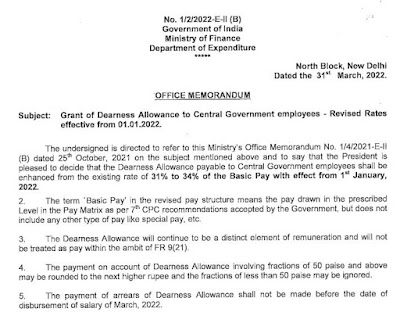
DA Jan 2022 - Grant of Dearness Allowance to Central Government employees - Revised Rates effective from 01.01.2022

 3% DA Hike - Revised Rates effective from 01.01.2022: DoE OM dated 31.03.2022 No. 1/2/2022-E-II (B) Government of India Ministry of Finance...