Showing posts with label Budget. Show all posts

Sunday, 10 September 2017

Finmin to initiate Budget exercise next week


Finmin to initiate Budget exercise next week

Work on India’s first post-GST Union Budget 2018-19 will start next week with the finance ministry issuing timelines for different processes that will culminate with its presentation in February.

Finance Minister Arun Jaitley arrived at the parliament on Wednesday for Budget.

It may also be the current government's last full-fledged Budget as general elections are due in 2019.

Even though independent India’s biggest tax reform of GST was implemented from July 1, the Budget for 2017-18 (April- March), had followed the practice of tax revenue projections under the heads of customs duty, central excise and service tax alongside direct tax numbers.

With excise duty and service tax being subsumed in the Goods and Services Tax (GST), the classifications will undergo change, an official said.

While a new classification for revenues to be accrued from GST will be included in the Budget for next fiscal, for the current year two sets of accounting may be presented - one for actual accruals during April-June for excise, customs and service tax, and the other for July-March period for GST and customs duty.

The official said that since the GST rates are decided by a GST Council, headed by Union Finance Minister and comprising of representatives of all states, the Budget for 2018-19 will not have any tax proposals concerning excise and service tax levies.

Only proposals for changes in direct taxes - both personal income tax and corporate tax, besides customs duty - are likely to be presented in the Budget along with new schemes and programmes of the government.

This will be Finance Minister Arun Jaitley's 5th Budget in a row.

It would also be the last full Budget of the BJP-led NDA government before the 2019 General Elections. As per practice a vote-on-account or approval for essential government spending for a limited period is taken in the election year and a full-fledged budget presented by the new government.

While P Chidambaram had presented the previous UPA government's vote- on-account in February 2014, Jaitley had presented a full budget in July that year.

The official said the finance ministry will next week issue the Budget circular and start consultations with other ministries from October for Revised Estimates (RE) of expenditure for the current fiscal.

The Budget Circular contains the timelines for submission of information of budget requirements to the Ministry of Finance along with prescribed formats.

The ministries will have to provide the actual money spent in 2016-17 along with the budget estimates and Revised Estimates for current fiscal.

Along with this, they have to give the Budget they are expecting for 2018-19 as well, the official added.

Scrapping a colonial-era tradition of presenting the Budget at the end of February, Jaitley had for the first time presented the annual accounts on February 1, 2017.

With the preponement of Budget, ministries are now allocated their budgeted funds from the start of the financial year beginning April.

This gives government departments more leeway to spend as well as allow companies time to adapt to business and taxation plans.

Previously, when the Budget was presented at the end of February, the three-stage Parliament approval process used to get completed some time in mid-May, weeks ahead of onset of monsoon rains.

This meant government departments would start spending on projects only from August-end or September, after the monsoon season ended.

Besides advancing the presentation date, the Budget scrapped the Plan and non-Plan distinction and merged the Railway Budget with it, ending a nearly century-long practice.

PTI

Saturday, 18 March 2017

Parliamentary Panel for shifting fiscal year to January-December


Parliamentary Panel for shifting fiscal year to January-December

New Delhi: India should shift to the January - December financial year by ending the decades old tradition of April - March fiscal introduced by the British, a Parliamentary Panel said today.

The present system was adopted by the Government of India in 1867 principally to align the Indian financial year with that of the British government. Prior to 1867, the financial year in India used to commence on May 1 and end on April 30 of the following year.

Criticising the Finance Ministry for "hastening" the exercise of Budget presentation, the Standing Committee on Finance, chaired by Congress MP M Veerappa Moily, said "greater preparation and adequate groundwork should have been made" before preponing Budget by a month.

"The Committee would thus expect a more thorough exercise next year onwards. Keeping in view the above constraints, the Committee would suggest that the financial year may also be correspondingly shifted to calendar year and the budget date be further advanced correspondingly," it said.

It concurred with the government's decision to advance budget date to end financial business of the government before March 31 so that the respective ministries are able to spend their allocated money from the beginning of the financial year.

Ending the decades old practice of presenting Union Budget on the last working day of February, the government presented the Budget for 2017-18 on February 1.

"The Committee, however, finds that shifting the Budget by one month leads to non-availability of comparative data for almost a quarter and in the process the utilisation of funds, achievement of physical and financial targets cannot be determined," the report said.

The government had last year appointed a high-level committee to study the feasibility of shifting financial year to January 1 from the current practice of starting the fiscal from April 1. The panel submitted its report to the Finance Minister in December.

A Niti Aayog panel, headed by its member Bibek Debroy, had also reportedly favoured following the calendar year as the financial year.

A change in financial year would require amendments in various statutes and changes in tax laws during the transitional period.

The Standing Committee also highlighted “inconsistencies” in budget allocation and occurrence of wide variations between the budget estimates and actuals of various departments.

Giving instances of inconsistent budgeting and recurring occurrences of wide variation between the budget estimates, revised estimates and actuals, it said the budgetary exercise should have been done with greater due diligence.

"The Committee would once again urge that the standard rules and guidelines may be strictly applied and if required, objective parameters may be devised for this purpose so as to avoid inconsistencies and mismatch in their estimates in future and put forth realistic and need based demands," it said.

PTI

Thursday, 2 March 2017

Central government to hire 2.8 lakh staff in a year, police, I-T and customs to get lions share


Central government to hire 2.8 lakh staff in a year, police, I-T and customs to get lions share

New Delhi: The size of the central government, particularly police and tax officials, is likely to grow with the Centre’s Budget providing for the recruitment of around 2.80 lakh more staff.

Of this number, more than 1.80 lakh would be recruits to departments of police, income tax, customs and central excise. As of March 2016, the central government had 32.84 lakh staff across 55 departments and ministries, including 13.31 lakh in railways, but excluding defence forces. This is projected to rise to 35.67 lakh by March 2018 if the recruitment goal is achieved.

Hiring-Spree


Strengthening enforcement agencies seems a priority with budgetary allocations made for expansion of police forces (central paramilitary and Delhi Police), taking their strength from 10.07 lakh to 11.13 lakh by March 2018. The Centre in its Budget has provided for the recruitment of around 2.80 lakh more staff. The income tax department, the agency involved in the drive against black money post-demonetisation, is set to expand from the existing strength of 46,000 to 80,000 by March 2018.

Similarly , customs and excise department, which will implement the ambitious goods and services tax regime, will get additional manpower of over 41,000.The current strength of 50,600 for customs and excise staff is to go up to 91,700. A review of the estimated strength of establishment  in the Budget annexures indicates no change in the manpower of railways, the single largest employer (13.31 lakh) other than defence, in the three years till 2018.

Departments of space, atomic energy , cabinet secretariat and the ministries of information and broadcasting and external affairs are some others where sanctioned strength has gone up significantly.

The government had projected to increase its manpower in 2016 by 1.88 lakh but failed to make fresh recruitments in I-T, customs and central excise departments.This led to an erosion in the employee base by at least 21,000 over the strength in 2015. People superannuating far exceeded new employees.

PM Narendra Modi's interest in foreign policy has translated into a significant jump in the strength of the foreign ministry where the government has decided to add over 2,000 employees -up from 9,294 in 2016 to 11,403 in 2018. The I&B ministry , too, has increased its sanctioned strength from 4,012 two years ago to 6,258 in 2018.The cabinet secretariat has been strengthened with manpower to go up from 921 to 1,218 by next year.

TNN

Wednesday, 18 January 2017

GST: Service tax likely to be hiked to 18 percent this budget


GST: Service tax likely to be hiked to 18 percent this budget

New Delhi: Most services are likely to attract a tax of 18 percent under the Goods and Services Tax (GST) as Union Finance Minister Arun Jaitley presents the Union Budget on February 1.

It will be interesting to witness whether the Centre raises the service tax rate from the existing 15 percent by at least one percentage point to 16 percent as a precursor to the rollout of GST.
However, the Centre and states have agreed to rollout GST from July 1, 2017, after which most services will turn costlier.

Also, a higher service tax, even for three months, will help the Centre partially offset the revenue loss after the GST kicks in, sources indicated.

Under GST, the service tax collections will be divided equally between the Centre and the states. A service tax closer to the GST rate will also help consumers avoid a greater price shock after the new system is rolled out.

Jaitley-headed GST Council has agreed on a four-slab structure -5, 12, 18 and 28 percent-along with a cess on luxury and 'sin' goods such as tobacco.

Within these, two standard rates of 12 percent and 18 percent could extend to a majority of the taxable goods.

ANI

Saturday, 7 January 2017

7th Pay Commission: Higher allowances to be paid after Budget


7th Pay Commission: Higher allowances to be paid after Budget

7th-Pay-Commission-allowances


New Delhi: The higher allowances under 7th pay commission is set to be paid to central government employees and pensioners after the budget 2017-18.

A top official in the Finance Ministry told The Sen Times on the condition on anonymity, "Government is very pleased to pay the higher allowances to its employees after Budget."

He added that the Finance Minister Arun Jaitley had earlier expressed confidence that the currency shortage would be mitigated after December 30.

"The acute cash crunch in banks and ATMs that prevailed for a month following the demonetization move of the government has eased from January 1, as the daily withdrawal limit from ATMs has been increased from Rs 2,500 to Rs 4,500. Hence, the Finance Ministry felt it would be wiser to announce of higher allowances after Budget." the official revealed.

Currently, the central government employees are getting hike in basic pay with retrospective effect from January 2016 under the recommendations of the 7th Pay Commission but they are getting allowances according to the 6th Pay Commission recommendations.

The 7th pay commission had recommended of abolishing 51 allowances and subsuming 37 others out of 196 allowances, so the government referred hike in allowances other than dearness allowance to the 'Committee on Allowances' headed by the Finance Secretary Ashok Lavasa for examination.

The 'Committee on Allowances' has finalized the report on the allowances in October, however the government gave extension the committee till February 22, 2017 to submit its report.

TST

Tuesday, 18 October 2016

Cabinet may consider Budget on Feb 1 this week


Cabinet may consider Budget on Feb 1 this week

New Delhi: The Cabinet is likely to consider this week fixing February 1 as date of presentation of the budget after the Election Commission gave its nod in light of upcoming Assembly elections in five states.
Having decided to advance the budget presentation by a month, the government took the line that it should not be presented in the middle of Assembly poll in Uttar Pradesh, Punjab, Uttarakhand, Goa and Manipur.
So, it consulted the Election Commission, which has concurred with the finance ministry’s view that it is an annual financial statement and can come anytime of the government’s choice, officials said.

The Cabinet headed by Prime Minister Narendra Modi is likely to meet on Wednesday or Thursday to decide on the date for Finance Minister Arun Jaitley to present the budget for 2017-18.

The Cabinet on September 21 had in-principle decided to end the colonial-era tradition of presenting the Union budget on last day of February and advance it by about a month to help complete the legislative approval for annual spending plans and tax proposals before beginning of the new financial year on April 1.
“The reason we wanted to advance the date was that we want the entire budgetary exercise to be over and the Finance Bill to be passed and implemented from April 1 onwards rather than June because then the monsoon sets in and effectively, the expenditures start in October,” Jaitley had stated last week.

Stating that the government wants expenditure to start in April itself, he had said there are five state Assembly elections lined up in 2017.

“So, we are just trying to co-ordinate that you do not have to announce the Budget bang in the middle of an election date. It should be reasonably before that or after that,” he had said.

The finance ministry had been proposing that the Budget presentation be fixed for February 1 and the entire exercise be completed by March 24.

It wanted the Budget Session of Parliament to begin before January 25 and go in for a three-week break between February 10-15 before reconvening between March 10-15 to complete the legislative exercise.

PTI

Wednesday, 18 May 2016

Finmin constitutes Fiscal Responsibility and Budget Management panel, N K Singh to be chairman

Finmin constitutes Fiscal Responsibility and Budget Management panel, N K Singh to be chairman

The Union Finance Ministry on Tuesday constituted a five member Fiscal Responsibility and Budget Management (FRBM) panel.

The panel would be headed by former Revenue and Expenditure Secretary and Member of Parliament N K Singh. Former Finance Secretary Sumit bose, Chief Economic Advisor Arvind Subramanian, Director of National Institute of Public Finance and Policy Rathin Roy and Deputy Governor of RBI Urijit Patel will be its members.

The panel will examine fiscal deficit range instead of fixed targets and look into feasibility of fiscal expansion or contraction in relation to credit expansion and contraction.

The FRBM Act deals with matters of fiscal discipline, such as spending and deficit, along with management of macro-economic factors and public funds.

The FRBM committee would submit its report to the government by October 31.

The panel, which was announced by Union Finance Minister Arun Jaitley in his Budget speech, will look into factors that influence the country’s fiscal targets.

ANI

Flash News

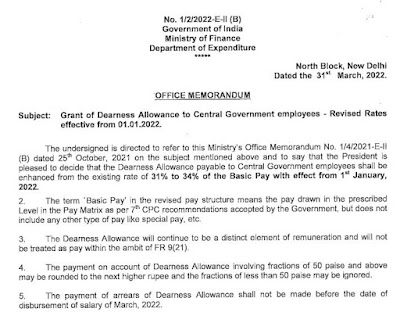
DA Jan 2022 - Grant of Dearness Allowance to Central Government employees - Revised Rates effective from 01.01.2022

 3% DA Hike - Revised Rates effective from 01.01.2022: DoE OM dated 31.03.2022 No. 1/2/2022-E-II (B) Government of India Ministry of Finance...