Wednesday, 24 June 2015

CSD Purchase Entitlement for Car, Bike, TV, WM and Refrigerator – CSD Guidelines on June 2015

CSD Purchase Entitlement for Car, Bike, TV, WM and Refrigerator – CSD Guidelines on June 2015

GUIDELINES FOR PURCHASE OF FOUR / TWO WHEELERS & OTHER AFD-I ITEMS
ENTITLEMENT FOR FOUR WHEELERS:

PURCHASE OF FOUR  TWO WHEELERS CSD

Entitlement for AFD-I items other than car (refrigerator, tv, w/machine, two wheelers etc.)
For all categories after every three years.

Procedure for purchase of four wheelers:
  • Customer who wishes to purchase four wheelers through CSD must obtain sanction from the office of Deputy Director General Canteen Services (DDGCS), QMG Branch, New Delhi in the prescribed application form.
  • Obtain availability certificate from the dealer.
  • On receipt of approval letter from DDGCS, QMG Branch New Delhi submit prescribed application (CSD Depot Indent form) at the concerned depot alongwith availability certificate and payment in the form of DD or RTGS/NEFT.
Other documents required at the depot for verification in addition to copy of car sanction letter from DDGCS, QMG Branch.
  • CSD depot indent form duly countersigned by Commanding Officer of the unit for serving personnel or by Station Commander or Dy Director of Zila Sainik Board for Ex-Servicemen.
  • Car sanction letter from DDGCS office, QMG Branch.
  • Copy of PAN card/ Form 16.
  • Copy of driving license (relaxable for retired PBORs & Senior citizens)
  • Certified copy of paybook bearing entry with regard to purchase of car (applicable only for serving JCOs/OR and equivalents).
  • Certificate from the CO/OC of Unit confirming that financial position of the applicant allows to purchase a car (applicable only for serving JCOs/OR and equivalents).
  • PPO/Discharge book/Release Order (for ESM).
  • Any other document as prescribed under the respective State Govt. notification.This is essential since State Govts while extending VAT relaxation prescribe specific documents to be submitted.
  • Address proof.
Procedure for purchase of two wheelers & other AFD I items:

Entitled customer can purchase the items from CSD depots on submission of prescribed application form duly filled in alongwith payment either by DD or RTGS/NEFT. No prior sanction is required for two wheelers and other AFD I items from QMG’s Branch.

Miscellaneous points
  • DD to be drawn in favour of “Canteen Stores Department, Public Fund Account (Main) from any nationalized bank payable at the station of CSD depot. Prior to making the bank draft latest rates should be confirmed from the concerned depot/ dealer as these are subject to change. For approximate rates please go to product search on the Home Page of this website.
  • On submission of application and payment, concerned depot will release documents such as OR, Sale letter, Supply Order, Authority letter etc.
  • These documents have to be submitted to the concerned dealer for effecting delivery of the item.
  • Payment for registration and insurance will be made to the dealer and not to CSD depot.
  • For additional accessories, customer has to bear the expenses.
  • In case a vehicle has a waiting list in the civil market, the same should be booked with a dealer who is affiliated with CSD, with minimum booking amount as decided by the manufacturer. Full payment can be made with CSD depot once the vehicle is available and the dealer issues an availability certificate. Advance booking of the vehicle with the civil dealer will be governed by the rules as promulgated by the manufacturer/dealer. This will save unnecessary blockage of funds.
  • No payment is to be made on account of CSD handling charges/ logistic charges
    etc. to the dealer.
  • Price will be charged as applicable at the time of delivery of item.
  • No interest will be paid by CSD or by the dealer for late delivery of the vehicle.
  • Business hours of CSD depots vary so please contact CSD depot concerned to ascertain transaction timings.
  • No transactions are entertained on Sundays and Holidays.
Authority: www.csdindia.gov.in

Clarifications on different scenarios being faced or likely to be faced by Post Offices after implementations of CBS

Clarifications on different scenarios being faced or likely to be faced by Post Offices after implementations of CBS
process+under+cbs+post+office
SB Order No. 7/2015
Government of India
Ministry of Communication & IT
Department of Posts
Dak Bhawan, Sansad Marg,
New Delhi-110001.
Date: 18.06.2015
To
All Heads of Circles/Regions
Addl. Director General APS, New Delhi.
Subject- Clarifications on different scenarios being faced or likely to be faced by Post Offices after implementations of CBS.
Sir/ Madam.
The undersigned is directed to refer to this office letter of even number dated 06.08.2014 (SB Order No.8/2014) & 14.08.2014 (Addendum to SB Order No. 8/2014) on the subject.

2. The competent authority has reviewed the process of all the 14 scenarios circulated vide above reference in the light of roll out of CBS HOs and 1790 SOs across the country as well as change in the process of Circle Processing Centres (CPC). Process mentioned in the scenario No. 2,3,5,6,10,11 and 14 have been revised. Revised process pertaining to these scenarios is attached as ANNEXURE with this letter. This will supersede the process circulated vide SB Order No. 8/1014 and Addendum to SB Order No.8/2014

3. This may kindly be circulated to all post offices for guidance and necessary action.
Yours faithfully,
(Kawal Jit Singh)
AD (SB-II)
ANNEXURE
Revised procedure to be followed in ease of following scenarios which will supersede the existing procedure.
2.Scenario:- When a Certificate holder attends any CBS Post Office to encash certificates either on maturity or for premature closure where certificates were purchased from other CBS Post Office. 

The Counter PA should first go to HACLI and see that Certificates are genuine and stand in Finacle. He/She will verify signatures of the holder(s) on the certificates with that available in Finacle. Once, it is confirmed from the signatures that holder is genuine, holder should be asked to fill NC-32 and give fresh ID as well as Address Proof and Mobile number. After proper verification of KYC documents. Certificates first be transferred IN by using HACXFSOL. Customer’s new address and mobile number should be entered through account modification menu and it should be verified by Supervisor. Then payment should be mode by crossed cheque or credit to savings account. Payment should not be made by cash in any case
An intimation of Transfer/Discharge should be sent to the office of issue by service registered post which will make Transfer/Discharge entry in the Purchase Application (in case of old certificates) or AOF.
NC-32 and KYC documents should he preserved in the CBS Post Office in a A4 size Ring Guard File.

3.Scenario:- When any claimant (In ease of death of holder) presents certificates issued by another CBS Office alongwith claim application form for payment or transfer to the claimant’s name.
In CBS environment claim form can be submitted at any CBS post office. What such a claim is presented at any CBS post office. first of all. user has to enter date of death in the CIF and supervisor has to verify. Then procedure of settlement of deceased claim case has to be followed. After sanction of claim. if claimant wants payment, procedure mentioned in scenario 2 should be followed. If claimant wants to transfer of certificates in his/her Mine. open new CIF in his/her name hosed on new AOF (if no CIF is available in his/her name) and attach the existing Certificates (Accounts) with new CIF. Name of holder can he changed through menu HAALM.

In this case also, an intimation of Sanction of Claim/Transfer/Discharge alongwith copy of sanction memo should be sent to the office of issue by service registered post which will make Death/Transfer/Discharge entry in the Purchase Application (in case old certificates) or AOF.

Claim Application Form and KYC documents of claimant and Account Opening Form (AOF) should be preserved in the CBS Post Office. If certificates are transferred in the name of claimant. KYC Form NB to be taken from the claimant and sent to CPC of the office where claim is sanctioned CPC will scan the Photograph and signature and attach the same with new CIF.

3. Scenario:- When Account Holder of MlS/SCSS/TD scheme approaches any CBS Post Office for taking Interest or closing accounts.
The Counter PA should fast go to HACLI and see that Accounts) are genuine and stand in Finacle. He/She will verify signatures of the holder) on the withdrawal Form or Account Closure Form with that available in Finacle. Once. it is continued from the signatures that holder is genuine, payment of interest should be made to the account holder as per process being followed for normal withdrawal. If account closure is requested. take SB10(b) form, fresh ID as well as Address Proof. After proper verification of KYC documents. Accounts(s) first to be transferred IN by using HACXFSOL. Whenever any account is closed at the office other than the office where account was opened. In any case. payment should not be ade by cash and payment should either be made by crossed cheque or credit to savings account (where required KYC documents have been taken and signatures are available in the system) only.

SB10(b) and fresh KYC documents obtained should be preserved in the CBS Post Office where payment is made. An intimation of Transfer/Closure should be sent to the office from where the account was transferred by service registered post which will make Transfer/Closure entry in the original AOF.

6.Scenario:- When any claimant presents documents {or preferring claim (In case of death of depositor) in respect of any MlS/SCSS/TD/RD/PPF accounts stand at another CBS Office alongwith claim application form for payment or transfer of account (RD/TD/SCSS) {only spouse}) in the name of claimant.

Death should be noted in the relewmt field in CIF of deceased depositor. Follow the procedure laid down for settlement of deceased claim case. After sanction of claim. follow the procedure mentioned in scenario 5 above. If claimant wants to transfer RD/TD/SCSS (only spouse) account in his/her name. open new CIF (based on new Account Opening Form (AOF)} in his/her name (if not already exists) and attach the existing Accounts with new CIF. Name of holder can be changed through menu HAALM.
Claim Application Form and KYC documents of claimant or Account Opening Form (AOF) should be preserved in the CBS Post Office and in case account(s) is/are transferred in the name of claimant. KYC Form has to be obtained and sent to CPC of the office where claim is sanctioned. CPC will scan the Photograph and Signature and attach the same with new CIF.

10.Scenario:- An account holder of a CBS Post Office applies for transfer of account to any Non CBS Post Office or any account holder of non-CBS post Office to a CBS Post Office.

Transfer of account from CBS Post Office to Non-CBS Post Office and vice verse is not allowed. However, Postmaster or Sub Postmaster of SOIHO where transfer of account is applied will go to DMCC Chennai website to see list of CBS Post Offices and confirm that post office to which transfer is applied is a CBS Office or not. If SO is completely manual and unable to see the I’m. it will be the duty of HO that before issue of AT, list should be consulted and if that post office is already in the list of CBS Post Offices. AT should not be issued.

In case transfer is sought from CBS to a non CBS Post Office. Account holder should be advised to select a nearby CBS Post Office (from the list) and get account transferred or avail services of that CBS Post Office
In case transfer is sought from a non CBS Post Office to a CBS Post Office. account holder should be advised to get his/her account transferred to a nearby non CBS Sub Post office.

11. Scenario:-Inter CBS Post office Transactions (INTERSOL TRANSACTIONS)
In CBS environment. transactions can be initiated in any CBS Post Office. Any depositor of Savings. RD. TD. MIS. SCSS. PPF or Certificates can initiate Financial Transactions at any CBS Post Office. Transaction will appear in the Report No.19 i.e Common Counter Wise Transactions Report-Inter Branch of the office where transaction is initiated Amount of the transaction would also appear in Consolidation of the same office. No transaction would appear in the office where account/certificate stands. Extra care should be taken at the time of such transactions. In respect of withdrawal from savings Account for more than for Rs. 50,000.’- , it should be allowed only if signatures are available in the system and are tallied In respect of accepting deposits. no extra care is required to be taken. As regards, payment of maturity value of MIS/RD/SCSS/TD/PPF/Certificates procedure given in the relevant scenario should be followed.

Non Financial transaction like modification in account or ClF can be made only the office where account stands and it should be supported by documentary proof. In case of change in name or photograph or address, fresh KYC Form (in duplicate) has to be obtained with documents and one copy of KYC Form has to be sent to CPC for scanning of fresh photograph or signature. Please ensure that all Financial or Non Financial Transactions should be verified by Supervisor/89M at the same office when initiated by PA.

14. Scenario:- A customer wants to do re-investment of matured amount in CBS post office. 
In case. depositor wants re-investment from one scheme’s maturity value to another scheme. customer should be asked if he/she has a Savings Account in any CBS Post Office. If yes, then signature in that account available in the system should be tallied with the signature on the Closure Form or Certificate & if not, customer should be asked to open new savings account under the same CIF (fresh KYC documents and Form should be taken if account/certificate matured belong to pre-migration period). Customer should write on the receipt side of the Account Closure Form or Certificate, the amount to be re-invested. name of scheme and Savings Account number under his/her signatures. In case of new AOF presented for re-investment. under the tiled “Mode of Deposit”. He/she has to write savings account number. In such a case. no separate withdrawal form is required to be given and this transaction has to be treated as non-cash transaction for the purpose of eligibility of commission to agents (if AOF contains detail of agent). Once Postmaster/Sub Postmaster is sure about genuineness of the depositor (from signatures/photograph/any other identification). total maturity value+interest should be credited into that Savings Account and then amount to be re-invested should be debited/withdrawn from this savings account and credited/deposited in the concerned new account while funding.

No re-investment should be accepted if customer does not have a savings account in a CBS Post Office or customer is not ready to open new savings account. in such a case, payment should be made by Postmaster Cheque only.

Source: http://www.staffnews.in/

Pay Commission likely to recommend 16000 as Minimum Salary and 1 lakh as Maximum for Kerala State Employees

Pay Commission likely to recommend 16000 as Minimum Salary and 1 lakh as Maximum for Kerala State Employees

According to the media reports, the 10th Kerala Pay Revision Commission may recommend Rs.16000 as the minimum salary and one lakh as the maximum salary for the employees working under the state government of Kerala. Revision of salary may calculated by merging of 80% Dearness Allowance with basic pay and the result of hike in salary would be 13%. The last Pay Revision Commission the salary hike was 12%.

The State Government of Kerala constituted a committee for the pay revision of its employees under Justice C.N.Ramachandran Nair last year and the committee will submit its report to the Government expected before 30th June 2015.

For state Government employees, Medical Insurance facility in association with private insurance companies may recommend is also expected in this report.

This pay revision will be effect for all employees working under state government and local self-government bodies, teachers in government and government-aided schools and colleges and university employees.

Source: 7thpaycommissionnews.in

Tuesday, 23 June 2015

Disciplinary action may be taken against Central Government Employees who are habitual late attendance – Dopt Orders on 22.6.2015

Disciplinary action may be taken against Central Government Employees who are habitual late attendance – Dopt Orders on 22.6.2015

Dopt once again issued orders on the subject of punctuality in Government Offices. The order is directed to take disciplinary action against Central Government employees who are habitual late attendance.

Observance of punctuality in Government Offices – Dopt Orders

G.I., Dept. of Per.& Trg., O.M.No.11013/9/2014-Estt.A-III, dated 22.6.2015
Subject: Observance of punctuality in Government Offices.

Instructions have been issued from time to time with regard to the need to observe punctuality by Government servants. Responsibility for ensuring punctuality in respect of their employees rests within Ministries/ Departments/ Offices.

2. The decision to introduce AADHAR enabled Bio-metric Attendance System (AEBAS) in Central Government offices, including attached/ sub-ordinate offices, to replace the manual system of marking of attendance to ensure punctuality is to be implemented in all Ministries/ Departments. This Department vide O.M. of even no. dated 21.11.2014 and 28.01.2015, while recognizing that the Biometric Attendance System is only an enabling platform had, inter-alia, stated that there was no change in the instructions relating to office hours, late attendance etc.

3. In this connection attention is invited to Rule 3(1)(ii) of CCS (Conduct) Rules, 1964 which stipulates that every Government servant shall at all times maintain devotion to duty. Habitual late attendance is viewed as conduct unbecoming of a Government servant and disciplinary action may be taken against such a Government servant. It is also added that punctuality in attendance is to be observed by Government servants at all levels.

4. It is also requested that the necessary directions may be issued to all employees to mark their attendance in BAS portal on regular basis.

Click to view the original order

Authority: www.persmin.gov.i

Benefits& Drawbacks of Pay Band and Grade Pay system introduced by 6th CPC

SUPPLEMENTARY MEMORANDUM SUBMITTED BY IRTSA
TO SEVENTH CENTRAL PAY COMMISSION
Chapter – 13
BENEFITS & DRAWBACKS OF PAY BAND & GRADE PAY SYSTEMINTRODUCED BY SIXTH CENTRAL PAY COMMISSION
13.1. Benefits& Drawbacks of Pay Band and Grade Pay system introduced by 6th CPC

Benefits & Drawbacks of Pay Band & Grade Pay System
  • Problem of Pay stagnation eliminated
  • Quantum of increment increases exponentially, but the difference is too large at higher levels.
  • Grade Pay decides the hierarchy.
  • Increase of Pay in Pay Band & Grade Pay is not uniform – in favour of higher scales.
  • Arbitrary adoption of formula of 40% of maximum of the merged scales for deciding the Grade Pay.
  • Inadequate rate on annual increment & increment during promotion.
  • Situation of senior promotes getting less pay than Junior direct recruits, is in violation of basic principle of Pay Band system.


i. Problem of stagnation in pay is eliminated, since pay bands are having long spans.

ii. If employees are stagnated at the maximum of any pay band for more than one year, continuously, he/she shall be placed in the immediate next higher pay band without change in the Grade Pay.

iii. Point to point fixation was facilitated by the pay band system, (with one increment in the revised pay cale for every three increments in the pre-revised scale)
  • But the employees with more years of service were placed in a disadvantageous position.
iv. Quantum of increment increases exponentially, instead of fixed rate of increment attached to every pay scale
  • But the difference became very large at higher levels – thus causing discrimination with those at middle & lower levels.
v. Grade Pay decides hierarchy / seniority of the post.

13.2. Main Draw backs of Pay Band and Grade Pay system introduced by 6th CPC

i. Increase between minimum basic pay of prerevised scale and minimum of every Revised Pay Band is not uniform. There is much greater increase in favour of PB-3 & PB-4.

ii. Arbitrary adoption of formula of 40% of maximum of the merged scales for deciding the Grade Pay – instead of progressive and proportionate rise of Grade Pay from one scale to the next.

iii. Disproportionate rise of pay after Sixth Pay commission – due to grant of disproportionate Higher Grade pays in higher scales (S-24 & above) as compared to S-4 to S-23 (Please see details in the following Table and also the table in next page)

Pay BandMinimum of V CPC scaleMinimum of pay bandNo. of times increase of Pay after 6th CPC
1234 (Col. 3 / 2)
S-1255044401.74
PB-1275052001.89
PB-2500093001.86
PB-38000156001.95
PB-414300374002.62
Rise is 3 to 3.37 times at higher levels. (Please see Table at the end of this Chapter)

iv. Rate of annual increment (3% of basic pay) is inadequate.
v. Increment on promotion (difference in grade pay + one additional increment) is inadequate.

vi. Situation of senior promotes getting less pay than Junior direct recruits, is in violation of basic principle of Pay Band system. For example,

a. A JE with five years of service while getting regular promotion from Grade Pay Rs.4200 in PB-2 to Grade Pay Rs.4600 as SSE is fixed at a Basic pay of Rs. 16120 compared to the Direct recruit’s basic pay of Rs.17140.

b. A JE with five years of service while getting promotion (through LDCE) from Grade Pay Rs.4200 in PB-2 to Grade Pay Rs.4800 as AWM/AME/AE is fixed a Basic pay of Rs. 16120 compared to the Direct recruit’s basic pay of Rs.18150.

c. Pay on Promotion should be fixed at least at par with Entry Pay in the Revised Pay Structure for direct recruits.

Table for Para 13.2.iii
DISPROPORTIONATE RISE OF PAY AFTER SIXTH PAY COMMISSION
Pay
Band
Pay + GPV CPC minimum paySixth CPC ScaleNo. of times increase from V CPC to
VI CPC
Starting pay in Pay bandGrade
Pay
Revised Basic pay
PB-15200-20200+180027505200180070002.55
PB-15200-20200+190030505880190077802.55
PB-15200-20200+200032006060200080602.52
PB-15200-20200+240040007440240098402.46
PB-15200-20200+2800450083702800111702.48
PB-29300-34800+4200500093004200135002.70
PB-29300-34800+42005500102304200144302.62
PB-29300-34800+42006500120904200162902.51
PB-29300-34800+46007450138604600184602.48
PB-29300-34800+48007500139504800187502.50
PB-29300-34800+54008000148805400202802.54
PB-315600-39100+54008000156005400210002.63
PB-315600-39100+54009000167405400221402.46
PB-315600-39100+660010325192106600258102.50
PB-315600-39100+660010000186006600252002.52
PB-315600-39100+660010650198106600264102.48
PB-315600-39100+760012000223207600299202.49
PB-315600-39100+760012750237207600299202.35
PB-315600-39100+760012000223207600299202.49
PB-437400-67000+870014300374008700461003.22
PB-437400-67000+870015100396908700483903.20
PB-437400-67000+890015400396908900485903.16
PB-437400-67000+890016400396908900485902.96
PB-437400-67000+10000143003740010000474003.31
PB-437400-67000+10000184004470010000547002.97
HAG67000-7900022400670002.99
HAG+ Scale775500-8000022400755003.37
HAG+ Scale775500-8000024050755003.14
Apex80000 (Fixed)26000800003.08
Cab.
Sec.
90000 (Fixed)30000900003.00
benefit+drawback+grade+pay+pay+band+system
[http://www.staffnews.in/2015/06/benefits-drawbacks-of-pay-band-and.html]

Denial of interim relief and the benefit of merger of DA with Pay must be viewed very seriously – NC JCM

Denial of interim relief and the benefit of merger of DA with Pay must be viewed very seriously – NC JCM

NATIONAL JOINT COUNCIL OF ACTION
4, State Entry Road New Delhi–110055
No.NJCA/2015
Dated: June 15, 2015
All the Members of the NJCA,

Dear Comrades,

Sub: National JCA Meeting held on 8th June

The National JCA, which met at the Staff Side Office on 8th June, 2015, took note of the fact that quite a few states are yet to hold the State Level Conventions. The meeting also noted that the strike decision taken on 28th April, 2015 has not been percolated down to the rank and file of the workers. The meeting wanted the affiliate to realize that the denial of the demand for wage revision to be effective from 01.01.2014 and the consequent denial of interim relief and the benefit of merger of DA with Pay must be viewed very seriously as the said decision will have far reaching consequence. The Government would discard the age old practice of grant of I.R. and merger of DA forever. It has decided to appeal to all the affiliates to chalk out independent programmes of actions in the months to come and to carry out the same in all seriousness so that the employees become fully aware of the possible outcome of the 7th CPC. The Chairman and Convenor of the National JCA will get in touch with those States, where the convention has not been held so far. The meeting decided to convey to members that the minimum wage computation, in the given situation would be on an imaginary basis. The National JCA was of the opinion that a meeting of all office bearers of the participating organizations must be convened at Delhi somewhere in the month of July to chalk out programmes of action to be pursued by the CGEs together. It was informed at the meeting that both Defence and Railways would be taking their strike ballot and would be concluded in the first week of October. The meeting, therefore, decided to advise the other units to chalk out progammes of action in July so that an ambience of struggle could be created. The NJCA also took note of the painful fact that despite assurances, Government was not convening the National Council and Departmental Councils and the JCM has been allowed to become defunct. The National JCA in conclusion decided to appeal to all affiliates to take concrete steps to invigorate the joint movement of the Central Government employees and meet the challenge that is likely to arise on receipt of the recommendations of the 7th CPC by creating an atmosphere of Unity, and determination to carry out the call of indefinite strike action scheduled to commence on 23rd November, 2015.
With greetings,
(Shiva Gopal Mishra)
Secretary (Staff Side)
NC JCM & Convener
Source: www.ncjcmstaffside.com

Monday, 22 June 2015

Finance Ministry approved 10th Bipartite Settlement Wage Revision for Bank employees for period 1.11.2012 to 31.10.2017

Finance Ministry approved 10th Bipartite Settlement Wage Revision for Bank employees for period 1.11.2012 to 31.10.2017

Salary Revision for Officer Employees of Public Sector Banks governed by Officer’s Service Regulation – 10th Bipartite Settlement for period 1.11.2012 to 31.10.2017

Government of India
Ministry of Finance
Department of Financial Services
Jeevan Deep. IIIrd Floor,
Parliament Street, New Delhi,
Dated the June 19, 2015
To
Sh. M.V.Tanksale,
Chief Executive,
Indian Banks’ Association,
Mumbai.

Subject: Salary Revision for Officer Employees of Public Sector Banks governed by Officer’s Service Regulation – 10th Bipartite Settlement for period 1.11.2012 to 31.10.2017

Sir.
I am directed to refer to your letter No. HR&IR/KSC/GOVT/665 dated 25th May, 2015 on the above subject and to say that Government has ‘No objection‘ to IBA authorizing the Banks to pay revised salary and arrears of pay and allowances to serving officers and revised pension and arrears to existing pension optees retired w.e.f. on or after 1.11.2012 as per the provisions at the Joint Note pending amendments to the Officer’s Service Regulations/Pension Regulations subject to the provisions made by the respective banks in the particular year.

2. As regards declaring 2nd and 4th Saturday as holidays and other Saturdays as full working days is concerned. IBA may rater to this Department’s letter No. 4/1/7/2015-IR dated 2.6.2015.

3. This issues with the approval of Hon’ble Finance Minister
Yours faithfully,
(S R. Mehar)
Deputy Secretary to the Government at India
10th Bipartite Settlement Wage Revision
Source: http://banknewskumar.blogspot.in/

Additional Memorandum to 7th Central Pay Commission – IRTSA

Additional Memorandum to 7th Central Pay Commission – IRTSA

Pros and Cons of Pay Band and Grade Pay System
Indian Railways Technical Supervisors Association already submitted a complete memorandum to 7th Pay Commission on 26.5.2014 and Oral evidence and Power Point Presentation also by IRTSA on 12.12.2014. Now, an another supplementary Memorandum submitted to 7th Central Pay Commission on 17.6.2015. The rejoinder memorandum insists on the demands of Higher Grade Pay and Classification of posts of Technical Supervisors in Railways.

SUPPLEMENTARY MEMORANDUM SUBMITTED BY IRTSA
TO SEVENTH CENTRAL PAY COMMISSION
Chapter – 13
BENEFITS & DRAWBACKS OF PAY BAND & GRADE PAY SYSTEM INTRODUCED BY SIXTH CENTRAL PAY COMMISSION

13.1. Benefits& Drawbacks of Pay Band and Grade Pay system introduced by 6th CPC
i. Problem of stagnation in pay is eliminated, since pay bands are having long spans.

ii. If employees are stagnated at the maximum of any pay band for more than one year, continuously, he/she shall be placed in the immediate next higher pay band without change in the Grade Pay.

iii. Point to point fixation was facilitated by the pay band system, (with one increment in the revised pay cale for every three increments in the pre-revised scale) – But the employees with
more years of service were placed in a disadvantageous position.

iv. Quantum of increment increases exponentially, instead of fixed rate of increment attached to every pay scale – But the difference became very large at higher levels – thus causing discrimination with those at middle & lower levels.

v. Grade Pay decides hierarchy / seniority of the post.

13.2. Main Draw backs of Pay Band and Grade Pay system introduced by 6th CPC
i. Increase between minimum basic pay of prerevised scale and minimum of every Revised Pay Band is not uniform. There is much greater increase in favour of PB-3 & PB-4.

ii. Arbitrary adoption of formula of 40% of maximum of the merged scales for deciding the Grade Pay – instead of progressive and proportionate rise of Grade Pay from one scale to the next.

iii. Disproportionate rise of pay after Sixth Pay commission – due to grant of disproportionate Higher Grade pays in higher scales (S-24 & above) as compared to S-4 to S-23 (Please see details in the following Table and also the table in next page)
Supplementary_Memorandum_to_7th_CPC
iv. Rate of annual increment (3% of basic pay) is inadequate.

v. Increment on promotion (difference in grade pay + one additional increment) is inadequate.

vi. Situation of senior promotes getting less pay than Junior direct recruits, is in violation of basic principle of Pay Band system. For example,

a. A JE with five years of service while getting regular promotion from Grade Pay Rs.4200 in PB-2 to Grade Pay Rs.4600 as SSE is fixed at a Basic pay of Rs. 16120 compared to the Direct recruit’s basic pay of Rs.17140.
b. A JE with five years of service while getting promotion (through LDCE) from Grade Pay Rs.4200 in PB-2 to Grade Pay Rs.4800 as AWM/AME/AE is fixed a Basic pay of Rs. 16120 compared to the Direct recruit’s basic pay of Rs.18150.

c. Pay on Promotion should be fixed at least at par with Entry Pay in the Revised Pay Structure for direct recruits.

Supplementary_Memorandum_to_7 CPC
Source: IRTSA

One Rank One Pension – Central Government Ignores Week-long Protests

One Rank One Pension – Central Government Ignores Week-long Protests

“The protests that began in New Delhi’s Jantar Mantar last Monday, demanding immediate implementation of the OROP continues even as the government chooses to turn a blind eye towards it”
Ex-servicemen have been protesting now for a week at New Delhi’s Jantar Mantar, demanding the immediate implementation of the OROP scheme. Similar protests are also on at 20 important cities in the country to put pressure on the government to act.

The series of protests is jointly organized by 30 ex-servicemen welfare organizations, under the leadership of Chairman of IESM, Maj. Gen. Satbir Singh. Speaking to the media, Satbir Singh said, “Until now the Government has not tried to negotiate with us. If there are no results for the protests, we will shift our protests to Bihar.”

The protesters believe that the government will be more receptive to their demands if the protests affect the party’s chances of winning the state elections in Bihar.

BJP’s parliamentary election manifesto last year promised immediate implementation of the OROP if they come to power. After coming to power, assurances were given by the ministers including the prime minister himself.

Ex-servicemen expected a formal announcement to be made at the first year rally. But, not a word was uttered about this. The ex-servicemen did not lose hope.

On June 1, in his ‘Mann ki Baat’ radio show, the prime minister assured that he will implement the OROP scheme.

Media reports indicated that sufficient funds were allocated in the previous financial year and that steps are on to implement the scheme. Reports further added that the revised pension scheme is very similar to those of the MPs. But, one has to also accept the fact that the scheme is much closer to implementation than it ever was during the Congress regime.

Many wonder why the army-men have resorted to protests. A number of reasons are being given for the protests.

Excess of trust in Modi government is one of the reasons. Congress-led UPA government, which failed to implement the OROP scheme, suffered humiliating defeat in the elections. The second reason is that more than 30 lakh ex-servicemen and their families spread throughout the country believed in the promises made by the BJP in its election campaign.

The third reason – contradictory stands among the Ministries of Finance and Defence – is considered to be the most important. There are claims that the Ministry of Finance had asked the Defence Ministry to refer to the 7th Central Pay Commission. This is rumoured to be the stand of the bureaucrats.

There have been warnings that implementing the OROP scheme is an expensive task and changes will have to be made to the current pension structure for the Central Government employees and Pensioners. The message was subtly conveyed to the representatives of ex-servicemen by the defence ministry. This had greatly angered the delegates. Protests were launched amidst worries that OROP will be shelved again.
Even now, the ex-servicemen trust the Prime Minister Modi because he doesn’t believe the bureaucrats easily.

Source: 7thpaycommissionnews.in

Absorption of medically unfit staff of RPF/RPSF in alternative post- Regarding

Absorption of medically unfit staff of RPF/RPSF in alternative post- Regarding

RBE No. 61/2015
GOVERNMENT OF INDIA
MINISTRY OF RAILWAYS
(RAILWAY BOARD)
No.E(NG)I-2015/RE-3/2
New Delhi, dated 12.06.2015
The General Managers (P)
All Zonal Railways & Production Units,
(As per standard list).
Sub:- Absorption of medically unfit staff of RPF/RPSF in alternative post- Regarding.
A question as to how the medically incapacitated staff of Railway Protection Force/Railway Protection Special Force may be absorbed in alternative jobs in other departments of the Zonal Railways has been under consideration of Railway Board.

2. Attention in this connection is invited to Board’s letter No. E(NG)I-88/RE-3/2 dated 18.01.1989 which provide that medically unfit RPF/RPSF staff may be first considered for absorption in ministerial post in their own department. The Committee constituted for considering such alternative appointments shall include an officer of the Personnel Department. In case no suitable posts to so accommodate them in RPF department are available, they may be considered for absorption in alternative posts in other departments of the railways within the framework of the provisions contained in Chapter XIII of the Indian Railway Establishment Manual Vol.I, Revised Edition 1989, First Reprint Edition-2009. Similarly, when staff of other departments are medically decategorised, they will also be considered for absorption against suitable posts in their own department at the outset and in case no posts are available therein then such staff will be considered against Ministerial posts in the RPF department, if such posts are available in that Department.
 
3. The matter has been considered by the Board. It is reiterated that the above instructions/procedure may be followed scrupulously in order to maintain the uniformity on all the Zonal Railways.
 
(This dispose of South Western Railway’s letter No.SWR/P.573/Med.Decatg/Vol.I dated 22.05.2014).
Receipt of this letter may be acknowledged.
(M.K.Meena)
Deputy Director Estt. (N)
Railway Board
Source: AIRF

Flash News

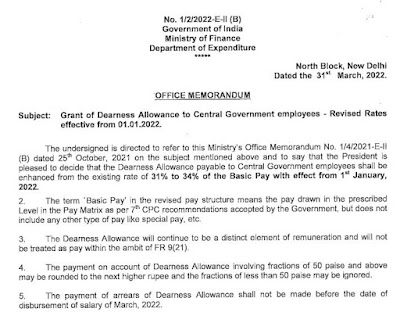
DA Jan 2022 - Grant of Dearness Allowance to Central Government employees - Revised Rates effective from 01.01.2022

 3% DA Hike - Revised Rates effective from 01.01.2022: DoE OM dated 31.03.2022 No. 1/2/2022-E-II (B) Government of India Ministry of Finance...