Showing posts with label pay revision. Show all posts

Tuesday, 3 September 2019

Long pending demands of the Central Government employees - CHARTER OF DEMANDS OF CONFEDERATION

Long pending demands of the Central Government employees - CHARTER OF DEMANDS OF CONFEDERATION

No.Confdn/Memorandum/ 2016-19
05th September 2019
To
Shri. Narendra Modiji,
Hon’ble Prime Minister of India,
South Block,
New Delhi - 110 001.

Respected Prime Minister,

Sub: Memorandum on the long pending demands of the Central Government employees - Request for kind intervention - regarding.

This Memorandum is submitted with the most fervent hope that the Hon’ble Prime Minister will be condescend to intercede on our behalf to settle the following long pending issues agitating the minds of 32 lakhs Central Government employees and 33 lakhs Central Govt. Pensioners.

1. Scrap New Contributory Pension Scheme (NPS) and restore Defined benefit Old Pension Scheme (OPS). Guarantee 50% of the last pay drawn as Minimum Pension.

Government of India has implemented New Contributory Pension Scheme (NPS) for all Central Govt. employees entering service on or after 01-01-2004. When compared to the Old Defined Benefit Pension Scheme (OPS) there are many adverse factors in the NPS. The monthly pension amount being received under the Insurance Annuity Scheme under NPS is less than Rs.3000/- per month, to those NPS employees who had already retired from service during 2018 and 2019, after completing 14 to 15 years of service, whereas as per the Old Pension Scheme an employee who completes minimum ten years qualifying service will get 50% of the last pay drawn as Minimum Pension which in any case will not be less than Rs.12,000/- for a lowest level employee (Multi Tasking Staff) with ten years service in Central service. Thus the very principle laid down by the Hon’ble Supreme Court of India that “Pension is a social welfare measure rendering socio-economic justice to those, who in the hey day of their life ceaselessly toiled for the employer on an assurance that in their old age, they would not be left in lurch”, stands defeated.

Seventh Central Pay Commission headed by Retired Justice of Supreme Court Shri. Ashok Kumar Mathur, in its report made the following observations about NPS:

Almost a whole lot of Government employees appointed on or after 01-01-2004, were unhappy with the New Pension Scheme. Government should take a call to look into their grievances”.
Govt. appointed a Secretary level committee called “NPS Committee” for streamlining the NPS, but that committee was not empowered to look into the main demand of the NPS employees i.e., scrap NPS, restore OPS and guarantee 50% of the last pay drawn as monthly pension. It is true that as per the recommendations of the NPS Committee, Govt’s contribution to NPS is increased to 14% from 10% and some other cosmetic changes are also made in the NPS Rules. But the basic grievance still remained unattended and unsettled, as a result uncertainty about the social security and Pension looms large over the head of every NPS employee, and the discontentment among the NPS employees (as correctly observed by 7th CPC) is growing day by day. We request the Hon’ble Prime Minister to have a relook into the entire matter, so that NPS will be scrapped and OPS will be restored and at least 50% of the last pay drawn will be guaranteed under Rules as Minimum monthly Pension on retirement.

2. Honour the assurances given by Group of Ministers on 30-06-2016 to National Council (JCM) Standing Committee members regarding increase in Minimum Pay and fitment factor recommended by Seventh Central Pay Commission (CPC) :

All the Federations/Unions/Associations in the Central Govt. Employees sector including Railways, Defence and Confederation had given a call for nationwide indefinite strike from 11th July 2016, demanding increase in Minimum Pay and Fitment formula recommended by Seventh CPC and other 7th CPC related issues. A goup of Cabinet Ministers including Shri. Rajnath Singh, then Home Minister, Shri. Arun Jaitley, then Finance Minister, Shri. Suresh Prabhu, then Railway Minister discussed the demands with the leaders of National Joint Council of Action (NJCA) and assured that Minimum Pay and Fitment formula will be increased and a High Level Committee will be appointed to submit recommendations in this regard. The assurances were reiterated by Shri. Rajnath Singh, then Home Minister on 6th July 2016 in the second round of discussion and Finance Ministry issued a press statement confirming the assurances. Accordingly, the proposed indefinite strike call of the NJCA was deferred, taking in good faith the assurances given by the Group of Ministers. We are sorry to bring it to the notice of the Hon’ble Prime Minister that even after a lapse of three years, neither the promised High Level Committee is constituted by the Govt. nor the Minimum Pay and fitment formula is increased. The entire employees feel betrayed. We request the Hon’ble Prime Minister to take immediate necessary action for implementing the assurances given by the Group of Ministers.

3. Grant “Option-I Parity” recommended by the 7th CPC to all Central Government Pensioners.

7th CPC has recommended a new formula called “Option-1” for refixing the existing pension of Central Government Pensioners retired prior to 01-01-2016. Government accepted the recommendation in principle and constituted a Secretary level committee to examine and recommend regarding the feasibility of implementing ''option-1'' recommended by 7th CPC. The Committee was not, ready to heed the valid and scientific pleadings made by the staff-side in favour of the recommendation mode by 7th CPC which is an ''Expert Body'' headed by retired Justice of Supreme Court, instead viewed the case with a closed mind and gave recommendation to the Government that implementation of Option-I is not feasible. Govt accepted the recommendations of the Secretary Level Committee and rejected ''option-I'' recommended by 7th CPC.

The entire Pension community is very much aggrieved of the decision of the Government. We request the Hon’ble Prime Minister to review the case dispassionately, so that the ''option-I party'' recommended by the 7th CPc will be accepted by the Government.

4. Regularisation of Gramin Dak Sevaks working in Postal Department and casual/contract workers working in all Central Govt Establishments.

(a) About 2.76 lakhs Gramin Dak Sevaks are employed in the Postal Department. Govt. appointed a one man committee headed by retired Postal Board Member Shri Kamalesh Chandra, to examine their wages and service conditions. The final report submitted by the Committee includes certain positive recommendations. As abnormal delay took place in implementing the recommendations of the Report, the entire Gramin Dak Sevaks went on indefinite strike for 16 days in 2018. Finally Govt issued orders, but many recommendations are either modified, diluted or rejected, including payment of arrears from 01-01- 2016 as per the formula recommended by the Committee, Children education Allowance, Promotions, etc, etc., We request the Hon’ble Prime Minister to take a lenient view to rederess the grievances of the low-paid Gramin Dak Sevaks which includes regularisation of their services and also implementation of the pending positive recommendations of the Kamalesh Chandra Committee report.

(b) There are thousands of causal/contract employees and workers engaged in all Central Govt departments and working for years together. They are not paid equal wages and not extended any benefits of regular employees. Even after working for more than ten years continuously, their request for regularisation is not considered favourably. There is no scheme to absorb them in regular service. We request the Hon’ble Prime Minister to consider their case sympathetically so that a scheme will be worked out to regularise all casual/contract workers and extend them all the benefits of regular employees.

5. Stop Corporatisation/ Privatisation of Railways, Defence and Postal Departments. Withdraw the orders for closure/reorganisation of Govt. of India Printing Presses, Geological Survey of India (GSI), Central Public Works Department (CPWD), Salt Department, Stationery Offices etc.

The no holds barred big bang reforms unleashed by the Central Government has given rise to an alarming situation in the Central Government Departments. The proposed move to Corporatize Railway Production Centres and allowing private passenger trains, Corporatisation of Defence Ordinance Factories, Life Insurance and Parcel Sector of Postal department, closure of Govt. of India Printing Presses, proposed reorganisation of Salt Department, Geological Survey of India (GSI), Central Public Works Department (CPWD), Stationary Offices etc. has put in danger the very existence of various Central Govt. Departments and also the job security of lakhs of Central Govt. Employees, Gramin Dak Sevaks and Casual/Contract Workers. The present fate of the Telecom Department which was corporatized in 2000 into different companies is a bitter lesson for all of us. We request the Hon’ble Prime Minister to desist from the proposed move to corporatisation, privatisation, closure and reorganisation of Central Govt. departments.

6. Filling up of seven lakhs vacancies existing in various Central Govt. Departments:
As per the 7th CPC report (Annexure to Chapter-3) there are 7,47,171 vacancies in the Central Govt. Departments as on 01- 01-2014. More retirements has taken place after 01-01-2014 and now the figure may go upto 8 lakhs. During the period from 2001 to 2008, thousands of posts are abolished in all Departments as per the downsizing orders issued by the Government in 2001. Only very few posts are filled up after 2014 and most of the Departments are running with 30 to 40% shortage of manpower. This has resulted in heavy increase in workload on the existing employees and has adversely affected the efficiency of all Central Govt. Departments to a great extent. We request the Hon’ble Prime Minister to take immediate necessary action for filling up all vacant posts in all departments of Central Government.

7. Revision of Wages from 01-01-2016 and payment of arrears of pay and Bonus from 2016 onwards to the employees of Autonomous bodies:
We regret to inform the Hon’ble Prime Minister, that due to the stringent conditions imposed by the Finance Ministry, the pay revision from 01-01-2016 and payment of arrears is still pending in most of the Autonomous bodies under Central Government. Further they are denied Bonus from 2015-16 onwards. We request the Hon’ble Prime Minister to take necessary action to redress the long pending genuine grievances of the Autonomous body employees.

There are other issues also which is already submitted to the Cabinet Secretary and the Heads of various Ministries/Departments earlier by us. We are enclosing herewith a copy of the Charter of Demands containing the important problems faced by the Central Govt. Employees and Pensioners.
Concludingly, we once again request the Hon’ble Prime Minister to be sympathetic enough to redress the grievances mentioned in this memorandum and enclosed Charter of Demands.

With profound regards,
Yours faithfully,
M. Krishnan,
Secretary General,
Confederation.
Mob: 09447068125
Email: mkrishnan6854@gmail.com

10 Points Charter of Demands of Confederation

  1. Scrap New Contributory Pension scheme (NPS). Restore Old defined benefit Pension Scheme (OPS) to all employees. Guarantee 50% of the last pay drawn as Minimum Pension.
  2. Honour assurance given by Group of Ministers (GoM) to NJCA leaders on 30-06-2016. Increase Minimum Pay and Fitment formula. Withdraw the proposed move to modify the existing time-tested methodology for calculation of Minimum wage. Grant HRA arrears from 01-01-2016. Withdraw “Very Good” bench mark for MACP, Grant promotional hierarchy and date of effect from 01-01-2006. Grant Option-I parity recommended by 7th CPC to all Central Govt. Pensioners. Settle all anomalies arising out of 7th CPC implementation.
  3. Stop corporatization / privatisation of Railways, Defence and Postal Departments. Withdraw closure orders of Govt. of India Printing Presses. Stop proposed move to close down Salt Department. Stop closure of Govt. establishments and outsourcing.
  4. Fill up all six lakhs vacant posts in the Central Government Departments in a time bound manner. Reintroduce Regional Recruitment for Group B & C posts.
  5. (a) Regularisation of Gramin Dak Sevaks and grant of Civil servant status. Implement remaining positive recommendations of Kamalesh Chandra Committee report.
    (b) Regularise all casual and contract workers including those joined on or after 01-09-1993.
  6. Ensure equal pay for equal work for all. Remove disparity in pay scales between Central Secretariat staff and similarly placed staff working in field units of various departments.
  7. Implement 7th CPC Wage Revision and Pension revision of remaining Autonomous bodies. Ensure payment of arrears without further delay. Grant Bonus to Autonomous body employees pending from 2016-17 onwards.
  8. Remove 5% condition imposed on compassionate appointments. Grant appointment in all eligible cases.
  9. Grant five time bound promotions to all Group B & C employees. Complete Cadre Review in all departments within a time-frame.
  10. (a) Withdraw the anti-worker wage/labour codes and other anti-worker Labour reforms. Stop attack on trade union rights. Ensure prompt functioning of various negotiating forums under the JCM Scheme at all levels.
    (b) Withdraw the draconian FR 56 (j) and Rule 48 of CCS (Pension Rules 1972.
Source: confederation

Tuesday, 12 February 2019

Pay revision of National Mineral Development Corporation (NMDC) unionized category workmen signed


Pay revision of National Mineral Development Corporation (NMDC) unionized category workmen signed
06.02.2019
PRESS RELEASE

Pay revision of NMDC’s unionized category workmen signed

The 10th pay revision of NMDC Unionized category workmen wage agreement signed today. In NMDC, Pay scales and other benefits of work men are revised every five years. Last time the pay revision was effective from 1st Jan’2012. The pay revision was due with effect from 1st January, 2017.

The NMDC management and All India NMDC Workers Federation had long negotiation for revision of their pay scales and other benefits. An agreement was arrived in a bipartite committee between NMDC management and Unions on 22nd Nov’2018. Today the tripartite agreement for revision of pay scales and other benefits was arrived in a meeting organized at Constitution Club, New Delhi in the presence of the leaders of All India NMDC Workers Federation lead by Shri R.D. Tripathi, Vice President; Shri R.D.C.P. Rao, Vice President and NMDC management lead by Shri Sandeep Tula, Director (Personnel) and other senior officers in the presence of Shri Rajan Verma, Chief Labour Commissioner, Dy. Chief Labour Commissioner, Regional Labour Commissioner of Govt. of India, New Delhi.

Shri N. Baijendra Kumar, IAS, CMD, NMDC said this revision would boost the morale of the employees and would also go a long way in improving production, productivity and profits of NMDC.

Source: NMDC

Wednesday, 27 December 2017

Pay Revision of Nurses


Pay-Revision-Nurses-7TH-CPC

GOVERNMENT OF INDIA
MINISTRY OF HEALTH AND FAMILY WELFARE
LOK SABHA
STARRED QUESTION NO: 103
ANSWERED ON: 22.12.2017

Pay Revision of Nurses
BHAVANA GAWALI (PATIL)
Will the Minister of
HEALTH AND FAMILY WELFARE be pleased to state:

Will the Minister of HEALTH AND FAMILY WELFARE be pleased to state:
(a) whether the All India Nurses Confederation has demanded review of their pay scale and increase in their allowances;
(b) if so, the details thereof;
(c) whether the Government has taken any decision in this regard and if so, the details thereof; and
(d) whether the Union of Nurses had called a pan-India strike in the recent past and if so, the details thereof along with the action taken by the Government to address their grievances?

ANSWER
THE MINISTER OF HEALTH AND FAMILY WELFARE
(SHRI JAGAT PRAKASH NADDA)
(a) to (d) : A Statement is laid on the Table of the House.
STATEMENT REFERRED TO IN REPLY TO LOK SABHA
STARRED QUESTION NO. 103* FOR 22TH DECEMBER, 2017

(a) to (c) - Government has not received any representation/demands from All India Nurses Confederation. However, representation from All India Government Nurses Federation (AIGNF) was received in the Ministry demanding revision in pay and allowances against 7th Central Pay Commission's report. The Government examined their demands along with demands of other Associations. The Government accepted the Commission's recommendations on minimum pay, fitment factor, Index of Rationalisation, Pay matrices and general recommendations on pay without any material alteration vide Resolution dated 25.07.2016. The recommendation on allowances was referred to an Empowered Committee comprising of Finance Secretary and Secretary (Expenditure) as Chairman and Secretaries of Home Affairs, Defence, Health & Family Welfare, Personnel & Training, Posts & Chairman, Railway Board as Members for further consideration.

AIGNF threatened to go on a nationwide strike with effect from 2nd August, 2016. Their main demands were granting entry pay of PB-3 with GP 5400/- to Staff Nurse ( Nursing Officer), Nursing allowance, Nurses to be covered under Risk and Hardship Matrix (R1H1), Uniform and Washing allowance, Knowledge allowance and other allowances according to the Grade Pay. Ministry of Health and Family Welfare examined their demands and recommended entry Grade Pay of Rs.5400/- to Staff Nurse (Nursing Officer) to Ministry of Finance. Detailed note in respect of allowances admissible to nurses vide 7th CPC recommendations, demand of nurses and Ministry's response thereon was sent to Empowered Committee for consideration. (Annexure).

(d) AIGNF went on a nationwide strike on 2nd September, 2016 reiterating their earlier demands on revision of pay and allowances. The strike was called off after discussion on 3.9.2016. The Ministry of Health & Family Welfare again referred the demands of the Association along with its recommendations to the Empowered Committee. AIGNF also made their presentation before the Committee on allowances on 15.9.2016.

The Empowered Committee examined the demands of the Nurses Associations. The accepted recommendations on allowances were notified vide Government of India notification dated 06th July, 2017. The Government of India has accepted to retain and rationalize Nursing allowance and Operation theatre allowance. Uniform and washing allowance has been retained and subsumed under the Dress allowance. Most of the demands of AIGNF have been considered and concluded to their satisfaction and a robust system of monthly interaction with nurses has been put in place.

LOK SABHA

Saturday, 9 September 2017

CPSE - Pay Revision of Board level and below Board level Executives and Non-Unionised Supervisors

CPSE - Pay Revision of Board level and below Board level Executives and Non-Unionised Supervisors

No.W-02/0028/2017-DPE (WC)-GL-XVI/ 17
Government of India
Ministry of Heavy Industries and Public Enterprises
Department of Public Enterprises
Public Enterprises Bhawan
Block No. 14, C. G. 0. Complex,
Lodhi Road, New Delhi-110003
Dated: 7th September, 2017
OFFICE MEMORANDUM

Subject : Pay Revision of Board level and below Board level Executives and Non-Unionised Supervisors of Central Public Sector Enterprises (CPSEs) w.e,f. 01,01.2017 - decision on Location based compensatory allowances and Non-Practicing Allowance (NPA)

The undersigned is directed to refer to para 10 of this department's O.M. of even. No. dated 3rd August, 2017 and sub-para. 3(b) of pars 1 of OM of even No. dated 4th August, 2017 regarding the issue of separate guidelines in respect of Location based Compensatory Allowance and Non-Practicing Allowance. After due consideration, the Government has decided on Location based Compensatory Allowance and Non- Practicing Allowance as follows:

Location based Compensatory Allowance:

(i) For serving in North-East States and Ladakh Region:
Assam, Meghalaya, Manipur, Nagaland, Tripura, Arunachal Pradesh, Mizoram and Sikkim10% of Basic Pay
Ladakh Region10% of Basic Pay

(ii) For serving in Island territories of Andaman and Nicobar (A&N) Islands and Lalishadweep
Areas around Capital Towns (Port Blair in A&N Islands, Kavaratti and Agatti in Lakshadwespi10% of Basic Pay
Difficult Areas (North and Middle Andaman, South Andaman excluding Port Blair, entire Lakshadweep except Kavaratti, Agatti and Minicoy10% of Basic Pay
More Difficult Areas (Little Andaman, Nicobar group of Islands, Narcondam  Islands, East Islands and Minicoy)10% of Basic Pay

(iii) Special allowance: For serving in the difficult and far flung areas:
Areas CoveredPercentage of Basic Pay
Part 'A' (Areas covered under Annexure-1 of D/o Expenditure O.M. No. 3/1/2017-EII(B) dated 19.7.2017)8% of Basic Pay
Part 'B' (Areas covered under Annexure-II of D/o Expenditure O.M. No. 3/1/2017-EII(B) dated 19.7,2017)6% of Basic Pay
Part 'C' (Areas covered under Annexure-III of D/o Expenditure 0.M. No. 3/1/201] 7- EII(3) dated 19.7,2017)4% of Basic Pay
Part 'D' (Areas covered under Annexure-IV of D/o Expenditure O.M. No, 3/1 /2017-EII(B) dated 19.7.2017)3% of Basic Pay

(iv) In the event of a place falling in more than one category, i.e. (i)(ii) and (iii) mentioned above, in that case only the higher rate of allowance will be admissible.

Non-practicing Allowance (NPA):
NPA upto 20% of Basic Pay would be paid to Medical Officers. NPA will not be considered as pay for the purpose of calculating other benefits.

2. The allowances specified in this O.M. will be outside the purview of Ceiling of 35% of Basic Pay wider 'Cafeteria Approach' and would be effective from the date of issue of presidential directive.
S/d,
(RajesKumar Chaudhry)
Joint Secretary to the Government of India

Wednesday, 9 August 2017

CSPE 3rd Pay Revision - Constitution of Anomalies Committee


CSPE 3rd Pay Revision - Constitution of Anomalies Committee

No. W-02/0028/ 2017-DPE (WC)
Government of India
Ministry of Heavy Industries and Public Enterprises
Department of Public Enterprises
Public Enterprises Bhawan
Block No. 14, C.G.O. Complex,
Lodhi Road, New Delhi-1 10003
Dated: 3rd August, 2017
OFFICE MEMORANDUM

Subject:- Pay Revision of Board level and below Board level Executives and Non-Unionised 
Supervisors of Central Public Sector Enterprises (CPSEs) w.e.f. 01.01.2017. - Constitution of Anomalies Committee.

The undersigned is directed to refer to this Department's O.M. No. W-02/0028/2017 dated 3rd August, 2017 regarding Government decision on the revision of pay scales for Board level and below Board level Executives and Non-unionised Supervisors of CPSEs w.e.f. 01.01.2017. The para 19 of the said OM provides for constitution of an Anomalies Committee to look into any specific issue / problem that may arise in implementation of the Government’s decision on the revision of pay scales w.e.f. 01.01.2017. Accordingly, an Anomalies Committee is constituted with the following composition:

1. Secretary, Department of Public Enterprises
2. Secretary, Department of Expenditure
3. Secretary, Department of Personnel and Training
The tenure of the Committee will be for 2 years w.e.f. the date of issue of this
sd/-
(Rajes Kumar Chaudhry)
Joint Secretary to the Government of India
Source: http://dpe.gov.in

Wednesday, 31 May 2017

7th Pay Commission - What about Performance Related Pay?

7th Pay Commission - What about Performance Related Pay?


Like its predecessors, the 7th Pay Commission too has waxed eloquent about performance-related pay (PRP) but without suggesting concrete and satisfactory appraisal tools.

To be sure, PRP is any day difficult to design and implement, especially for not-for-profit and non-revenue producing service organisations which most of the government ministries are.

However, it is the job of any commission or expert body for that matter to go beyond generalities (lest they become banalities) and come up with concrete and implementable measures.

In a factory, usually payment per unit is considered to be a strong motivator to produce more, either individually or as a group though in a group there is the danger of laggards benefitting at the expense of hard workers.

But at the supervisory and managerial levels, the work is mostly qualitative, which defies precise and satisfactory measurement so as to be amenable to PRP. This however has not deterred the tribe of HR managers.

A company typically rewards excellence with commission based on turnover or profits, though there is a carping criticism that profit can be increased through expedients - by sacrificing quality, fleecing customers, scrimping on discretionary spends like ads and R&D - that are inimical to long-term survival and growth.
ESOP or employees stock options address this concern because managers and directors eschew the tempting option of short-term expedients in the dawning realisation that they bear down on long-term growth.
There is no reason why a beginning cannot be made with the Indian Railways, the largest employer, by corporatising all its divisions and rewarding employees through PRP such as profitability, turnover, ESOP, etc.

Tax departments and its officials too can be appraised on the strength of tax collections, though target-setting at the pain of repressive measures must be eschewed. The system of rewards based as percentage of tax collected from crooks, practised widely when the late VP Singh was finance minister, is worthy of emulation despite the fear of harassment because India has an independent judiciary to check high- handedness.
And non-revenue producing departments and ministries perforce have to be appraised on non-revenue touchstones. Home ministry, human resources ministry etc. are the quintessential pure-play service organisations sans revenue.

But all such departments can be judged by the quality of services they render to the public as evidenced by feedback from them. RTI queries are often probing and result in court proceedings. A department and an officer can be judged on the basis of public perception of his performance and response to queries.
That is why RTI should never be rolled back, though there is a view that it often works at cross purposes with the official secrets law despite the exceptions provided to cocoon government and its employees from public scrutiny, mainly on security grounds.

A dispassionate appraisal of government employees is also marred by political interference. Location of a railway station or introduction of a train on an uneconomic route etc. happen, thanks to political interference. Transfer of key police personnel and unbalanced budgets once again take place, thanks to cynical political considerations and interference.

It would therefore not be wrong to pine for the American-style presidential system where government departments are administered by secretaries handpicked by the president and who generally are not politicians.

It is the US president who is answerable to the Congress and not the secretaries at the helm of each ministry, but they obviously can continue only if they retain the president's confidence. Such a dispensation lends itself to appraisal of the entire ministry including the minister at the helm.

In the Westminster-style parliamentary system India has adopted on the other hand, political interference is ingrained and cannot be wished away unless the Prime Minister leads by example and reads the riot act to his ministers.

Despite the seemingly insurmountable difficulties, successive pay commissions have been guilty of skirting the issue and holding out just homilies, whereas their job was to get down to brass-tacks.

Source: dailyo

Sunday, 15 January 2017

7th Pay Commission Pay Revision for Autonomous bodies - Finmin Orders

7th Pay Commission Pay Revision for Autonomous bodies - Finmin Orders

AUTONOMOUS BODY'S PAY REVISION ORDERS ISSUED

Pay revision of employees of Quasi-Government Organizations, Autonomous Organizations, Statutory Bodies etc. set up by and funded/controlled by the Central Government - Guidelines

F.No.1/1/2016-E.III(A)
Government of India
Ministry of Finance
Department of Expenditure
New Delhi, 13th January, 2017
Office Memorandum

Subject: Pay revision of employees of Quasi-Government Organizations, Autonomous Organizations, Statutory Bodies etc. set up by and funded/controlled by the Central Government - Guidelines
The employees working in the Quasi-government Organizations, Autonomous Organizations, Statutory Bodies etc. set up and funded/controlled by the Central Government, are not Central Government employees and, therefore, the benefits implemented by Central Government in respect of Central Government employees as part of their service conditions, are not directly applicable to the employees working in such autonomous organizations. The application of such benefits as given to Central Government employees in respect of employees of such autonomous organizations as well as the manner and conditions governing such application, including sharing of the additional financial implications arising thereon, requires specific approval of the Central Government. The autonomous organizations are expected to manage their affairs in such a fashion that their dependence on Central Government for financial support to meet the extra financial implications is minimal, as such autonomous organizations are expected to be financially Self-sufficient So as not to cause any extra burden on the Central Exchequer.

2. In the above background, the question of extension of the revised pay scales in terms of the CCS (RP) Rules, 2016 as notified on 25.7.2016 in respect of Central Government employees based on the recommendations of the 7th Central Pay Commission, to the employees of the Quasi-government Organizations, Autonomous Organizations, Statutory Bodies, etc., Set up and funded/controlled by the Central Government, where pattern of emolument structure, i.e. pay scales and allowances, in particular Dearness Allowance, House Rent Allowance and Transport Allowance, are identical to those in case of the Central Government employees, has been considered by the Government and it has been decided that the revised pay scales as per the Pay Matrix, as contained in Part-A of the Schedule of the CCS(RP) Rules, 2016 as well as the principle of pay fixation as contained in the said rules, may be extended to the employees of such organizations, subject to the following stipulations:-
(i) The conditions of service of employees of these organizations, especially those relating to hours of work, payment of OTA etc. are exactly Similar to those in Case of the Central Government employees.

(ii) The revised pay structure shall be admissible to those employees who opt for the same in accordance with the extant Rules.

(iii) Deductions on account of Provident Fund, Contributory Provident Fund or National Pension System, as may be applicable, will have to be made on the basis of the revised pay w.e.f. the date an employee opts to elect the revised pay structure.

3. The revised pay scales contained in Parts B & part C of the Schedule of the CCS(RP) Rules, 2016, shall not be automatically applicable to the employees Of Autonomous Organizations. The concerned Administrative Ministry shall consider such cases keeping in view whether these pay scales are justified for the category of staff of Autonomous Organizations based on functional considerations, recruitment qualifications, as well as the applicable pre-revised pay scales. Based on such an examination by the concerned Administrative Ministry, appropriate proposals, if justified, would be submitted to the Ministry of Finance, Department of Expenditure, through their Integrated Finance.

4. In case of those categories of employees whose pattern of emoluments structure, i.e., pay scales and allowances and conditions of service are not similar to those of the Central Government employees, a separate ‘Group of Officers’ in respect of each of the Autonomous Bodies may be constituted in the respective Ministry/Department. The Financial Adviser of the respective Ministry/Department will represent the Ministry of Finance on this Group. The Group would examine the proposals for revision of pay scales etc. taking into account the views, if any, expressed by the Staff representatives of the concerned organizations. It would be necessary to ensure that the final package of benefits proposed to be extended to the employees of these Autonomous Organizations etc. is not more beneficial than that admissible to the corresponding categories of the Central Government employees. The final package recommended by the ‘Group of Officers’ will require the concurrence of the Ministry of Finance.

5. In regard to the additional financial impact arising out of the implementation of the revised pay Scales, as provided above, the following parameters shall be kept in view:-
(i) In respect of those Autonomous Organizations, which have not been depending upon the Government Grants for their operations or for meeting the cost of salary, including those autonomous organisations which are in a position to meet the additional financial impact from their Own internal resources, the additional financial impact shall be met by the concerned autonomous organizations without any financial support whatsoever from the Government, No financial Support shall be given by the Central Government in Such cases.

(ii) In respect of the other Autonomous Organizations. which are not in a position to meet the additional financial impact, either fully or partly, on account Of the implementation of the revised pay scales, the concerned autonomous organization will take up the proposals with the Advisers of the respective Administrative Financial Ministry/Department, bringing out the extent to which the additional cost could be met internally, the shortfall to be made up and the reasons for the shortfall. While giving concurrence to the implementation of the revised pay scales, the Financial Advisers shall ensure that the extent of Government support is kept at the minimum, and in no case the Government support shall be more than 70% (seventy percent) of the additional financial impact.

(iii) In respect of Autonomous organisations set up under a specific Act of Parliament, not generating adequate internal resources to meet the additional financial impact, the extent of Government support may be more than 70% of the additional impact, provided in the opinion of the concerned Financial Adviser the nature of functions and the fund position of the organisations so warrant.

(iv) The mode of payment of arrears, as laid down in Rule 14 of the CCS(RP) Rules, 2016 shall be followed, subject to the overall financial impact and the capacity of the concerned autonomous organization to absorb the cost without putting any avoidable burden on the Governments finances, provided the conditions mentioned above are met.


6. The Central Government has not taken any decision so far in regard to various allowances based on the 7th Central Pay Commission in respect of Central Government employees and, therefore, until further orders the existing allowances in the autonomous organizations shall continue to be admissible as per the existing terms and conditions, irrespective of the revised pay Scales having been adopted.
sd/-
(Amar Shth Singh)
Director
Click to view the order
Authority: www.finmin.nic.in

Friday, 10 June 2016

Government constitutes 3rd pay Revision Committee for the executive of CPSUs

Government constitutes 3rd pay Revision Committee for the executive of CPSUs

The Ministry of Heavy Industry & Public Enterprises has constituted the 3rd Pay Revision Committee for the executives of the Central Public Sector Undertakings under the chairmanship of Justice Satish Chandra (Retd.). The other members of the committee will be Shri Jugal Mohapatra, Ex-IAS Officer, Prof. Manoj Panda, Director, Institute for Economic Growth Delhi and Shri Shailendra Pal Singh, Executive Director (HR), NTPC Ltd. The Secretary Department of Public Enterprises will be the Ex-Officio Member while the Joint Secretary/Additional Secretary, DPE will be the member secretary for the committee.

The last pay revision for the executives of Central Public Sector Undertakings came into effect from 1.1.2007.

The Committee will provide its recommendations on the matter to the government, covering Board level functionaries, below–Board level executives and non-unionized supervisory staff of CPSEs. While submitting the final recommendations to the government, the Committee shall also take into account the Report of the 7th Central Pay Commission. The Pay Revision Committee will make its recommendations within 6 months from the date of its constitution. The decision of the Government on the recommendations of the Committee will take effect from 1.1.2017.

PIB

Saturday, 23 January 2016

Kerala 10th Pay Revision Report approved – Download Government Order

Kerala 10th Pay Revision Report approved – Download Government Order

Government of Kerala has issued a G.O.(P) No.7/2016/Fin. Dated 20/01/2016 for pay revision based on the 10 pay revision committee recommendations. The revised scales will come into force from 01/07/2014. The pay revision is for all Kerala State Government Employees and Teachers including part time staff.


Kerala Govt Order on the Recommendations of the 10th pay revision and allowances of State Government Employees and Teachers

Kerala Govt has issued a GO on the Recommendations of the 10th pay revision and allowances of State Government Employees and Teachers.

Kerala Government appointed the 10th Pay Revision Commission to suggest modifications, if found necessary, for the pay and allowances of all Government employees, including employees in part-time posts and casual sweepers.

Based on the 10th Pay Commission recommendations Kerala Government issued G.O.(P) No.7/2016/Fin. Dated 20/01/2016 for pay revision.  The revised scales will come into force from 01/07/2014. The revised scales of pay of different categories of posts in various Departments are shown in Annexures.

Download Government Order

Thursday, 21 January 2016

Kerala Pay Revision Commission Recommendations approved by Cabinet on 20th January 2016

Kerala Pay Revision Commission Recommendations approved by Cabinet on 20th January 2016.

The Cabinet Committee has approved to revise the salaries of State Government Employees from 1.7.2014.

Yesterday Cabinet Ministry has approved almost all the recommendations made by the Pay Revision Commission 2014. The new revised scale will be calculated from July 2014 and the arrears for about 18 months will be given in four installments from April 2017.

The minimum and maximum pay scale would be between 16,500 and 1,20,000. Some changes has been made in the recommendations of Pay Revision Commission by the Government to reduce the additional burden.

And wait for a week to know the authentic information about the Government decision on the recommendations of Kerala Pay Revision Commission.

Click to view the official website of Kerala Govt Finance Department

Saturday, 19 December 2015

Pay Revision for Kerala Government Employees would be implemented by February

Pay Revision for Kerala Government Employees would be implemented by February

Thiruvananthapuram: Kerala Chief Minister Oommen Chandy today told the state assembly that new pay scales for government employees would be implemented by January end or in February next.

Replying to a notice for an adjournment motion on the issue moved by CPI(M)-led LDF opposition, Chandy said the cabinet sub-committee, set up to study the 10th Pay Revision Commission report,had already considered the report two times.

The report was submitted in July last.

Government would not delay implementing salary revision, the chief minister said, adding, “UDF government would take employees into confidence before implementing the revision.”

Seeking notice for the motion, A K Balan (CPI-M) said UDF was trying to sabotage the recommendations by delaying it even though the report was submitted six months ago.

More than five lakh government employees and four lakh pensioners would benefit by the revision, he said.

PTI

Monday, 19 October 2015

LIC Wage Revision – Joint Session Reporting

LIC Wage Revision – Joint Session Reporting

As scheduled, the discussions on Wage-revision were held today, i.e. on 16th October 2015 at Mumbai. The management was represented by the Chairman Shri S K Roy, all the three Managing Directors & the officials of Personnel department.

NOINO was represented by Shri Dattaraj Prabhukhanolkar, All India GS, NOINO; Shri Y N Murthy, All India Joint Secretary, NOINO; & Shri R Dhayalan, Zonal Secretary, NOINO SZ unit.

The Chief(Personnel) Shri Prakash Chand took stock of the situation. He lauded the role of the Chairman & our MD Smt Usha Sangwan in the wage-revision issue.

Thereafter, Smt Usha Sangwan, Managing Director spoke. She stressed on the need of a better professional approach; setting higher benchmarks in customer service etc.

Thereafter Shri V K Sharma, Managing Director, spoke. He stressed on the importance of agency retention. He also spoke on the issues of Market Share of LIC & the growth of New Business.

Shri S B Mainak, Managing Director expressed concern over the reduction in accounting surplus.

Thereafter, the Chairman spoke. The Chairman in his speech covered the following points:-
We all have put our best efforts during these hard times & expressed confidence that this teamwork will help facing the future challenges
Only thing permanent is ‘Change’
Degrowth of 41% in policies & 10% in FPI as on 31.3.2015
Achievement to budget was only 55% on policies & 82% on FPI.
Total income crossed 4 lakh crore; Asset base crossed 20 lakh crores
Claim settlement 99.77% as on 31.3.2015.
Adoption & use of technology is the need of the hour
Transfer & Mobility policy & Biometric Authentication (for eFEAP) to be applicable from 1st April 2016.
Thereafter the ED(P) gave the wage-proposal. Following are the salient features of the proposal (for Class I Officers) :-
  • Rise of 13.5% in Basic Pay after 100% Merger of DA in old Basic as on 1.8.2012.
  • Rate of DA 0.10%(Old—0.15%)
  • HRA—A Class cities—10% of Basic Pay. Maximum 5200; B Class—-8%. Maximum 4320; C Class—7%. Maximum 4200.
  • CCA—A Class cities—3% of Basic Pay. Maximum 1275; B Class—-2.5%. Maximum 1210; C Class—2%. Maximum 930.
  • Transport allowance—1300(Old 800).
  • Cash Medical Benefit—upto Basic 60165—- 13000; above 60165—–19440.
  • PG 1 Allowance—1120(Old 680)
  • Audit allowance—1405(Old 850).
The Joint Session ended there.
The reporting of the Individual session with NOINO is being done separately.

Monday, 13 July 2015

Kerala Pay Commission Report handed over to Government – Download link

Kerala Pay Commission Report handed over to Government – Download link

Kerala pay panel hands over report to govt

Thiruvananthapuram: The Justice C.N. Ramachandran Nair Commission submitted its report recommending a hike in government employees’ salary here today.

Ramachandran Nair handed over the report to Chief Minister Oommen Chandy. The report recommends a hike ranging between Rs 2,000 to Rs. 12,000. It has been recommended that the revision be implemented with effect from July 1, 2014.

Other major recommendations include; promote high school teachers to the post of deputy headmaster on completion of 28 years and bring in a hike of house allowance ranging from Rs 1,000 to Rs 3,000.

The commission recommends a minimum wage of Rs.17,000 and maximum of Rs 1.2 lakh for the employees working under the state government. It suggests that government increase the retiring age to 58 from the present 56. It also proposes to lower the ceiling of minimum service needed for awarding pension from 30 years to 25.

Proposed scale and existing scale in bracket

LD Clerk: Rs 21,000 – 43,000 ( Rs 9,940-15,380); UD Clerk: Rs 26,500 – 53,000 ( Rs 13,210 -22,370); HSA : Rs 30,700 – 62,000 ( Rs 14,620 – 23,480); Last grade: Rs 17,000 – 35,000 (Rs 8,730 – 12,550)
If the government approves it, the recommendations will be implemented with effect from July 2014. The due amounts are likely to be merged with the provident fund.

Source: www.english.manoramaonline.com
Kerala 10th Pay Commission Report – Download link (Official Website of Pay Revision Commission)

Monday, 6 July 2015

Hike in Retirement age of Kerala State Employees – 10th Pay Revision Commission may recommend to hike to 58 years

Hike in Retirement age of Kerala State Employees – 10th Pay Revision Commission may recommend to hike to 58 years

According to recent reports published in the ‘Manoramaonline’, the 10th Kerala Pay Revision Commission expected to recommend to hike in retirement age for Kerala State Govt employees by two years from 56 to 58.

Kerala may raise retirement age to 58

“Thiruvananthapuram: Increasing the retirement age for Kerala government employees by two years to 58 may be one of the recommendations of the 10th Kerala Pay Revision Commission. The commission, led by Justice C.N. Ramachandran Nair, will submit its report on July 10.


The commission is expected to recommend the increase of retirement age to balance the extra burden on the treasury due to a pay rise across the board. The report recommends a minimum salary of Rs 16,000 and a maximum salary of Rs 1 lakh for employees.


The youth wings of all political parties are against increasing the retirement age in the government service. Even the United Democratic Front government’s policies do not favour later retirement. The retirement age was raised to 56 from 55 during the previous Left Democratic Front rule.


Other recommendations include lowering the minimum eligibility for full pension to 25 years in service from the present 30. Full pension is equivalent to half of the basic pay. The report would also have recommendations intended to raise the efficiency of the employees along with their pay scale.”

Read more at www.english.manoramaonline.com

Saturday, 4 July 2015

Parliament panel wants doubling of pay, automatic pay revision mechanism for MPs

“Pay revision mechanism for parliamentarians like that of pay commission for government employees : The Committee has proposed that an automatic pay revision mechanism for parliamentarians like that of pay commission for government employees.”


Parliament panel wants doubling of pay, automatic pay revision mechanism for MPs
A parliamentary panel has recommended doubling the salary of law makers and also increasing pension of former MPs by almost 75%. The joint committee, which has submitted its recommendations to the government, has also proposed an automatic pay revision mechanism for parliamentarians like that of pay commission for government employees.

Sources said the panel has made a total of around 60 recommendations. “The committee has reasoned that the last revision of MPs salary happened in 2010 and they don’t get any dearness allowance like that of government employees,” said a government source.

At present, sitting MPs get monthly salary of Rs 50,000. The panel has also recommended that the daily allowance of Rs 2,000, which they get for attending the House during Parliament sessions should be increased substantially, sources said.

“The hike is overdue. Our daily expenses only for offering tea to visitors come to around Rs 1,000. Can we stop showing this little courtesy to electorates?” asked a sitting BJP lawmaker.

Read more at TOI

Wednesday, 24 June 2015

Pay Commission likely to recommend 16000 as Minimum Salary and 1 lakh as Maximum for Kerala State Employees

Pay Commission likely to recommend 16000 as Minimum Salary and 1 lakh as Maximum for Kerala State Employees

According to the media reports, the 10th Kerala Pay Revision Commission may recommend Rs.16000 as the minimum salary and one lakh as the maximum salary for the employees working under the state government of Kerala. Revision of salary may calculated by merging of 80% Dearness Allowance with basic pay and the result of hike in salary would be 13%. The last Pay Revision Commission the salary hike was 12%.

The State Government of Kerala constituted a committee for the pay revision of its employees under Justice C.N.Ramachandran Nair last year and the committee will submit its report to the Government expected before 30th June 2015.

For state Government employees, Medical Insurance facility in association with private insurance companies may recommend is also expected in this report.

This pay revision will be effect for all employees working under state government and local self-government bodies, teachers in government and government-aided schools and colleges and university employees.

Source: 7thpaycommissionnews.in

Wednesday, 17 June 2015

Pay Commission report to be filed by late June

Pay Commission report to be filed by late June

Even as tenure of the State Pay Commission is drawing to a close on June 30, the Commission is keeping itself on its toes to submit the report in time. The date has not been finalised yet in view of the impending by-election in Aruvikkara.

Since the Commission, headed by Justice C.N. Ramachandran Nair, was unable to take decisions on certain crucial issues, the report carries only recommendations on pay scale and pension of the employees.

The members of the commission had earlier sought to extend the deadline to include recommendations covering all the issues. However, the Justice Ramachandran, and other members of the Commission, K.V. Thomas and T.V. George reached a consensus to file the report in time.

Read more at Manoramaonline

Flash News

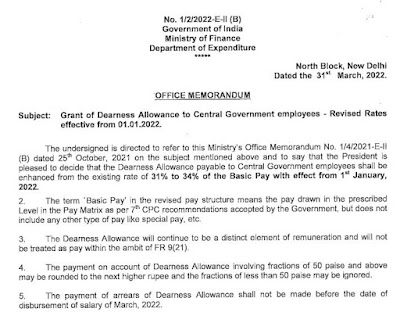
DA Jan 2022 - Grant of Dearness Allowance to Central Government employees - Revised Rates effective from 01.01.2022

 3% DA Hike - Revised Rates effective from 01.01.2022: DoE OM dated 31.03.2022 No. 1/2/2022-E-II (B) Government of India Ministry of Finance...